Proceedings of the 2019 Conference on Empirical Methods in Natural Language Processing 6071
Pre-Training BERT on Domain Resources for Short Answer Grading
Chul Sung∗
IBM Watson Education, USA
Tejas Indulal Dhamecha
IBM Research, India
Swarnadeep Saha†
UNC Chapel Hill, USA
Tengfei Ma
IBM Research AI, USA
Vinay Reddy
IBM Watson Education, USA
Rishi Arora
IBM GBS, India
Abstract
Pre-trained BERT contextualized representa-tions have achieved state-of-the-art results on multiple downstream NLP tasks by fine-tuning with task-specific data. While there has been a lot of focus on task-specific fine-tuning, there has been limited work on improving the pre-trained representations. In this paper, we ex-plore ways of improving the pre-trained con-textual representations for the task of auto-matic short answer grading, a critical compo-nent of intelligent tutoring systems. We show that the pre-trained BERT model can be im-proved by augmenting data from the domain-specific resources like textbooks. We also present a new approach to use labeled short answering grading data for further enhance-ment of the language model. Empirical eval-uation on multi-domain datasets shows that task-specific fine-tuning on the enhanced pre-trained language model achieves superior per-formance for short answer grading.
1 Introduction
Intelligent tutoring system (ITS) is one of the tools to facilitate personalized learning. Auto-matic short answer grading (ASAG) is an impor-tant component of a dialog-based tutoring (DBT) system; especially, to enable Socratic tutoring. Automatic grading is the task of evaluating the correctness of a student answer for a specific ques-tion by comparing it to a reference answer. In short answer grading, the reference answers are typi-cally one or two sentences long and close ended. A broad range of approaches from simple bag-of-words to transfer learning and deep neural net-works have been explored to address the short an-swer grading problem (Mueller and Thyagarajan, 2016;Saha et al.,2018;Marvaniya et al.,2018).
∗
Corresponding author.
†
The work was done when the author was an employee at IBM Research, India.
Pre-training BERT Updating the BERT
Domain-Textbooks or Question-Answers
Fine-tuning the BERT
[image:1.595.310.524.221.278.2]Textbooks or QAs Labeled Task Data
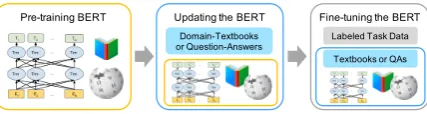
Figure 1: In this work, we propose to update the pre-trained BERT language model by utilizing the textbook or question-answer data to improve short answer grad-ing.
For a variety of natural language processing (NLP) tasks, state-of-the-art results have been re-ported with pre-trained deep language models, such as BERT (Devlin et al.,2018), GPT (Radford et al., 2018), and ULMFit (Howard and Ruder, 2018). In these approaches, pre-trained language models are utilized for down-stream NLP tasks by means of task-specificfine-tuning.
A typical DBT, and therefore a short answer grading system, is often used across various sub-jects or domains (e.g., Science, Sociology, and Psychology). A pre-trained language model, such as that of BERT, is typically trained on generic English language corpus. Thus, there may be a scope for updating and improving the pre-trained language model on available textual resources for the domains of short answer grading. Textbooks used to create questions and reference answers are mostly available in digital form. Moreover, the labeled data for short answer grading have ques-tion and reference answer pairs available but con-textual information between the pairs and even just questions are easily ignored. Thus, in this research, we aim to explore and evaluate vari-ous methods of updating the pre-trained BERT language model (LM)∗ on such domain-specific
∗
We prefer the phrase to update LM to imply further training or modifying the pre-trained LM. In some literature, the termLM fine-tuningis also used to refer to the update of pre-trained language model. However, we reserve the term
available resources in the context of ASAG to an-swer the following research questions.
RQ1 Is updating pre-trained BERT LM helpful in improving short answer grading perfor-mance?
RQ2 What is the effect of unsupervised domain corpora (i.e. domain textbooks) in updating LM for short answer grading?
RQ3 How generalizable are the pre-trained and the updated BERT models to unseen domains, in case, where textbooks are not available?
RQ4 How can labeled Question-Answer data be exploited to update LM for short answer grading, in addition to fine-tuning?
Our evaluations are performed on four subjects (Physiology, American Government, and two on Psychology). In addition to the empirical analysis, we also propose a novel approach to effectively utilize the question-answer data as part of the pre-trained model update.
2 Related Work
The problem of short answer grading has attracted significant attention of the researchers over the years. Various approaches, starting from tradi-tional hand-crafted features (Mohler et al.,2011; Sultan et al.,2016) to more recent deep learning models (Riordan et al.,2017;Kumar et al.,2017) and their combination (Saha et al., 2018) have been explored. However, similar to most down-stream NLP tasks, ASAG also suffers from the overhead of task-specific architectures and thus scalability across different subjects has proven to be hard.
In a step towards alleviating this overhead, the NLP community has recently proposed multiple generic pre-trained language models which can be transferred seamlessly and fine-tuned for any end task. Universal Language Model Fine-Tuning (ULMFiT) (Howard and Ruder,2018) method is one of the first such initiatives to illustrate the ef-fectiveness of language model fine-tuning. Em-beddings from Language Models, commonly re-ferred to as ELMo (Peters et al.,2018) also learns deep contextualized word representations using the internal states of a deep bidirectional language model. Finally, Bidirectional Encoder Represen-tations from Transformers (BERT) (Devlin et al.,
2018) improves on all previous pre-training tech-niques by training a deep language model that jointly conditions on both the left and right context simultaneously through all the layers. BERT’s ef-fectiveness has been widespread and Sung et al.
(Sung et al., 2019) have shown that fine-tuning BERT for ASAG also outperforms all existing techniques.
While BERT has been fine-tuned to achieve state-of-the-art results on a large number of tasks, the idea of further pre-training of the language model to incorporate more domain knowledge has been explored less. BioBERT (Lee et al., 2019) for biomedical tasks and SciBERT (Beltagy et al., 2019) for science domains have shown the effec-tiveness of language model pre-training for tasks in specific domains. Motivated by these prior works, we propose two pre-training techniques for BERT in the context of short answer grading that improve over the generic BERT.
3 Method
Bidirectional Encoder Representations from Transformers (BERT) (Devlin et al., 2018) is a deep bidirectional pre-trained language model that is fine-tuned for downstream NLP tasks. As illustrated in Figure 1, we describe the usage of BERT in two parts: firstly the proposed enhance-ments in the pre-training step and secondly, the fine-tuning step for short answer grading.
3.1 Pre-Training BERT
We start with the pre-trained BERT language model, trained using the English Wikipedia and BooksCorpus and propose two methods to further improve it.
3.1.1 Usage of Textbooks
samples, that is indeed the case. Further details on the textbooks and their pre-processing steps for data preparation is provided in the experiments section.
3.1.2 Usage of Question-Answer Pairs
Our second approach leverages the labeled (ques-tion, reference answer, student answer) data triples as unsupervised data for pre-training the language model. We consider the triples with correct la-bels only and create pairs of the following form for each of the correct student answers.
Question-Reference Answer pair
What does the telencephalon contain?
The telencephalon contains most of the cerebral cortex.
Question-Correct Answer pair
What does the telencephalon contain?
It contains the cerebral cortex, limbic system, and basal ganglia.
Each of these pairs is fed as documents to the BERT architecture. Since one of the training ob-jectives for BERT is next sentence prediction, the answer in a (question, answer) pair provides an immediate context to the question. Incorrect and partially correct student answers, apart from be-ing factually incomplete, are often grammatically incorrect and thus may harm the language model learning. Hence, we ignore those triples for pre-training.
3.2 Fine-tuning for ASAG
The BERT fine-tuning step using labeled short an-swer grading data proceeds similar to any sen-tence pair classification task. The (reference an-swer, student answer) pair is converted to a sin-gle sequence of tokens by using a separator token [SEP]between the pair and a classification token [CLS] at the beginning. The input pair’s repre-sentation, as obtained from the embedding of the [CLS]token, is then fed into a dense layer, which along with the language model is updated during fine-tuning.
4 Experiments
The experiments section is organized as follows. We start by providing a brief description of the dataset, followed by a discussion about the imple-mentation details. In the concluding two subsec-tions, we analyze the effect of the two proposed pre-training methodologies for short answer grad-ing.
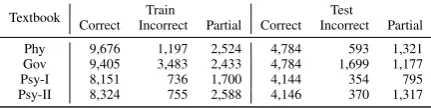
Textbook Train Test
Correct Incorrect Partial Correct Incorrect Partial
[image:3.595.309.525.64.118.2]Phy 9,676 1,197 2,524 4,784 593 1,321 Gov 9,405 3,483 2,433 4,784 1,699 1,177 Psy-I 8,151 736 1,700 4,144 354 795 Psy-II 8,324 755 2,588 4,146 370 1,317
Table 1: Class-wise student answer distribution in train and test sets for the four domains used in experiments.
Corpus # of words Domain
English Wiki 2.5B General BooksCorpus 0.8B General
Textbooks 1.1M Phy + Gov
QAs 0.6M Phy + Gov
[image:3.595.314.517.159.244.2]1.3M Phy + Gov + Psy-I,II
Table 2: Size and domain of pre-training text corpora.
4.1 Dataset
We show results on a proprietary large-scale industry dataset consisting of three domains -(1) Physiology of Behavior (Phy), (2) American Government (Gov), and (3) Psychology – Hu-man Development (Psy-I) and Abnormal Psychol-ogy (Psy-II). Given a question, reference answer and student answer, we address a 3-way classi-fication task into correct, incorrect and partially correctclasses. Table 1 shows the train-test splits for each of the domains.
We obtain three textbooks for each of the Physi-ology and American Government domains. These include our own textbooks and additional ones downloaded from Lumen Learning† and Guten-berg‡ websites. We do not use any textbooks for the Psychology domain, to show the effect of BERT pre-training on out-of-domain data. We combine the data from all the textbooks for fur-ther pre-training of BERT. Table2summarizes the sizes of the textbook corpora (1.1M words) and question-answer corpora (1.3M words) used in our experiments. Note that, the original BERT model is learned with about 3.3B words corpora.
4.2 Implementation Details
We leverage the TensorFlow implementation of BERT-Base§for all our experiments. It is further pre-trained for 240K, 150K, and 240K epochs for BERT+TextbookPhy+Gov, BERT+QAPhy+Gov, and
BERT+QAPhy+Gov+Psy-I,II respectively using the
same hyperparameters until the accuracy of the two pre-training objectives converges to 100%.
†
https://lumenlearning.com/
‡
https://www.gutenberg.org/
BERT (+Textbook) (+QA) (+Textbook+QA)
Phy 81.35 82.28 83.95 83.64 Gov 74.55 76.25 75.43 77.28
Psy-I 78.69 78.05 77.71 77.89 Psy-II 80.06 79.10 79.46 80.74
Table 3: Effect of domain data. Textbook and Question-Answer data from only Phy and Gov domains are used in the pre-trained model update; making Psy-I and Psy-II unseen domains.
Note that the corpus size for Phy+Gov is smaller, leading to faster convergence. Once the pre-training is done, we fine-tune the model with the short answer grading labeled data for 3 epochs us-ing a learnus-ing rate of 3e-5. All results are reported in terms of macro-averaged F1.
4.3 Effect of Domains Textbook Data
In this set of experiments, we aim to understand the effect of updating the pre-trained BERT LM on textbook data. We take the textbooks from only two domains (Physiology and American Govern-ment), for designing a scenario where textbooks are not available. Such a scenario helps us un-derstand the generalizability of BERT (for which all the domains are unseen), and BERT+Textbook data (for which Psy-I and Psy-II are unseen mains). We combine the data from both the do-mains and train a single BERT model as pre-training per-domain models is computationally ex-pensive and almost impossible to scale.
Table 3 shows the results. The pre-trained BERT model, as is, performs fairly well (74-81% M-F1). The LM updated with textbook data (BERT+Textbook), improves performance on the domains included in additional pre-training (Phy and Gov). However, we suspect that the updated model becomes more specialized towards seen do-mains, which leads to performance degradation on the unseen domain of Psychology.
• RQ1 and RQ2 can be answered asLM update using domain textbook data positively affects the short answer grading performance on the corresponding domains.
• RQ3 can be answered asthe updated BERT LM model does not appear to generalize well on un-seen domains, as the evidence suggests that LM becomes more domain-specific.
4.4 Effect of Question-Answer Data
In this set of experiments, we aim to understand effectiveness of the Question-Answer (QA) data
to update the LM. As explained earlier, for each reference answer and correct answer, question-answer pairs are created and utilized as docu-ments.
In Table 3, a combined QA dataset from Psy and Gov subjects is used for running additional steps of LM pre-training. This again simulates the unseen domain scenario for Psy-I and Psy-II in pre-training update. It can be observed that the proposed approach utilizing QA data (BERT+QA) improves the performance consistently in both the seen subjects of Phy and Gov. Akin to textbook data experiments, the performance is degrading for unseen domains as the model becomes more specialized. Interestingly enough, the updated LM on both strategies (BERT+Textbook+QA) also positively impacts on in-domain performance.
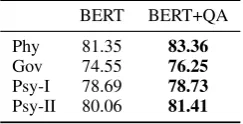
Additionally, another set of results is obtained by utilizing the QA dataset of all four domains; simulating an all seen-domain scenario. Table 4 reports the corresponding results showing that the QA data helps improve the model for all the do-mains, consistently.
BERT BERT+QA
Phy 81.35 83.36
Gov 74.55 76.25
Psy-I 78.69 78.73
Psy-II 80.06 81.41
Table 4: Effect of Question-Answer data in seen-domains scenario. All four seen-domains are included in the Question-Answer data.
These observations suggest that the proposed approach re-purposes the Next Sentence Prediction task to effectively encode the la-tent features of ASAG. Further, RQ1 can be an-swered affirmatively; and RQ4 can be anan-swered
as it is advisable to use the QA corpora for LM
model update in addition to fine-tuning.
5 Conclusion
[image:4.595.356.478.381.443.2]per-formance on unseen domains.
We limited the scope of this paper to the task of automatic short answer grading only. However, our findings of the sensitivity of domain-specific BERT models appear generic. We believe that any multi-domain text classification task should exhibit similar behavior. We also note that our strategies for improving the BERT model should be directly applicable to other QA tasks as well. Future directions include trying our method on dif-ferent tasks and difdif-ferent relevant data.
References
Iz Beltagy, Arman Cohan, and Kyle Lo. 2019. Scibert: Pretrained contextualized embeddings for scientific text. arXiv preprint arXiv:1903.10676.
Jacob Devlin, Ming-Wei Chang, Kenton Lee, and Kristina Toutanova. 2018. Bert: Pre-training of deep bidirectional transformers for language understand-ing. arXiv preprint arXiv:1810.04805.
Jeremy Howard and Sebastian Ruder. 2018. Universal language model fine-tuning for text classification.
arXiv preprint arXiv:1801.06146.
Sachin Kumar, Soumen Chakrabarti, and Shourya Roy. 2017. Earth moverâ ˘A ´Zs distance pooling over siamese lstms for automatic short answer grading. InProceedings of the International Joint Conference on Artificial Intelligence, pages 2046–2052.
Jinhyuk Lee, Wonjin Yoon, Sungdong Kim, Donghyeon Kim, Sunkyu Kim, Chan Ho So, and Jaewoo Kang. 2019. Biobert: pre-trained biomed-ical language representation model for biomedbiomed-ical text mining. arXiv preprint arXiv:1901.08746.
Smit Marvaniya, Swarnadeep Saha, Tejas I Dhamecha, Peter Foltz, Renuka Sindhgatta, and Bikram Sen-gupta. 2018. Creating scoring rubric from repre-sentative student answers for improved short answer grading. InProceedings of the 27th ACM Interna-tional Conference on Information and Knowledge Management, pages 993–1002. ACM.
Michael Mohler, Razvan Bunescu, and Rada Mihal-cea. 2011. Learning to grade short answer questions using semantic similarity measures and dependency graph alignments. In Proceedings of the 49th An-nual Meeting of the Association for Computational Linguistics: Human Language Technologies-Volume 1, pages 752–762. Association for Computational Linguistics.
Jonas Mueller and Aditya Thyagarajan. 2016. Siamese recurrent architectures for learning sentence similar-ity. InAAAI, volume 16, pages 2786–2792.
Matthew E. Peters, Mark Neumann, Mohit Iyyer, Matt Gardner, Christopher Clark, Kenton Lee, and Luke
Zettlemoyer. 2018. Deep contextualized word rep-resentations. InProc. of NAACL.
Alec Radford, Karthik Narasimhan, Tim Salimans, and Ilya Sutskever. 2018. Improving language under-standing by generative pre-training.
Brian Riordan, Andrea Horbach, Aoife Cahill, Torsten Zesch, and Chong Min Lee. 2017. Investigating neural architectures for short answer scoring. In
Proceedings of the 12th Workshop on Innovative Use of NLP for Building Educational Applications, pages 159–168.
Swarnadeep Saha, Tejas I Dhamecha, Smit Marvaniya, Renuka Sindhgatta, and Bikram Sengupta. 2018. Sentence level or token level features for automatic short answer grading?: Use both. InInternational Conference on Artificial Intelligence in Education, pages 503–517. Springer.
Md Arafat Sultan, Cristobal Salazar, and Tamara Sum-ner. 2016. Fast and easy short answer grading with high accuracy. InProceedings of the 2016 Confer-ence of the North American Chapter of the Associ-ation for ComputAssoci-ational Linguistics: Human Lan-guage Technologies, pages 1070–1075.