72
Cross-Task Knowledge Transfer for Query-Based Text Summarization
Elozino Egonmwan†∗ Vittorio Castelli‡
†University of Lethbridge, Lethbridge, AB, Canada
‡IBM Research AI
[email protected], [email protected], [email protected]
Md Arafat Sultan‡
Abstract
We demonstrate the viability of knowledge transfer between two related tasks: machine reading comprehension (MRC) and query-based text summarization. Using an MRC model trained on the SQuAD1.1 dataset as a core system component, we first build an
extractive query-based summarizer. For bet-ter precision, this summarizer also compresses the output of the MRC model using a novel sentence compression technique. We further leverage pre-trained machine translation sys-tems toabstractour extracted summaries. Our models achieve state-of-the-art results on the publicly available CNN/Daily Mail and De-batepedia datasets, and can serve as simple yet powerful baselines for future systems. We also hope that these results will encourage research on transfer learning from largeMRCcorpora to query-based summarization.
1 Introduction
Query-based single-document text summarization is the process of selecting the most relevant points in a document for a given query and arranging them into a concise and coherent snippet of text. The query can range from an individual word to a fully formed natural language question. Extrac-tivesummarizers select verbatim the most relevant span of text in the source, whileabstractive sum-marizers further paraphrase the selected content for better clarity and brevity.
By and large, existing approaches train models using summarization data corpora (Nema et al., 2017;Hasselqvist et al.,2017), which are of mod-erate size. At the same time, large corpora are available for related tasks, specifically machine reading comprehension (MRC) and machine trans-lation (MT). To find out if such corpora have util-ity for summarizers, we propose methods to
di-∗
Work done at IBM.
rectly produce extractive and abstractive query-based summaries from pretrained MRC and MT
modules, requiring no further adaptation or trans-fer learning steps.
In our experiments, this approach outperforms existing methods, suggesting a novel route to query-based summarization: pre-training sys-tems on such related tasks, where an abun-dance of training data is enabling extremely rapid progress (Wang et al., 2018; Sun et al., 2018; Vaswani et al., 2017), and using summarization-specific corpora for transfer learning.
The main contributions of this work are:
• We show how existing off-the-shelf compo-nents for tasks other than query-based sum-marization are competitive with the state-of-the-art in the field, even without model adap-tation or transfer learning – we hope to en-courage researchers to more closely examine transfer learning among these tasks.
• Specifically, we show how processing the output of an MRC system (trained on the SQuAD1.1 dataset (Rajpurkar et al., 2016)) with a simple rule-based sentence compres-sion module that operates on the dependency parse (de Marneffe and Manning, 2008) of the answer sentence yields results that are better than those of query-based extractive summarizers trained for the specific dataset.
Passage: people whether overweight or not are still people. you can not compare a per-son with a suitcase. suitcases don’t live and breathe. this rule is the same with weight. excess weight in a suitcase is not comparable with a fat person .
Query: is it necessary to charge fat passen-gers extra when flying?
Reference Summary: there is no compari-son between a percompari-son and a suitcase.
Our method (abstractive) : The overweight in the bag can’t be compared with the fat guy. Diversity driven attention model: beings are definitely by the<unk>to illegal illegal.
Table 1: Example/comparison of ourabstractive sum-mary on a Debatepedia sample with the output of the diversity driven attention model ofNema et al.(2017). Our generated summary is relevant to the query.
2 Task Definition
Given a document D = (S1, ..., Sn) with n
sentences comprising of a set of words DW =
{d1, ..., dw}, and a queryQ= (q1, ..., qm)withm
words, one desires to produce anextractive (SE)
orabstractive (SA) summary that provides
infor-mation about the answer toQ, whereSE ⊆ DW
andSA = {w1, ..., ws} | ∃wi 6∈ DW . Tables1
and2show examples of abstractive and extractive summaries, respectively.
3 Method
Our proposed system comprises of three modules for extractive summarization: retrieval of candi-date answer phrases using a reading comprehen-sion system, sentence extraction, and sentence compression. Additionally we utilize two MT
modules (English to Spanish and back) to para-phrase for abstractive summarization.
3.1 Machine Reading Comprehension
MRC requires the identification of a contiguous
span of words in a passage that answers a given query (Rajpurkar et al., 2016;Wang et al.,2018; Hu et al.,2017). We use theMRCmodel byWang et al. (2016b) trained on the SQuAD1.1 dataset (Rajpurkar et al.,2016) to identify the topn (em-pirically:n=5) possibly overlapping candidate an-swer phrases, orchunks, for the given query. The chunks are typically short, 3.2 words on average in the training set. Obviously, chunks fromMRCare
Passage (truncated): [...] offensive italian football expert and author john foot explained how paulo berlusconi ’s words were offensive on several levels . “ it is an insult , ” foot told cnn [...]
Query:john foot
Reference Summary: italian football expert and author john foot says paulo berlusconi ’s words are offensive on several levels . Our method (extractive) : offensive italian football expert and author john foot explained how paulo berlusconi ’s words were offensive on several levels .
Table 2: Example of our extractive summary on an example from the query-based version of CNN/Daily Mail (Hermann et al.,2015).
not meant to be summaries, but in our system they help the summarizer focus on the regions of the input document that appear related to the query.
3.2 Sentence Extraction
Sentence extraction consists of selecting the sen-tences containing the top n chunks produced by
MRC. This is in contrast to methods based on sentence ranking algorithms such as those used in (Boudin et al.,2015;Parveen and Strube,2015; Nallapati et al., 2017;Cheng and Lapata, 2016). For our experiments, we impose the constraint that the candidate answer chunks for each query be contained in a single sentence. Hence, starting fromn = 5, we iteratively reducenuntil the top n candidate chunks are all contained in one sen-tence.
3.3 Sentence Compression
Input Sentence: it is ridiculous to suggest governments should restrict their own ability to help their economies.
Paraphrase (withMT): It isabsurdto sug-gest that governmentsimpose limitson their ability to help their economies.
Input Sentence: this favoritism would only increase that of which the laws are trying to suppress .
Paraphrase (withMT):Thesenepotismwill
only increase the laws that you try to sup-press.
Table 3: Examples of some of our paraphrased sen-tences using anMTsystem. Bolded words are novel.
Given a summary with length≥20, we obtain the dependency parses of its sentences using the IBM Watson NLU toolkit. Next, we remove words in the sentences (starting from the rear) that are not in a dependency relationship with any of the candidate phrases, until the summary length limit is reached.
3.4 Back Translation
Recent research has shown gains in leveraging on the enormous corpora in machine translation (MT) for paraphrasing (Mallinson et al.,2017;Wieting and Gimpel, 2017). Inspired by such research and our fundamental goal of investigating the via-bility of cross-task knowledge transfer for query-based summarization, we paraphrase our extracts using an off-the-shelfMT system1. The final En-glish paraphrase of the input sentence is obtained by translating it into Spanish and back-translating the translation into English. We experimented with English-French-English and English-Italian-English as well as with multi-hops approaches be-fore settling on the English-Spanish pair, based on subjective analysis of the results. Table 3 shows examples of paraphrased sentences using back-translation.
4 Experiments
We test our approach on two publicly available datasets—Debatepedia (Nema et al., 2017) for abstractive summarization, and the version of CNN/Daily Mail that was adapted in (Hermann et al., 2015) for both extractive and abstractive
1The
MT engine is used in the IBM Watson Language Translator service.
CNN. Deb.
Test 14,725 979
[image:3.595.326.505.60.132.2]Avg. #words/psg. 776 70 Avg. #words/query 2 11 Avg. #words/summ. 14 10
Table 4: Statistics of the dataset test samples after pro-cessing by theWang et al.(2016b)MRCsystem’s pre-processing module. Note that the preprocessor fails to parse 2-3% of the test samples in each dataset.
summarization. No training was involved; the test sets were simply passed through the modules dis-cussed in section3.
4.1 Datasets
We processed the CNN/DM2 and Debatepedia3 datasets using the respective official Python scripts to yield the corpora with passages, queries and summaries tailored to the queries (Table 4). CNN/DM is much larger in terms of both the number of samples and the lengths of passages, with short queries consisting of few words, mostly entity names. Debatepedia is a smaller dataset, but the queries are fully-formed natural language questions. Interestingly, although our MRC sys-tem was originally designed to answer full-length questions, as our results show later in this section, it identifies key regions of the document remark-ably well in both test sets.
4.2 Evaluation
As customary in summarization tasks, we evalu-ate our system usingROUGE(Lin,2004)—a fam-ily of metrics that compute the textual overlap be-tween the output and the reference summary. The publicly available ROUGE 2.0 toolkit4 was used as the implementation.
4.3 Results
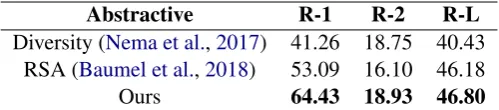
Tables5and6summarize the performances of our model and other published models on Debatepe-dia and CNN/Daily Mail, respectively. Our mod-els, both extractive and abstractive, outperform the published results on both test sets.
The extractive performance on CNN/DM indi-cates that the combination of a reading
compre-2
https://github.com/helmertz/ querysum-data/
3
https://github.com/PrekshaNema25/ DiverstiyBasedAttentionMechanism
Abstractive R-1 R-2 R-L Diversity (Nema et al.,2017) 41.26 18.75 40.43
RSA (Baumel et al.,2018) 53.09 16.10 46.18
Ours 64.43 18.93 46.80
Table 5: ROUGE(%) performances of our model and competing models on the Debatepedia dataset. Our model outpeforms both baselines on all metrics.
Extractive R-1 R-2 R-L R-SU4
QSum (Hasselqvist et al.,2017) 33.81 18.19 29.22 17.49 Ours 65.45 30.07 60.40 36.62 Abstractive
[image:4.595.174.424.62.117.2]QSum (Hasselqvist et al.,2017) 18.25 5.04 16.17 6.13 Ours 58.46 25.12 54.32 32.06
Table 6: ROUGE(%) scores of our models and the competing model on the CNN/Daily Mail dataset. Our proposed approach yields the best system for both extractive and abstractive summarization.
hension system and a syntax-driven compression module can be highly effective in identifying re-gions in a document that contain key informa-tion with respect to a given query. Moreover, the abstractive performances on both test sets show the effectiveness of machine translation as a para-phrasing component for abstractive summariza-tion. In particular, in the CNN/DM test set the improvement over the baseline is greater in the abstractive than in the extractive case, again sug-gesting that both text selection andMT-based para-phrasing contribute to the gain.
5 Related Work
Text summarization has long been an active area of research and query-based summarization has gained momentum more recently. Classical sum-marization models usually identify salient parts of a text by encapsulating manually crafted rules into linear functions (Lin and Bilmes,2011) which are solved using integer linear programming (ILP) (Nayeem and Chali, 2017; Boudin et al., 2015), conditional random fields (CRF) (Shen et al., 2007), or graph algorithms (Parveen and Strube, 2015; Erkan and Radev, 2004). More recently, neural networks, mostly with an encoder-decoder framework (Bahdanau et al., 2014), have been used to learn the underlying features (Jadhav and Rajan,2018;Nallapati et al.,2016) trained by min-imizing the cross-entropy loss (Nallapati et al., 2017) or reinforcement learning (Narayan et al., 2018;Paulus et al.,2017).
Our baseline models for query-based
summa-rization (Nema et al., 2017; Hasselqvist et al., 2017) are both implemented on the encoder-decoder framework with the former incorporating a diversity function in their model aimed at mini-mizing the problem of repetitive word generation inherent in encoder-decoder models. However our approach is similar to neither, as our goal is not to train a query-based summarizer from scratch but rather to investigate the competitiveness of using pre-trained models for closely related tasks—i.e.,
MRCandMT—on query-based summarization.
6 Conclusions
We described an approach to extractive and ab-stractive summarization that relies on components designed for different tasks: MRC, sentence com-pression, and MT. We have shown that
retriev-ing the topnanswer chunks from a passage with an MRC system and trimming the corresponding sentences using their dependency trees yields an extractive summarizer that outperforms published results on a publicly available dataset. We also showed that using MTto produce a paraphrase of
the answers yields a high-performance abstractive summarization method.
iii) computing the AMR parse (Banarescu et al., 2013) of the candidate answers followed by text generation (Song et al.,2018) instead of usingMT.
Acknowledgments
We thank the reviewers for their valuable com-ments and suggestions. We also thank Zhiguo Wang and Preksha Nema for clarification of their work.
References
Dzmitry Bahdanau, Kyunghyun Cho, and Yoshua Ben-gio. 2014. Neural machine translation by jointly learning to align and translate. arXiv preprint arXiv:1409.0473.
Laura Banarescu, Claire Bonial, Shu Cai, Madalina Georgescu, Kira Griffitt, Ulf Hermjakob, Kevin Knight, Philipp Koehn, Martha Palmer, and Nathan Schneider. 2013. Abstract meaning representation for sembanking. InProceedings of the 7th Linguis-tic Annotation Workshop and Interoperability with Discourse, pages 178–186. Association for Compu-tational Linguistics.
Tal Baumel, Matan Eyal, and Michael Elhadad. 2018. Query focused abstractive summarization: Incorpo-rating query relevance, multi-document coverage, and summary length constraints into seq2seq mod-els.arXiv preprint arXiv:1801.07704.
Florian Boudin, Hugo Mougard, and Benoit Favre. 2015. Concept-based summarization using integer linear programming: From concept pruning to mul-tiple optimal solutions. InConference on Empirical Methods in Natural Language Processing (EMNLP) 2015.
Jianpeng Cheng and Mirella Lapata. 2016. Neural summarization by extracting sentences and words.
arXiv preprint arXiv:1603.07252.
G¨unes Erkan and Dragomir R Radev. 2004. Lexrank: Graph-based lexical centrality as salience in text summarization. Journal of artificial intelligence re-search, 22:457–479.
Johan Hasselqvist, Niklas Helmertz, and Mikael K˚ageb¨ack. 2017. Query-based abstractive sum-marization using neural networks. arXiv preprint arXiv:1712.06100.
Karl Moritz Hermann, Tomas Kocisky, Edward Grefenstette, Lasse Espeholt, Will Kay, Mustafa Su-leyman, and Phil Blunsom. 2015. Teaching ma-chines to read and comprehend. InAdvances in Neu-ral Information Processing Systems, pages 1693– 1701.
Minghao Hu, Yuxing Peng, Zhen Huang, Xipeng Qiu, Furu Wei, and Ming Zhou. 2017. Reinforced
mnemonic reader for machine reading comprehen-sion.arXiv preprint arXiv:1705.02798.
Aishwarya Jadhav and Vaibhav Rajan. 2018. Extrac-tive summarization with swap-net: Sentences and words from alternating pointer networks. In Pro-ceedings of the 56th Annual Meeting of the Associa-tion for ComputaAssocia-tional Linguistics (Volume 1: Long Papers), volume 1, pages 142–151.
Chin-Yew Lin. 2004. Rouge: A package for auto-matic evaluation of summaries.Text Summarization Branches Out.
Hui Lin and Jeff Bilmes. 2011. A class of submodu-lar functions for document summarization. In Pro-ceedings of the 49th Annual Meeting of the Associ-ation for ComputAssoci-ational Linguistics: Human Lan-guage Technologies-Volume 1, pages 510–520. As-sociation for Computational Linguistics.
Jonathan Mallinson, Rico Sennrich, and Mirella Lap-ata. 2017. Paraphrasing revisited with neural ma-chine translation. InProceedings of the 15th Con-ference of the European Chapter of the Association for Computational Linguistics: Volume 1, Long Pa-pers, volume 1, pages 881–893.
Marie-Catherine de Marneffe and Christopher D. Man-ning. 2008. Stanford typed dependencies manual. Stanford.
Ramesh Nallapati, Feifei Zhai, and Bowen Zhou. 2017. Summarunner: A recurrent neural network based se-quence model for extractive summarization of docu-ments. InAAAI, pages 3075–3081.
Ramesh Nallapati, Bowen Zhou, Cicero dos Santos, C¸ a glar Gulc¸ehre, and Bing Xiang. 2016. Abstrac-tive text summarization using sequence-to-sequence rnns and beyond.CoNLL 2016, page 280.
Shashi Narayan, Shay B Cohen, and Mirella Lapata. 2018. Ranking sentences for extractive summariza-tion with reinforcement learning. InProceedings of the 2018 Conference of the North American Chap-ter of the Association for Computational Linguistics: Human Language Technologies, Volume 1 (Long Pa-pers), volume 1, pages 1747–1759.
Mir Tafseer Nayeem and Yllias Chali. 2017. Extract with order for coherent multi-document summariza-tion. InProceedings of TextGraphs-11: the Work-shop on Graph-based Methods for Natural Lan-guage Processing, pages 51–56.
Preksha Nema, Mitesh M Khapra, Anirban Laha, and Balaraman Ravindran. 2017.Diversity driven atten-tion model for query-based abstractive summariza-tion. InProceedings of the 55th Annual Meeting of the Association for Computational Linguistics (Vol-ume 1: Long Papers), volume 1, pages 1063–1072.
Romain Paulus, Caiming Xiong, and Richard Socher. 2017. A deep reinforced model for abstractive sum-marization.arXiv preprint arXiv:1705.04304.
Pranav Rajpurkar, Jian Zhang, Konstantin Lopyrev, and Percy Liang. 2016. Squad: 100,000+ questions for machine comprehension of text. arXiv preprint arXiv:1606.05250.
Dou Shen, Jian-Tao Sun, Hua Li, Qiang Yang, and Zheng Chen. 2007. Document summarization us-ing conditional random fields. InIJCAI, volume 7, pages 2862–2867.
Linfeng Song, Yue Zhang, Zhiguo Wang, and Daniel Gildea. 2018. A graph-to-sequence model for amr-to-text generation. In Proceedings of the 56th An-nual Meeting of the Association for Computational Linguistics (Volume 1: Long Papers), pages 1616– 1626. Association for Computational Linguistics.
Fu Sun, Linyang Li, Xipeng Qiu, and Yang Liu. 2018. U-net: Machine reading comprehension with unanswerable questions. arXiv preprint arXiv:1810.06638.
Ilya Sutskever, Oriol Vinyals, and Quoc V Le. 2014. Sequence to sequence learning with neural net-works. InAdvances in neural information process-ing systems, pages 3104–3112.
Ashish Vaswani, Noam Shazeer, Niki Parmar, Jakob Uszkoreit, Llion Jones, Aidan N Gomez, Ł ukasz Kaiser, and Illia Polosukhin. 2017. Attention is all you need. In I. Guyon, U. V. Luxburg, S. Bengio, H. Wallach, R. Fergus, S. Vishwanathan, and R. Gar-nett, editors, Advances in Neural Information Pro-cessing Systems 30, pages 5998–6008. Curran As-sociates, Inc.
Lu Wang, Hema Raghavan, Vittorio Castelli, Radu Florian, and Claire Cardie. 2016a. A sentence compression based framework to query-focused multi-document summarization. arXiv preprint arXiv:1606.07548.
Wei Wang, Ming Yan, and Chen Wu. 2018. Multi-granularity hierarchical attention fusion networks for reading comprehension and question answering. In Proceedings of the 56th Annual Meeting of the Association for Computational Linguistics (Volume 1: Long Papers), volume 1, pages 1705–1714.
Zhiguo Wang, Haitao Mi, Wael Hamza, and Radu Florian. 2016b. Multi-perspective context match-ing for machine comprehension. arXiv preprint arXiv:1612.04211.