Proceedings of the 2007 Joint Conference on Empirical Methods in Natural Language Processing and Computational
Improving Query Spelling Correction
Using Web Search Results
Qing Chen
Natural Language Processing Lab
Northeastern University
Shenyang, Liaoning, China, 110004
[email protected]
Mu Li
Microsoft Research Asia
5F Sigma Center
Zhichun Road, Haidian District
Beijing, China, 100080
[email protected]
Ming Zhou
Microsoft Research Asia
5F Sigma Center
Zhichun Road, Haidian District
Beijing, China, 100080
[email protected]
Abstract
Traditional research on spelling correction in natural language processing and infor-mation retrieval literature mostly relies on pre-defined lexicons to detect spelling er-rors. But this method does not work well for web query spelling correction, because there is no lexicon that can cover the vast amount of terms occurring across the web. Recent work showed that using search query logs helps to solve this problem to some extent. However, such approaches cannot deal with rarely-used query terms well due to the data sparseness problem. In this paper, a novel method is proposed for use of web search results to improve the existing query spelling correction models solely based on query logs by leveraging the rich information on the web related to the query and its top-ranked candidate. Ex-periments are performed based on real-world queries randomly sampled from search engine’s daily logs, and the results show that our new method can achieve 16.9% relative F-measure improvement and 35.4% overall error rate reduction in comparison with the baseline method.
1
Introduction
Nowadays more and more people are using Inter-net search engine to locate information on the web. Search engines take text queries that users type as input, and present users with information of ranked web pages related to users’ queries. During this process, one of the important factors that lead to poor search results is misspelled query terms. Ac-tually misspelled queries are rather commonly ob-served in query logs, as shown in previous investi-gations into the search engine’s log data that around 10%~15% queries were misspelled (Cucer-zan and Brill, 2004).
Sometimes misspellings are due to simple typo-graphic errors such as teh for the. In many cases the spelling errors are more complicated cognitive errors such as camoflauge for camouflage. As a matter of fact, correct spelling is not always an easy task – even many Americans cannot exactly spell out California governor’s last name: Schwar-zenegger. A spelling correction tool can help im-prove users’ efficiency in the first case, but it is more useful in the latter since the users cannot fig-ure out the correct spelling by themselves.
There has been a long history of general-purpose spelling correction research in natural language processing and information retrieval literature (Kukich, 1992), but its application to web search
query is still a new challenge. Although there are some similarities in correction candidate genera-tion and selecgenera-tion, these two settings are quite dif-ferent in one fundamental problem: How to deter-mine the validity of a search term. Traditionally, the measure is mostly based on a pre-defined spel-ling lexicon – all character strings that cannot be found in the lexicon are judged to be invalid. How-ever, in the web search context, there is little hope that we can construct such a lexicon with ideal coverage of web search terms. For example, even manually collecting a full list of car names and company names will be a formidable task.
To obtain more accurate understanding of this problem, we performed a detailed investigation over one week’s MSN daily query logs, among which found that 16.5% of search terms are out of the scope of our spelling lexicon containing around 200,000 entries. In order to get more specific num-bers, we also manually labeled a query data set that contains 2,323 randomly sampled queries and 6,318 terms. In this data set, the ratio of out-of-vocabulary (OOV) terms is 17.4%, which is very similar to the overall distribution. However, only 25.3% of these OOV terms are identified to be misspelled, which occupy 85% of the overall spel-ling errors. All these statistics indicate that accu-rate OOV term classification is of crucial impor-tance to good query spelling correction perfor-mance.
Cucerzan and Brill (2004) first investigated this issue and proposed to use query logs to infer cor-rect spellings of misspelled terms. Their principle can be summarized as follows: given an input query string q, finding a more probable query c than q within a confusion set of q, in which the edit distance between each element and q is less than a given threshold. They reported good recall for misspelled terms, but without detailed discussions on accurate classification of valid out-of-vocabulary terms and misspellings. In Li’s work, distributional similarity metrics estimated from query logs were proposed to be used to discrimi-nate high-frequent spelling errors such as massen-ger from valid out-of-vocabulary terms such as biocycle. But this method suffers from the data sparseness problem: sufficient amounts of occur-rences of every possible misspelling and valid terms are required to make good estimation of dis-tributional similarity metrics; thus this method does not work well for rarely-used
out-of-vocabulary search terms and uncommon misspel-lings.
In this paper we propose to use web search re-sults to further improve the performance of query spelling correction models. The key contribution of our work is to identify that the dynamic online search results can serve as additional evidence to determine users’ intended spelling of a given term. The information in web search results we used in-cludes the number of pages matched for the query, the term distribution in the web page snippets and URLs. We studied two schemes to make use of the returning results of a web search engine. The first one only exploits indicators of the input query’s returning results, while the other also looks at other potential correction candidate’s search results. We performed extensive evaluations on a query set randomly sampled from search engines’ daily query logs, and experimental results show that we can achieve 35.4% overall error rate reduction and 18.2% relative F-measure improvement on OOV misspelled terms.
The rest of the paper is structured as follows. Section 2 details other related work of spelling cor-rection research. In section 3, we show the intuitive motivations to use web search results for the query spelling correction. After presenting the formal statement of the query spelling correction problem in Section 4, we describe our approaches that use machine learning methods to integrate statistical features from web search results in Section 5. We present our evaluation methods for the proposed methods and analyze their performance in Section 6. Section 7 concludes the paper.
2
Related Work
nat-ural language processing, including spelling cor-rection task. (Brill and Moore, 2000) presented an improved error model over the one proposed by (Kernighan et al., 1990) by allowing generic string-to-string edit operations, which helps with modeling major cognitive errors such as the confu-sion between le and al. Via explicit modeling of phonetic information of English words, (Toutanova and Moore, 2002) further investigated this issue. Both of them require misspelled/correct word pairs for training, and the latter also needs a pronuncia-tion lexicon, but recently (Ahmad and Kondrak, 2005) demonstrated that it is also possible to learn such models automatically from query logs with the EM algorithm, which is similar to work of (Martin, 2004), learning from a very large corpus of raw text for removing non-word spelling errors in large corpus. All the work for non-word spelling correction focused on the current word itself with-out taking into account contextual information.
Real-word spelling correction is also referred to be context sensitive spelling correction (CSSC), which tries to detect incorrect usage of valid words in certain contexts. Using a pre-defined confusion set is a common strategy for this task, such as in the work of (Golding and Roth, 1996) and (Mangu and Brill, 1997). Opposite to non-word spelling correction, in this direction only contextual evi-dences were taken into account for modeling by assuming all spelling similarities are equal.
The complexity of query spelling correction task requires the combination of these types of evidence, as done in (Cucerzan and Brill, 2004; Li et al., 2006). One important contribution of our work is that we use web search results as extended contex-tual information beyond query strings by taking advantage of application specific knowledge. Al-though the information used in our methods can all be accessed in a search engine’s web archive, such a strategy involves web-scale data processing which is a big engineering challenge, while our method is a light-weight solution to this issue.
3
Motivation
When a spelling correction model tries to make a decision whether to make a suggestion c to a query q, it generally needs to leverage two types of evi-dence: the similarity between c and q, and the va-lidity plausibility of c and q. All the previous work estimated plausibility of a query based on the
query string itself – typically it is represented as the string probability, which is further decomposed into production of consecutive n-gram probabilities. For example, both the work of (Cucerzan and Brill, 2004; Li et al., 2006) used n-gram statistical lan-guage models trained from search engine’s query logs to estimate the query string probability.
In the following, we will show that the search results for a query can serve as a feedback mechan-ism to provide additional evidences to make better spelling correction decisions. The usefulness of web search results can be two-fold:
First, search results can be used to validate query terms, especially those not popular enough in query logs. One case is the validation for navi-gational queries (Broder, 2004). Navinavi-gational que-ries usually contain terms that are key parts of des-tination URLs, which may be out-of-vocabulary terms since there are millions of sites on the web. Because some of these navigational terms are very relatively rare in query logs, without knowledge of the special navigational property of a term, a query spelling correction model might confuse them with other low-frequency misspellings. But such infor-mation can be effectively obtained from the URLs of retrieved web pages. Inferring navigational que-ries through term-URL matching thus can help re-duce the chance that the spelling correction model changes an uncommon web site name into popular search term, such as from innovet to innovate. Another example is that search results can be used in identifying acronyms or other abbreviations. We can observe some clear text patterns that relate ab-breviations to their full spellings in the search re-sults as shown in Figure 1. But such mappings cannot easily be obtained from query logs.
can be attributed to the collective link text distribu-tion on the web – many links with misspelled text point to sites with correct spellings. Such evi-dences can boost the confidence of a spelling cor-rection model to suggest vacuum as a correction.
Figure 2. Sample search results for vaccum cleaner
The number of matched pages can be used to measure the popularity of a query on the web, which is similar to term frequencies occurring in query logs, but with broader coverage. Poor cor-rection candidates can usually be verified by a smaller number of matched web pages.
Another observation is that the documents re-trieved with correctly-spelled query and misspelled ones are similar to some extent in the view of term distribution. Both the web retrieval results of va-cuum and vaccum contain terms such as cleaner, pump, bag or systems. We can take this similarity as an evidence to verify the spelling correction re-sults.
4
Problem Statement
Given a query q, a spelling correction model is to find a query string c that maximizes the posterior probability of c given q within the confusion set of q. Formally we can write this as follows:
𝑐∗= 𝐚𝐫𝐠𝐦𝐚𝐱
𝑐∈𝐶 𝑃𝑟(𝑐|𝑞) (1)
where C is the confusion set of q. Each query string c in the confusion set is a correction candi-date for q, which satisfies the constraint that the spelling similarity between c and q is within given threshold 𝛿.
In this formulation, the error detection and cor-rection are performed in a unified way. The query q itself always belongs to its confusion set C, and when the spelling correction model identifies a more probable query string c in C which is differ-ent from q, it claims a spelling error detected and makes a correction suggestion c.
There are two tasks in this framework. One is how to learn a statistical model to estimate the
conditional probability 𝑃𝑟 𝑐 𝑞 , and the other is how to generate confusion set C of a given query q
4.1 Maximum Entropy Model for Query Spelling Correction
We take a feature-based approach to model the posterior probability 𝑃𝑟 𝑐 𝑞 . Specifically we use the maximum entropy model (Berger et al., 1996) for this task:
𝑃𝑟 𝑐 𝑞 = exp 𝜆𝑖𝑓𝑖 𝑐, 𝑞
𝑁 𝑖=1
exp( 𝑐 𝑁𝑖=1𝜆𝑖𝑓𝑖(𝑐, 𝑞))
(2)
where exp( 𝑐 𝑁𝑖=1𝜆𝑖𝑓𝑖(𝑐, 𝑞)) is the normalization
factor; 𝑓𝑖 𝑐, 𝑞 is a feature function defined over
query q and correction candidate c ,while 𝜆𝑖is the
corresponding feature weight. 𝜆𝑠 can be optimized using the numerical optimization algorithms such as the Generalized Iterative Scaling (GIS) algo-rithm (Darroch and Ratcliff, 1972) by maximizing the posterior probability of the training set which contains a manually labeled set of query-truth pairs:
𝜆∗= argmax
𝑐,𝑞log 𝑃𝑟𝜆(𝑐|𝑞) (3)
The advantage of maximum entropy model is that it provides a natural way and unified frame-work to integrate all available information sources. This property is well fit for our task in which we are using a wide variety of evidences based on lex-icon, query log and web search results.
4.2 Correction Candidate Generation
Correction candidate generation for a query q can be decomposed into two phases. In the first phase, correction candidates are generated for each term in the query from a term-base extracted from query logs. This task can leverage conventional spelling correction methods such as generating candidates based on edit distance (Cucerzan and Brill, 2004) or phonetic similarity (Philips, 1990). Then the correction candidates of the entire query are gener-ated by composing the correction candidates of each individual term. Let 𝑞 = 𝑤1⋯ 𝑤𝑛, and the
confusion set of 𝑤𝑖 is 𝐶𝑤𝑖, then the confusion set
of q is 𝐶𝑤1⨂𝐶𝑤2⨂ ⋯ ⨂𝐶𝑤𝑛1. For example, for a
query 𝑞 = 𝑤1𝑤2, 𝑤1 has candidates 𝑐11 and 𝑐12,
while 𝑤2 has candidates 𝑐21and 𝑐22, then the con-fusion set C is {𝑐11𝑐21, 𝑐11𝑐22, 𝑐12𝑐21, 𝑐12𝑐22}.
The problem of this method is the size of confu-sion set C may be huge for multi-term queries. In practice, one term may have hundreds of possible candidates, then a query containing several terms may have millions. This might lead to impractical search and training using the maximum entropy modeling method. Our solution to this problem is to use candidate pruning. We first roughly rank the candidates based on the statistical n-gram language model estimated from query logs. Then we only choose a subset of C that contains a specified number of top-ranked (most probable) candidates to present to the maximum entropy model for of-fline training and online re-ranking, and the num-ber of candidates is used as a parameter to balance top-line performance and run-time efficiency. This subset can be efficiently generated as shown in (Li et al., 2006).
5
Web Search Results based Query
Spel-ling Correction
In this section we will describe in detail the me-thods for use of web search results in the query spelling correction task. In our work we studied two schemes. The first one only employs indicators of the input query’s search results, while the other also looks at the most probable correction candi-dates’ search results. For each scheme, we extract additional scheme-specific features from the avail-able search results, combine them with baseline features and construct a new maximal model to perform candidate ranking.
5.1 Baseline model
We denote the maximum entropy model based on baseline model feature set as M0 and the feature set S0 derived from the latest state of the art works of (Li et al., 2006), where S0 includes the features mostly concerning the statistics of the query terms and the similarities between query terms and their correction candidates.
5.2 Scheme 1: Using search results for input query only
In this scheme we build more features for each cor-rection candidate (including input query q itself) by distilling more evidence from the search results of the query. S1 denotes the augmented feature set, and M1 denotes the maximum entropy model based on S1. The features are listed as follows:
1. Number of pages returned: the number of web search pages retrieved by a web search engine, which is used to estimate the popu-larity of query. This feature is only for q. 2. URL string: Binary features indicating
whether the combination of terms of each candidate is in the URLs of top retrieved documents. This feature is for all candidates. 3. Frequency of correction candidate term: the number of occurrences of modified terms in the correction candidate found in the title and snippet of top retrieved docu-ments based on the observation that correc-tion terms possibly co-occur with their misspelled ones. This feature is invalid for q. 4. Frequency of query term: the number of
occurrences of each term of q found in the title or snippet of the top retrieved docu-ments, based on the observation that the cor-rect terms always appear frequently in their search results.
5. Abbreviation pattern: Binary features indi-cating whether inputted query terms might be abbreviations according to text patterns in search results.
5.3 Scheme 2: Using both search results of input query and top-ranked candidate
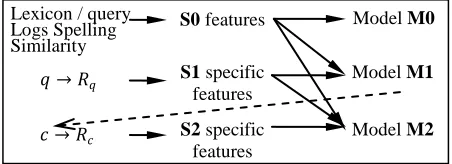
In this scheme we extend the use of search results both for query q and for top-ranked candidate c other than q determined by M1. First we submit a query to a search engine for the initial retrieval to obtain one set of search results 𝑅𝑞, then use M1 to find the best correction candidate c other than q. Next we perform a second retrieval with c to ob-tain another set of search results 𝑅𝑐. Finally addi-tional features are generated for each candidate based on 𝑅𝑐, then a new maximum entropy model
[image:5.612.314.540.597.679.2]M2 is built to re-rank the candidates for a second time. The entire process can be schematically shown in Figure 3.
Figure 3. Relations of models and features
Lexicon / query Logs Spelling Similarity
𝑞 → 𝑅𝑞
𝑐 → 𝑅𝑐
S0 features
S1 specific features
S2 specific features
Model M1
Model M2
where 𝑅𝑞 is the web search results of query q; 𝑅𝑐is
the web search results of c which is the top-ranked correction of q suggested by model M1.
The new feature set denoted with S2 is a set of document similarities between 𝑅𝑞 and 𝑅𝑐, which
includes different similarity estimations between the query and its correction at the document level using merely cosine measure based on term fre-quency vectors of 𝑅𝑞 and 𝑅𝑐.
6
Experiments
6.1 Evaluation Metrics
In our work, we consider the following four types of evaluation metrics:
Accuracy: The number of correct outputs
proposed by the spelling correction model di-vided by the total number of queries in the test set
Recall: The number of correct suggestions for
misspelled queries by the spelling correction model divided by the total number of miss-pelled queries in the test set
Precision: The number of correct suggestions
for misspelled queries proposed by the spel-ling correction model divided by the total number of suggestions made by the system
F-measure: Formula 𝐹 = 2𝑃𝑅/(𝑃 + 𝑅) used
for calculating the f-measure, which is essen-tially the harmonic mean of recall and preci-sion
Any individual metric above might not be suffi-cient to indicate the overall performance of a query spelling correction model. For example, as in most retrieval tasks, we can trade recall for precision or vice versa. Although intuitively F might be in ac-cordance with accuracy, there is no strict theoreti-cal relation between these two numbers – there are conditions under which accuracy improves while F-measure may drop or be unchanged.
6.2 Experimental Setup
We used a manually constructed data set as gold standard for evaluation. First we randomly sam-pled 7,000 queries from search engine’s daily query logs of different time periods, and had them manually labeled by two annotators independently. Each query is attached to a truth, which is either the query itself for valid queries, or a spelling cor-rection for misspelled ones. From the annotation
results that both annotators agreed with each other, we extracted 2,323 query-truth pairs as training set and 991 as test set. Table 1 shows the statistics of the data sets, in which Eq denotes the error rate of
query and Et denotes the error rate of term.
# queries # terms Eq Et
Training set 2,323 6,318 15.0% 5.6%
Test set 991 2,589 12.8% 5.2%
Table 1. Statistics of training set and test set In the following experiments, at most 50 correc-tion candidates were used in the maximum entropy model for each query if there is no special explana-tion. The web search results were fetched from MSN’s search engine. By default, top 100 re-trieved items from the web retrieval results were used to perform feature extraction. A set of query log data spanning 9 months are used for collecting statistics required by the baseline.
6.3 Overall Results
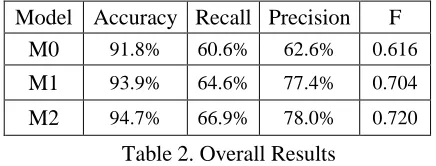
Following the method as described in previous sec-tions, we first ran a group of experiments to eva-luate the performance of each model we discussed with default settings. The detailed results are shown in Table 2.
Model Accuracy Recall Precision F M0 91.8% 60.6% 62.6% 0.616
M1 93.9% 64.6% 77.4% 0.704
[image:6.612.318.536.418.501.2]M2 94.7% 66.9% 78.0% 0.720
Table 2. Overall Results
From the table we can observe significant per-formance boosts on all evaluation metrics of M1 and M2 over M0.
We can achieve 25.6% error rate reduction and 23.6% improvement in precision, as well as 6.6% relative improvement in recall, when adding S1 to M1. Paired t-test gives p-value of 0.002, which is significant to 0.01 level.
6.4 Impact of Candidate number
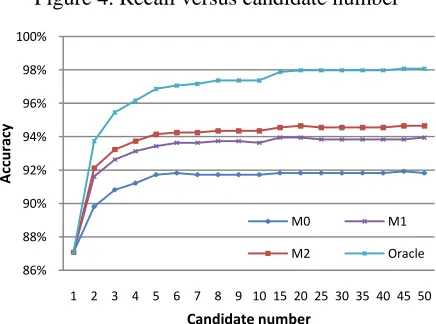
Theoretically the number of correction candidates in the confusion set determines the accuracy and recall upper bounds for all models concerned in this paper. Performance might be hurt if we use a too small candidate number, which is because the corrections are separated from the confusion sets. These curves shown in Figure 4 and 5, include both theoretical bound (oracle) and actual perfor-mance of our described models. From the chart we can see that our models perform best when 𝑁𝑡 is around 50, and when 𝑁𝑡 > 15 the oracle recall and
accuracy almost stay unchanged, thus the actual models’ performance only benefits a little from larger 𝑁𝑡 values. The missing part of recall is
[image:7.612.310.545.110.289.2]largely due to the fact that we are not able to gen-erate truth candidates for some weird query terms rather than insufficient size of confusion set.
Figure 4. Recall versus candidate number
Figure 5. Accuracy versus candidate number
6.5 Discussions
We also studied the performance difference be-tween in-vocabulary (IV) and out-of-vocabulary
(OOV) terms when using different spelling correc-tion models. The detailed results are shown in Ta-ble 3 and TaTa-ble 4.
Accuracy Precision Recall F
M0 88.2% 77.1% 67.3% 0.718
M1 92.4% 88.5% 77.3% 0.825
M2 93.2% 91.6% 79.1% 0.849
Table 3. OOV Term Results
Accuracy Precision Recall F
M0 98.8% 44.0% 45.8% 0.449
M1 99.0% 62.5% 20.8% 0.313
[image:7.612.76.293.310.457.2]M2 99.1% 75.0% 37.5% 0.500
Table 4. IV Term Results
The results show that M1 is very powerful to identify and correct OOV spelling errors compared with M0. Actually M1 is able to correct spelling errors such as guiness, whose frequency in query log is even higher than its truth spelling guinness. Since most spelling errors are OOV terms, this ex-plains why the model M1 can significantly outper-form the baseline. But for IV terms things are dif-ferent. Although the overall accuracy is better, the F-measure of M1 is far lower than M0. M2 per-forms best for the IV task in terms of both accura-cy and F-measure. However, IV spelling errors is so small a portion of the total misspelling (only 17.4% of total spelling errors in our test set) that the room for improvement is very small. This helps to explain why the performance gap between M1 and M0 is much larger than the one between M2 and M1, and shows the tendency that M1 prefer to identify and correct OOV misspellings in compari-son to IV ones, which causes F-measure drop from M0 to M1; while by introducing more useful evi-dence, M2 outperforms better for both OOV and IV terms over M0 and M1.
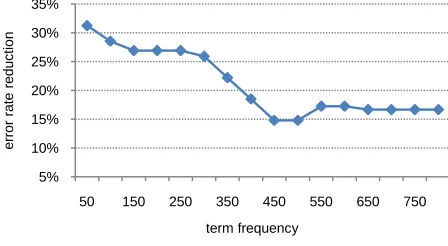
Another set of statistics we collected from the experiments is the performance data of low-frequency terms when using the models proposed in this paper, since we believe that our approach would help make better classification of low-frequency search terms. As a case study, we identi-fied in the test set all terms whose frequencies in our query logs are less than 800, and for these terms we calculated the error reduction rate of model M1 over the baseline model M0 at each in-0%
10% 20% 30% 40% 50% 60% 70% 80% 90%
1 2 3 4 5 6 7 8 9 10 15 20 25 30 35 40 45 50
R
e
cal
l
Candidate number
M0 M1
M2 Oracle
86% 88% 90% 92% 94% 96% 98% 100%
1 2 3 4 5 6 7 8 9 10 15 20 25 30 35 40 45 50
A
ccur
acy
Candidate number
M0 M1
[image:7.612.77.295.469.631.2]terval of 50. The detailed results are shown in Fig-ure 6. The clear trend can be observed that M1 can achieve larger error rate reduction over baseline for terms with lower frequencies. This is because the performance of baseline model drops for these terms when there are no reliable distributional si-milarity estimations available due to data sparse-ness in query logs, while M1 can use web data to alleviate this problem.
Figure 6. Error rate reduction of M1 over baseline for terms in different frequency ranges
7
Conclusions and Future Work
The task of query spelling correction is very differ-ent from convdiffer-entional spelling checkers, and poses special research challenges. In this paper, we psented a novel method for use of web search re-sults to improve existing query spelling correction models.
We explored two schemes for taking advantage of the information extracted from web search re-sults. Experimental results show that our proposed methods can achieve statistically significant im-provements over the baseline model which only relies on evidences of lexicon, spelling similarity and statistics estimated from query logs.
There is still further potential useful information that should be studied in this direction. For exam-ple, we can work on page ranking information of returning pages, because trusted or well-known sites with high page rank generally contain few wrong spellings. In addition, the term co-occurrence statistics on the returned snippet text are also worth deep investigation.
References
Ahmad F. and Grzegorz Kondrak G. Learning a spelling error model from search query logs. Proceedings of EMNLP 2005, pages 955-962, 2005
Berger A. L., Della Pietra S. A., and Della Pietra V. J. A maximum entropy approach to natural language processing. Computation Linguistics, 22(1):39-72, 1996
Brill E. and Moore R. C. An improved error model for noisy channel spelling correction. Proceedings of 38th annual meeting of the ACL, pages 286-293, 2000.
Broder, A. A taxonomy of web search. SIGIR Forum Fall 2002, Volume 36 Number 2, 2002.
Church K. W. and Gale W. A. Probability scoring for spelling correction. In Statistics and Computing, vo-lume 1, pages 93-103, 1991.
Cucerzan S. and Brill E. Spelling correction as an itera-tive process that exploits the collecitera-tive knowledge of web users. Proceedings of EMNLP’04, pages 293-300, 2004.
Damerau F. A technique for computer detection and correction of spelling errors. Communication of the ACM 7(3):659-664, 1964.
Darroch J. N. and Ratcliff D. Generalized iterative scal-ing for long-linear models. Annals of Mathematical Statistics, 43:1470-1480, 1972.
Efthimiadis, N.E., Query Expansion, In Annual Review of Information Systems and Technology, Vol. 31, pp. 121-187 , 1996.
Golding A. R. and Roth D. Applying winnow to con-text-sensitive spelling correction. Proceedings of ICML 1996, pages 182-190, 1996.
J. Lafferty and C. Zhai. Document language models, query models, and risk minimization for information retrieval. In Proceedings of SIGIR’2001, pages 111-119, Sept 2001.
J. Xu and W. Croft. Query expansion using local and global document analysis. In Proceedings of the SI-GIR 1996, pages 4-11, 1996
Kernighan M. D., Church K. W. and Gale W. A. A spel-ling correction program based on a noisy channel model. Proceedings of COLING 1990, pages 205-210, 1990.
Kukich K. Techniques for automatically correcting words in text. ACM Computing Surveys. 24(4): 377-439, 1992.
Levenshtein V. Binary codes capable of correcting dele-tions, insertions and reversals. Soviet Physice – Dok-lady 10: 707-710, 1966.
Li M., Zhu M. H., Zhang Y. and Zhou M. Exploring distributional similarity based models for query
spel-5% 10% 15% 20% 25% 30% 35%
50 150 250 350 450 550 650 750
e
rr
o
r
ra
te
r
e
d
u
ctio
n
ling correction. Proceedings of COLING-ACL 2006, pages 1025-1032, 2006
Mangu L. and Eric Brill E. Automatic rule acquisition for spelling correction. Proceedings of ICML 1997, pages 734-741, 1997.
Martin Reynaert. Text induced spelling correction. Pro-ceedings of COLING 2004,pages 834-840, 2004.
Mayes E., Damerau F. and Mercer R. Context based spelling correction. Information processing and management, 27(5): 517-522, 1991.
Philips L. Hanging on the metaphone. Computer Lan-guage Magazine, 7(12): 39, 1990.