Proceedings of the 2007 Joint Conference on Empirical Methods in Natural Language Processing and Computational
Determining Case in Arabic:
Learning Complex Linguistic Behavior
Requires Complex Linguistic Features
Nizar Habash†, Ryan Gabbard‡, Owen Rambow†, Seth Kulick‡and Mitch Marcus‡
†Center for Computational Learning Systems, Columbia University New York, NY, USA
{habash,rambow}@cs.columbia.edu
‡Department of Computer and Information Science,University of Pennsylvania Philadelphia, PA, USA
{gabbard,skulick,mitch}@cis.upenn.edu
Abstract
This paper discusses automatic determina-tion of case in Arabic. This task is a ma-jor source of errors in full diacritization of Arabic. We use a gold-standard syntac-tic tree, and obtain an error rate of about 4.2%, with a machine learning based system outperforming a system using hand-written rules. A careful error analysis suggests that when we account for annotation errors in the gold standard, the error rate drops to 0.8%, with the hand-written rules outperforming the machine learning-based system.
1 Introduction
In Modern Standard Arabic (MSA), all nouns and adjectives have one of three cases: nominative (NOM), accusative (ACC), or genitive (GEN). What sets case in MSA apart from case in other languages is most saliently the fact that it is usually not marked in the orthography, as it is written using diacrit-ics which are normally omitted. In fact, in a re-cent paper on diacritization, Habash and Rambow (2007) report that word error rate drops 9.4% ab-solute (to 5.5%) if the word-final diacritics (which include case) need not be predicted. Similar drops have been observed by other researchers (Nelken and Shieber, 2005; Zitouni et al., 2006). Thus, we can deduce that tagging-based approaches to case identification are limited in their usefulness, and if we need full diacritization for subsequent process-ing in a natural language processprocess-ing (NLP) applica-tion (say, language modeling for automatic speech
recognition (Vergyri and Kirchhoff, 2004)), we need to perform more complex syntactic processing to re-store case diacritics. Options include using the out-put of a parser in determining case.
An additional motivation for investigating case in Arabic comes from treebanking. Native speakers of Arabic in fact are native speakers of one of the Arabic dialects, all of which have lost case (Holes, 2004). They learn MSA in school, and have no native-speaker intuition about case. Thus, determin-ing case in MSA is a hard problem for everyone, including treebank annotators. A tool to catch case-related errors in treebanking would be useful.
In this paper, we investigate the problem of de-termining case of nouns and adjectives in syntactic trees. We use gold standard trees from the Arabic Treebank (ATB). We see our work using gold stan-dard trees as a first step towards developing a sys-tem for restoring case to the output of a parser. The complexity of the task justifies an initial investiga-tion based on gold standard trees. And of course, the use of gold standard trees is justified for our other objective, helping quality control for treebanking.
The study presented in this paper shows the im-portance of what has been called “feature engineer-ing” and the issue of representation for machine learning. Our initial machine learning experiments use features that can be read off the ATB phrase structure trees in a straightforward manner. The lit-erature on case in MSA (prescriptive and descrip-tive sources) reveals that case assignment in Ara-bic does not always follow standard assumptions about predicate-argument structure, which is what
the ATB annotation is based on. Therefore, we transform the ATB so that the new representation is based entirely on case assignment, not predicate-argument structure. The features for machine learn-ing that can now be read off from the new represen-tation yield much better results. Our results show that we can determine case with an error rate of 4.2%. However, our results would have been impos-sible without a deeper understanding of the linguis-tic phenomenon of case and a transformation of the representation oriented towards this phenomenon.
Using either underlying representation, machine learning performs better than hand-written rules. However, a closer look at the errors made by the machine learning-derived classifier and the hand-written rules reveals that most errors are in fact treebank errors (between 69% and 86% of all er-rors for the machine learning-derived classifier and the hand-written rules, respectively). Furthermore, the machine learning classifier agrees more often with treebank errors than the hand-written rules do. This fact highlights the problem of machine learning (garbage in, garbage out), but holds out the prospect for improvement in the machine learning based clas-sifier as the treebank is checked for errors and re-released.
In the next section, we describe all relevant lin-guistic facts of case in Arabic. Section 3 details the resources used in this research. Section 4 describes the preprocessing done to extract the relevant lin-guistic features from the ATB. Sections 5 and 6 de-tail the two systems we compare. Sections 7 and 8 present results and an error analysis of the two sys-tems. And we conclude with a discussion of our findings in Section 9.
2 Linguistic Facts
All Arabic nominals (common nouns, proper nouns, adjectives and adverbs) are inflected for case, which has three values in Arabic: nominative (NOM), ac-cusative (ACC) or genitive (GEN). We know this from case agreement facts, even though the mor-phology and/or orthography do not necessarily al-ways make the case realization overt. We discuss morphological and syntactic aspects of case in MSA in turn.
2.1 Morphological Realization of Case
The realization of nominal case in Arabic is com-plicated by its orthography, which uses optional dia-critics to indicate short vowel case morphemes, and by its morphology, which does not always distin-guish between all cases. Additionally, case realiza-tion in Arabic interacts heavily with the realizarealiza-tion of definiteness, leading to different realizations de-pending on whether the nominal is indefinite, i.e., re-ceiving nunation ( ), definite through the deter-miner Al+ () or definite through being the gover-nor of an idafa possessive construction (
). Most details of this interaction are outside the scope of this paper, but we discuss it as much as it helps clarify is-sues of case.
Buckley (2004) describes eight different classes of nominal case expression, which we briefly review. We first discuss the realization of case in morpholog-ically singular nouns (including broken, i.e., irregu-lar, plurals). Triptotes are the basic class which ex-presses the three cases in the singular using the three short vowels of Arabic: NOMis +u,
1ACCis
+a, and GENis
+i. The corresponding nunated forms for these three diacritics are:
+˜u for NOM,
+ã for ACC, and
+˜ı for GEN. Nominals not ending with
Ta Marbuta (
¯
h) or Alif Hamza ( A’) receive an
extra Alif in the accusative indefinite case (e.g,
kitAbAã ‘book’ versus
kitAba¯hã ‘writing’). Diptotes are like triptotes except that when they are indefinite, they do not express nunation and they use the +a suffix for both ACCand GEN. The class of diptotes is lexically specific. It includes nomi-nals with specific meanings or morphological pat-terns (colors, elatives, specific broken plurals, some proper names with Ta Marbuta ending or location names devoid of the definite article). Examples include
!#"%$'&
bayruwt ‘Beirut’ and
(*) )
Âazraq 1All Arabic transliterations are provided in the
Habash-Soudi-Buckwalter transliteration scheme (Habash et al., 2007). This scheme extends Buckwalter’s transliteration scheme (Buckwalter, 2002) to increase its readability while maintaining the 1-to-1 correspondence with Arabic orthography as repre-sented in standard encodings of Arabic, i.e., Unicode, CP-1256, etc. The following are the only differences from Buckwalter’s scheme (which is indicated in parentheses): ¯A+, (|), Â-, (>),
ˆ w
-.
(&), ˇA,
-(<), ˆy/10 (}),¯h 23 (p),θ 4
5
(v), ð 6
7
(∗), š 4 8 ($),
ˇ D 6
9
(Z),ς: (E),γ
6
: (g), ý0 (Y), ã
;< (F), ˜u=< (N), ˜ı<
;
‘blue’.
The next three classes are less common. The in-variables show no case in the singular (e.g. nomi-nals ending in long vowels:
)
suwryA ‘Syria’ or
$
ðikraý ‘memoir’). The indeclinables always use the +a suffix to express case in the singular and allow for nunation (
maςnaýã ‘meaning’). The defective nominals, which are derived from roots with a final radical glide (y or w), look like triptotes except that they collapse NOM and GEN into the GEN form, which also includes loosing their final glide:
qAD˜ı (NOM,GEN) versus
qADiyAã (ACC) ‘a judge’.
For the dual and sound plural, the situa-tion is simpler, as there are no lexical excep-tions. The duals and masculine sound plurals express number, case and gender jointly in sin-gle morphemes that are identifiable even if undia-critized:
kAtib+uwna ‘writersmasc,pl’ (NOM),
kAtib+Ani ‘writersmasc,du’ (NOM),
kAtib+atAni ‘writersf em,du’ (NOM). The ACCand GEN forms are identical, e.g.,
& kAtib+iyna ‘writersmasc,pl’ (ACC,GEN). Finally, the dual and masculine sound plural do not express nunation. On the other hand, the feminine sound plural marks nunation explicitly, and all of its case mor-phemes are written only as diacritics, e.g.,
! kAtib+At+u ‘writersf em,pl’ (NOM).
2.2 Syntax of Case
Traditional Arabic grammar makes a distinction between verbal clauses (
) and nominal clauses (
). Verbal clauses are verb-initial sentences, and we (counter to the Arabic grammat-ical tradition) include copula-initial clauses in this group. The copula is
kAn ‘to be’ or one of her sisters. Nominal clauses begin with a topic (which is always a nominal), and continue with a complement which is either a verbal clause, a nominal predicate, or a prepositional predicate. If the complement of a topic is a verbal clause, an inflectional subject mor-pheme or a resumptive object clitic pronoun replace the argument which has become the topic.
Arabic case system falls within the class of nominative-accusative languages (as opposed to ergative-absolutive languages). Some of the com-mon behavior of case in Arabic with other languages
includes:2
• NOM is assigned to subjects of verbal clauses, as well as other nominals in headings, titles and quotes.
• ACCis assigned to (direct and indirect) objects
of verbal clauses, verbal nouns, or active par-ticiples; to subjects of small clauses governed by other verbs (i.e., “exceptional case marking” or “raising to object” contexts; we remain ag-nostic on the proper analysis); adverbs; and cer-tain interjections, such as $ šukrAã ‘Thank you’.
• GEN is assigned to objects of prepositions and to possessors in idafa (possessive) construction.
• There is a distinction between case-by-assignment and case-by-agreement. In case-by-assignment, a specific case is assigned to a nominal by its case assigner; whereas in case-by-agreement, the modifying or conjoined nominal copies the case of its governor.
Arabic case differs from case in other languages in the following conditions, which relate to nominal clauses and numbers.
• The topic (independently of its grammatical function) is ACCif it follows the subordinating conjunction !
ˇ
Ain∼a (or any of her “sisters”:
!
"
liÂan∼a, !
kaÂan∼a, !
"
lakin∼a, etc.). Otherwise, the topic is NOM.
• Nominal predicates are ACC if they are
gov-erned by the overt copula. They are also ACCif they are objects of verbs that take small clause complements (such as ‘to consider’), unless the predicate is introduced by a subordinating con-junction. In all other cases, they are NOM.
• In constructions involving a nominal and a number (
" $$#%'& Eišruwna kAtibAã ‘twenty writers’), the head of the phrase for case assignment is the number, which receives whichever case the context assigns. The case of the nominal depends on the number. If the number is between 11 and 99, the nominal is 2
ACC by tamiyz ($ &
– lit. “specification”). Otherwise, the nominal is GENby idafa.
3 The Data
We use the third section of the current version of the Arabic Treebank released by the Linguistic Data Consortium (LDC) (Maamouri et al., 2004). We use the division into training and devtest corpora pro-posed by Zitouni et al. (2006), further dividing their devtest set into two equal parts to give us a devel-opment and a test set. The training set has approxi-mately 367,000 words, and the development and test sets each have about 33,000 words. In our training data, of 133,250 case-marked nominals, 66.4% are GEN, 18.5% ACC, and 15.1% NOM.
The ATB annotation in principle indicates for each nominal its case and the corresponding realiza-tion (including diacritics). The only systematic ex-ception is that invariables are not marked at all with their unrealized case, and are marked as having NO-CASE. We exclude all nominals marked NOCASE from our evaluations, as we believe that these nom-inals actually do have case, it is just not marked in the treebank, and we do not wish to predict the mor-phological realization, only the underlying case. In reporting results, we use accuracy on the number of nominals whose case is given in the treebank.
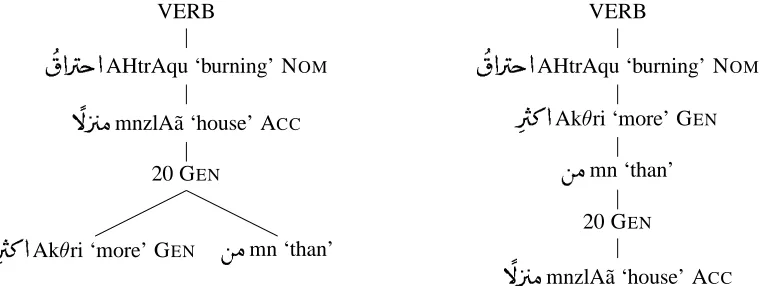
While the ATB does not contain explicit infor-mation about headedness in its phrase structure, we can say that the syntactic annotations in the ATB are roughly based on predicate-argument structure. For example, for the structure shown in Figure 1, the “natural” interpretation is that the head is
(
$ &
AHtrAqu ‘burning’, with a modifier
$ &
mnzlAã ‘house’, which in turn is modified by a QP whose head is (presumably) the number 20, which is modi-fied by$
&
Akθri ‘more’ and
mn ‘than’. This de-pendency structure is shown on the left in Figure 2. Another annotation detail relevant to this paper is that the ATB marks the topic of a nominal clause as “SBJ” (i.e., as a subject) except when the predicate is a verbal clause; then it is marked as TPC. We con-sider these two cases to be the same case and relabel all such cases as TPC.
NP
Noun NOM
(
$ &
AHtrAqu ‘burning’
NP
QP
Adj Comp
GEN
$
&
Akθri ‘more’
Prep
mn ‘than’
Num GEN
20
Noun ACC
$ &
[image:4.612.332.541.60.266.2]
mnzlAã ‘house’
Figure 1: The representation of numbers in the Ara-bic Treebank, for a subject NP meaning ‘the burning of more than 20 houses’
4 Determining the Case Assigner
Case assignment is a relationship between two words: one word (the case governor or assigner) assigns case to the other word (the case assignee). Because case assignment is a relationship between words, we switch to a dependency-based version of the treebank. There are many possible ways to transform a phrase structure representation into a de-pendency representation; we explore two such con-versions in the context of this paper. Note that if we had used the Prague Arabic Dependency Tree-bank (Smrž and Hajiˇc, 2006) instead of the ATB, we would not have had to convert to dependency, but we still would have had to analyze whether the depen-dencies are the ones we need for modeling case as-signment, possibly having to restructure the depen-dencies.
For determining the dependency relations that de-termine case assignment, we start out by using a standard head percolation algorithm with the fol-lowing parameters: Verbs head all the arguments in VPs; prepositions head the PP arguments; and the first nominal in an NP or ADJP heads those struc-tures. Non-verbal predicates (NPs, ADJPs or PPs) head their subjects (topics). The subordinating con-junction !
ˇ
Ain∼a is governed by what follows it. The overt copula
predicate. Conjunctions are headed by what they follow and head what they precede (with the excep-tion of the common sentence initial conjuncexcep-tion
"
w+ ‘and’, which is headed by the sentence it intro-duces). We will call the result of this algorithm the
Basic Case Assigner Identification Algorithm, or Basic Representation for short.
After initial experiments with both hand-written rules and machine learning, we extend the Basic Representation in order to account for the special case assigning properties of numbers in Arabic by adding additional head percolation parameters and restructuring rules to handle the structure of NPs in the ATB. This is because the current ATB represen-tation is not useful in some cases for representing case assignment. Consider the structure in Figure 1. Here, the head of the NP is the noun
(
$ &
AHtrAqu ‘burning’, which has NOMbecause the NP is a sub-ject (the verb is not shown). The QP’s first member,
$
&
Akθri ‘more’ is GEN because it is in an idafa construction with the noun
(
$&
AHtrAqu.
$
&
Akθri is modified by the preposition
mn ‘than’ which assigns GENto the number 20 (which is writ-ten in Arabic numerals and thus does not show any
case at all). The noun
$ &
mnzlAã ‘house’ is in a tamyiz relation with the number 20 which governs it, and thus it is ACC. It is clear that the phrase structure chosen for the ATB does not represent these case-assignment relations in a direct manner.
To create the appropriate head relations for case determination, we flatten all QPs and use a set of simple deterministic rules to create the more appro-priate structure which expresses the chain of case as-signments. In our development set, 5.8% of words get a new head using this new head assignment. We call this new representation the Revised
Represen-tation. Figure 2 shows the dependency
represen-tation corresponding to the phrase structure in Fig-ure 1.
We make use of all dash-tags provided by the ATB as arc labels and we extend the label set to explic-itly mark objects of prepositions (POBJ), possessors in idafa construction (IDAFA), conjuncts (CONJ) and conjunctions (CC), and the accusative specifier, tamyiz (TMZ). All other modifications receive the label (MOD).
5 Hand Written Rules
Our first system is based on hand-written rules (henceforth, we refer to this system as the rule-based system). We add two features to nominals in the tree: (1) we identify if a word governs a subordinat-ing conjunction !
ˇ
Ain∼a or any of its sisters; and (2) we also identify if a topic of a nominal sentence has an ˇAin∼a sibling.
The following are the simple hand written rules we use:
• RULE 1: The default case assigned is ACCfor all words.
• RULE 2: Assign NOMto nominals heading the tree and those labeled HLN (headline) or TTL (title).
• RULE 3: Assign GENto nominals with the la-bels POBJ or IDAFA.
• RULE 4: Assign NOMto nominals with the la-bel PRD if NOT headed by a verbal (verb or deverbal noun) or if it has an ˇAin∼a child.
• RULE 5: Assign NOM to nominal topics that
do not have an ˇAin∼a sibling.
• RULE 6: All case-unassigned children of nom-inal parents (and conjunctions), whose label is MOD, CONJ or CC, copy the case of their par-ent. Conjunctions carry the case temporarily to pass on agreement. Verbs do not pass on agree-ment.
The first rule is applied to all nodes. The second to fifth rules are case-by-assignment rules applied in an if-else fashion (no overwriting is done). The last rule is a case-by-agreement rule. All non-nominals receive the case NA.
6 Machine Learning Experiments: The Statistical System
VERB
(
$ &
AHtrAqu ‘burning’ NOM
$ &
mnzlAã ‘house’ ACC
20 GEN
$
&
Akθri ‘more’ GEN
mn ‘than’
VERB
(
$ &
AHtrAqu ‘burning’ NOM
$
&
Akθri ‘more’ GEN
mn ‘than’
20 GEN
$ &
mnzlAã ‘house’ A
[image:6.612.112.494.61.204.2]CC
Figure 2: Two possible dependency trees for the phrase structure tree in Figure 1, meaning ‘burning of more than 20 houses’; the tree on the left, our Basic Representation, represents a standard predicate-argument-modification style tree, while the tree on the right represents the chain of case assignment and is our Revised Representation
whose label is MOD(case-by-agreement). We han-dle conjunctions in the statistical system differently from the rule-based system: we resolve conjunc-tions so that conjoined words are labeled exactly the same. For example, in John and Mary went to the store, both John and Mary would have the subject label, even though Mary has a conjunction label in the raw dependency tree. Both models are trained only on those words which are marked for case in the treebank.
6.1 The Core Model
The core model uses the following features of a word:
• the word’s POS tag;
• the conjunction of the word’s POS tag and its arc label;
• the word’s last length-one and length-two suf-fixes (to model written case morphemes);
• the conjunction of the word’s arc label, its POS tag, and its parent’s POS tag;
• if the word is the object of a preposition, the preposition it is the object of;
• whether the word is a PRD child of a verb (with the identity of that verb conjoined if so);
• if the word has a sister which is a subordinating conjunction, and if so, that conjunction con-joined with its arc label;
• whether the word is in an embedded clause con-joined with its arc label under the verb of the embedded clause;
• if the word is a PRD child of a verb, the verb;
• the word’s left sister’s POS tag conjoined with this word’s arc label and its sister’s arc label;
• whether the word’s sister depends on the word or something else;
• and the left sister’s terminal symbol.
Arabic words which do not overtly show case are still determined for purposes of resolving agree-ment. The classifier is applied to these cases at run-time anyway.
6.2 The Agreement Model
The agreement model uses the following features of a word:
• the word itself;
• the word’s last length-one and length-two suf-fixes;
• and the conjunction of the word’s POS tag and the case of what it agrees with.
System Basic Revised Rule-based 93.5 94.4
Statistical 94.0 95.8
Table 1: Accuracies of various approaches on the test set in both basic and revised dependency repre-sentations.
7 Results
The performance of our two systems on the test data set is shown in table 1. There are three points to note: first, even in the basic representation, the statistical system reduces error over the rule-based system by 7.7%. Second, the revised representa-tion helps tremendously, resulting in a 13.8% reduc-tion in error for the rule-based system and 30% for the statistical system. Finally, the statistical system gains much more than the rule-based system from the improved representation, increasing the gap be-tween them to a 25% reduction in error.
8 Error Analysis
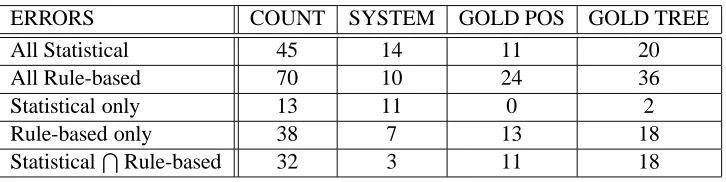
We took a sample of 105 sentences (around 10%) from our development data prepared in the revised representation. Our rule-based system accuracy for the sample is about 94.1% and our statistical system accuracy is 96.2%. Table 2 classifies the different types of errors found. The first and second rows list the errors made by the statistical and rule-based sys-tems, respectively. The third row lists errors made by the statistical system only. The fourth row lists errors made by the rule-based system only. And the fifth row lists errors made by both. The second col-umn indicates the count of all errors. The rest of the columns specify the error types as: system errors, gold POS errors or gold tree errors. The gold POS and tree errors are treebank errors that misguide our systems. They represent 69% of all statistical system errors and 86% of all rule-based system errors. Gold POS errors represent around 35-40% of all gold er-rors. They most commonly include the wrong POS tag or the wrong case. One example of such errors is the mis-annotation of the ACC case to a GEN for
a diptote nominal (which are indistinguishable out of context). Gold tree errors are primarily errors in the dash-tags used (or missing) in the treebank or at-tachment errors that are inconsistent with the gold
POS tag.
The rule-based system errors involve various con-structions that were not addressed in our study, e.g. flat adjectival phrases or non S constructions at the highest level in a tree (e.g. FRAG or NP). The ma-jority of the statistical system errors involve agree-ment decisions and incorrect choice of case despite the presence of the dash-tags. The ratio of system er-rors for the statistical system is 31% (twice as much as those of the rule-based system’s 14%). Thus, it seems that the statistical system manages to learn some of the erroneous noise in the treebank.
9 Discussion
9.1 Accomplishments
We have developed a system that determines case for nominals in MSA. This task is a major source of errors in full diacritization of Arabic. We use a gold-standard syntactic tree, and obtain an error rate of about 4.2%, with a machine learning based system outperforming a system using hand-written rules. A careful error analysis suggests that when we account for annotation errors in the gold standard, the error rate drops to 0.8%, with the hand-written rules out-performing the machine learning-based system.
9.2 Lessons Learned
We can draw several general conclusions from our experiments.
• The features relevant for the prediction of com-plex linguistic phenomena cannot necessarily be easily read off from the given represen-tation of the data. Sometimes, due to data sparseness and/or limitations in the machine learning paradigm used, we need to extract features from the available representation in a manner that profoundly changes the represen-tation (as is done in bilexical parsing (Collins, 1997)). Such transformations require a deep understanding of the linguistic phenomena on the part of the researchers.
ERRORS COUNT SYSTEM GOLD POS GOLD TREE
All Statistical 45 14 11 20
All Rule-based 70 10 24 36
Statistical only 13 11 0 2
Rule-based only 38 7 13 18
[image:8.612.126.489.58.149.2]StatisticalTRule-based 32 3 11 18
Table 2: Results of Error Analysis
is the type of learning (human or machine). For certain phenomena, machine learning may re-sult in only a small or no improvement in per-formance over hand-written rules.
• Error analysis remains a crucial part of any empirical work in natural language processing. Not only does it contribute insight into how the system can be improved, it also reveals prob-lems with the underlying data. Sometimes the problems are just part of the noise in the data, but sometimes the problems can be fixed. An-notations on data are not themselves naturally occurring data and thus may be subject to cri-tique. Note that an error analysis requires a good understanding of the linguistic phenom-ena and of the data.
9.3 Outlook
Our work was motivated in two ways: to help tree-banking, and to develop tools for automatic case determination from unannotated text. For the first goal, our error analysis has shown that 86% of the errors found by our hand-written rules are in fact treebank errors. Furthermore, we suspect that the hand-written rules have very few false positives (i.e., cases in which the treebank has been annotated in er-ror but our rules predict exactly that erer-ror). Thus we believe that our tool can serve an important function in improving the treebank annotation.
For our second motivation, the next step will be to adapt our feature extraction to work on the output of parsers, which typically exclude dash-tags. We note that for many contexts, we do not currently rely on dash-tags but rather identify the relevant struc-tures on our own (such as idafa, tamyiz, and so on). We suspect that the machine learning-based ap-proach will outperform the hand-written rules, as it can learn typical errors the parser makes. As the
treebank will soon be revised and hand-checked, we will postpone this work until the new release of the treebank, which will allow us to train better parsers as the data will be more consistent.
Acknowledgements
The research presented here was supported by the Defense Advanced Research Projects Agency (DARPA) under Contract Nos. HR0011-06-C-0023, HR0011-06-C-0022 and HR0011-06-1-0003. Any opinions, findings and conclusions or recommenda-tions expressed in this paper are those of the authors and do not necessarily reflect the views of DARPA.
References
Ron Buckley. 2004. Modern Literary Arabic: A Refer-ence Grammar. Librairie du Liban.
Tim Buckwalter. 2002. Buckwalter Arabic morphologi-cal analyzer version 1.0.
Michael Collins. 1997. Three Generative, Lexicalised Models for Statistical Parsing. In Proceedings of the 35th Annual Meeting of the ACL (jointly with the 8th Conference of the EACL), pages 16–23, Madrid, Spain.
Nizar Habash and Owen Rambow. 2007. Arabic Di-acritization through Full Morphological Tagging. In Proceedings of the 8th Meeting of the North American Chapter of the Association for Computational Linguis-tics/Human Language Technologies Conference (HLT-NAACL07).
Nizar Habash, Abdelhadi Soudi, and Tim Buckwalter. 2007. On Arabic Transliteration. In A. van den Bosch and A. Soudi, editors, Arabic Computational Mor-phology: Knowledge-based and Empirical Methods. Springer.
Clive Holes. 2004. Modern Arabic: Structures, Func-tions, and Varieties. Georgetown University Press. Revised Edition.
Building a Large-Scale Annotated Arabic Corpus. In NEMLAR Conference on Arabic Language Resources and Tools, pages 102–109, Cairo, Egypt.
Andrew Kachites McCallum. 2002. Mal-let: A machine learning for language toolkit. http://mallet.cs.umass.edu.
Rani Nelken and Stuart Shieber. 2005. Arabic Diacriti-zation Using Weighted Finite-State Transducers. In Proceedings of the Workshop on Computational Ap-proaches to Semitic Languages at 43rd Meeting of the Association for Computational Linguistics (ACL’05), pages 79–86, Ann Arbor, Michigan.
Otakar Smrž and Jan Hajiˇc. 2006. The Other Arabic Treebank: Prague Dependencies and Functions. In Ali Farghaly, editor, Arabic Computational Linguis-tics: Current Implementations. CSLI Publications.
Dimitra Vergyri and Katrin Kirchhoff. 2004. Au-tomatic Diacritization of Arabic for Acoustic Mod-eling in Speech Recognition. In Ali Farghaly and Karine Megerdoomian, editors, COLING 2004 Work-shop on Computational Approaches to Arabic Script-based Languages, pages 66–73, Geneva, Switzerland.