Constructing Information Networks Using One Single Model
Qi Li† Heng Ji† Yu Hong†‡ Sujian Li¶
†Computer Science Department, Rensselaer Polytechnic Institute, USA ‡School of Computer Science and Technology, Soochow University, China ¶Key Laboratory of Computational Linguistics, Peking University, MOE, China
†{liq7,hongy2,jih}@rpi.edu,¶[email protected]
Abstract
In this paper, we propose a new frame-work that unifies the output of three infor-mation extraction (IE) tasks - entity men-tions, relations and events as an informa-tion network representainforma-tion, and extracts all of them using one single joint model based on structured prediction. This novel formulation allows different parts of the information network fully interact with
each other. For example, many
rela-tions can now be considered as the re-sultant states of events. Our approach achieves substantial improvements over traditional pipelined approaches, and sig-nificantly advances state-of-the-art end-to-end event argument extraction.
1 Introduction
Information extraction (IE) aims to discover entity mentions, relations and events from unstructured texts, and these three subtasks are closely inter-dependent: entity mentions are core components of relations and events, and the extraction of rela-tions and events can help to accurately recognize entity mentions. In addition, the theory of eventu-alities (D¨olling, 2011) suggested that relations can be viewed as states that events start from and result in. Therefore, it is intuitive but challenging to ex-tract all of them simultaneously in a single model. Some recent research attempted to jointly model multiple IE subtasks (e.g., (Roth and Yih, 2007; Riedel and McCallum, 2011; Yang and Cardie, 2013; Riedel et al., 2009; Singh et al., 2013; Li et al., 2013; Li and Ji, 2014)). For example, Roth and Yih (2007) conducted joint inference over entity mentions and relations; Our previous work jointly extracted event triggers and arguments (Li et al., 2013), and entity mentions and relations (Li and Ji, 2014). However, a single model that can ex-tract all of them has never been studied so far.
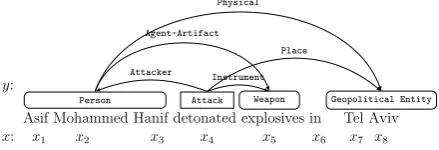
Asif Mohammed Hanif detonated explosives in Tel Aviv
Attack
Person Weapon Geopolitical Entity Place
Instrument Attacker
Agent-Artifact Physical
x1 x2 x3 x4 x5 x6 x7 x8
[image:1.595.307.527.206.281.2]x: y:
Figure 1: Information Network Representation. Information nodes are denoted by rectangles. Ar-rows represent information arcs.
For the first time, we uniformly represent the IE
output from each sentence as aninformation
net-work, where entity mentions and event triggers are
nodes, relations and event-argument links are arcs. We apply a structured perceptron framework with a segment-based beam-search algorithm to
con-struct theinformation networks(Collins, 2002; Li
et al., 2013; Li and Ji, 2014). In addition to the per-ceptron update, we also apply k-best MIRA (Mc-Donald et al., 2005), which refines the perceptron update in three aspects: it is flexible in using var-ious loss functions, it is a large-margin approach, and it can use mulitple candidate structures to tune feature weights.
In an information network, we can capture the
interactions among multiple nodes by learning joint features during training. In addition to the cross-component dependencies studied in (Li et al., 2013; Li and Ji, 2014), we are able to cap-ture interactions between relations and events. For
example, in Figure 1, if we know that thePerson
mention “Asif Mohammed Hanif” is an Attacker
of theAttack event triggered by “detonated”, and
theWeaponmention “explosives” is anInstrument,
we can infer that there exists an Agent-Artifact
relation between them. Similarly we can infer the Physical relation between “Asif Mohammed Hanif” and “Tel Aviv”.
However, in practice many useful interactions are missing during testing because of the data
sity problem of event triggers. We observe that 21.5% of event triggers appear fewer than twice in
the ACE’051 training data. By using only lexical
and syntactic features we are not able to discover the corresponding nodes and their connections. To tackle this problem, we use FrameNet (Baker and Sato, 2003) to generalize event triggers so that semantically similar triggers are clustered in the same frame.
The following sections will elaborate the de-tailed implementation of our new framework.
2 Approach
We uniformly represent the IE output from each
sentence as aninformation network y = (V, E).
Each node vi ∈ V is represented as a triple
hui, vi, tiiof start indexui, end indexvi, and node
type ti. A node can be an entity mention or an
event trigger. A particular type of node is⊥
(nei-ther entity mention nor event trigger), whose max-imal length is always 1. Similarly, each
infor-mation arc ej ∈ E is represented as huj, vj, rji,
whereuj andvj are the end offsets of the nodes,
and rj is the arc type. For instance, in
Fig-ure 1, the event trigger “detonated” is represented
as h4,4,Attacki, the entity mention “Asif
Mo-hammed Hanif” is represented ash1,3,Personi,
and their argument arc is h4,3,Attackeri. Our
goal is to extract the whole information networky
for a given sentencex.
2.1 Decoding Algorithm
Our joint decoding algorithm is based on ex-tending the segment-based algorithm described in
our previous work (Li and Ji, 2014). Let x =
(x1, ..., xm) be the input sentence. The decoder
performs two types of actions at each token xi
from left to right:
• NODEACTION(i, j): appends a new node
hj, i, tiending at thei-th token, wherei−dt<
j ≤ i, and dt is the maximal length of type-t
nodes in training data.
• ARCACTION(i, j): for each j < i,
incremen-tally creates a new arc between the nodes ending
at thej-th andi-th tokens respectively:hi, j, ri.
After each action, the top-k hypotheses are
se-lected according to their features f(x, y0) and
1http://www.itl.nist.gov/iad/mig//tests/ace
weightsw:
bestk y0∈bufferf(x, y
0)·w
Since a relation can only occur between a pair of entity mentions, an argument arc can only occur between an entity mention and an event trigger, and each edge must obey certain entity type
con-straints, during the search we prune invalid AR
-CACTIONs by checking the types of the nodes
ending at thej-th and thei-th tokens. Finally, the
top hypothesis in the beam is returned as the final prediction. The upper-bound time complexity of
the decoding algorithm isO(d·b·m2), where d
is the maximum size of nodes,bis the beam size,
andmis the sentence length. The actual execution
time is much shorter, especially when entity type constraints are applied.
2.2 Parameter Estimation
For each training instance (x, y), the structured
perceptron algorithm seeks the assignment with the highest model score:
z= argmax
y0∈Y(x) f(x, y 0)·w
and then updates the feature weights by using:
wnew =w+f(x, y)−f(x, z)
We relax the exact inference problem by the afore-mentioned beam-search procedure. The stan-dard perceptron will cause invalid updates be-cause of inexact search. Therefore we apply early-update (Collins and Roark, 2004), an instance of violation-fixing methods (Huang et al., 2012). In
the rest of this paper, we overrideyandzto denote
prefixes of structures.
In addition to the simple perceptron update, we also apply k-best MIRA (McDonald et al., 2005), an online large-margin learning algorithm. During each update, it keeps the norm of the change to
feature weightswas small as possible, and forces
the margin between y and the k-best candidatez
greater or equal to their lossL(y, z). It is
formu-lated as a quadratic programming problem:
minkwnew−wk
s.t.wnewf(x, y)−wnewf(x, z)≥L(y, z)
∀z∈bestk(x,w)
Freq. Relation Type Event Type Arg-1 Arg-2 Example
159 Physical Transport Artifact Destination He(arg-1)was escorted(trigger)into Iraq(arg-2).
[image:3.595.74.545.61.157.2]46 Physical Attack Target Place Many people(arg-1)were in the cafe(arg-2)during the blast(trigger). 42 Agent-Artifact Attack Attacker Instrument Terrorists(arg-1)might use(trigger)the devices(arg-2)as weapons. 41 Physical Transport Artifact Origin The truck(arg-1)was carrying(trigger)Syrians fleeing the war in Iraq(arg-2). 33 Physical Meet Entity Place They(arg-1)have reunited(trigger)with their friends in Norfolk(arg-2). 32 Physical Die Victim Place Two Marines(arg-1)were killed(trigger)in the fighting in Kut(arg-2). 28 Physical Attack Attacker Place Protesters(arg-1)have been clashing(trigger)with police in Tehran(arg-2). 26 ORG-Affiliation End-Position Person Entity NBC(arg-2)is terminating(trigger)freelance reporter Peter Arnett(arg-1).
Table 1: Frequent overlapping relation and event types in the training set.
• The first one is F1loss:
L1(y, z) = 1−2|y· ||y+∩|zz||
When counting the numbers, we treat each node and arc as a single unit. For example, in Fig-ure 1,|y|= 6.
• The second one is 0-1 loss:
L2(y, z) = (
1 y6=z
0 y=z
It does not discriminate the extent to which z
deviates fromy.
• The third loss function counts the difference
be-tweenyandz:
L3(y, z) =|y|+|z| −2· |y∩z|
Similar to F1 loss function, it penalizes both
missing and false-positive units. The difference
is that it is sensitive to the size ofyandz.
2.3 Joint Relation-Event Features
By extracting three core IE components in a joint search space, we can utilize joint features over multiple components in addition to factorized fea-tures in pipelined approaches. In addition to the features as described in (Li et al., 2013; Li and Ji, 2014), we can make use of joint features be-tween relations and events, given the fact that relations are often ending or starting states of events (D¨olling, 2011). Table 1 shows the most frequent overlapping relation and event types in
our training data. In each partial structurey0
dur-ing the search, if both arguments of a relation par-ticipate in an event, we compose the correspond-ing argument roles and relation type as a joint
fea-ture fory0. For example, for the structure in
Fig-ure 1, we obtain the following joint relation-event features:
Attacker Instrument Agent-Artifact
Attacker Place Physical
Split Sentences Mentions Relations Triggers Arguments
Train 7.2k 25.7k 4.8k 2.8k 4.5k
Dev 1.7k 6.3k 1.2k 0.7k 1.1k
[image:3.595.309.521.197.416.2]Test 1.5k 5.3k 1.1k 0.6k 1.0k
Table 2: Data set
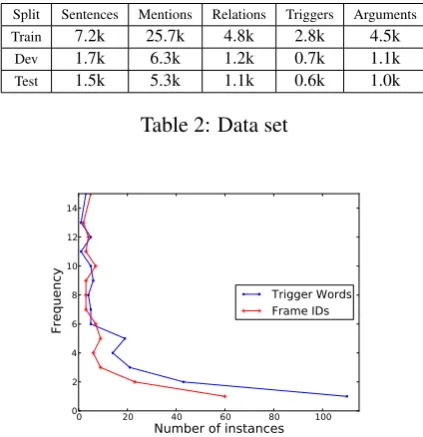
0 20 40 60 80 100
Number of instances
0 2 4 6 8 10 12 14
Frequency
Trigger Words Frame IDs
Figure 2: Distribution of triggers and their frames.
2.4 Semantic Frame Features
One major challenge of constructing information networks is the data sparsity problem in extract-ing event triggers. For instance, in the
sen-tence: “Others were mutilated beyond
recogni-tion.” TheInjuretrigger “mutilated” does not oc-cur in our training data. But there are some
sim-ilar words such as “stab” and “smash”. We
uti-lize FrameNet (Baker and Sato, 2003) to solve this problem. FrameNet is a lexical resource for semantic frames. Each frame characterizes a ba-sic type of semantic concept, and contains a num-ber of words (lexical units) that evoke the frame. Many frames are highly related with ACE events.
For example, the frame “Cause harm” is closely
related withInjure event and contains 68 lexical
units such as “stab”, “smash” and “mutilate”.
Methods Entity Mention (%)P R F Relation (%) Event Trigger (%) Event Argument (%)
1 P R F1 P R F1 P R F1
Pipelined Baseline 83.6 75.7 79.5 68.5 41.4 51.6 71.2 58.7 64.4 64.8 24.6 35.7
Pipeline + Li et al. (2013) N/A 74.5 56.9 64.5 67.5 31.6 43.1
Li and Ji (2014) 85.2 76.9 80.8 68.9 41.9 52.1 N/A
Joint w/ Avg. Perceptron 85.1 77.3 81.0 70.5 41.2 52.0 67.9 62.8 65.3 64.7 35.3 45.6 Joint w/ MIRA w/ F1Loss 83.1 75.3 79.0 65.5 39.4 49.2 59.6 63.5 61.5 60.6 38.9 47.4
Joint w/ MIRA w/ 0-1 Loss 84.2 76.1 80.0 65.4 41.8 51.0 65.6 61.0 63.2 60.5 39.6 47.9
Joint w/ MIRA w/L3Loss 85.3 76.5 80.7 70.8 42.1 52.8 70.3 60.9 65.2 66.4 36.1 46.8
Table 3: Overall performance on test set.
once in the training data from 100 to 60 and al-leviate the sparsity problem. For each token, we exploit the frames that contain the combination of its lemma and POS tag as features. For the above
example, “Cause harm” will be a feature for “
mu-tilated”. We only consider tokens that appear in at most 2 frames, and omit the frames that occur fewer than 20 times in our training data.
3 Experiments
3.1 Data and Evaluation
We use ACE’05 corpus to evaluate our method with the same data split as in (Li and Ji, 2014). Ta-ble 2 summarizes the statistics of the data set. We report the performance of extracting entity men-tions, relamen-tions, event triggers and arguments
sep-arately using the standard F1 measures as defined
in (Ji and Grishman, 2008; Chan and Roth, 2011):
• An entity mention is correct if its entity type (7
in total) and head offsets are correct.
• A relation is correct if its type (6 in total) and the
head offsets of its two arguments are correct.
• An event trigger is correct if its event subtype
(33 in total) and offsets are correct.
• An argument link is correct if its event subtype,
offsets and role match those of any of the refer-ence argument mentions.
In this paper we focus on entity arguments while disregard values and time expressions because they can be most effectively extracted by hand-crafted patterns (Chang and Manning, 2012).
3.2 Results
Based on the results of our development set, we trained all models with 21 iterations and chose the beam size to be 8. For the k-best MIRA updates, we set k as 3. Table 3 compares the overall perfor-mance of our approaches and baseline methods.
Our joint model with perceptron update out-performs the state-of-the-art pipelined approach in (Li et al., 2013; Li and Ji, 2014), and further improves the joint event extraction system in (Li
et al., 2013) (p < 0.05for entity mention
extrac-tion, and p < 0.01 for other subtasks,
accord-ing to Wilcoxon Signed RankTest). For the
k-best MIRA update, theL3 loss function achieved
better performance than F1 loss and 0-1 loss on
all sub-tasks except event argument extraction. It also significantly outperforms perceptron update on relation extraction and event argument
extrac-tion (p < 0.01). It is particularly encouraging to
see the end output of an IE system (event argu-ments) has made significant progress (12.2% ab-solute gain over traditional pipelined approach).
3.3 Discussions 3.3.1 Feature Study
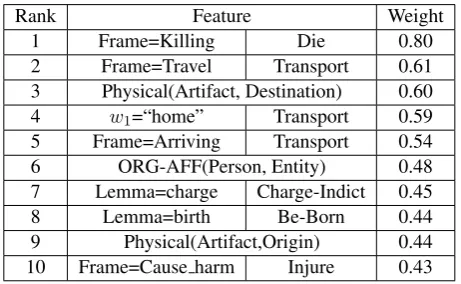
Rank Feature Weight
1 Frame=Killing Die 0.80 2 Frame=Travel Transport 0.61 3 Physical(Artifact, Destination) 0.60 4 w1=“home” Transport 0.59
[image:4.595.308.539.494.636.2]5 Frame=Arriving Transport 0.54 6 ORG-AFF(Person, Entity) 0.48 7 Lemma=charge Charge-Indict 0.45 8 Lemma=birth Be-Born 0.44 9 Physical(Artifact,Origin) 0.44 10 Frame=Cause harm Injure 0.43
Table 4: Top Features about Event Triggers.
Table 4 lists the weights of the most significant
features about event triggers. The 3rd, 6th, and
9th rows are joint relation-event features. For
in-stance, Physical(Artifact, Destination)means the
arguments of a Physical relation participate in a
and FrameNet based features are of vital impor-tance to event trigger labeling. We tested the im-pact of each type of features by excluding them in
the experiments of “MIRA w/L3loss”. We found
that FrameNet based features provided 0.8% and
2.2% F1 gains for event trigger and argument
la-beling respectively. Joint relation-event features
also provided 0.6% F1gain for relation extraction.
3.3.2 Remaining Challenges
Event trigger labeling remains a major bottleneck. In addition to the sparsity problem, the remain-ing errors suggest to incorporate external world knowledge. For example, some words act as trig-gers for some certain types of events only when they appear together with some particular argu-ments:
• “Williams picked up the child again and this time,threwAttackherout the window.”
The word “threw” is used as an Attack event
trigger because theVictimargument is a “child”.
• “Ellison to spend$10.3 billion togetMerge Org his company.” The common word “get” is
tagged as a trigger of Merge Org, because its
object is “company”.
• “We believe that the likelihood of them
usingAttackthoseweaponsgoes up.”
The word “using” is used as an Attack event
trigger because the Instrument argument is
“weapons”.
Another challenge is to distinguish physical and non-physical events. For example, in the sentence:
• “we are paying great attention to their ability to
defendAttackon the ground.”,
our system fails to extract “defend” as an Attack
trigger. In the training data, “defend” appears
mul-tiple times, but none of them is tagged asAttack.
For instance, in the sentence:
• “North Korea could do everything todefend it-self.”
“defend” is not anAttacktrigger since it does not relate to physical actions in a war. This challenge calls for deeper understanding of the contexts.
Finally, some pronouns are used to refer to ac-tual events. Event coreference is necessary to rec-ognize them correctly. For example, in the follow-ing two sentences from the same document:
• “It’s important that people all over the world know that we don’t believe in thewarAttack.”,
• “Nobody questions whether thisAttack is right or not.”
“this” refers to “war” in its preceding contexts.
Without event coreference resolution, it is difficult
to tag it as anAttackevent trigger.
4 Conclusions
We presented the first joint model that effectively extracts entity mentions, relations and events based on a unified representation: information networks. Experiment results on ACE’05 cor-pus demonstrate that our approach outperforms pipelined method, and improves event-argument performance significantly over the state-of-the-art. In addition to the joint relation-event features, we demonstrated positive impact of using FrameNet to handle the sparsity problem in event trigger la-beling.
Although our primary focus in this paper is in-formation extraction in the ACE paradigm, we be-lieve that our framework is general to improve other tightly coupled extraction tasks by capturing the inter-dependencies in the joint search space.
Acknowledgments
We thank the three anonymous reviewers for their insightful comments. This work was supported by the U.S. Army Research Laboratory under Coop-erative Agreement No. W911NF-09-2-0053 (NS-CTA), U.S. NSF CAREER Award under Grant IIS-0953149, U.S. DARPA Award No. FA8750-13-2-0041 in the Deep Exploration and Filtering of Text (DEFT) Program, IBM Faculty Award, Google Research Award, Disney Research Award and RPI faculty start-up grant. The views and con-clusions contained in this document are those of the authors and should not be interpreted as rep-resenting the official policies, either expressed or implied, of the U.S. Government. The U.S. Gov-ernment is authorized to reproduce and distribute reprints for Government purposes notwithstanding any copyright notation here on.
References
Collin F. Baker and Hiroaki Sato. 2003. The framenet data and software. InProc. ACL, pages 161–164.
Angel X. Chang and Christopher Manning. 2012. Su-time: A library for recognizing and normalizing time expressions. InProc. LREC, pages 3735–3740. Michael Collins and Brian Roark. 2004.
Incremen-tal parsing with the perceptron algorithm. InProc. ACL, pages 111–118.
Michael Collins. 2002. Discriminative training meth-ods for hidden markov models: Theory and experi-ments with perceptron algorithms. InProc. EMNLP, pages 1–8.
Johannes D¨olling. 2011. Aspectual coercion and even-tuality structure. pages 189–226.
Liang Huang, Suphan Fayong, and Yang Guo. 2012. Structured perceptron with inexact search. InProc. HLT-NAACL, pages 142–151.
Heng Ji and Ralph Grishman. 2008. Refining event ex-traction through cross-document inference. InProc. ACL.
Qi Li and Heng Ji. 2014. Incremental joint extraction of entity mentions and relations. InProc. ACL. Qi Li, Heng Ji, and Liang Huang. 2013. Joint event
extraction via structured prediction with global fea-tures. InProc. ACL, pages 73–82.
Ryan McDonald, Koby Crammer, and Fernando Pereira. 2005. Online large-margin training of de-pendency parsers. InProc. ACL, pages 91–98. Sebastian Riedel and Andrew McCallum. 2011. Fast
and robust joint models for biomedical event extrac-tion. InProc. EMNLP.
Sebastian Riedel, Hong-Woo Chun, Toshihisa Takagi, and Jun’ichi Tsujii. 2009. A markov logic ap-proach to bio-molecular event extraction. InProc. the Workshop on Current Trends in Biomedical Nat-ural Language Processing: Shared Task.
Dan Roth and Wen-tau Yih. 2007. Global inference for entity and relation identification via a lin- ear programming formulation. In Introduction to Sta-tistical Relational Learning. MIT.
Sameer Singh, Sebastian Riedel, Brian Martin, Jiap-ing Zheng, and Andrew McCallum. 2013. Joint inference of entities, relations, and coreference. In
Proc. CIKM Workshop on Automated Knowledge Base Construction.