A Multi-lingual Annotated Dataset
for Aspect-Oriented Opinion Mining
Salud Mar´ıa Jim´enez Zafra1, Giacomo Berardi2, Andrea Esuli2,
Diego Marcheggiani2, Mar´ıa Teresa Mart´ın-Valdivia1, Alejandro Moreo Fern´andez2 1Departamento de Inform´atica, Escuela Polit´ecnica Superior de Ja´en
Universidad de Ja´en, E-23071 - Ja´en, Spain {sjzafra, maite}@ujaen.es
2Istituto di Scienza e Tecnologie dell’Informazione “A. Faedo” Consiglio Nazionale delle Ricerche, I-56124 - Pisa, Italy
{firstname.lastname}@isti.cnr.it
Abstract
We present the Trip-MAML dataset, a Multi-Lingual dataset of hotel reviews that have been manually annotated at the sentence-level with Multi-Aspect senti-ment labels. This dataset has been built as an extension of an existent English-only dataset, adding documents written in Ital-ian and Spanish. We detail the dataset construction process, covering the data gathering, selection, and annotation. We present inter-annotator agreement figures and baseline experimental results, compar-ing the three languages. Trip-MAML is a multi-lingual dataset for aspect-oriented opinion mining that enables researchers (i) to face the problem on languages other than English and (ii) to the experiment the application of cross-lingual learning meth-ods to the task.
1 Introduction
Reviews of products and services that are sponta-neously produced by customers represent a source of unquestionable value not only for marketing strategies of private companies and organizations, but also for other users since their purchasing de-cisions are likely influenced by other customers’ opinions (Chevalier and Mayzlin, 2006).
Overall ratings (e.g., in terms of a five stars rat-ing scale), and also aspect-specific ratrat-ings (e.g., theCleanlinessorLocationof a hotel), are the typi-cal additional information expressed by customers in their reviews. Those ratings help to derive a number of global scores to facilitate a first screen-ing of the product or service at hand. Notwith-standing, users who pay more attention to a par-ticular aspect (e.g., theRoomsof a hotel) remain
constrained to manually inspect the entire text of reviews in order to find out the reasons other users argued in that respect. Methods for au-tomatic analysis of the aspect-oriented sentiment expressed in reviews would enable highlighting aspect-relevant parts of the document, so as to al-low users to perform a faster and focused inspec-tion of them.
Previous work on opinion mining (Pang and Lee, 2008) has already faced the overall sentiment prediction (Pang et al., 2002), multiple aspect-oriented analysis (Hu and Liu, 2004), and fine-grained phrase-level analysis (Wilson et al., 2009). Most of the available opinion mining datasets con-tain only documents written in English, as this lan-guage is the most used on the Internet and the one for which more NLP tools and resources are avail-able. (Hu and Liu, 2004) worked on the summa-rization of reviews by means of weakly supervised feature mining. (T¨ackstr¨om and McDonald, 2011) used a finer-grained dataset in which global po-larity annotation is applied also to each sentence composing the document. Similarly did (Socher et al., 2013) with the Stanford Sentiment Tree-bank, which annotates each syntactically plausi-ble phrase in thousands of sentences using anno-tators from Amazon’s Mechanical Turk, annotat-ing the polarity of phrases on a five-level scale. (Lazaridou et al., 2013) performed a single-label polarity annotation of elementary discourse units of TripAdvisor reviews, adopting ten aspect labels. (Marcheggiani et al., 2014) did a similar annota-tion work, using sentences as the annotaannota-tion ele-ments and adopting a multi-label polarity annota-tion, i.e., each sentence can be assigned to zero, one, or more than one aspect.
Cross-lingual sentiment classification (Wan, 2009; Prettenhofer and Stein, 2011) explores the scenario in which training data are available for
a language that is different from the language of the test documents. Cross-lingual learning meth-ods have important practical applications, since they allow to build classifiers for many languages reusing the training data produced for a single lan-guage (typically English), probably giving up a bit of accuracy, but compensating it with a large save in terms of human annotation costs.
Multi-lingual datasets are beneficial to the re-search community both as a benchmark to ex-plore cross-lingual learning and also as resources on which to develop and test new NLP tools for languages other than English. Prettenhofer and Stein (2010) used a multi-lingual dataset focused on full-document classification at the global po-larity level. Denecke (2008) used a dataset of 200 Amazon reviews in German to test cross-lingual document polarity classification using an English training set. Klinger and Cimiano (2014) pro-duced a bi-lingual dataset (English and German), named USAGE, in which aspect expressions and subjective expressions are annotated in Amazon product reviews. In (Klinger and Cimiano, 2014) aspect expressions can be any piece of text that mentions a relevant property of the reviewed en-tity (e.g.,washer, hose, looks) and are not categor-ical label, as in our dataset. The USAGE dataset is thus more oriented at information extraction rather than at text classification applications. Banea et al. (2010) used machine translation to create a multi-lingual version of the information-extraction ori-ented MPQA dataset (Wiebe et al., 2005) on six languages (English, Arabic, French, German, Ro-manian and Spanish).
In this paper we present Trip-MAML, which extends the Trip-MA1 dataset of Marcheggiani et
al. (2014) with Italian and Spanish annotated re-views. We describe Trip-MAML and report ex-periments aimed at defining a first baseline. Both the dataset and the software used in experiments are publicly available at http://hlt.isti. cnr.it/trip-maml/.
2 Annotation Process
We recall the annotation process adopted by Marcheggiani et al. (2014) for Trip-MA and the procedure we employed to extend it into Trip-MAML. We will use the national codes EN, ES, 1Marcheggiani et al. (2014) gave no name to their dataset, here we name it Trip-MA to identify its source and its multi-aspect nature.
and IT, to denote the English, Spanish, and Ital-ian parts of the Trip-MAML dataset, respectively. Note that EN coincides with Trip-MA.
2.1 English Reviews
The Trip-MA dataset was created by Marcheg-giani et al. (2014) by annotating a set of 442 reviews, written in English, randomly sampled from the publicly available TripAdvisor dataset of Wang et al. (2010), composed by 235,793 reviews. Each review comes with an overall rating on a dis-crete ordinal scale from 1 to 5 “stars”. The dataset was annotated according to 9 recurrent aspects fre-quently involved in hotel reviews: Rooms, Clean-liness, Value, Service, Location, Check-in, Business, Food, and Building. The last two are not officially rated by TripAdvisor but were added because they are frequently commented in reviews. Two “catch-all” aspects,OtherandNotRelated, were also added, for a total of 11 aspect. Aspect Other denotes opinions that are pertinent to the hotel being re-viewed, but not relevant to any of the former nine aspects (e.g., generic evaluations likePulitzer ex-ceeded our expectations). Aspect NotRelated de-notes opinions that are not related to the hotel (e.g.,Tour Eiffel is amazing).
If a sentence is relevant to an aspect, the possi-ble sentiment label values are three: Positive, Neg-ative, and Neutral/Mixed2. Neutral/Mixed annotates subjective evaluations that are not clearly polar-ized (e.g., The hotel was fine with some excep-tions).
2.1.1 Annotation protocol
Marcheggiani et al. (2014) relied on three human annotators to annotate each sentence of the 442 re-views with respect to polarities of opinions that are relevant to any of the 11 aspects. 73 reviews, out of 442, were independently annotated by all the annotators in order to measure the inter-annotator agreement, while the remaining 369 reviews were partitioned into 3 equally-sized sets, one for each annotator. Bias in the estimation of inter-annotator agreement was minimized by sorting the list of views of each annotator so that every eighth re-view was common to all annotators; this ensured that each annotator had the same amount of coding experience when labeling the same shared review.
# Reviews # Sentences # Opinion-laden sentences
EN 442 5799 4810
ES 500 2620 2400
IT 500 2593 2392
Table 1: Number of reviews, sentences, and sen-tences with at least one opinion annotation.
2.2 Spanish and Italian Reviews
For the creation of ES and IT parts of the Trip-MAML dataset we followed the same annotation protocol of Marcheggiani et al. (2014), employ-ing teams of three native speakers as annotators for each language. We crawled the Spanish and Italian reviews from TripAdvisor by accessing its websites with the ‘.es’ and ‘.it’ domains, which mostly contains reviews in the national language. From that domains we downloaded the reviews for the 10 most visited cities in Spain and Italy, respectively. We downloaded 10 reviews for ev-ery hotel of each city, obtaining a total of 17,020 reviews for Spanish and 33,325 for Italian. For each dataset, 500 reviews were selected by ran-domly sampling 50 reviews for each city. We thus obtained 139 unique reviews for each annotator, plus 83 reviews which all three annotators inde-pendently annotated.
We decided to annotate the aspects that were ratable on TripAdvisor at the time of our crawl (April 2015:Rooms,Cleanliness,Value,Service, Lo-cation, andSleep Quality). Differently from the as-pect schema in EN, we included the new asas-pect Sleep Quality, and we did not consider the miss-ing aspects Check-in and Businnes, which are, in any case, the least frequent aspects in the Trip-MA dataset (see Table 2). We kept the additional as-pectsFood,Building,Other, andNotRelated, as they still appear frequently in the reviews. We adopted the same 3-values sentiment label schema of EN, i.e.,Positive,Negative, orNeutral/Mixed.
Following the same procedure adopted by Marcheggiani et al. (2014), the Spanish and Ital-ian annotator teams performed a preliminary an-notation session on reviews not included in the fi-nal dataset. This preliminary activity was aimed at aligning the annotators’ understanding about the labeling process for the different aspects, by shar-ing and solvshar-ing any doubt that might arise durshar-ing the annotation of some examples.
2.3 Statistics
Table 1 shows that English reviews have, on av-erage, about double the number of sentences of Spanish and Italian reviews. This can be in part motivated by observing that the sentences in EN are, on average, 25% shorter than in ES and IT. Also, after a manual inspection of the data, we found that the EN part contains some reviews re-lated to long vacations in resorts, thus describ-ing in longer details the experience, while IT and ES reviews are mainly related to relatively short visits to classic hotels. However, the portion of opinionated sentences is similar across the three parts, indicating homogeneity in content, which is confirmed by the detailed aspect-level statistics re-ported in Table 2.
Both aspect and sentiment labels show imbal-anced distributions that follow similar distribu-tions across the three parts. The most frequent aspect in all collections is Other, followed by Rooms, Service, and Location. Building and Value are among the least frequent ones. The average value of the Pearson correlation between the lists of the shared aspects ranked by their relative fre-quency, measured pairwise among the three parts, is 0.795, which indicates a good uniformity of content among the parts. In all the three parts, Pos-itiveis the most frequent sentiment label, followed byNegative. Locationis always the aspect with the highest frequency of positive labels.
3 Inter-annotator Agreement
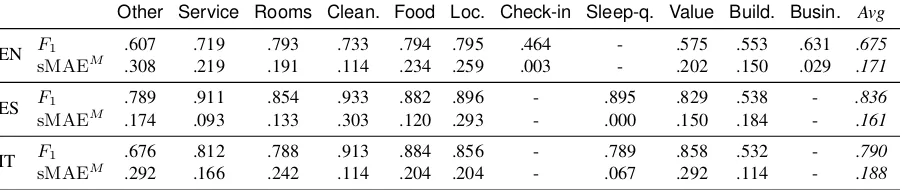
We measured the inter-annotator agreement in two steps. The F1 score measures the agreement on
aspect identification, regardless of the sentiment label assigned. Then symmetric Macro-averaged Mean Absolute Error (sMAEM) (Baccianella et
al., 2009) measures the agreement on sentiment labels on the annotations for which the annotators agreed at the aspect level. AspectNotRelatedis not included in agreement evaluation, nor in the ex-periments of Section 4. sMAEM is computed
be-tween each of the three possible pairs of annota-tors and then averaged to determine the agreement values reported in Table 3.
Other Service Rooms Clean. Food Loc. Check-in Sleep-q. Value Build. Busin. NotRelated Total
EN
Pos 893 513 484 180 287 435 93 - 188 185 23 63 3344
Neg 353 248 287 66 127 51 56 - 87 62 3 40 1377
Neu 167 40 111 5 82 38 12 - 35 22 4 350 866
Total 1413 801 882 251 496 524 161 - 310 269 30 453 5587
ES
Pos 634 382 275 181 128 452 - 126 114 71 - 39 2402
Neg 244 85 159 40 37 38 - 75 48 28 - 38 792
Neu 46 19 62 6 32 22 - 6 18 7 - 4 222
Total 924 486 496 227 197 512 - 207 180 106 - 81 3416
IT
Pos 582 415 267 259 207 389 - 103 135 77 - 50 2484
Neg 189 74 110 65 56 22 - 50 27 43 - 15 651
Neu 102 30 59 10 52 49 - 1 32 32 - 100 467
[image:4.595.77.524.74.221.2]Total 873 519 436 334 315 460 - 154 194 152 - 165 3602
Table 2: Number of opinion expressions at the sentence level of the datasets.
Other Service Rooms Clean. Food Loc. Check-in Sleep-q. Value Build. Busin. Avg
EN F1 .607 .719 .793 .733 .794 .795 .464 - .575 .553 .631 .675
sMAEM .308 .219 .191 .114 .234 .259 .003 - .202 .150 .029 .171
ES F1 .789 .911 .854 .933 .882 .896 - .895 .829 .538 - .836
sMAEM .174 .093 .133 .303 .120 .293 - .000 .150 .184 - .161
IT F1 .676 .812 .788 .913 .884 .856 - .789 .858 .532 - .790
sMAEM .292 .166 .242 .114 .204 .204 - .067 .292 .114 - .188
Table 3: Inter-annotator agreement.F1on sentence-level aspect identification (higher is better).sMAEM
on sentence-level sentiment agreement (only on matching aspects, lower is better).
there is, in general, a higher or equal agreement in ES and IT with respect to EN, indicating that the formers two were annotated in a more consistent way. The agreement on assignment of sentiment label is rather similar across the whole dataset.
4 Experiments
The experiments we present here are aimed at defining a shared baseline for future experiments. For this reason we chose a relatively simple setup that uses a simple learning model and minimal lin-guistic resources. We used a sentence-level Linear Chain (LC) Conditional Random Field (Lafferty et al., 2001) as described by Marcheggiani et al. (2014). With respect to the features extracted from text, we used three simple features types: word unigrams, bigrams, and SentiWordNet-based fea-tures, which consist of a Positive and a Negative feature extracted every time the review contains a word that is marked as such in SentiWordNet (Baccianella et al., 2010). To use SentiWord-Net on ES and IT, we used Multilingual Cen-tral Repository (Gonzalez-Agirre et al., 2012) and MultiWordNet (Pianta et al., 2002) to map senti-ment labels to Spanish and to Italian, respectively. Experiments were run separately on the EN, ES,
and IT parts, leaving cross-lingual experiments to future work. On each part we built five 70%/30% train/test splits, randomly generated by sampling the reviews annotated by single reviewers (we left out reviews annotated by all the reviewers, as we consider that part of the dataset more useful as a validation set for the optimization of methods tested in future experiments). We then run the five experiments and averaged their results.
4.1 Evaluation Measures
As for the agreement evaluation (Section 3), we split the evaluation of experiments into two parts, aspect detection and sentiment labeling. For the sentiment labeling part we used simple Macro-averaged Mean Absolute Error (MAEM, not the
symmetric version) as the true dataset labels are the reference ones in this case, while in the anno-tator agreement case the two sets of labels have equal importance.
4.2 Results
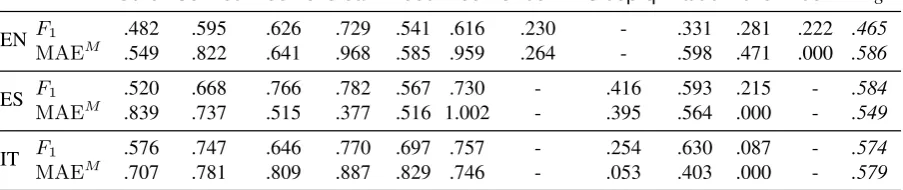
Experiments on ES and IT obtain betterF1values
[image:4.595.73.524.256.351.2]Other Service Rooms Clean. Food Loc. Check-in Sleep-q. Value Build. Busin. Avg
EN F1MAEM .482.549 .822.595 .641.626 .729 .541 .616.968 .585 .959 .230.264 -- .331 .281 .222.598 .471 .000 .586.465
ES F1MAEM .520.839 .737.668 .766.515 .782 .567 .730.377 .516 1.002 -- .416.395 .593 .215.564 .000 -- .584.549
[image:5.595.72.524.77.172.2]IT F1MAEM .576.707 .781.747 .646.809 .770 .697 .757.887 .829 .746 -- .254.053 .630 .087.403 .000 -- .574.579
Table 4: Linear Chain CRFs experiments. F1 on sentence-level aspect identification (higher is better). MAEM on sentence-level sentiment assignment (only on correctly identified aspects, lower is better).
and Italian.
MAEM values are all similar across languages,
again confirming what has been observed on agreement. However, MAEM values on
experi-ments are sensibly worse than those measured on agreement, possibly due to the fact that we used very basic features, with limited use of sentiment-related information.
5 Conclusion
We have presented Trip-MAML a multi-lingual extension of Trip-MA, originally presented in (Marcheggiani et al., 2014). The extension pro-cess involved crawling and selecting the reviews for the two new languages, Spanish and Italian, and their annotation by a total of six native lan-guage speakers. We measured dataset statistics and inter-annotator agreement, which show that the new ES and IT parts we produced are consis-tent with the original EN part. We also presented experiments on the dataset, based on a linear chain CRFs model for the automatic detection of aspects and their sentiment labels, establishing a baseline for future research. Trip-MAML enables the ex-ploration of cross-lingual approaches to the prob-lem of multi-aspect sentiment classification.
Acknowledgments
This work has been partially supported by ATTOS project (TIN2012-38536-C03-0) from the Spanish Government.
References
Stefano Baccianella, Andrea Esuli, and Fabrizio Sebas-tiani. 2009. Evaluation measures for ordinal re-gression. InProocedings of the 9th Conference on Intelligent Systems Design and Applications (ISDA 2009), pages 283–287.
Stefano Baccianella, Andrea Esuli, and Fabrizio Sebas-tiani. 2010. Sentiwordnet 3.0: An enhanced lexical resource for sentiment analysis and opinion mining. InLREC, volume 10, pages 2200–2204.
Carmen Banea, Rada Mihalcea, and Janyce Wiebe. 2010. Multilingual subjectivity: Are more lan-guages better? In Proceedings of the 23rd Inter-national Conference on Computational Linguistics, COLING ’10, pages 28–36, Stroudsburg, PA, USA. Association for Computational Linguistics.
Judith A Chevalier and Dina Mayzlin. 2006. The ef-fect of word of mouth on sales: Online book re-views. Journal of marketing research, 43(3):345– 354.
Kerstin Denecke. 2008. Using sentiwordnet for mul-tilingual sentiment analysis. In Data Engineering Workshop, 2008. ICDEW 2008. IEEE 24th Interna-tional Conference on, pages 507–512. IEEE. Aitor Gonzalez-Agirre, Egoitz Laparra, and German
Rigau. 2012. Multilingual central repository ver-sion 3.0. In Proceedings of the 8th International Conference on Language Resources and Evaluation (LREC 2012), pages 2525–2529.
Minqing Hu and Bing Liu. 2004. Mining and summa-rizing customer reviews. InProceedings of the Tenth ACM SIGKDD International Conference on Knowl-edge Discovery and Data Mining, KDD ’04, pages 168–177, New York, NY, USA. ACM.
Roman Klinger and Philipp Cimiano. 2014. The usage review corpus for fine-grained, multi-lingual opin-ion analysis. InProceedings of the Language Re-sources and Evaluation Conference (LREC), Reyk-javik, Iceland, May. ELRA.
John D. Lafferty, Andrew McCallum, and Fernando C. N. Pereira. 2001. Conditional random fields: Probabilistic models for segmenting and labeling sequence data. In Proceedings of the 18th Inter-national Conference on Machine Learning (ICML 2001), pages 282–289.
discourse representations. In Proceedings of the 51st Annual Meeting of the Association for Computational Linguistics (ACL 2013), pages 1630–1639.
Diego Marcheggiani, Oscar T¨ackstr¨om, Andrea Esuli, and Fabrizio Sebastiani. 2014. Hierarchical multi-label conditional random fields for aspect-oriented opinion mining. In Proceedings of the 36th Eu-ropean Conference on IR Research (ECIR 2014), pages 273–285.
Bo Pang and Lillian Lee. 2008. Opinion mining and sentiment analysis. Foundations and trends in infor-mation retrieval, 2(1-2):1–135.
Bo Pang, Lillian Lee, and Shivakumar Vaithyanathan. 2002. Thumbs up?: sentiment classification using machine learning techniques. InProceedings of the ACL-02 conference on Empirical methods in natural language processing-Volume 10, pages 79–86. As-sociation for Computational Linguistics.
Emanuele Pianta, Luisa Bentivogli, and Christian Gi-rardi. 2002. Multiwordnet: developing an aligned multilingual database. InProceedings of the first in-ternational conference on global WordNet, volume 152, pages 55–63.
Peter Prettenhofer and Benno Stein. 2010. Cross-language text classification using structural corre-spondence learning. InProceedings of the 48th An-nual Meeting of the Association for Computational Linguistics (ACL 2010), pages 1118–1127.
Peter Prettenhofer and Benno Stein. 2011. Cross-lingual adaptation using structural correspondence learning. ACM Transactions on Intelligent Systems and Technology (TIST), 3(1):13.
Richard Socher, Alex Perelygin, Jean Y Wu, Jason Chuang, Christopher D Manning, Andrew Y Ng, and Christopher Potts. 2013. Recursive deep mod-els for semantic compositionality over a sentiment treebank. In Proceedings of the conference on empirical methods in natural language processing (EMNLP 2013), volume 1631, page 1642.
Oscar T¨ackstr¨om and Ryan McDonald. 2011. Dis-covering fine-grained sentiment with latent variable structured prediction models. InProceedings of the 33rd European Conference on Advances in Informa-tion Retrieval (ECIR 2011), pages 368–374. Xiaojun Wan. 2009. Co-training for cross-lingual
sen-timent classification. In Proceedings of the Joint Conference of the 47th Annual Meeting of the ACL and the 4th International Joint Conference on Natu-ral Language Processing of the AFNLP: Volume 1-Volume 1, pages 235–243.
Hongning Wang, Yue Lu, and Chengxiang Zhai. 2010. Latent aspect rating analysis on review text data: A rating regression approach. In Proceedings of the 16th ACM SIGKDD International Conference on Knowledge Discovery and Data Mining (KDD 2010), pages 783–792.
Janyce Wiebe, Theresa Wilson, and Claire Cardie. 2005. Annotating expressions of opinions and emo-tions in language. Language resources and evalua-tion, 39(2-3):165–210.