S t o c h a s t i c
H P S G
Chris B r e w
Language Technology Group
HCRC, University of Edinburgh
2 Buccleuch Place
• Edinburgh EH8 9LW
Scotland, UK
email: C h r i s . Brew0edinburgh. ac. uk
A b s t r a c t
In this p a p e r we provide a probabilis- tic interpretation for t y p e d feature struc- tures very similar to those used by Pol- lard and Sag. We begin with a ver- sion of the interpretation which lacks a t r e a t m e n t of re-entrant feature struc- tures, then provide an extended interpre- tation which allows them. We sketch al- g o r i t h m s allowing the numerical p a r a m - eters of our probabilistic interpretations of H P S G to be estimated from corpora.
1
I n t r o d u c t i o n
T h e purpose of our p a p e r is to develop a princi- pled technique for a t t a c h i n g a probabilistic inter- pretation to feature structures. Our techniques apply to the feature structures described by Car- penter (Carpenter, 1992). Since these structures are the ones which are used in by Pollard and Sag (Pollard and Sag, 1994) their relevance to c o m p u t a t i o n a l g r a m m a r s is apparent. On the ba- sis of the usefulness of probabilistic context-free g r a m m a r s (Charniak, 1993, ch. 5), it is plausible to assume t h a t t h a t the extension of probabilistic techniques to such structures will allow the ap- plication of known and new techniques of parse ranking and g r a m m a r induction to more interest- ing g r a m m a r s t h a n has hitherto been the case.
T h e p a p e r is structured as follows. We start by reviewing the training and use of probabilis- tic context-free g r a m m a r s ( P C F G s ) . We then de: velop a technique to allow analogous probabilistic annotations on type hierarchies. This gives us a clear account of the relationship between a large class of feature structures and their probabilities, but does not treat re-entrancy. We conclude by sketching a technique which does treat such struc- tures. While we know of previous work which as- sociates scores with feature structures (Kim, 1994) are not aware of any previous t r e a t m e n t which makes explicit the link to classical probability the- ory.
We take a slightly unconventional perspective
on feature structures, because it is easier to cast our theory within the more general framework of incremental description refinement (Mellish, 1988) than to exploit the usual m e t a p h o r s of constraint-based g r a m m a r . In fact we can afford to remain entirely agnostic a b o u t the means by which the H P S G g r a m m a r associates signs with linguistic strings, because all that we need in or- der to train our stochastic procedures is a corpus of signs which are known to be valid descriptions of strings.
2
Probabilistic i n t e r p r e t a t i o n of
P C F G s
We review the standard probabilistic interpreta- tion of P C F G s 1
A P C F G is a four-tuple < W , N , N 1 , R > , where W is a Set of terminal symbols { w l , . . . , w~}, N is a set of non-terminal symbols { N 1 , . . . , N ~ } , N1 is the starting symbol and R is a set of rules of the form N ~ ~ (J, where (J is a string of terminals and non-terminals. Each rule has a probability P ( N i --~ ~J) and the prob- abilities for all the rules t h a t expand a given non- terminal m u s t sum to one. We associate probabil- ities with partial phrase markers, which are sets of terminal and non-terminal nodes generated by beginning from the starting node successively ex- panding non-terminal leaves of the partial tree. Phrase markers are those partial phrase markers which have no non-terminal leaves. Probabilities are assigned by the following inductive definition:
• P ( N 1 ) = 1.
• If T is a partial phrase marker, and T ' is a partial phrase marker which differs from it only in t h a t a single non-terminal node N k in T has been expanded to ~'~ in T ', then P(T') = P(T) × P(N~ ~ ~'~).
In this definition R acts as a specification of the accessibility relationships which can hold be- tween nodes of the trees a d m i t t e d by the g r a m - mar. T h e rule probabilities specify the cost of 1 Our description is closely based on that given by Charniak(Charniak, 1993, p. 52 if)
m a k i n g particular choices a b o u t the way in which the rules develop. It is going to turn out t h a t an exactly analogous system of accessibility rela- tions is present in the probabilistic t y p e hierar- chies which we define later.
L i m i t a t i o n s o f P C F G s T h e definition of P C F G s implies t h a t the probability of a phrase m a r k e r depends only on the choice of rules used in expanding non-terminal nodes. In particular, the probability does not depend on the order in which the rules are applied. This has the ar- guably unwelcome consequence t h a t P C F G s are unable to m a k e certain discriminations between trees which differ only in their configuration 2. T h e models developed in this paper build in simi- lar independence assumptions. A large p a r t of the art of probabilistic language modelling resides in the m a n a g e m e n t of the trade-off between descrip- tive power (which has the merit of allowing us to m a k e the discriminations which we want) and in- dependence a s s u m p t i o n s (which have the merit of m a k i n g training practical by allowing us to treat similar situations as equivalent).
T h e crucial a d v a n t a g e of P C F G s over C F G s is t h a t they can be trained a n d / o r learned from cor- pora. Readers for w h o m this fact is unfamiliar are referred to C h a r n i a k ' s t e x t b o o k (Charniak, 1993, C h a p t e r 7). We do not have space to recapitu- late the discussion of training which can be found there. We do however illustrate the outcome of training.
2.1 A p p l y i n g a P C F G t o a s i m p l e c o r p u s Consider the simple g r a m m a r in figure 1 and its training against the corpus in figure 2. Since there are 3 plural sentences and only 2 singular sen- tences, the o p t i m a l set of p a r a m e t e r s will reflect the distribution found in the corpus, as shown in figure 3 One m i g h t have hoped t h a t the ra- tio P(np-sing[np)/P(np-pl[np) would be 2/3, but it is instead V / - ~ . This is a consequence of the a s s u m p t i o n of independence. Effectively the algo- r i t h m is ascribing the difference in distribution of singular and plural sentences to the joint effect of two independent decisions. W h a t we would really like it to do is to recognize t h a t the two apparently independent decisions are (in effect) one and the same. Also, because the g r a m m a r has no means of enforcing n u m b e r agreement, the system sys- t e m a t i c a l l y prefers plurals to singulars, even when doing this will lead to agreement clashes. T h u s "buses stop" has e s t i m a t e d 0.55 x 0.55 = 0.3025, "bus stop" and "buses stops" b o t h have proba- bility 0.55 x 0.45 = 0.2475 and "bus stops" has p r o b a b i l i t y 0.45 x 0.45 = 0.2025. This behaviour is clearly u n m o t i v a t e d by the corpus, and arises
purely because of the inadequacy of the proba- bilistic model.
3
Probabilistic type
h i e r a r c h i e s
A L E s i g n a t u r e s C a r p e n t e r ' s ALE (Carpenter, 1993) allows the user to define the type hierarchy of a g r a m m a r by writing a collection of clauses which together denote an inheritance hierarchy, a set of features and a set of appropriateness condi- tions. An example of such a hierarchy is given in ALE s y n t a x in figure 4.W h a t t h e A L E s i g n a t u r e t e l l s u s T h e inher- itance information tells us t h a t a sign is a forced choice between a sentence and a phrase, t h a t a phrase is a forced choice between a noun-phrase (np) and a verb-phrase (vp) and t h a t n u m b e r val- ues (num) are partitioned into singular ( s i n g ) and plural (pl). T h e features which are defined are l e f t , r i g h t , and nura, and the appropriateness in- formation says t h a t the feature num introduces a new instance of the type num on all p h r a s e s , and t h a t l e f t and r i g h t introduce np and vp respec- tively on s e n t e n c e s .
T h e p a r a l l e l w i t h P C F G s T h e parallel which makes it possible to apply the P C F G training scheme almost unchanged is t h a t the sub-types of a given super-type partition the feature structures of t h a t type in just the same way t h a t the differ- ent rules which expand a given non-terminal N of the P C F G partition the space of trees whose top- m o s t node is N. Equally, the features defined in the hierarchy act as an accessibility relation be- tween nodes in a way which is for our purposes entirely equivalent to the way in which the right hand sides of the rules introduce new nodes into partial phrase markers 3. T h e hierarchy in figure 4 is related to but not isomorphic with the g r a m m a r in figure 1.
One difference is t h a t num is explicitly intro- duced as a feature in the hierarchy, where at is only implicitly present in the original g r a m m a r . T h e other difference is the use of l e f t and r i g h t as models of the dominance relationships between nodes.
4
A probabilistic interpretation of
typed feature-structures
For our purposes, a probabilistic t y p e hierarchy ( P T H ) is a four-tuple
< MT, NT, NT1, I >
bike c a r lorry bikes c a r s lorries stops stop
s ---* np vp
np --* np-sing I np-pl vp --* vp-sing I vp-pl
np-sing bus np-sing np-sing cat np-sing np-sing
np-pl buses np-pl np-pl cats np-pl np-pl
vp-sing crosses vp-sing vp-pl cross vp-pl
Figure 1: A simple g r a m m a r
car stops bikes stop
bus stops
cats cross
lorries stop
Figure 2." A simple corpus
P ( n p vpls ) = 1.0 P(np-singlnp ) = 0.45
P(np-pl[np) = 0.55 P(vp-sing[vp) = 0.45 P(vp-pllvp ) = 0.55
Figure 3: T h e results of training a P C F G
b o t s u b [ s i g n , n u m ] .
s i g n sub [ s e n t e n c e , p h r a s e ] .
sentence sub []
intro [left : np,right : vp]. phrase sub [np,vp]
intro [num:num] . np sub [].
vp sub [].
num sub [sing,pl]. sing sub []. pl sub [].
Figure 4: An ALE signature
NT1 is the s t a r t i n g s y m b o l and I is a set of in- troduction relationships of the form ( T ~ ~ TJ) ~k, where ~J is a multiset of m a x i m a l and non- m a x i m a l types. Each introduction relationship has a p r o b a b i l i t y P ( ( T i ~ TJ) --+ ~k) and the probabilities for all the introduction relationships t h a t apply to a given n o n - m a x i m a l t y p e m u s t s u m to one.
As things stand this definition is nearly isomor- phic to t h a t given for P C F G s , with the m a j o r dif- ferences being two changes which move us from rules to introduction relationships. Firstly, we relax the stipulation t h a t the items on the right hand side of the rules are strings, allowing t h e m instead to be multisets. Secondly, we introduce an additional t e r m in the head of introduction rules to signal the fact t h a t when we apply a partic- ular introduction relationship to a node we also specialize the t y p e of the node by picking exactly one of the direct s u b t y p e s of its current type. Fi- nally, we need to deal with the case where TJ is non-maximal. This is simply achieved by defin- ing the iterated introduction relationships f r o m T i as being those corresponding to the chains of in- troduction relationships from T i which refine the t y p e to a m a x i m a l type. In the probabilistic t y p e hierarchy, it is the iterated introduction relation- ships which correspond to the context-free rewrite rules of a P C F G . A useful side-effect of this is t h a t we can preserve the invariant t h a t all types except those at the fringe of the structure are maximal.
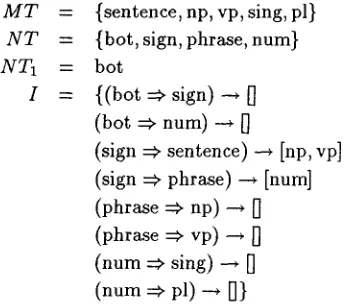
T h e hierarchy whose A L E s y n t a x is given in figure 4 is captured in the new notation by figure 5 We associate probabilities with feature struc- tures, which are sets of m a x i m a l and n o n - m a x i m a l nodes generated by beginning f r o m the start- ing node and successively expanding n o n - m a x i m a l leaves of the partial tree. Maximally specified lea- lure slruclures are those feature structures which have only m a x i m a l leaves. Probabilities are as- signed by the following inductive definition:
• P ( N T 1 ) = 1.
• If F is a feature structure, and F ' is a partial feature structure which differs from it only in t h a t a single n o n - m a x i m a l node N T k of t y p e To k in F has been refined to t y p e T1 k expanded to ~'~ in F ' , then P ( F ' ) = P ( F ) x P((TO :=~ T1) --+ ~'~).
Modulo notation, this definition is identical to the one given earlier for P C F G s . Given the corre- spondence between the definitions of a P T H and a P C F G it should be a p p a r e n t t h a t the training m e t h o d s which apply to one can equally be used with the other. We will shortly provide an exam- ple. Because we have not yet treated the crucial m a t t e r of re-entrancy, it would be i n a p p r o p r i a t e to call w h a t we so far have stochastic H P S G , so
4.1 U s i n g s t o c h a s t i c H P S G - w i t h t h e c o r p u s
Using the hierarchy in figure 4 the analyses of the five sentences from figure 2 are as in figure 6.
Training is a m a t t e r of counting the transitions which are found the observed results, then us- ing counts to refine initial estimates of the prob- abilities of particular transitions. This is entirely analogous to what went on with P C F G s . T h e re- sults of training are essentially identical to those given earlier, with the o p t i m a l assignment being as shown in figure 7. At this point we have pro- vided a system which allows us to use feature structures instead of P C F G s , b u t we have not yet dealt with the question of re-entrancy, which forms a crucial p a r t of the expressive power of t y p e d feature structures. We will return to this shortly, but first we consider the detailed implica- tions of what we have done so far. T h e similarities between these results and those in figure 3
• We still model the distribution observed in the corpus by assuming two independent de- cisions.
• We still get a strange ranking of the parses, which favours n u m b e r disagreement,in spite of the fact t h a t the g r a m m a r which generated the corpus enforces n u m b e r agreement. T h e differences between these results and the ear- lier ones are:
• T h e hierarchy uses b o t rather t h a n s as its s t a r t symbol. T h e probabilities tell us t h a t the corpus contains no free-standing struc- tures of type num.
• T h e zero probability of sign ~ phrase
codifies a similar observation t h a t there are no free-standing structures with t y p e p h r a s e . • Since items of t y p e phrase are never intro- duced at t h a t type, but only in the f o r m of sub-types, there are no transitions f r o m p h r a s e in the corpus. Therefore the initial estimates of the probabilities of such transi- tions are unaffected by training.
• In the P C F G the s y m m e t r y between the ex- pansions of np and vp to singular and plural variants is implicit, whereas in the P T H the distribution of singular and plural variants is encoded at a single location, namely t h a t at which num is refined.
M T =
N T =
N T 1 =
I =
{sentence, np, vp, sing, pl} {bot, sign, phrase, num} bot
{(bot :2z sign) --* (bot ::~ num) --+
(sign ::V sentence) --+ [np, vp] (sign =V phrase) --~ [num] (phrase ::~ np) --~ [] (phrase ::~ vp) ~ ]] (num =:~ sing) --* (num ::~ pl) --* []}
Figure 5: A more formal version of the simple hierarchy
L E F T
R I G H T vp
(2
occurrences)
L E F T
R I G H T vp
(3 occurrences).
op[N M sin ]l
vp[N M si g]]
op[N M
v [N M pl]J
Figure 6: Analyses of the corpus using the ALE-hierarchy
P ( b o t :=~ sign) = 1.0
P ( b o t =~num) = 0.0
P(sign ::~ sentence) = 1.0
P(sign =~ phrase) = 0.0
P(num==~ sing) = 0.45
P(num:=~ pl) = 0.55
P(phrase :=~ np) = A
P(phrase:=~vp) = 1 - A
Figure 7: The results of training the probabilistic type hierarchy
[image:5.596.79.254.73.227.2]• C l a r i t y : T h e decisions which we have m a d e lead to a s y s t e m with a clear probabilistic se- mantics.
• T r a i n a b i l i t y : the n u m b e r of p a r a m e t e r s which m u s t be estimated for a g r a m m a r is a linear function of the size of the type hierar- chy
• E a s y e x t e n s i b i l i t y : There is a clear route to a more finely grained account if we allow the expansion probabilities to be conditioned on surrounding context. This would increase the n u m b e r of p a r a m e t e r s to be estimated, which m a y or m a y not prove to be a problem.
5
A d d i n g re-entrancies
We now turn to an extension of the system which takes proper account of re-entrancies in the struc- ture. T h e essence of our approach is to define a stochastic procedure which simultaneously ex- pands the nodes of the tree in the way outlined above and guesses the p a t t e r n of re-entrancies which relate t h e m . It pays to stipulate t h a t the structures which we build are
fully inequated
in the sense defined by C a r p e n t e r (Carpenter, 1992, p120).T h e essential insight is t h a t the choice of a fully inequated feature structure involving a set of nodes is the s a m e thing as the choice of an a r b i t r a r y equivalence relation over these nodes, and this is in turn equivalent to the choice of a partition of the set of nodes into a set of non- e m p t y sets. These sets of nodes are equivalence classes. T h e s t a n d a r d reeursive procedure for gen- erating partitions of k + 1 elements is to non- deterministically add the k + l t h q node to each of the equivalence classes of each of the partitions of k nodes, and also to nondeterministically con- sider the new node as a singleton set. T h e basis of the stochastic procedure for generating fully- inequated feature structures is to interleave the generation of equivalence classes with the expan- sion f r o m the initial node as described above.
For the purposes of the expansion algorithm, a fully inequated feature structure consists of a fea- ture tree (as before) and an equivalence relation 5 over all the m a x i m a l nodes in t h a t tree. T h e task of the a l g o r i t h m is to generate all such structures and to equip t h e m with probabilities. We proceed as in the case without re-entrancy, except t h a t we only ever expand sub-trees in the case where the new node begins a new equivalence class. This avoids the double counting which was a problem earlier.
T h e remaining task is t h a t of assigning scores to equivalence relations. We do not have a fully sat- 5Since maximal types are mutually inconsistent,
isfactory solution to this problem. T h e reason for this is t h a t we would ideally like to assign prob- abilities to intermediate structures in such a way t h a t the probabilities of fully expanded structures are independent of the route by which they were arrived at. This can be done, and the m e t h o d which we adopt has the merit of simplicity.
5.1 S c o r i n g r e - e n t r a n c i e s
We associate a single probabilistic p a r a m e t e r
P(T=)
with each type T, and derive the probabil-ity of the structure in which a particular pairwise equation of-nodes in type T have been equated by multiplying the probability of the structure in which no decision has been m a d e by
P(T=).
We derive the probability of the corresponding in- equated structure by multiplying by 1 -P(T=)
in an entirely analogous way. This ensures t h a t the probabilities of the equated and inequated exten- sions of the original structure s u m to the origi- nal probability. The cost is a deficiency in m o d - elling, since this takes no account of the fact t h a t token identity of nodes is transitive, which are generated. As things stand the stochastic proce- dure is free to generate structures where nl ~ n2, n2 - n3 but nl 7~ n3, which are not in fact legal feature structures. This leads to distortions of the probability estimates since the training algorithm spends part of its probability mass on impossible structures.5.2 E v a l u a t i o n
6
C o n c l u s i o n s
We have presented two proposals for the associa- tion of probabilities with typed feature-structures of the form used in HPSG. As far as we know these are the most detailed of their type, and the ones which are most likely to be able to exploit stan- dard training and parsing algorithms. For typed feature structures lacking re-entrancy we believe our proposal to be the simplest and most natural which is available. The proposal for dealing with re-entrancy is less satisfactory but offers a basis for empirical exploration, and has definite advan- tages over the straightforward use of PCFGs. We plan to follow up the current work by training and testing a suitable instantiation of our framework against manually annotated corpora.
7 Acknowledgements
I acknowledge the support of the Language Tech- nology Group of the Human Communication Re- search Centre, which is a UK ESRC funded insti- tution.
R e f e r e n c e s
Bob Carpenter. 1992. The Logic of Typed Fea- ture Structures. Cambridge Tracts in Theoreti- cal Computer Science. CUP. With Applications to Unification Grammars, Logic Programs and Constraint Resolution.
Bob Carpenter, 1993. ALE. The Atlribule Logic Engine user's guide, version ~. Carnegie Mel- lon University, Pittsburgh, Pa., Laboratory for Computational Linguistics, MAY.
Eugene Charniak. 1 9 9 3 . Statistical Language Learning. The MIT Press.
Albert Kim. 1994. Graded unification: A frame- work for interactive processing. In Proceedings of the 32nd Annual Meeting of the Association for Computational Linguistics, pages 313-315, June.
C.S. Mellish. 1988. Implementing systemic classi- fication by unification. Computational Linguis- tics, 14(1):40-51. Winter.
Carl Pollard and Ivan A. Sag. 1 9 9 4 . Head- Driven Phrase Structure Grammar. CSLI and University of Chicago Press, Stanford, Ca. and Chicago, Ill.