A u t o m a t i c
P r o c e s s i n g
o f P r o p e r
N a m e s
i n T e x t s
Francis Wolinski I 2 Frantz Vichot I B r u n o D i l l e t 1
1 Informatique C D C 2 L A F O R I ACaisse des D@6ts et Consignations Universit~ de Paris VI
France France
E-mail: { wolinski,vichot,dillet } @icdc.fr
A b s t r a c t
This p a p e r shows first the problems raised by proper names in natural language processing. Second, it in- troduces the knowledge representation structure we use based on conceptual graphs. Then it explains the techniques which are used to process known and unknown proper names. At last, it gives the perfor- mance of the system and the further works we intend to deal with.
or unknown. Some of these techniques are taken out of existing systems but they have been uni- fied and completed in constructing this single oper- ational module. Besides some innovative techniques for desambiguating known proper names using the context have been implemented.
2
P r o b l e m s
r a i s e d
b y p r o p e r
n a m e s
i n N L P
1
I n t r o d u c t i o n
The Exoseme system [6, 7] is an operational applica- tion which continuously analyses the economic flow from Agence France Presse (AFP). AFP, which cov- ers the current economic life of the m a j o r industri- alised countries, t r a n s m i t s on average 400 dispatches per day on this flow. Their content is drafted in French in a journalistic style. Using this flow, Ex- oseme feeds various users concerning precise and varied subjects, for example, rating announcements, c o m p a n y results, acquisitions, sectors of activity, ob- servation of competition, partners or clients, etc. 50 such themes have currently been developed. T h e y rely on precise filtering of dispatches with highlight- ing of sentences for fast reading.
Exoseme is composed of several modules : a mor- phological analyser, a proper n a m e module, a syn- tactical analyser, a semantic analyser and a filtering module. The proper n a m e module has two goals : segmenting and categorising proper names. During the whole processing of a dispatch, the proper n a m e module is involved in three different steps. First, it segments proper names during the morphological analysis. Second, it categorises proper names dur- ing the semantic analysis. Third, it is invoked by the filtering module to supply some more informa- tion needed for routing the dispatch.
The proper n a m e module is based on different techniques which are used to detect and categorise proper names depending on whether they are known
In the A F P flow, proper names constitute a signif- icant part of the text. T h e y account for approxi- m a t e l y one third of noun groups and half the words used in proper names do not belong to the French vocabulary (e.g. family names, names of locations, foreign words). In addition, the n u m b e r of words used in constructing proper names is potentially in- finite.
The first step of the processing is segmentation, i.e. accurate cutting-up of proper names in the text; the second step is categorisation, i.e. the attribution to each proper n a m e of a conceptual category (indi- vidual, company, location, etc.). It should be noted t h a t segmentation and categorisation are processed differently depending on whether the proper n a m e is known or unknown.
ple, i n t h e s e n t e n c e The d i r e c t o r o f D o l l f u s , Mieg a n d C i e h a s a n n o u n c e d p o s i t i v e r e s u l t s , the anal- yser has difficulties in finding t h a t The d i r e c t o r is the subject of announce if it does not know the c o m p a n y D o l l f u s , Mieg and Cie. In the Exoseme process, the Sylex syntactical analyser [3] delegates the segmentation of these a g r a m m a t i c a l gaps to our proper name module.
Segmentation of known proper names has al- ready been studied and is treated in some systems such as N a m e F i n d e r [5]; segmentation of unknown proper na,nes based on p a t t e r n m a t c h i n g is imple- mented in several systems [1, 2, 4, 9]; the morpho- logical m a t c h i n g of acronyms is described in [11].
2.2
Categorisation of proper names
Once the segmentation has been achieved, categori- sation of proper names is necessary for the seman- tic analyse> Categorisation m a p s proper names into a set of concepts (e.g. h u m a n being, company, location). T h e very nature of proper names con- tributes widely to the understandin.g of texts. T h e semantic analyser m u s t be able to use the various categories of proper names as semantic constraints which are c o m p l e m e n t a r y for the understanding of texts. For example, in the filtering theme of acqui- sitions, the sentence E x p r e s s g r o u p i n t e n d s t o s e l l Le P o i n t f o r 700 MF indicates a sale of interests in the newspaper Le Point. Whereas the following sen- tence, which is g r a m m a t i c a l l y identical to the pre- ceding one, C o m p a g n i e d e s S i g n a u x i n t e n d s t o s e l l
T V M 4 3 0 f o r 700 MF indicates only a price for an industrial product.
Categorisation of unknown proper names has al- ready been studied as well. Particularly, categori- sation of unknown proper names is a u t o m a t i c a l l y acquired in p a t t e r n m a t c h i n g techniques quoted in previous section; rules using the context of proper names in order to categorise t h e m are also imple- mented in [2, 9].
In our system, these ontological categories are extended to attributes needed by the semantic anal- yser or the filtering module. For instance, proper names m a y have different attributes such as city, rating agencies, sector of activity, market, financial indexes, etc.
3
R e p r e s e n t a t i o n
o f
p r o p e r
n a m e s
We will see t h a t the proper n a m e module requires a large a m o u n t of information concerning proper names, their forms, their categories, their attributes, the words of which they are composed, etc. This in- f o r m a t i o n m u s t be able to be enriched in order to
include additional processes, and accessible in order to be shared by several processes. We use a repre- sentation system similar to conceptual graphs [10], the flexibility of which effectively gives expressive- ness, reusability and the possibility of further devel- opment. It enables indispensable and heterogeneous d a t a to be memorised and used in order to process proper names.
For a given proper name, its category and its var- ious attributes are directly represented in the form of a conceptual graph. For example, our knowledge base contains the graphs of Figure 1. This simple representation will be completed in the subsequent sections. We are going to show how each encoun- tered p r o b l e m uses the information of tile knowledge base and m a y add its own information to it.
T h e final result is a large knowledge base in- cluding 8,000 proper names sharing 10,000 fornas, based on 11,000 words. There are also 90 at- tributes of proper names or words. Each new filter- ing t h e m e m a y be a special case and its implemen- tation m a y lead to introduce additional attributes into the knowledge base. T h e adopted representa- tional f o r m a l i s m enables these additions to be m a d e without leading to substantial modifications of its structure.
4
P r o c e s s i n g
k n o w n
p r o p e r
n a m e s
Firstly, we recognise the proper names in which we are directly interested in order to allocate to t h e m attributes which are required for subsequent pro- cesses. We also seek to recognise the m o s t frequent proper names (e.g. country, cities, regions, states- men) in order to segment t h e m and categorise t h e m correctly.
4.1
Immediate recognition
T h e first idea which comes to mind is to memorise the proper names as they are encountered in the dispatches and to allocate to t h e m the attributes. All this information is stored in the knowledge base which contains, for e x a m p l e :
• ' ' N e w ' ' + ' ' Y o r k ' ' --* P N - ~ l o c a t i o n
• ' ~ S o c i 4 t 4 ' ' + ~ G 4 n 4 r a l e ' ' --+ P N - - + b a n k
• ' ~ S t a n d a r d ' ' + ~ a n d ' ~ + ' ' P o o r ' s ~ ' --~ P N --+ r a t i n g agency
I
PN
'Paris' I
I
PN
'City of Saint-Louis'
I PN 'Group Saint-Louis' 1
Figure 1: Representation of Proper Names
I PN 'Eridiana Beghin Say' ]
[ oompa~y I
I,oo~io~l
Figure 2: Words composing Proper Names
1
1
"Boris" ~followed_by)-~-~l-"Eltsine"
I PN 'Boris Eltsine' 1
[image:3.596.52.425.76.194.2] [image:3.596.50.426.233.428.2] [image:3.596.51.425.459.722.2]4 . 2 " E q u i v a l e n t " w o r d s
However, words lnaking up proper names accept. many slippages which result from abbreviat, ions, translation, common faults, etc. For example :
• S t a n d a r d a n d P o o r ' s :
S t a n d a r d a n d P o o r s , S t a n d a r d e t P o o r ' s
• S o c i ~ t ~ G ~ n ~ r a l e :
Soc. gen., St~ g ~ n ~ r a l e • B o r i s E l t s i n e :
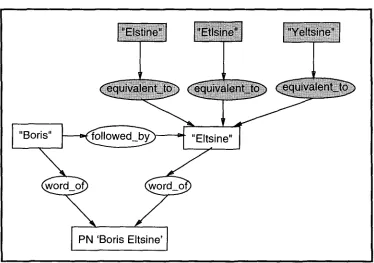
B o r i s Elstine, B o r i s Etlsine, B o r i s Y e l t s i n e
In order to avoid listing pointlessly all the forms that a proper name can take, through slippages of its words, certain variations in the recorded form are au- thorised. To this end, slippages in a given word are grouped around an "equivalent". This technique, which has been developed in the NameFinder sys- tem [5], under the term "alternative" words, enables to make a correspondence with different forms likely to appear.
Equivalent words are expressed in the knowledge base through a relationship. For example, our base contains the graph of Figure 3.
4.3
S y n o n y m o u s p r o p e r
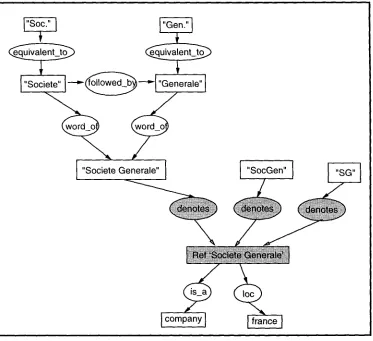
n a m e sHowever, one can use very different proper names to designate a given reality. For example, we can find simple synonyms such as Hexagone for France or Rue d ' A n t i n for Paribas. This notion is similar to alternative names in [5]. Dispatches also contain more or less complex transformations, that it can be difficult to derive from the standard form, such
a s NewYork a n d NY f o r New Y o r k , o r i n d e e d S e t P a n d
S - P o o r s for S t a n d a r d a n d P o o r ' s .
Once again, in order to avoid listing pointlessly the attributes for all the necessary proper names, the forms of synonymous proper names are grouped around a single reference to which the various at- tributes are allocated. This grouping enables the various references memorised to be represented, and their attributes to be factorised. The knowledge base is modified according to the enriched model showed in Figure 4.
4 . 4
D i s a m b i g u a t i n g p r o p e r
n a m e sWhen a user is interested in a given proper name, it is not sufficient to look for it through the dispatches since a simple selection on this name frequently pro- duces homonyms. Such interference, which is annoy- ing for users, reflects the limitations of traditional keyword systems. In the A F P flow, for example, the form S a i n t - L o u i s m a y designate equally well:
• the capital of Missouri,
• a french group in the food production industry,
• les Cristalleries de Saint Louis, • a small town in Bas-Rhin province, • an hospital in Paris,
The crucial problem posed is to succeed in dis- ambiguating this type of forms. Or, in other words, in determining, or at least in delimiting, the denoted reference.
4.4.1 D i s a m b i g u a t i n g t h r o u g h the local c o n - t e x t
Exploration of the local context using the proper name can in certain cases enable a choice to be made between these various references. If the text speaks of St-Louis ( M i s s o u r i ) , only the first interpretation will be adopted, if the knowledge base contains the information that S a i n t - L o u i s is in the United States, and if a rule is able to interpret the affixing of a parenthesis. We are currently working on this del- icate aspect in order to unify all the rules we have accumulated for resolving concrete cases. We are aware that these types of inference are comparable to the micro-theories of the Cyc project [8] in which the need for a great a m o u n t of information is the main thesis.
We will see in section 5.2.1 that the local con- text m a y categorise an unknown proper name and therefore it m a y help to desambiguate an ambigu- ous known proper name. For instance, if the text speaks of the mayor of S t - L o u i s , the company and hospital can certainly be ruled out.
4.4.2 D i s a m b i g u a t i n g t h r o u g h the global context
Abbreviations of proper names are another, much more frequent, source of ambiguities. Depending on the context, la G6n6rale m a y designate Soci~t~ G4n4rale, Compagnie G4n~rale des Eaux or indeed G4n~rale de Sucri~re. Similarly, acronyms, which are almost always c o m m o n to several proper names, constitute an extreme form of abbreviation. We thus discover from time to time new organisations which share the acronym CDC with Caisse des D ~ p 6 t s e t
Consignat ion.
Consequently, when there is an interest in an individual reference and the corpus has revealed homonyms, we record t h e m in the knowledge base. We link t h e m with the individual reference in order to be able to m a n a g e the ambiguities.
Nevertheless, when the ambiguity is unable to be removed, we choose the most frequent interpre- tation, but the user is told of the doubtful nature of our choice. In the dispatch title "Saint Louis: r e s u l t s up", for example, the proper n a m e Saint Louis is processed as the food production group, which is the most frequent ease, although it could equally well designate l e s C r i s t a l l e r i e s .
5
P r o c e s s i n g
u n k n o w n
p r o p e r
n a m e s
T h e preceding techniques tackled the problem of the variability of known proper names. However, al- though m a n y proper names a p p e a r frequently, oth- ers a p p e a r only once. Even if the constituted knowl- edge base is very comprehensive, it is absolutely'im- possible to record all potential proper names. We have therefore to deal with unknown proper names.
5.1
Prototypes of
p r o p e r n a m e sAs fully explained in [2], some proper names are con- structed according to prototypes which enable t h e m to be categorised through their appearance alone. For example :
• known-first-name + unknown-upcase-word --*
human being (e.g. Andr4 Blavier)
• unknown-upcase-word + company-legal-form
--+ company (e.g. K y o c e r a C o r p )
unknown-upcase-word + ~'-sur-'' + unknown-upcase-word--+location
(e.g. Cond&sur-Huisne)
Furthermore, certain categories of proper names accept traditional extensions which it is also possible to detect. For example :
• known-human-being + human-title --+
human being (e.g. K e n n e d y Jr)
• known-company + company-activity--+ company
(e.g. H o n d a Motor)
known-company + ' ' - ' ' + k n o w n - l o c a t i o n , --+
company (e.g. IBM-France)
• known-human-being + company-activity -~
company (e.g. Bernard Tapie Finance)
Lastly, such extensions m a y be combined,
e.g, "Siam Nissan Automobile Co Ltd" is probably a
subsidiary of
Nissan.These prototypes enable bot]~ to segment and categorise proper names. Of course, they do not constitute infallible rules (for example, Guy L a r o c h e is a c o m p a n y while its p r o t o t y p e makes one believe it is a h u m a n being) but they give correct results in a large m a j o r i t y of cases.
In order to use these prototypes, we build a rulebase for detecting and extending proper names. Moreover, we add some attributes to the existing words in our knowledge base (e.g. first names, legal c o m p a n y forms, c o m p a n y activities). For example, it contains the graph of Figure 5.
5.2
Other techniques of categorisa-
tion
Nevertheless, a p r o t o t y p e is not always enough to categorise a proper name. In particular, an isolated proper n a m e does not enable one to infer its category directly. For example, who can say simply on sight of the proper n a m e t h a t Peskine is an individual, Fibaly a c o m p a n y and Gisenyi a town ?
5.2.1 C a t e g o r i s a t i o n t h r o u g h t h e l o c a l c o n - t e x t
However, the text often contains elements enabling one to deduce the category of a proper n a m e [2]. To this end, rules using the local context give good results. For example :
,, apposition of an individual's position : Peskine, d i r e c t o r o f t h e group,
* n a m e c o m p l e m e n t typical of a c o m p a n y : the s h a r e h o l d e r s of Fibaly
• n a m e complement typical of a location : t h e m a y o r o f Gisenyi.
These rules once again require t h a t certain words from the knowledge base are m a r k e d by individual attributes. For example, the word "mayor" has both the following attributes :
• human-being-apposition :
(e.g. Chirac, m a y o r of the town)
• location-name-complement :
i "soc,ete" I--'-~-'-I"Geoera,e" I
I"Socie'~eoe,a'o" I
I "SocGen"
I
company
Figure 4: Synonymous Proper Names
- - ~
t,,Thomsoo,,1--~
I
"IBM C'~ ~
~~,Ref '~~romson'J
[image:6.596.167.540.76.417.2] [image:6.596.166.541.501.672.2]5.2.2 C a t e g o r i s a t i o n t h r o u g h t h e g l o b a l c o n - t e x t
However, the local context of a proper name does not necessarily enable one to infer its category. For in- stance, the mere radical of a proper name (e.g. fam- ily name, main company) is often used later in the text instead of the full name. The company Kyocera Corp, for example, may be designated by the single word Kyocera in the remainder of the text.
Consequently, for each unknown proper name, we look to see whether it does not appear in another proper name in the text. In this case, we estab- lish a link between these two proper names in order to transfer the attributes of the recognised proper name to this new proper name. However, one should always beware since different proper names some- times share the same radical : Mr Mitterand and Mrs Mitterand, or again Mr Bollor4 and Bollor6 Group. Although, in the most frequent cases, we resolve this well-known problem but as in [11] we do not have a general solution.
5.3 Matching acronyms
Acronyms occur frequently in A F P dispaches. On one hand, the linguistical construction of the cor- responding text of acronyms m a y be relatively com- plex. On the other hand, in some case, the relatively simple morphological construction of acronyms may be treated with a simple pattern matching with the corresponding text. Moreover, acronyms are widespread ambiguous forms of which it is unthink- able to list all cases and we have seen in section 4.4.2 that desambiguation of proper names needed to memorize all potential homonyms. Therefore, a process for dealing with acronyms will first seg- ment these unknown proper names and second de- sambiguate these potential homonylns.
In general, when an acronym is introduced in a text, its complete form is given using parentheses. For example :
• International Primary Aluminium Institute
(IPAI)
• AIEA (Agence Internationale de i' Energie
Atomique)
• Centre de recherche, d'~tudes et de
documentation en 4conomie de la sant~
(CREDES)
As observed in [11], it is possible to explore the local structure of the parentheses in order to de- termine whether the acronym corresponds to the complete form and, if so, the acronym and the full name are propagated throughout the remainder of the text. Some words (e.g. articles, prepositions)
may be j u m p e d when matching up acronyms and text. For example, the acronym SHF of Soci6t4 des B o u r s e s F r a n ~ a i s e s o m i t s t h e p r e p o s i t i o n " d e s " , while the acronym BDF of Banque de France keeps the "de". In order for our processing module to recog- nise these words, we allocate a special attribute to them in the knowledge base.
This simple and effective technique enables most of the acronyms introduced to be processed cor- rectly. Only foreign acronyms accompanied by their translation are not processed.
6
R e s u l t s a n d p r o s p e c t s
Built for an operationnal system which filters in real time A F P dispatches, we have presented the mod- ule for the automatic processing of proper names. This module unifies and completes known techniques which enable to segment and categorise proper names. Particularly, we have explained our inno- vative technique for disambiguating known proper names and its relationship with the techniques for categorising unknown proper names and for match- ing acronyms. Our system currently detects 90% of proper names in A F P dispatches and categorises 85% of them correctly. The full Exoseme pro- cess is undertaken in approximately 14 seconds per dispatch on a SUN SPARC 10, i.e. in 1,400 words/minute approximately.
We consider continuing with our work relating to the exploration of the local context (Cf. 4.4.1 and 5.2.1) in two complementary directions. From the grammatical point of view, our exploration of the context is incomplete. For example, we do not categorise the unknown proper name in a complex
case s u c h as Its Belgian subsidiary specialising in flat products Nokia. F r o m the semantic point
of view, we do not use all the contextual data. For example, the sentence The company a l r e a d y s e r v e s Houston, S a i n t - L o u i s and D a l l a s should be suffi- cient to disambiguate Saint-Louis. We are cur- rently accumulating examples in which the local con- text enables certain proper names to be categorised a n d / o r to be disambiguated. Our next step will con- sist in tightening cooperation with the following lay- ers in order to use the grammatical and semantic data they provide in the whole process.
A k n o w l e d g e m e n t s
R e f e r e n c e s
[1]
[2]
ANDERSEN P., HAYES P., HUETTNER A., SCHMANDT L.~ NIRENBURG I.~ WEINSTEIN S. 1992 Automatic Extraction from Press Re- leases to Generate News Stories, ANLP '92 COATES-STEPHEN S. 1992 The Analysis and Acquis~twn of Proper Names for Robust Text
Understanding, Ph.D. Department of Com-
put.er Science of City University, London, Eng- land
[3] CONSTANT P. 1991 Analyse syntaxique par couche, Th~se Tdldcom Paris, France
[4] JACOBS P., RAU L. 1993 Innovations in text interpretation, Artificial Intelligence 63 [5] HAYES PH. 1994 NameFinder : Software that
find names in Text, RIAO '94 New York [6] LANDAU M.-C., SILLION F., VICHOT F. 1993
Exoseme : A Thematic Document Filtering
System, Avignon '93
[7] LANDAU M.-C., SILLION F., VICHOT F. 1993 Exoseme : A Document Filtering System
Based on Conceptual Graphs, ICCS '93
[8] LENAT D., GUHA R. 1990 Building large Knowledge-based Systems : Representation and Inference in the Cye Project, Addison- Wesley
[9] McDONALD D. 1994 Trade-off Between Syn- tactic and Semantic Processing in the Com- prehension of Real texts, RIAO '94 New York [10] SOWA J. 1984 Conceptual Structures. In- formation Processing Mind and Machines,
Addison-Wesley
[11] WACHOLDER N., RAVIN Y., BYRD 1:~. 1994
Retrieving Information from Full Text Using