Large-scale Opinion Relation Extraction with Distantly Supervised
Neural Network
Changzhi Sun2, Yuanbin Wu1, 2, Man Lan1, 2,
Shiliang Sun1, 2, and Qi Zhang3
1Shanghai Key Laboratory of Multidimensional Information Processing 2Department of Computer Science and Technology, East China Normal University
3School of Computer Science, Fudan University
{changzhisun}@stu.ecnu.edu.cn {ybwu,mlan,slsun}@cs.ecnu.edu.cn
{qz}@fudan.edu.cn
Abstract
We investigate the task of open domain opinion relation extraction. Given a large number of unlabelled texts, we propose an efficient distantly supervised framework based on pattern matching and neural net-work classifiers. The patterns are de-signed to automatically generate training data, and the deep learning model is de-signed to capture various lexical and syn-tactic features. The result algorithm is fast and scalable on large-scale corpus. We test the system on the Amazon online review dataset, and show that the proposed model is able to achieve promising performances without any human annotations.
1 Introduction
Opinion mining systems aim to detect and ex-tract opinion-related information from texts. With the help of natural language processing algo-rithms and large-scale user generated contents, re-searchers could take a closer look at how peo-ple express their opinions on various objects and topics. Such observations are important both for applications (e.g., recommendation and retrieval) and linguistic studies.
In this paper, we address the task of opin-ion relatopin-ion extractopin-ion. The task tries to identify opinion expressions (words indicating sentiments, emotions and comments), opinion targets (objects of opinions) and their relations (what opinion on which target). The following are two examples.
1. The unit is [well designed] and [per-fect reception].
2. The Passion of The Christ will [touch your heart].
Opinion relations in the two sentences are (“well designed”, “unit”), (“perfect reception”, “unit”), and (“touch your heart”, “The Passion of The Christ”). Extracting opinion bearing relations is usually the first step towards fine-gained analysis of opinion in texts, and plays an important role in other sentiment related applications (e.g., senti-ment summarization). The goal of this paper is to extract opinion relations from open domain large-scale opinion bearing texts.
Previous works on fine-grained opinion infor-mation extraction have achieved notable success on many aspects: various domains were exam-ined (Pontiki et al., 2015), different types of re-lations were studied (Ganapathibhotla and Liu, 2008; Narayanan et al., 2009; Wu et al., 2011), and both supervised and unsupervised (pattern-based) algorithms were applied. But we have ob-served some difficulties when trying to use exist-ing methods. The pattern based methods (both lexical patterns and syntactic patterns) are simple, fast, and scalable on large-scale datasets. How-ever, the robustness of patterns is usually question-able in practice. For example, syntactic patterns are sensitive to errors in parse trees, which are common in user generated contents. Lexical pat-terns either have limited coverage (e.g., fixed set of patterns (Riloff and Wiebe, 2003)), or hard-to-control noise (e.g., bootstrapping approaches (Qiu et al., 2011)). On the other hand, supervised mod-els can achieve better performances than patterns on manually labeled datasets, but it is often diffi-cult to obtain large number of annotations for the relation extraction task, and the trained models are
also limited to specified domains. Thus, we still need an algorithm to better combine the power of syntactic and lexical patterns, while reduce man-ual annotations.
Another problem is that many existing systems rely on general purpose opinion lexicons to se-lect candidate relations. If an opinion expression is not recognized by the lexicon, the systems are unable to extract the related relations. As an ex-ample, one weakness of many existing lexicons is the lack of support on multiword expressions (e.g., “more than what I expected”, “honest to the book” and “adrenaline pumping”), which are common in opinion bearing texts. Another example is that some true expressions could be ignored either due to errors from POS taggers and syntactic parsers. Thus, to enlarge the coverage of opinion relation extraction, we need some method to better detect opinion expressions.
Regarding above problems, we make efforts to contribute to following aspects.
First, we propose a distantly supervised algo-rithm for open domain opinion relation extrac-tion. The algorithm first applies domain inde-pendent patterns to get a set of opinion relations, then trains a classifier on them. We show that, although the relations from pattern matching are not as accurate as gold standard annotations, the distantly supervised classifier still improves per-formances. Our algorithm significantly outper-forms the double propagation algorithm (Qiu et al., 2011), which is the state-of-the-art unsuper-vised opinion relation extraction system.
Second, we develop a neural network model to learn representations for lexical and syntactic con-texts. The model uses bidirectional LSTMs to cap-ture global information and convolutional neural networks to get local low dimensional feature em-beddings. Comparing with other neural network models on relation extraction, we learn representa-tions for different contexts explicitly, which is in-spired by features in traditional relation classifiers. Empirical results show that the proposed model outperforms a strong logistic regression baseline, which uses handcrafted features as state-of-the-art supervised relation classifiers.
Third, we explore an unsupervised classifier to detect multiword opinion expressions. Given an expression, the classifier looks adjacent words and predicts whether it is an opinion expression. The new classifier helps us to discover opinion
expres-sions which are not in general purpose opinion lex-icons, and benefits the relation extractor.
We aim to make all algorithms simple, fast and scalable for large-scale corpus. Our sys-tem is tested on Amazon review data which con-tains 15 different domains and 33 million reviews. The output database contains 72.5 million pairs of opinion relations. Extensive experiments have been conducted on various aspects of the algo-rithm, and the performances of the proposed un-supervised models are even competitive with pre-vious supervised models.
2 Related Works
Opinion relation extraction is an important task for fine-grained sentiment analysis. If human anno-tations are provided (e.g. MPQA corpus (Deng and Wiebe, 2015)), we could formulate the task into a supervised relation extraction problem as (Kobayashi et al., 2007; Johansson and Moschitti, 2013). Two types of models have been applied: pipeline models which first extract candidates of opinion expressions and targets then identify cor-rect relations (Wu et al., 2009; Li et al., 2010; Yang and Cardie, 2012), and joint models which extract opinion expressions, targets and relations using a unified joint model (Yang and Cardie, 2013; Yang and Cardie, 2014). One consideration of applying supervised methods is their dependen-cies on the domains and human annotations.
Semi-supervised and unsupervised models are also applied for extracting opinion relations. Ap-proaches include rule-based bootstrapping (Qiu et al., 2011), graph propagation algorithms (Xu et al., 2013; Liu et al., 2014; Brody and Elhadad, 2010), integer programming (Lu et al., 2011), and proba-bilistic topic models (Titov and McDonald, 2008; Mukherjee and Liu, 2012).
are investigated (Li et al., 2015; dos Santos et al., 2015). One similar network structure to our model is proposed in (Miwa and Bansal, 2016). They jointly extract entities and relations using two LSTM models. Another recent work (Jeb-bara and Cimiano, 2016) uses stacked RNNs and CNNs for aspect and opinion detection. Different from models there, we will learn representations for different lexical and syntactic features explic-itly. Our formulation follows the features in tradi-tional relation classifiers, which helps to interpret the learned vectors.
A closely related task is aspect-based opin-ion mining (Zhao et al., 2010; Yu et al., 2011; Wang et al., 2015). Instead of locating the opin-ion expressopin-ions, aspect-based opinopin-ion mining di-rectly analyzes polarities of different opinion tar-gets. The targets are usually constrained to be some predefined set. Shared tasks (SemEval2014, SemEval2015) have been held on the task, and various systems are proposed and evaluated (Pon-tiki et al., 2014; Pon(Pon-tiki et al., 2015). Comparing with aspect-based opinion mining, we will extract opinion expressions which are more informative, and we won’t constrain opinion target types which helps us to handle open domain texts.
3 The Approach
Given an input sentence s = w1, w2,· · · , wn,
where wi is a word, the opinion relation
ex-traction task outputs (O, T) pairs, where O = wi, wi+1, . . . , wj is an opinion expression, T =
wk, wk+1, . . . , wlis an opinion target and the pair
(O, T) is an opinion relation which asserts that opinion O is directed to target T 1. BothO and
T could be multiword expressions.
3.1 Patterns
Syntactic patterns have been shown to be effec-tive for relation extraction. They are fast and can generalize well across domains, which are highly desirable for the open domain large-scale relation extraction task. However, despite of their advan-tages, two concerns are often raised: syntactic trees could be unreliable due to noise in texts and parsing errors, and the coverage of patterns is lim-ited. To tackle the first problem, we deploy strong constraints on patterns in order to guarantee the quality of output. For the second problem, we
en-1We assumeO, T are non-overlapped, and their distance
insis less than a threshold (10in all experiments).
large the coverage by using a distantly supervised classifier (Section 3.2) and an opinion expression classifier (Section 3.3)
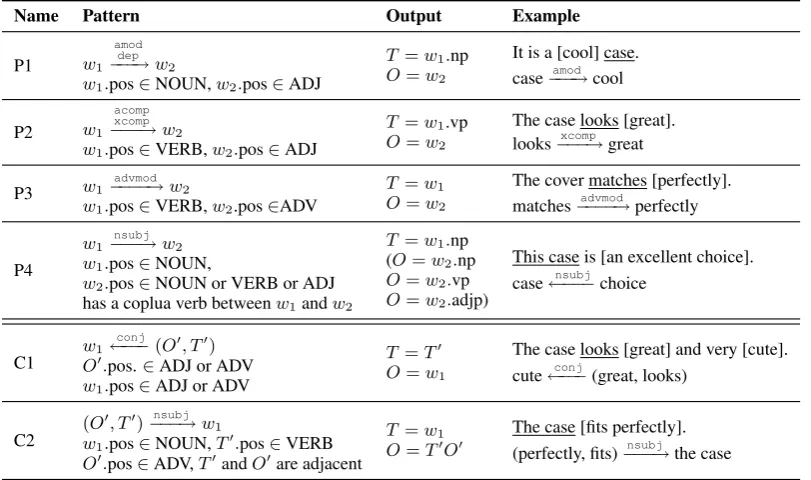
Table 1 lists the patterns used in our system. Like (Qiu et al., 2011), patterns are based on the dependency tree of input sentences, which ba-sically capture adjective-noun, verb-complement and adverb-verb relations. The notationw1−→l w2 denotes that there is a dependency relation be-tween wordw1 andw2 with dependency relation typel. For example, the pattern P1 is activated if
w1is the parent ofw2in the dependency tree, and the dependency type isamodordep.
In order to overcome noise and errors in depen-dency trees, we constrain all patterns by prede-fined part-of-speech (POS) tag sets and a general purpose opinion lexiconL. For example, the pat-tern P1 only accepts nouns and adjectives as ar-guments, and the adjectives are required to be an opinion word inL.
We also design the patterns to be able to handle multiword opinion expressions and targets (about 30% of all annotated expressions). Two cases are considered here. First, when two words match a pattern, we expand them to the smallest phrases containing them. It helps to collect some lo-cal contexts of opinion relations. For example, in pattern P4, the matching words “case” and “choice” are expanded to “the case” and “an ex-cellent choice”. Second, a relation pair could be compiled to a new opinion expression, which may have relations with other opinion targets. For ex-ample, in pattern C2, (“perfectly”, “fit”) is a re-lation, and it can be compiled into “fit perfectly” which appears in a new relation (“fit perfectly”, “the case”). The compiled expressions can bring more informative relations which are ignored in previous works.
Name Pattern Output Example
P1 w1
amod dep
−−−→w2
w1.pos∈NOUN,w2.pos∈ADJ
T =w1.np O=w2
It is a [cool] case. case−−−→amod cool
P2 w1
acomp xcomp
−−−→w2
w1.pos∈VERB,w2.pos∈ADJ
T =w1.vp O=w2
The case looks [great]. looks−−−→xcomp great
P3 w1−−−−→advmod w2
w1.pos∈VERB,w2.pos∈ADV
T =w1 O=w2
The cover matches [perfectly]. matches−−−−→advmod perfectly
P4
w1−−−→nsubj w2 w1.pos∈NOUN,
w2.pos∈NOUN or VERB or ADJ has a coplua verb betweenw1andw2
T =w1.np (O=w2.np O=w2.vp O=w2.adjp)
This case is [an excellent choice]. case←−−−nsubj choice
C1 w1
conj
←−−−(O′, T′)
O′.pos.∈ADJ or ADV
w1.pos∈ADJ or ADV
T =T′
O=w1
The case looks [great] and very [cute]. cute←−−−conj (great, looks)
C2 (O
′, T′)−−−→nsubj w
1
w1.pos∈NOUN,T′.pos∈VERB O′.pos∈ADV,T′andO′are adjacent
T =w1
[image:4.595.98.504.63.303.2]O=T′O′ The case [fits perfectly].(perfectly, fits)−−−→nsubj the case
Table 1: Syntactic patterns in the system. We denote POS tag sets: NOUN ={NN, NNS}, VERB ={VB, VBD, VBN, VBP, VBZ}, ADJ ={JJ, JJR, JJS}, ADV ={RB, RBR, RBS}.wi.pos is the POS tag ofwi.wi.np (wi.vp,wi.adjp)
is the smallest noun (verb, adjective) phrase containingwi(returnwiif no such phrase exists).T, T′are opinion targets,O, O′
are opinion expressions. “(O′, T′)→” and “←(O′, T′)” represent dependency relations on wordsO′andT′respectively.
3.2 Distant Supervision
Despite of the high precision, one well-known disadvantage of pattern-based methods is the low coverage. Consider the following example,
Ordered the k9ballistics Crate Pad and I am [so pleased].
No pattern in Table 1 is applicable on relation (“so pleased”, “Ordered the k9ballistics Crate Pad”), although it could be inferred from the context. In fact, the two expressions are close in distance, and “Ordered the k9ballistics Crate Pad ” is the only possible object of “please” in the sentence. Many similar cases appear in online review corpus which downgrade the performance of patterns. To fur-ther explore those relations, we develop distantly supervised classifiers to integrate various lexical and syntactic contexts. Our experiments show that classifiers help to increase coverage of patterns by 20%.
Given a candidate relation x = (O, T)
in sentence s, the classifier outputs probability
p(y|x), y ∈ {1,−1} telling whether x is a valid opinion relation. Since manually labelled corpus are costly and difficult to obtain for open domains, we would prefer unsupervised classifiers. On the other side, the pattern matching can generate a set of opinion relations without any human
annota-tions. Although the relations are not completely correct, they are almost free to collect and easily amount to a large set. Thus, we can take the re-lations from the pattern matching as the distant supervision, and hope the broad coverage could overcome the noise.
Formally, we take all relations extracted by pat-terns as positive samples. For each positive sam-ple(O, T), we add a negative sample(O, T′)for T′ ̸= T (T′ is NP, VP or ADJP). Similarly, we
add negative samples(O′, T)for all O′ ̸=O. At
test time, we consider all VP and ADJP inswhich contain at least one word in the general opinion lexiconLas candidate opinion expressions, all NP and VP as candidate opinion targets, and all possi-ble pairs between them are candidate relations.
... biLSTM
w1 wi-1 wi ... wj wj+1 ... wk-1 wk ... wl wl+1 ... wn
biLSTM biLSTM biLSTM biLSTM
CNN CNN CNN CNN CNN
O B T R
L
hL hO hB hT hR
D wp1
wp2 wp3
wp4 biLSTM
[image:5.595.80.524.60.211.2]hD
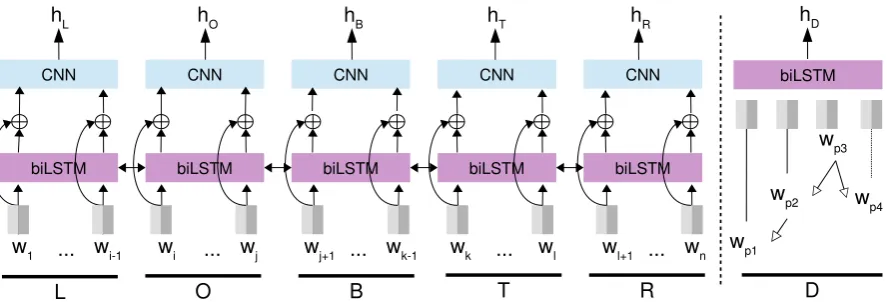
Figure 1: Representation learning of lexical and syntactic contexts. The left hand side is the five CNNs and the sentence level biLSTM for lexical contexts. For a wordw, operator “⊕” concatenates word/POS embeddings ofwand the output vectors of the biLSTM on w. The right hand side is the biLSTM for syntactic contexts. wp1, . . . , wp4is the dependency pathD,wp3 is the lowest common ancestor of head words ofOandT.
O = wi, . . . , wj, T = wk, . . . , wl, denote other
parts of s to be L = w1, . . . , wi−1, B =
wi+1, . . . , wk−1, R = wl+1, . . . , wn, whereL, R
are the left and right contexts ofx, B is the con-text betweenOandT 2. LetD = wp1, . . . , wpm
be the path connecting head words ofO andT in the dependency tree.
To capture lexical contexts of x, we use five convolutional neural networks (CNN) to learn rep-resentations forL, O, B, T, R. TakeB as an ex-ample, the outputhB∈Rdis the result of a single
layer convolution of inputs with max-pooling. The input of the CNN includes word and POS tag em-beddings ofwi+1, . . . , wk−1. The five local CNN models can be independently trained before mak-ing the final predictions, however, it ignores global information of the sentence, and also the poten-tial sharing of features among local models. In or-der to incorporate global structures, we build the five local models on top of a sentence level bidi-rectional long short term memory network (biL-STM). The recurrent structure and memory mech-anism of biLSTM can propagate and share long distance features of s. We take outputs of mem-ory cells as inputs of the CNN models (in ad-dition to the embeddings). All representations
hL,hO,hB,hT,hR use the same network
struc-ture in our experiments. Finally, to make a pre-diction ony, we use a softmax functionp(y|x) =
1
Zexp{θ⊺Φ(x, y)}on the weighted averaged
fea-2For simplicity, we assumeOappears beforeT. In the
implementation, an indicator dimension is set to identify whetherOappears first.
ture vectorΦ(x, y),
Φ(x, y) =aLhL+aOhO+aBhB+aThT
+aRhR,
where aL, aO, aB, aT, aR ∈ R, θ ∈ Rd are
pa-rameters of the model.
We also try to incorporate dependency pathD
into the model as suggested by (Xu et al., 2015a; Xu et al., 2015b). We use a similar bidirectional LSTM like (Xu et al., 2015b), and concatenate the final outputs of the forward LSTM and the back-ward LSTM to get feature representation hD ∈
Rd. The experiments show that, however, h D
can not get further performance gains. We sus-pect that the errors from dependency parsing lim-ited the contribution of this feature.
3.3 Opinion Expression Classifier
In above pattern matching and distant supervision algorithms, a candidate opinion expression is ex-tracted if it contains at least one opinion word in the general purpose opinion lexiconL. Although the simple approach helps to handle multiword ex-pressions, some expressions could also be ignored since they have no opinion words inLor their POS tags are wrongly assigned. In this section, we in-troduce our unsupervised opinion expression clas-sifier, which predicts whether a phrase is an opin-ion expressopin-ion based on its contexts.
Formally, for a candidate expression O = wi, . . . , wj in sentence s, we use context words
wi−c, . . . , wi−1andwj+1, . . . , wj+cas inputs of a
we set it to 5 in all experiments). After the con-volution layer, max-pooling and softmax (similar to the CNNs in Section 3.2), the classifier outputs probability p(z|O) where z ∈ {−1,1} indicates whetherO is a valid opinion expression. In order to get the training set, we rely on the lexicon L. Given the unlabelled corpus andw ∈ L, we con-sider each appearance ofwin the corpus as a posi-tive example, and other randomly chosen words as negative examples.
To apply the opinion expression classifier in the opinion relation classifier, we add expressions which havep(z|O)greater than some thresholdγ
to the relation classifier. 4 Experiments 4.1 Configurations
We extract opinion relations on a subset of Ama-zon product review corpus provided by (McAuley et al., 2015), which contains 15 domains and 33 million reviews. The statistics of extracted rela-tions are in Table 2.
For quantitative evaluation, we select four do-mains (Cell Phones, Movie and TV, Food, Pet Supplies) for detailed analyses. We manually la-bel all correct opinion relations in1000sentences, and select200sentences as the development set, the rest800as the test set3. Furthermore, to
com-pare with previous supervised methods, we also conduct experiments on USAGE corpus (Klinger and Cimiano, 2014) which annotates 4481 opinion relations for 8 products.
We use NLTK (Bird et al., 2009) for sentence splitting and word segmentation, Stanford parser
4 for getting POS tags, phrase chunks and
depen-dency trees, and scikit-learn toolkit (Pedregosa et al., 2011) and TensorFlow5 for machine learning
algorithms. The general purpose opinion lexicon is from (Wilson et al., 2005).
4.2 Main Results
Table 4 shows results on four domains. The meth-ods for comparison are:
• Adjacentis a simple baseline system from (Hu and Liu, 2004). It first identifies words in the general purpose opinion lexicon, then finds the nearest noun or verb phrase to them as their opinion targets.
3https://github.com/AntNLP/OpinionRelationCorpus 4http://nlp.stanford.edu/software/lex-parser.shtml 5https://www.tensorflow.org/
Domain #Reviews #Sents #Relations
Cell Phones 3.4 19.1 6.7
Movie and TV 4.6 47.6 15.3
Food 1.3 7.6 2.5
Pet Supplies 1.2 8.0 2.4
Automotive 1.4 9.5 2.6
Digital Music 0.8 7.3 2.4
Beauty 2.2 6.4 3.8
Toys and Games 2.3 11.7 3.8
Instruments 0.5 13.5 1.4
Office Products 1.2 4.1 2.6
Patio 1.0 8.3 2.0
Baby 0.9 6.5 1.8
Clothing 5.7 29.1 10.2
Sports 3.3 20.2 7.1
Kindle 3.2 25.0 7.9
All 33 223.9 72.5
Table 2: Statistics of the opinion relation database. The relations are extracted by patterns in Table 1 and normalized by removing leading articles, pro-nouns and copulas of opinion expressions and tar-gets. All numbers are in106.
• Bootstrappingreimplements the double propa-gation in (Qiu et al., 2011), which is the state-of-the-art unsupervised opinion relation extraction algorithm. It also uses a set of patterns, but adds new opinion words discovered by the patterns to the existing lexicon on the fly. The updated lexicon is then used in following bootstrapping iterations.
• Patternis the pattern matching method in Sec-tion 3.1.
• LRis a logistic regression trained with the same distant supervision as Section 3.2. We use standard relation extraction features (Table 3), which are used in state-of-the-art supervised re-lation classifiers (Mintz et al., 2009)6.
• NNis our neural network model in Section 3.2. We set the dimensiondof outputs (e.g.,hB) be
128, the output dimension of biLSTM be 128, the dimension of word/POS tag embeddings be
300. We use three convolution kernels with win-dow size 1, 2, 3, and initialize word embeddings with pre-trained word vectors from word2vec tools7. By default, we use the five CNNs on the
sentence level biLSTM and not include depen-dency pathhD and the opinion expression
clas-sifier (the configuration of “NN” equals “biL-STM+LOBTR” in Table 5). In order to build
Lexical Features 1
⃝POS tag sequences ofOandT. 2
⃝The length ofOandT. 3
⃝The distance betweenOandT. 4
⃝The word sequence betweenOandTins. 5
⃝POS tags of words betweenOandTins. 6
⃝Words, POS tags ofwi−1,wi−2,wj+1,wj+2. 7
⃝Words, POS tags ofwk−1,wk−2,wl+1,wl+2. 8
⃝Combined POS tags ofOandT. Syntactic Features
9
⃝Does a dependency relation exist betweenOandT. 10
⃝The dependency path betweenOandT. 11
⃝The length of the dependency path.
Table 3: Features in logistic regression.
the training set, we run the pattern matching on
6×10⁴unlabelled sentences.
• NN+Pattern stacks results of “Pattern” and “NN”.
We have several observations on Table 4. First, performances of “Adjacent” are poor, which means that we do need some advanced linguistic features for the task. Second, “Bootstrapping” un-derperforms “Pattern” in four domains. We exam-ine the outputs of “Bootstrapping” and find that the newly added words bring a lot of noise into the opinion lexicon, which affect the accuracy nega-tively. Third, while “Pattern” has the highest pre-cision in all systems, distantly supervised meth-ods (“LR” and “NN”) help to improve recall and achieve better F1 values (except on the Pet do-main). Hence, based on the distant supervision from patterns, classifiers cover more correct rela-tions. Regarding the Pet domain, the precision of “Pattern” is low, so the number of errors in training set of “LR” and “NN” is large, and one could fail to learn reliable models. Fourth, the neural net-work model “NN” outperforms traditional classi-fier “LR” on all domains, which shows that learn-ing feature representations has some advantages than handcrafting features on our experiment set-tings. Finally, simply stacking the results of “Pat-tern” and “NN” can improve the overall scores.
Next, we test our neural network model with various settings in Table 5. First, we com-pare models with different configurations on CNNs in row 1 to row 3. The setting “biL-STM+B” only uses the CNN corresponding to the words in B (i.e., the words between O and
T); “biLSTM+OBT” uses three CNN on words inB, O, T; “biLSTM+LOBTR” involves all five CNNs (equals to “NN” in Table 4). We see
that, in general, the performances (especially re-calls) increase as we introduce more CNNs. How-ever, the dependency path feature hD
(“biL-STM+LOBTR+D” in row 4) won’t help to get fur-ther improvements. Second, in row 5, we drop the sentence level biLSTM and only use the five CNNs, and observe some loss on performances compared with row “biLSTM+LOBTR”. Hence, the long distance information provided by the biL-STM is also helpful. Third, we test the opinion ex-pression classifier in the last two rows. Recall that
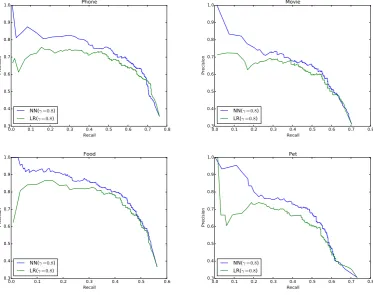
γ is the threshold that controls the output of the classifier. The result shows that when γ = 0.8, new opinion expressions added by the classifier can improve the scores, but when γ = 0.5, the noise can overwhelm the gains. We futher show the precision-recall curves of “NN” and “LR” in the case of γ = 0.8 in Figure 2. Some inter-esting opinion expressions added by the classi-fier are “not even enough”, “became extremely hot”, “*just* enough”, “arrived damaged”, “looks cool n cute”, which shows that the classifier could both discover opinion expressions without words in general purpose lexicons, and have some toler-ance to noise.
4.3 Results on USAGE Corpus
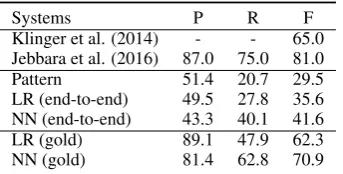
In order to compare with fully supervised meth-ods, we evaluate our models on USAGE corpus in Table 6. To build the distantly supervised mod-els, we use untagged reviews which are about the 8 products of USAGE. The baseline systems are (Klinger and Cimiano, 2014) and (Jebbara and Cimiano, 2016), which are state-of-the-art sys-tems on the dataset.
Results show that, with the same setting (“gold”)8, our fully unsupervised models achieve
competitive precision scores against previous fully supervised methods. By examining the outputs, one reason for the performance gaps on recall may be the differences of annotation guidelines be-tween USAGE and our dataset. For example, we don’t annotate pronouns as opinion targets while USAGE does (e.g., (“love”, “it”) is a proper an-notation in USAGE). We can also observe that distant supervisions provide notable performances gains than direct pattern matching.
8Both baselines don’t report end-to-end performances. As
System Phone Movie Food Pet
P R F P R F P R F P R F
Adjacent 38.6 65.7 48.6 30.0 58.8 39.7 31.4 46.5 37.5 28.4 62.2 39.0 Bootstrapping 44.0 62.9 51.8 26.9 49.3 34.8 43.6 54.0 48.2 33.6 57.7 42.5 Pattern 69.4* 64.4 61.1 62.2* 42.4 50.4 76.0* 41.9 54.1 59.9* 51.3 55.3∗ LR 60.1 64.7 62.4 55.6 57.0 55.3 65.5 49.2∗ 56.2 47.6 59.3* 52.8
[image:8.595.91.510.212.325.2]NN 63.4 67.9∗ 65.6∗ 56.8 58.2∗ 57.5* 70.5 47.7 56.9∗ 51.4 58.0 54.5 NN+Pattern 64.4 70.5 67.3 58.2 59.9 59.1 68.4 50.8 58.3 54.9 58.2 56.5
Table 4: Comparison with different baseline systems. The dark entries are the highest scores among all systems, and “*” indicates the highest scores excluding “NN+Pattern”.
System Phone Movie Food Pet
P R F P R F P R F P R F
biLSTM +B 59.8 69.5 64.3 54.7 59.1 56.8 64.8 48.5 55.5 47.4 57.2 51.8 biLSTM +OBT 63.4 66.7 65.3 59.8 58.2 58.9 68.6 46.8 55.6 56.2 56.9 56.5 biLSTM +LOBTR 63.4 67.9 65.6 56.8 58.2 57.5 66.5 47.7 55.5 51.4 58.0 54.5 biLSTM +LOBTR+D 65.5 61.3 63.4 59.5 55.8 57.6 69.1 46.8 55.8 54.9 57.7 56.3 LOBTR 64.0 65.3 64.7 57.5 56.7 57.1 70.6 43.1 53.5 54.3 57.7 55.9
γ= 0.5 64.2 64.7 64.5 56.2 57.9 57.0 65.5 45.5 53.7 61.6 54.3 57.7 γ= 0.8 65.6 66.1 65.9 61.1 58.2 59.6 67.1 48.2 56.1 58.6 50.8 54.4
Table 5: Different settings of the proposed model.
0.0 0.1 0.2 0.3 0.4 0.5 0.6 0.7 0.8
Recall 0.3
0.4 0.5 0.6 0.7 0.8 0.9 1.0
Precision
Phone
NN(γ=0.8)
LR(γ=0.8)
0.0 0.1 0.2 0.3 0.4 0.5 0.6 0.7 0.8
Recall 0.3
0.4 0.5 0.6 0.7 0.8 0.9 1.0
Precision
Movie
NN(γ=0.8)
LR(γ=0.8)
0.0 0.1 0.2 0.3 0.4 0.5 0.6
Recall 0.3
0.4 0.5 0.6 0.7 0.8 0.9 1.0
Precision
Food
NN(γ=0.8)
LR(γ=0.8)
0.0 0.1 0.2 0.3 0.4 0.5 0.6 0.7 0.8
Recall 0.3
0.4 0.5 0.6 0.7 0.8 0.9 1.0
Precision
Pet
NN(γ=0.8)
LR(γ=0.8)
Figure 2: Precision recall curves forγ = 0.8.
4.4 Error Analysis
Finally, we do some error analyses on the ex-tracted relations. Taking movie domain as exam-ple, we find that for movie reviews, the opinions
[image:8.595.110.484.370.665.2]Systems P R F Klinger et al. (2014) - - 65.0 Jebbara et al. (2016) 87.0 75.0 81.0
Pattern 51.4 20.7 29.5
[image:9.595.97.269.62.149.2]LR (end-to-end) 49.5 27.8 35.6 NN (end-to-end) 43.3 40.1 41.6 LR (gold) 89.1 47.9 62.3 NN (gold) 81.4 62.8 70.9
Table 6: Results on USAGE corpus. First two rows are state-of-the-art systems on the dataset. Both of them assume gold annotations on opin-ion expressopin-ions and targets have been given. We report results with identical settings (“gold”), and also “end-to-end” results in which no gold annota-tions are provided.
in “Also said repeatedly how Tojo was [loyal to Emperor Hirohito]”, the word “loyal” indicates a wrong opinion relation since it’s a description of the story. A true comment from the reviewer is behind the word “repeatedly”, which is hard to be expressed with our opinion relations. We plan to introduce both more background knowledge and more powerful relation types in future work.
5 Conclusion
We investigate the task of large-scale opinion re-lation extraction. Our algorithm first uses syntac-tic patterns to get a set of opinion relations, then builds a neural network classifier based on these relations. We also develop an opinion expression classifier to better extract opinion words. Exten-sive experiments on Amazon review data show the effectiveness of the proposed methods.
6 Acknowledgements
The authors wish to thank the reviewers for their helpful comments and suggestions. This research is supported by NSFC (61402175, 61473092) and STCSM (15ZR1410700, 14DZ2260800). Yuan-bin Wu is supported by Microsoft Research Asia Collaborative Research Program. The correspond-ing authors are Yuanbin Wu, Man Lan and Shil-iang Sun.
References
Steven Bird, Ewan Klein, and Edward Loper. 2009.
Natural Language Processing with Python: An-alyzing Text with the Natural Language Toolkit. O’Reilly.
Samuel Brody and Noemie Elhadad. 2010. An unsu-pervised aspect-sentiment model for online reviews. In Human Language Technologies: The 2010 An-nual Conference of the North American Chapter of the Association for Computational Linguistics, pages 804–812, Los Angeles, California, June. As-sociation for Computational Linguistics.
Lingjia Deng and Janyce Wiebe. 2015. Mpqa 3.0: An entity/event-level sentiment corpus. In Proceed-ings of the 2015 Conference of the North Ameri-can Chapter of the Association for Computational Linguistics: Human Language Technologies, pages 1323–1328, Denver, Colorado, May–June. Associa-tion for ComputaAssocia-tional Linguistics.
Cicero dos Santos, Bing Xiang, and Bowen Zhou. 2015. Classifying relations by ranking with con-volutional neural networks. InProceedings of the 53rd Annual Meeting of the Association for Compu-tational Linguistics and the 7th International Joint Conference on Natural Language Processing (Vol-ume 1: Long Papers), pages 626–634, Beijing, China, July. Association for Computational Linguis-tics.
Murthy Ganapathibhotla and Bing Liu. 2008. Mining opinions in comparative sentences. InProceedings of the 22nd International Conference on Computa-tional Linguistics (Coling 2008), pages 241–248. Minqing Hu and Bing Liu. 2004. Mining and
summa-rizing customer reviews. InProc. of SIGKDD, pages 168–177.
Soufian Jebbara and Philipp Cimiano. 2016. Aspect-based relational sentiment analysis using a stacked neural network architecture. InECAI, pages 1123– 1131.
Richard Johansson and Alessandro Moschitti. 2013. Relational features in fine-grained opinion analysis.
Computational Linguistics, 39(3):473–509.
Roman Klinger and Philipp Cimiano. 2014. The US-AGE review corpus for fine grained multi lingual opinion analysis. In Proceedings of the Ninth In-ternational Conference on Language Resources and Evaluation (LREC-2014), pages 2211–2218. Nozomi Kobayashi, Kentaro Inui, and Yuji Matsumoto.
2007. Extracting evaluation and aspect-of relations in opinion mining. In Proceedings of the 2007 Joint Conference on Empirical Meth-ods in Natural Language Processing and Com-putational Natural Language Learning (EMNLP-CoNLL), pages 1065–1074, Prague, Czech Repub-lic, June. Association for Computational Linguis-tics.
Jiwei Li, Thang Luong, Dan Jurafsky, and Eduard Hovy. 2015. When are tree structures necessary for deep learning of representations? In Proc. of EMNLP, pages 2304–2314.
Kang Liu, Liheng Xu, and Jun Zhao. 2014. Extracting opinion targets and opinion words from online re-views with graph co-ranking. InProceedings of the 52nd Annual Meeting of the Association for Compu-tational Linguistics (Volume 1: Long Papers), pages 314–324, Baltimore, Maryland, June. Association for Computational Linguistics.
Yue Lu, Mal´u Castellanos, Umeshwar Dayal, and ChengXiang Zhai. 2011. Automatic construction of a context-aware sentiment lexicon: an optimization approach. InProc. of WWW, pages 347–356. Julian J. McAuley, Rahul Pandey, and Jure Leskovec.
2015. Inferring networks of substitutable and com-plementary products. In Proceedings of the 21th ACM SIGKDD International Conference on Knowl-edge Discovery and Data Mining, Sydney, NSW, Australia, August 10-13, 2015, pages 785–794. Mike Mintz, Steven Bills, Rion Snow, and Daniel
Ju-rafsky. 2009. Distant supervision for relation ex-traction without labeled data. InProceedings of the Joint Conference of the 47th Annual Meeting of the ACL and the 4th International Joint Conference on Natural Language Processing of the AFNLP, pages 1003–1011, Suntec, Singapore, August. Association for Computational Linguistics.
Makoto Miwa and Mohit Bansal. 2016. End-to-end re-lation extraction using lstms on sequences and tree structures. InProceedings of the 54th Annual Meet-ing of the Association for Computational LMeet-inguis- Linguis-tics (Volume 1: Long Papers), pages 1105–1116, Berlin, Germany, August. Association for Compu-tational Linguistics.
Arjun Mukherjee and Bing Liu. 2012. Aspect extrac-tion through semi-supervised modeling. In Proceed-ings of the 50th Annual Meeting of the Association for Computational Linguistics (Volume 1: Long Pa-pers), pages 339–348, Jeju Island, Korea, July. As-sociation for Computational Linguistics.
Ramanathan Narayanan, Bing Liu, and Alok Choud-hary. 2009. Sentiment analysis of conditional sen-tences. In Proceedings of the 2009 Conference on Empirical Methods in Natural Language Process-ing, pages 180–189, Singapore, August. Association for Computational Linguistics.
F. Pedregosa, G. Varoquaux, A. Gramfort, V. Michel, B. Thirion, O. Grisel, M. Blondel, P. Pretten-hofer, R. Weiss, V. Dubourg, J. Vanderplas, A. Pas-sos, D. Cournapeau, M. Brucher, M. Perrot, and E. Duchesnay. 2011. Scikit-learn: Machine learn-ing in Python. JMLR, 12:2825–2830.
Maria Pontiki, Dimitris Galanis, John Pavlopoulos, Harris Papageorgiou, Ion Androutsopoulos, and
Suresh Manandhar. 2014. Semeval-2014 task 4: Aspect based sentiment analysis. InProceedings of the 8th International Workshop on Semantic Evalu-ation (SemEval 2014), pages 27–35.
Maria Pontiki, Dimitris Galanis, Haris Papageorgiou, Suresh Manandhar, and Ion Androutsopoulos. 2015. Semeval-2015 task 12: Aspect based sentiment anal-ysis. InProceedings of the 9th International Work-shop on Semantic Evaluation (SemEval 2015), pages 486–495.
Guang Qiu, Bing Liu, Jiajun Bu, and Chun Chen. 2011. Opinion word expansion and target extraction through double propagation. Computational Lin-guistics, 37(1):9–27.
Ellen Riloff and Janyce Wiebe. 2003. Learning extrac-tion patterns for subjective expressions. In Michael Collins and Mark Steedman, editors,Proceedings of the 2003 Conference on Empirical Methods in Nat-ural Language Processing, pages 105–112.
Rion Snow, Daniel Jurafsky, and Andrew Y. Ng. 2004. Learning syntactic patterns for automatic hypernym discovery. InNIPS, pages 1297–1304.
Ivan Titov and Ryan McDonald. 2008. A joint model of text and aspect ratings for sentiment summariza-tion. InProceedings of ACL-08: HLT, pages 308– 316, Columbus, Ohio, June. Association for Com-putational Linguistics.
Ngoc Thang Vu, Heike Adel, Pankaj Gupta, and Hin-rich Sch¨utze. 2016. Combining recurrent and con-volutional neural networks for relation classifica-tion. In Proceedings of the 2016 Conference of the North American Chapter of the Association for Computational Linguistics: Human Language Tech-nologies, pages 534–539, San Diego, California, June. Association for Computational Linguistics.
Linlin Wang, Kang Liu, Zhu Cao, Jun Zhao, and Ger-ard de Melo. 2015. Sentiment-aspect extraction based on restricted boltzmann machines. In Pro-ceedings of the 53rd Annual Meeting of the Associ-ation for ComputAssoci-ational Linguistics and the 7th In-ternational Joint Conference on Natural Language Processing (Volume 1: Long Papers), pages 616– 625, Beijing, China, July. Association for Computa-tional Linguistics.
Theresa Wilson, Janyce Wiebe, and Paul Hoffmann. 2005. Recognizing contextual polarity in phrase-level sentiment analysis. In Proceedings of Hu-man Language Technology Conference and Confer-ence on Empirical Methods in Natural Language Processing, pages 347–354, Vancouver, British Columbia, Canada, October. Association for Com-putational Linguistics.
Empirical Methods in Natural Language Process-ing, pages 1533–1541, Singapore, August. Associ-ation for ComputAssoci-ational Linguistics.
Yuanbin Wu, Qi Zhang, Xuanjing Huang, and Lide Wu. 2011. Structural opinion mining for graph-based sentiment representation. InProceedings of the 2011 Conference on Empirical Methods in Nat-ural Language Processing, pages 1332–1341, Edin-burgh, Scotland, UK., July. Association for Compu-tational Linguistics.
Liheng Xu, Kang Liu, Siwei Lai, Yubo Chen, and Jun Zhao. 2013. Mining opinion words and opinion tar-gets in a two-stage framework. InProceedings of the 51st Annual Meeting of the Association for Compu-tational Linguistics (Volume 1: Long Papers), pages 1764–1773, Sofia, Bulgaria, August. Association for Computational Linguistics.
Kun Xu, Yansong Feng, Songfang Huang, and Dongyan Zhao. 2015a. Semantic relation classifi-cation via convolutional neural networks with sim-ple negative sampling. InProceedings of the 2015 Conference on Empirical Methods in Natural Lan-guage Processing, pages 536–540, Lisbon, Portugal, September. Association for Computational Linguis-tics.
Yan Xu, Lili Mou, Ge Li, Yunchuan Chen, Hao Peng, and Zhi Jin. 2015b. Classifying relations via long short term memory networks along shortest depen-dency paths. In Proceedings of the 2015 Confer-ence on Empirical Methods in Natural Language Processing, pages 1785–1794, Lisbon, Portugal, September. Association for Computational Linguis-tics.
Bishan Yang and Claire Cardie. 2012. Extracting opinion expressions with semi-markov conditional random fields. In Proceedings of the 2012 Joint Conference on Empirical Methods in Natural guage Processing and Computational Natural Lan-guage Learning, pages 1335–1345, Jeju Island, Ko-rea, July. Association for Computational Linguistics. Bishan Yang and Claire Cardie. 2013. Joint infer-ence for fine-grained opinion extraction. In Pro-ceedings of the 51st Annual Meeting of the Associa-tion for ComputaAssocia-tional Linguistics (Volume 1: Long Papers), pages 1640–1649, Sofia, Bulgaria, August. Association for Computational Linguistics.
Bishan Yang and Claire Cardie. 2014. Joint modeling of opinion expression extraction and attribute classi-fication. Transactions of the Association of Compu-tational Linguistics, 2:505–516.
Jianxing Yu, Zheng-Jun Zha, Meng Wang, Kai Wang, and Tat-Seng Chua. 2011. Domain-assisted prod-uct aspect hierarchy generation: Towards hierarchi-cal organization of unstructured consumer reviews. In Proceedings of the 2011 Conference on Empiri-cal Methods in Natural Language Processing, pages 140–150, Edinburgh, Scotland, UK., July. Associa-tion for ComputaAssocia-tional Linguistics.
Daojian Zeng, Kang Liu, Yubo Chen, and Jun Zhao. 2015. Distant supervision for relation extraction via piecewise convolutional neural networks. In Pro-ceedings of the 2015 Conference on Empirical Meth-ods in Natural Language Processing, pages 1753– 1762, Lisbon, Portugal, September. Association for Computational Linguistics.
Dongxu Zhang and Dong Wang. 2015. Relation clas-sification via recurrent neural network.CoRR. Xin Zhao, Jing Jiang, Hongfei Yan, and Xiaoming Li.