Proceedings of NAACL-HLT 2019, pages 3693–3704 3693
Document-Level
N
-ary Relation Extraction with Multiscale
Representation Learning
Robin Jia1∗ Cliff Wong2 Hoifung Poon2
1 Stanford University, Stanford, California, USA
2 Microsoft Research, Redmond, Washington, USA
[email protected], {cliff.wong,hoifung}@microsoft.com
Abstract
Most information extraction methods focus on binary relations expressed within single sen-tences. In high-value domains, however,n-ary relations are of great demand (e.g., drug-gene-mutation interactions in precision oncology). Such relations often involve entity mentions that are far apart in the document, yet exist-ing work on cross-sentence relation extraction is generally confined to small text spans (e.g., three consecutive sentences), which severely limits recall. In this paper, we propose a novel multiscale neural architecture for document-level n-ary relation extraction. Our system combines representations learned over various text spans throughout the document and across the subrelation hierarchy. Widening the sys-tem’s purview to the entire document maxi-mizes potential recall. Moreover, by integrat-ing weak signals across the document, multi-scale modeling increases precision, even in the presence of noisy labels from distant super-vision. Experiments on biomedical machine reading show that our approach substantially outperforms previousn-ary relation extraction methods.
1 Introduction
Knowledge acquisition is a perennial challenge in AI. In high-value domains, it has acquired new urgency in recent years due to the advent of big data. For example, the dramatic drop in genome sequencing cost has created unprecedented oppor-tunities for tailoring cancer treatment to a tumor’s genetic composition (Bahcall,2015). Despite this potential, operationalizing personalized medicine is difficult, in part because it requires painstaking curation of precision oncology knowledge from biomedical literature. With tens of millions of pa-pers on PubMed, and thousands more added every
∗
Work done as an intern at Microsoft Research.
“We next expressedALKF1174L,ALKF1174L/L1198P,
ALKF1174L/G1123S, andALKF1174L/G1123Din the original SH-SY5Y cell line.”
(. . . 15 sentences spanning 3 paragraphs . . . )
“The 2 mutations that were only found in the neurob-lastoma resistance screen (G1123S/D) are located in the glycine-rich loop, which is known to be crucial for ATP and ligand binding and are the first mutations de-scribed that induce resistance to TAE684, but not to
PF02341066.”
Figure 1: Two examples of drug-gene-mutation re-lations from a biomedical journal paper. The rela-tions are expressed across multiple paragraphs, requir-ing document-level extraction.
day,1we are sorely in need of automated methods to accelerate manual curation.
Prior work in machine reading has made great strides in sentence-level binary relation extraction. However, generalizing extraction to n-ary rela-tions poses new challenges. Higher-order relarela-tions often involve entity mentions that are far away in the document. Recent work onn-ary relation traction has begun to explore cross-sentence ex-traction (Peng et al.,2017;Wang and Poon,2018), but the scope is still confined to short text spans (e.g., three consecutive sentences), even though a document may contain hundreds of sentences and tens of thousands of words. While this al-ready increases the yield compared to sentence-level extraction, it still misses many relations. For example, in Figure1, the drug-gene-mutation re-lations between PF02341066, ALK, G1123S(D)
(PF02341066 can treat cancers with mutation G1123S(D)in geneALK) can only be extracted by substantially expanding the scope. High-value in-formation, such as latest medical findings, might only be mentioned once in the corpus.
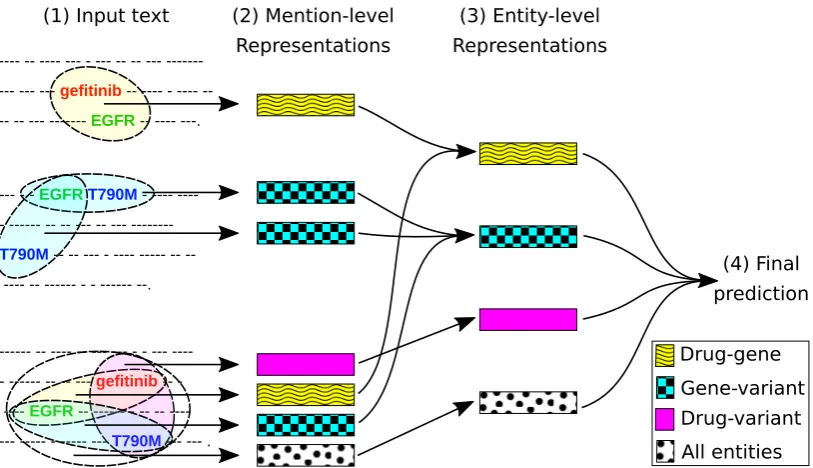
ing recall is thus of paramount importance. In this paper, we propose a novel multiscale neural architecture for document-leveln-ary rela-tion extracrela-tion. By expanding extracrela-tion scope to the entire document, rather than restricting rela-tion candidates to co-occurring entities in a short text span, we ensure maximum potential recall. To combat the ensuing difficulties in document-level extraction, such as low precision, we introduce multiscale learning, which combines representa-tions learned over text spans of varying scales and for various subrelations (Figure2). This approach deviates from past methods in several key regards. First, we adopt an entity-centric formulation by making a single prediction for each entity tuple occurring in a document. Previous n-ary rela-tion extracrela-tion methods typically classify individ-ual mention tuples, but this approach scales poorly to whole documents. Since each entity can be mentioned many times in the same document, ap-plying mention-level methods leads to a combina-torial explosion of mention tuples. This creates not only computational challenges but also learn-ing challenges, as the vast majority of these tuples do not express the relation. Our entity-centric for-mulation alleviates both of these problems.
Second, for each candidate tuple, prior meth-ods typically take as input the contiguous text span encompassing the mentions. For document-level extraction, the resulting text span could become untenably large, even though most of it is unre-lated to the relation of interest. Instead, we allow discontiguous input formed by multiple discourse units (e.g., sentence or paragraph) containing the given entity mentions.
Finally, while ann-ary relation might not reside within a discourse unit, its subrelations might. In Figure 1, the paper first mentions a gene-mutation subrelation, then discusses a drug-mutation subre-lation in a later paragraph. By including subrela-tions in our modeling, we can predictn-ary rela-tions even when allnentities never co-occur in the same discourse unit.
With multiscale learning, we turn the document view from a challenge into an advantage by com-bining weak signals across text spans and subre-lations. Following recent work in cross-sentence relation extraction, we conduct thorough evalua-tion in biomedical machine reading. Our approach substantially outperforms priorn-ary relation ex-traction methods, attaining state-of-the-art results
on a large benchmark dataset recently released by a major cancer center. Ablation studies show that multiscale modeling is the key to these gains.2
2 Document-LevelN-ary Relation Extraction
Prior work on relation extraction typically formu-lates it as a mention-level classification problem. Lete1, . . . , enbe entity mentions that co-occur in
a text spanT. Relation extraction amounts to clas-sifying whether a relationR holds fore1, . . . , en
inT. For the well-studied case of binary relations within single sentences,n= 2andTis a sentence. In high-value domains, however, there is in-creasing demand for document-level n-ary rela-tion extracrela-tion, wheren >2andT is a full docu-ment that may contain hundreds of sentences. For example, a molecular tumor board needs to know if a drug is relevant for treating cancer patients with a certain mutation in a given gene. We can help the tumor board by extracting such ternary in-teractions from biomedical articles. The mention-centric view of relation extraction does not scale well to this general setting. Each of the n enti-ties may be mentioned many times in a document, resulting in a large number of candidate mention tuples, even though the vast majority of them are irrelevant to the extraction task.
In this paper, we adopt an entity-centric for-mulation for document-leveln-ary relation extrac-tion. We use upper case for entities (E1,· · ·, En)
and lower case for mentions (e1,· · · , en). We
de-fine an n-ary relation candidate to be an (n + 1)-tuple (E1, . . . , En, T), where each entity Ei
is mentioned at least once in the text span T. The relation extraction model is given a candidate
(E1, . . . , En, T)and outputs whether or not the
tu-ple expresses the relationR.3 Deciding what in-formation to use from the various entity mentions within T is now a modeling question, which we address in the next section.
3 Our Approach: Multiscale Representation Learning
We present a general framework for document-level n-ary relation extraction using multiscale
2 Our code and data will be available at hanover. azurewebsites.net
---- -- ---- --- - --- -- -- ---
--- --- --- gefitinib -
---- ---- --- --- EGFR-- ---- ---.
--- - - EGFRT790M-
--- --- -- -- --- -- ---
---T790M - - -
---- -- --- - - --- --.
-- -- -- --- --- - - ---
--- --- --- --- --- gefitinib
---- EGFR-- -- - -- --
--- --- - --- --- T790M--- --- .
(2) Mention-level Representations
(3) Entity-level Representations (1) Input text
(4) Final prediction
[image:3.595.97.504.59.293.2]Drug-gene Gene-variant Drug-variant All entities
Figure 2: Multiscale representation learning for document-level n-ary relation extraction, an entity-centric ap-proach that combines mention-level representations learned across text spans and subrelation hierarchy. (1) Entity mentions (e.g., gefitinib, a drug; EGFR, a gene; T790M, a variant) are identified from text, and mentions that co-occur within a discourse unit (e.g., paragraph) are isolated. (2) Within each discourse unit, mention-level rep-resentations are computed for each tuple of entity mentions. These reprep-resentations may correspond to the entire
n-ary relation or subrelations over subsets of entities (drug-variant,drug-gene,gene-variant). (3) At the document scale, mention-level representations for both then-ary relation and its subrelations are combined into entity-level representations. (4) Entity-level representations are used to predict the relation.
representation learning. Given a document with text T and entities E1, . . . , En, we first build
mention-level representations for groups of these entities whenever they co-occur within the same discourse unit. We then aggregate these repre-sentations across the whole document, yielding entity-level representations for each subset of en-tities. Finally, we predict whetherE1, . . . , En
par-ticipate in the relation based on the concatenation of these entity-level representations. These steps are depicted in Figure2.
3.1 Mention-level Representation
Let the full documentTbe composed of discourse unitsT1, . . . , Tm (e.g., different paragraphs). Let
Tj be one such discourse unit, and suppose
e1, . . . , enare entity mentions ofE1, . . . , Enthat
co-occur in Tj. We construct a contextualized
representation for mention tuple (e1, . . . , en) in
Tj. In this paper, we use a standard approach
by applying a bi-directional LSTM (BiLSTM) to
Tj, concatenating the hidden states for each
men-tion, and feeding this through a single-layer neu-ral network. We denote the resulting vector as
r(R, e1, . . . , en, Tj)for the relationR.
3.2 Entity-level Representation
Let M(R, E1, . . . , En, T) denote the set of all
mention tuples (e1, . . . , en) and discourse units
Tj within T such that each ei appears in
Tj. We can create an entity-level representation
r(R, E1, . . . , En, T) of thenentities by
combin-ing mention-level representations uscombin-ing an aggre-gation operatorC:
C
(e1,...,en,Tj)∈M(R,E1,...,En,T)
r(R, e1, . . . , en, Tj)
A standard choice forCis max pooling, which works well if it is pretty clear-cut whether a men-tion tuple expresses a relamen-tion. In practice, how-ever, the mention tuples could be ambiguous and less than certain individually, yet collectively ex-press a relation in the document. This motivates us to experiment withlogsumexp, the smooth ver-sion of max, where
logsumexp(x1, . . . , xk) = log k
X
i=1
exp(xi).
3.3 Subrelations
For higher-order relations (i.e., larger n), it is less likely that they will be completely contained within a discourse unit. Often, the relation can be decomposed into subrelations over subsets of entities, each of which is more likely to be ex-pressed in a single discourse unit. This moti-vates us to construct entity-level representations for subrelations as well. The process is straightfor-ward. LetRS be the|S|-ary subrelation over
en-titiesES1,· · ·, ES|S|, whereS ⊆ {1, . . . , n}and |S|denotes its size. We first construct mention-level representations r(RS, eS1,· · · , eS|S|, T) for RS and its relevant entity mentions, then
com-bine them into an entity-level representation
r(RS, ES1,· · · , ES|S|, D)using the chosen
aggre-gation operator C. We do this for every S ⊆ {1, . . . , n}with|S| ≥ 2(including the whole set, which corresponds to the full relation R). This gives us an entity-level representation for each subrelation of arity at least2, or equivalently, each subset of entities of size at least2.
3.4 Relation Prediction
To make a final prediction, we first con-catenate all of the entity-level representations
r(RS, ES1, . . . , ES|S|, D)for allS ⊆ {1, . . . , n}
with |S| ≥ 2. The concatenated representation is fed through a two-layer feedforward neural net-work followed by a softmax function to predict the relation type.
It is possible that for some subrelationsRS, all
|S|entities do not co-occur in any discourse unit. When this happens, we setr(RS, ES1, . . . , ES|S|)
to a bias vector which is learned separately for each RS. This ensures that the concatenation is
done over a fixed number of vectors, e.g., 4 for a tenary relation (three binary subrelations and the main relation). Importantly, this strategy en-ables us to make meaningful predictions for rela-tion candidates even if allnentities never co-occur in the same discourse unit; such candidates would never be generated by a system that only looks at single discourse units in isolation.
3.5 Document Model
Our document model is actually a family of rep-resentation learning methods, conditioned on the choice of discourse units, subrelations, and ag-gregation operators. In this paper, we consider sentences and paragraphs as possible discourse
Sentence Paragraph Document
level level level
Text Units 2,326 3,687 3,362
Pos. Examples 2,222 4,906 8,514
[image:4.595.309.521.62.116.2]Neg. Examples 2,849 13,371 323,584
Table 1: Statistics of our training corpus using PMC-OA articles and distant supervision from CIVIC, GDKD, and OncoKB. “Text Units” refers to the num-ber of distinct sentences, paragraphs, and documents that contain a candidate triple of drug, gene, mutation.
Development Test
Documents 118 225
Annotated facts 701 1,324
Paragraphs per document 101 105
Sentences per document 314 320
Words per document 6,871 7,010
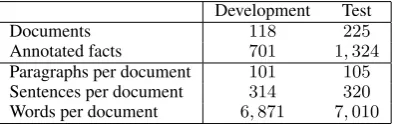
Table 2: Statistics of the CKB evaluation corpus.
units. We exploremax andlogsumexpas aggre-gation operators. Moreover, we explore ensemble prediction as an additional aggregation method. Specifically, we learn a restricted multiscale model by limiting the text span to a single discourse unit (e.g., a paragraph); the model still combines representations across mentions and subrelations. At test time, given a full document with m dis-course units, we obtain independent predictions
p1, . . . , pmfor each discourse unit. We then
com-bine these probabilities using an ensemble opera-torP. A natural choice forP is max, though we also experiment with noisy-or:
P(p1,· · · , pk) = 1− k
Y
i=1
(1−pi).
It is also possible to ensemble multiple models that operate on different discourse units, using this same operator.
[image:4.595.319.517.204.266.2]4 Experiments
4.1 Biomedical Machine Reading
We validate our approach on a standard biomed-ical machine reading task: extracting drug-gene-mutation interactions from biomedical articles (Peng et al., 2017; Wang and Poon, 2018). We cast this task as binary classification: given a drug, gene, mutation, and document in which they are mentioned, determine whether the document as-serts that the mutation in the gene affects response to the drug. For training, we use documents from the PubMed Central Open Access Subset (PMC-OA)4. For distant supervision, we use three ex-isting knowledgebases (KBs) with hand-curated drug-gene-mutation facts: CIVIC,5GDKD ( Dien-stmann et al., 2015), and OncoKB (Chakravarty et al.,2017). Table1shows basic statistics of this training data. Past methods using distant super-vision often need to up-weight positive examples, due to the large proportion of negative candidates. Interestingly, we found that our document model was robust to this imbalance, as re-weighting had little effect and we didn’t use it in our final results. Evaluating distant supervision methods is chal-lenging, as there is often no gold-standard test set, especially at the mention level. Prior work thus re-sorts to reporting sample precision (estimated pro-portion of correct system extractions) and absolute recall (estimated number of correct system extrac-tions). This requires subsampling extraction re-sults and manually annotating them. Subsampling variance also introduces noise in the estimate.
Instead, we used CKB CORE™, a public sub-set of the Clinical Knowledgebase (CKB)6 ( Pat-terson et al., 2016), as our gold-standard test set. CKB CORE™ contains document-level annota-tion of drug-gene-mutaannota-tion interacannota-tions manually curated by The Jackson Laboratory (JAX), an NCI-designated cancer center. It is a high-quality KB containing facts from a few hundred PubMed articles for 86 genes, with minimal overlap with the three KBs we used for distant supervision. To avoid contamination, we removed CKB entries whose documents were used in our training data, and split the rest into a development and test set. See Table2for statistics. We tuned hyperparam-eters and thresholds on the development set, and report results on the test set.
4www.ncbi.nlm.nih.gov/pmc 5
civic.genome.wustl.edu 6ckbhome.jax.org
4.2 Implementation Details
We conducted standard preprocessing and entity linking, similar to Wang and Poon (2018) (see Section A.1). Following standard practice, we masked all entities of the same type with a dummy token, to prevent the classifier from simply mem-orizing the facts in distant supervision. Wang and Poon(2018) observed that many errors stemmed from incorrect gene-mutation association. We therefore developed a simple rule-based system that predicts which gene-mutation pairs are valid (see Section A.2). We removed candidates that contained a gene-mutation pair that was not pre-dicted by the rule-based system.
4.3 Main Results
We evaluate primarily on area under the precision recall curve (AUC).7We also report maximum re-call, which is the fraction of true facts for which a candidate was generated. Finally, we report pre-cision, recall, and F1, using a threshold tuned to maximize F1 on the CKB development set.
We compared our multiscale system (MULTISCALE) with three restricted variants (SENTLEVEL, PARALEVEL, DOCLEVEL). SENTLEVEL and PARALEVEL restricted train-ing and prediction to strain-ingle discourse units (i.e., sentences and paragraphs), and produced a document-level prediction by applying the ensemble operator over individual discourse units. DOCLEVEL takes the whole document as input, with each paragraph as a discourse unit. MULTISCALE further combined SENTLEVEL, PARALEVEL, and DOCLEVEL using the ensem-ble operator. For additional details about the models, see Section A.3. We also compared MULTISCALEwith DPL (Wang and Poon,2018), the prior state of the art in cross-sentence n-ary relation extraction. DPL classifies drug-gene-mutation interactions within three consecutive sentences using the same model architecture as Peng et al. (2017), but incorporates additional indirect supervision such as data programming and joint inference. We used the DPL code from the authors and produced a document-level prediction similarly using the ensemble operator. In the base version, we used max as the ensemble operator. We also evaluated the effect when we
System AUC Max Recall Precision Recall F1
Base versions
DPL 24.4 53.8 27.3 42.3 33.2
SENTLEVEL 22.4 36.6 39.3 34.7 36.9
PARALEVEL 33.1 58.9 36.5 44.6 40.1
DOCLEVEL 36.7 79.0 45.4 38.5 41.7
MULTISCALE 37.3 79.0 41.8 43.3 42.5
+ Noisy-Or
DPL 31.5 53.8 33.3 41.5 36.9
SENTLEVEL 25.3 36.6 39.3 35.3 37.2
PARALEVEL 35.6 58.9 44.3 40.6 42.4
DOCLEVEL 36.7 79.0 45.4 38.5 41.7
MULTISCALE 39.7 79.0 48.1 38.9 43.0
+ Noisy-Or + Gene-mutation filter
DPL 39.1 52.6 50.5 47.8 49.1
SENTLEVEL 29.0 35.5 63.3 34.2 44.4
PARALEVEL 42.1 57.2 50.6 50.7 50.7
DOCLEVEL 42.9 74.4 49.3 46.6 47.9
[image:6.595.131.464.60.255.2]MULTISCALE 47.5 74.4 52.6 53.0 52.8
Table 3: Comparison of our multiscale system with restricted variants and DPL (Wang and Poon,2018) on CKB.
used noisy-or as the ensemble operator, as well as when we applied the gene-mutation filter during postprocessing.
Table 3shows the results on the CKB test set. In all scenarios, our full model (MULTISCALE) substantially outperforms the prior state-of-the-art system (DPL). For example, in the best set-ting, using both noisy-or and the gene-mutation filter, the full model improves over DPL by 8.4
AUC points. Multiscale learning is the key to this performance gain, with MULTISCALE sub-stantially outperforming more restricted variants. Not surprisingly, expanding extraction scope from sentences to paragraphs resulted in the biggest gain, already surpassing DPL. Conducting end-to-end learning over a document-level representation, as in DOCLEVEL, is beneficial compared to en-sembling over predictions for individual discourse units (SENTLEVEL, PARALEVEL), especially in the base version. Interestingly, MULTISCALEstill attained significant gain over DOCLEVEL with an ensemble over SENTLEVELand PARALEVEL, suggesting that the document-level representation can still be improved. In addition to prediction ac-curacy, the document-level models also have much more room to grow, as maximum recall is about 20 absolute points higher in MULTISCALE and DOCLEVEL, compared to PARALEVELor DPL.8
The ensemble operator had a surprisingly large effect, as shown by the gain when it was changed from max (base version) to noisy-or. This
sug-8The difference in actual recall is less pronounced, as we chose thresholds to maximize F1 score. We expect actual recall to increase significantly as document-level models im-prove, whereas the other models are closer to their ceiling.
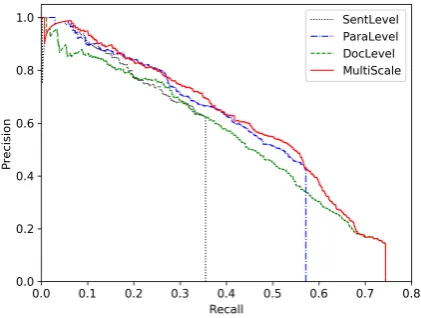
Figure 3: Precision-recall curves on CKB (with noisy-or and gene-mutation filter). MULTISCALE at-tained generally better precision than PARALEVEL, and higher maximum recall like DOCLEVEL.
gests that combining weak signals across mul-tiple scales can be quite beneficial. Our hand-crafted gene-mutation filter also improved all sys-tems substantially, corroborating the analysis of Wang and Poon(2018). In particular, without the filter, it is hard for the document-level models to achieve high precision, so they sacrifice a lot of recall to get good F1 scores. Using the filter helps them attain significantly higher recall while main-taining respectable precision.
[image:6.595.311.522.298.457.2]combi-System AUC MR P R F1 MULTISCALE 47.5 74.4 52.6 53.0 52.8 – SENTLEVEL 47.0 74.4 43.0 55.8 48.6 – PARALEVEL 45.9 74.4 48.8 49.8 49.3 – DOCLEVEL 42.4 57.2 59.6 44.4 50.9
Table 4: Results on CKB when removing either SENTLEVEL, PARALEVEL, or DOCLEVEL from the ensemble computed by MULTISCALE. MR=max re-call, P=precision, R=recall.
System AUC P R F1
[image:7.595.311.522.64.221.2]SENTLEVEL 28.3 62.7 35.1 45.0 PARALEVEL 38.1 47.4 52.2 49.7 DOCLEVEL 41.1 48.2 45.6 46.9 MULTISCALE 43.7 45.7 51.2 48.3
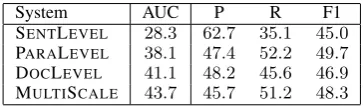
Table 5: Results on CKB after replacing logsumexp with max (with noisy-or and gene-mutation filter). P=precision, R=recall. Max recall same as in Table3.
nation: it generally improves precision while cap-turing more cross-paragraph relations. This can also be seen in Table4, where we ablate each of the three variants used by MULTISCALE. All three variants in the ensemble contributed to overall per-formance.
We uselogsumexpas the aggregation operator to combine mention-level representations into an entity-level one. If we replace it with max pool-ing, the performance drops substantially across the board, as shown in Table 5. For example, MULTISCALE lost 3.8 absolute points in AUC. Such difference is also observed in Verga et al. (2018). As in comparing ensemble operators, this demonstrates the benefit of combining weak sig-nals using a multiscale representation.
4.4 Cross-sentence and Cross-paragraph Extractions
Compared to standard sentence-level extraction, our method can extract relations among entities that never co-occur in the same sentence or even paragraph. Figure4shows the proportion of cor-rectly predicted facts by MULTISCALE that are expressed across paragraph or sentence bound-aries. MULTISCALE can substantially improve the recall by making additional cross-sentence and cross-paragraph extractions. We manually inspected twenty correct cross-paragraph extrac-tions (with the chosen threshold for the preci-sion/recall numbers in Table3) and found that our model was able to handle some interesting linguis-tic phenomena. Often, a paper would first de-scribe the mutations present in a patient cohort,
Figure 4: Breakdown of MULTISCALErecall based on whether entities in a correctly extracted fact occurred within a single sentence, cross-sentence but within a single paragraph, or only cross-paragraph. Adding cross-sentence and cross-paragraph extractions is im-portant for high recall.
System AUC MR P R F1
Base version
SENTDRUGMUT 31.0 40.8 60.0 40.7 48.5 SENTDRUGGENE 17.9 64.2 31.4 27.9 29.5 PARADRUGMUT 39.9 57.7 49.3 50.3 49.8 PARADRUGGENE 19.9 68.9 32.1 18.9 23.8
+ Noisy-Or
SENTDRUGMUT 32.6 40.8 61.1 39.4 47.9 SENTDRUGGENE 23.5 64.2 36.3 34.2 35.2 PARADRUGMUT 42.0 57.7 49.9 51.5 50.7 PARADRUGGENE 26.1 68.9 46.1 29.5 36.0
Table 6: Results of subrelation decomposition base-lines on CKB, with the gene-mutation filter. MR=max recall, P=precision, R=recall.
and later describe the effects of drug treatment. There are also instances of bridging anaphora, for example via cell lines. One paper first stated the gene and mutation for a cell line “The
FLT3-inhibitor resistant cells Ba/F3-ITD+691, Ba/F3-ITD+842, . . . , which harbored FLT-ITD plus F691L, Y842C, . . . mutations. . .”, and later stated the drug effect on the cell line “E6201also demonstrated strong anti-proliferative effects in
FLT3-inhibitor resistant cells. . . such as Ba/F3-ITD+691, Ba/F3-ITD+842 . . .”.
4.5 Subrelation Decomposition
As a baseline, we also consider a different document-level strategy where we decompose the
[image:7.595.90.272.183.236.2] [image:7.595.307.530.322.434.2]gene-mutation subrelation classifier was too noisy. Therefore, we focused on training drug-gene and drug-mutation classifiers, and joined each with the rule-based gene-mutation predictions to make ternary predictions. Table6 shows the results on CKB. The paragraph-level drug-mutation model is quite competitive, which benefits from the fact that the gene-mutation associations in a document are unique. This is not true in generaln-ary rela-tions. Still, it trails MULTISCALEby a large mar-gin in predictive accuracy, and with an even larger gap in the potential upside (i.e., maximum recall). The drug-gene model has higher maximum recall, but much worse precision. This low precision is expected, as it is usually not valid to assume that if a drug and gene interact, then all possible mu-tations in the gene will have an effect on the drug response.
4.6 Error Analysis
While much higher compared to other systems, the maximum recall for MULTISCALEis still far from 100%. For over 20% of the relations, we can’t find all three entities in the document. In many cases, the missing entities are in figures or supplements, beyond the scope of our extraction. Some muta-tions are indirectly referenced by well-known cell lines. There are also remaining entity linking er-rors (e.g., due to missing drug synonyms).
We next manually analyzed some sample pre-diction errors. Among 50 false positive errors, we found a significant portion of them were ac-tually true mentions in the paper but were ex-cluded by curators due to additional curation cri-teria. For example, CKB does not curate a fact referenced in related work, or if they deem the em-pirical evidence as insufficient. This suggests the need for even higher-order relation extraction to cover these aspects. We also inspected 50 sample false negative errors. In 40% of the cases, the tex-tual evidence is vague and requires corroboration from a table or figure. In most of the remaining cases, there is direct textual evidence, though they require cross-paragraph reasoning (e.g., bridging anaphora). While MULTISCALEwas able to pro-cess such phenomena sometimes, there is clearly much room to improve.
5 Related Work
N-ary relation extraction Prior work onn-ary relation extraction generally follows Davidsonian
semantics by reducing then-ary relation ton bi-nary relations between the reified relation and its arguments, a.k.a. slot filling. For example, early work on the Message Understanding Conference (MUC) dataset aims to identify event participants in news articles (Chinchor,1998). More recently, there has been much work in extracting seman-tic roles for verbs, as in semanseman-tic role labeling (Palmer et al., 2010), as well as properties for popular entities, as in Wikipedia Infobox (Wu and Weld,2007) and TAC KBP9. In biomedicine, the BioNLP Event Extraction Shared Task aims to ex-tract genetic events such as expression and regu-lation (Kim et al., 2009). These approaches typ-ically assume that the whole document refers to a single coherent event, or require an event an-chor (e.g., verb in semantic role labeling and trig-ger word in event extraction). We instead follow recent work in cross-sentence n-ary relation ex-traction (Peng et al.,2017;Wang and Poon,2018; Song et al.,2018), which does not have these re-strictions.
Document-level relation extraction Most in-formation extraction work focuses on modeling and prediction within sentences (Surdeanu and Ji, 2014). Duan et al. (2017) introduces a pre-trained document embedding to aid event detec-tion, but their extraction is still at the sentence level. Past work on cross-sentence extraction often relies on explicit coreference annotations or the as-sumption of a single event in the document (Wick et al., 2006; Gerber and Chai, 2010; Swampil-lai and Stevenson,2011;Yoshikawa et al., 2011; Koch et al.,2014;Yang and Mitchell,2016). Re-cently, there has been increasing interest in gen-eral cross-sentence relation extraction (Quirk and Poon, 2017; Peng et al., 2017; Wang and Poon, 2018), but their scope is still limited to short text spans of a few consecutive sentences. These meth-ods all extract relations at the mention level, which does not scale to whole documents due to the com-binatorial explosion of relation candidates. Wu et al. (2018b) applies manually crafted rules to heavily filter the candidates. We instead adopt an entity-centric approach and combine mention-level representations to create an entity-mention-level rep-resentation for extraction. Mintz et al.(2009) ag-gregates mention-level features into entity-level ones within a document, but they only consider
binary relations within single sentences. Kil-icoglu (2016) used hand-crafted features to im-prove cross-sentence extraction, but they focus on binary relations, and their documents are limited to abstracts, which are substantially shorter than the full-text articles we consider. Verga et al. (2018) applies self-attention to combine the rep-resentations of all mention pairs into an entity pair representation, which can be viewed a special case of our framework. Their work is also limited to binary relations and abstracts, rather than full doc-uments.
Multiscale modeling Deep learning on long se-quences can benefit from multiscale modeling that accounts for varying scales in the discourse struc-ture. Prior work focuses on generative learning such as language modeling (Chung et al., 2017). We instead apply multiscale modeling to discrim-inative learning for relation extraction. In addi-tion to modeling various scales of discourse units (sentence, paragraph, document), we also combine mention-level representations into an entity-level one, as well as sub-relations of then-ary relation. McDonald et al. (2005) learn n2 pairwise rela-tion classifiers, then construct maximal cliques of related entities, which also bears resemblance to our subrelation modeling. However, our approach incorporates the entire subrelation hierarchy, pro-vides a principled end-to-end learning framework, and extracts relations from the whole document rather than within single sentences.
Distant supervision Distant supervision has emerged as a powerful paradigm to generate large but potentially noisy labeled datasets (Craven et al., 1999;Mintz et al., 2009). A common de-noising strategy applies multi-instance learning by treating mention-level labels as latent variables (Hoffmann et al., 2011). Noise from distant su-pervision increases as extraction scope expands beyond single sentences, motivating a variety of indirect supervision approaches (Quirk and Poon, 2017;Peng et al., 2017;Wang and Poon, 2018). Our entity-centric representation and multiscale modeling provide an orthogonal approach to com-bat noise by combining weak signals spanning var-ious text spans and subrelations.
6 Conclusion
We propose a multiscale, entity-centric approach for document-level n-ary relation extraction.
We vastly increase maximum recall by scoring document-level candidates. Meanwhile, we pre-serve precision with a multiscale approach that combines representations learned across the sub-relation hierarchy and text spans of various scales. Our method substantially outperforms prior cross-sentence n-ary relation extraction approaches in the high-value domain of precision oncology.
Our document-level view opens opportunities for multimodal learning by integrating informa-tion from tables and figures (Wu et al., 2018a). We used the ternary drug-gene-mutation relation as a running example in this paper, but knowledge bases often store additional fields such as effect (sensitive or resistance), cancer type (solid tumor or leukemia), and evidence (human trial or cell line experiment). It is straightforward to apply our method to such higher-order relations. Finally, it will be interesting to validate our approach in a real-world assisted-curation setting, where a ma-chine reading system proposes candidate facts to be verified by human curators.
Acknowledgements
We thank Sara Patterson and Susan Mockus for guidance on precision oncology knowledge cura-tion and CKB data, Hai Wang for help in run-ning experiments with deep probabilistic logic, and Tristan Naumann, Rajesh Rao, Peng Qi, John Hewitt, and the anonymous reviewers for their helpful comments. R.J. is supported in part by an NSF Graduate Research Fellowship under Grant No. DGE-114747.
References
Orli Bahcall. 2015. Precision medicine. Nature, 526:335.
and Nikolaus Schultz. 2017. Oncokb: A precision oncology knowledge base. JCO Precision Oncol-ogy.
Nancy Chinchor. 1998. Overview of MUC-7/MET-2. Technical report, Science Applications International Corporation, San Diego, CA.
Junyoung Chung, Sungjin Ahn, and Yoshua Bengio. 2017. Hierarchical multiscale recurrent neural net-works. InICLR.
M. Craven, J. Kumlien, et al. 1999. Constructing bi-ological knowledge bases by extracting information from text sources. InISMB, pages 77–86.
Rodrigo Dienstmann, In Sock Jang, Brian Bot, Stephen Friend, and Justin Guinney. 2015. Database of ge-nomic biomarkers for cancer drugs and clinical tar-getability in solid tumors.Cancer Discovery, 5.
Shaoyang Duan, Ruifang He, and Wenli Zhao. 2017. Exploiting document level information to improve event detection via recurrent neural networks. In
IJCNLP.
Matthew Gerber and Joyce Y. Chai. 2010. Beyond NomBank: A study of implicit arguments for nomi-nal predicates. In Proceedings of the Forty-Eighth Annual Meeting of the Association for Computa-tional Linguistics.
R. Hoffmann, C. Zhang, X. Ling, L. S. Zettlemoyer, and D. S. Weld. 2011. Knowledge-based weak su-pervision for information extraction of overlapping relations. In Association for Computational Lin-guistics (ACL), pages 541–550.
Halil Kilicoglu. 2016. Inferring implicit causal rela-tionships in biomedical literature. InProceedings of the 15th Workshop on Biomedical Natural Language Processing.
Jin-Dong Kim, Tomoko Ohta, Sampo Pyysalo, Yoshi-nobu Kano, and Junichi Tsujii. 2009. Overview of bionlp-09 shared task on event extraction. In Pro-ceedings of the BioNLP Workshop 2009.
D. Kingma and J. Ba. 2014. Adam: A method for stochastic optimization. arXiv preprint arXiv:1412.6980.
Mitchell Koch, John Gilmer, Stephen Soderland, and S. Daniel Weld. 2014. Type-aware distantly su-pervised relation extraction with linked arguments. In Proceedings of the 2014 Conference on Em-pirical Methods in Natural Language Processing (EMNLP), pages 1891–1901. Association for Com-putational Linguistics.
Ryan McDonald, Fernando Pereira, Seth Kulick, Scott Winters, Yang Jin, and Pete White. 2005. Sim-ple algorithms for comSim-plex relation extraction with applications to biomedical IE. In Proceedings of the Forty-Third Annual Meeting on Association for Computational Linguistics.
M. Mintz, S. Bills, R. Snow, and D. Jurafsky. 2009. Distant supervision for relation extraction without labeled data. InAssociation for Computational Lin-guistics (ACL), pages 1003–1011.
Martha Palmer, Daniel Gildea, and Nianwen Xue. 2010. Semantic role labeling. Synthesis Lectures on Human Language Technologies, 3(1).
Sarah E. Patterson, Rangjiao Liu, Cara M. Statz, Daniel Durkin, Anuradha Lakshminarayana, and Susan M. Mockus. 2016. The clinical trial landscape in oncol-ogy and connectivity of somatic mutational profiles to targeted therapies.Human Genomics, 10.
Nanyun Peng, Hoifung Poon, Chris Quirk, and Kristina Toutanova Wen tau Yih. 2017. Cross-sentence N -ary relation extraction with graph LSTMs. Transac-tions of the Association for Computational Linguis-tics, 5:101–115.
Sampo Pyysalo, F Ginter, Hans Moen, T Salakoski, and Sophia Ananiadou. 2013. Distributional semantics resources for biomedical text processing. In Pro-ceedings of Languages in Biology and Medicine.
Chris Quirk and Hoifung Poon. 2017. Distant super-vision for relation extraction beyond the sentence boundary. InProceedings of the Fifteenth Confer-ence on European chapter of the Association for Computational Linguistics.
Linfeng Song, Yue Zhang, Zhiguo Wang, and Daniel Gildea. 2018. N-ary relation extraction using graph state LSTM. In Proceedings of the Conference on Empirical Methods in Natural Language Process-ing.
Mihai Surdeanu and Heng Ji. 2014. Overview of the English Slot Filling Track at the TAC2014 Knowl-edge Base Population evaluation. In Proceed-ings of the TAC-KBP 2014 Workshop, pages 1–15, Gaithersburg, Maryland, USA.
Kumutha Swampillai and Mark Stevenson. 2011. Ex-tracting relations within and across sentences. In
Proceedings of the Conference on Recent Advances in Natural Language Processing.
A. Vaswani, N. Shazeer, N. Parmar, J. Uszkoreit, L. Jones, A. N. Gomez, L. Kaiser, and I. Polosukhin. 2017. Attention is all you need. arXiv preprint arXiv:1706.03762.
Patrick Verga, Emma Strubell, and Andrew McCallum. 2018. Simultaneously self-attending to all mentions for full-abstract biological relation extraction. In
NAACL.
Hai Wang and Hoifung Poon. 2018. Deep probabilistic logic: A unifying framework for indirect supervi-sion. InEMNLP.
database records from unstructured text. In Pro-ceedings of the Conference on Empirical Methods in Natural Language Processing.
Fei Wu and Daniel S. Weld. 2007. Autonomously se-mantifying wikipedia. In Proceedings of the Six-teenth ACM Conference on Conference on Informa-tion and Knowledge Management.
S. Wu, L. Hsiao, X. Cheng, B. Hancock, T. Rekatsi-nas, P. Levis, and C. R’e. 2018a. Fonduer: Knowl-edge base construction from richly formatted data. InProceedings of SIGMOD 2018.
Sen Wu, Luke Hsiao, Xiao Cheng, Braden Hancock, Theodoros Rekatsinas, Philip Levis, and Christo-pher R. 2018b. Fonduer: Knowledge base construc-tion from richly formatted data. InSIGMOD.
Bishan Yang and Tom Mitchell. 2016. Joint extraction of events and entities within a document context. In
NAACL.
Katsumasa Yoshikawa, Sebastian Riedel, Tsutomu Hi-rao, Masayuki Asahara, and Yuji Matsumoto. 2011. Coreference based event-argument relation extrac-tion on biomedical text. Journal of Biomedical Se-mantics, 2(5).
A Appendices
A.1 Preprocessing
Full-text documents in this study were obtained from PMC. The text was first tokenized using NLTK10, then entities were extracted using a com-bination of regular expressions and dictionary lookups. To identify mutation mentions, we ap-plied a regular expression rule for missense mu-tations. To identify gene mentions, we used dic-tionary lookup from the HUGO Gene Nomencla-ture Committee (HGNC)11 dataset. To identify drug mentions, we used dictionary lookup from a curated list of drugs and their synonyms. For our training set, our list of drugs consists of all the drugs present in the distant supervision knowl-edge bases and selected cancer-related drugs from DrugBank12(770 drugs total). For our test set, our drug dictionary consists of all the drugs in CKB (1119 drugs).
A.2 Gene-mutation Rule-based System
Here we describe our rule-based system for link-ing mutations and genes within a document. We first generate a global mapping of mutations to sets of genes by combining publicly-available
10
https://www.nltk.org/ 11
https://www.genenames.org/ 12https://www.drugbank.ca/
mutation-gene datasets (COSMIC13, COSMIC Cell Lines Project14, CIViC15, and OncoKB16). We then augment this mapping by finding the gene that most frequently co-occurs with each mutation in all of PubMed Central (PMC) full-text articles based on three high-precision rules:
1. Gene and mutation are in the same token (e.g., ”EGFR-T790M”)
2. Gene token is followed by mutation token (e.g., ”EGFR T790M”)
3. Gene token is followed by a token of any sin-gle character and then followed by mutation token (e.g., ”EGFR - T790M”)
For each mutation, we start with the first rule, and find all text matches for a gene with that mutation and rule. If we found at least one match, we add the gene that occurred in the most matches to the global map. Otherwise, we repeat with the next rule.
Each mutation in the global mutation-gene map is mapped to more than 20 genes on average. However, within the context of a document, each mutation is (usually) associated with just a single gene. Given a document containing a mutation, we associate that mutation with the gene that (1) is in the global mutation-gene map for that mutation, and (2) appears closest to any mutation mention in the document.
To associate genes for the remaining mutations, we apply two recall-friendly regular expression rules within that document:
4. Mutation is in same sentence as “GENEmut”
5. Mutation is in same paragraph as “GENE mutation”
We choose the first gene in the document that satisfies one of the two rules, in the above order. If there is still no matching gene at this point, the most frequent gene in the document is selected for that mutation.
A.3 Model Details
We used 200-dimensional word vectors, initial-ized with word2vec vectors trained on a biomedi-cal text corpus (Pyysalo et al.,2013). We updated
13https://cancer.sanger.ac.uk/cosmic 14
https://cancer.sanger.ac.uk/cell lines 15