Abstract—Moving object detection is very important for video
surveillance. In this paper, we present a new real time motion detection algorithm that is based on the integration of accumulative optical flow and double background filtering method (long-term background and short-term background) to achieve better performance. The accumulative optical flow method is used to obtain and keep a stable background image to cope with variations on environmental changing conditions and the double background filtering method is used to eliminate the background information and separate the moving object from it. The biggest advantage of this algorithm is that it does not need to learn the background model from hundreds of images and can handle quick image variations without prior knowledge about the object size and shape. The algorithm has high capability of anti-interference and preserves high accurate rate detection at the same time. The effectiveness of the proposed algorithm for motion detection is demonstrated in a simulation environment and the evaluation results are reported in this paper.
Index Terms—Background filtering, motion detection, optical
flow, region-based matching.
I. INTRODUCTION
In recent years, motion detection has attracted a great interest from computer vision researchers due to its promising applications in many areas, such as video surveillance [1], traffic monitoring or sign language recognition. However, it is still in its early developmental stage and needs to improve its robustness when applied in a complex environment.
Several techniques for moving object detection have been proposed in [2]-[8], among them the two representative approaches are based on optical flow and background subtraction. The most commonly used approach in presence of still cameras is background subtraction. The principle of this method is to use a model of the background and compare the current image with a reference. In this way the foreground objects present in the scene are detected. The method of statistical model based on the background subtraction is flexible and fast, but the background scene and the camera are
Manuscript received March 4, 2007. This work was supported in part by the BlueStar Technology Co., Ltd., China.
Nan Lu (e-mail: [email protected]), Jihong Wang (e-mail: [email protected]; phone: +44 151 794 4509; fax: +44 151 794 4540), Henry Wu (e-mail: [email protected]), Li Yang (e-mail: [email protected]) are all with the Department of Electrical Engineering and Electronics, the University of Liverpool, Brownlow Hill, Liverpool L69 3GJ, UK.
required to be stationary when this method is applied. The optical flow is an approximation of the local image motion and specifies how much each image pixel moves between adjacent images. It can achieve success of motion detection in the presence of camera motion or background changing. According to the smoothness constraint, the corresponding points in the two successive frames should not move more than a few pixels. For an uncertain environment, this means that the camera motion or background changing should be relatively small. The method based on optical flow is complex, but it can detect the motion accurately even without knowing the background. The main idea in this paper is to integrate the advantages of these two methods ([9], [10]).
In this paper, an integrated accumulative optical flow and double background filtering method is represented. The main goal of the method is to separate the background and foreground effectively and detect the object in motion accurately. In this way, an accumulative optical flow method is used to obtain and keep a stable background image to address variations on environmental changing conditions and use a double background (long-term background and short-term background) method to eliminate the background information and separate the moving object from it. Different from the paper [11], a new strategy is proposed which improves the capability of detecting the object in motion.
This paper is organized as follows. In Section II, an overview of the method is presented to explain the whole procedure
.
In Section III, the optical flow method is introduced and Section IVis dedicated to
the double background filtering method. Section V describes a region-based matching method and Section VI presents the experimental results. Section VII concludes the achievement of the paper.II. OVERVIEW OF THE METHOD
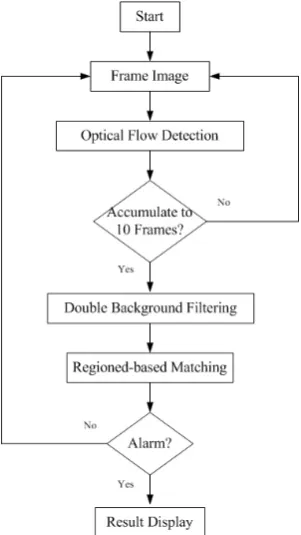
The method is depicted in the flow chart of Fig.1. As can be seen, the diagram is comprised of three main parts: (1) Optical flow detection, in which frame-to-frame optical flow is calculated; (2) Double background filtering, which is the method used to separate the background and foreground information; (3) Region-based matching, the moving object is detected for alarming.
The final processing result is a binary image in which the background area and moving object area are shown as white color, the other areas are shown in black color and the top right
Motion Detection Based On Accumulative
Optical Flow and Double Background Filtering
corner is the alarm symbol. The experimental result in Section VI (Fig.5) presents a set of images to help in understanding the processes achieved in the present method.
Fig 1. Flowchart of Motion Detection Method
III. OPTICAL FLOW DETECTION METHOD
The movement in space can be described as motion field, but on the image plane, the object motion is always embodied through the difference of different image grayscale distribution in image sequences. So, if the motion field in space is transformed to image, it can be represented as optical flow field which shows the changing trend of grayscale of each pixel on the image. The optical flow can be thought as transient velocity field which is caused by the motion of pixel.
A. Lucas-Kanade Method
To extract a 2D motion field, Lucas-Kanade method is employed to compute optical flow because of its accuracy and efficiency. Barron [12] compared the accuracy of different optical flow techniques on both real and synthetic image sequences, they found that the most reliable one was the first-order, local differential method of Lucas and Kanade. Liu [13] studied the accuracy and the efficiency trade-offs in different optical flow algorithms. They focused on the motion algorithm implementations in real world tasks. Their results showed that Lucas Kanade method is pretty fast. Galvin [14] evaluated eight optical flow algorithms. The Lucas-Kanade method consistently produces accurate depth maps, and has a low computational cost, and good noise tolerance.
The Lucas-Kanade method [15] is trying to calculate the motion between two image frames which are taken at time t
and t + δt for every pixel position. As a pixel at location (x,y,t)
with intensity I (x,y,t) will have moved by δx, δy and δt
between the two frames, the following image constraint equation can be given:
) , , ( ) , ,
(x y t I x x y y t t
I = +δ +δ +δ (1)
Assuming that the movement is small enough, the image constraint at I(x, y, t) with Taylor series can be derived to give:
T O H t t I y y I x x I
t y x I t t y y x x I
. . ) , , ( ) , , (
+ ∂ ∂ + ∂ ∂ + ∂ ∂ +
= + + +
δ δ δ
δ δ δ
(2)
where H.O.T. means those higher order terms, which are small enough to be ignored. From (1) and (2), the following can be obtained:
0 = ∂ ∂ + ∂ ∂ + ∂ ∂
t t I y y I x x
Iδ δ δ
(3)
or
0 = ∂ ∂ + ∂ ∂ + ∂ ∂
t t t I t y y I t x x I
δ δ δ δ δ δ
(4)
which will result in,
0
= ∂ ∂ + ∂ ∂ + ∂ ∂
t I V y I V x I
y
x (5) where Vx and Vy are the x and y components of the velocity or
optical flow of I(x, y, t) and ∂I/∂x, ∂I/∂yand ∂I/∂t are the derivatives of the image at (x,y,t) in the corresponding
directions.
Equation (5) is called the optical flow constraint equation since it expresses a constraint on the components Vx and Vy of
the optical flow. The optical flow constraint equation can be rewritten as:
t y y x
xV IV I
I + =− (6)
or
t y x y
x I
V V I
I ⎥=−
⎦ ⎤ ⎢ ⎣ ⎡ ]
[ (7)
We wish to calculate Vx and Vy, but unfortunately the above
constraint gives us only one equation for two unknowns, so this is not enough by itself. To find the optical flow, another set of equations is needed, given by some additional constraints. The solution as given by Lucas and Kanade is a non-iterative method which assumes a locally constant flow.
position to another. Assuming that the flow (Vx, Vy) is constant
in a small window of size
m
×
m
with m > 1, which iscentered at (x, y) and numbering the pixels as 1...n, a set of
equations can be derived:
n n
n x y y t x t y y x x t y y x x I V I V I I V I V I I V I V I − = + − = + − = + M 2 2 2 1 1 1 (8)
With (8), there are more than three equations for the three unknowns and thus the system is over-determined. Hence:
⎥ ⎥ ⎥ ⎥ ⎥ ⎦ ⎤ ⎢ ⎢ ⎢ ⎢ ⎢ ⎣ ⎡ − − − = ⎥ ⎦ ⎤ ⎢ ⎣ ⎡ ⎥ ⎥ ⎥ ⎥ ⎥ ⎦ ⎤ ⎢ ⎢ ⎢ ⎢ ⎢ ⎣ ⎡ n n n t t t y x y x y x y x I I I V V I I I I I I M M M 2 1 2 2 1 1 (9) or b v
Ar=− (10)
To solve the over-determined system of equations, the least squares method is used:
) ( b A v A
AT r= T − (11) )
( ) (A A 1A b
vr= T − T − (12) or ⎥ ⎥ ⎦ ⎤ ⎢ ⎢ ⎣ ⎡ − − ⎥ ⎥ ⎦ ⎤ ⎢ ⎢ ⎣ ⎡ = ⎥ ⎦ ⎤ ⎢ ⎣ ⎡
∑
∑
∑
∑
∑
∑
− i i i i i i i i i i t y t x y y x y x x y x I I I I I I I I I I V V 1 2 2 (13)with the sums running from i=1 to n. And there is a limit
condition for the calculation of motion vector in (13) as:
⎥ ⎥ ⎦ ⎤ ⎢ ⎢ ⎣ ⎡ =
∑
∑
∑
∑
22 i i i i i i y y x y x x T I I I I I I A
A (14)
Equation (14) must be an invertible matrix, which means that the optical flow can be found by calculating the derivatives of the image in all three dimensions: x-direction, y-direction and time-direction. One of the characteristics of the Lucas-Kanade algorithm is that it does not yield a very high density of flow vectors, i.e. the flow information fades out quickly across motion boundaries and the inner parts of large homogenous areas show little motion. The advantage for the method is accuracy and robustness of detection in presence of noise.
B. Simplified Calculation
The theoretical calculation procedure of the optical flow method is explained in the above subsection, but for the
requirement of practical application, some operation characteristics between matrices can be used to simplify the complexity of calculation. For the calculation of invertible matrix in (13), the companion matrix method can be used:
M M M
∗
−1= (15)
where M* is the companion matrix of M and M is the
determinant of M.
C. Gradient Operator
From the operation expression of optical flow, the estimation of the gradient has a great influence on the final results of optical flow calculation. The most common gradient operators used in optical flow calculation are Horn, Robert, Sobel, Prewitt, Barron and so on. In an ordinary way, the calculation of gradient on both t and x directions uses the same template.
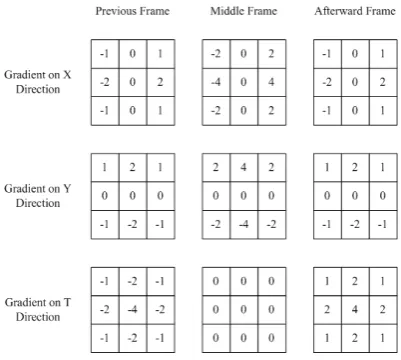
For different operators, the number of frames required for calculation of the time gradient is different. For example, the Horn operator needs two frames and Barron operator needs five frames at least. In this paper, a better 3D Sobel operator is used which was proposed in [16]. This operator uses three different templates to do the convolution calculation for three frames in a row along the directions of x, y and t and to
calculate the gradient along three directions for central pixels of the template in the middle frame. Fig.2 shows the operators.
D. Results of Optical Flow Detection
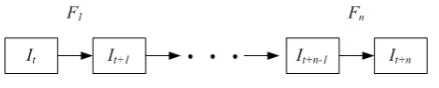
The optical flow information for every frame of an image is calculated. As shown in Fig.3, the optical flow of frames
n t t
t I I
I, +1,K, + in a period time [t, t+n] are represented as
n F F
F1, 2,K, . The result of optical flow is shown as a binary
[image:3.595.328.529.555.735.2]image and a threshold is selected to distinguish the moving pixel from the still pixel. The pixels whose optical flow values are greater than threshold will be considered as moving pixels and are shown in white.
Fig 3. Diagram of optical flow calculation
The threshold formula that we used can be written as:
⎩ ⎨
⎧ >
=
Otherwise Threshold j
i F if j
i
F n
n
0
) , ( 255 ) ,
( (16)
where Fn(i,j) is the absolute value for optical flow and the threshold is set as 0.1.
IV. DOUBLE BACKGROUND FILTERING
By using the optical flow method, two types of optical flow information are obtained, which are the edge information of image background and the information of image pixel with any possibility of movement. In theory, the optical flow doesn’t exit for the still background, but in the real situation, because of the environment such as light, vibration and so on, the edge information of the background still can be detected.
In this paper, a novel approach is developed to update the background. This approach is based on a double background principle. In one of them (Long-term background) we will save the information which has happened in a long time, and in the other (Short-term background) we will consider the most recent changes. These two background images are modified to update adequately the background image and to detect and correct abnormal conditions.
During practical tests, we found that although the optical flow can be detected for the background without moving object, it is relatively stable for some specific areas on the image and the amount of the optical flow doesn’t change very much. For the area where the moving object appears, the amount of optical flow must change significantly in the specific area. According to these characteristics, the moving object should be easily detected if the information for the background and foreground can be separated. In this paper, a method entitled Double Background Filtering is proposed, which consists of five steps.
1) The optical flow information of the first five frames is accumulated for saving the optical flow information of the background. Let 5
A be the accumulation matrix, which is
defined with the same size as the video images and set the initial value as zeros. To compute this matrix the formula below is applied:
5 , 4 , 3 , 2 , 1 0 ) , ( ) , (
255 ) , ( 1 ) , ( ) ,
( 5
5
5 =
⎩ ⎨ ⎧
= = +
= k
j i F if j i A
j i F if j i A j i A
k
k (17)
2) The optical flow information of the last three frames is accumulated for moving object detection. Let 3
A be the
accumulation matrix and computed as follow:
10 , 9 , 8 0
) , ( )
, (
255 ) , ( 1 ) , ( ) ,
( 3
3
3 =
⎩ ⎨ ⎧
= = +
= k
j i F if j i A
j i F if j i A j i A
k
k (18)
3) By comparing the results of steps (1) and (2) and eliminating the overlap optical flow, the rest should be the optical flow left to represent with the real movement. The Table I shown below explains the method in a tabular way. The algorithm to detect whether a pixel B(I, j)
belongs to an object with salient motion is described as follows:
⎩ ⎨ ⎧
> =
> >
=
0 ) , ( 0
) , ( 255
0 ) , ( 0
) , ( 0
) ,
( 5 3
3 5
j i A and j
i A if
j i A and j
i A if j
i
B (19)
4) Mathematical morphology method (erosion) is used to eliminate the noise for the optical flow information of the background. The noise is defined as the isolated single pixel in the video image.
SE j i B j i
BE(, )= (, )Ο (20)
where Ο is the erosion operator, structure element (SE) is shown in Fig.4.
5) Background Updating, This last step is an updating function of the new value of the accumulation matrix, both 5
A and A3 are set to zero, with the new video frame
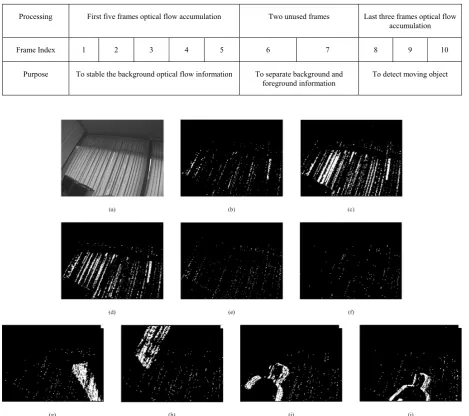
[image:4.595.397.460.574.644.2]input, the five steps above are then repeated again. In this method, there are always two unused frames during the process, the purpose of this is to separate the background and moving object effectively. When the moving object appears in the last three frames, the information of moving object will not be lost while the background is updating.
Table I. Double background filtering method
Processing First five frames optical flow accumulation Two unused frames Last three frames optical flow accumulation
Frame Index 1 2 3 4 5 6 7 8 9 10
Purpose To stable the background optical flow information To separate background and foreground information
To detect moving object
Fig 5. Experimental results. (a) original video image; (b) result of optical flow; (c) result of optical flow after first five frames accumulation; (d) result of optical flow after last three frames accumulation; (e) result of optical flow after double background filtering method; (f) result of optical flow after morphological method;
(g)-(h) result of motion detection for moving object; (i)-(j) result of motion detection for moving people.
V. REGION-BASED MATCHING
After applying the process of double background filtering under ideal circumstances, the optical flow information of the background should be eliminated and only the optical flow information of real moving object is left. But during the real experimental test, there is still some optical flow of background can not be eliminated. It distributes in the background area randomly and sparsely. For the optical flow of moving object, it appears in some specific area and the amount of it shows invariable in short time. By taking advantage of this feature, we use the region-based matching method to detect the movement of moving object and give the alarm without delay. The method can be described as follows:
Firstly, the image after double background filtering is divided into small regions whose size is 8×8 pixels. The size of the original image is 320×240 pixels. So the image is divided into 1200 regions. Secondly, we set a judgment condition for the detection. We assumed that there must be an object movement if the amount of optical flow in these 8×8 regions between two adjacent frames changes a lot.
1200 , , 2 , 1 0
1
1 = K
⎪⎩ ⎪ ⎨
⎧ − >
= − j
Otherwise Threshold B
B if D
j E j E
k i i (21)
where Dk is the symbol for alarming,
j Ei
B is the pixel number of
optical flow in the jth 8×8 block of the ith frame and
threshold is set as 30.
VI. EXPERIMENTAL RESULTS
In this section, the effectiveness of the proposed algorithm for motion detection is demonstrated in Fig.5 for a simulation environment whose background is a vibrated curtain cause by winds. The algorithm runs using Visual C++ program. The size of the video image is 320×240 pixels and the sample rate is 25 frames per second.
Fig.5 illustrates the algorithm on a video sequence in which a moving object is moving under the complex background. Fig.5(a) shows original video image. Fig.5(b) shows the result of video image after using optical flow method. Fig.5(c) shows the result of optical flow after first five frames accumulation. Fig.5(d) shows the result of optical flow after last three frames accumulation. Fig.5(e) shows the result of optical flow after double background filtering method. Fig.5(f) shows the result of optical flow after morphological method. Fig.5(g) and Fig.5(h) show the result of motion detection for moving object. Fig.5(i) and Fig.5(j) show the result of motion detection for moving people. The little white square on up right corner shows the alarm signal.
VII. CONCLUSION
In this paper a new approach is proposed for motion detection using optical flow and double background filtering. The paper integrates the advantages of these two methods and presents a fast and robust motion detection and abnormity alarm algorithm. The paper introduces the optical flow algorithm to detect any possible movement pixels in the video image initially. Then, the paper presents an improved motion detection algorithm based on a double background filtering technique which consists of long-term and short-term background processing. The long-term and short-term backgrounds are used to obtain the optical flow information of background and moving object. Finally, the combination of the background elimination and area matching method is used for the motion detection. The experiments indicated that the algorithm can detect moving objects precisely, including slow moving or tiny objects, and give an alarm in time.
ACKNOWLEDGMENT
The authors would like to thank BlueStar Technology Co., Ltd., for their financial and equipment supports. The authors also wish to thank Mr. CaiGuang He and Mr. XiaoHui Gao for their helpful advices for this work.
REFERENCES
[1] Y.L. Tian and A. Hampapur, “Robust Salient Motion Detection with Complex Background for Real-time Video Surveillance,” IEEE Computer Society Workshop on Motion and Video Computing,
Breckenridge, Colorado, January 5 and 6, 2005.
[2] A. Manzanera and J.C. Richefeu, “A new motion detection algorithm based on Σ-Δ background estimation,” Pattern Recognition Letters, vol.
28, n 3, Feb 1, 2007, pp. 320-328.
[3] Y, Ren, C.S. Chua and Y.K. Ho, “Motion detection with nonstationary background,” Machine Vision and Applications, vol. 13, n 5-6, March, 2003, pp. 332-343.
[4] J. Guo, D. Rajan and E.S. Chng, “Motion Detection with Adaptive Background and Dynamic Thresholds,” 2005 Fifth International Conference on Information, Communications and Signal Processing,
06-09 Dec. 2005, pp. 41-45.
[5] A. Elnagar and A. Basu, “Motion detection using background constraints,” Pattern Recognition, vol. 28, n 10, Oct, 1995, pp. 1537-1554.
[6] J.F. Vazquez, M. Mazo, J.L. Lazaro, C.A. Luna, J. Urefla, J.J. Garcia and E. Guillan, “Adaptive threshold for motion detection in outdoor environment using computer vision,” Proceedings of the IEEE
International Symposium on Industrial Electronics, 2005. ISIE 2005,
vol. 3, 20-23 June 2005, pp. 1233-1237.
[7] P. Spagnolo, T. D'Orazio, M. Leo and A. Distante, “Advances in background updating and shadow removing for motion detection algorithms,” Lecture Notes in Computer Science, vol. 3691 LNCS, 2005, pp. 398-406.
[8] D.E. Butler, V.M. Bove Jr. and S. Sridharan, “Real-time adaptive foreground/background segmentation,” Eurasip Journal on Applied Signal Processing, vol. 2005, n 14, Aug 11, 2005, pp. 2292-2304. [9] L. Wixson, “Detecting salient motion by accumulating
directionally-consistent flow,” IEEE Transactions on Pattern Analysis and Machine Intelligence, vol. 22, issue 8, Aug. 2000, pp. 774-780. [10] H.J. Elias, O.U. Carlos and S. Jesus, “Detected motion classification with
a double-background and a Neighborhood-based difference,” Pattern Recognition Letters, vol. 24, n 12, August, 2003, pp. 2079-2092. [11] J. Zheng, B. Li, B. Zhou and W. Li, “Fast motion detection based on
accumulative optical flow and double background model,” Lecture Notes in Computer Science, Computational Intelligence and Security - International Conference, CIS 2005, Proceedings, vol. 3802 LNAI, 2005, pp. 291-296.
[12] J. Barron, D. Fleet and S. Beauchemin, “Performance of Optical Flow Techniques,” International Journal of Computer Vision, vol. 12, n 1,
1994, pp. 42–77.
[13] H. Liu, T. Hong, M. Herman and R. Chellappa, “Accuracy vs. Efficiency Trade-offs in Optical Flow Algorithms,” In the Proceeding of Europe Conference Of Computer Vision, 1996.
[14] B. Galvin, B. McCane, K. Novins, D. Mason, and S.Mills, “Recovering Motion Fields: An Evaluation of Eight Optical Flow Algorithms,” In Proc. Of the 9th British Machine Vision Conference (BMVC’98), vol. 1, Sept. 1998, pp. 195-204.
[15] Wikipedia, the free encyclopedia. 20 February 2007. Lucas Kanade method. Available: http://en.wikipedia.org/wiki/Lucas_Kanade_method [16] J. Lopez, M. Markel, N. Siddiqi, G. Gebert and J. Evers, “Performance
of passive ranging from image flow,” IEEE International Conference on