Towards efficient parsing with
proof-nets
A l a i n L e c o m t e G R I L
U n i v e r s i t 6 B l a i s e P a s c a l 6 3 0 3 7 - C l e r m o n t - F e r r a n d
F r a n c e
e m a i l : l e c o m t e @ s h m . g r e n e t . f r
A b s t r a c t
This paper presents a method for parsing associative Lambek grammars based on graph- theoretic properties. Connection graphs, which are a simplified version of proof-nets, are actually a mere conservative extension of the earlier method o f syntactic connexion, discovered by Ajduckiewicz [1935]. The method amounts to find alternating spanning trees in graphs. A sketch o f an algorithm for finding such a tree is provided. Interesting properties of time-complexity for this method are expected. It has some similarities with chart-parsing ([KOnig, 1991, 1992], [Hepple, 1992]) but is different at least in the fact that intervals are here edges and words are vertices (or trees) instead of the contrary in classical chart- parsing.
1 I n t r o d u c t i o n
In this paper, we present a method for parsing Lambek grammars based on graph-theoretic properties. We expect that it may be done efficiently by an algorithm (time-polynomial even in the worst case) which aims at finding an alternating spanning tree in a graph. We do not give the explicit formulation of such an algorithm in this paper: we will only give an idea and an illustration of it. This paper is thus mostly devoted to the properties on which the method is based. We call connection graphs the special kind of proof-nets we explore, just in order to make explicit some difference with the usual method of proof-nets, as it can be found in [Roorda, 1991; 1992] and [Moortgat 1992], but the two concepts are very similar. In many respects, connection graphs are a mere conservative extension of
the earlier method of syntactic connection, discovered by Ajduckiewicz [1935]. The method amounts to link the nodes of an ordered sequence of trees in such a way that properties of connexion, "non overlapping", acyclicity and "strong connectivity" are verified. Connection graphs are simpler than proof-nets in that they loose some information. As they are here formulated, they are only convenient for the associative version of the product-free Lambek calculus. One of their advantages lies in the geometrical viewpoint they provide on the proofs of a sequent. By means of this viewpoint, questions of provability may be reduced to graph- theoretical problems. For instance, every reading of a sentence is provided by an alternating spanning tree.
In many aspects, the method resembles the well known method of chart-parsing. Ktnig [1991, 1992] was the first to apply chart-parsing to Lambek calculus. Hepple [1992] has recently improved this application. An obvious difference with the method proposed here lies in the fact that, in ours, words are points and intervals between them are edges instead of the contrary in chart-parsing. In both cases, computational advantages are found by keeping correct partial analyses after they have been obtained. A chart is actually used in both methods.
2 C o n n e c t i o n G r a p h s 2.1 Links and Nodes
Definition 1: Let S be a set of signed vertices (i-e: labelled with letters belonging to an alphabet A and with a + or - sign). We define three types of links:
• external links:
+a . . . a or -a . . . +a, between complementary vertices (same letter and opposite signs)
• type 1:
fight-oriented: left-oriented:
+B +B
% s"
% /
-A -A
• type 2:
right-oriented: left-oriented:
-B -B
\
/
+ A + A
2.2 Connection Graphs (inductive definition) W e define by induction the class o f connection graphs and the associated notions o f unit and o f linking a sequence of units.
• every external link is a connection graph, which links the units +a and -a,
• (I) if (z is a connection graph which links a sequence o f units x and a unit +A and if [3 is a connection graph which links y, -B and z (where z = z' +C) 1, then the following schemes define new connection graphs:
(a)
y -B
\
X Z+ A ('o)
y x - B z
/
+A
they will be noted respectively: o ~ r 13 and c ~ 1 [~, and they link respectively: y, - (B/A), x, z and y, x, -(AkB), z where -(B/A) and -(AkB) are new units. • (II) if ~ is a connection graph which links -A, x and +B, then:
(a) if -A is the left end o f the linking, we get a new connection graph which links x and +(AkB) by the scheme:
x +B
s'
,¢
-A
1 W e u s e s m a l l latin l e t t e r s for s e q u e n c e s o f units and capital latin letters with a sign for units.
(b) if -A is the right end just before +B, then we get a new connection graph which links x and +(B/A) by the scheme:
x + B % %
-A
they are respectively noted: tl(a) and tr(ot).
Example:
-b . . . +b is a connection graph which links -b and +b, idem for -c . . . +c.
By (Ib), we get:
_ KIIII:.:
. . .+ c
which is a connection graph which links -(b/c), -c and +b
-a ... +a is also a connection graph and w e obtain by (la):
"°%,°.
+ a + c
which is a c o n n e c t i o n graph which links -a, - (a~(b/c)), -c and +b
and we obtain by (Ha):
/ N . . - -
/
+a +c -a
which links - (a~(b/c)), -c and +(akb).
Proposition l: f o r any sign +_, we have f o r all A, B and C :
_+ (AkB)IC = +__ A\(BIC)
Proof: assume we have a connection graph [3 which links y, -(AXB), z and a connection graph a which links x and +C, then, by (Ia) we obtain a connection graph which links y, -((AkB)/C), x and z. But since 13 links units having already a type 2 link, it necessarily comes from a [y', -B, z] and a Ix', +A] such that y' x' = y. F r o m [y', -B, z] and [x, +C] we obtain a connection graph which links y', -(B/C), x and z and from this graph and the graph which links Ix', +A], we get a graph which links y', x', -(A~(B/C)), x and z, that means a graph which links y, -(A~(B/C)), x and z, which is identical to the graph which links y, -((AkB)/C), x and z. 0
2.3 Alternating trees
Proposition 2: Let G be a connection graph and E be the set o f its external links. The set G - E is an ordered set o f units, each o f them consisting in an alternating tree, noted -A if the root is negative and +A i f the root is positive.
Proof. by induction on building a connection graph. 1) Let G consist in a single external link, if we remove the external link, we get two distinct vertices: +a and -a, which are alternating trees.
2) Let us assume the property true for ~ which links y, -B, z and for ct which links x and +A. -B, as a unit, is an alternating negative tree and +A is an alternating positive tree. By (Ia) and 0b), a type 2 link is added
from the root of -B. We thus keep a tree the root of which is negative and the type of the added link is the same as that of the links at the same level. Moreover, no cycle is added because before this operation, the two graphs were not already connected. -(B/A) and -(AkB) are thus alternating Irees.
3) Let us assume now the property true for ct which links -A, x and +B, then it is also true for tl(¢0 and tr(cx) because a type 1 link is added from the positive root o f +B. Obviously, no cycle is added when we exclude the external links. 0
2 . 4 N u m b e r i n g the n o d e s o f a c o n n e c t i o n
graph
Let F be the ordered set o f alternating trees in a connection graph G.
Proposition 3: F contains one and only one positive tree. It is the last tree of the set. Its root will be called the positive root of G.
Proof." very easy, by induction on building a connection graph.0
P r o p o s i t i o n 4: Let us assume that G contains 2n
vertices. There is one and only one way o f numbering these vertices in order that the following conditions are full filled:
• i f X and Y are alternating trees and X< Y (X before Y in the order defined on 1-') the set I X o f numbers associated to X and the set I y are such that: I X < I y (where I < I" means: ~ Vi" i ~ l and i'El' ==~ i<i')
• type 1 links:
+ B + B
% J '
- A - A
IA < IB IA > IB
• type 2 links:
-B
-B
\
/
+ A + A
I B < I A IA < I B
Proof: easy. (cf one of the several ways of enumerating the nodes of a tree).0
E x a m p l e :
- "'" ..-c ~" ... "": + b 5
;
6
+ a 1 -I-12 -a
Definition 3: a connection graph G is said to be well
numbered if and only if its nodes are numbered according to Proposition 4.
2 . 5 C o m p l e t e n e s s o f C o n n e c t i o n G r a p h s
with respect to the A s s o c i a t i v e P r o d u c t - f r e e L a m b e k C a l c u l u s
We show that every deduction d in the calculus A (for Associative Product-free Lambek calculus) may be translated into a connection graph %(d).
axiom: a ---> a is translated into:
-a ... -+a or +a . . . a
rules:
[L/q: if x ---> A translates into 13 and y B z --> C translates into y, y B/A x z translates into l] ~ r y
[L\]: y x AkB z translates into 13 @1 7
[R/]: translates into tr(a) where ~ is the translation o f A x---> B
[R\]: translates into tl(cx).0
Remark: this translation is not a one-to-one mapping,
because several deductions can be translated into the same connection graph. We assume here that connection graphs provide a semantics for derivations. It is possible to show that this semantics is isomorphic to the associative directed lambda calculus (see Wansing 1990).
2 . 6 S o u n d n e s s o f C o n n e c t i o n G r a p h s with
respect to A
This paragraph is very similar to Roorda 1991, chap IIl,
§ 4 .
L e m m a 1: I f we remove a type 1 link f r o m a
connection graph G, we keep a connection graph. Proof: we may assume that this link has been added at the last stage of the construction.(>
D e f i n i t i o n 4: a type 2 link is called separable if it
could have been added in the last stage of the conslruction.
L e m m a 2: I f a connection graph, consisting of more
than one link, has no terminal type 1 link, it has a separable type 2 link.
Proof'. obvious.
P r o p o s i t i o n 5: To every connection graph G the
units o f which are: -A1. -A 2 . . . -A n, +B, there corresponds a deduction in A of the sequent:
(where X* is the formula associated with the alternating tree X)
P r o o f : b y induction on the structure o f G. G has necessarily a last link, in the order o f the construction. As seen in the previous lemma, it is necessarily either a type 1 link or a type 2 link. In the first case, when r e m o v i n g it, we still have a connection graph. In the second case, when removing it, we get two connection g r a p h s ct and [3 w h i c h c o r r e s p o n d , b y induction hypothesis, respectively to x ---> A and y B z---> C.
2 . 7 Non-Overlapping property
Definition 5: given a connection graph G, we call interval every set o f integers [i, j] (ie: {x; i<x<j} such that i and j are indices associated with ending points o f an external link (and i<j).
T w o intervals [i, j] and [i', j'] do not overlap if and only if:
• [i, j] n [i', j'] = gl
or • [i, j] D [i', jq and i ~ i' and j ~: j' or • [i', j'] D [i, j] and i ¢ i' and j ¢ j'
Given a family I o f intervals, we say that it satisfies the Non Overlapping Condition (NOC) if it does not contain any pair o f intervals which overlap.
Theorem 1: in a well numbered connection graph G, the family of intervals associated with all the external links satisfies NOC.
Proof: easy, by induction.<)
2 . 8 Linking the p o s i t i v e root
Theorem 2: in a connection graph G, the positive root is connected by an external link either to a negative vertex in the same tree (just below it) or to a negative root.
2 . 9 C o n n e c t i v i t y and a c y c l i c i t y by external links and type 2 links
Theorem 3: Let G be a connection graph. Let L1 be the set o f its type 1 links. G - L 1 is connected and acyclic (it is a tree).
Proof: a type 2 link connects two connection graphs for the first time they m e e t and a type 1 link does neither connect two graphs, nor modify the topology o f type 2 links and external links. 0
2 . 1 0 One-to-one mapping between nodes Theorem 4: f o r every i in a connection graph G, let (~(i) be the node linked to i by an external link, ~ is a one-to-one mapping f r o m S onto S.
Proof: trivial b y induction. 0
2-11 Strong connectivity
Definition 6: given a graph G, a spanning tree of G is defined as a tree on the complete set of nodes of G. A tree is said to be alternating on L2 u E, if each of its
paths from the root to a leaf is alternatively composed by L2-edges and E-edges.
Theorem 5: every connection graph G admits an alternating spanning tree with the positive root of G as the root.
Proof'.
• true for any axiom,
• Let us assume it is true for tx and 7. Then by (la) and fro):
• by induction hypothesis, there is a path from the root o f +C to the root o f -B which is alternating. Since it arrives at a negative vertex, its last link cannot be of type 2, then it is an external link.
• There is also a path from the root of +A to any leaf of the spanning tree o f ix, which is alternating. Since it comes from a positive vertex, it cannot begin with a type 2 link, hence it begins with an extrernal link. Thus, b y inserting a type 2 link between the external link arriving at -B and the external link starting from +A, we get a path starting from the positive root of +C and arriving at any leaf o f ct, inserted into 7, which is alternating.
Therefore, there is an alternating path from the positive root of +C to any leaf of ct0)7.
Let us assume now it is true for ct which links -A, x and +B. The transformation t r or t I does not modify the set o f paths starting from the positive root o f +B. 0 Definition 7: a node in a connection graph G will be said strongly connected to another node in the same graph if they are connected by an alternating path. Definition 8: a link will be said to be strong if its two ends are srongly connected.
Theorem 6: in a connection graph G, every type 1 link is strong.
Proof: this is shown when installing a new type 1 link. Such an installation does not modify the topology o f G - L 1 . The previous graph (before applying t 1 or t r) was necessarily a connection graph. Thus by Theorem 5, it was scanned by an alternating spanning nee with as root the positive root o f the graph. This tree is preserved by t I or t r, it contained an alternating path connecting the two vertices which are now linked by a type 1 link. 0
As a matter o f recapitulation, we enumerate now the following properties, satisfied by any connection graph.
• one-to-one mapping by external links (CG0) • positive root property + uniqueness of the positive root ( C G 1 )
• non-overlapping condition (CG2) • strong connectivity ( C G 3 )
• connectivity and acyclicity on L2 u E ( C G 4 ) • alternating spanning tree (CGS)
• G - E is a set of well numbered alternating trees ( C G 6 )
Proof: By C G 4 , G - L 1 is a tree on S, it is therefore a spanning tree o f G. Let us consider a path ~ from the positive root +b (which is the root o f the positive tree +B, and which is unique according to C G 1 ) to a leaf a. We must notice that a cannot be positive, because if it was, it would necessarily be an end o f a type 2 link and this type 2 link would be the last edge on the path a , but by C G 0 , it would be linked by an external link to another node and thus it would not be a leaf. Thus, a is necessarily negative, and we can write -a instead o f a. If -a is isolated (as a negative root o f a negative tree), we can remove the last external link and the type 2 link before the last, we are led to the same problem: a path c ' arriving at a negative leaf, but or' is shorter than ~.
If -a is not isolated, it is necessarily the end o f a type 1 link, but by C G 3 , there is an alternating path joining -a and the positive node +c which is the other end. Removing this path and the type 2 link arriving at +c, we still get the same problem o f a path c ' arriving at a negative node, but again a ' is shorter than g. We can proceed like that until we have a mere external link between the positive root +b and a vertex -b. In this case, the path is obviously alternate.
3 W e l l L i n k e d G r a p h s ( W L G )
D e f i n i t i o n 9: Let -A1, -A2 . . . -An, +B a sequence o f alternating trees on the set S o f signed vertices. We call Well Linked Graph on [-A1, -A2 . . . -An, +B] the result o f adding external links in order that C G 0 , C G 1 , C G 2 , C G 3 , C G 4 are satisfied.
P r o p o s i t i o n 7: every connection graph is a well linked graph.
Proof: obvious according to the previous §.0
T h e o r e m 7: every well linked graph is a connection graph.
(ie: every well linked graph could be obtained by the inductive construction o f a connection graph, with the sequence of alternating trees as G-E).
Proof: given a W L G on I-A1, -A2 . . . -An, +B], it has a unique positive root +b (the root o f +B). Thus it satisfies the property o f uniqueness of the positive root. Let us assume there is a type 1 link from +b, then let us remove:
• if it is left-oriented: the leftmost one
• if it is right-oriented: the rightmost one. Let us assume for instance that it is left-oriented: • The tree below this link m a y be moved towards the left end o f the sequence o f trees by the inverse o f the c o n s t r u c t i o n rule (IIa). This m o v e preserves the topological structure o f E u L 2 , therefore, CG1, CG3 and C G 4 are preserved. This m o v e implies a re- numbering but it does not destroy the non-overlapping property. Thus C G 2 is preserved. C G 0 is trivially preserved. The argument is similar for a right-oriented link. Thus after this removal, we keep a WLG.
Let us assume now there is no type 1 link from +b. Then there is an external link which links +b to a vertex -b situated among the negative trees. If -b is not related to another node, we get an elementary WLG: -b .... +b, which is obviously a connection graph. If -b is related to another node, then by CG5, either -b is a leaf, or it is the starting point of a type 2 link. Let us assume -b is a leaf (of a non atomic tree), then -b is linked by a type 1 link to a vertex +a (and not to +b since we have assumed there is no longer type 1 link from +b). Because o f CG3, -b and +a are connected by an alternating path on E u L 2 , thus -b is necessarily the starting point of a type 2 link, but in this case, -b is not a leaf. Therefore -b is not a leaf and it is the starting point of a t y p e 2 link. Let +c the other end of this link. • Let us assume that this link is left-oriented: we r e m o v e the leftmost one if many. In this case, the scanning tree is broken into two parts and the connection graph is also separated into two pieces. One contains +b, the other contains +c.
Let us consider the first one: • it keeps CG3 and CG4: for example CG3:
- let us consider a type 1 link situated in this part. It
does not come from +b since we have assumed there is no longer type 1 link from +b.
- its ends are linked by an alternating path. Let us
assume that the removed type 2 link belonged to this path. By removing it, we get either a single external link: -b . . . +b, but such a piece does not contain any type 1 link, or another kind of graph. If we want this graph has a type 1 link, it necessarily must contain another type 2 link starting from -b, and arriving, say, at +d, But an alternating path between two ends of a type 1 link can neither arrive by an external link at -b since -b is already connected by such a link to the positive root +b (and we have assumed there is no type 1 link attached to +b), nor pass through +d since, in this case, the path would have two consecutive type 2 links, which contradicts the definition o f an alternating path. Therefore, the removed type 2 link cannot be on the alternating path linking the ends o f a type 1 link in this part of the graph. Finally, no alternating path in the first component is destroyed by this removal, among all the alternating paths connecting ends of type 1 links. Let us consider the second one:
When all the type 2 links attached to -b are removed, there remains only the external link -b .... +b which is a W L G , and we can perform this decomposition for each part resulting from a previous s t e p .
It would then b e possible to reconstruct the graph accordint to the induction schemes (I) and (II), starting only from axioms.
Corollary: well linked graphs are sound and complete with respect to the calculus A.
4 M e t h o d o f c o n s t r u c t i o n o f a w e l l l i n k e d g r a p h
An alternating tree was defined by a set o f signed vertices and a set o f typed links which link them. W e are now adding two new kinds o f entity in order to facilitate tree-encoding.
4.1 Colours and anti-colours 4.1.1 Colours
Let us assign to each vertex in a sequence of trees [-A1, -A2 . . . -An, +B] a colour (originally unknown and represented by a free variable X) in order that:
a) two nodes linked by a type 2 link have same colours b) two nodes which are not linked or which are linked by a type-1 link have not the same colours (X ~ Y). Proposition 8:for every connection graph G with set of type 1 links L1, the connectivity and acyclicity of G - L 1 translates into: every external link links two nodes having differents colours. After linking by an external link, the two colours are equalized (X = Y).
4.1.2 Anticolours
Anticolours are assigned to nodes in an alternating tree in order that:
a) two nodes linked b y a type 1 link have s a m e anticolour,
b) if a positive node receives an anticolour a , (by (a) or by an external link), the negated anticolour 9 c t is transmitted to all other positive nodes having s a m e colour.
Rule:
1) When joining two nodes by an external link, which are associated with different (positive) anticolours tx and 13, ¢t and ~ are said to be equalized, that means: put in a same multi-set.
2) When joining a node having a negated anticolour 913 to a node having a colour X by an external link, the anticolour --,13 is transmitted to the colour X as a label. 3) When linking two ends of a type 1 link by external links, the two o c c u r r e n c e s o f the s a m e (positive) anticolour tx must meet only one colour, or two colours which have been already equalized and such that one of the two is not labelled by a negated anticolour 913 if 13 is an anticolour already equalized to ix.
Proposition 9: in a connection graph G, the strong connectivity translates into: the anticolour proper to a
type 1 link meets only one colour (or colours which have been equalized).
Corollary: Every connection graph verifies: CGO, C G I , C G 2 , C G 3 ' , C G 4 ' , C G 5 ' , C G 6 where: CG3' is the condition on unifying anti-colours, CG4' the conditions on colours, C G 5 ' the fact that any connection graph is monocoloured.
4.2 Method
4.2.1 Categories
Definition 9: W e call a category any set of 6-tuples each consisting in:
• a label taken from an alphabet A, • a sign (+ or -)
• an index (integer), • a colour (free variable)
• an anticolour (free variable o f a second sort) • the indication of being a root if it is the case. Definition 10: W e call an ordered category a category where 6-tuples are ordered according to their index. Proposition 10: each alternating tree has one and only one encoding into an ordered category.
Examples:
- a
(l~-b s s s
o_d
translates into: {<+,b,I,X,U,_>, <-,d,2,Y,U,_>, <+,c,3,X,~U, >, <-,a,4,X,_,r> }
--a
( ~ b ( ~ c
translates into: {<+,b,I,X, gU,_>, <-,d,2,Y,U, >, <+,c,3,X,U,_>, <-,a,4,X,_,r> }
Definition 11: two 6-tuples are said to be mergeable if:
• they have same literal label, • they have opposite signs, • they have different colours,
• if one o f them has an anticolour ~ , the other must not have a colour which has been labelled by a negated anticolour --,13 such that ~ and 13 have already been equalized, in a same multiset.
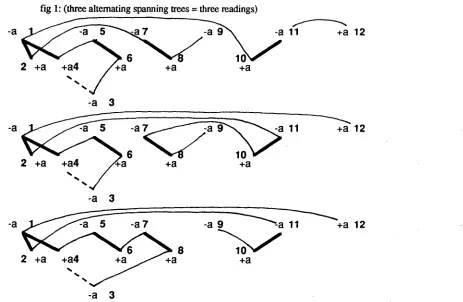
fig 1: (three alternating spanning trees = three readings)
-a -a 7 - a ~ i a 11
10,~ v
+a
-a 3
-a ~
a
~
a
11
2+a +a4 / a
+a
+a
-a ~
8 -a 9 ""'"~-a
-a 3
4-2-2 A sketch o f an algorithm
We scan the ordered list of nodes from left to right, creating links at each step, between the current node and all the possible mergeable nodes on its left or just shifting. When nodes are shifted, they are pushed onto a stack. Links are recorded on the chart in the following way. Each link is a node of the chart (in consequence, the chart has no more than n 2 nodes, where n is the number of nodes on the reading tape R). A link 1 is joined by arcs in the chart to all links already recorded 11 . . . . 1 n such that 1 makes a correct partial linking by insertion into the linkings represented by the paths arriving at 11 . . . . In. and 1 has a left extremity which coincides with either the rightmost right extremity of a link already recorded on such a path, or with a top of stack attached to such a previously recorded link. Thus, a link 1 may be an arriving point for several paths. In this case, we will consider 1 as a new starting point. That means that when joining a new link 1' to links above 1 in the chart, we only test the correctness of a partial linking down to the link I. We consider here that if 1 is in the chart at this place, there is necessarily a correct path up to it, and all the partial paths from I to the current node are, by definition, correct. Thus, when adding a link above 1 (and before a possible new "crossroads"), even if there are many paths joining I to it, there is at least one correct path from the bottom of the chart to the current node. Each time a link is recorded and joined to other ones, we record for each arc arriving at it, the possible tops of stack, the possible
+a 12
+a 12
11
+a 12
[image:7.596.47.510.81.383.2]the method is time-polynomial and more improvements can be expected in the future.
Example:
Suppose we have to demonstrate the sequent: ( a / a ) / ( a / a ) a / a a / a a a \ a --) a (cf fig 1)
At beginning steps 1, 2, 3, 4, nodes are pushed onto the top of the stack. At step 5, the link (4 5) is created and recorded in the chart. The new top of stack 3 is attached to it. At step 6, (3 6) is added (with new top of stack 2), on the top of the previous link. At step 7, (6 7) is created and joined to (4 5) (with top of stack 3) and not to (3 6) (because they have the node 6 in common). (2 7) is joined to (3 6) (with top of stack 1). At step 8, (3 8) is created and joined to (6 7) (with top of stack 2), but not to (2 7) because of anticolours (7 receives 913 and 8 receives ~ and they have same colour). (1 8) is not created because they have same colour. At step 9, (2 9) is created and joined to (3 8), and (8 9) is created too, but joined to (6 7) and (2 7). At step 10, (1 10) is joined to (8 9), (3 10) is joined to (8 9) and (6 7), (9 10) to (3 8). (7 10) is also joined to (8 9) and (3 8) because 7 is a rightmost right extremity in paths leading to these nodes. In such a circumstance, the node previously linked to the released right extremity, here 2 or 6 is pushed onto the stack. After that, (2 11) may be added to ' ( 7 10) and (9 10) but not to (2 11) because of anticolours. And finally, (1 12) may be joinedto (2 11) and (11 12) to (1 10). By looking at the list of nodes attached to links installed in the chart, we see that these last moves lead to complete linkings. By going down to the bottom of the chart, we find the three solutions: [1 [2 [3 [4 5] 6] 7] [8 9] 10][11 12], [1 [2 [3 [4 5] 6] [7 [8 9] 10] 11] 12] and [1 [2 [3 [4 5] [6 7] 8] [9 10] 11] 12] (cf fig 2).
fig2: the final chart.
(1 12)
(11
12)
--./
f
(7 10)
(3 10)
(1.10)
(9 10)
~
~
12 9)
(4 51
5- C o n c l u s i o n
We have presented a conception of parsing essentially based on a geometrical viewpoint. It amounts to build a
correct linking of nodes in an ordered sequence of types represented as trees. Such a linking corresponds to an alternating spanning tree in a graph. We have shown that this method is sound and complete with respect to the associative product free Lambek calculus and we have given an idea of what an algorithm for finding such a spanning tree could be.
References
[Ajduckiewicz,1935] K.Ajduckiewicz. Die Syntaktische Konnexitltt,
Studia Philosophica
1, 1-27, engl. transl. 'Syntactic Connexion', in S. McCall (ed)(1967), 207-231.[Busacker and Saaty, 1965] R.Busacker and T.Saaty.
Finite Graphs and Networks, An Introduction with
Applications,
McGraw-Hill, New-York.[Hepple, 1992] Mark Hepple. Chart Parsing Lambek Grammars: Modal extensions and lncrementality,
Proceedings of COLING,
Nantes, 23-28 july. [K6nig, 1991] Esther K6nig. Parsing CategorialGrammar, DYANA, deliverable 2.1.2.C., reproduced in [Lecomte, 1992a].
[KOnig, 1992] Esther KOnig. Chart Parsing and the Treatment of Word Order by Hypothetical Reasoning, in [Lecomte, 1992a].
[Lecomte, 1992a] Alain Lecomte
(ed.).Word Order in
Categorial Grammar,
ADOSA, Clermont-Ferrand. [Lecomte, 1992b] Alain Lecomte. Proof-Nets andDependencies,
Proceedings of COLING,
Nantes, 23- 28 july.[Moortgat, 1992] Michael Moortgat. Labelled Deductive Systems for categorial theorem proving.
Proceedings of the 8th Amsterdam Colloquium,
Dekker & Stokhof (eds).
[Roorda, 1991] Dirk Roorda.
Resource Logics: Proof-
theoretical Investigations,
PhD Thesis, Faculteit van Wiskunde en Informatica, Amsterdam.[Roorda, 1992] Dirk Roorda. Proof Nets for Lambek Calculus,