Projecting the Knowledge Graph to Syntactic Parsing
Andrea Gesmundo and Keith B. Hall Google, Inc.
{agesmundo,kbhall}@google.com
Abstract
We present a syntactic parser training paradigm that learns from large scale Knowledge Bases. By utilizing the Knowledge Base context only during training, the resulting parser has no inference-time dependency on the Knowl-edge Base, thus not decreasing the speed during prediction. Knowledge Base infor-mation is injected into the model using an extension to the Augmented-loss training framework. We present empirical results that show this approach achieves a signif-icant gain in accuracy for syntactic cat-egories such as coordination and apposi-tion.
1 Introduction
Natural Language Processing systems require large amounts of world knowledge to achieve state-of-the-art performance. Leveraging Knowl-edge Bases (KB) provides allows us to inject hu-man curated world-knowledge into our systems. As these KBs have increased in size, we are now able to leverage this information to improve upon the state-of-the-art. Large scale KB have been de-veloped rapidly in recent years, adding large num-bers of entities and relations between the entities. Such entities can be of any kind: an object, a per-son, a place, a company, a book, etc. Entities and relations are stored in association with rele-vant data that describes the particular entity or re-lation; for example, the name of a book, it’s author, other books by the same author, etc.. Large scale KB annotation efforts have focused on the collec-tion of both current and historical entities, but are biased towards the contemporary entities.
Of the many publicly available KBs, we focus this study on the use of Freebase1: a large
collab-orative Knowledge Base composed and updated by a member community. Currently it contains roughly 40 million entities and 1.1 billion rela-tions.
The aim of the presented work is to use the in-formation provided by the KB to improve the ac-curacy of the statistical dependency parsing task (Kubler et al., 2009). In particular we focus on the recognition of relations such as coordination and apposition. This choice is motivated by the fact that the KB stores information about real-world entities while many of the errors associated with coordination and apposition is the lack of knowl-edge of these real-world entities.
We begin by defining the task (section 2). Fol-lowing, we present the modified augmented-loss training framework (section 3). In section 4, we define how the Knowledge Base data is integrated into the training process. Finally, we discuss the empirical results (section 5).
2 Task
Apposition is a relation between two adjacent noun-phrases, where one noun-phrase specifies or modifying the other. For example, in the sentence “My friend Anna”, the nouns “friend” and “Anna” are in apposition. Coordination between nouns relates two or more elements of the same kind. The coordination is often signaled by the appear-ance of a coordinating conjunction. For example, in the sentence “My friend and Anna”, the nouns “friend” and “Anna” are in coordination. The se-mantic difference between the two relations is that the nouns in apposition refer to the same entity,
1www.freebase.com
while the nouns in coordination refer to distinct entities of the same kind or sharing some proper-ties.
Statistical parsers are inaccurate in classifying relations involving proper nouns that appear rarely in the training set. In the sentence:
“They invested in three companies, Google, Microsoft, and Yahoo.”
“companies” is in apposition with the coordina-tion “Google, Microsoft, and Yahoo”. By integrat-ing the information provided by a large scale KB into the syntactic parser, we attempt to increase the ability to disambiguate the relations involving these proper nouns, even if the parser has been trained on a different domain.
3 Model
We present a Syntactic Parsing model that learns from the KB. An important constraint that we im-pose, is that the speed of the Syntactic Parser must not decrease when this information is integrated. As the queries to the KB would significantly slow down the parser, we limit querying the KB to train-ing. This constraint reduces the impact that the KB can have on the accuracy, but allows us to design a parser that can be substituted in any setting, even in the absence of the KB.
We propose a solution based on the loss framework (Hall et al., 2011a). Augmented-loss is a training framework for structured predic-tion tasks such as parsing. It can be used to ex-tend a standard objective function with additional loss-functions and be integrated with the struc-tured perceptron training algorithm. The input is enriched with multiple datasets each associated with a loss function. The algorithm iterates over the datasets triggering parameter updates when-ever the loss function is positive.
Loss functions return a positive value if the pre-dicted output is “worse” than the gold standard. Augmented-loss allows for the inclusion of mul-tiple objective functions, either based on intrinsic parsing quality or task-specific extrinsic measures of quality. In the original formalization, both the intrinsic and extrinsic losses require gold standard information. Thus, each dataset must specify a gold standard output for each input.
We extend the Augmented-loss framework to apply it when the additional dataset gold-standard is unknown. Without the gold standard, it is not possible to trigger updates using a loss function.
Instead, we use asampling function, S(·), that is defined such that: if yˆ is a candidate parse tree, thenS(ˆy)returns a parse tree that is guaranteed to be “not worse” thany. In other words:ˆ
LS(ˆy, S(ˆy))≥0 (1)
Where theLS(·)is theimplicit loss function. This
formalization will allow us to avoid stating explic-itly the loss function. Notice thatS(ˆy)is not guar-anteed to be the “best” parse tree. It can be any parse tree in the search space that is “not worse” than y.ˆ S(ˆy) can represent an incremental im-provement overy.ˆ
Algorithm 1 Augmented-loss extension 1: {Input loss function:L(·)}
2: {Input sample function:S(·)} 3: {Input data sets}:
4: DL={dLi = (xLi, yiL)|1≤i≤NL} 5: DS ={dSi = (xSi)|1≤i≤NS} 6: θ=~0
7: repeat
8: fori= 1. . . NLdo 9: yˆ=Fθ(xLi )
10: ifL(ˆy, yiL)>0then 11: θ=θ+ Φ(yiL)−Φ(ˆy) 12: end if
13: end for
14: fori= 1. . . NSdo 15: yˆ=Fθ(xSi) 16: y∗ =S(ˆy)
17: θ=θ+ Φ(y∗)−Φ(ˆy) 18: end for
19: untilconverged 20: {Return modelθ}
Algorithm 1 summarizes the extension to the Augmented-loss algorithm.
The algorithm takes as input: the loss func-tionL(·); the sample functionS(·); the loss func-tion data samples DL; and the sample function
data samples DS. Notice that DL specifies the
gold standard parseyL
i for each input sentencexLi.
While,DSspecifies only the input sentencexS i.
The model parameter are initialized to the zero vector (line 6). The main loop iterates until the model reaches convergence (lines 7-19). After which the model parameters are returned.
The first inner loop iterates over DL (lines
xL
i , is predicted given the current model
parame-ters,θ(line 9). In the structured perceptron setting (Collins and Roark, 2004; Daum´e III et al., 2009), we have that:
Fθ(x) =argmaxy∈Y θ·Φ(y) (2)
WhereΦ(·)is the mapping from a parse treey to a high dimensional feature space. Then, the algo-rithm tests if the current prediction is wrong (line 10). In which case the model is updated promot-ing features that fire in the gold-standard Φ(yL
i ),
and penalizing features that fire in the predicted output,Φ(ˆy)(line 11).
The second inner loop iterates over DS (lines
14-18). First, the candidate parse,y, is predictedˆ (line 15). Then the sample parse, y∗, is
pro-duced by the sample function (line 16). Finally, the parameters are updated promoting the features of y∗. The updates are triggered without
test-ing if the loss is positive, since it is guaranteed that LS(ˆy, y∗) ≥ 0. Updating in cases where
LS(ˆy, y∗) = 0does not harm the model. To
opti-mize the algorithm, updates can be avoided when ˆ
y=y∗.
In order to simplify the algorithmic descrip-tion, we define the algorithm with only one loss function and one sample function, and we formal-ized it for the specific task we are considering. This definitions can be trivially generalized to in-tegrate multiple loss/sample functions and to be formalized for a generic structured prediction task. This generalization can be achieved following the guidelines of (Hall et al., 2011a). Furthermore, we defined the algorithm such that it first iterates over DLand then over DS. In practice, the algorithm
can switch between the data sets with a desired fre-quency by using a scheduling policy as described in (Hall et al., 2011a). For the experiments, we trained on 8 samples ofDLfollowed by 1 samples
ofDS, looping over the training sets.
4 Sample Function
We integrate the Knowledge Base data into the training algorithm using a sampling function. The idea is to correct errors in the candidate parse by using the KB. The sample function corrects only relations among entities described in the KB. Thus, it returns a better or equal parse tree that may still contain errors. This is sufficient to guar-antee the constraint on the implicit loss function (equation 1).
The sample function receives as input the can-didate dependency parse and the input sentence enriched with KB annotation. Then, it corrects the labels of each arc in the dependency tree con-necting two entities. The labels are corrected ac-cording to the predictions produced by a classifier. As classifier we use a standard multi-class percep-tron (Crammer and Singer, 2003). The classifier is trained in a preprocessing step on a parsed corpus enriched with KB data. The features used by the classifier are:
• Lexical features of the head and modifier. • Sentence level features: words distance
be-tween head and modifier; arc direction (L/R); neighboring words.
• Syntactic features: POS and syntactic label of head and modifier and modifier’s left sibling. • Knowledge Base features: types defined for
entities and for their direct relations. 5 Experiments
The primary training corpus is composed of manu-ally annotated sentences with syntactic tress which are converted to dependency format using the Stanford converter v1.6 (de Marneffe et al., 2006). We run experiments using 10k sentences or 70k sentences from this corpus. The test set contains 16k manually syntactically annotated sentences crawled from the web. The test and train sets are from different domains. This setting may degrade the parser accuracy in labelling out-of-domain en-tities, as we discussed in section 2. Thus, we use web text as secondary training set to be used for the Augmented-loss loss sample training. Web text is available in any quantity, and we do not need to provide gold-standard parses in order to integrate it in the Augmented-loss sample train-ing. The classifier is trained on 10k sentences ex-tracted from news text which has been automati-cally parsed. We chose to train the classifier on news data as the quality of the automatic parses is much higher than on general web text. We do this despite the fact that we will apply the classifier to a different domain (the web text).
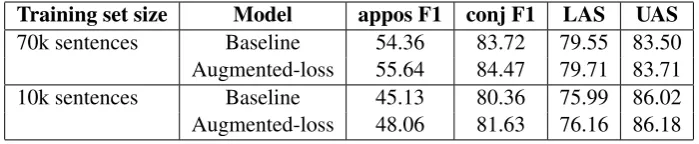
Training set size Model appos F1 conj F1 LAS UAS 70k sentences Baseline 54.36 83.72 79.55 83.50 Augmented-loss 55.64 84.47 79.71 83.71 10k sentences Baseline 45.13 80.36 75.99 86.02 Augmented-loss 48.06 81.63 76.16 86.18
Table 1: Accuracy Comparison.
the perceptron algorithm as in (Zhang and Clark, 2008) with a beam size of 16. The baseline is the same model but trained only the primary training corpus without Augmented-loss.
Table 1 reports the results of the accuracy com-parison. It reports the metrics for Labeled At-tachment Score (LAS) and Unlabeled AtAt-tachment Score (UAS) to measure the overall accuracy. The syntactic classes that are affected the most are ap-position (appos) and conjunction (conj). On the development set we measured that the percentage of arcs connecting 2 entities that are labeled as conjunction is 36.11%. While those that are la-belled as apposition is 25.06%. Each of the other 40 labels cover a small portion of the remaining 38.83%.
Training the models with the full primary train-ing corpus (70k sentences), shows a significant gain for the Augmented-loss model. Apposition F1 gains 1.28, while conjunction gains 0.75. The LAS gain is mainly due to the gain of the two men-tioned classes. It is surprising to measure a simi-lar gain also for the unlabeled accuracy. Since the classifier can correct the label of an arc but never change the structure of the parse. This implies that just by penalizing a labeling action, the model learns to construct better parse structures.
Training the model with 10k sentences shows a significantly bigger gain on all the measures. This results shows that, in cases where the set of la-beled data is small, this approach can be applied to integrate in unlimited amount of unlabeled data to boost the learning.
6 Related Work
As we mentioned, Augmented-loss (Hall et al., 2011a; Hall et al., 2011b) is perhaps the closest to our framework. Another difference with its origi-nal formalization is that it was primarily aimed to cases where the additional weak signal is precisely what we wish to optimize. Such as cases where we wish to optimize parsing to be used as an input to a downstream natural language processing tasks
and the accuracies to be optimized are those of the downstream task and not directly the parsing ac-curacy. While our work is focused on integrating additional data in a semi-supervised fashion with the aim of improving the primary task’s accuracy and/or adapt it to a different domain.
Another similar idea is (Chang et al., 2007) which presents a constraint driven learning. In this study, they integrate a weak signal into the training framework with the aim to improve the structured prediction models on the intrinsic evaluation met-rics.
7 Conclusion
We extended the Augmented-loss framework defining a method for integrating new types of sig-nals that require neither gold standard data nor an explicit loss function. At the same time, they al-low the integration of additional information that can inform training to learn for specific types of phenomena.
This framework allows us to effectively inte-grate large scale KB in the training of structured prediction tasks. This approach integrates the data at training time without affecting the prediction time.
Experiments on syntactic parsing show that a significant gain for categories that model relation between entities defined in the KB.
References
Ming-Wei Chang, Lev Ratinov, and Dan Roth. 2007. Guiding semi-supervision with constraint-driven
learning. InACL ’07: Proceedings of the 45th
Con-ference of the Association for Computational Lin-guistics.
Michael Collins and Brian Roark. 2004. Incremental
parsing with the perceptron algorithm. InACL ’04:
Proceedings of the 42rd Conference of the Associa-tion for ComputaAssocia-tional Linguistics.
Koby Crammer and Yoram Singer. 2003. Ultracon-servative online algorithms for multiclass problems.
Hal Daum´e III, John Langford, and Daniel Marcu.
2009. Search-based structured prediction.
Submit-ted to Machine Learning Journal.
Marie-Catherine de Marneffe, Bill MacCartney, and Christopher D. Manning. 2006. Generating typed dependency parses from phrase structure trees. In
LREC.
Keith Hall, Ryan McDonald, Jason Katz-brown, and Michael Ringgaard. 2011a. Training dependency parsers by jointly optimizing multiple objectives. In
EMNLP ’11: Proceedings of the 2011 Conference on Empirical Methods in Natural Language Pro-cessing.
Keith Hall, Ryan McDonald, and Slav Petrov. 2011b. Training structured prediction models with extrinsic
loss functions. InDomain Adaptation Workshop at
NIPS, October.
Sandra Kubler, Ryan McDonald, and Joakim Nivre.
2009. Dependency parsing. In Synthesis Lectures
on Human Language Technologies. Morgan & Clay-pool Publishers.
Joakim Nivre. 2008. Algorithms for deterministic in-cremental dependency parsing. volume 34, pages 513–553.
Yue Zhang and Stephen Clark. 2008. A tale of two parsers: Investigating and combining graph-based and transition-graph-based dependency parsing. In