Search-Aware Tuning for Hierarchical Phrase-based Decoding
Feifei ZhaiQueens College City University of New York
Liang Huang Kai Zhao
Queens College & Graduate Center City University of New York
{lianghuang.sh,kzhao.hf}@gmail.com
Abstract
Parameter tuning is a key problem for sta-tistical machine translation (SMT). Most popular parameter tuning algorithms for SMT are agnostic of decoding, result-ing in parameters vulnerable to search er-rors in decoding. The recent research of “search-aware tuning” (Liu and Huang, 2014) addresses this problem by consid-ering the partial derivations in every de-coding step so that the promising ones are more likely to survive the inexact de-coding beam. We extend this approach from phrase-based translation to syntax-based translation by generalizing the eval-uation metrics for partial translations to handle tree-structured derivations in a way inspired by inside-outside algorithm. Our approach is simple to use and can be ap-plied to most of the conventional parame-ter tuning methods as a plugin. Extensive experiments on Chinese-to-English trans-lation show significant BLEU
improve-ments on MERT, MIRAand PRO. 1 Introduction
Efforts in parameter tuning algorithms for SMT, such as MERT (Och, 2003; Galley et al., 2013),
MIRA(Watanabe et al., 2007; Chiang et al., 2009;
Cherry and Foster, 2012; Chiang, 2012), and PRO (Hopkins and May, 2011) have improved
the translation quality considerably in the past decade. These tuning algorithms share the same characteristic that they treat the decoder as a black box. This decoding insensitiveness has two ef-fects: 1) the parameter tuning algorithm can be more general to choose the most effective decod-ing paradigm for different language pairs; 2) how-ever, it also means that the learned parameters may not fit the decoding algorithm well, so that promis-ing partial translations might be pruned out due to the beam search decoding.
Recent researches reveal that the parameter tun-ing algorithms tailored for specific decodtun-ing al-gorithms can be beneficial in general structured prediction problems (Huang et al., 2012), and in machine translation (Yu et al., 2013; Zhao et al., 2014; Liu and Huang, 2014). Particularly, Liu and Huang (2014) show that by requiring the conven-tional parameter tuning algorithms to consider the final decoding results (full translations) as well as the intermediate decoding states (partial transla-tions) at the same time, the inexact decoding can be significantly improved so that correct interme-diate partial translations are more likely to survive the beam. However, the underlying phrase-based decoding model suffers from limited distortion, and thus, may not be flexible enough for translat-ing language pairs that are syntactically different, which require long distance reordering.
In order to better handle long distance reorder-ing which beyonds the capability of phrase-based MT, we extend the search-aware tuning frame-work from phrase-based MT to syntax-based MT, in particular the hierarchical phrase-based transla-tion model (HIERO) (Chiang, 2007).
One key advantage of search-aware tuning for previous phrase-based MT is the minimal change to existing parameter tuning algorithms, which is achieved by defining BLEU-like metrics for
the intermediate decoding states with sequence-structured derivations. To keep our approach simple, we generalize these BLEU-like metrics
to handle intermediate decoding states with tree-structured derivations in HIERO, which are
cal-culated by dynamic programming algorithms in-spired by the inside-outside algorithm.
We make the following contributions:
1. We extend the framework of search-aware tuning methods from phrase-based transla-tion to syntax-based translatransla-tion. This exten-sion is simple to be applied to most conven-tional parameter tuning methods, requiring minimal extra changes to existing algorithms.
2. We propose two BLEUmetrics and their
vari-ants to evaluate partial derivations. In order to efficiently compute the new BLEUmetrics,
we investigate dynamic programming based algorithms to recover the good partial deriva-tions for search-aware tuning.
3. Our method obtains significant improve-ments on large-scale Chinese-to-English translation on top of MERT, MIRA and PRO
baselines.
2 Hierarchical Phrase-based Decoding
We first briefly describe the hierarchical phrase-based translation (Chiang, 2007), HIERO, by a
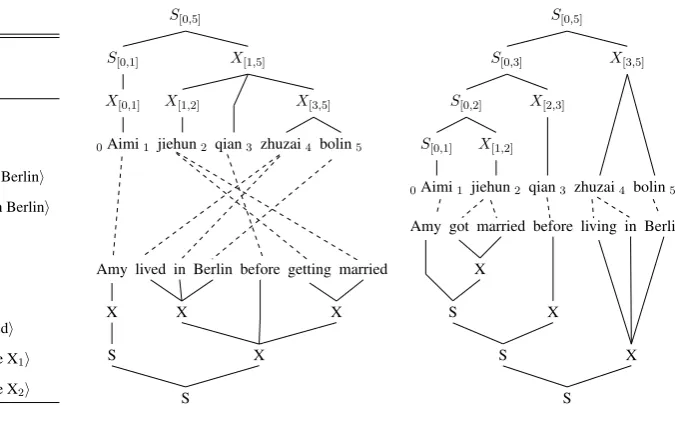
Chinese-English translation example (Figure 1). A HIERO decoder translates a source sentence
by using a synchronous grammar (Figure 1 (a)) to parse it into a bilingual derivation tree, as shown in Figure 1 (b) and Figure 1 (c). An example rule of the synchronous grammar is
r8:X→ hX1qian X2, X2before X1i,
where the left-hand-side is a non-terminal symbol, and the right-hand-side is a pair of source and tar-get strings, each of which consists a sequence of lexical terminals and non-terminals. Specifically, the same subscript on both sides denotes a one-to-one correspondence between their non-terminals. We use |r| to denote the arity of rule r, i.e., the number of non-terminals. Usually, the rule used in HIEROsystem has a maximum arity 2.
Let hx, yi be a Chinese-English sentence pair in tuning set, the HIERO decoder will generate a
derivation tree for it (Figure 1 (b)), which can be defined recursively in afunctionalway:
d=
r |r|= 0
r(d1) |r|= 1
r(d1, d2) |r|= 2, (1)
where d is a (partial) derivation, i.e., the (sub-) derivation tree. Whenr is a fully lexicalized rule (|r| = 0), the decoder generates a tree node di-rectly (e.g., X[3,5] in Figure 1 (b)). If|r| > 0, a
new (partial) derivation will be created by apply-ing r to its children nodes. In our notation, we denote this process as applying a function of rule
r to its arguments. For example, node X[1,5] in
Figure 1(b) is created by applying ruler8 in
Fig-ure 1(a), where the arguments ared1 =X[1,2]and d2=X[3,5]respectively.
Practically, we organize the partial derivations based on spans in HIEROdecoder, and use a beam B[i,j]to keep thek-best partial derivations for each
span[i, j]:
B[i,j]=topkw(D[i,j]),
whereD[i,j]is the set of all possible partial deriva-tions for span[i, j], andtopk
w(·)returns the topk
ones according to the current modelw. Figure 2 shows an example of the HIERO beam-search
de-coding.
3 Search-Aware Tuning forHIERO
As we discussed in Section 1, current tuning meth-ods for HIEROsystem (MERT, MIRA, or PRO) are
mostly search-agnostic. They only consider the
completetranslations in final beamB[1,|x|], but
ig-nore the partial ones in the intermediate beams. However, because MT decoding is inexact (beam-search), many potentially promising derivations might be pruned before reaching the final beam (e.g., the partial derivationX[1,5]of Figure 1(b) is pruned in beamB[1,5]in Figure 2). Consequently,
once we lose these good partial derivations in de-coding, it is hard to promote them by these search-agnostic tuning methods.
In order to address this problem, search-aware tuning (Liu and Huang, 2014) aims to promote not only the accurate complete translations in the final beam, but more importantly those promising par-tial derivations in non-final beams.
In this section, we apply search-aware tuning to HIERO system. Similar to the phrase-based one,
the key challenge here is also the evaluation of par-tial derivations. Following (Liu and Huang, 2014), we design two different evaluation metrics,partial
BLEUandpotentialBLEUrespectively for HIERO
decoding.
3.1 PartialBLEU
Given a partial derivationdof span[i, j], partial
BLEU evaluates it by comparing its partial
trans-lation e(d) directly with the (full) reference. We explore two different partial BLEUmeasures here: full partialBLEUand span partialBLEU.
Full partialBLEUis similar to the one used in
(Liu and Huang, 2014), which comparese(d)with the full referenceyand computes BLEUscore
id rule
r0 S→ hX1,X1i
r1 S→ hS1X1,S1X1i
r2 X→ hAimi,Amyi
r2 X→ hAimi,Amy hasi
r3 X→ hzhuzai bolin,lived in Berlini
r3 X→ hzhuzai bolin,living in Berlini
r4 X→ hqian,beforei
r5 X→ hqian,formeri
r6 X→ hjiehun,got marriedi
r7 X→ hjiehun,getting marriedi
r8 X→ hX1qian X2,X2before X1i
r9 X→ hX1qian X2,X1before X2i
S[0,5]
X[1,5]
X[3,5]
bolin5
zhuzai4
qian3
X[1,2]
jiehun2
S[0,1]
X[0,1]
0Aimi1
S
X
X married getting before
X Berlin in lived
S X Amy
S[0,5]
X[3,5]
bolin5
zhuzai4
S[0,3]
X[2,3]
qian3
S[0,2]
X[1,2]
jiehun2
S[0,1]
0Aimi1
S X
Berlin in living
S X before
S X
married got Amy
[image:3.595.182.520.63.281.2](a) HIEROrules (b) good derivation (c) bad derivation
Figure 1: An example of HIEROtranslation.
B[0,1] B[1,2] B[2,3] B[3,4] B[4,5] B[3,5]
B[0,2] B[0,3]
B[0,5]
B[1,5]
at Berlin living in
lived in
Berlin former
before got married
getting married Amy
Amy has
living in Berlin lived in Berlin Amy got married
Amy has got married Amy got married before Amy has got married before
got married before living in Berlin getting married before living in Berlin Amy got married before living in Berlin
Amy has got married before living in Berlin
Aimi jiehun qian zhuzai bolin
0 1 2 3 4 5
Figure 2: An example of HIERO beam search
decoding (beam size = 2). We can see the good derivation (Figure 1(b)) is pruned very early, while the bad derivation (Figure 1(c)) ranks first at the fi-nal beam.
the number of translated source words). See (Liu and Huang, 2014) for more details.
Span partial BLEU differs from full partial
BLEU by creating aspan referencefor span [i, j]
to evaluate its partial derivations, rather than us-ing the full reference. We use word alignment to determine the span references of different spans.
Specifically, we first add the tuning set into train-ing data, and then run GIZA++ to get the word alignment. For a pair of source and target span which are consistent with word alignment1, the
string of target span is used as the span reference for the source span.2 For example, in Figure 1(b),
the span reference of source span[1,5]is “lived in Berlin before getting married”.
Partial BLEU is quite an intuitive choice for
evaluating partial derivations. However, as Liu and Huang (2014) discussed, partial BLEU only
evaluates the partial derivation itself without con-sidering any of its context information, leading to a performance degradation. Thus, in order to take the context information into account, we investi-gate a more reasonable metric, potential BLEU, in
the next section.
3.2 PotentialBLEU
Potential BLEU evaluates the partial derivation dby assessing its potential, which is a complete translation generated from d, rather thane(d) as in partial BLEU. In phrase-based decoding, Liu
1Two spans are consistent with word alignment means that words in one span only align to words in the other span via word alignment, and vice versa.
[image:3.595.75.290.371.567.2]and Huang (2014) introduce a future stringf(d)
to denote the translation of the untranslated part, and get the potential of dby concatenating e(d)
andf(d).
Different from their work, we define anoutside stringfordin HIEROsystem. Suppose a complete
translation generated fromdise¯(d), it can be de-composed as follows:
¯
e(d) =η(d)◦e(d)◦ξ(d) (2) where ◦ is an operator that concatenates strings monotonically,η(d)andξ(d)are the left and right parts of e¯(d) apart frome(d), which we call left
andright future stringsofd. The pair ofη(d)and
ξ(d)is defined as the outside string ofd:
O(d) =hη(d), ξ(d)i
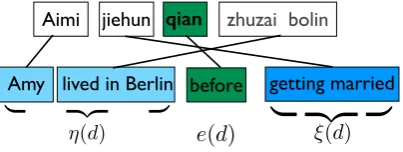
An example of the outside string is shown in Fig-ure 3. Assume we are evaluating the partial deriva-tion which translates Chinese word “qian” to En-glish word “before”, and get a complete transla-tion “Amy lived in Berlin before getting married” from it, then its outside string would be:
hAmy lived in Berlin, getting marriedi
⌘(d) ⇠(d)
8 > > > > > > < > > > > > > :
jiehun
Aimi zhuzai bolin
lived in Berlin
Amy getting married
e(d) before
qian
8 > <
> :
Figure 3: Example of outside string when we use“Amy lived in Berlin before getting married” as the potential for the partial derivation which trans-lates word “qian” to “before”.
Theoretically, different partial derivations of the same span could have different outside strings. To simplify the problem, we use the same outside string for all partial derivations of the same span. The outside string for span[i, j]is defined as:
O([i, j]) =hη([i, j]), ξ([i, j])i
For a specific partial derivationdof span [i, j], by combiningO([i, j])ande(d), we can compute its potential BLEU against the reference.
Appar-ently, different outside string will lead to different potential BLEU score. In the rest of this section,
we will explore three different methods to gener-ate outside strings.
3.2.1 Concatenation
In order to generate outside string, one simple and straightforward way is concatenation. For a spe-cific span [i, j], we first get the best translation of its adjacent spans[0, i]and[j,|x|](e([0, i])and
e([j,|x|])respectively).3 Then for a partial
deriva-tiondof span[i, j], we generate the outside string ofdbyconcatenation
η([i, j]) =e([0, i]) ξ([i, j]) =e([j,|x|]) ¯
ex(d) =e([0, i])◦e(d)◦e([j,|x|])
Also take the example of Figure 3, if we per-form concatenation on it, the outside string of the corresponding partial derivation is:
hAmy getting married, lived in Berlini.
Obviously, this outside string is not good, since it does not consider the reordering between spans. In order to incorporate reordering into outside string, we propose a new top-down algorithm in the next subsection.
3.2.2 Top-Down
Top-down method (Algorithm 1) is defined over the derivation tree, and takes the complete transla-tions in the final beam as the potential for comput-ing potential BLEU.
Suppose we have a partial derivation d = r(d1, d2) as shown in Formula 1, and the target
side string of ruleris:
w1· · ·wpX1wq· · ·wmX2wn· · ·wl
The corresponding(partial) translatione(d)ofd
could be generated by applying anr-based func-tioner(·)withd1andd2 as the arguments:
er(d1, d2) =w1···wpe(d1)wq···wme(d2)wn···wl
wheree(d1) ande(d2)are the partial translations ofd1andd2. We can further decomposeer(d1, d2)
based one(d1):
w1· · ·wp
| {z }
ηd(d1)
e(d1) |wq· · ·wm e{z(d2) wn· · ·w}l ξd(d1)
.
[image:4.595.80.282.418.494.2]Algorithm 1Top-Down Outside String.
1: functionTOPDOWN(d) 2: r←the rule that generatesd
3: foreach non-terminalxin rulerdo 4: η(dx) =η(d)◦ηd(dx)
5: ξ(dx) =ξd(dx)◦ξ(d) 6: TOPDOWN(dx) 7: return
to the outside cost of inside-outside algorithm, we compute the outside string hη(d1), ξ(d1)i for d1
based on the decomposition:
η(d1) =η(d)◦ηd(d1) ξ(d1) =ξd(d1)◦ξ(d).
Similarly, if we decompose er(d1, d2) based on
e(d2)we have:
w1· · ·wp e(d1) wq· · ·wm
| {z }
ηd(d2)
e(d2) w| {z }n· · ·wl ξd(d2)
,
and the outside stringhη(d2), ξ(d2)iford2is:
η(d2) =η(d)◦ηd(d2) ξ(d2) =ξd(d2)◦ξ(d).
The top-down method works based on the above decompositions. For a complete translation in the final beamB[0,|x|], the algorithm tracebacks on its
derivation tree, and gets the outside string for all spans in the derivation. Taking the span[1,2] in Figure 1(b) as an example, if we do top-down, its outside string would be:
hAmy lived in Berlin before, i.
where denotes the empty string. Compared to the concatenation method, top-down is able to consider the reordering between spans, and thus would be much better. However, since it bases on thek-best list in the final beam, it can only handle the spans appearing in the finalk-best derivations. In our experiments, top-down algorithm only cov-ers about 30% of all spans.4 In order to
incorpo-rate more spans into search-aware tuning, we en-hance the top-down algorithm and propose guided backtrace algorithm in the next subsection. 3.2.3 Guided Backtrace
The guided backtrace algorithm is a variation of top-down method. In guided backtrace, we first 4We do not consider the hypothesis recombination in top-down algorithm.
introduce a container s[i,j] to keep a best partial derivation for each split point of[i, j]during de-coding.5 Hence, there will be at most j−i
par-tial derivations ins[i,j].6For instance, suppose the
span is[2,5], we will keep three partial derivations ins[i,j]for split point 2, 3, and 4 respectively.
Dif-ferent from the similark-best list in the decoding beam,s[i,j]introduces more diverse partial deriva-tions for backtracing, and thus could help to cover more spans.
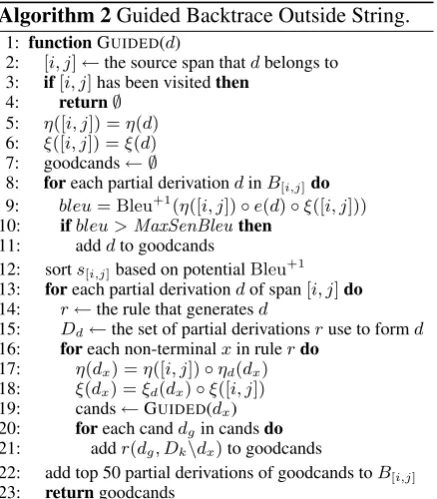
After decoding, we employ algorithm 2 to do backtrace. The algorithm starts from the best translation in the final beam. At first, we get the corresponding span of the input partial derivation
d (line 2), and the outside string for this span (line 5-6). We then sort the partial derivations ins[i,j] based on their potentialBleu+1 (line 12).
Thus, the sorting will guide us to first backtrace the partial derivations with better potentialBleu+1
scores. Then we traverse all these partial deriva-tions (line 13-14), and do guided backtrace recur-sively on its child partial derivations (line 16-19). In this process, about 90% of all spans are visited in our experiments. We demand each span will only be visited once (line 3-4),
During the above process, guided backtrace will collect good partial derivations which have bet-ter potentialBleu+1 scores than the best Bleu+1
scoreMaxSenBleuof the final beam (line 10-11) into goodcands. Meanwhile, we also collect the good partial derivations from descendant nodes (line 19), and apply ruler to them to form good partial derivations for span[i, j](line 20-21). At last, we add the top 50 good partial derivations to the beamB[i,j]for tuning (line 22).
The purpose of adding good partial derivations for tuning is to recover the good ones pruned out of the beam. For example, the partial derivation
X[1,5]in Figure 1 has been pruned out of the beam B[1,5]in Figure 2. If we only consider the partial derivations in the beam, it is still hard to promote it. After adding good partial derivations, we will have more good targets to do better tuning.
From Algorithm 2, we can also get a new way to compute oracle BLEUscore of a translation
Algorithm 2Guided Backtrace Outside String.
1: functionGUIDED(d)
2: [i, j]←the source span thatdbelongs to 3: if[i, j]has been visitedthen
4: return∅ 5: η([i, j]) =η(d) 6: ξ([i, j]) =ξ(d) 7: goodcands← ∅
8: foreach partial derivationdinB[i,j]do 9: bleu= Bleu+1(η([i, j])◦e(d)◦ξ([i, j]))
10: ifbleu >MaxSenBleuthen
11: adddto goodcands
12: sorts[i,j]based on potentialBleu+1
13: foreach partial derivationdof span[i, j]do 14: r←the rule that generatesd
15: Dd←the set of partial derivationsruse to formd
16: foreach non-terminalxin rulerdo 17: η(dx) =η([i, j])◦ηd(dx) 18: ξ(dx) =ξd(dx)◦ξ([i, j]) 19: cands←GUIDED(dx) 20: foreach canddgin candsdo
21: addr(dg, Dk\dx)to goodcands
22: add top 50 partial derivations of goodcands toB[i,j]
23: returngoodcands
tences in the tuning or test set, and use them to compute BLEUscore of the set. This can be seen
as an approximation upper bound of the current model and decoder, which we callguided oracle.
3.3 Implementation
The major process of search-aware tuning is sim-ilar to traditional tuning pipeline. We first decode the source sentence, and then output both the com-plete translations in the final beam and the partial derivations from the shorter spans as training in-stances. For potential BLEU, the outputs of
par-tial derivations would be the corresponding com-plete translations generated by Equation (2). If we use partial BLEU, the outputs are the
correspond-ing partial translations. Each span will serve as a single tuning instance. Different from (Liu and Huang, 2014), we only use the features from par-tial derivations for tuning.
For the spans that top-down or guided backtrace algorithm cannot get outside strings, we use con-catenation for them to maintain consistent number of tuning instances between different tuning iter-ations. However, since we do not want to spent much effort on them, we only use the one-best par-tial derivation for each of them.
4 Experiments
To evaluate our method, we conduct experiments on Chinese-to-English translation. The train-ing data includes 1.8M biltrain-ingual sentence pairs,
with about 40M Chinese words and 48M English words. We generate symmetric word alignment using GIZA++ and thegrow-diag-final-and strat-egy. We train a 4-gram language model on the Xinhua portion of English Gigaword corpus by SRILM toolkit (Stolcke, 2002). We use BLEU
4 with “average reference length” to evaluate the translation performance for all experiments.
We use the NIST MT 2002 evaluation data (878 sentences) as the tuning set, and adopt NIST MT04 (1,789 sentences), MT05 (1,082 sentences), MT06 (616 sentences from new portion) and MT08 (691 sentences from new portion) data as the test set.
Our baseline system is an in-house hierarchical phrase-based system. The translation rules are ex-tracted with Moses toolkit (Koehn et al., 2007) by default settings. For the decoder, we set the beam size to 30, nbest list to 50, and 20 as the maximum length of spans for using non-glue rules.
The baseline tuning methods are batch tun-ing methods based onk-best translations, includ-ing MERT (Och, 2003), MIRA (Cherry and
Fos-ter, 2012) and PRO (Hopkins and May, 2011)
from Moses. Another baseline tuning method is hypergraph-MERTfromcdectoolkit (Dyer et al.,
2010). To guarantee the tuning efficiency, we con-strain the minimum length of spans for search-aware tuning to restrict the number of training in-stances. For the sentences with less than 20 words, we only use the spans longer than 0.75 times sen-tence length. For the ones with more than 20 words, the minimum span length is set to 18.7 All
results are achieved by averaging three indepen-dent runs for fair comparison (Clark et al., 2011).
[image:6.595.73.292.62.312.2]4.1 Translation Results
Table 1 compares the main results of our MERT
-based search-aware tuning with traditional tuning: MERTand hypergraph-MERT.
From the results, we can see that hypergraph-MERT is better than MERT by 0.5 BLEU points,
verifying the result of (Kumar et al., 2009). For search-aware tuning, partial BLEU (both full and
span one) only gets comparable results with base-line tuning method, confirming our previous anal-ysis in section 3.1, and the results are also consis-tent with (Liu and Huang, 2014).
nist03 nist04 nist05 nist06 nist08 avg.
MERT 34.4 35.9 34.2 31.9 28.2 32.9
MERT-S 34.3 36.1 34.3 32.3 28.5 33.1
hypergraph-MERT 34.5 36.4 34.4 33.0 28.9 33.4
full partial BLEU 34.3 35.9 34.1 32.4 28.1 33.0
span partial BLEU 34.1 36.1 34.5 32.5 28.4 33.1
concatenation 34.3 36.4 34.6 33.1 28.5 33.4
top-down 34.5 36.6 34.5 33.1 28.9 33.5
[image:7.595.140.458.60.190.2]guided backtrace 34.9 36.9 35.2 33.7 29.1 34.0
Table 1: MERTresults: BLEUscores the test sets (nist03, nist04, nist05, nist06, and nist08). MERT-S is
an enhanced version of MERT, which uses a beam size 200 and nbest list 200 for tuning, and beam size
30 for testing.
methods nist02 nist04 1-best guided backtraceMERT +0.536.1 35.9+1.0
k-best Oracle guided backtraceMERT +1.143.3 42.8+1.2
[image:7.595.331.500.256.301.2]Guided Oracle guided backtraceMERT +1.448.0 47.2+1.4
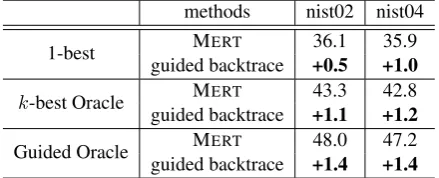
Table 2: The oracle BLEU comparison between
baseline MERTand guided backtrace.
Compared to partial BLEU, potential BLEU is
more helpful. Both concatenation and top-down method are better than MERTon all five test sets.
Guided backtrace gets the best performance over all methods. It outperforms traditional MERT
by 1.1 BLEU points on average, and better than
hypergraph-MERTby 0.6 BLEUpoints.
4.2 Analysis
In this section, we analyze the results of search-aware tuning by comparing MERT-based baseline
and guided backtrace in detail.
[image:7.595.73.293.257.346.2]Oracle BLEU We first compare the oracle BLEU scores of baseline and guided backtrace in
Table 2. In order to get thek-best oracle, we first look for the bestBleu+1 translation in the k-best
list for each source sentence, and then use these best translations to compute the BLEUscore of the
entire set. To get the guided oracle, we use the weights from baseline MERTto run Algorithm 2
on tuning set (nist02) and nist04 test set, and gen-erate the best oracle translation (section 3.2.3) for each source sentence for evaluation.
The final oracle BLEUcomparison is shown in
Table 2. On both nist02 tuning set and nist04 test set, guided backtrace method gains at lease 1.0
nist02 nist04
MERT 0.3960 0.3791
guided backtrace 0.4098 0.3932 Table 3: The diversity comparison based onk-best list in the final beam on both tuning set (nist02) and nist04 test set. The higher the value is, the more diverse thek-best list is.
BLEUpoints improvements over traditional MERT
on both k-best oracle and guided oracle. More-over,k-best and guided oracle get more improve-ments than1-best, indicating that by search-aware tuning, the decoder could generate a betterk-best list, and has a higher upper bound.
Diversity As shown in (Gimpel et al., 2013; Liu and Huang, 2014), diversity is important for MT tuning. An k-best list with higher diversity can better represent the entire decoding space, and thus tuning on it will lead to a better performance. Similar as (Liu and Huang, 2014), our method encourages the diversity of partial translations in each beam, including the ones in the final beam. We use the metric in (Liu and Huang, 2014) to compare the diversity of traditional MERT and
guided backtrace. The metric is based on then -gram matches between two sentencesyandy0:
∆(y, y0) =− |yX|−q
i=1
|y0|−q X
j=1
hyi:i+q=yj0:j+qi
d(y, y0) = 1− 2×∆(y, y0)
∆(y, y) + ∆(y0, y0),
whereq=n−1andhxiequals to1ifxis true,0
[image:7.595.329.506.635.703.2]33 34 35 36 37
2 4 8 16 30
BLEU
Beam Size Guided Backtrace
[image:8.595.312.522.66.220.2]MERT
Figure 4: The BLEU comparison between MERT
and guided backtrace on nist04 test set over differ-ent beam sizes.
Beam Size As we discussed before, search-aware tuning helps to accommodate search errors in decoding, and promotes good partial deriva-tions. Thus, we believe that even with a small beam, these good partial derivations can still sur-vive with search-aware tuning, resulting in a good translation quality. Figure 4 compares the results of different beam sizes (2,4,8,16,30) between traditional MERTand guided backtrace. The
com-parison shows that guided backtrace achieves bet-ter result than baseline MERT, and when the beam
is smaller, the improvement is bigger. More-over, guided backtrace method with a beam size 8 could achieve comparable BLEU score to
tradi-tional MERTwith beam size 30.
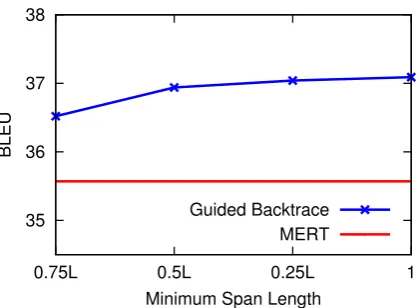
Span SizeFor a big tuning set, in order to make the tuning tractable, we constrain the length of spans for search-aware tuning. Intuitively, towards search-aware tuning, more spans will get better re-sults because we have more training instances to guide the tuning process, and accommodate search errors in early decoding stage (shorter spans). To verify this intuition, we perform experiments on a small tuning set, which is generated by select-ing the sentences with less than 20 words from the original NIST MT 02 tuning set.
Figure 5 compares the results of traditional MERT and guided backtrace over different
mini-mum span length. The curve in the figure shows that by using more spans for search-aware tuning, we can achieve better translation performance.
35 36 37 38
0.75L 0.5L 0.25L 1
BLEU
Minimum Span Length Guided Backtrace
[image:8.595.76.289.66.218.2]MERT
Figure 5: The BLEU comparison between MERT
and guided backtrace on nist04 test set over dif-ferent span sizes. L denotes the sentence length. The value ofx-axis refers to the minimum length of spans used for search-aware tuning. More spans will be used in tuning with smaller minimum span length.
4.3 MIRA and PRO Results
Table 4 and Table 5 shows the final results of MIRAand PRO for traditional tuning and
search-aware tuning using potential BLEU. We can see
that potential BLEU is helpful for tuning. Guided
backtrace is also the best one, which outperforms the baseline MIRAand PROby 0.9 and 0.8 BLEU
points on average.
4.4 Efficiency
Table 6 shows the training time comparisons be-tween search-aware tuning and traditional tuning. From this Table, we can see that search-aware tun-ing slows down the traintun-ing speed.8 The slow
training is due to three reasons.
Similar to (Liu and Huang, 2014), as search-aware tuning considers partial translations of spans besides the complete translations, it has much more training instances than traditional tun-ing. In our experiments, although we have con-strained the length of spans, we get a total of 38,539 instances for search-aware tuning, while it is 878 for traditional tuning.
Another time consuming factor is the compu-tation ofBleu+1 scores. In guided backtrace
set-ting, we need to compute theBleu+1scores for all
candidates of spans we consider. This is why the
nist03 nist04 nist05 nist06 nist08 avg.
MIRA 34.5 36.1 34.4 32.1 28.5 33.1
concatenation 34.5 36.5 34.6 33.6 28.9 33.6
top-down 34.4 36.6 34.6 33.5 28.8 33.6
[image:9.595.143.453.62.135.2]guided backtrace 35.0 36.9 35.1 33.7 29.1 34.0
Table 4: MIRAresults: BLEUscores on test sets (nist03, nist04, nist05, nist06, and nist08).
nist03 nist04 nist05 nist06 nist08 avg.
PRO 34.2 36.1 33.9 32.3 28.7 33.1
concatenation 34.6 36.2 34.7 32.3 28.5 33.2
top-down 34.8 36.4 34.7 32.7 29.0 33.5
guided backtrace 35.0 36.8 34.7 33.4 29.6 33.9
Table 5: PROresults: BLEUscores on test sets (nist03, nist04, nist05, nist06, and nist08). Similar to (Liu
and Huang, 2014), there is also an monster phenomenon (Nakov et al., 2013) in our search-aware tuning setting. Therefore, here we perform search-aware tuning on only 109 short sentences (with less than 10 words) from nist02.
MERT MIRA
Total Optim. Total Optim.
baseline 17 2 17 2
concatenation 59 44 38 23
top-down 31 14 23 8
guided backtrace 108 45 69 22
Table 6: Comparison on training efficiency. The time (in minutes) is measured at the last iteration of tuning. Column “Total” refers to the time for an entire iteration, while “Optim.” is the time of op-timization. We use a parallelized MERTfor tuning
by 24 cores.
decoding of guided backtrace is much slower than baseline or top-down.
Finally, adding good candidates enlarges thek -best lists of training instances, which further slows down the tuning process of guided backtrace.
It should be noted that although search-aware tuning is slower than traditional tuning method, since the decoding is all the same for them in test-ing time, it does not slow down the testtest-ing speed.
5 Conclusion
We have presented an extension of “search-aware tuning” to accommodate search errors in hier-archical phrase-based decoding and promote the promising partial derivations so that they are more likely to survive in the inexact beam search. In order to handle the tree-structured derivations for HIERO system, we generalize the BLEU metrics
and propose corresponding partial BLEU and
po-tential BLEU to evaluate partial derivations. Our
approach can be used as a plugin for most popu-lar parameter tuning algorithms including MERT,
MIRAand PRO. Extensive experiments confirmed
substantial BLEUgains from our method. 6 Acknowledgment
We thank the three anonymous reviewers for the valuable suggestions. This project was supported in part by DARPA FA8750-13-2-0041 (DEFT), NSF IIS-1449278, and a Google Faculty Research Award.
References
Colin Cherry and George Foster. 2012. Batch tuning strategies for statistical machine translation. In Pro-ceedings of the 2012 Conference of the North Amer-ican Chapter of the Association for Computational Linguistics: Human Language Technologies, pages 427–436, Montr´eal, Canada, June. Association for Computational Linguistics.
David Chiang, Kevin Knight, and Wei Wang. 2009. 11,001 new features for statistical machine transla-tion. InProceedings of NAACL 2009.
David Chiang. 2007. Hierarchical phrase-based trans-lation.Computational Linguistics, 33(2):201–208. David Chiang. 2012. Hope and fear for discriminative
training of statistical translation models. J. Machine Learning Research (JMLR), 13:1159–1187. Jonathan H. Clark, Chris Dyer, Alon Lavie, and
[image:9.595.76.287.319.394.2]Linguistics: Human Language Technologies, pages 176–181, Portland, Oregon, USA, June. Association for Computational Linguistics.
Chris Dyer, Adam Lopez, Juri Ganitkevitch, Johnathan Weese, Ferhan Ture, Phil Blunsom, Hendra Seti-awan, Vladimir Eidelman, and Philip Resnik. 2010. cdec: A decoder, alignment, and learning framework for finite-state and context-free translation models. InProceedings of the ACL.
Michel Galley, Chris Quirk, Colin Cherry, and Kristina Toutanova. 2013. Regularized minimum error rate training. InProceedings of the 2013 Conference on Empirical Methods in Natural Language Process-ing, pages 1948–1959, Seattle, Washington, USA, October. Association for Computational Linguistics. Kevin Gimpel, Dhruv Batra, Chris Dyer, and Gregory Shakhnarovich. 2013. A systematic exploration of diversity in machine translation. InProceedings of the 2013 Conference on Empirical Methods in Natu-ral Language Processing, pages 1100–1111, Seattle, Washington, USA, October. Association for Compu-tational Linguistics.
Mark Hopkins and Jonathan May. 2011. Tuning as ranking. InProceedings of EMNLP.
Liang Huang, Suphan Fayong, and Yang Guo. 2012. Structured perceptron with inexact search. In Pro-ceedings of NAACL.
P. Koehn, H. Hoang, A. Birch, C. Callison-Burch, M. Federico, N. Bertoldi, B. Cowan, W. Shen, C. Moran, R. Zens, C. Dyer, O. Bojar, A. Constantin, and E. Herbst. 2007. Moses: open source toolkit for statistical machine translation. In Proceedings of ACL: Demonstrations.
Shankar Kumar, Wolfgang Macherey, Chris Dyer, and Franz Och. 2009. Efficient minimum error rate training and minimum bayes-risk decoding for trans-lation hypergraphs and lattices. InProceedings of the Joint Conference of the 47th Annual Meeting of
the ACL and the 4th International Joint Conference on Natural Language Processing of the AFNLP: Vol-ume 1-VolVol-ume 1, pages 163–171. Association for Computational Linguistics.
Lemao Liu and Liang Huang. 2014. Search-aware tuning for machine translation. In Proceedings of the 2014 Conference on Empirical Methods in Nat-ural Language Processing (EMNLP), pages 1942– 1952, Doha, Qatar, October. Association for Com-putational Linguistics.
Preslav Nakov, Francisco Guzm´an, and Stephan Vogel. 2013. A tale about pro and monsters. In Proceed-ings of the 51st Annual Meeting of the Association for Computational Linguistics (Volume 2: Short Pa-pers), pages 12–17, Sofia, Bulgaria, August. Asso-ciation for Computational Linguistics.
Franz Joseph Och. 2003. Minimum error rate training in statistical machine translation. InProceedings of ACL, pages 160–167.
Andreas Stolcke. 2002. Srilm - an extensible lan-guage modeling toolkit. InProceedings of ICSLP, volume 30, pages 901–904.
Taro Watanabe, Jun Suzuki, Hajime Tsukada, and Hideki Isozaki. 2007. Online large-margin training for statistical machine translation. InProceedings of EMNLP-CoNLL.
Heng Yu, Liang Huang, Haitao Mi, and Kai Zhao. 2013. Max-violation perceptron and forced decod-ing for scalable MT traindecod-ing. In Proceedings of EMNLP.