Evaluation methods for unsupervised word embeddings
Tobias Schnabel
Cornell University Ithaca, NY, 14853
Igor Labutov
Cornell University Ithaca, NY, 14853
David Mimno, Thorsten Joachims
Cornell University
[email protected], [email protected]
Abstract
We present a comprehensive study of eval-uation methods for unsupervised embed-ding techniques that obtain meaningful representations of words from text. Differ-ent evaluations result in differDiffer-ent orderings of embedding methods, calling into ques-tion the common assumpques-tion that there is one single optimal vector representation. We present new evaluation techniques that directly compare embeddings with respect to specific queries. These methods re-duce bias, provide greater insight, and allow us to solicit data-driven relevance judgments rapidly and accurately through crowdsourcing.
1 Introduction
Neural word embeddings represent meaning via geometry. A good embedding provides vector rep-resentations of words such that the relationship be-tween two vectors mirrors the linguistic relation-ship between the two words. Despite the growing interest in vector representations of semantic in-formation, there has been relatively little work on direct evaluations of these models. In this work, we explore several approaches to measuring the quality of neural word embeddings. In particu-lar, we perform a comprehensive analysis of eval-uation methods and introduce novel methods that can be implemented through crowdsourcing, pro-viding better insights into the relative strengths of different embeddings.
Existing schemes fall into two major categories: extrinsic and intrinsic evaluation. In extrinsic eval-uation, we use word embeddings as input features to a downstream task and measure changes in per-formance metrics specific to that task. Examples include part-of-speech tagging and named-entity recognition (Pennington et al., 2014). Extrinsic
evaluation only provides one way to specify the goodness of an embedding, and it is not clear how it connects to other measures.
Intrinsic evaluations directly test for syntactic or semantic relationships between words (Mikolov et al., 2013a; Baroni et al., 2014). These tasks typi-cally involve a pre-selected set of query terms and semantically related target words, which we refer to as a query inventory. Methods are evaluated by compiling an aggregate score for each method such as a correlation coefficient, which then serves as an absolute measure of quality. Query inven-tories have so far been collected opportunistically from prior work in psycholinguistics, information retrieval (Finkelstein et al., 2002), and image anal-ysis (Bruni et al., 2014). Because these inventories were not constructed for word embedding evalu-ation, they are often idiosyncratic, dominated by specific types of queries, and poorly calibrated to corpus statistics.
To remedy these problems, this paper makes the following contributions. First, this is the first paper to conduct a comprehensive study cover-ing a wide range of evaluation criteria and popu-lar embedding techniques. In particupopu-lar, we study how outcomes from three different evaluation cri-teria are connected: word relatedness, coherence, downstream performance. We show that using dif-ferent criteria results in difdif-ferent relative orderings of embeddings. These results indicate that embed-ding methods should be compared in the context of a specific task, e.g., linguistic insight or good downstream performance.
Second, we study the connections between di-rect evaluation with real users and pre-collected offline data. We propose a new approach to evalu-ation that focuses on direct comparison of embed-dings with respect to individual queries rather than overall summary scores. Because we phrase all tasks as choice problems rather than ordinal rel-evance tasks, we can ease the burden of the
notators. We show that these evaluations can be gathered efficiently from crowdsourcing. Our re-sults also indicate that there is in fact strong corre-lation between the results of automated similarity evaluation and direct human evaluation. This re-sult justifies the use of offline data, at least for the similarity task.
Third, we propose a model- and data-driven ap-proach to constructing query inventories. Rather than picking words in an ad hocfashion, we se-lect query words to be diverse with respect to their frequency, parts-of-speech and abstractness. To facilitate systematic evaluation and compar-ison of new embedding models, we release a new frequency-calibrated query inventory along with all user judgments at http://www.cs. cornell.edu/˜schnabts/eval/.
Finally, we observe that word embeddings en-code a surprising degree of information about word frequency. We found this was true even in models that explicitly reserve parameters to com-pensate for frequency effects. This finding may explain some of the variability across embeddings and across evaluation methods. It also casts doubt on the common practice of using the vanilla co-sine similarity as a similarity measure in the em-bedding space.
It is important to note that this work is a survey ofevaluationmethods not a survey ofembedding methods. The specific example embeddings pre-sented here were chosen as representative samples only, and may not be optimal.
2 Word embeddings
We refer to a word embedding as a mappingV → RD :w7→ ~wthat maps a wordwfrom a vocabu-laryV to a real-valued vector ~win an embedding space of dimensionalityD.
Following previous work (Collobert et al., 2011; Mikolov et al., 2013a) we use the com-monly employed cosine similarity, defined as
similarity(w1, w2) = kw~w~11kk·w~w~22k, for all similar-ity computations in the embedding space. The list of nearest neighbors of a word w are all words
v ∈ V \ {w}, sorted in descending order by
similarity(w, v). We will denote w as thequery
wordin the remainder of this paper.
All experiments in this paper are carried out on six popular unsupervised embedding meth-ods. These embeddings form a representative but incomplete subset; and since we are
study-ing evaluation methods and not embeddstudy-ings them-selves, no attempt has been made to optimize these embeddings. The first two embedding models, the CBOW model of word2vec (Mikolov et al., 2013a) and C&W embeddings (Collobert et al., 2011) both are motivated by a probabilistic predic-tion approach. Given a number of context words around a target word w, these models formulate the embedding task as that of finding a representa-tion that is good at predictingwfrom the context representations.
The second group of models, Hellinger PCA (Lebret and Collobert, 2014), GloVe (Pennington et al., 2014), TSCCA (Dhillon et al., 2012) and Sparse Random Projections (Li et al., 2006) fol-low a reconstruction approach: word embeddings should be able to capture as much relevant infor-mation from the original co-occurrence matrix as possible.
Training corpus.We tried to make the
compar-ison as fair as possible. As the C&W embeddings were only available pretrained on a November 2007 snapshot of Wikipedia, we chose the closest available Wikipedia dump (2008-03-01) for train-ing the other models. We tokenized the data us-ing the Stanford tokenizer (Mannus-ing et al., 2014). Like Collobert et al. (2011), we lower-cased all words and replaced digits with zeros.
Details. All models embedded words into a
50-dimensional space (D = 50). As implemented, each method uses a different vocabulary, so we computed the intersection of the six vocabularies and used the resulting set of 103,647 words for all nearest-neighbor experiments.
3 Relatedness
3.1 Absolute intrinsic evaluation
For the absolute intrinsic evaluation, we used the same datasets and tasks as Baroni et al. (2014). While we present results on all tasks for complete-ness, we will mainly focus on relatedness in this section. There are four broad categories:
• Relatedness: These datasets contain
relat-edness scores for pairs of words; the cosine similarity of the embeddings for two words should have high correlation (Spearman or Pearson) with human relatedness scores.
• Analogy: This task was popularized by
Mikolov et al. (2013a). The goal is to find a termxfor a given termyso thatx:ybest resembles a sample relationshipa:b.
• Categorization: Here, the goal is to
re-cover a clustering of words into different cat-egories. To do this, the corresponding word vectors of all words in a dataset are clustered and the purity of the returned clusters is com-puted with respect to the labeled dataset.
• Selectional preference: The goal is to
deter-mine how typical a noun is for a verb either as a subject or as an object (e.g., people eat, but we rarely eat people). We follow the pro-cedure that is outlined in Baroni et al. (2014).
Several important design questions come up when designing reusable datasets for evaluating relatedness. While we focus mainly on challenges that arise in the relatedness evaluation task, many of the questions discussed also apply to other sce-narios.
Query inventory. How we pick the word
pairs to evaluate affects the results of the evalu-ation. The commonly-used WordSim-353 dataset (Finkelstein et al., 2002), for example, only tries to have word pairs with a diverse set of similarity scores. The more recent MEN dataset (Bruni et al., 2014) follows a similar strategy, but restricts queries to words that occur as annotations in an image dataset. However, there are more important criteria that should be considered in order to cre-ate a diverse dataset: (i) the frequency of the words in the English language (ii) the parts of speech of the words and (iii) abstractness vs. concreteness of the terms. Not only is frequency important be-cause we want to test the quality of embeddings on rare words, but also because it is related with
distance in the embedding space as we show later and should be explicitly considered.
Metric aggregation. The main conceptual
shortcoming of using correlation-based metrics is that they aggregate scores of different pairs — even though these scores can vary greatly in the embedding space. We can view the relatedness task as the task of evaluating a set of rankings, similar to ranking evaluation in Information Re-trieval. More specifically, we have one query for each unique query wordwand rank all remaining wordsvin the vocabulary accordingly. The prob-lem now is that we usually cannot directly com-pare scores from different rankings (Aslam and Montague, 2001) as their scores are not guaran-teed to have the same ranges. An even worse case is the following scenario. Assume we use rank correlation as our metric. As a consequence, we need our gold ranking to define an order on all the word pairs. However, this also means that we somehow need to order completely unrelated word pairs; for example, we have to decide whether (dog, cat) is more similar than (banana, apple). 3.2 Absolute results
Table 1 presents the results on 14 different datasets for the six embedding models. We excluded ex-amples from datasets that contained words not in our vocabulary. For the relatedness and selective preference tasks, the numbers in the table indicate the correlation coefficient of human scores and the cosine similarity times 100. The numbers for the categorization tasks reflect the purities of the re-sulting clusters. For the analogy task, we report accuracy.
CBOW outperforms other embeddings on 10 of 14 datasets. CBOW especially excels at the relat-edness and analogy tasks, but fails to surpass other models on the selective preferences tasks. Ran-dom projection performs worst in 13 out of the 14 tasks, being followed by Hellinger PCA. C&W and TSCCA are similar on average, but differ across datasets. Moreover, although TSCCA and GloVe perform similarly on most tasks, TSCCA suffers disproportionally on the analogy tasks. 3.3 Comparative intrinsic evaluation
relatedness categorization sel. prefs analogy
rg ws wss wsr men toefl ap esslli batt. up mcrae an ansyn ansem average
CBOW74.0 64.0 71.5 56.5 70.7 66.7 65.9 70.5 85.2 24.1 13.9 52.2 47.8 57.6 58.6
[image:4.595.73.530.65.180.2]GloVe 63.7 54.8 65.8 49.6 64.6 69.4 64.1 65.9 77.8 27.0 18.4 42.2 44.2 39.7 53.4 TSCCA 57.8 54.4 64.7 43.3 56.7 58.3 57.5 70.564.2 31.0 14.4 15.5 19.0 11.1 44.2 C&W 48.1 49.8 60.7 40.1 57.5 66.7 60.6 61.4 80.2 28.3 16.0 10.9 12.2 9.3 43.0 H-PCA 19.8 32.9 43.6 15.1 21.3 54.2 34.1 50.0 42.0 -2.5 3.2 3.0 2.4 3.7 23.1 Rand. Proj. 17.1 19.5 24.9 16.1 11.3 51.4 21.9 38.6 29.6 -8.5 1.2 1.0 0.3 1.9 16.2
Table 1: Results on absolute intrinsic evaluation. The best result for each dataset is highlighted in bold. The second row contains the names of the corresponding datasets.
embeddings themselves will be used to define the comparable target words.
Query inventory. We compiled a diverse
in-ventory of 100 query words that balance fre-quency, part of speech (POS), and concreteness. First, we selected 10 out of 45 broad categories from WordNet (Miller, 1995). We then chose an equal number of categories that mostly contained abstract concepts and categories that referred to concrete concepts. Among those categories, we had one for adjectives and adverbs each, and four for nouns and verbs each. From each category, we drew ten random words with the restriction that there be exactly three rare words (i.e., occur-ring fewer than 2500 times in the training corpus) among the ten.
Details. Our experiments were performed with
users from Amazon Mechanical Turk (MTurk) that were native speakers of English with sufficient experience and positive feedback on the Amazon Mechanical Turk framework.
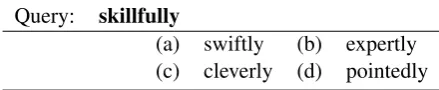
For each of the 100 query words in the dataset, the nearest neighbors at ranksk ∈ {1,5,50}for the six embeddings were retrieved. For each query word andk, we presented the six words along with the query word to the users. Each Turker was re-quested to evaluate between 25 and 50items per task, where an item corresponds to the query word and the set of 6 retrieved neighbor words from each of the 6 embeddings. The payment was be-tween $0.01 and $0.02 per item. The users were then asked to pick the word that is most similar ac-cording to their perception (the instructions were almost identical to the WordSim-353 dataset in-structions). Duplicate words were consolidated, and a click was counted for all embeddings that returned that word. An option “I don’t know the meaning of one (or several) of the words” was also
provided as an alternative. Table 2 shows an exam-ple instance that was given to the Turkers.
Query: skillfully
(a) swiftly (b) expertly (c) cleverly (d) pointedly
Table 2: Example instance of comparative in-trinsic evaluation task. The presented options in this example are nearest neighbors to the query word according to (a) C&W, (b) CBOW, GloVe, TSCCA (c) Rand. Proj. and (d) H-PCA.
The combination of 100 query words and 3 ranks yielded 300 items on which we solicited judgements by a median of 7 Turkers (min=5, max=14). We compare embeddings by average win ratio, where the win ratio was how many times raters chose embedding edivided by the number of total ratings for itemi.
3.4 Comparative results
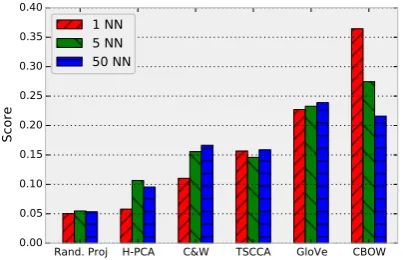
Overall comparative results replicate previous re-sults. Figure 1(a) shows normalized win ratio scores for each embedding across 3 conditions corresponding to the frequency of the query word in the training corpus. The scores were normal-ized to sum to one in each condition to emphasize relative differences. CBOW in general performed the best and random projection the worst (p-value
<0.05 for all pairs except H-PCA and C&W in comparing un-normalized score differences for the ALL-FREQcondition with a randomized permuta-tion test). The novel comparative evaluapermuta-tions cor-respond both in rank and in relative margins to those shown in Table 1.
[image:4.595.306.526.279.324.2]Rand. Proj H-PCA C&W TSCCA GloVe CBOW 0.00
0.05 0.10 0.15 0.20 0.25 0.30 0.35 0.40
Score
freq 2500 freq > 2500 all freq
(a) Normalized scores by global word frequency.
Rand. Proj H-PCA C&W TSCCA GloVe CBOW 0.00
0.05 0.10 0.15 0.20 0.25 0.30 0.35 0.40
Score
1 NN 5 NN 50 NN
(b) Normalized scores by nearest neighbor rankk.
Rand. Proj H-PCA C&W TSCCA GloVe CBOW 0.00
0.05 0.10 0.15 0.20 0.25 0.30 0.35 0.40
Score
adj POS adv POS noun POS verb POS
(c) Normalized scores by part of speech.
Rand. Proj H-PCA C&W TSCCA GloVe CBOW 0.00
0.05 0.10 0.15 0.20 0.25 0.30 0.35 0.40
Score
abstract concrete
[image:5.595.306.508.68.198.2](d) Normalized scores by category.
Figure 1: Direct comparison task
broken up by the rankkof the neighbors that were compared. CBOW has its strengths especially at rankk = 1. For neighbors that appear after that, CBOW does not necessarily produce better em-beddings. In fact, it even does worse for k = 50
than GloVe. It is important to note, however, that we cannot make absolute statements about how performance behaves across different values ofk
since each assessment is always relative to the quality of all other embeddings.
We balanced our query inventory also with re-spect to parts of speech and abstractness vs. con-creteness. Figure 1(c) shows the relative per-formances of all embeddings for the four POS classes (adjectives, adverbs, nouns and verbs). While most embeddings show relatively homoge-neous behaviour across the four classes, GloVe suffers disproportionally on adverbs. Moving on to Figure 1(d), we can see a similar behavior for TSCCA: Its performance is much lower on con-crete words than on abstract ones. This differ-ence may be important, as recent related work finds that simply differentiating between general and specific terms explains much of the observed
variation between embedding methods in hierar-chical classification tasks (Levy et al., 2015b). We take the two observations above as evidence that a more fine-grained analysis is necessary in discern-ing different embedddiscern-ing methods.
As a by-product, we observed that there was no embedding method that consistently performed best on all of the four different absolute evaluation tasks. However, we would like to reiterate that our goal is not to identify one best method, but rather point out that different evaluations (e.g., changing the rankkof the nearest neighbors in the compar-ison task) result in different outcomes.
4 Coherence
quantitative evaluation. Good embeddings should have coherent neighborhoods for each word, so inserting a word not belonging to this neighbor-hood should be easy to spot. Similar to Chang et al. (2009), we presented Turkers with four words, three of which are close neighbors and one of which is an “intruder.” For each of the 100 words in our query set of Section 3.3, we retrieved the two nearest neighbors. These words along with the query word defined the set of (supposedly) good options. Table 3 shows an example instance that was given to the Turkers.
(a) finally (b) eventually (c) immediately (d) put
Table 3: Example instance of intrusion task. The query word is option (a), intruder is (d).
To normalize for frequency-based effects, we computed the average frequencyavg of the three words in this set and chose the intruder word to be the first word that had a frequency of avg±500
starting at rank 100 of the list of nearest neighbors.
Results. In total, we solicited judgments on 600
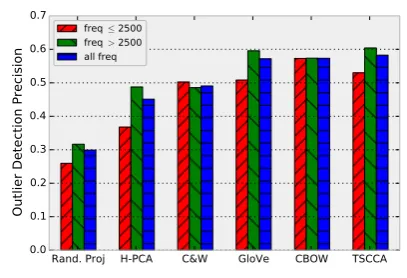
items (100 query words for each of the 6 em-beddings) from a median of 7 Turkers (min=4, max=11) per item, where each Turker evaluated between 25 and 50 items per task. Figure 2 shows the results of the intrusion experiment. The evalu-ation measure is micro-averaged precision for an embedding across 100 query words, where per-item precision is defined as the number of raters that discovered the intruder divided the total num-ber of raters of itemi. Random guessing would achieve an average precision of 0.25.
All embeddings perform better than guessing, indicating that there is at least some coherent structure captured in all of them. However, the best performing embeddings at this task are TSCCA, CBOW and GloVe (the precision mean differences were not significant under a random permutation test), while TSCCA attains greater precision (p<0.05) in relation to C&W, H-PCA and random projection embeddings. These re-sults are in contrast to the direct comparison study, where the performance of TSCCA was found to be significantly worse than that of CBOW. However, the order of the last three embeddings remains un-changed, implying that performance on the intru-sion task and performance on the direct
compari-Rand. Proj H-PCA C&W GloVe CBOW TSCCA 0.0
0.1 0.2 0.3 0.4 0.5 0.6 0.7
Outlier Detection Precision
[image:6.595.311.515.70.209.2]freq 2500 freq > 2500 all freq
Figure 2: Intrusion task: average precision by global word frequency.
son task are correlated. CBOW and C&W seem to do equally well on rare and frequent words, whereas the other models’ performance suffers on rare words.
Discussion. Evaluation of set-based properties
of embeddings may produce different results from item-based evaluation: rankings we got from the intrusion task did not match the rankings we ob-tained from the relatedness task. Pairwise similar-ities seem to be only part of the information that is encoded in word embeddings, so looking at more global measures is necessary for a better under-standing of differences between embeddings.
We choose intruder words based on similar but lower-ranked words, so an embedding could score well on this task by doing an unusually bad job at returning less-closely related words. However, the results in Figure 1(b) suggest that there is lit-tle differences at higher ranks (rank 50) between embeddings.
5 Extrinsic Tasks
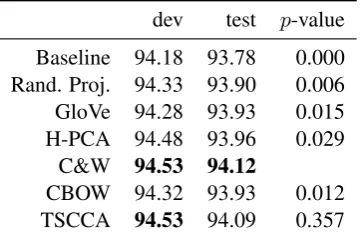
dev test p-value Baseline 94.18 93.78 0.000 Rand. Proj. 94.33 93.90 0.006 GloVe 94.28 93.93 0.015 H-PCA 94.48 93.96 0.029
C&W 94.53 94.12
[image:7.595.92.273.63.181.2]CBOW 94.32 93.93 0.012 TSCCA 94.53 94.09 0.357
Table 4: F1 chunking results using different word embeddings as features. Thep-values are with re-spect to the best performing method.
test p-value BOW (baseline) 88.90 7.45·10−14
Rand. Proj. 62.95 7.47·10−12 GloVe 74.87 5.00·10−2 H-PCA 69.45 6.06·10−11
C&W 72.37 1.29·10−7
CBOW 75.78
[image:7.595.90.274.244.362.2]TSCCA 75.02 7.28·10−4
Table 5: F1 sentiment analysis results using differ-ent word embeddings as features. Thep-values are with respect to the best performing embedding.
Noun phrase chunking. First we use a noun
phrase chunking task similar to that used by Turian et al. (2010). The only difference is that we nor-malize all word vectors to unit length, rather than scaling them with some custom factor, before giv-ing them to the conditional random field (CRF) model as input. We expect that this task will be more sensitive to syntactic information than to se-mantic information.
Sentiment classification. Second we use a
re-cently released dataset for binary sentiment clas-sification by Maas et al. (2011). The dataset con-tains 50K movie reviews with a balanced distribu-tion of binary polarity labels. We evaluate the rel-ative performance of word embeddings at this task as follows: we generate embedding-only features for each review by computing a linear combina-tion of word embeddings weighted by the num-ber of times that the word appeared in the review (using the same bag-of-words features as Maas et al. (2011)). A LIBLINEAR logistic regression model (Fan et al., 2008) with the default parame-ters is trained and evaluated using 10 fold cross-validation. A vanilla bag of words feature set is
the baseline (denoted as BOW here). We expect that this task will be more sensitive to semantic information than syntactic information.
Results. Table 4 shows the average F1-scores
for the chunking task. The p-values were com-puted using randomization (Yeh, 2000) on the sen-tence level. First, we can observe that adding word vectors as features results in performance lifts with all embeddings when compared to the baseline. The performance of C&W and TSCCA is statis-tically not significant, and C&W does better than all the remaining methods at the p = 0.05 level. Surprisingly, although the performance of Ran-dom Projections is still last, the gap to GloVe and CBOW is now very small. Table 5 shows results on the sentiment analysis task. We recover a sim-ilar order of embeddings as in the absolute intrin-sic evaluation, however, the order of TSCCA and GloVe is now reversed.
Discussion. Performance on downstream tasks
is not consistent across tasks, and may not be con-sistent with intrinsic evaluations. Comparing per-formance across tasks may provide insight into the information encoded by an embedding, but we should not expect any specific task to act as a proxy for abstract quality. Furthermore, if good downstream performance is really the goal of an embedding, we recommend that embeddings be trained specifically to optimize a specific objective (Lebret and Collobert, 2014).
6 Discussion
primar-102 103 104 105 Word frequency
0.5 0.6 0.7 0.8 0.9 1.0
Accuracy CCA
C&W CBOW GloVe Rand. Proj H-PCA
Figure 3: Embeddings can accurately predict whether a word is frequent or rare.
ily driven by semantics: the relatively small num-ber of frequent words should be evenly distributed through the space, while large numbers of rare, specific words should cluster around related, but more frequent, words.
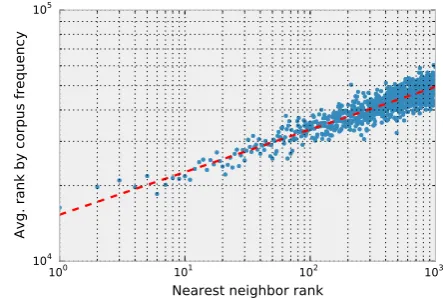
We trained a logistic regression model to predict word frequency categories based on word vectors. The linear classifier was trained to put words ei-ther in a frequent or rare category, with thresholds varying from 100 to 50,000. At each threshold fre-quency, we sampled the training sets to ensure a consistent balance of the label distribution across all frequencies. We used length-normalized em-beddings, as rare words might have shorter vec-tors resulting from fewer updates during training (Turian et al., 2010). We report the mean accuracy and standard deviation (1σ) using five-fold cross-validation at each threshold frequency in Figure 3. All word embeddings do better than random, suggesting that they contain some frequency in-formation. GloVe and TSCCA achieve nearly 100% accuracy on thresholds up to 1000. Unlike all other embeddings, accuracy for C&W embed-dings increases for larger threshold values. Fur-ther investigation revealed that the weight vector direction changes gradually with the threshold fre-quency — indicating that frefre-quency seems to be encoded in a smooth way in the embedding space. Although GloVe and CBOW are the two best performing embeddings on the intrinsic tasks, they differ vastly in the amount of frequency informa-tion they encode. As a consequence, we can con-clude that most of the differences in frequency pre-diction are not due to intrinsic properties of natu-ral language: it is not the case that frequent words naturally have only frequent neighbors.
100 101 102 103
Nearest neighbor rank 104
105
[image:8.595.305.527.65.214.2]Avg. rank by corpus frequency
Figure 4: Avg. word rank by frequency in train-ing corpus vs. nearest-neighbor rank in the C&W embedding space.
Word frequency information in the embedding space also affects cosine similarity. For each of the words in the WordSim-353 dataset, we queried for
thek = 1000nearest neighbors. We then looked
up their frequency ranks in the training corpus and averaged those ranks over all the query words. We found a strong correlation between the frequency of a word and its position in the ranking of near-est neighbors in our experiments. Figure 4 shows a power law relationship for C&W embeddings between a word’s nearest neighbor rank (w.r.t. a query) and the word’s frequency rank in the train-ing corpus (nn-rank ∼ 1000 ·corpus-rank0.17). This is a concern: the frequency of a word in the language plays a critical role in word processing of humans as well (Cattell, 1886). As a conse-quence, we need to explicitly consider word fre-quency as a factor in the experiment design. Also, the above results mean that the commonly-used cosine similarity in the embedding space for the intrinsic tasks gets polluted by frequency-based effects. We believe that further research should address how to better measure linguistic relation-ships between words in the embedding space, e.g., by learning a custom metric.
7 Related work
[image:8.595.82.284.75.210.2]embed-dings seem to capture even more complex linguis-tic properties. Chen et al. (2013) show that word embeddings even contain information about re-gional spellings (UK vs. US), noun gender and sentiment polarity.
Previous work in evaluation for word embed-dings can be divided into intrinsic and extrin-sic evaluations. Intrinextrin-sic evaluations measure the quality of word vectors by directly measuring correlation between semantic relatedness and ge-ometric relatedness, usually through inventories of query terms. Focusing on intrinsic measures, Baroni et al. (2014) compare word embeddings against distributional word vectors on a variety of query inventories and tasks. Faruqui and Dyer (2014) provide a website that allows the automatic evaluation of embeddings on a number of query inventories. Gao et al. (2014) publish an improved query inventory for the analogical reasoning task. Finally, Tsvetkov et al. (2015) propose a new in-trinsic measure that better correlates with exin-trinsic performance. However, all these evaluations are done on precollected inventories and mostly lim-ited to local metrics like relatedness.
Extrinsic evaluations use embeddings as fea-tures in models for other tasks, such as semantic role labeling or part-of-speech tagging (Collobert et al., 2011), and improve the performance of ex-isting systems (Turian et al., 2010). However, they have been less successful at other tasks such as parsing (Andreas and Klein, 2014).
More work has been done in unsupervised se-mantic modeling in the context of topic models. One example is theword intrusiontask (Chang et al., 2009), in which annotators are asked to iden-tify a random word inserted into the set of high probability words for a given topic. Word embed-dings do not produce interpretable dimensions, so we cannot directly use this method, but we present a related task based on nearest neighbors. Manual evaluation is expensive and time-consuming, but other work establishes that automated evaluations can closely model human intuitions (Newman et al., 2010).
8 Conclusions
There are many factors that affect word embed-ding quality. Standard aggregate evaluations, while useful, do not present a complete or con-sistent picture. Factors such as word frequency play a significant and previously unacknowledged
role. Word frequency also interferes with the commonly-used cosine similarity measure. We present a novel evaluation framework based on di-rect comparisons between embeddings that pro-vides more fine-grained analysis and supports sim-ple, crowdsourced relevance judgments. We also present a novelCoherencetask that measures our intuition that neighborhoods in the embedding space should be semantically or syntactically re-lated. We find that extrinsic evaluations, although useful for highlighting specific aspects of embed-ding performance, should not be used as a proxy for generic quality.
Acknowledgments
This research was funded in part through NSF Award IIS-1513692. We would like to thank Alexandra Schofield, Adith Swaminathan and all other members of the NLP seminar for their help-ful feedback.
References
Jacob Andreas and Dan Klein. 2014. How much do word embeddings encode about syntax? InACL: Short Papers, pages 822–827.
Javed Aslam and Mark Montague. 2001. Models for metasearch. InSIGIR, pages 276–284.
Marco Baroni, Georgiana Dinu, and Germ´an Kruszewski. 2014. Don’t count, predict! a systematic comparison of context-counting vs. context-predicting semantic vectors. InACL, pages 238–247.
Elia Bruni, Nam-Khanh Tran, and Marco Baroni. 2014. Multimodal distributional semantics. JAIR, 49:1–47.
James McKeen Cattell. 1886. The time taken up by cerebral operations. Mind,, (42):220–242.
Jonathan Chang, Jordan Boyd-Graber, Sean Gerrish, Chong Wang, and David Blei. 2009. Reading tea leaves: How humans interpret topic models. In
NIPS, pages 288–296.
Yanqing Chen, Bryan Perozzi, Rami Al-Rfou, and Steven Skiena. 2013. The expressive power of word embeddings. arXiv preprint: 1408.3456.
Ronan Collobert, Jason Weston, L´eon Bottou, Michael Karlen, Koray Kavukcuoglu, and Pavel Kuksa. 2011. Natural language processing (almost) from scratch. JLMR, 12:2493–2537.
Rong-En Fan, Kai-Wei Chang, Cho-Jui Hsieh, Xiang-Rui Wang, and Chih-Jen Lin. 2008. LIBLIN-EAR: A library for large linear classification. JLMR, 9:1871–1874.
Manaal Faruqui and Chris Dyer. 2014. Community evaluation and exchange of word vectors at word-vectors.org. InACL: System Demonstrations.
Lev Finkelstein, Ehud Rivlin Zach Solan Gadi Wolf-man Evgeniy Gabrilovich, Yossi Matias, and Eytan Ruppin. 2002. Placing search in context: The con-cept revisited. TOIS, 20(1):116–131, January.
Bin Gao, Jiang Bian, and Tie-Yan Liu. 2014. Wor-dRep: A benchmark for research on learning word representations. ICML Workshop on Knowledge-Powered Deep Learning for Text Mining.
R´emi Lebret and Ronan Collobert. 2014. Word em-beddings through Hellinger PCA. InEACL, pages 482–490.
Omer Levy and Yoav Goldberg. 2014. Neural word embedding as implicit matrix factorization. InNIPS, pages 2177–2185.
Omer Levy, Yoav Goldberg, and Ido Dagan. 2015a. Improving distributional similarity with lessons learned from word embeddings. TACL.
Omer Levy, Steffen Remus, Chris Biemann, and Ido Dagan. 2015b. Do supervised distributional meth-ods really learn lexical inference relations? In
NAACL.
Ping Li, Trevor J Hastie, and Kenneth W Church. 2006. Very sparse random projections. In KDD, pages 287–296.
Andrew L. Maas, Raymond E. Daly, Peter T. Pham, Dan Huang, Andrew Y. Ng, and Christopher Potts. 2011. Learning word vectors for sentiment analysis. InHLT-ACL, pages 142–150.
Christopher D. Manning, Mihai Surdeanu, John Bauer, Jenny Finkel, Steven J. Bethard, and David Mc-Closky. 2014. The Stanford CoreNLP natural lan-guage processing toolkit. In ACL: System Demon-strations, pages 55–60.
Tomas Mikolov, Ilya Sutskever, Kai Chen, Greg S Cor-rado, and Jeff Dean. 2013a. Distributed representa-tions of words and phrases and their compositional-ity. InNIPS, pages 3111–3119.
Tomas Mikolov, Wen-Tau Yih, and Geoffrey Zweig. 2013b. Linguistic regularities in continuous space word representations. InHLT-NAACL, pages 746– 751.
George A Miller. 1995. WordNet: a lexical database for english. Communications of the ACM, 38(11):39–41.
David Newman, Jey Han Lau, Karl Grieser, and Tim-othy Baldwin. 2010. Automatic evaluation of topic coherence. InHLT-NAACL, pages 100–108. Jeffrey Pennington, Richard Socher, and
Christo-pher D. Manning. 2014. GloVe: Global vectors for word representation. InEMNLP.
Yulia Tsvetkov, Manaal Faruqui, Wang Ling, Guil-laume Lample, and Chris Dyer. 2015. Evaluation of word vector representations by subspace alignment. InEMNLP.
Joseph Turian, Lev Ratinov, and Yoshua Bengio. 2010. Word representations: a simple and general method for semi-supervised learning. InACL, pages 384– 394.
Peter D. Turney. 2008. A uniform approach to analo-gies, synonyms, antonyms, and associations. In
COLING, pages 905–912.