Proceedings of the 2019 Conference on Empirical Methods in Natural Language Processing 4969
Fine-Grained Entity Typing via Hierarchical Multi Graph Convolutional
Networks
Hailong Jin1,2,3, Lei Hou1,2,3∗, Juanzi Li1,2,3, Tiansi Dong4 1Department of Computer Science and Technology, Tsinghua University
2KIRC, Institute for Artificial Intelligence, Tsinghua University 3Beijing National Research Center for Information Science and Technology
4B-IT, University of Bonn, Bonn, Germany
{jinhl15@mails., houlei@, lijuanzi@}tsinghua.edu.cn [email protected]
Abstract
This paper addresses the problem of infer-ring the fine-grained type of an entity from a knowledge base. We convert this problem into the task of graph-based semi-supervised classification, and propose Hierarchical Multi Graph Convolutional Network (HMGCN), a novel Deep Learning architecture to tackle this problem. We construct three kinds of con-nectivity matrices to capture different kinds of semantic correlations between entities. A recursive regularization is proposed to model the subClassOf relations between types in given type hierarchy. Extensive experiments with two large-scale public datasets show that our proposed method significantly outper-forms four state-of-the-art methods.
1 Introduction
Nowadays, Knowledge Base (KB for short) at-tracts increasing research interests in various ar-eas. One of the fundamental components inKB is the information of entity type, which clusters a group of entities with same properties, and is the glue that holds our mental world together ( Mur-phy, 2004). Traditional entity typing focuses on a small set of types, such as Person, Loca-tion and Organization (Ratinov and Roth, 2009;
Nadeau and Sekine, 2007), while Fine-Grained Entity Typing assigns more specific types to an en-tity, which normally forms atype-pathin the type hierarchy inKB (Ren et al.,2016). For example, Messiis classified as having the path of following types: F ootballP layer ⊂ Athlete ⊂ P erson. Types in KB are usually organized as a hierar-chical structure, namelytype hierarchy. Unfortu-nately, mostKBs are incomplete and lack of type information. For example, in DBpedia, the aver-age number of types is only 2.9 (5,044,223 enti-ties with 14,760,728 types), while 36.53% entienti-ties
∗
Corresponding author
do not have type information. As Figure1shows, for each unlabeled entity, we will fully utilize its textual description, category and property to pre-dict missing types. In this paper, we aim at assign-ing Fine-grained Entity Typassign-ing for entities inKB (such as Wikipedia and DBpedia).
Figure 1: Entity (i.e., Yao Ming) with textual de-scription (with anchor text in red), property (e.g., bornIn Shanghai) and category (e.g., Houston Rock-ets players). Yao Ming is associated with a type-path: BasketballP layer ⊂ Athlete ⊂ P erson ⊂ Agent⊂T hing
Many researches have been carried out in this field. State-of-the-art methods normally learn dis-tributed representation for each entity, and apply a multi-label classification model to make type in-ference. For example, (Neelakantan and Chang,
2015) and (Xu et al.,2016) exploit various kinds of information to construct the feature represen-tation of an entity, such as entity textual descrip-tion, property and category. After that, a pre-dict function is learned to infer whether entity e
is an instance of type t. (Yaghoobzadeh et al.,
[image:1.595.306.526.317.442.2]among entities as the structural information, and constructed an Entity Graph, further proposed a network embedding framework to learn the corre-lation among entities. It will be profitable to en-rich entity features to entity graph structures, as recent studies have suggested to bring both node feature and graph structure information in a convo-lutional manner (Defferrard et al.,2016;Atwood and Towsley, 2016). Among these works, graph convolutional network (GCN) is the most widely-used model which can directly operate on graphs with arbitrary sizes and shapes (Kipf and Welling,
2016). The inputs of a GCN are feature vectors of nodes and graph structure. The most signifi-cant aspect of GCN is information diffusion, with which node’s feature vector can be enriched by all the feature vectors of its neighbors.
Here, we convert entities in KB into three semantic graphs, each encoding a specific kind of correlation among entities, as follows: Aco a graph of the topical co-occurrence relations among entities, Acat a category-based graph en-coding the category-proximity between entities, and Aprop a property-based graph encoding the property-proximity between entities. We propose Hierarchical Multi Graph Convolutional Network (HMGCN), a novel deep learning architecture consisting of three Graph Convolutional Networks (GCNs): GCNco and GCNcat and GCNprop. Each connectivity matrix is fed to its correspond-ing GCN model, and the three GCN models are learned by shared parameters and consistency reg-ularization. We adopt a simple and effective re-cursive regularization to deal withsubClassOf re-lations between types. The main contributions of this paper are as follows:
• Graph convolutional network is applied for fine-grained entity typing task, which effec-tively integrates entity feature and structural information.
• Multi connectivity matrices are constructed to encode different kinds of semantic relat-edness between entities. A recursive regular-ization is proposed to modelsubClassOf re-lations between types.
• Extensive experiments show that our pro-posed method significantly outperforms four state-of-the-art methods, with 1.7% and 1.3% improvement in Mi-F1 and Ma-F1 (on FIGER dataset), respectively.
The rest of this paper is organized as follows. Section 2 formally defines the problem of Fine-Grained Entity Typing in knowledge bases. Sec-tion 3 describes the proposed approach in de-tail. Section 4 reports a number of experiments with evaluations. Section5 outlines some related works. Section6concludes our work.
2 Problem Formulation
In this section, we formally define the problem of Fine-Grained Entity TypinginKB.
Definition 1 Knowledge BaseKB = (E,T,R), where E, T andRare sets of entities, types and isA relations, respectively. |E| = N and |T | =
K. R = Ri ∪ Rs consists of instanceOf and subClassOf triples. Ri = {(ei, isA, tj)|ei ∈ E, tj ∈ T } collects all instanceOf triples and Rs = {(ti, isA, tj)|ti, tj ∈ T } collects all sub-ClassOf triples.
Note that not each entity in a knowledge base KBis assigned with types. We split the entity set E into two subsets: El and Eu, E = El ∪ Eu, El ∩ Eu = ∅. El denotes the entity set whose member is assigned with type information.Eu de-notes the entity set whose member has no type in-formation. |El| = Nl, |Eu| = Nu. Types inT form a tree or a directed acyclic graph (DAG) via subClassOf relations, we refer it as type hierarchy H= (T,Rs).
For each entity, we distinguish three kinds of features, namely,Text Description,Category, and Property, which are beneficial to Fine-Grained Entity Typingtask.
• Text Descriptionis a succinct summary of an entity, providing valuable clues to predict en-tity types. As Figure 1 shows, there are a large number of anchor texts in textual de-scription.
• Category refers, in Wikipedia, actually to tags/topics that group entities on similar sub-jects. For instance, Yao Ming in Wikipedia has category Olympic basketball players of China, which is the topic of the entity instead of its type.Categorycan be a useful informa-tion to infer missing type informainforma-tion.
Besides entity features above, there are many kinds of semantic correlations between entities, which organize entities into graph structures. We refer it as entity graph. Each kind of semantic correlation corresponds to a kind of connectivity matrix. There are many ways to construct en-tity graph via different connectivity manner, which will be discussed in Section3.
Definition 2 Entity GraphG = (A,X,Y). A∈ RN×N is the connectivity matrix representing a
kind of link relation between entities.X∈RN×M is the feature matrix representing inherent features for all entities, where M is the number of features. Each row inXrefers to an entity’s feature vector
Xi.Xcan either be binary or take any real value.
Y ∈RNl×K
is the type matrix collecting type in-formation for entities inEl. Each row inYrefers to the instanceOf relations between an entity and all types. Yij = 1if ei has been assigned with typetj, otherwise 0.
The task of Fine-Grained Entity Typing can be formally described as follows: Given a partially-labeled Entity GraphG = (A,X,Y), we aim at learning a type predictor fromY, which compre-hensively takes graph structure and entity features into account. Then we utilize the learned type predictor to predict the missing instanceOf rela-tions in Eu, i.e., whether(e
i, instanceOf, tj) is true. In this way, we convert the task of Fine-Grained Entity Typing into a task of graph-based semi-supervised classification.
3 Hierarchical Multi Graph
Convolutional Network (HMGCN)
State-of-the-art methods convert entities in KB into entity graph, then apply graph-based algo-rithm. The difficulties lie in two facts:
• Firstly, it is hard to effectively integrate entity features and structural information. Although network embedding methods, in terms of at-tributed network embedding, can take both graph structure and features into considera-tion (Huang et al., 2017), the node features are usually only served as auxiliary informa-tion in structure learning (Yang et al.,2016;
Liao et al.,2017).
• Secondly, it is not easy to effectively in-tegrate different connectivity matrix which
capture different kinds of structural informa-tion (Wang et al., 2018; Zhuang and Ma,
2018).
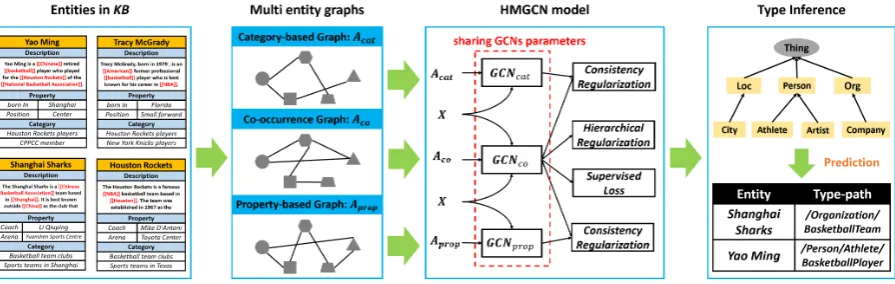
We propose a Hierarchical Multi GCN model (HMGCN) to encode heterogeneous structural information in an ensemble manner, as illus-trated in Figure 2. We construct three undi-rected entity graphs to capture different kinds of semantic correlations between entities, i.e., co-occurrence graph Aco, category-based graph
Acat, and property-based graph Aprop. Aco en-codes the topical relevance between entities, and is derived from textual anchor texts. Acat is con-structed through similarity computation based on category information, based on the assumption that entities with similar categories tend to have the same type. In the same way, we construct property-based graph Aprop. Each entity graph is fed to corresponding GCN model, namely,
GCNco, GCNcat and GCNprop. These models use shared parameters and unsupervised consis-tency regularization, so that they can jointly con-sider opinions from three semantic perspectives. To achieve this, a simple and effective recursive regularization is adopted to deal with the subClas-sOf relations between types.
3.1 GCN-Based Entity Type Classification
GCN model consists of multiple stacked GCN lay-ers. Given the input feature matrix X ∈ RN×M and adjacency matrixA ∈ RN×N, the output of thei-th hidden layer of the networkZ(i)is defined as:
Z(i)=σ( ˜D−12A˜D˜− 1
2Z(i−1)W(i)) (1)
˜
A = A +In is the adjacency matrix with self-loops, where In ∈ RN×N is the identity matrix.
˜
Dii =
P
jA˜ij. Accordingly, D˜− 1 2A˜D˜−
1 2 is the
normalized adjacency matrix.Z(Ai−1)is the output of the(i−1)-th layer, andZ(0)=X.W(i)are the trainable parameters of the network, andσ(·) de-notes an activation function (e.g.,ReLU,Sigmoid). A detailed explanation of GCN model is presented in the original work (Kipf and Welling,2016).
Figure 2: Framework of HMGCN. We convert entities in KB into multi kinds of semantic graphs. The co-occurrence graphAco is constructed from anchor text in textual description. The category-based graphAcat is derived from category proximity. The property-based graph Aprop is derived from property proximity. Each graph is fed to corresponding GCN model with same feature matrixX. The three GCN models are learned by sharing parameters and consistency regularization. A hierarchical regularization is used to deal with the subClassOf relations between types.
the cross-entropy between the true type distribu-tion and the predicted distribudistribu-tion.
Ls=− Nl X
i=1
K
X
j=1
Yi,jln ˆZi,j+ (1−Yi,j) ln (1−Zˆi,j)
(2)
WhereYi,j indicates whether entityeibelongs to typetj. Zˆi,j refers to the probability of GCN pre-diction.
The role of D˜−12A˜D˜− 1
2Z(i−1)W(i) is to ex-actly conduct a 1-hop diffusion process in each layer. Namely, a node’s feature vector is enriched in the way of linearly adding all the feature vectors of its neighbors. With more hidden layers, an en-tity’s feature can diffuse to further entities (2-hop, 3-hop and so on). Research shows that there’s no significant increase when the number of layers is higher than 3 (Kipf and Welling,2016). Here, we assume adjacency matrixAand feature matrixX
are given. In the next part of this section, we show how to computeAandX.
3.2 Connectivity Matrix Designing
In Knowledge Graphs, there are large numbers of descriptive anchor texts that are helpful for type inference. For an entity e, CXT(e) is an entity set which contains all entities occur in its textual description. For example in Figure 1, Houston Rockets is in CXT(Y aoM ing). If entity ei ∈
CXT(ej), we can say thateioccurs inej’context or ej cites ei in its textual description. These are co-occurrence information among entities, and can be explicitly extracted and represented by the
connectivity matrixAco.
Aco[i, j] =
(
1 ei ∈CXT(ej)or ej ∈CXT(ei) 0 otherwise
(3)
Aco can capture co-occurrence relations, though not precise enough. For example,Houston RocketsandNBAoccur inYao Ming’s context, but they do not belong to same type.
Besides Aco, we calculate the correlation be-tween entities via category information. If en-tityei andej share common categories,ei andej will be likely belong to a same type. For exam-ple in Figure2, bothHouston Rocketsand Shang-hai Sharks have category Basketball team clubs, they have same type BasketballTeam. We con-structAcat, and use Jaccard similarity coefficient to calculate each elementAcat[i, j]:
Acat[i, j] =
|Cat(ei)∩Cat(ej)| |Cat(ei)∪Cat(ej)|
(4)
in which,Cat(e)is the category set of entitye. In the same way, we can calculate the correlation be-tween entities via property information, and con-struct Aprop, whose element is calculated as fol-lows.
Aprop[i, j] = |P rop(ei)∩P rop(ej)| |P rop(ei)∪P rop(ej)|
(5)
GCNprop, respectively. As mentioned in Sec-tion2, each entity is associated with text descrip-tion, category and property. We used category and property information to construct connectivity ma-trix, therefore, words appeared in the text descrip-tion of an entity can be approximately viewed as features of this entity. We apply fastText method, which treats the average of word/n-grams embed-dings as entity feature (Joulin et al., 2016), and construct the feature matrixX. As shown in Fig-ure2, bothGCNco,GCNcatandGCNproptakeX as input feature matrix.
3.3 Parameters Sharing and Consistency Regularization
The success of our model largely relies on the strategy that three GCN models share common parameters (i.e., neural network weightsW(i) in Eqs.1), as shown in Figure 2. By doing so, our model (which is characterized by the parameters
W(i)) can simultaneously consider the knowledge encoded in Aco, Acat and Aprop. The predic-tion of GCNco and GCNcat are denoted as Zˆco andZˆcat ∈ RN×K, respectively. To jointly con-sider the opinions fromGCNco andGCNcat, we apply an unsupervised regularizer for the ensem-ble. We minimize the mean squared difference be-tweenZˆcoandZˆcatfor allN entities.
Lc1 = N X i=1 ˆ
Zcati,: −Zˆcoi,:
2
(6)
The prediction ofGCNpropis denoted asZˆprop. In the same way, we minimize the mean squared differences betweenZˆcoandZˆpropover allN en-tities.
Lc2 = N X i=1 ˆ
Zpropi,: −Zˆcoi,:
2
(7)
Our model can jointly consider the opinions of
GCNco, GCNcat andGCNprop. Although shar-ing the same parametersW(i), three GCN mod-els utilize different connectivity matrices as in-put, which capture different semantic correlations between entities. This difference may cause the predictions of three GCN models to differ. Our model is expected to give a consistent prediction via the proposed unsupervised consistency regu-larizations, i.e., minimizing Eqs. 6 and7. As a result, the learned parameter matrixW(i) consid-ers the judgments from bothGCNco,GCNcatand
GCNprop.
3.4 Recursive Hierarchical Regularization
Leaf nodes (in type hierarchy) may have insuffi-cient training examples. In that case, decisions can be regularized by its parent, if a type hier-archy is available. We introduce dependency re-lations among types to improve the classification performance. Similar to (Peng et al.,2018;Gopal and Yang,2013), we use a recursive regularization over the final layer. Two types shall have similar embeddings, if they are close in a graph. In par-ticular, types that are related by subClassOf re-lation shall have similar embeddings. For exam-ple, in Figure1, there is an edge betweenAthlete andBasketballPlayer, so the parameters of the two types could be similar to each other. Assuming there arenhidden layers, the last layer parameter matrixW(n) can be regarded as the type embed-ding matrix, each row inW(n)refers to a type rep-resentation. LetC(t)refer to the sub-type set oft
(t’s children in the hierarchy). We use the follow-ing recursive regularization term to regularize the parameter of each type:
Lhie= K
X
i=1
X
j∈C(ti)
1 2
W
(n) i,: −W
(n) j,: 2 (8)
3.5 Model Training
We calculate the supervised loss over all labeled entities for GCNco (Eqs. 2). Although Zcoi is regarded as the final type prediction result, our model can consider the opinions from three GCN models via parameters sharing and consistency regularization. The total loss is the sum of super-vised loss, two consistency regularizations and re-cursive regularization.
Loss=Ls+λ(t)(Lc1+Lc2) +λ0Lhie (9)
in which λ(t) is a dynamic weight function, and
λ0 is chosen among a fixed set based on perfor-mance on the dev set. At the beginning of the training process,λ(t)is small, the loss function is mainly dominated byLs. HMGCNis inclined to agree withGCNcowhen making decisions, which encodes co-occurrence relation between entities.
λ(t) increases as time goes on, our model will obtain posterior distribution over the types using
above loss functions. For each ei ∈ Eu, we use
Zcoi as the type prediction result.
4 Experiments
4.1 Datasets and Metrics
Datasets: There are two public large-scale datasets available for Fine-Grained Entity Typing inKB,FIGER1andDBpedia(Zhang et al.,2015). FIGERis a widely used dataset which is proposed by Yaghoobzadeh et al.. The DBpediadataset is constructed by picking 14 non-overlapping types for text classification originally, we expand these 14 types and form a hierarchy. For each dataset, we extract entity feature from DBpedia2. For FIGER andDBpedia, we split entities into train (50%), dev (20%) and test (30%) sets. Since DB-pedia dataset contains 630,000 entities, which is too big for computation, we divide it equally into three parts (i.e., DB-1, -2 and -3). Table1shows some statistics about the two datasets. Our source code is available3for reference. More detailed in-formation can be found there.
Table 1: Statistics of the datasets.
Dataset FIGER DB-1 DB-2 DB-3
#Entities 200,000 210,000 210,000 210,000
#Types 102 48 48 48
Metrics: To evaluate the performance of our proposed method, we use Accuracy (Strict-F1), Micro-averaged F1 (Mi-F1) and Macro-averaged F1 (Ma-F1), which have been used in many fine-grained typing systems (Ling and Weld,2012;Ren et al.,2016;Yaghoobzadeh et al.,2017).
4.2 Methods for Comparison
Baseline: we compare HMGCN with four
state-of-the-art of methods and three variants of
HMGCN:
• CUTE:(Xu et al.,2016) utilizes three kinds of entity features: category, property and property-value pair, and employs a hierarchi-cal multi-label classification method.
• MuLR:(Yaghoobzadeh and Sch¨utze,2017) applies embeddings of words, entities and
1
https://github.com/yyaghoobzadeh/figment
2
http://wiki.dbpedia.org/downloads-2016-10
3https://github.com/SIGKDD/HMGCN
types in entity typing task, and uses multi-level representations of entities via character, word, and entity embedding technologies.
• FIGMENT:(Yaghoobzadeh et al.,2017) in-troduces global model and context model to provide complementary information for en-tity typing.
• APE:(Jin et al., 2018) applies an attributed and predictive entity embedding method to learn entity representations. In a way, it takes graph structure and entity features into ac-count.
• HMGCN’s variants: HMGCNno cat
only use GCNco and GCNprop to make type inference. HMGCNno prop only use
GCNco and GCNcat to make type infer-ence. HMGCNno co only use GCNcat and GCNprop to make type inference.
HMGCNf lat ignores the correlation be-tween types, i.e., removes hierarchical recursive regularization.
Parameter Settings: HMGCN is implemented based on the original GCN model (Kipf and Welling, 2016). In our implementation, both
[image:6.595.309.537.707.750.2]GCNco, GCNcat andGCNprop have two hidden layers. Namely, there are two separate parameter vectors, W(1) and W(2), that need training. Table 2 presents detailed information about the implementation of our method for each dataset, including (1) number of hidden units; (2) dropout rate; and (3) learning rateη. λ0 is chosen among {0.00625,0.0125,0.025,0.05,0.1,0.2,0.4,0.8}, we found λ0 = 0.2 achieves best performance. We set λ(t) in several ways, which is discussed in Section 4.4. We train all models for a max-imum of 200 epochs (training iterations) using Adam (Kingma and Ba,2014) and early stopping with a window size of 10 to minimize loss functions.
Table 2: Values of the Hyper-Parameters inHMGCN
model.
Dataset W(1) W(2) Dropout rate Learning rate
DBpedia 32 48 30% 0.001
4.3 Overall Comparison Results
Table 3 and4 shows the overall performance on two datasets and we have the following conclu-sions:
Comparison with Entity Typing methods. Our model significantly outperforms the state-of-the-art entity typing methods over all datasets.
HMGCNoutperforms the best baseline with 1.7% and 1.3% improvement in Mi-F1 and Ma-F1 on FIGER dataset, 3.2% and 3.6% improvement in Mi-F1 and Ma-F1 on DB-1 dataset, 3.9% and 3.5% improvement in Mi-F1 and Ma-F1 on DB-2dataset, 3.7% and 3.8% improvement in Mi-F1 and Ma-F1 on DB-3 dataset, respectively. Com-pared with other methods, the performance of
CUTE is relatively poor, as it ignores the rich structure information both in entity graph and type hierarchy. FIGMENT and MuLR achieve bet-ter performance, in part because powerful em-bedding technologies are applied and the deci-sion is made in global-view and context-view.
APEconsiders graph structure and entity features in attributed network embedding manner, while
HMGCNapplies this in a convolutional manner, which can embed the graph knowledge more suffi-ciently (Kipf and Welling,2016;Zhuang and Ma,
2018).
Comparison with Variants. HMGCN
consis-tently outperforms all four variants, because in
HMGCN three GCN models provide
comple-mentary information. The key of HMGCN is parameter-sharing (W(i) inGCNco, GCNcat and
GCNprop) and unsupervised regularizer for en-semble. The three GCNs encode different kinds of semantic correlations between entities, so that
HMGCN could have a trade-off in decision-making. As a result, the trained parametersW(i)
have considered opinions from all three GCNs.
HMGCNno co and HMGCNno prop demonstrate better performance than HMGCNno cat, which suggests that category information should be more import than co-occurrence and property informa-tion. HMGCNf lat ignores the correlations be-tween types (i.e., subClassOf relations), while
HMGCNtake the structure of type hierarchy as prior knowledge. Infrequent types benefit from the recursive regularization inHMGCN. Because when an infrequent type has less training exam-ple, the decision can be regularized by its parent (super-type).
4.4 Result Analysis
Effects of Labeled Data. Intuitively, our model can learn better embeddings and achieve better performance, if we have more labeled entities. We investigate the effect of labeled data proportion. The results show that three metrics strikingly in-crease with more labeled data added, and grad-ually become stable when the proportion is over 0.5, as illustrated in Figure3(a). This shows that our model can achieve a satisfactory result, even with not enough labeled data, and this advantage is benefited from the information diffusion of the GCN model, i.e., similar entities should share in-formation between each other.
Results of Frequent/Infrequent Types. We
evaluate the performance on frequent types (f requency > 3,000; 15 types) and infrequent types (f requency < 200; 36 types). The clas-sification measure is the type macro average F1 (F1 of entities assigned to a type, then averaged over types) (Yosef et al., 2012). Note that it is different from Ma-F1 reported in Table3. Gener-ally, the performance on infrequent types is worse than frequent ones. Our model consistently out-performs the other methods on infrequent types, which demonstrates its ability on dealing with rare types. The results for infrequent and fre-quent types inFIGERdataset are illustrated in Fig-ure3(b).
Effect of Regularization Weight λ(t). Our model uses a weight functionλ(t)to balance the trade-off between the supervised loss and unsu-pervised consistency regularizer. We devised sev-eral different weight functions (Zhuang and Ma,
2018), as shown in Figure3(c). Here,tis defined as the number of epochs. fi(1≤i≤4) increases with different increment speed, as the number of epochs increases; whilef5 decreases as the num-ber of epochs increases. fi (1 ≤ i ≤ 4) strik-ingly outperformsf5, as shown in Figure3(d). We can see that the knowledge embedded inGCNcat and GCNprop is beneficial to entity typing task. At the beginning of training process, supervised loss function plays the leading role. After several epochs, λ(t) forces our model to simultaneously consider the knowledge encoded in GCNcat and
GCNprop.
5 Related Work
ex-Table 3: Typing performance on DBpedia.
Methods DB-1 DB-2 DB-3
Strict Ma-F1 Mi-F1 Strict Ma-F1 Mi-F1 Strict Ma-F1 Mi-F1
CUTE 0.518 0.679 0.702 0.520 0.681 0.713 0.524 0.685 0.717
MuLR 0.608 0.748 0.771 0.612 0.757 0.784 0.610 0.752 0.775
FIGMENT 0.601 0.740 0.766 0.597 0.738 0.765 0.605 0.745 0.769
APE 0.612 0.758 0.784 0.614 0.761 0.785 0.611 0.760 0.782
HMGCNno cat 0.619 0.769 0.792 0.622 0.772 0.796 0.620 0.770 0.793
HMGCNno prop 0.621 0.771 0.793 0.625 0.782 0.801 0.623 0.775 0.799
HMGCNno co 0.627 0.789 0.808 0.629 0.790 0.814 0.626 0.786 0.812
HMGCNf lat 0.626 0.785 0.812 0.633 0.794 0.820 0.628 0.791 0.817
HMGCN 0.635 0.794 0.816 0.637 0.796 0.824 0.631 0.798 0.819
(a) Label proportion (b) Frequent/infrequent types (c)λ(t)implementations (d)λ(t)performances
Figure 3: (a). Performance on different labeled data proportion. (b). Performance on frequent and infrequent types in FIGER dataset (c). Five different implementations of the weight function. X-axis represents the function variable t and the Y-axis represents the function value. (d). Classification accuracy using differentλ(t)functions for training on FIGER dataset.
Table 4: Typing performance on FIGER.
Methods Strict Ma-F1 Mi-F1
CUTE 0.531 0.743 0.782
MuLR 0.548 0.776 0.812
FIGMENT 0.563 0.785 0.819
APE 0.515 0.722 0.756
HMGCNno cat 0.546 0.773 0.805
HMGCNno prop 0.552 0.781 0.814
HMGCNno co 0.557 0.784 0.821
HMGCNf lat 0.564 0.789 0.827
HMGCN 0.570 0.798 0.836
isting methods do type inference by utilizing en-tity’s inherent feature (textual description, prop-erty and category) or mention in text (anchor text). (Neelakantan and Chang,2015) use text scription as entity feature representation, then de-sign a global objective function to predict miss-ing entity types in a KB. (Xu et al., 2016) use property and category information, along with a multi-label hierarchical classifier, to assign DBpe-dia types to Chinese entities. (Yaghoobzadeh and Sch¨utze,2015)first propose FIGMENT to address this problem. They only used contextual informa-tion to assign types for entities inKB. After that,
they present FIGMENT-Multi to learn multi-level representations of entities on three complementary levels (character, word and entity) (Yaghoobzadeh and Sch¨utze, 2017). FIGMENT-Multi predicts whether an entity is a member of a type based on the learned embeddings. Finally, they pro-pose an embedding based method which combines a global model with a context model. A global model that scores based on aggregated context in-formation and a context model that aggregates the scores of individual contexts (Yaghoobzadeh et al.,
2017). Recent research convert entities inKB to an entity graph and apply graph-based algorithm on it. (Jin et al.,2018) use links between entities to construct an entity graph, jointly utilize entity fea-ture and graph strucfea-ture to make type inference. They apply an attributed and predictive network embedding method to encode entity feature and graph structure. After that, a multi-label classifier is employed to carry out type classification.
6 Conclusion
convolutional network (HMGCN) that fully uti-lizes entity features, entity graph structure, and type hierarchy structure to address this task. Three GCN models are devised to embed multi kinds of semantic correlations between entities. A re-cursive regularization is proposed to make the model understand, to a certain extent, the struc-ture of type hierarchy. Experiments on two real datasets demonstrate the effectiveness of the pro-posed model.
7 Acknowledgements
This work is supported by National Key Re-search and Development Program of China
(2017YFB1002101), NSFC key projects
(U1736204, 6153301), a research fund by Alibaba, and THUNUS NExT Co-Lab.
References
James Atwood and Don Towsley. 2016. Diffusion-convolutional neural networks. InAdvances in Neu-ral Information Processing Systems, pages 1993– 2001.
Micha¨el Defferrard, Xavier Bresson, and Pierre Van-dergheynst. 2016. Convolutional neural networks on graphs with fast localized spectral filtering. In Advances in neural information processing systems, pages 3844–3852.
Siddharth Gopal and Yiming Yang. 2013. Recursive regularization for large-scale classification with hi-erarchical and graphical dependencies. In Proceed-ings of the 19th ACM SIGKDD international con-ference on Knowledge discovery and data mining, pages 257–265. ACM.
Xiao Huang, Jundong Li, and Xia Hu. 2017. Label informed attributed network embedding. In Pro-ceedings of the Tenth ACM International Conference on Web Search and Data Mining, pages 731–739. ACM.
Hailong Jin, Lei Hou, Juanzi Li, and Tiansi Dong. 2018. Attributed and predictive entity embedding for fine-grained entity typing in knowledge bases. In Proceedings of the 27th International Conference on Computational Linguistics, pages 282–292.
Armand Joulin, Edouard Grave, Piotr Bojanowski, and Tomas Mikolov. 2016. Bag of tricks for efficient text classification. arXiv preprint arXiv:1607.01759.
Diederik P Kingma and Jimmy Ba. 2014. Adam: A method for stochastic optimization. arXiv preprint arXiv:1412.6980.
Thomas N Kipf and Max Welling. 2016. Semi-supervised classification with graph convolutional networks. arXiv preprint arXiv:1609.02907.
Lizi Liao, Xiangnan He, Hanwang Zhang, and Tat Seng Chua. 2017. Attributed social network embedding. arXiv:1705.04969.
Xiao Ling and Daniel S Weld. 2012. Fine-grained en-tity recognition. InAAAI, pages 94–100.
Gregory Murphy. 2004. The big book of concepts. MIT press.
David Nadeau and Satoshi Sekine. 2007. A sur-vey of named entity recognition and classification. Lingvisticae Investigationes, 30(1):3–26.
Arvind Neelakantan and Ming Wei Chang. 2015. In-ferring missing entity type instances for knowledge base completion: New dataset and methods. Com-puter Science, pages 35–40.
Hao Peng, Jianxin Li, Yu He, Yaopeng Liu, Mengjiao Bao, Lihong Wang, Yangqiu Song, and Qiang Yang. 2018. Large-scale hierarchical text classification with recursively regularized deep graph-cnn. In Pro-ceedings of the 2018 World Wide Web Conference on World Wide Web, pages 1063–1072. International World Wide Web Conferences Steering Committee.
Lev Ratinov and Dan Roth. 2009. Design challenges and misconceptions in named entity recognition. In Proceedings of the Thirteenth Conference on Com-putational Natural Language Learning, pages 147– 155. Association for Computational Linguistics.
Xiang Ren, Wenqi He, Meng Qu, Lifu Huang, Heng Ji, and Jiawei Han. 2016. Afet: Automatic fine-grained entity typing by hierarchical partial-label embedding. In Proceedings of the Conference on Empirical Methods in Natural Language Processing (EMNLP), pages 1369–1378.
Zhichun Wang, Qingsong Lv, Xiaohan Lan, and Yu Zhang. 2018. Cross-lingual knowledge graph alignment via graph convolutional networks. In Pro-ceedings of the 2018 Conference on Empirical Meth-ods in Natural Language Processing, pages 349– 357.
Bo Xu, Yi Zhang, Jiaqing Liang, Yanghua Xiao, Seung-won Hwang, and Wei Wang. 2016. Cross-lingual type inference. InInternational Conference on Database Systems for Advanced Applications, pages 447–462.
Yadollah Yaghoobzadeh, Heike Adel, and Hinrich Sch¨utze. 2017. Corpus-level fine-grained entity typ-ing.arXiv:1708.02275.
Yadollah Yaghoobzadeh and Hinrich Sch¨utze. 2015. Corpus-level fine-grained entity typing using con-textual information. In Proceedings of the 2015 Conference on Empirical Methods in Natural Lan-guage Processing, pages 715–725.
Zhilin Yang, William W Cohen, and Ruslan Salakhut-dinov. 2016. Revisiting semi-supervised learning with graph embeddings. InICML, pages 40–48.
M Amir Yosef, Sandro Bauer, Johannes Hoffart, Marc Spaniol, and Gerhard Weikum. 2012. Hyena: Hi-erarchical type classification for entity names. In Proceedings of the 24th International Conference on Computational Linguistics, pages 1361–1370.
Xiang Zhang, Junbo Zhao, and Yann LeCun. 2015. Character-level convolutional networks for text clas-sification. In Advances in neural information pro-cessing systems, pages 649–657.