Proceedings of the 2019 Conference on Empirical Methods in Natural Language Processing 1793
Adaptive Parameterization for Neural Dialogue Generation
Hengyi Cai†,§∗, Hongshen Chen‡, Cheng Zhang†, Yonghao Song†, Xiaofang Zhao†andDawei Yin‡ †Institute of Computing Technology, Chinese Academy of Sciences
§University of Chinese Academy of Sciences
‡
Data Science Lab, JD.com
[email protected], [email protected],
{zhangcheng, songyonghao, zhaoxf}@ict.ac.cn, [email protected]
Abstract
Neural conversation systems generate re-sponses based on the sequence-to-sequence (SEQ2SEQ) paradigm. Typically, the model is equipped with a single set of learned pa-rameters to generate responses for given in-put contexts. When confronting diverse con-versations, its adaptability is rather limited and the model is hence prone to generate generic responses. In this work, we propose an Adaptive Neural Dialogue generation model, ADAND, which manages various conversa-tions with conversation-specific parameteriza-tion. For each conversation, the model gener-ates parameters of the encoder-decoder by re-ferring to the input context. In particular, we propose two adaptive parameterization mech-anisms: a context-aware and a topic-aware pa-rameterization mechanism. The context-aware parameterization directly generates the param-eters by capturing local semantics of the given context. The topic-aware parameterization en-ables parameter sharing among conversations with similar topics by first inferring the latent topics of the given context and then generat-ing the parameters with respect to the distri-butional topics. Extensive experiments con-ducted on a large-scale real-world conversa-tional dataset show that our model achieves su-perior performance in terms of both quantita-tive metrics and human evaluations.
1 Introduction
Open-domain dialogue models, usually called chit-chat systems, draw increasing attention from both academia and industry in recent years. Building on the successful sequence-to-sequence (SEQ2SEQ) paradigm (Sutskever et al.,2014;Cho et al.,2014; Bahdanau et al.,2015), contemporary mainstream open-domain dialogue generation models (Shang et al.,2015;Serban et al.,2016,2017;Shen et al., 2017;Clark and Cao,2017;Zhao et al.,2017;Xing
∗
Work done at Data Science Lab, JD.com.
et al.,2017;Zhao et al.,2018), trained on a large number of context-response pairs, attempt to gen-erate an appropriate response for the given context based on a single set of the model parameters.
Because of its great potential in understanding and modeling conversations, SEQ2SEQ has been widely applied in different kinds of conversation scenarios including technical supporting, movie discussions, and social entertainment, etc. How-ever, when confronting conversations with diverse topics or themes, SEQ2SEQ is usually prone to make generic meaningless responses due to its over-simplified parameterization. To tackle this issue, Xing et al.(2017) proposed a topic-aware response generation model, which utilizes a single encoder-decoder, augmented with topic information ob-tained from a pre-trained LDA model. Though effective, the model heavily relies on the outsourc-ing topic information to capture the topic varia-tions of different conversavaria-tions. Another approach, per-topic/theme encoder-decoder model ( Choud-hary et al.,2017), uses separate encoder-decoder model for each topic or theme. This method needs the preorganized topic/theme annotations for each conversation, which are prohibitively expensive to obtain. Furthermore, building multiple sep-arate topic/theme-specific encoder-decoders not only weakens the applicability and efficiency of the system, but also prevents parameter sharing across domains, which leads to overparameterization due to the excessive amount of model parameters.
topic-aware parameterization enables parameter sharing among conversations with similar topic dis-tributions by first inferring the latent topics of the input context, and then generating the parameters with respect to the inferred latent topics. Equipped with both the context-aware and topic-aware pa-rameterization mechanisms, the model is capable of generating responses for diverse conversations with a single encoder-decoder through a more flexi-ble and efficient approach. Moreover, our model is trained in an end-to-end fashion without any costly external or labeled topic annotations.
We empirically evaluate our approach on a large scale real-world conversational dataset. Extensive experiments show that our proposed ADAND out-performs existing dialogue generation models in terms of both the automatic evaluation metrics and human judgements.
2 Neural Dialogue Generation Model
Conventionally, neural dialogue generation model follows the encoder-decoder paradigm. Given the contextx = {x1, x2,· · ·, xTx}and the target
re-sponsey={y1, y2,· · ·, yTy}, the model learns to
maximize the following conditional probability:
p(y|x) =
Ty
Y
t=1
p(yt|y<t,x), (1)
wherey<t =y1· · ·yt−1.
Typically, the probability p(yt|y<t,x)is mod-eled as follows:
p(yt|y<t,x) =p(yt|st−1), (2)
wherest−1 is the decoding hidden state up to time
stept−1, depending ony<tandx. Thestcan be defined as:
st=F(yt, st−1,G(x)), (3)
where the encoder G and the decoder F can be implemented as recurrent neural networks such as LSTMs (Hochreiter and Schmidhuber, 1997) or GRUs (Cho et al., 2014), or the trans-former (Vaswani et al., 2017) (with the atten-tion mechanism (Bahdanau et al., 2015) or self-attention mechanism).
In this work, we employ the LSTM-based encoder-decoder dialogue generation model. The
Encoder-Decoder Model Adapter
[image:2.595.312.522.61.150.2]x
y
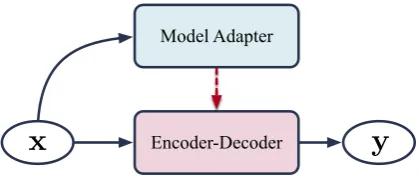
Figure 1: General model architecture. Black solid lines denote information flow, and the red dashed line indi-cates the adaptive parameterization operation.
LSTM unit is formulated as:
it=Whiht−1+Wxixt+bi
gt=Whght−1+Wxgxt+bg
ft=Whfht−1+Wxfxt+bf
ot=Whoht−1+Wxoxt+bo
ct=σ(ft)ct−1+σ(it)tanh(gt)
ht=σ(ot)tanh(ct),
(4)
where σ is the sigmoid operator and stands for Hadamard product. ht−1 is the previous
hid-den state and xt is the input embedding at step
t. W = {Whi, Whg, Whf, Who, Wxi, Wxg, Wxf, Wxo} andb={bi, bg, bf, bo}are the LSTM parameters. The model parameters are tuned on the training corpus.
When testing, given the input context, it gener-ates a response with the learned parameters. This architecture shows great success in neural dialogue generation (Shang et al.,2015;Serban et al.,2016, 2017;Shen et al.,2017;Clark and Cao,2017;Xing et al., 2017;Choudhary et al., 2017;Zhao et al., 2018). However, with a single set of model param-eters and the oversimplified model architecture, the flexibility of the model is rather limited, especially when confronting conversations with diverse topics or themes.
3 Adaptive Neural Dialogue Generation Model
(b)
Context Encoder
x1 x2 x3 y1 y2 y3
(a)
Encoder Decoder
x
Parameter Adapter
Legend
W Hidden states
Parameterization operation
LSTM weights
ζ
,
ζ ht−1
Φ
=ξt Ac =W ξt [image:3.595.73.290.60.241.2], , U, V
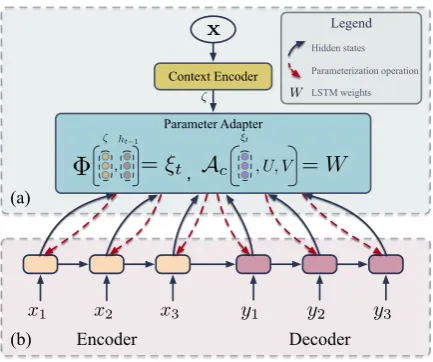
Figure 2: General architecture of the context-aware pa-rameterization. (a) Context-aware parameter adapter. (b) One layer of the dialogue generation model. Black solid lines denote information flow, and red dashed lines indicate adaptive parameterization operations.Ac stands for the context-aware parameterization function (Eq.(7)).
encoder-decoder model generates the response with a specific set of model parameters.
3.1 Context-aware Parameterization
Context-aware parameterization parameterizes the dialogue encoder-decoder with respect to the local semantics of the given context. As shown in Fig-ure2, we first obtain the semantic representation of the context through a context encoder. Then, the pa-rameter adapter dynamically adapts the papa-rameters of the encoder-decoder at each time step. Here, we utilize a bidirectional LSTM to transform the input context into the semantic hidden representationζ. The parameter adapter then generates the weights of LSTM units as:
W =M[1:Nr]ζ, (5)
whereW ∈ RNr×Nc andM[1:Nr] ∈
RNr×Nc×Nζ is a tensor. Nr = 4Nh and Nc = Nh +Nx, in whichNhis the hidden size of the LSTM andNx is the embedding size. ζ ∈ RNζ is the context representation. The productM[1:Nr]ζ results in a weight matrixW, where each row is computed by one slicej = 1,2,· · ·, Nr of the tensor: Wj =
(Mjζ)T.
Although such parameterization seems to be straightforward, due to the quadratic size of M[1:Nr], the parameter size of such
parame-ter adapparame-ter is Nζ times larger than the basic encoder-decoder model. Therefore, overfitting
and expensive computational cost make it infea-sible (Bertinetto et al.,2016;Ha et al.,2017). Fol-lowing Flennerhag et al. (2018), we reduce the parameter space by factorizing the weights as:
W =Ac(ξt, U, V)
ξt= Φ(ζ, ht−1),
(6)
whereΦis implemented as a LSTM unit,ht−1is
the previous encoder or decoder hidden state, and ξt∈RNζ is the context representation at time step
t.Acdenotes the context-aware parameterization function, defined as:
Ac(ξt, U, V) =U ξtVT, (7)
whereU ∈ RNr×Nζ andV ∈ RNc×Nζ are
learn-able weights.
The context-aware parameterization functionAc is reminiscent of the Singular Value Decomposi-tion (SVD). Here,Accomposes a projection by adapting the dialogue context to the weight matri-ces and does not perform matrix decomposition actually. The number of parameters in this formu-lation isL = Nr×Nζ +Nc×Nζ and the total parameter number of the model is linear withL, so that the total number of model parameters does not explode.
3.2 Topic-aware Parameterization
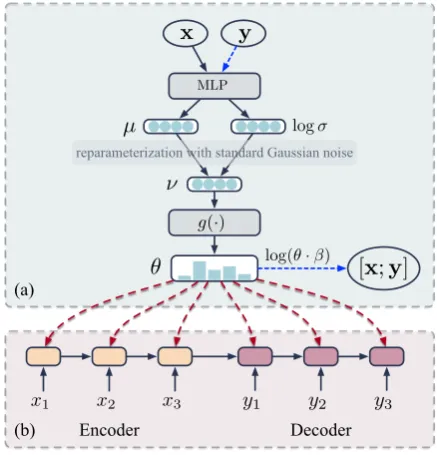
Context-aware parameterization adapts the encoder-decoder parameters regarding each input context. As a result, the adapted encoder-decoder is sensitive to the input context. To enable the parameter sharing among similar topics, we further propose a topic-aware parameterization mechanism. As shown in the Figure3, the topic inferrer first distills the topic distributionθfrom the context (Figure3(a)), and then the parameters of the encoder-decoder model are constructed uponθ(Figure3(b)).
3.2.1 Latent Topic Inference
We introduce a variational topic inferrer to infer the topic distributionθof the conversation. Drawing inspirations from neural topic model (Miao et al., 2017), as illustrated in Figure3(a), the generation process of the variational topic inferrer is formu-lated as follows:
logσ
µ
θ
MLP
(b)
x1 x2 x3 y1 y2 y3
Encoder Decoder
(a)
g(·)
reparameterization with standard Gaussian noise
log(θ·β)
x y
[x;y]
[image:4.595.71.290.62.290.2]ν
Figure 3: Illustration of the topic-aware parameteriza-tion. (a) Topic inferrer. (b) One layer of the dialogue generation model. Black solid lines denote information flow, blue dashed lines only appear in training, and red dashed lines indicate adaptive parameterization opera-tions.
(ii) The topic distribution θis constructed from the latent variableνthrough a softmax func-tion.
(iii) The dialogue d, composing of a context-response pair(x,y), is drawn from the topic distribution over wordsp(wi|βzi), whereziis a topic assignment sampled from a multino-mial distribution parameterized by the topic distributionθ, andβzi is the topic-word distri-bution of topic assignmentzi.
Given a context x, the latent variable ν is sampled from P(ν|x) = N(µprior, σ2prior), and
N(µprior, σprior2 )is the multivariate normal distri-bution with meanµpriorand diagonal covariance matrixσprior2 . In practice,νis reparameterized as: ν = µprior+·σpriorandis a standard Gaus-sian noise. The GausGaus-sian parametersµprior and
σprior2 are the outputs of multilayer perceptrons (MLP) given the bag-of-words (BoW) represtation of the context as input. To reduce the en-coding noise of stop words, here we choose the BoW instead of LSTM for context representations, followingMiao et al.(2017). To implement neu-ral variational inference, we utilize an inference networkQ(ν|d) =N(µposterior, σ2posterior)to ap-proximate the intractable true posterior p(ν|d),
whereµposteriorandσ2posteriorare computed in the same way as the prior, taking the bag-of-words rep-resentation of dialoguedas input. The dialogued consists of the context-response pair(x,y).
The topic distributionθis constructed from the latent variableνthrough a softmax function:
θ=g(ν) =softmax(ν·Wν), (8) whereWν is a linear transformation and the bias terms are left out for brevity.
Then, the dialoguedis generated based on the topic distributionθ. Givenθ, the marginal likeli-hood of a dialoguedis formulated as:
p(d) =
Z
θ
p(θ) |d|
Y
i=1
X
zi
p(wi|βzi)p(zi|θ)dθ. (9)
In addition, the topic assignment zi can be inte-grated out and the log-likelihood of a wordwiin dialoguedcan be factorized as:
logp(wi|β, θ) = log
X
zi
[p(wi|βzi)p(zi|θ)]
= log(θ·βT).
(10)
The topic-word distributionβkis defined by:
βk=softmax(z·ΛTk), (11) wherez∈RC×H is the topical word embedding
matrix and Λ ∈ RK×H is the topic embedding
matrix,Kis the number of topics,Cis the number of topical words, H is the embedding size and β ={β1, β2,· · · , βK}.
3.2.2 Parameterization with Latent Topics We parameterize the encoder-decoder with the in-ferred topic distributionθ. In context-aware param-eterization, the parameters of the encoder-decoder are adapted dynamically at each time step, whereas in topic-aware parameterization, as illustrated in Figure3(b), we generate only one set of parame-ters for each conversation.
Similar to the context-aware parameterization function in Eq.(7), given the topic distributionθ, the topic-aware parameterization functionAκ con-structs the LSTM weightW as follows:
W =Aκ(θ, U, V)
Aκ(θ, U, V) =U θVT,
(12)
whereU ∈RNr×KandV ∈
RNc×K are learnable
3.3 Parameterization with Both Context and Topics
Intuitively, context-aware parameterization is more adept at capturing local semantics of the input con-text while topic-aware parameterization enables pa-rameter sharing between conversations with similar topic distributions. To benefit the model parameter-ization with both the local and global information, we further adapt parameters of the encoder-decoder by utilizing both the context representationsξtand the topic distributionθ. In particular, the LSTM weightW at time steptis adapted as follows:
W =ΨtAc(ξt, Uc, Vc)+
(1−Ψt)Aκ(θ, Uκ, Vκ)
Ψt=σ(ξt, θ),
(13)
whereΨtis the gating function deciding whether the parameterization relies more on the context or the topics.Uc, Vc, UκandVκare learnable weights.
Ac and Aκ denote the context-aware and topic-aware parameterization function respectively.σis the sigmoid function.
3.4 Learning
To enable the joint optimization of latent topic in-ference, adaptive model parameterization, and re-sponse generation in ADAND, given the definitions in Eq.(9), similar toKingma and Welling(2014) and Miao et al. (2017), we derive a variational lower bound for the generation likelihood:
J =EQ(θ|d)[
|d| X
i=1
[logX zi
[p(wi|βzi)p(zi|θ)]] + logp(y|x)]
−DKL(Q(θ|d)||P(θ|x))
=EQ(θ|d)[
|d| X
i=1
logp(wi|β, θ) + Ty
X
t=1
logp(yt|st−1)]
−DKL(Q(θ|d)||P(θ|x))
=EQ(ν|d)[
|d| X
i=1
logp(wi|β, ν) + Ty
X
t=1
logp(yt|st−1)]
−DKL(Q(ν|d)||P(ν|x))
≈
|d| X
i=1
logp(wi|β, ν) + Ty
X
t=1
logp(yt|st−1)
−DKL(Q(ν|d)||P(ν|x)),
(14) wherey ={y1, y2,· · · , yTy},P(ν|x)is the prior estimation of the latent variableν which approx-imates the posteriorQ(ν|d). The priorP(θ|x)= P(g(ν)|x)=P(ν|x), and the posteriorQ(θ|d)= Q(g(ν)|d)=Q(ν|d). The first term is the dialogue generation objective in the latent topic inferrer, the
second term is the response generation objective, and the third term is the KL divergence between two Gaussian distributions. All the parameters are learned by optimizing Eq.(14) and updated with back-propagation.
The following previously proposed strate-gies (Bowman et al.,2016;Zhao et al.,2017) are adopted in training to alleviate the vanishing latent variable problem: (1) KL annealing: the weight of the KL divergence term is gradually increasing from 0 to 1 during training; (2) Bag-of-words loss: the bag-of-words loss requires the latent variableν, together with the dialogue context, to reconstruct the response bag-of-words representationyb.
4 Experiments
4.1 Dataset and Competitor Baselines
To ascertain the effectiveness of the proposed model, we construct an open-domain conversa-tion corpus covering a broad range of resources including a movie discussions dataset collected from Reddit (Dodge et al., 2015), an Ubuntu technical corpus (Lowe et al., 2015), and a chit-chat dataset (Zhang et al.,2018). 87,468 context-response pairs were sampled for training, 4,460 for validation and 4,468 for testing.
The code and corpus are available athttp:// github.com/hengyicai/AdaND.
The following state-of-the-art models are adopted as our comparison systems.
SEQ2SEQ The attention-based sequence-to-sequence model (Bahdanau et al., 2015), which is a representative baseline.
CVAE A latent variable conversation model in which it incorporates a latent variable at the sentence-level to inject stochasticity and diver-sity (Clark and Cao,2017;Zhao et al.,2017).
LAED A recurrent encoder-decoder conversa-tion model using discrete latent acconversa-tions for inter-pretable neural dialogue generation (Zhao et al., 2018).
TA-SEQ2SEQ TA-SEQ2SEQ incorporates the outsourcing topic information into the response generation, where the topics are learned from a separate LDA model to enrich the context (Xing et al.,2017).
Models
Relevance (%) Informativeness (%)
BLEU Average Greedy Extrema Distinct-1 Distinct-2 Distinct-3
SEQ2SEQ 0.845 69.60 64.94 45.29 0.2822 0.5922 0.7873
CVAE 1.546 71.23 66.67 47.14 0.5465 1.716 2.731
LAED 0.7545 69.91 63.55 43.12 0.3890 0.9165 1.243
TA-SEQ2SEQ 1.465 72.47 65.9 45.19 0.3593 0.7994 1.016
DOM-SEQ2SEQ 1.189 74.42 66.6 48.47 0.4977 1.294 1.814
ADAND (with context para.) 1.94 74.03 66.76 49.23 0.6493 1.889 2.745 ADAND (with topic para.) 2.051 74.17 66.65 49.04 0.5919 1.699 2.438
[image:6.595.79.525.65.202.2]ADAND (with both) 1.90 75.59 67.25 51.17 0.7092 2.10 3.108
Table 1: Quantitative evaluation results (%).
SEQ2SEQ models for response generation ( Choud-hary et al.,2017).
4.2 Evaluation
Following the evaluation procedure in previous work (Li et al., 2016; Xing et al., 2017; Chen et al., 2018), experimental results of all models are reported in terms of the relevance and infor-mativeness. To evaluate the semantic relevance between the generated response and the ground-truth response, we adopted the BLEU metric ( Pap-ineni et al.,2002) and three embedding-based sim-ilarity metrics proposed inLiu et al.(2016): Em-bedding Average (Average), Embedding Extrema (Extrema) and Embedding Greedy (Greedy). To measure informativeness and diversity of the re-sponse, we exploited the Distinct-1, Distinct-2 and Distinct-3 metrics. A higher ratio of distinct n-grams implies more informative and diverse re-sponses.
4.3 Implementation and Reproducibility
We implemented our model with ParlAI (Miller et al.,2017). The sequence lengths are truncated at 50. We used Adam (Kingma and Ba,2014) with an initial learning rate of 0.001 to optimize the model. For all the experiments, we employed a 2-layer bidirectional LSTM as the encoder and a unidirectional one as the decoder. The hidden size and the word embedding dimension are both set to 300. The latent variable size is set to 64. The topic numberK in our model is set to 5 and the most frequent 3,159 words are taken as the topical words vocabulary by stemming, filtering stop-words from the training set. The batch size is set to 128 for all models. We trained a Twitter LDA model to obtain the topical words for TA-SEQ2SEQ and set its model-specific parameters following the original
paper (Xing et al.,2017). For regularization and preventing over-fitting, a dropout of 0.1 is applied and the weight decay is set to3×10−5. We used the pretrained word embeddings (Pennington et al., 2014) of 300 dimensions, and the vocabulary size is set to 20,000. All models are trained with early stopping, i.e., if the loss does not decrease after 10 validations. The loss is computed on the validation set at every 0.5 epochs and we save the parameters for the top model on the validation set. We finally report evaluation scores on the test set from the saved model.
4.4 Overall Performance
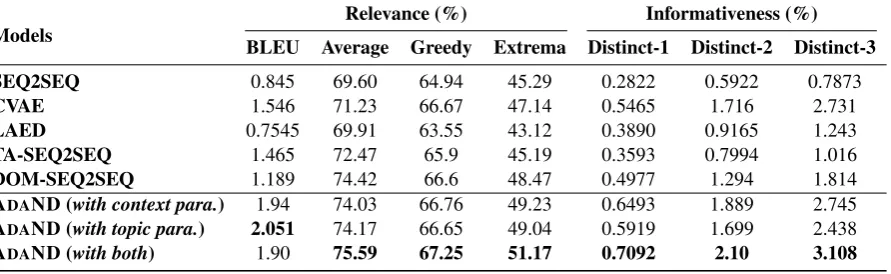
Table 1 lists the performance of our system and the comparison systems. CVAE and LAED inject SEQ2SEQ with stochastic latent variable, resulting in more informative responses and better perfor-mance on Distinct-{1, 2, 3}. TA-SEQ2SEQ in-corporates SEQ2SEQ with the outsourcing topic information from LDA. It is not surprising that it performs much better on the response relevance (BLEU, Average, Greedy, Extrema), while its im-provements on the informativeness are limited. DOM-SEQ2SEQ builds multiple domain-specific encoder-decoders. It gains improvements on both the relevance metrics and informativeness metrics.
In general, with both the context-aware and topic-aware parameterization, our model outper-forms all the competitive baselines in terms of the response relevance and informativeness.
4.5 Context-awarevsTopic-aware Parameterization
Ta-Opponent Win Loss Tie Kappa ADAND vs. SEQ2SEQ 62.5% 2.52% 34.98% 46.46
ADAND vs. CVAE 36.98% 7.56% 55.46% 51.59
ADAND vs. LAED 44.54% 6.72% 48.74% 55.57
ADAND vs. TA-SEQ2SEQ 54.62% 5.88% 39.5% 54.91
[image:7.595.308.525.63.198.2]ADAND vs. DOM-SEQ2SEQ 32.78% 10.08% 57.14% 55.53
Table 2: The results of human evaluation.
Models Speed (cases/ms)
SEQ2SEQ 0.740
CVAE 0.541
LAED 0.435
TA-SEQ2SEQ 0.172 DOM-SEQ2SEQ 0.106 ADAND 0.407
Table 3: Speed test.
ble1, both parameterization mechanisms perform much better than the original SEQ2SEQ model, while context-aware parameterization is slightly better in terms of informativeness. When jointly utilizing both the context-aware and topic-aware parameterization mechanisms, we observe the best performance, indicating that these two mechanisms are both beneficial and complementary.
4.6 Human Evaluation
We conducted human evaluations on the test set to further validate the effectiveness of the model. We randomly selected 500 samples from the test set. Three well-educated students were invited to conduct the evaluation. For each case, we pro-vided annotators with triplets (sample, response1, response2) whereby one response is generated by ADAND, and the other is generated by a competi-tor model. The annotacompeti-tors, who have no knowl-edge about which system the response is from, are then required to independently rate among win (response1is better), loss (response2is better) and tie (they are equally good or bad), considering four factors: context relevance, logical consistency, flu-ency and informativeness. Note that if annotators rate different options, this triplet will be counted as “tie”. Table2reveals the results of subjective
evalu-ation. The kappa scores indicate that the annotators came to a fair agreement in the judgment.
As expected, ADAND outperforms the other baselines and enjoys a large margin over the ex-isting models. The relative performance of the competitors is consistent with the quantitative eval-uation results, confirming the superior performance of our proposed method.
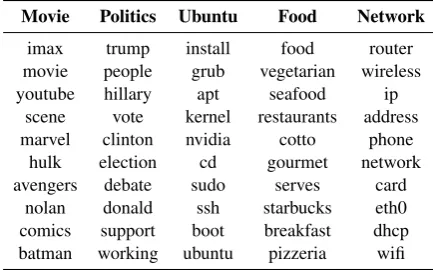
Movie Politics Ubuntu Food Network
imax trump install food router movie people grub vegetarian wireless youtube hillary apt seafood ip
scene vote kernel restaurants address marvel clinton nvidia cotto phone
hulk election cd gourmet network avengers debate sudo serves card
nolan donald ssh starbucks eth0 comics support boot breakfast dhcp batman working ubuntu pizzeria wifi
Table 4: Topics by the words (βin Eq.(10)) with top-10 highest probability discovered by the latent topic infer-rer.
4.7 Speed Test
We conducted speed test to verify the efficiency of the ADAND model empirically in Table3. Aug-mented with auxiliary components, all the exten-sion models exhibit higher time cost than the origi-nal SEQ2SEQ model. We observe that the decod-ing speeds of CVAE and LAED are relatively com-parable with our model. However, when comparing with TA-SEQ2SEQ and DOM-SEQ2SEQ that also elaborately and explicitly model conversations with diverse topics or themes, ADAND shows a clear superiority in decoding speed. For TA-SEQ2SEQ, it relies on an outside LDA model to obtain the topic information. The joint attention and copying mechanism also reduce its efficiency. For DOM-SEQ2SEQ, it is not surprising that the time com-plexity of multiple topic/theme-specific encoder-decoders is much higher than all-other comparison models. ADAND utilizes a single encoder-decoder and is parameterized dynamically regarding the input context, which ensures its flexibility and effi-ciency.
4.8 Analysis & Case Study
To get some insights of how topic-aware parame-terization performs, we present the topics by the words (β in Eq.(10)) with top-10 highest proba-bilities in Table4. The discernible clusters of the topical words (zin Eq.(11)) are illustrated in
Fig-ure4. These evidences demonstrate that the topic inferrer in topic-aware parameterization effectively distills the latent topic distribution of each conver-sation, which enables the parameter sharing among conversations with similar topics.
[image:7.595.74.290.63.120.2]differ-Figure 4: t-SNE (van der Maaten and Hinton, 2008) projection of topical word embeddings (zin Eq.(11))
in the latent topic inferrer. Words with similar topics are in the same color.
ent parameter initialization methods (drawn values from normal distribution or uniform distribution). We observe thatU UTandV VTapproximate iden-tity matrices. We conjecture that such SVD-alike parameterization implicitly enforces orthogonality during training.
We list several examples generated by different models in Table5. The inferred latent topic distri-butions are also presented in the table. It can be observed that responses generated by the original SEQ2SEQ model are more generic. Latent variable conversation models (CVAE and LAED) generate more diverse but sometimes irrelevant responses, TA-SEQ2SEQ tends to produce short responses while DOM-SEQ2SEQ does not perform obviously better than TA-SEQ2SEQ. The responses generated by ADAND are not only relevant but also informa-tive.
5 Related Work
Our work is closely related to the research of dia-logue generation in diverse conversations. Previous work relies on external pre-organized topic infor-mation (Xing et al.,2017;Wang et al.,2017) or predicted keywords (Yao et al.,2017;Wang et al., 2018) to boost the response informativeness and coherence. Choudhary et al.(2017) further lever-aged the topic/theme annotations to build multiple separate encoder-decoder models for topic/theme-aware response generation. In contrast, we do not exploit any outsourcing or labeled topic informa-tion. The proposed model directly infers the latent topics of each conversation and is trained in an end-to-end manner. Another difference is that we
1
Context:Hi, can you help me find a good movie to watch? Reference:Hi, I would like to help out.
SEQ2SEQ:I’m sorry, I’m sorry, I’m sorry. CVAE:I’m looking for a good comedy movie. LAED:I’m sorry, I’m not sure.
TA-SEQ2SEQ:I am looking for a good movie.
DOM-SEQ2SEQ:I sent the info on your screen, drive carefully!
ADAND:What kind of movies do you like?
Inferred topic distribution:
2
Context:I love to sit on the couch and play video games myself. Reference:My brother does too, especially since our parents moved to florida recently.
SEQ2SEQ:I’m sorry, I’m not a good. CVAE:I’m not sure that is my favorite. LAED:I’m not a good. I’m a good. TA-SEQ2SEQ:That’s cool.
DOM-SEQ2SEQ:I’m a good. I’m a unk .
ADAND:That’s cool. What do you do for a living?
Inferred topic distribution:
3
Context:We go back to celebration in Florida often. It is our home town.
Reference:Oh how nice! I love taking my dog to the beach! SEQ2SEQ:I’m sorry, I’m not a good.
CVAE:I’m a little more than a lot of time.
LAED:I’m sorry, I’m sorry, but there are no results for any other restaurants in the centre. Would you like to try another area? TA-SEQ2SEQ::)
DOM-SEQ2SEQ:I have a 4 star hotel near a park, museum, and theatre, 8.86/10 guest rating, free parking, breakfast, and wifi,
from September 2nd to 13th, business class flights, unk . 86.
ADAND:That’s cool. Do you have any hobbies?
Inferred topic distribution:
4
Context:Oh, that’s all right. No need to reserve my ticket. But I do need the travel time, please.
Reference:Your travel time is 60 minutes. Is there anything else that I can do for you?
SEQ2SEQ:I have booked you for the reference number is unk . CVAE:The travel time is 105 minutes.
LAED:I’ m sorry, I’ m sorry, I’ m sorry, but there are no results for that time. Would you like to try another day or time? TA-SEQ2SEQ:The train id is unk .
DOM-SEQ2SEQ:You’re welcome. Have a great day! ADAND:The travel time is 163 minutes. Is there anything else i can help you with?
Inferred topic distribution:
5
Context:How is gonna be the weather forecast in San Mateo for the next weekend?
Reference:In San Mateo it will be stormy on Saturday, and hail on Sunday.
SEQ2SEQ:The address is a park, and the address is a park. CVAE:It will be a low of 60F and a high of 70F.
LAED:what city would you like to know the weather for? TA-SEQ2SEQ:Do you have a budget?
DOM-SEQ2SEQ:It will not be cloudy this week. ADAND:It will not be cloudy in San Mateo next week.
[image:8.595.306.527.59.577.2]Inferred topic distribution:
Table 5: Test samples of our model (ADAND) and the baselines. The latent topic distributions inferred by ADAND are also presented. The reference is the ground-truth response in the dataset.
maintain a single encoder-decoder for various con-versations whereas the model is dynamically and specially parameterized.
[image:8.595.95.269.63.211.2]parameteriza-tion has been shown to be successful in many NLP tasks, including language modeling (Suarez,2017; Flennerhag et al.,2018), sequence generation (Ha and Eck,2018;Peng et al.,2019), and neural ma-chine translation (Platanios et al.,2018). In our work, we parameterize the encoder-decoder with respect to both the context and the latent topics.
Regarding latent variable conversation models, prior researches strive to learn meaningful latent variables for dialogue systems, and reveal that la-tent variables befit the neural dialogue models with more diverse response generations (Serban et al., 2017; Zhao et al., 2017; Clark and Cao, 2017; Chen et al., 2018) and interpretable dialogue ac-tions (Zhao et al., 2018). In our model, instead of directly injecting the latent variable into dia-logue models, we distill the latent topics through neural variational inference, offering a more inter-pretable latent variable. Moreover, we parameter-ize the encoder-decoder with the inferred latent topics, which allows parameter sharing among con-versations with similar topics.
6 Conclusion
This paper presents an adaptive neural dialogue generation model—ADAND, which allows the dy-namical parameterization of the model to each con-versation and enables the generation of appropriate responses in diverse conversations. Specially, we propose two adaptive parameterization approaches: context-aware parameterization which captures lo-cal semantics of the input context; and topic-aware parameterization which enables parameter sharing by first inferring the latent topics of the given con-text and then generating the parameters with the inferred latent topics. The proposed approaches are assessed on a large-scale conversational dataset and the results show that our model achieves supe-rior performance and higher efficiency. It should be noted that our approach is not isolated to only LSTMs. We would like to explore the effectiveness of the approach regarding other structures in future work.
Acknowledgments
We would like to thank all the reviewers for their insightful and valuable comments and suggestions. Hongshen Chen and Cheng Zhang are the corre-sponding authors.
References
Dzmitry Bahdanau, Kyunghyun Cho, and Yoshua Ben-gio. 2015. Neural machine translation by jointly learning to align and translate. InICLR.
Luca Bertinetto, Jo˜ao F. Henriques, Jack Valmadre, Philip H. S. Torr, and Andrea Vedaldi. 2016. Learn-ing feed-forward one-shot learners. InNIPS, pages 523–531.
Samuel R. Bowman, Luke Vilnis, Oriol Vinyals, An-drew M. Dai, Rafal J´ozefowicz, and Samy Ben-gio. 2016. Generating sentences from a continuous space. InSIGNLL, pages 10–21.
Hongshen Chen, Zhaochun Ren, Jiliang Tang, Yi-hong Eric Zhao, and Dawei Yin. 2018. Hierarchical variational memory network for dialogue generation. InWWW, pages 1653–1662.
Kyunghyun Cho, Bart van Merrienboer, Caglar Gul-cehre, Dzmitry Bahdanau, Fethi Bougares, Holger Schwenk, and Yoshua Bengio. 2014. Learning phrase representations using rnn encoder–decoder for statistical machine translation. InEMNLP, pages 1724–1734.
Sajal Choudhary, Prerna Srivastava, Lyle H. Ungar, and Jo˜ao Sedoc. 2017. Domain aware neural dialog sys-tem.CoRR, abs/1708.00897.
Stephen Clark and Kris Cao. 2017. Latent variable di-alogue models and their diversity. InEACL, pages 182–187.
Jesse Dodge, Andreea Gane, Xiang Zhang, Antoine Bordes, Sumit Chopra, Alexander H. Miller, Arthur Szlam, and Jason Weston. 2015. Evaluating prereq-uisite qualities for learning end-to-end dialog sys-tems.CoRR, abs/1511.06931.
Sebastian Flennerhag, Hujun Yin, John A. Keane, and Mark Elliot. 2018. Breaking the activation function bottleneck through adaptive parameterization. In
NeurIPS, pages 7750–7761.
David Ha, Andrew M. Dai, and Quoc V. Le. 2017. Hy-pernetworks. InICLR.
David Ha and Douglas Eck. 2018. A neural representa-tion of sketch drawings. InICLR.
Sepp Hochreiter and J¨urgen Schmidhuber. 1997. Long short-term memory. Neural Comput., 9(8):1735– 1780.
Diederik P. Kingma and Jimmy Ba. 2014. Adam: A method for stochastic optimization. InICLR.
Diederik P. Kingma and Max Welling. 2014. Auto-encoding variational bayes. InICLR.
Jiwei Li, Michel Galley, Chris Brockett, Jianfeng Gao, and Bill Dolan. 2016. A diversity-promoting ob-jective function for neural conversation models. In
Chia-Wei Liu, Ryan Lowe, Iulian Serban, Michael Noseworthy, Laurent Charlin, and Joelle Pineau. 2016. How NOT to evaluate your dialogue system: An empirical study of unsupervised evaluation met-rics for dialogue response generation. In EMNLP, pages 2122–2132.
Ryan Lowe, Nissan Pow, Iulian Serban, and Joelle Pineau. 2015. The ubuntu dialogue corpus: A large dataset for research in unstructured multi-turn dia-logue systems. InSIGDIAL, pages 285–294.
Laurens van der Maaten and Geoffrey Hinton. 2008. Visualizing data using t-SNE. Journal of Machine Learning Research, 9:2579–2605.
Yishu Miao, Edward Grefenstette, and Phil Blunsom. 2017. Discovering discrete latent topics with neural variational inference. In ICML, volume 70, pages 2410–2419.
A. H. Miller, W. Feng, A. Fisch, J. Lu, D. Batra, A. Bor-des, D. Parikh, and J. Weston. 2017. Parlai: A dialog research software platform. arXiv preprint arXiv:1705.06476.
Kishore Papineni, Salim Roukos, Todd Ward, and Wei-Jing Zhu. 2002. Bleu: a method for automatic eval-uation of machine translation. InACL, pages 311– 318.
Hao Peng, Ankur P. Parikh, Manaal Faruqui, Bhuwan Dhingra, and Dipanjan Das. 2019. Text generation with exemplar-based adaptive decoding. In NAACL-HLT, pages 2555–2565.
Jeffrey Pennington, Richard Socher, and Christopher D. Manning. 2014.Glove: Global vectors for word rep-resentation. InEMNLP, pages 1532–1543.
Emmanouil Antonios Platanios, Mrinmaya Sachan, Graham Neubig, and Tom M. Mitchell. 2018. Con-textual parameter generation for universal neural ma-chine translation. InEMNLP, pages 425–435.
Iulian Vlad Serban, Alessandro Sordoni, Yoshua Ben-gio, Aaron C. Courville, and Joelle Pineau. 2016. Building end-to-end dialogue systems using gener-ative hierarchical neural network models. InAAAI, pages 3776–3784.
Iulian Vlad Serban, Alessandro Sordoni, Ryan Lowe, Laurent Charlin, Joelle Pineau, Aaron C. Courville, and Yoshua Bengio. 2017. A hierarchical latent variable encoder-decoder model for generating dia-logues. InAAAI, pages 3295–3301.
Lifeng Shang, Zhengdong Lu, and Hang Li. 2015. Neu-ral responding machine for short-text conversation. InACL, pages 1577–1586.
Xiaoyu Shen, Hui Su, Yanran Li, Wenjie Li, Shuzi Niu, Yang Zhao, Akiko Aizawa, and Guoping Long. 2017. A conditional variational framework for dia-log generation. InACL, pages 504–509.
Joseph Suarez. 2017. Character-level language model-ing with recurrent highway hypernetworks. InNIPS, pages 3269–3278.
Ilya Sutskever, Oriol Vinyals, and Quoc V Le. 2014. Sequence to sequence learning with neural networks. InNIPS, pages 3104–3112.
Ashish Vaswani, Noam Shazeer, Niki Parmar, Jakob Uszkoreit, Llion Jones, Aidan N Gomez, Ł ukasz Kaiser, and Illia Polosukhin. 2017. Attention is all you need. InNIPS, pages 5998–6008.
Di Wang, Nebojsa Jojic, Chris Brockett, and Eric Ny-berg. 2017. Steering output style and topic in neural response generation. InEMNLP, pages 2140–2150.
Wenjie Wang, Minlie Huang, Xin-Shun Xu, Fumin Shen, and Liqiang Nie. 2018. Chat more: Deep-ening and widDeep-ening the chatting topic via A deep model. InSIGIR, pages 255–264.
Chen Xing, Wei Wu, Yu Wu, Jie Liu, Yalou Huang, Ming Zhou, and Wei-Ying Ma. 2017. Topic aware neural response generation. InAAAI, pages 3351– 3357.
Lili Yao, Yaoyuan Zhang, Yansong Feng, Dongyan Zhao, and Rui Yan. 2017. Towards implicit content-introducing for generative short-text conversation systems. InEMNLP, pages 2190–2199.
Saizheng Zhang, Emily Dinan, Jack Urbanek, Arthur Szlam, Douwe Kiela, and Jason Weston. 2018. Per-sonalizing dialogue agents: I have a dog, do you have pets too? InACL, pages 2204–2213.
Tiancheng Zhao, Kyusong Lee, and Maxine Esk´enazi. 2018. Unsupervised discrete sentence representa-tion learning for interpretable neural dialog genera-tion. InACL, pages 1098–1107.