Proceedings of the 2019 Conference on Empirical Methods in Natural Language Processing
2723
Semi-supervised Entity Alignment via Joint Knowledge Embedding
Model and Cross-graph Model
Chengjiang Li1,2,3, Yixin Cao4∗, Lei Hou1,2,3, Jiaxin Shi1,2,3, Juanzi Li1,2,3, Tat-Seng Chua4 1Department of Computer Science and Technology, Tsinghua University
2KIRC, Institute for Artificial Intelligence, Tsinghua University
3Beijing National Research Center for Information Science and Technology
4School of Computing, National University of Singapore, Singapore
{iamlockelightning,caoyixin2011,greener2009,shijx12}@gmail.com [email protected], [email protected]
Abstract
Entity alignment aims at integrating comple-mentary knowledge graphs (KGs) from dif-ferent sources or languages, which may ben-efit many knowledge-driven applications. It is challenging due to the heterogeneity of KGs and limited seed alignments. In this paper, we propose a semi-supervised en-tity alignment method by joint Knowledge Embedding model and Cross-Graph model (KECG). It can make better use of seed align-ments to propagate over the entire graphs with KG-based constraints. Specifically, as for the knowledge embedding model, we utilize TransE to implicitly complete two KGs to-wards consistency and learn relational con-straints between entities. As for the cross-graph model, we extend Graph Attention Net-work (GAT) with projection constraint to ro-bustly encode graphs, and two KGs share the same GAT to transfer structural knowledge as well as to ignore unimportant neighbors for alignment via attention mechanism. Results on publicly available datasets as well as fur-ther analysis demonstrate the effectiveness of KECG. Our codes can be found inhttps: //github.com/THU-KEG/KECG.
1 Introduction
Recently, many Knowledge Graphs (KGs) (e.g., DBpedia (Lehmann et al., 2015), YAGO (Rebele et al.,2016) and BabelNet (Navigli and Ponzetto, 2012)) have emerged to provide structural knowl-edge for different applications. These separately constructed KGs contain heterogeneous but com-plementary contents; thus integrating KGs from different sources or languages into a unified KG becomes essential to better benefit knowledge-driven applications, ranging from information ex-traction (Han et al.,2018;Cao et al.,2018) to ques-tion answering (Cui et al.,2017).
∗
Corresponding author
KG2
KG1
country New York City
Hudson River
New York
Hudson River
New York (state) U.S. state
the U.S.
adjacentTo locatedIn
hasRiver adjoin
country
[image:1.595.317.514.223.321.2]country
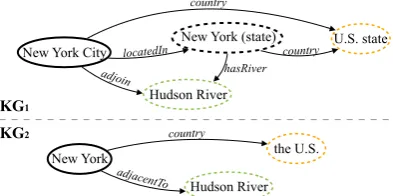
Figure 1: Example of theNew York Cityentity and its neighbors in two heterogeneous KGs (Dashed circles in the same color means prior alignments).
Some efforts have been made to integrate KGs by aligning entities with their semantically same counterparts, namely entity alignment. Early en-tity alignment approaches either rely on human efforts (Mahdisoltani et al., 2013) or extra re-sources (Hu et al.,2011;Wang et al.,2013) to dis-cover new equivalent entity pairs. Recent embed-ding approaches show significant improvement on entity alignment. We roughly classify these em-bedding models into two groups: KG-based mod-els and graph-based modmod-els. KG-based mod-els (Hao et al.,2016;Chen et al.,2017;Sun et al., 2017; Zhu et al., 2017; Sun et al., 2018; Chen et al., 2018) utilize existing KG representation learning methods to learn embeddings of entities and relations in different KGs, and then align them into a unified vector space. This type of method can not only preserve KG structures, but also im-plicitly complete KG with the missing links from existing knowledge. However, KG-based meth-ods require a sufficient number of seed alignments, which is usually expensive to obtain.
the entire graph. However, GCN-based models are sensitive to structural differences of KGs (Vaswani et al.,2017) and may not perform well for entity alignment, since different KGs are very heteroge-neous. Another issue of this type of method is that they fail to consider relation types, which ac-tually play an important role in entity alignment. As shown in Figure 1, the New York City entity has different surface forms in the two KGs (i.e.,
New York City in KG1 and New York in KG2).
There are two possible mappings from the New York CityandNew York (state)in KG1to theNew
York in KG2, and the New York in KG2 shares
the same neighbors Hudson Riverand U.S. state
withNew York CityandNew York (state)in KG1.
In this case, we need to further consider the re-lation types: adjoin and hasRiver to distinguish the two candidate alignments; otherwise, a graph-based method may be misled here.
In this paper, we propose a semi-supervised entity alignment method by joint Knowledge Embedding model and Cross-Graph model (KECG), which combines the above two types of methods. The basic idea of KECG is to utilize a cross-graph model to embed entities into a unified vector space by using inner-graph structure and inter-graph alignments information; meanwhile the knowledge embedding model learns KG representations to implicitly complete different KGs towards consistency and model relational constraints among entities. There are two key points for high-quality jointly training. First, the completion from KG learning may exacerbate the heterogeneity between two KGs, because two KGs may contain different rich parts, which shall become richer during training. Second, different from conventional KG representation learning, entity alignment requires one-to-one mapping, which implies that the similar entities sharing common neighbors cannot be embeded closely, otherwise they shall be aligned incorrectly as shown in Figure1.
Therefore, as for cross-graph model, we pro-pose to utilize an extended Graph Attention Net-work (GAT) (Vaswani et al.,2017) as our cross-graph model that allows robustly encoding of KGs. To alleviate the negative impacts of hetero-geneity, we encode different KGs with the same GAT, so that it not only highlights the entities that are important for alignment in the graph, but also transfers structural knowledge via shared
parame-ters. We also extend it with constraints on weight matrices, making our model more efficient and ef-fective. Moreover, we employ the nearest neigh-bor sampling strategy to differentiate the entities that are embeded closely but not the same to fur-ther boost the performance. We summarize the main contributions as follows:
1. We propose a novel semi-supervised KECG model for entity alignment by joint knowl-edge embedding model and cross-graph model.
2. We utilize an extended GAT to alleviate the negative impacts of heterogeneous KGs, and employ the nearest neighbor sampling strat-egy for KG representation learning towards one-to-one mapping, making the combina-tion more suitable for entity alignment.
3. We evaluate KECG on five publicly avail-able datasets including three cross-lingual datasets and two large-scale datasets from different sources. Compared with four state-of-the-art baselines, experimental results and further analysis demonstrate the outperfor-mance of KECG.
2 Background
2.1 Problem Formulation
Formally, we represent two heterogeneous KGs as G1 = (E1, R1, T1) and G2 = (E2, R2, T2),
where Ei, Ri, Ti represent the sets of entity,
re-lation and triplet in Gi, i ∈ {1,2}, respectively. Ne = {e0|(e, r, e0) ∈ T} ∪ {e0|(e0, r, e) ∈ T}
is the set of neighbors of the entityein G. S =
{(e1, e2) ∈E1×E2|e1 ↔ e2}is a set of labeled entity pairs that are same in semantics, where an equivalence relation↔holds between e1 ande2,
e.g.,e1inG1describes the same real-world entity withe2inG2. Entity alignment aims to find the
re-maining semantically same entity pairs inE1×E2.
For convenience, we putG1 andG2 together into one large graphG = G1 +G2, R = R1 ∪R2, T = T1 ∪T2, andn = |E1|+|E2|is the total
number of entities. We use bold-face letters to de-note the vector representations of the correspond-ing terms throughout the paper.
2.2 Graph Neural Networks (GNNs)
Cross-graph Model
KG2
KG1
α1
α3 α2 α6
α5 α4 α7 dist(e′1,e2′) =||e′1−e′2||2
r1 r2
r3
r4
r5 e1′
e2′
e1
e2 e1
e2
e1′
e′2
Output r1 r4
r3 r5
r2
e′1 e′2
Input Knowledge Embedding
Model
Minimize:
GAT GAT
[image:3.595.113.482.61.243.2]TransE
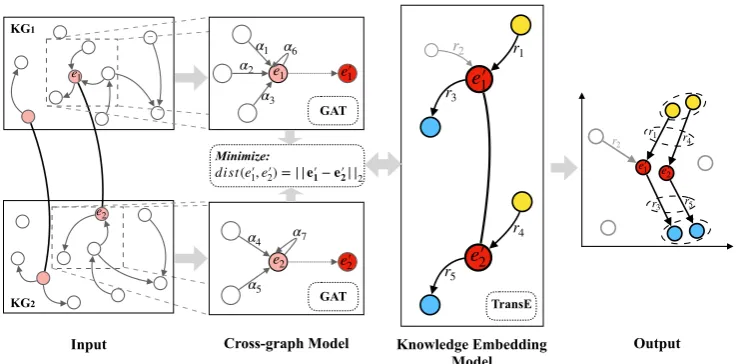
Figure 2: The overview framework of KECG. Solid lines (in Input) connect pre-aligned entities in two KGs. Nodes in different sizes (in Knowledge Embedding Model) show the attention of the center nodes over their neighbors. Circled nodes in the output are the potentially equivalent entities that we want to find out (in Output).
2014; Defferrard et al., 2016; Hamilton et al., 2017). They take a graph as an input, output la-bels for each node, and are similar to a propagation model: to enhance the features of a node according to its neighbor nodes. Among them, GCN (Kipf and Welling, 2017) is a simplification of spectral graph convolutions, whose formulation is as fol-lows:
H(l+1) =σ(AH(l)W(l))
where A is a normalized adjacent matrix of the input graph with self-connection, H(l) andW(l) are the hidden states and weights in thelthlayer,
andσ(·)is a non-linear activation, such asReLu. Subsequently,Vaswani et al. (2017) introduce at-tention mechanism into GCN by dynamically cal-culating A according to the attention values be-tween each entity pairs, which is capable of min-ing structural knowledge better.
3 Method
To combine KG-based methods and graph-based methods with consideration of seed limit and KG heterogeneity, we propose a novel semi-supervised method KECG for entity alignment. As shown in Figure 2, KECG consists of two parts: cross-graph model and knowledge embed-ding model. The input of KECG includes a com-positionGof two KGs and their prior alignment setS.
3.1 Cross-graph Model
The goal of our cross-graph model is to uti-lize structural information, including inner-graph
structure and inter-graph alignments, to embed en-tities into a unified vector space. Due to the in-completeness of KGs, there may be some enti-ties and relations existing in one KG but miss-ing in another KG. We utilize an extended GAT with projection constraint as an encoder to em-bed the KGs while paying different attention over their neighbors, therefore it is able to alleviate the negative impact of heterogeneity by ignoring some unimportant neighbors for alignment. Besides, the graph convolution operation allows us to lever-age both the labeled entities and the abundant un-labeled entity information for alignment, making our method naturally semi-supervised.
The input of the encoder includes an entity em-bedding matrixX∈Rn×dand neighbor sets of all
entities as KG structure, wheredis the dimension of entities. The KG encoder is built by stacking multiple GAT layers:
H(l+1) =σ(A(l)H(l)W(l)) (1)
where H(l) ∈ Rn×d(l)
and W(l) ∈ Rd(l)×d(l+1) are the hidden states and weights in thelth layer,
H(0) = X,σ(·) is a non-linear activation chosen
as ReLU(·) = max(0,·), and A(l) ∈ Rn×n is
a connectivity matrix computed by self-attention over the input graph. Considering a single element
a(ijl)ofA(l), the weight from entityeito entityej,
we compute it using self-attention mechanism:
a(ijl)=sof tmax(c(ijl)) = exp(c (l) ij)
P
ek∈Nei∪{ei}exp(c
(l) ik)
, whereNei ∪ {ei}is the neighbor set ofei with self-loop, c(ijl)is the attention coefficient of entity
eito entityej. Following Velickovic et al.(2018),
the attention coefficient c(ijl) is computed as fol-lows:
c(ijl)=LeakyReLU(qT[W(l)h(il)⊕W (l)
h(jl)]) (3)
where h(il),hj(l) ∈ H(l) are the hidden states of
eiandej, respectively,LeakyReLU (Maas et al.,
2013) is a nonlinear function,q∈R2d(l)is a
learn-able parameter,·T represents transposition and ⊕
indicates vector concatenation. LetLbe the num-ber of layers. After L iterations of convolution, the hidden state H(L) integrates both features of entities and their neighbors, theith row of which
represents theattention enhanced embeddingof entityei.
Projection Constraint. Note that in every for-ward propagation, we useW(l)to transform from
d(l) dimension vector space to d(l+1) dimension. Motivated by (Yang et al.,2015), we keep the di-mensions of the layers and embeddings to be the same, and restrict the projection matrix W to be a diagonal matrix. Such constraint can reduce the number of parameters and computations, increase the generalizability of the model. That’s why we claim that we extend the normal GAT.
ObjectiveOC. For semi-supervised entity
align-ment, we then minimize the representation dis-tance of equivalent entities over all labeled align-ments similar to (Wang et al.,2018):
OC=
X
(ei,ej)∈S X
(e0i,e0j)∈S0
[dist(ei, ej) +γ1−dist(e
0
i, e
0
j)]+
(4) wheredist(ei, ej) =||ei−ej||2is the L2distance
between the aligned entity pair(ei, ej),
represen-tations ofeiandejare from the attention enhanced
embedding matrix H(L), S0 represents the nega-tive pair set of S generated by nearest neighbor sampling (Kotnis and Nastase,2017), andγ1 >0
is a margin hyper-parameter. Because an entity can only have one corresponding entity in another KG, the entity closest to the corresponding entity in the same KG should be the best choice as a neg-ative example to accurately discriminate the target entity. More formally, given a pre-aligned entity pair (ei, ej) ∈ S,where ei ∈ E1, ej ∈ E2, K2
is the number of negative samples, we chooseK2
entities that are nearest toejinE2as the negative
samples of ei, and vice versa forej. After that,
each pre-aligned entity pair will have 2*K2
neg-ative samples. We utilize the L2 distance as the
measure to search for the nearest negative samples due to its superior performance in experiments.
3.2 Knowledge Embedding Model
The goal of our knowledge embedding model is to model inner-graph relationships, making entities more distinguishable. Here, we use TransE ( Bor-des et al.,2013), which is one of the most repre-sentative translation-based methods, as our knowl-edge embedding model. It is worth mentioning that other advanced KG learning methods can also be applied to our knowledge embedding model such as TransD (Ji et al., 2015), which is left for future work as our main idea is to joint cross-graph embeddings and knowledge embeddings for entity alignment.
ObjectiveOK.Formally, given a relational triplet (eh, r, et), TransE wantseh+r'et. So it defines
the score functionf(eh, r, et) =||eh+r−et||2to
measure the plausibility of(eh, r, et), where|| · ||2
means 2-norm. Following TransE, we utilize a margin-based ranking loss function as the training objective of the knowledge embedding model, de-fined as:
OK=
X
(eh,r,et)∈T
X
(e0
h,r0,e0t)∈T0
[f(eh, r, et) +γ2
−f(e0h, r
0
, e0t)]+ (5)
where[·]+ =max{0,·}represents the maximum between 0 and the input, embeddings of entitieseh
andetare from the attention enhanced embedding
matrixH(L), relationris from the relation matrix R∈ R|R|×dwhich needs to be learned,T0stands
for the negative sample triplet set ofT, andγ2 >0
is a margin hyper-parameter separating positive and negative triplets.T0is generated by corrupting
T. For a triplet(eh, r, et) ∈ T, we replace eh to
generate a negative triplet(e0h, r, et), wheree0halso
has the same relation typerconnect to other enti-ties, and so doeset. K1 is the number of negative
samples for each positive triplet. For example, we thinkBeijing City can be a replacer forNew York City in (New York City, country, United States), sinceBeijing Cityalso has the relationcountrybut connected with a different tail entityChina. If the number of replacers is less thanK1, we randomly
3.3 Optimization and Inference
Overall ObjectiveO. Here, we define the objec-tive function of KECG corresponding to the above two parts:
O =OC+OK (6)
whereOC andOK denote the objective function
of the cross-graph model and the knowledge em-bedding model, respectively. It is worth noting that we can set different weights forOC andOK.
But in order to treat both kinds of models equally, here, we set the same weight for them in exper-iments. We use AdaGrad (Duchi et al., 2011) to optimize the overall objectiveO.
Inference. When inferring, new equivalent enti-ties are discovered based on the L2 distances
be-tween entities in the joint embeddings. Equivalent entities should become close with each other, so do equivalent relation types, e.g., circled nodes,r1
andr4in the output of Figure 2.
4 Experiments
We evaluate KECG on entity alignment with five publicly available datasets including three cross-lingual datasets and two large-scale datasets from different sources. We compare KECG with four state-of-the-art baselines and conduct further anal-ysis of essential components of KECG.
4.1 Datasets
Following (Sun et al., 2017, 2018; Wang et al., 2018), we use the DBP15K and the DWY100K datasets for evaluation. DBP15K contains three cross-lingual datasets built from DBpedia, denoted by DBP15KZH−EN(Chinese to English), DBP15KJA−EN(Japanese to English) and DBP15KFR−EN(French to English). Each dataset contains 15,000 reference entity align-ments. To test the adaptability of KECG to large-scale data, we evaluate on DWY100K. DWY100Kcontains two large-scale datasets ex-tracted from DBpedia, Wikidata and YAGO3, denoted by DWY100KWD(DBpedia to Wikidata) and DWY100KYG(DBpedia to YAGO3). Each dataset has 100,000 reference entity alignments. The detailed information of each dataset is listed in Table 1.
4.2 Experiment Settings
To investigate the ability of KECG, we compare it with the following state-of-the-art entity
align-Datasets Entities Relations Rel. triplets
DBP15KZH−EN
Chinese 66,469 2,830 153,929 English 98,125 2,317 237,674
DBP15KJA−EN
Japanese 65,744 2,043 164,373 English 95,680 2,096 233,319
DBP15KFR−EN
French 66,858 1,379 192,191 English 105,889 2,209 278,590
DWY100KWD DBpedia 100,000 330 463,294 Wikidata 100,000 220 448,774
DWY100KYG DBpedia 100,000 302 428,952 YAGO3 100,000 31 502,563
Table 1: Statistics of DBP15K and DWY100K.
ment methods including three KG-based models and one graph-based model.
• KG-based models: MTransE (Chen et al., 2017) is the basic KG-based method. JAPE (Sun et al., 2018) combines relation and attribute embeddings for entity align-ment. AlignEA is the non-iterative version of BootEA (Sun et al.,2018) for entity align-ment, which gets the best results.
• Graph-based model: GCN-Align (Wang
et al., 2018) aligns cross-lingual entity via GCN.
More specifically, we use a 3-layer extended GAT as the encoder to process the composite KG
Gto generate embeddings of its entities. We set the dimension of all layers to be the samed. The entity embedding matrixX and the relation ma-trixRare initialized randomly and updated during training. Besides, we separated two variants from KECG for ablation study, called KECG(w/o NNS) and KECG(w/o K).
• KECG(w/o NNS) replaces the nearest neigh-bor sampling (NNS) strategy with normal uniform negative sampling.
• KECG(w/o K) simply removes the knowl-edge embedding model, only considering the equivalent relation as what GCN-Align does.
Methods DBP15KZH−EN DBP15KJA−EN DBP15KFR−EN DWY100KWD DWY100KYG Hits@1 Hits@10 MRR Hits@1 Hits@10 MRR Hits@1 Hits@10 MRR Hits@1 Hits@10 MRR Hits@1 Hits@10 MRR
MTransE 30.83 61.41 0.364 27.86 57.45 0.349 24.41 55.55 0.335 28.12 51.95 0.363 25.15 49.29 0.334
JAPE 41.18 74.46 0.490 36.25 68.50 0.476 32.39 66.68 0.430 31.84 58.88 0.411 23.57 48.41 0.320
AlignEA 47.18 79.19 0.581 44.76 78.89 0.563 48.12 82.43 0.599 56.55 82.70 0.655 63.29 84.76 0.707
GCN-Align 41.25 74.38 0.549∗ 39.91 74.46 0.546∗ 37.29 74.49 0.532∗ 50.60∗ 77.21∗ 0.600∗ 59.72∗ 83.80∗ 0.682∗
KECG(w/o NNS) 41.10 77.67 0.549 41.05 77.55 0.550 39.30 77.17 0.547 46.95 76.29 0.571 57.10 80.58 0.653
KECG(w/o K) 43.04 79.12 0.551 44.61 80.70 0.567 43.22 81.45 0.559 59.77 87.99 0.695 73.83 93.04 0.806
KECG 47.77 83.50 0.598 48.97 84.40 0.610 48.64 85.06 0.610 63.23 89.97 0.726 72.76 91.51 0.795 “*” denotes the unreported metrics in their papers. We reproduced the results using their source code.
Table 2: Results comparison on entity alignment(Results of Hits@1 and Hits@10 are percentage values).
(Hits@N). Higher values of MRR and Hits@N in-dicate a better entity alignment model.
For parameter settings, the dimension of the hidden units in each GAT layer is set to be the same d = 128 as the entity and relation em-beddings. Learning rate λ for AdaGrad is cho-sen among {0.001,0.005,0.01,0.05,0.1}. Mar-gin γ1 and γ2 are chosen among {1.0,2.0,3.0}. The number of negative samples for cross-graph model and knowledge model are K1 = 25 and K2 = 2, respectively, and the negative samples will be updated every 10 epochs. The total number of training rounds is 1000. The optimal configura-tion of our models for the entity alignment task is:
λ= 0.005,γ1 = 3.0,γ2= 3.0.
4.3 Results
Table 2 lists the results of entity alignment on DBP15K and DWY100K. In general, KECG is significantly more effective than MTransE, JAPE, and GCN-Align on all datasets, and slightly outperform AlignEA on small-scale datasets but greatly on large-scale datasets. Among all the baselines, AlignEA is the strongest one, which results from it using two margins to control the scores of triplets, making the KG structure mod-eling based on triplets more accurate than others. We conclude the detailed results in three aspects:
• For different model groups. Compared with the KG-based models, KECG performs much better than MTransE and JAPE. On DBP15KZH−EN, KECG and AlignEA get very close results regarding Hits@1 with a gap of 0.59%, but as for Hits@10 and MRR, the differences become 4.31% and 0.017, respectively. The reason is that, though some entities are not accurately aligned, their neighbors, or neighbors of neighbors, may already be aligned. And KECG propagates these features to unaligned entities, making
the positions of the unaligned entities in the vector space very close to the correspond-ing entities. It reflects the importance of the global structural information of KGs. Com-pared with the graph-based model, KECG significantly outperforms GCN-Align regard-ing all metrics. It shows that involving the local relationships between entities can make entities more distinguishable, making the alignment more accurate.
• For different data scales. It can be seen that KECG has good adaptability on differ-ent data scales. The average gains of KECG regarding Hits@1 are 8%-41.3% on large-scale datasets and 1.7%-20.7% on small-scale datasets. With large-small-scale KGs provid-ing richer relational and structural informa-tion, KECG can encode entities with more semantics. However, we found that, on DWY100KYG, KECG’s variant KECG(w/o K) works better than itself. This will be fur-ther discussed in Section 4.4.
neg-ative impacts of heterogeneous KGs, which successfully highlights the entities that are important for alignment in the graph. Be-cause English and French share many simi-larities, both KECG and baselines get satis-factory results on DBP15KFR−EN.
4.4 Analysis
4.4.1 Effectiveness of Knowledge Embedding Model
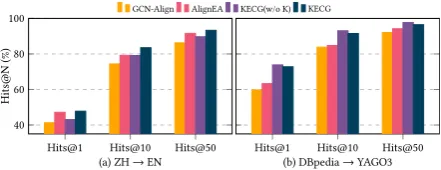
For better comparison, we draw two detailed Hits@N bar plots of GCN-Align, AlignEA, KECG(w/o K) and KECG on DBP15KZH−EN and DWY100KYG, as shown in Figure 3. In Fig-ure 3(a), KECG(w/o K) gets better results than GCN-Align, which reflects the power of the graph attention mechanism. However, KECG(w/o K) cannot exceed AlignEA, showing that only con-sidering structural information is not enough for entity alignment. After adding the knowledge embedding model, KECG achieves the highest Hits@{1,10,50}. The effectiveness of knowledge embedding model lies in two parts. Firstly, it ap-plies constraints to entities by involving represen-tation of relation types. Entity alignment leads to some relationship alignment, and entities hav-ing similar relations become close. Secondly, the knowledge embedding model is beneficial for the graph attention mechanism to learn better atten-tion values.
In Figure 3(b), KECG still outperforms GCN-Align and GCN-AlignEA, but KECG(w/o K) exceeds KECG regarding three metrics, which reflects the weakness of the current knowledge embedding model. According to our statistics, the 1-to-N, N-to-1, and N-to-N relations account for 79.58% of the total in DWY100KYG, while 60.05% in DBP15KZH−EN. The introduced knowledge em-bedding model is based on TransE, lacking the ability of modeling complex relationships (e.g., 1-to-N, N-to-1, and N-to-N relations). When there are too many complex relationships in the datasets, it brings more decrement rather than improvement to the results. To ease this situation, we can use a stronger representation model for complex rela-tionships, such as TransR (Lin et al., 2015). We leave this for future work.
4.4.2 Effectiveness of Nearest Neighbor Sampling
In Table 2, it can be seen that KECG(w/o NNS) outperforms many baselines and its Hits@1 on
Hits@1 Hits@10 Hits@50
40 60 80 100
(a) ZH→EN
Hits@N
(%)
Hits@1 Hits@10 Hits@50
(b) DBpedia→YAGO3
[image:7.595.309.530.63.148.2]GCN-Align AlignEA KECG(w/o K) KECG
Figure 3: Detailed Hits@N for investigating the effec-tiveness of Knowledge Embedding Model.
DBP15KFR−EN reaches 39.30%, which is higher than another graph-based method GCN-Align by 2.01%. But the Hits@1 of KECG(w/o NNS) is lower than GCN-Align’s by approximately 3% on DWY100K. It is because DWY100K has a larger number of triplets, while the number of relations is relatively small. Involving the representation of complex relationships will introduce noise and affect the performance of the cross-graph model. After employing the nearest neighbor sampling strategy in cross-graph model, KECG consider-ably improves the results of KECG(w/o NNS), e.g., Hits@1 on DWY100KWD is raised from 46.95% to 63.23%. The excellent performance of nearest neighbor sampling owing to its accurately discriminating the target entity from other close entities, especially on large-scale datasets.
4.4.3 Sensitivity to Proportion of Prior Alignment
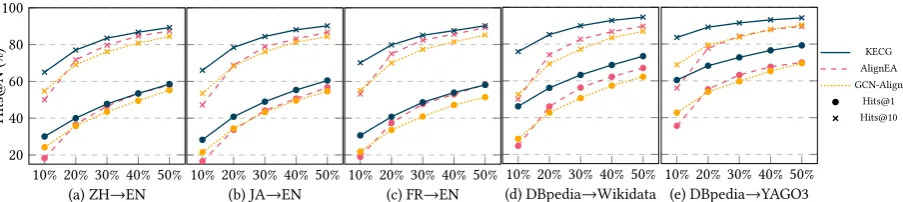
To investigate whether KECG is sensitive to the proportion of pre-aligned entities, we vary the pro-portion from 10% to 50% with step 10% for train-ing, and use the rest of pre-aligned entities for test-ing. Intuitively, more pre-aligned entities should provide more information to discover the potential pairs of equivalent entities.
10% 20% 30% 40% 50% 20
40 60 80 100
(a) ZH→EN
Hits@N
(%)
10% 20% 30% 40% 50%
(b) JA→EN 10% 20% 30% 40% 50%(c) FR→EN (d) DBpedia10% 20% 30% 40% 50%→Wikidata 10% 20% 30% 40% 50%(e) DBpedia→YAGO3
KECG AlignEA GCN-Align
[image:8.595.76.528.64.165.2]Hits@1 Hits@10
Figure 4: Hits@N of KECG, AlignEA and GCN-Align on entity alignment w.r.t. proportion of prior align-ment.(The x-axis represents the proportion of prior alignment.)
5 Related Work
5.1 KG Embedding
Various KG embedding methods have shown ef-fectiveness in modeling the semantic information of KGs. TransE (Bordes et al., 2013) is a mile-stone in learning embeddings for KGs, which in-terprets a relation as the translation from its head entity to its tail entity. Then it motivated several enhanced methods like TransR (Lin et al.,2015). In addition to them, non-translational methods also achieve satisfactory performances, such as RESCAL (Nickel et al.,2011), ConvE (Dettmers et al.,2018) and RotatE (Sun et al.,2019). Mean-while, external information in KGs is fused to im-prove embedding (Wang and Li,2016). More de-tailed KG embedding methods are summarized in (Wang et al.,2017).
5.2 Entity Alignment
Early human efforts, such as crowdsourcing and hand-crafted features (Lehmann et al., 2015; Mahdisoltani et al., 2013), are utilized to address the entity alignment problem. Though reaching high precisions, they are usually time-consuming and costly. Many automated approaches lever-age the extra resources, such as OWL properties and Wikipedia links (Hu et al.,2011;Wang et al., 2013) to align entities, but such extra information is not generally available for all KGs.
Recently, KG embedding-based approaches be-come the most popular solution for entity align-ment. JE (Hao et al., 2016) is an early work to jointly embed different KGs into a uniform vec-tor space to align entities in KGs. MTransE (Chen et al.,2017) learns transitions to translate each en-tity embedding vector to its counterparts in an-other space. JAPE (Sun et al.,2017) jointly trains the attribute embedding and structure embedding by a skip-gram model and a translational model,
respectively, to align entities. GCN-Align (Wang et al.,2018) is a new graph-based model aligning KGs via GCN. It takes advantage of GCN to prop-agate information from neighbors, and align entity embeddings enhanced by structural knowledge. However, GCN-Align only considers the equiv-alent relations between entities in model train-ing, neglecting the use of abundant relationships in KGs to precisely distinguish entities with sim-ilar neighbors. At the same time, iterative align-ment becomes a new fashion to improve the results of entity alignment. IPTransE (Zhu et al., 2017) and BootEA (Sun et al., 2018) integrate knowl-edge among different KGs by enlarging the train-ing data (prior alignments) in a bootstrapptrain-ing way. KDCoE (Chen et al., 2018) iteratively co-trains multilingual KG embeddings and fuses them with entity description information for alignment. The aforementioned iterative methods improve the re-sults mainly by increasing the number of pre-align entity pairs while training, and such a strategy can be a general enhancement for most alignment ap-proaches (Sun et al.,2018). A better non-iterative method should achieve better results through boot-strap. Therefore, we are more concerned with the best result that a non-iterative method can achieve.
6 Conclusions
In this paper, we propose a semi-supervised en-tity alignment method KECG that combines the knowledge embedding model and graph-based model. We utilize an extended GAT to encode het-erogeneous KGs and perform entity alignment by propagating alignment information over the entire graphs. Meanwhile, the KG learning is involved to model different relation types, making entities more distinguishable. Experimental results show that KECG significantly outperforms four state-of-the-art baselines.
embedding model of KECG to other KG represen-tation learning methods, such as TransD (Ji et al., 2015), to gain a stronger ability of modeling rela-tionships. Besides, iteratively discovering new en-tity alignments based on the framework of KECG is another interesting direction.
Acknowledgments
This work is supported by National Key Re-search and Development Program of China
(2017YFB1002101), NSFC key projects
(U1736204, 6153301), a research fund by Alibaba, and THUNUS NExT Co-Lab. NExT++ research is supported by the National Research Foundation, Prime Minister’s Office, Singapore under its IRC@SG Funding Initiative.
References
Antoine Bordes, Nicolas Usunier, Alberto Garcia-Duran, Jason Weston, and Oksana Yakhnenko. 2013. Translating embeddings for modeling multi-relational data. InNeurIPS.
Joan Bruna, Wojciech Zaremba, Arthur Szlam, and Yann LeCun. 2014. Spectral networks and locally connected networks on graphs. InICLR.
Yixin Cao, Lei Hou, Juanzi Li, and Zhiyuan Liu. 2018. Neural collective entity linking. InCOLING.
Muhao Chen, Yingtao Tian, Kai-Wei Chang, Steven Skiena, and Carlo Zaniolo. 2018. Co-training em-beddings of knowledge graphs and entity descrip-tions for cross-lingual entity alignment. InIJCAI.
Muhao Chen, Yingtao Tian, Mohan Yang, and Carlo Zaniolo. 2017. Multilingual knowledge graph em-beddings for cross-lingual knowledge alignment. In IJCAI.
Wanyun Cui, Yanghua Xiao, Haixun Wang, Yangqiu Song, Seung-won Hwang, and Wei Wang. 2017. Kbqa: learning question answering over qa corpora and knowledge bases. PVLDB.
Micha¨el Defferrard, Xavier Bresson, and Pierre Van-dergheynst. 2016. Convolutional neural networks on graphs with fast localized spectral filtering. In NeurIPS.
Tim Dettmers, Minervini Pasquale, Stenetorp Pon-tus, and Sebastian Riedel. 2018. Convolutional 2d knowledge graph embeddings. InAAAI.
John Duchi, Elad Hazan, and Yoram Singer. 2011. Adaptive subgradient methods for online learning and stochastic optimization. JMLR.
Will Hamilton, Zhitao Ying, and Jure Leskovec. 2017. Inductive representation learning on large graphs. In NeurIPS.
Xu Han, Zhiyuan Liu, and Maosong Sun. 2018. Neural knowledge acquisition via mutual attention between knowledge graph and text. InAAAI.
Yanchao Hao, Yuanzhe Zhang, Shizhu He, Kang Liu, and Jun Zhao. 2016. A joint embedding method for entity alignment of knowledge bases. InCCKS.
Wei Hu, Jianfeng Chen, and Yuzhong Qu. 2011. A self-training approach for resolving object corefer-ence on the semantic web. InWWW.
Guoliang Ji, Shizhu He, Liheng Xu, Kang Liu, and Jun Zhao. 2015. Knowledge graph embedding via dy-namic mapping matrix. InACL.
Thomas N Kipf and Max Welling. 2017. Semi-supervised classification with graph convolutional networks. InICLR.
Bhushan Kotnis and Vivi Nastase. 2017. Analy-sis of the impact of negative sampling on link prediction in knowledge graphs. arXiv preprint arXiv:1708.06816.
Jens Lehmann, Robert Isele, Max Jakob, Anja Jentzsch, Dimitris Kontokostas, Pablo N Mendes, Sebastian Hellmann, Mohamed Morsey, Patrick Van Kleef, S¨oren Auer, et al. 2015. Dbpedia–a large-scale, multilingual knowledge base extracted from wikipedia. Semantic Web.
Yankai Lin, Zhiyuan Liu, Maosong Sun, Yang Liu, and Xuan Zhu. 2015. Learning entity and relation em-beddings for knowledge graph completion. InAAAI.
Andrew L Maas, Awni Y Hannun, and Andrew Y Ng. 2013. Rectifier nonlinearities improve neural net-work acoustic models. InICML.
Farzaneh Mahdisoltani, Joanna Biega, and Fabian M Suchanek. 2013. Yago3: A knowledge base from multilingual wikipedias. InCIDR.
Roberto Navigli and Simone Paolo Ponzetto. 2012. Babelnet: The automatic construction, evaluation and application of a wide-coverage multilingual se-mantic network. Artificial Intelligence.
Maximilian Nickel, Volker Tresp, and Hans-Peter Kriegel. 2011. A three-way model for collective learning on multi-relational data. InICML.
Thomas Rebele, Fabian Suchanek, Johannes Hoffart, Joanna Biega, Erdal Kuzey, and Gerhard Weikum. 2016. Yago: A multilingual knowledge base from wikipedia, wordnet, and geonames. InISWC.
Zequn Sun, Wei Hu, Qingheng Zhang, and Yuzhong Qu. 2018. Bootstrapping entity alignment with knowledge graph embedding. InIJCAI.
Zhiqing Sun, Zhi-Hong Deng, Jian-Yun Nie, and Jian Tang. 2019. Rotate: Knowledge graph embedding by relational rotation in complex space. InICLR.
Ashish Vaswani, Noam Shazeer, Niki Parmar, Jakob Uszkoreit, Llion Jones, Aidan N Gomez, Łukasz Kaiser, and Illia Polosukhin. 2017. Attention is all you need. InNeurIPS.
Petar Velickovic, Guillem Cucurull, Arantxa Casanova, Adriana Romero, Pietro Lio, and Yoshua Bengio. 2018. Graph attention networks. InICLR.
Quan Wang, Zhendong Mao, Bin Wang, and Li Guo. 2017. Knowledge graph embedding: A survey of approaches and applications. TKDE.
Zhichun Wang, Juanzi Li, and Jie Tang. 2013. Boost-ing cross-lBoost-ingual knowledge linkBoost-ing via concept an-notation. InIJCAI.
Zhichun Wang, Qingsong Lv, Xiaohan Lan, and Yu Zhang. 2018. Cross-lingual knowledge graph alignment via graph convolutional networks. In EMNLP.
Zhigang Wang and Juanzi Li. 2016. Text-enhanced representation learning for knowledge graph. In IJ-CAI.
Bishan Yang, Wen-tau Yih, Xiaodong He, Jianfeng Gao, and Li Deng. 2015. Embedding entities and relations for learning and inference in knowledge bases. InICLR.