Proceedings of the 2019 Conference on Empirical Methods in Natural Language Processing 3011
Extractive Summarization of Long Documents by Combining Global and
Local Context
Wen Xiao and Giuseppe Carenini Department of Computer Science
University of British Columbia Vancouver, BC, Canada, V6T 1Z4
{xiaowen3, carenini}@cs.ubc.ca
Abstract
In this paper, we propose a novel neural single-document extractive summarization model for long documents, incorporating both the global context of the whole document and the local context within the current topic. We evalu-ate the model on two datasets of scientific pa-pers , Pubmed and arXiv, where it outperforms previous work, both extractive and abstractive models, on ROUGE-1, ROUGE-2 and ME-TEOR scores. We also show that, consistently with our goal, the benefits of our method be-come stronger as we apply it to longer docu-ments. Rather surprisingly, an ablation study indicates that the benefits of our model seem to come exclusively from modeling the local context, even for the longest documents.
1 Introduction
Single-document summarization is the task of generating a short summary for a given document. Ideally, the generated summaries should be fluent and coherent, and should faithfully maintain the most important information in the source docu-ment. This is a very challenging task, because it arguably requires an in-depth understanding of the source document, and current automatic solutions are still far from human performance (Allahyari et al.,2017).VII
Single-document summarization can be either extractive or abstractive. Extractive methods typ-ically pick sentences directly from the original document based on their importance, and form the summary as an aggregate of these sentences. Usually, summaries generated in this way have a better performance on fluency and grammar, but they may contain much redundancy and lack in coherence across sentences. In contrast, abstrac-tive methods attempt to mimic what humans do
VIISentence coloring and Roman numbering will be
ex-plained in the result sub-section 4.5.
by first extracting content from the source docu-ment and then produce new sentences that aggre-gate and organize the extracted information. Since the sentences are generated from scratch they tend to have a relatively worse performance on flu-ency and grammar. Furthermore, while abstractive summaries are typically less redundant, they may end up including misleading or even utterly false statements, because the methods to extract and ag-gregate information form the source document are still rather noisy.
In this work, we focus on extracting informative sentences from a given document (without dealing with redundancy), especially when the document is relatively long (e.g., scientific articles).
Most recent works on neural extractive summa-rization have been rather successful in generating summaries of short news documents (around 650 words/document) (Nallapati et al., 2016) by ap-plying neural Seq2Seq models (Cheng and Lap-ata,2016). However when it comes to long doc-uments, these models tend to struggle with longer sequences because at each decoding step, the de-coder needs to learn to construct a context vector capturing relevant information from all the tokens in the source sequence (Shao et al.,2017).
Long documents typically cover multiple top-ics. In general, the longer a document is, the more topics are discussed. As a matter of fact, when humans write long documents they organize them in chapters, sections etc.. Scientific papers are an example of longer documents and they fol-low a standard discourse structure describing the problem, methodology, experiments/results, and finally conclusions (Suppe,1998).
sentence classifier is a categorical feature with val-ues likeHighlight,Abstract,Introduction, etc., de-pending on which section the sentence appears in. In contrast, in order to exploit section infor-mation, in this paper we propose to capture a distributed representation of both the global (the whole document) and the local context (e.g., the section/topic) when deciding if a sentence should be included in the summary
Our main contributions are as follows: (i) In order to capture the local context, we are the first to apply LSTM-minus to text summarization. LSTM-minus is a method for learning embeddings of text spans, which has achieved good perfor-mance in dependency parsing (Wang and Chang,
2016), in constituency parsing (Cross and Huang,
2016), as well as in discourse parsing (Liu and La-pata,2017). With respect to more traditional meth-ods for capturing local context, which rely on hi-erarchical structures, LSTM-minus produces sim-pler models i.e. with less parameters, and there-fore faster to train and less prone to overfitting.
(ii)We test our method on the Pubmed and arXiv datasets and results appear to support our goal of effectively summarizing long documents. In par-ticular, while overall we outperform the baseline and previous approaches only by a narrow mar-gin on both datasets, the benefit of our method become much stronger as we apply it to longer documents. Furthermore, in an ablation study to assess the relative contributions of the global and the local model we found that, rather surprisingly, the benefits of our model seem to come exclu-sively from modeling the local context, even for the longest documents.VI (iii)In order to evalu-ate our approach, we have creevalu-ated oracle labels for both Pubmed and arXiv (Cohan et al., 2018), by applying a greedy oracle labeling algorithm. The two datasets annotated with extractive labels will be made public.1
2 Related work
2.1 Extractive summarization
Traditional extractive summarization methods are mostly based on explicit surface features (Radev et al.,2004), relying on graph-based methods ( Mi-halcea and Tarau,2004), or on submodular maxi-mization (Tixier et al.,2017). Benefiting from the
1The data and code are available at https:
//github.com/Wendy-Xiao/Extsumm_local_ global_context.
success of neural sequence models in other NLP tasks, Cheng and Lapata (2016) propose a novel approach to extractive summarization based on neural networks and continuous sentence features, which outperforms traditional methods on the Dai-lyMail dataset. In particular, they develop a gen-eral encoder-decoder architecture, where a CNN is used as sentence encoder, a uni-directional LSTM as document encoder, with another uni-directional LSTM as decoder. To decrease the number of pa-rameters while maintaining the accuracy, Nallap-ati et al.(2017) present SummaRuNNer, a simple RNN-based sequence classifier without decoder, outperforming or matching the model of (Cheng and Lapata, 2016). They take content, salience, novelty, and position of each sentence into consid-eration when deciding if a sentence should be in-cluded in the extractive summary. Yet, they do not capture any aspect of the topical structure, as we do in this paper. So their approach would arguably suffer when applied to long documents, likely con-taining multiple and diverse topics.
While SummaRuNNer was tested only on news,
Kedzie et al.(2018) carry out a comprehensive set of experiments with deep learning models of ex-tractive summarization across different domains, i.e. news, personal stories, meetings, and medical articles, as well as across different neural architec-tures, in order to better understand the general pros and cons of different design choices. They find that non auto-regressive sentence extraction per-forms as well or better than auto-regressive extrac-tion in all domains, where by auto-regressive sen-tence extraction they mean using previous predic-tions to inform future predicpredic-tions. Furthermore, they find that the Average Word Embedding sen-tence encoder works at least as well as encoders based on CNN and RNN. In light of these find-ings, our model is not auto-regressive and uses the Average Word Embedding encoder.
2.2 Extractive summarization on Scientific papers
Datasets # docs avg. doc. length avg. summ. length
CNN 92K 656 43
Daily Mail 219K 693 52 NY Times 655K 530 38 PubMed 133K 3016 203
[image:3.595.73.291.62.129.2]arXiv 215K 4938 220
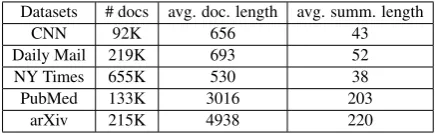
Table 1: Comparison of news datasets and scientific pa-per datasets(Cohan et al.,2018), the length is in terms of the number of words
classifier to select content from a scientific pa-per based on the rhetorical status of each sentence (e.g., whether it specified a research goal, or some generally accepted scientific background knowl-edge, etc.). More recently, researchers have ex-tended this work by applying more sophisticated classifiers to identify more fine-grain rhetorical categories, as well as by exploiting citation con-texts. Liakata et al. (2013) propose the CoreSC discourse-driven content, which relies on CRFs and SVMs, to classify the discourse categories (e.g. Background, Hypothesis, Motivation, etc.) at the sentence level. The recent work most similar to ours is (Collins et al.,2017) where, in order to determine whether a sentence should be included in the summary, they directly use the section each sentence appears in as a categorical feature with values like Highlight, Abstract, Introduction, etc.. In this paper, instead of using sections as categor-ical features, we rely on a distributed representa-tion of the semantic informarepresenta-tion within each sec-tion, as the local context of each sentence. In a very different line of work, Cohan and Goharian
(2015) form the summary by also exploiting infor-mation on how the target paper is cited in other papers. Currently, we do not use any information from citation contexts.
2.3 Datasets for long documents
Dernoncourt et al. (2018) provide a comprehen-sive overview of the current datasets for sum-marization. Noticeably, most of the larger-scale summarization datasets consists of relatively short documents, like CNN/DailyMail (Nallapati et al.,
2016) and New York Times (Sandhaus, 2008). One exception is (Cohan et al.,2018) that recently introduce two large-scale datasets of long and structured scientific papers obtained from arXiv
and PubMed. These two new datasets contain
much longer documents than all the news datasets (See Table1) and are therefore ideal test-beds for the method we present in this paper.
2.4 Neural Abstractive summarization on long documents
While most current neural abstractive summariza-tion models have focused on summarizing rela-tively short news articles (e.g., (See et al.,2017)), few researchers have started to investigate the summarization of longer documents by exploiting their natural structure. Celikyilmaz et al. (2018) present an encoder-decoder architecture to address the challenges of representing a long document for abstractive summarization. The encoding task is divided across several collaborating agents, each is responsible for a subsection of text through a multi-layer LSTM with word attention. Their model seems however overly complicated when it comes to the extractive summarization task, where word attention is arguably much less critical. So, we do not consider this model further in this paper.
Cohan et al. (2018) also propose a model for abstractive summarization taking the structure of documents into consideration with a hierarchical approach, and test it on longer documents with section information, i.e. scientific papers. In par-ticular, they apply a hierarchical encoder at the word and section levels. Then, in the decoding step, they combine the word attention and section attention to obtain a context vector.
This approach to capture discourse structure is however quite limited both in general and espe-cially when you consider its application to ex-tractive summarization. First, their hierarchical method has a large number of parameters and it is therefore slow to train and likely prone to over-fitting2. Secondly, it does not take the global con-text of the whole document into account, which may arguably be critical in extractive methods, when deciding on the salience of a sentence (or
even a word). The extractive summarizer we
present in this paper tries to address these limita-tions by adopting the parameter lean LSTM-minus method, and by explicitly modeling the global context.
2.5 LSTM-Minus
The LSTM-Minus method is first proposed in (Wang and Chang,2016) as a novel way to learn sentence segment embeddings for graph-based de-pendency parsing, i.e. estimating the most likely
2To address this, they only process the first 2000 words
dependency tree given an input sentence. For each dependency pair, they divide a sentence into three segments (prefix, infix and suffix), and LSTM-Minus is used to represent each segment. They ap-ply a single LSTM to the whole sentence and use the difference between two hidden stateshj−hito
represent the segment from wordwi to wordwj.
This enables their model to learn segment embed-dings from information both outside and inside the segments and thus enhancing their model ability to access to sentence-level information. The intu-ition behind the method is that each hidden vector
ht can capture useful information before and
in-cluding the wordvt.
Shortly after, Cross and Huang(2016) use the same method on the task of constituency parsing, as the representation of a sentence span, extend-ing the original uni-directional LSTM-Minus to the bi-directional case. More recently, inspired by the success of LSTM-Minus in both depen-dency and constituency parsing, Liu and Lapata
(2017) extend the technique to discourse pars-ing. They propose a two-stage model consisting of an intra-sentential parser and a multi-sentential parser, learning contextually informed represen-tations of constituents with LSTM-Minus, at the sentence and document level, respectively.
Similarly, in this paper, when deciding if a sen-tence should be included in the summary, the lo-cal context of that sentence is captured by apply-ing LSTM-Minus at the document level, to rep-resent the sub-sequence of sentences of the doc-ument (i.e., the topic/section) the target sentence belongs to.
3 Our Model
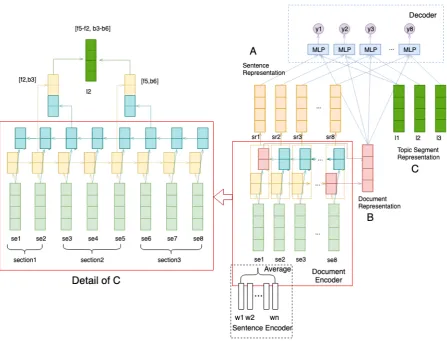
In this work, we propose an extractive model for long documents, incorporating local and global context information, motivated by natural topic-oriented structure of human-written long docu-ments. The architecture of our model is shown in Figure1, each sentence is visited sequentially in the original document order, and a corresponding confidence score is computed expressing whether the sentence should be included in the extractive
summary. Our model comprises three
compo-nents: the sentence encoder, the document encoder and the sentence classifier.
3.1 Sentence Encoder
The goal of the sentence encoder is mapping se-quences of word embeddings to a fixed length vec-tor (See bottom center of Figure1). There are sev-eral common methods to embed sentences. For ex-tractive summarization, RNN were used in ( Nal-lapati et al., 2017), CNN in (Cheng and Lapata,
2016), and Average Word Embedding in (Kedzie et al.,2018).Kedzie et al.(2018) experiment with all the three methods and conclude that Word Em-bedding Averaging is as good or better than either RNNs or CNNs for sentence embedding across different domains and summarizer architectures. Thus, we use the Average Word Embedding as our sentence encoder, by which a sentence embedding is simply the average of its word embeddings, i.e.
se= 1 n
wn
X
w0
emb(wi), se∈Rdemb.
Besides, we also tried the popular pre-trained BERT sentence embedding (Devlin et al., 2019), but initial results were rather poor. So we do not pursue this possibility any further.
3.2 Document Encoder
At the document level, a bi-directional recurrent neural network (Schuster and Paliwal,1997) is of-ten used to encode all the senof-tences sequentially forward and backward, with such model achieving remarkable success in machine translation ( Bah-danau et al., 2015). As units, we selected gated recurrent units (GRU) (Cho et al., 2014), in light of favorable results shown in (Chung et al.,2014). The GRU is represented with the standard reset, update, and new gates.
The output of the bi-directional GRU for each sentence t comprises two hidden states, hft ∈
Rdhid, hbt ∈ Rdhid as forward and backward
hid-den state, respectively.
A. Sentence representationAs shown in Figure
1(A), for each sentence t, the sentence represen-tation is the concatenation of both backward and forward hidden state of that sentence.
srt= (hft :h b
t), srt∈Rdhid∗2
In this way, the sentence representation not only represents the current sentence, but also partially covers contextual information both before and af-ter this sentence.
Figure 1: The structure of our model,sei, sri represent the sentence embedding and sentence representation of
sentencei, respectively. The binary decision of whether the sentence should be included in the summary is based on the sentence itself (A), the whole document (B) and the current topic (C). The document representation is simply the concatenation of the last hidden states of the forward and backward RNNs, while the topic segment representation is computed by applying LSTM-Minus, as shown in detail in the left panel (Detail of C).
whole document. It is computed as the concatena-tion of the final state of the forward and backward GRU, labeled as B in Figure1. (Li et al.,2018)
d= (hfn:hb0), d∈Rdhid∗2
C. Topic segment representation To capture the local context of each sentence, namely the information of the topic segment that sentence falls into, we apply the LSTM-Minus method3, a method for learning embeddings of text spans. LSTM-Minus is shown in detail in Figure 1 (left panel C), each topic segment is represented as the subtraction between the hidden states of the start and the end of that topic. As illustrated in Figure 1, the representation for section 2 of the sample document (containing three sections and eight sentences overall) can be computed as
3In the original paper, LSTMs were used as recurrent unit.
Although we use GRUs here, for consistency with previous work, we still call the method LSTM-Minus
[f5−f2, b3−b6], wheref5, f2are the forward
hid-den states of sentence5and2, respectively, while
b3, b6are the backward hidden states of sentence3
and6, respectively. In general, the topic segment representationltfor segmenttis computed as:
ft = hfendt −hfstartt−1, ft∈R
dhid
bt = hbstartt −h
b
endt+1, bt∈R
dhid
lt = (ft:bt), lt∈Rdhid∗2
where startt, endt is the index of the beginning
and the end of topict,ft andbtdenote the topic
segment representation of forward and backward, respectively. The final representation of topictis the concatenation of forward and backward repre-sentationlt. To obtainfiandbi, we utilize
subtrac-tion between GRU hidden vectors of startt and endt, and we pad the hidden states with zero
behind this process is that the GRUs can keep pre-vious useful information in their memory cell by exploiting reset, update, and new gates to decide how to utilize and update the memory of previous information. In this way, we can represent the con-textual information within each topic segment for all the sentences in that segment.
3.3 Decoder
Once we have obtained a representation for the sentence, for its topic segment (i.e., local context) and for the document (i.e., global context), these three factors are combined to make a final predic-tionpion whether the sentence should be included
in the summary. We consider two ways in which these three factors can be combined.
Concatenation We can simply concatenate the vectors of these three factors as,
inputi = (d:lt:sri), inputi ∈Rdhid∗6
where sentenceiis part of the topict, andinputi
is the representation of sentenceiwith topic seg-ment information and global context information.
Attentive context As local context and global context are all contextual information of the given sentence, we use an attention mechanism to decide the weight of each context vector, represented as
scoredi = vTtanh(Wa(d:sri))
scoreli = vTtanh(Wa(lt:sri))
weightdi = score d i scored
i +scoreli
weightli = score l i scoredi +scoreli
contexti = weightdi ∗d+weightli∗lt inputi = (sri :contexti), inputi ∈Rdhid∗4
where the contexti is the weighted context
vec-tor of each sentencei, and assume sentenceiis in topict.
Then there is a final multi-layer percep-tron(MLP) followed with a sigmoid activation function indicating the confidence score for select-ing each sentence:
hi = Dropout(ReLU(Wmlpinputi+bmlp)) pi = σ(Whhi+bh)
4 Experiments
To validate our method, we set up experiments on the two scientific paper datasets (arXiv and
PubMed). With ROUGE and METEOR scores as automatic evaluation metrics, we compare with previous works, both abstractive and extractive.
4.1 Training
The weighted negative log-likelihood is mini-mized, where the weight is computed as wpos =
#negative
#postive , to solve the problem of highly
imbal-anced data (typical in extractive summarization).
L = −
N
X
d=1 Nd
X
i=1
(wpos∗yilogp(yi|W, b)
+ (1−yi) logp(yi|W, b))
whereyi represent the ground-truth label of
sen-tencei, with yi = 1meaning sentenceiis in the
gold-standard extract summary.
4.2 Extractive Label Generation
In the Pubmed and arXiv datasets, the extractive summaries are missing. So we follow the work of (Kedzie et al.,2018) on extractive summary label-ing, constructing gold label sequences by greed-ily optimizing ROUGE-1 on the gold-standard ab-stracts, which are available for each article. 4 The algorithm is shown in Appendix A.
4.3 Implementation Details
We train our model using the Adam optimizer (Kingma and Ba,2015) with learning rate0.0001
and a drop out rate of 0.3. We use a mini-batch with a batch size of 32 documents, and the size of the GRU hidden states is 300. For word em-beddings, we use GloVe (Pennington et al.,2014) with dimension 300, pre-trained on the Wikipedia and Gigaword. The vocabulary size of our model is 50000. All the above parameters were set based on (Kedzie et al., 2018) without any fine-tuning. Again following (Kedzie et al., 2018), we train each model for 50 epochs, and the best model is selected with early stopping on the validation set according to Rouge-2 F-score.
4.4 Models for Comparison
We perform a systematic comparison with previ-ous work in extractive summarization. For com-pleteness, we also compare with recent neural ab-stractive approaches. In all the experiments, we use the same train/val/test splitting.
4For this, we use a popular python implementation of the
Model ROUGE-1 ROUGE-2 ROUGE-L METEOR
SumBasic* 29.47 6.95 26.30 -LSA* 29.91 7.42 25.67 -LexRank* 33.85 10.73 28.99 -Attn-Seq2Seq* 29.30 6.00 25.56 -Pntr-Gen-Seq2Seq* 32.06 9.04 25.16 -Discourse-aware* 35.80 11.05 31.80 -Baseline 42.91 16.65 28.53 21.35 Cheng & Lapata 42.24 15.97 27.88 20.97 SummaRuNNer 42.81 16.52 28.23 21.35 Ours-attentive context 43.58 17.37 29.30 21.71
Ours-concat 43.62 17.36 29.14 21.78
[image:7.595.73.294.61.194.2]Lead 33.66 8.94 22.19 16.45 Oracle 53.88 23.05 34.90 24.11
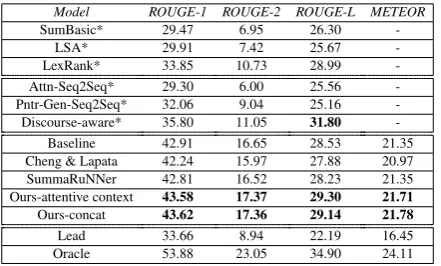
Table 2: Results on the arXiv dataset. For models with an∗, we report results from (Cohan et al.,2018). Mod-els are traditional extractive in the first block, neural abstractive in the second block, while neural extractive in the third block. The Oracle (last row) corresponds to using the ground truth labels, obtained (for training) by the greedy algorithm, see Section 4.2. Results that are not significantly distinguished from the best sys-tems are bold.
• Traditional extractive summarization models: SumBasic (Vanderwende et al., 2007), LSA (Steinberger and Jezek,2004), and LexRank (Erkan and Radev,2004)
• Neural abstractive summarization models: Attn-Seq2Seq (Nallapati et al., 2016), Pntr-Gen-Seq2Seq (See et al., 2017) and Discourse-aware (Cohan et al.,2018)
• Neural extractive summarization models:
Cheng&Lapata (Cheng and Lapata, 2016) and SummaRuNNer (Nallapati et al.,2017). Based on (Kedzie et al., 2018), we use the Average Word Encoder as sentence encoder for both models, instead of the CNN and RNN sentence encoders that were originally used in the two systems, respectively.5
• Baseline: Similar to our model, but without local context and global context, i.e. the input to MLP is the sentence representation only. • Lead: Given a length limit ofkwords for the
summary, Lead will return the firstk words of the source document.
• Oracle: uses the Gold Standard extractive la-bels, generated based on ROUGE (Sec. 4.2).
4.5 Results and Analysis
For evaluation, we follow the same procedure as in (Kedzie et al.,2018). Summaries are generated
5
Aiming for a fair and reproducible comparison, we re-implemented the models by borrowing the extractor classes from (Kedzie et al., 2018), the source code can be found https://github.com/kedz/nnsum/ tree/emnlp18-release
Model ROUGE-1 ROUGE-2 ROUGE-L METEOR
SumBasic* 37.15 11.36 33.43 -LSA* 33.89 9.93 29.70 -LexRank* 39.19 13.89 34.59 -Attn-Seq2Seq* 31.55 8.52 27.38 -Pntr-Gen-Seq2Seq* 35.86 10.22 29.69 -Discourse-aware* 38.93 15.37 35.21 -Baseline 44.29 19.17 30.89 20.56 Cheng & Lapata 43.89 18.53 30.17 20.34 SummaRuNNer 43.89 18.78 30.36 20.42 Ours-attentive context 44.81 19.74 31.48 20.83
Ours-concat 44.85 19.70 31.43 20.83
[image:7.595.309.526.62.193.2]Lead 35.63 12.28 25.17 16.19 Oracle 55.05 27.48 38.66 23.60
Table 3: Results on the Pubmed dataset. See caption of Table2above for details on compared models and notation.
by selecting the top ranked sentences by model probabilityp(yi|W, b), until the length limit is met
or exceeded. Based on the average length of ab-stracts in these two datasets, we set the length
limit to 200 words. We use ROUGE scores6
(Lin and Hovy, 2003) and METEOR scores7 (Denkowski and Lavie,2014) between the model results and ground-truth abstractive summaries as evaluation metric. The unigram and bigram over-lap (ROUGE-1,2) are intended to measure the informativeness, while longest common subse-quence (ROUGE-L) captures fluency to some
ex-tent (Cheng and Lapata, 2016). METEOR was
originally proposed to evaluate translation systems by measuring the alignment between the system output and reference translations. As such, it can also be used as an automatic evaluation metric for summarization (Kedzie et al.,2018).
The performance of all models on arXiv and Pubmed is shown in Table2and Table3, respec-tively. Follow the work (Kedzie et al., 2018), we use the approximate randomization as the statisti-cal significance test method (Riezler and Maxwell,
2005) with a Bonferroni correction for multiple comparisons, at the confidence level 0.01 (p < 0.01). As we can see in these tables, on both datasets, the neural extractive models outperforms the traditional extractive models on informative-ness (ROUGE-1,2) by a wide margin, but results are mixed on ROUGE-L. Presumably, this is due to the neural training process, which relies on a goal standard based on ROUGE-1. Exploring other training schemes and/or a combination of
6We use a modified version of rouge papier, a
python wrapper of ROUGE-1.5.5, https://github. com/kedz/rouge_papier. The command line is ’Perl ROUGE-1.5.5 -e data -a -n 2 -r 1000 -f A -z SPL config file’
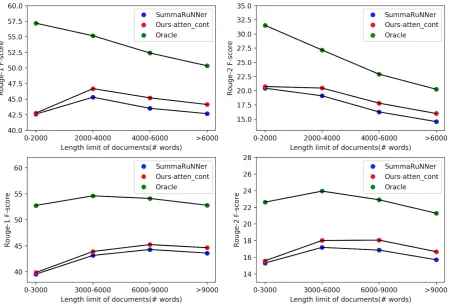
Figure 2: A Comparison between our model, SummaRuNNer and Oracle when applied to documents with increas-ing length, left-up: ROUGE-1 on Pubmed dataset, right-up: ROUGE-2 on Pubmed dataset, left-down: ROUGE-1 on arXiv dataset, right-down: ROUGE-2 on arXiv dataset
traditional and neural approaches is left as fu-ture work. Similarly, the neural extractive mod-els also dominate the neural abstractive modmod-els on ROUGE-1,2, but these abstractive models tend to have the highest ROUGE-L scores, possibly be-cause they are trained directly on gold standard abstract summaries.
Compared with other neural extractive models, our models (both with attentive context and con-catenation decoder) have better performances on all three ROUGE scores, as well as METEOR. In particular, the improvements over the Base-line model show that a combination of local and global contextual information does help to iden-tify the most important sentences (more on this in the next section). Interestingly, just the Base-line model already achieves a slightly better per-formance than previous works; possibly because the auto-regressive approach used in those models is even more detrimental for long documents.
Figure2shows the most important result of our analysis: the benefits of our method, explicitly de-signed to deal with longer documents, do actually become stronger as we apply it to longer
docu-ments. As it can be seen in Figure2, the perfor-mance gain of our model with respect to current state-of-the-art extractive summarizer is more pro-nounced for documents with>= 3000 words in both datasets.
Finally, the result of Lead (Table 2, 3) shows that scientific papers have less position bias than news; i.e., the first sentences of these papers are not a good choice to form an extractive summary.
4.6 Ablation Study
Model ROUGE-1(+l/+g) ROUGE-2(+l/+g) ROUGE-L(+l/+g)
BSL 44.29 (na/na) 19.17 (na/na) 30.89 (na/na) BSL+l 44.85(+.56/na) 19.77(+.6/na) 31.51(+.62/na) BSL+g 44.06 (na/-.23) 18.83 (na/-.34) 30.53 (na/-.36) BSL+l+g 44.81(+.75/-.04) 19.74(+.91/-.03) 31.48(+.95/-.03) BSL 43.85 (na/na) 15.94 (na/na) 28.13 (na/na) BSL+l 44.65(+.8/na) 16.75(+.81/na) 28.99(+.85/na) BSL+g 43.70 (na/-.15) 15.74 (na/-.2) 27.67 (na/-.46) BSL+l+g 44.64(+.94/-.01) 16.69(+.95/-.06) 28.96(+1.29/-.03)
Table 4: Ablation study on the Pubmed dataset, with all the documents(up) and a subset of long documents (down,> 6000words). BSL is the model with tence representation only, BSL+l is the model with sen-tence and local topic information, BSL+g is the model with sentence and global document information, and the last one is the full model with attentive context de-coder. The numbers in parenthesis represent the im-provements with the additional local/global context, respectively. Results that are not significantly distin-guished from the best systems are bold.
Model ROUGE-1(+l/+g) ROUGE-2(+l/+g) ROUGE-L(+l/+g)
BSL 42.91 (na/na) 16.65 (na/na) 28.53 (na/na) BSL+l 43.57(+.66/na) 17.35(+.7/na) 29.29(+.76/na) BSL+g 42.90 (na/-.01) 16.58 (na/-.07) 28.36 (na/-.17) BSL+l+g 43.58(+.68/+.01) 17.37(+.79/+.02) 29.30(+.94/+.01) BSL 42.95 (na/na) 14.85 (na/na) 28.66 (na/na) BSL+l 44.01(+1.06/na) 15.95(+1.1/na) 29.68(+1.02/na) BSL+g 43.05 (na/+.1) 14.91 (na/+.06) 28.57 (na/-.09) BSL+l+g 44.17(+1.12/+.16) 16.01(+1.1/+.06) 29.72(+1.15/+.04)
Table 5: Ablation study on arXiv dataset, with all documents (up) and a subset of long document(down,
> 9000words). Results that are not significantly dif-ferent from the best systems are in bold.
In order to assess the relative contributions of the global and local models to the performance of our approach, we ran an ablation study. This was done for each dataset both with the whole test set, as well as with a subset of long documents. The results for Pubmed and arXiv are shown in Table
4and Table5, respectively. For statistical signif-icance, as it was done for the general results in Section 4.5, we use the approximate randomiza-tion method (Riezler and Maxwell,2005) with the Bonferroni correction at (p <0.01).
From these tables, we can see that on both datasets the performance significantly improves when local topic information (i.e. local context) is added. And the improvement is even greater when we only consider long documents. Rather surprisingly, this is not the case for the global con-text. Adding a representation of the whole docu-ment (i.e. global context) never significantly im-proves performance. In essence, it seems that all
the benefits of our model come exclusively from modeling the local context, even for the longest documents. Further investigation of this finding is left as future work.
5 Conclusions and Future Work
In this paper, we propose a novel extractive sum-marization model especially designed for long documents, by incorporating the local context within each topic, along with the global context of the whole document.II Our approach inte-grates recent findings on neural extractive sum-marization in a parameter lean and modular ar-chitecture.III We evaluate our model and com-pare with previous works in both extractive and abstractive summarization on two large scientific paper datasets, which contain documents that are much longer than in previously used corpora.IV Our model not only achieves state-of-the-art on these two datasets, but in an additional experi-ment, in which we consider documents with in-creasing length, it becomes more competitive for longer documents.VWe also ran an ablation study to assess the relative contribution of the global and local components of our approach. I Rather sur-prisingly, it appears that the benefits of our model come only from modeling the local context.
For future work, we initially intend to inves-tigate neural methods to deal with redundancy. Then, it could be beneficial to integrate explicit features, like sentence position and salience, into
our neural approach. More generally, we plan
to combine of traditional and neural models, as suggested by our results. Furthermore, we would like to explore more sophistical structure of docu-ments, like discourse tree, instead of rough topic segments. As for evaluation, we would like to elicit human judgments, for instance by inviting authors to rate the outputs from different systems,
when applied to their own papers. More long
term, we will study how extractive/abstractive techniques can be integrated; for instance, the out-put of an extractive system could be fed into an abstractive one, training the two jointly.
Acknowledgments
References
Mehdi Allahyari, Seyed Amin Pouriyeh, Mehdi Assefi, Saeid Safaei, Elizabeth D. Trippe, Juan B. Gutier-rez, and Krys Kochut. 2017. Text summarization techniques: A brief survey.CoRR, abs/1707.02268.
Dzmitry Bahdanau, Kyunghyun Cho, and Yoshua Bengio. 2015. Neural machine translation by jointly learning to align and translate. CoRR, abs/1409.0473.
Asli Celikyilmaz, Antoine Bosselut, Xiaodong He, and Yejin Choi. 2018. Deep communicating agents for abstractive summarization. In Proceedings of the 2018 Conference of the North American Chapter of the Association for Computational Linguistics: Hu-man Language Technologies, Volume 1 (Long Pa-pers), pages 1662–1675, New Orleans, Louisiana. Association for Computational Linguistics.
Jianpeng Cheng and Mirella Lapata. 2016. Neural summarization by extracting sentences and words. In Proceedings of the 54th Annual Meeting of the Association for Computational Linguistics (Volume 1: Long Papers), pages 484–494, Berlin, Germany. Association for Computational Linguistics.
Kyunghyun Cho, Bart van Merri¨enboer, Dzmitry Bah-danau, and Yoshua Bengio. 2014. On the properties of neural machine translation: Encoder–decoder ap-proaches. InProceedings of SSST-8, Eighth Work-shop on Syntax, Semantics and Structure in Statisti-cal Translation, pages 103–111, Doha, Qatar. Asso-ciation for Computational Linguistics.
Junyoung Chung, C¸ aglar G¨ulc¸ehre, KyungHyun Cho, and Yoshua Bengio. 2014. Empirical evaluation of gated recurrent neural networks on sequence model-ing. CoRR, abs/1412.3555.
Arman Cohan, Franck Dernoncourt, Doo Soon Kim, Trung Bui, Seokhwan Kim, Walter Chang, and Na-zli Goharian. 2018. A discourse-aware attention model for abstractive summarization of long docu-ments. InProceedings of the 2018 Conference of the North American Chapter of the Association for Computational Linguistics: Human Language Tech-nologies, Volume 2 (Short Papers), pages 615–621, New Orleans, Louisiana. Association for Computa-tional Linguistics.
Arman Cohan and Nazli Goharian. 2015.Scientific ar-ticle summarization using citation-context and arti-cle’s discourse structure. InProceedings of the 2015 Conference on Empirical Methods in Natural Lan-guage Processing, pages 390–400, Lisbon, Portugal. Association for Computational Linguistics.
Ed Collins, Isabelle Augenstein, and Sebastian Riedel. 2017. A supervised approach to extractive sum-marisation of scientific papers. In Proceedings of the 21st Conference on Computational Natural Language Learning (CoNLL 2017), pages 195–205, Vancouver, Canada. Association for Computational Linguistics.
James Cross and Liang Huang. 2016.Span-based con-stituency parsing with a structure-label system and provably optimal dynamic oracles. InProceedings of the 2016 Conference on Empirical Methods in Natural Language Processing, pages 1–11, Austin, Texas. Association for Computational Linguistics.
Michael Denkowski and Alon Lavie. 2014. Meteor universal: Language specific translation evaluation for any target language. InProceedings of the Ninth Workshop on Statistical Machine Translation, pages 376–380, Baltimore, Maryland, USA. Association for Computational Linguistics.
Franck Dernoncourt, Mohammad Ghassemi, and Wal-ter Chang. 2018. A repository of corpora for sum-marization. InLREC.
Jacob Devlin, Ming-Wei Chang, Kenton Lee, and Kristina Toutanova. 2019. BERT: Pre-training of deep bidirectional transformers for language under-standing. InProceedings of the 2019 Conference of the North American Chapter of the Association for Computational Linguistics: Human Language Technologies, Volume 1 (Long and Short Papers), pages 4171–4186, Minneapolis, Minnesota. Associ-ation for ComputAssoci-ational Linguistics.
G¨unes Erkan and Dragomir R. Radev. 2004. Lexrank: Graph-based lexical centrality as salience in text summarization.J. Artif. Int. Res., 22(1):457–479.
Chris Kedzie, Kathleen McKeown, and Hal Daume III. 2018. Content selection in deep learning models of summarization. In Proceedings of the 2018 Con-ference on Empirical Methods in Natural Language Processing, pages 1818–1828. Association for Com-putational Linguistics.
Diederik P. Kingma and Jimmy Ba. 2015. Adam: A method for stochastic optimization. CoRR, abs/1412.6980.
Wei Li, Xinyan Xiao, Yajuan Lyu, and Yuanzhuo Wang. 2018. Improving neural abstractive docu-ment summarization with explicit information selec-tion modeling. In Proceedings of the 2018 Con-ference on Empirical Methods in Natural Language Processing, pages 1787–1796, Brussels, Belgium. Association for Computational Linguistics.
Maria Liakata, Simon Dobnik, Shyamasree Saha, Colin Batchelor, and Dietrich Rebholz-Schuhmann. 2013. A discourse-driven content model for sum-marising scientific articles evaluated in a complex question answering task. InProceedings of the 2013 Conference on Empirical Methods in Natural Lan-guage Processing, pages 747–757, Seattle, Wash-ington, USA. Association for Computational Lin-guistics.
Yang Liu and Mirella Lapata. 2017. Learning contex-tually informed representations for linear-time dis-course parsing. In Proceedings of the 2017 Con-ference on Empirical Methods in Natural Language Processing, pages 1289–1298, Copenhagen, Den-mark. Association for Computational Linguistics.
Rada Mihalcea and Paul Tarau. 2004.Textrank: Bring-ing order into text. InProceedings of the 2004 Con-ference on Empirical Methods in Natural Language Processing.
Ramesh Nallapati, Feifei Zhai, and Bowen Zhou. 2017. Summarunner: A recurrent neural network based se-quence model for extractive summarization of docu-ments. InProceedings of the Thirty-First AAAI Con-ference on Artificial Intelligence, AAAI’17, pages 3075–3081. AAAI Press.
Ramesh Nallapati, Bowen Zhou, Cicero dos Santos, C¸ a˘glar Gulc¸ehre, and Bing Xiang. 2016. Ab-stractive text summarization using sequence-to-sequence RNNs and beyond. InProceedings of The 20th SIGNLL Conference on Computational Natural Language Learning, pages 280–290, Berlin, Ger-many. Association for Computational Linguistics.
Ani Nenkova, Sameer Maskey, and Yang Liu. 2011. Automatic summarization. In Proceedings of the 49th Annual Meeting of the Association for Com-putational Linguistics: Tutorial Abstracts of ACL 2011, HLT ’11, pages 3:1–3:86, Stroudsburg, PA, USA. Association for Computational Linguistics.
Jeffrey Pennington, Richard Socher, and Christo-pher D. Manning. 2014. Glove: Global vectors for word representation. InEmpirical Methods in Nat-ural Language Processing (EMNLP), pages 1532– 1543.
Dragomir Radev, Timothy Allison, Sasha Blair-Goldensohn, John Blitzer, Arda C¸ elebi, Stanko Dimitrov, Elliott Drabek, Ali Hakim, Wai Lam, Danyu Liu, Jahna Otterbacher, Hong Qi, Horacio Saggion, Simone Teufel, Michael Topper, Adam Winkel, and Zhu Zhang. 2004. Mead - a plat-form for multidocument multilingual text summa-rization. InProceedings of the Fourth International Conference on Language Resources and Evaluation (LREC’04), Lisbon, Portugal. European Language Resources Association (ELRA).
Stefan Riezler and John T. Maxwell. 2005. On some pitfalls in automatic evaluation and significance test-ing for MT. InProceedings of the ACL Workshop on Intrinsic and Extrinsic Evaluation Measures for Machine Translation and/or Summarization, pages 57–64, Ann Arbor, Michigan. Association for Com-putational Linguistics.
Evan Sandhaus. 2008. The New York Times
An-notated Corpus. https://catalog.ldc.
upenn.edu/LDC2008T19.
M. Schuster and K.K. Paliwal. 1997. Bidirectional recurrent neural networks. Trans. Sig. Proc., 45(11):2673–2681.
Abigail See, Peter J. Liu, and Christopher D. Manning. 2017.Get to the point: Summarization with pointer-generator networks. InProceedings of the 55th An-nual Meeting of the Association for Computational Linguistics (Volume 1: Long Papers), pages 1073– 1083, Vancouver, Canada. Association for Compu-tational Linguistics.
Louis Shao, Stephan Gouws, Denny Britz, Anna Goldie, Brian Strope, and Ray Kurzweil. 2017. Generating long and diverse responses with neural conversation models.CoRR, abs/1701.03185.
Josef Steinberger and Karel Jezek. 2004. Using latent semantic analysis in text summarization and sum-mary evaluation.
Frederick Suppe. 1998. The structure of a scientific paper. Philosophy of Science, 65(3):381–405.
Simone Teufel and Marc Moens. 2002. Articles sum-marizing scientific articles: Experiments with rele-vance and rhetorical status.Computational Linguis-tics, 28(4):409–445.
Antoine Tixier, Polykarpos Meladianos, and Michalis Vazirgiannis. 2017. Combining graph degeneracy and submodularity for unsupervised extractive sum-marization. InProceedings of the Workshop on New Frontiers in Summarization, pages 48–58. Associa-tion for ComputaAssocia-tional Linguistics.
Lucy Vanderwende, Hisami Suzuki, Chris Brockett, and Ani Nenkova. 2007. Beyond sumbasic: Task-focused summarization with sentence simplifica-tion and lexical expansion. Inf. Process. Manage., 43:1606–1618.