Adapting Sequence Models for Sentence Correction
Allen Schmaltz* Yoon Kim Alexander M. Rush Stuart M. Shieber
Harvard University
{schmaltz@fas,yoonkim@seas,srush@seas,shieber@seas}.harvard.edu
*Part of this work was completed while as an intern at Rakuten.
Abstract
In a controlled experiment of sequence-to-sequence approaches for the task of sen-tence correction, we find that character-based models are generally more effec-tive than word-based models and models that encode subword information via con-volutions, and that modeling the output data as a series of diffs improves effec-tiveness over standard approaches. Our strongest sequence-to-sequence model im-proves over our strongest phrase-based statistical machine translation model, with access to the same data, by 6 M2 (0.5
GLEU) points. Additionally, in the data environment of the standard CoNLL-2014 setup, we demonstrate that modeling (and tuning against) diffs yields similar or better M2 scores with simpler models
and/or significantly less data than previous sequence-to-sequence approaches.
1 Introduction
The task of sentence correction is to convert a natural language sentence that may or may not have errors into a corrected version. The task is envisioned as a component of a learning tool or writing-assistant, and has seen increased interest since 2011 driven by a series of shared tasks (Dale and Kilgarriff, 2011;Dale et al.,2012;Ng et al., 2013,2014).
Most recent work on language correction has focused on the data provided by the CoNLL-2014 shared task (Ng et al.,2014), a set of corrected es-says by second-language learners. The CoNLL-2014 data consists of only around 60,000 sen-tences, and as such, competitive systems have made use of large amounts of corrected text with-out annotations, and in some cases lower-quality
crowd-annotated data, in addition to the shared data. In this data environment, it has been sug-gested that statistical phrase-based machine trans-lation (MT) with task-specific features is the state-of-the-art for the task (Junczys-Dowmunt and Grundkiewicz, 2016), outperforming word-and character-based sequence-to-sequence models (Yuan and Briscoe,2016;Xie et al.,2016;Ji et al., 2017), phrase-based systems with neural features (Chollampatt et al., 2016b,a), re-ranking output from phrase-based systems (Hoang et al., 2016), and combining phrase-based systems with classi-fiers trained for hand-picked subsets of errors (Ro-zovskaya and Roth,2016).
We revisit the comparison across translation ap-proaches for the correction task in light of the Au-tomated Evaluation of Scientific Writing (AESW) 2016 dataset, a correction dataset containing over 1 million sentences, holding constant the training data across approaches. The dataset was previ-ously proposed for the distinct binary classifica-tion task of grammatical error identificaclassifica-tion.
Experiments demonstrate that pure character-level sequence-to-sequence models are more ef-fective on AESW than word-based models and models that encode subword information via con-volutions over characters, and that representing the output data as a series ofdiffssignificantly in-creases effectiveness on this task. Our strongest character-level model achieves statistically sig-nificant improvements over our strongest phrase-based statistical machine translation model by 6
M2 (0.5 GLEU) points, with additional gains
when including domain information. Further-more, in the partially crowd-sourced data envi-ronment of the standard CoNLL-2014 setup in which there are comparatively few professionally annotated sentences, we find that tuning against the tags marking the diffs yields similar or su-perior effectiveness relative to existing
to-sequence approaches despite using significantly less data, with or without using secondary mod-els. All code is available athttps://github. com/allenschmaltz/grammar.
2 Background and Methods
Task We follow recent work and treat the task of sentence correction as translation from a source sentence (the unedited sentence) into a target sen-tence (a corrected version in the same language as the source). We do not make a distinction between grammatical and stylistic corrections.
We assume a vocabularyV of natural language word types (some of which have orthographic er-rors). Given a sentence s = [s1· · ·sI], where si ∈ V is thei-th token of the sentence of length I, we seek to predict the corrected target sentence t = [t1· · ·tJ], wheretj ∈ V is thej-th token of
the corrected sentence of lengthJ. We are given bothsandtfor supervised training in the standard setup. At test time, we are only given access to se-quence s. We learn to predict sequencet (which is often identical tos).
Sequence-to-sequence We explore word and character variants of the sequence-to-sequence framework. We use a standard word-based model (WORD), similar to that ofLuong et al.(2015), as
well as a model that uses a convolutional neural network (CNN) and a highway network over char-acters (CHARCNN), based on the work of Kim
et al. (2016), instead of word embeddings as the input to the encoder and decoder. With both of these models, predictions are made at the word level. We also consider the use of bidirectional versions of these encoders (+BI).
Our character-based model (CHAR+BI) follows
the architecture of the WORD+BI model, but the
input and output consist of characters rather than words. In this case, the input and output sequences are converted to a series of characters and whites-pace delimiters. The output sequence is converted back totprior to evaluation.
The WORD models encode and decode over
a closed vocabulary (of the 50k most frequent words); the CHARCNN models encode over an
open vocabulary and decode over a closed vocab-ulary; and the CHAR models encode and decode
over an open vocabulary.
Our contribution is to investigate the impact of sequence-to-sequence approaches (including those not considered in previous work) in a series
of controlled experiments, holding the data con-stant. In doing so, we demonstrate that on a large, professionally annotated dataset, the most effec-tive sequence-to-sequence approach can signifi-cantly outperform a state-of-the-art SMT system without augmenting the sequence-to-sequence model with a secondary model to handle low-frequency words (Yuan and Briscoe,2016) or an additional model to improve precision or inter-secting a large language model (Xie et al.,2016). We also demonstrate improvements over these previous sequence-to-sequence approaches on the CoNLL-2014 data and competitive results withJi et al.(2017), despite using significantly less data.
The work of Schmaltz et al. (2016) applies WORD and CHARCNN models to the distinct
bi-nary classification task of error identification.
Additional Approaches The standard formula-tion of the correcformula-tion task is to model the output sequence astabove. Here, we also propose mod-eling the diffs betweensandt. The diffs are pro-vided in-line withint and are described via tags marking the starts and ends of insertions and dele-tions, with replacements represented as deletion-insertion pairs, as in the following example se-lected from the training set: “Some key points are worth<del>emphasiz </del> <ins> emphasiz-ing</ins>.”. Here, “emphasiz” is replaced with “emphasizing”. The models, including the CHAR
model, treat each tag as a single, atomic token. The diffs enable a means of tuning the model’s propensity to generate corrections by modifying the probabilities generated by the decoder for the 4 diff tags, which we examine with the CoNLL data. We include four bias parameters associated with each diff tag, and run a grid search between 0 and 1.0 to set their values based on the tuning set. It is possible for models with diffs to output invalid target sequences (for example, inserting a word without using a diff tag). To fix this, a deter-ministic post-processing step is performed (greed-ily from left to right) that returns to source any non-source tokens outside of insertion tags. Diffs are removed prior to evaluation. We indicate mod-els that do not incorporate target diff annotation tags with the designator–DIFFS.
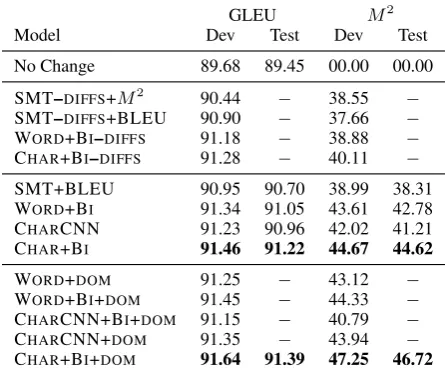
GLEU M2
Model Dev Test Dev Test
No Change 89.68 89.45 00.00 00.00
SMT–DIFFS+M2 90.44 − 38.55 −
SMT–DIFFS+BLEU 90.90 − 37.66 −
WORD+BI–DIFFS 91.18 − 38.88 −
CHAR+BI–DIFFS 91.28 − 40.11 −
SMT+BLEU 90.95 90.70 38.99 38.31
WORD+BI 91.34 91.05 43.61 42.78
CHARCNN 91.23 90.96 42.02 41.21
CHAR+BI 91.46 91.22 44.67 44.62
WORD+DOM 91.25 − 43.12 −
WORD+BI+DOM 91.45 − 44.33 −
CHARCNN+BI+DOM 91.15 − 40.79 −
CHARCNN+DOM 91.35 − 43.94 −
[image:3.595.71.294.64.250.2]CHAR+BI+DOM 91.64 91.39 47.25 46.72
Table 1: AESW development/test set correction results. GLEU andM2differences on test are statistically significant via paired bootstrap resampling (Koehn,2004;Graham et al.,
2014) at the 0.05 level, resampling the full set 50 times.
models we propose modeling the input and output sequences with a special initial token representing the journal domain (+DOM).2
3 Experiments
Data AESW (Daudaravicius,2016; Daudaravi-cius et al.,2016) consists of sentences taken from academic articles annotated with corrections by professional editors used for the AESW shared task. The training set contains 1,182,491 sen-tences, of which 460,901 sentences have edits. We set aside a 9,947 sentence sample from the orig-inal development set for tuning (of which 3,797 contain edits), and use the remaining 137,446 sen-tences as the dev set3(of which 53,502 contain
ed-its). The test set contains 146,478 sentences. The primary focus of the present study is con-ducting controlled experiments on the AESW dataset, but we also investigate results on the CoNLL-2014 shared task data in light of recent neural results (Ji et al., 2017) and to serve as a baseline of comparison against existing sequence-to-sequence approaches (Yuan and Briscoe,2016; Xie et al., 2016). We use the common sets of public data appearing in past work for train-ing: the National University of Singapore (NUS) Corpus of Learner English (NUCLE) (Dahlmeier et al., 2013) and the publicly available Lang-8
so document-level context is not available.
2Characteristics of the dataset preclude experiments with additional paragraph context features. (See Appendix A.)
3The dev set contains 13,562 unique deletion types, 29,952 insertion types, and 39,930 replacement types.
data (Tajiri et al., 2012; Mizumoto et al., 2012). The Lang-8 dataset of corrections is large4 but
is crowd-sourced5 and is thus of a different
na-ture than the professionally annotated AESW and NUCLE datasets. We use the revised 2013 test set as a tuning/dev set and the CoNLL-2014 test set (without alternatives) for testing. We do not make use of the non-public Cambridge Learner Corpus (CLC) (Nicholls, 2003), which contains over 1.5 million sentence pairs.
Evaluation We follow past work and use the Generalized Language Understanding Evaluation (GLEU) (Napoles et al., 2016) and MaxMatch (M2) metrics (Dahlmeier and Ng,2012).
Parameters All our models, implemented with OpenNMT (Klein et al.), are2-layer LSTMs with 750hidden units. For the WORDmodel, the word
embedding size is also set to 750, while for the CHARCNN and CHAR models we use a
char-acter embedding size of 25. The CHARCNN
model has a convolutional layer with 1000 fil-ters of width 6 followed by max-pooling, which is fed into a2-layer highway network. Additional training details are provided in Appendix A. For AESW, the WORD+BImodel contains around 144
million parameters, the CHARCNN+BI model
around 79 million parameters, and the CHAR+BI
model around 25 million parameters.
Statistical Machine Translation As a baseline of comparison, we experiment with a phrase-based machine translation approach (SMT) shown to be state-of-the-art for the CoNLL-2014 shared task data in previous work (Junczys-Dowmunt and Grundkiewicz, 2016), which adds task specific features and the M2 metric as a scorer to the
Moses statistical machine translation system. The SMT model follows the training, parameters, and dense and sparse task-specific features that gener-ate stgener-ate-of-the-art results for CoNLL-2014 shared task data, as implemented in publicly available code.6 However, to compare models against the
same training data, we remove language model features associated with external data.7 We
exper-4about 1.4 million sentences after filtering
5derived from the Lang-8 language-learning website 6SRI International provided access to SRILM (
Stol-cke,2002) for runningJunczys-Dowmunt and Grundkiewicz
(2016)
iment with tuning againstM2 (+M2) and BLEU
(+BLEU). Models trained with diffs were only tuned with BLEU, since the tuning pipeline from previous work is not designed to handle removing such annotation tags prior toM2scoring.
4 Results and Analysis: AESW
Table 1 shows the full set of experimental results on the AESW development and test data.
The CHAR+BI+DOMmodel is stronger than the
WORD+BI+DOM and CHARCNN+DOM models
by 2.9M2 (0.2 GLEU) and 3.3M2 (0.3 GLEU),
respectively. The sequence-to-sequence models were also more effective than the SMT models, as shown in Table 1. We find that training with target diffs is beneficial across all models, with an increase of about 5M2 points for the WORD+BI
model, for example. Adding +DOM information
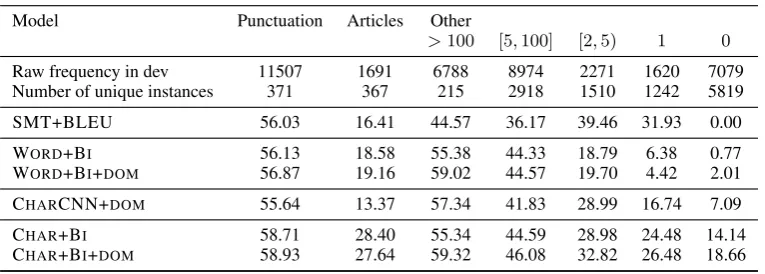
slightly improves effectiveness across models. We analyzed deletion, insertion, and replace-ment error types. Table 2 compares effec-tiveness across replacement errors. We found the CHARCNN+BI models were less effective
than CHARCNN variants in terms of GLEU and
M2, and the strongest CHARCNN models were
eclipsed by the WORD+BI models in terms of
the GLEU and M2 scores. However, Table 2
shows CHARCNN+DOMis stronger on lower
fre-quency replacements than WORD models. The
CHAR+BI+DOMmodel is relatively strong on
ar-ticle and punctuation replacements, as well as er-rors appearing with low frequency in the training set and overall across deletion and insertion error types, which are summarized in Table3.
Errors never occurring in training The com-paratively high Micro F0.5 score (18.66) for the
CHAR+BI+DOM model on replacement errors
(Table2) never occurring in training is a result of a high precision (92.65) coupled with a low re-call (4.45). This suggests some limited capacity to generalize to items not seen in training. A se-lectively chosen example is the replacement from “discontinous” to “discontinuous”, which never occurs in training. However, similar errors of low edit distance also occur once in the dev set and never in training, but the CHAR+BI+DOMmodel filtered against the NUCLE corpus,hurteffectiveness for the phrase-based models. This is likely a reflection of the do-main specific nature of the academic text and LaTeX holder symbols appearing in the text. Here, we conduct controlled experiments without introducing additional domain-specific monolingual data.
never correctly recovers many of these errors, and many of the correctly recovered errors are minor changes in capitalization or hyphenation.
Error frequency About 39% of the AESW training sentences have errors, and of those sen-tences, on average, 2.4 words are involved in changes in deletions, insertions, or replacements (i.e., the count of words occurring between diff tags) per sentence. In the NUCLE data, about 37% of the sentences have errors, of which on aver-age, 5.3 words are involved in changes. On the AESW dev set, if we only consider the 9545 sen-tences in which 4 or more words are involved in a change (average of 5.8 words in changes per sen-tence), the CHAR+BImodel is still more effective
than SMT+BLEU, with a GLEU score of 67.21 vs. 65.34. The baseline GLEU score (No Change) is 60.86, reflecting the greater number of changes relative to the full dataset (cf. Table 1).
Re-annotation The AESW dataset only pro-vides 1 annotation for each sentence, so we per-form a small re-annotation of the data to gauge effectiveness in the presence of multiple annota-tions. We collected 3 outputs (source, gold, and generated sentences from the CHAR+BI+DOM
model) for 200 randomly sampled sentences, re-annotating to create 3 new references for each sentence. The GLEU scores for the 200 original source, CHAR+BI+DOM, and original gold
sen-tences evaluated against the 3 new references were 79.79, 81.72, and 84.78, respectively, suggesting that there is still progress to be made on the task relative to human levels of annotation.
5 Results and Analysis: CoNLL
Table4 shows the results on the CoNLL dev set, and Table5contains the final test results.
Since the CoNLL data does not contain enough data for training neural models, previous works add the crowd-sourced Lang-8 data; however, this data is not professionally annotated. Since the distribution of corrections differs between the dev/test and training sets, we need to tune the pre-cision and recall.
As shown in Table 4, WORD+BI effectiveness
increases significantly by tuning the weights8
as-signed to the diff tags on the CoNLL-2013 set9. 8In contrast, in early experiments on AESW, tuning yielded negligible improvements.
Replacement Error Type (out of 39,930) – Frequency relative to training
Model Punctuation Articles Other
>100 [5,100] [2,5) 1 0
Raw frequency in dev 11507 1691 6788 8974 2271 1620 7079
Number of unique instances 371 367 215 2918 1510 1242 5819
SMT+BLEU 56.03 16.41 44.57 36.17 39.46 31.93 0.00
WORD+BI 56.13 18.58 55.38 44.33 18.79 6.38 0.77
WORD+BI+DOM 56.87 19.16 59.02 44.57 19.70 4.42 2.01
CHARCNN+DOM 55.64 13.37 57.34 41.83 28.99 16.74 7.09
CHAR+BI 58.71 28.40 55.34 44.59 28.98 24.48 14.14
[image:5.595.109.492.76.213.2]CHAR+BI+DOM 58.93 27.64 59.32 46.08 32.82 26.48 18.66
Table 2:MicroF0.5scores on replacement errors on the dev set. Errors are grouped by ‘Punctuation’, ‘Article’, and ‘Other’. ‘Other’ errors are further broken down based on frequency buckets on the training set, with errors grouped by the frequency in which they occur in the training set.
Deletions Insertions Replacements
SMT+BLEU 46.56 31.48 42.21
WORD+BI 47.75 38.31 46.02
WORD+BI+DOM 47.78 39.00 47.29
CHARCNN+DOM 48.30 39.57 46.24
CHAR+BI 49.05 37.17 48.55
[image:5.595.302.527.275.382.2]CHAR+BI+DOM 50.20 42.51 50.39
Table 3:MicroF0.5scores across error types
Precision Recall F0.5
WORD+BI–DIFFS 65.36 6.19 22.45
WORD+BI, before tuning 72.34 0.97 4.60
WORD+BI, after tuning 46.66 15.35 33.14
Table 4:M2scores on the CoNLL-2013 set.
Note that we are tuning the weights on this same CoNLL-2013 set. Without tuning, the model very rarely generates a change, albeit with a high pre-cision. After tuning, it exceeds the effective-ness of WORD+BI–DIFFS. The comparatively low
effectiveness of WORD+BI–DIFFS is consistent
with past sequence-to-sequence approaches utiliz-ing data augmentation, additional annotated data, and/or secondary models to achieve competitive levels of effectiveness.
Table5shows that WORD+BIis within 0.2M2
of Ji et al. (2017), despite using over 1 million fewer sentence pairs, and exceeds theM2 scores
ofXie et al.(2016) andYuan and Briscoe(2016) without the secondary models of those systems. We hypothesize that further gains are possible uti-lizing the CLC data and moving to the charac-ter model. (The characcharac-ter model is omitted here due to the long training time of about 4 weeks.)
Data M2
Yuan and Briscoe(2016) CLC∗ 39.90
Xie et al.(2016) NUCLE, Lang-8,
Common Crawl LM 40.56
Ji et al.(2017) NUCLE, Lang-8,
CLC∗ 41.53
WORD+BI–DIFFS NUCLE, Lang-8 35.73
[image:5.595.71.291.279.374.2]WORD+BI NUCLE, Lang-8 41.37
Table 5: M2scores on the CoNLL-2014 test set and data used for recent sequence-to-sequence based systems. Results for previous works are those reported by the original authors. ∗CLC is proprietary.
Notably, SMT systems (with LMs) are still more effective than reported sequence-to-sequence re-sults, as inJi et al.(2017), on CoNLL.10
6 Conclusion
Our experiments demonstrate that on a large, professionally annotated dataset, a sequence-to-sequence character-based model of diffs can lead to considerable effectiveness gains over a state-of-the-art SMT system with task-specific fea-tures, ceteris paribus. Furthermore, in the crowd-sourced environment of the CoNLL data, in which there are comparatively few professionally anno-tated sentences in training, modeling diffs enables a means of tuning that improves the effectiveness of sequence-to-sequence models for the task.
[image:5.595.72.289.409.462.2]References
Shamil Chollampatt, Duc Tam Hoang, and Hwee Tou
Ng. 2016a. Adapting grammatical error correction
based on the native language of writers with neural network joint models. In Proceedings of the 2016 Conference on Empirical Methods in Natural Lan-guage Processing, pages 1901–1911, Austin, Texas. Association for Computational Linguistics.
Shamil Chollampatt, Kaveh Taghipour, and Hwee Tou
Ng. 2016b. Neural network translation models for
grammatical error correction. In Proceedings of the Twenty-Fifth International Joint Conference on Artificial Intelligence, IJCAI’16, pages 2768–2774. AAAI Press.
Daniel Dahlmeier and Hwee Tou Ng. 2012.
Bet-ter evaluation for grammatical error correction. In
Proceedings of the 2012 Conference of the North American Chapter of the Association for Computa-tional Linguistics: Human Language Technologies, NAACL HLT ’12, pages 568–572, Stroudsburg, PA, USA. Association for Computational Linguistics. Daniel Dahlmeier, Hwee Tou Ng, and Siew Mei Wu.
2013. Building a large annotated corpus of learner
english: The nus corpus of learner english. In
Proceedings of the Eighth Workshop on Innova-tive Use of NLP for Building Educational Applica-tions, pages 22–31, Atlanta, Georgia. Association for Computational Linguistics.
Robert Dale, Ilya Anisimoff, and George Narroway.
2012. Hoo 2012: A report on the preposition and
determiner error correction shared task. In Pro-ceedings of the Seventh Workshop on Building Ed-ucational Applications Using NLP, pages 54–62, Stroudsburg, PA, USA. Association for Computa-tional Linguistics.
Robert Dale and Adam Kilgarriff. 2011. Helping our
own: The hoo 2011 pilot shared task. In Proceed-ings of the 13th European Workshop on Natural Language Generation, ENLG ’11, pages 242–249, Stroudsburg, PA, USA. Association for Computa-tional Linguistics.
Vidas Daudaravicius. 2016. Automated evaluation of scientific writing data set (version 1.2) [data file]. VTeX.
Vidas Daudaravicius, Rafael E. Banchs, Elena
Volo-dina, and Courtney Napoles. 2016. A report on
the automatic evaluation of scientific writing shared task. InProceedings of the 11th Workshop on Inno-vative Use of NLP for Building Educational Appli-cations, pages 53–62, San Diego, CA. Association for Computational Linguistics.
Yvette Graham, Nitika Mathur, and Timothy Baldwin.
2014. Randomized significance tests in machine
translation. In Proceedings of the Ninth Workshop on Statistical Machine Translation, pages 266–274, Baltimore, Maryland, USA. Association for Compu-tational Linguistics.
Duc Tam Hoang, Shamil Chollampatt, and Hwee Tou
Ng. 2016. Exploiting n-best hypotheses to
im-prove an smt approach to grammatical error correc-tion. In Proceedings of the Twenty-Fifth Interna-tional Joint Conference on Artificial Intelligence, IJ-CAI’16, pages 2803–2809. AAAI Press.
J. Ji, Q. Wang, K. Toutanova, Y. Gong, S. Truong, and
J. Gao. 2017. A Nested Attention Neural Hybrid
Model for Grammatical Error Correction. ArXiv e-prints.
Marcin Junczys-Dowmunt and Roman Grundkiewicz.
2016. Phrase-based machine translation is
state-of-the-art for automatic grammatical error correction. In Proceedings of the 2016 Conference on Empiri-cal Methods in Natural Language Processing, pages 1546–1556, Austin, Texas. Association for Compu-tational Linguistics.
Yoon Kim, Yacine Jernite, David Sontag, and Alexan-der M. Rush. 2016. Character-Aware Neural
Lan-guage Models. InProceedings of AAAI.
G. Klein, Y. Kim, Y. Deng, J. Senellart, and A. M.
Rush. OpenNMT: Open-Source Toolkit for Neural
Machine Translation.ArXiv e-prints.
Philipp Koehn. 2004. Statistical significance tests for
machine translation evaluation. In Proceedings of
EMNLP 2004, pages 388–395, Barcelona, Spain. Association for Computational Linguistics.
Minh-Thang Luong, Hieu Pham, and Christopher D.
Manning. 2015. Effective approaches to
attention-based neural machine translation. In Empir-ical Methods in Natural Language Processing (EMNLP), pages 1412–1421, Lisbon, Portugal. As-sociation for Computational Linguistics.
Tomoya Mizumoto, Yuta Hayashibe, Mamoru Ko-machi, Masaaki Nagata, and Yuji Matsumoto. 2012. The effect of learner corpus size in grammatical er-ror correction of ESL writings. InProceedings of COLING 2012: Posters, pages 863–872, Mumbai, India. The COLING 2012 Organizing Committee. Courtney Napoles, Keisuke Sakaguchi, Matt Post, and
Joel Tetreault. 2016. GLEU without tuning. eprint
arXiv:1605.02592 [cs.CL].
Hwee Tou Ng, Siew Mei Wu, Ted Briscoe, Christian Hadiwinoto, Raymond Hendy Susanto, and
Christo-pher Bryant. 2014. The CoNLL-2014 shared task
on grammatical error correction. InProceedings of the Eighteenth Conference on Computational Nat-ural Language Learning: Shared Task, pages 1– 14, Baltimore, Maryland. Association for Compu-tational Linguistics.
Hwee Tou Ng, Siew Mei Wu, Yuanbin Wu, Christian
Hadiwinoto, and Joel Tetreault. 2013. The
CoNLL-2013 shared task on grammatical error correction. In Proceedings of the Seventeenth Conference on Computational Natural Language Learning: Shared
Task, pages 1–12, Sofia, Bulgaria. Association for
Diane Nicholls. 2003. The cambridge learner corpus: Error coding and analysis for lexicography and ELT. InProceedings of the Corpus Linguistics 2003 con-ference, pages 572–581.
Alla Rozovskaya and Dan Roth. 2016. Grammatical
error correction: Machine translation and classifiers. InProceedings of the 54th Annual Meeting of the As-sociation for Computational Linguistics (Volume 1: Long Papers), pages 2205–2215, Berlin, Germany. Association for Computational Linguistics.
Allen Schmaltz, Yoon Kim, Alexander M. Rush, and
Stuart Shieber. 2016. Sentence-level grammatical
error identification as sequence-to-sequence correc-tion. InProceedings of the 11th Workshop on In-novative Use of NLP for Building Educational Ap-plications, pages 242–251, San Diego, CA. Associ-ation for ComputAssoci-ational Linguistics.
Andreas Stolcke. 2002. Srilm – an extensible language
modeling toolkit. In Proc. Intl. Conf. on Spoken
Language Processing, volume 2, pages 901–904, Denver.
Toshikazu Tajiri, Mamoru Komachi, and Yuji
Mat-sumoto. 2012. Tense and aspect error correction
for esl learners using global context. In Proceed-ings of the 50th Annual Meeting of the Association for Computational Linguistics (Volume 2: Short Pa-pers), pages 198–202, Jeju Island, Korea. Associa-tion for ComputaAssocia-tional Linguistics.
Ziang Xie, Anand Avati, Naveen Arivazhagan, Dan
Ju-rafsky, and Andrew Y. Ng. 2016. Neural language
correction with character-based attention. CoRR, abs/1603.09727.
Zheng Yuan and Ted Briscoe. 2016. Grammatical
er-ror correction using neural machine translation. In