A Cognition Based Attention Model for Sentiment Analysis
Yunfei Long1, Qin Lu1, Rong Xiang2, Minglei Li1 and Chu-Ren Huang3 1Department of Computing, The Hong Kong Polytechnic University
csylong,csluqin,[email protected] 2Advanced Micro Devices, Inc.(Shanghai)
3Department of Chinese and Bilingual Studies, The Hong Kong Polytechnic University [email protected]
Abstract
Attention models are proposed in senti-ment analysis because some words are more important than others. However, most existing methods either use local context based text information or user preference information. In this work, we propose a novel attention model trained by cognition grounded eye-tracking data. A reading prediction model is first built us-ing eye-trackus-ing data as dependent data and other features in the context as in-dependent data. The predicted reading time is then used to build a cognition based attention (CBA) layer for neural sentiment analysis. As a comprehensive model, We can capture attentions of words in sentences as well as sentences in doc-uments. Different attention mechanisms can also be incorporated to capture other aspects of attentions. Evaluations show the CBA based method outperforms the state-of-the-art local context based atten-tion methods significantly. This brings in-sight to how cognition grounded data can be brought into NLP tasks.
1 Introduction
Sentiment analysis is critical for many applica-tions such as sentimental product recommenda-tion (Dong et al., 2013), public opinion detec-tion (Pang et al.,2008), and human-machine inter-action (Clavel and Callejas, 2016), etc.Sentiment analysis has been well-explored (Pang et al.,2002;
Vanzo et al.,2014;Tang et al.,2015a;Chen et al.,
2016;Maas et al., 2011).Recently, deep learning based methods have further elevated the perfor-mance of sentiment analysis without the need for labor intensive feature engineering.
Attention models are incorporated into senti-ment analysis because not all words are created equal. Some words are more important than oth-ers in conveying the message in a sentence. Simi-larly, some sentences are more important than oth-ers in a document. Although the overall reading time as a cognitive process may reflect the syn-tax and discourse complexity, reading time of in-dividual words is also an indicator of their seman-tic importance in text (Roseman,2001;Demberg and Keller, 2008). Previous attention models are built using information embedded in text including users, products and text in local context for senti-ment classification (Tang et al.,2015b;Yang et al.,
2016;Chen et al., 2016;Gui et al., 2016). How-ever, attention models using local context based text through distributional similarity lack theoret-ical foundation to reflect the cognitive basis. But, the key in sentiment analysis lies in its cognitive basis. Thus, we envision that cognition grounded data obtained in text reading should be helpful in building an attention model.
In this paper, we propose a novel cognition based attention(CBA) model for sentiment analy-sis learned from cognition grounded eye-tracking data. Eye-tracking is the process of measuring ei-ther the point of gaze or the motion of an eye rel-ative to the head1. In psycho-linguistics
experi-ments, Barrett(2016) shows that readers are less likely to fixate on close-class words that are pre-dictable from context. Readers also fixate longer on words which play significant semantic roles (Demberg and Keller, 2008) in addition to infre-quent words, ambiguous words, and morphologi-cal complex words (Rayner,1998). Since reading time can be learned from an eye-tracking dataset, predicted reading time of words in its context can be used as indicators of attention weights.
1https://en.wikipedia.org/wiki/Eye-tracking
We first build a regression model to map syn-tax, and context features of a word to its reading time based on eye-tracking data. We then apply the model to sentiment analysis text to obtain the estimated reading time of words at the sentence level. The estimated reading time can then be used as the attention weights in its context to build the attention layer in a neural network based senti-ment analysis model. Evaluation on the four sen-timent analysis benchmark datasets (IMDB, Yelp 13, Yelp 14 and IMDB2) show that our proposed model can significantly improve the performance compared to the state-of-the-art attention methods. To sum up, we have two major contributions: (1) We propose a novel cognition grounded at-tention model to improve the state-of-the-art neu-ral network based sentiment analysis models by learning attention information from eye-tracking data. This is one of the first attempts to use cog-nition grounded data in sentiment analysis. The CBA model not only can capture attention of words at the sentence level, it can also be aggre-gated to work at the document level. (2) Evalu-ation on several real-world datasets in sentiment analysis shows that our method outperforms other state-of-the-art methods significantly. This work validates the effectiveness of cognition grounded data in building attention models.
2 Related works
The basic task in sentiment analysis can be formu-lated as a classification problem. Class labels can either be binary (positive/negative) or polarity ei-ther as intensity by continuous values or as ratings in certain range such as 0 to 5 or 1 to 10, etc..
In recent years, deep learning based methods have greatly improved the performance of senti-ment analysis. Commonly used models include Convolutional Neural Networks (Socher et al.,
2011), Recursive Neural Network (Socher et al.,
2013), and Recurrent Neural Networks (Irsoy and Cardie,2014). RNN naturally benefits sentiment classification because of its ability to capture se-quential information in text. However, standard RNN suffers from the gradient vanishing problem (Bengio et al., 1994) where gradients may grow or decay exponentially over long sequences. To address this problem, Long-Short Term Memory model (LSTM) is introduced by adding a gated mechanism to keep long term memory. Each LSTM layer is generally followed by mean
pool-ing and then feed into the next layer. Experiments in datasets which contain long documents and sen-tences demonstrate that the LSTM model outper-forms the traditional RNN (Tang et al.,2015a,c).
Not all words contribute equally to the seman-tics of a sentence (Hahn and Keller,2016). Atten-tion based neural networks are proposed to high-light their difference in contribution (Yang et al.,
2016). In document level sentiment classifica-tion, both sentence level attention and document level attention are proposed. In the sentence level attention layer, an attention mechanism identi-fies words that are important. Those informative words are aggregated as attention weights to form sentence embedding representation. This method is generally called local context attention method. Similarly, some sentences can also be highlighted to indicate their importance in a document.
Apart from local context attention, user/product attentions are also included in deep learning based methods either in a separate network (Gui et al.,
2016) or a unified network (Tang et al.,2015c;Gui et al.,2016). Some feature engineering method to some specific datasets can also achieve very good result(Sadeghian and Sharafat, 2015). However, they are not suited for other genre of text as user-product information are not generally available.
Attention models can be built not only from lo-cal text or user/product information but also from cognitive grounded data, especially eye-tracking data (Rayner,1998;Allopenna et al.,1998). Joshi (2014) proposes a novel metric called Sentiment Annotation Complexity for measuring sentiment annotation complexity based on eye-tracking data. Mishra (2014) presents a cognitive study of senti-ment detection from the perspective of AI where readers are tested as sentiment readers. Mishra (Mishra et al.,2016b) recently proposes a model in sentiment analysis and sarcasm detection by using eye-tracking data as a feature in addition to text features using Naive-Bayes and SVM classifiers.
In other NLP tasks, Joshi (2013) shows that Word-Sense-Disambiguation can make use of si-multaneous eye-tracking. Eye-tracking data are also used to measure the difficulty in translation annotation (Mishra et al., 2013). Barrett (2016) finds that gaze patterns during reading are strongly influenced by the role a word plays in terms of syn-tax, semantic, and discourse.
Eye-Tracking Corpus), and Mishra et al. (Mishra et al., 2016b) are considered high-quality re-sources (Kennedy,2003;Cop et al.,2016;Mishra et al., 2016b). The Dundee corpus contains eye movement data from English and French news-papers (Kennedy, 2003). Measurements were taken while 10 participants read 20 newspaper articles. GECO is an English-Dutch bilingual corpus with eye-tracking data from 17 participants collected from reading the complete novel The Mysterious Affair at Styles. The corpus has 4,934 sentences, 774,015 tokens, and 9,876 words. The Mishra(Mishra et al.,2016a) dataset contains 994 text snippets with 383 positive and 611 negative examples from newspaper clippings, sampled from seven native speakers.
To predict reading time using eye-tracking data, Tomanek et al. (2010) proposes a regression model using linguistic features related to syntax and semantics for calibration. Hahn (2016) pro-poses a novel approach to model both skipping and reading using unsupervised method which com-bines neural attention with auto-encoding trained on raw text using reinforcement learning.
3 Our proposed CBA model
The basic idea of our method is to add a CBA model into a neural-network based LSTM senti-ment classifier. Let D be a collection of docu-ments. A documentdk,dk ∈ D, hasmnumber
of sentencesS1, S2, ...Sj, ..., Sm. A sentenceSjis
formed by a sequence of wordsSj =wj1w2j...wjlj,
where lj is the length of Sj. The features of
a word wi ∈ D form a feature vector ~vwi =
[F1wi, F2wi....Fnwi]wheren is the feature space
size. The purpose of document level sentiment classification is to project a documentdk into the
target space ofLclass labels. Similarly, at the sen-tence level, the purpose is to project a sensen-tenceSj
into the target class space.
To build the CBA model, we need to first build a reading time prediction model for words within each sentence. Reading time is predicted based on word features and text features calibrated by tracking data. Note that reading time from an eye-tracking dataset cannot be used directly because the text of any eye-tracking dataset is too small for sufficient coverage. Consequently, our method has four tasks: (1) to predict the reading time of words using eye-tracking data and~vwi as features; (2) to
build attention models based on predicted reading
time at sentence level and document level; (3) to integrate attentions from other attention models; and (4) to add the attention model into the LSTM based sentiment classifier.
3.1 Modeling of reading time
To learn the reading time of words in a sentence, our method is based on regression analysis us-ing eye-trackus-ing data as dependent variables and context information in~vw∈Sj as independent
vari-ables. In the eye-tracking process, a number of different time measures such asfirst fixation dura-tion,gaze duration, andtotal reading time. In this work, we only usethe total reading time.
Since a document set is always available for sentiment analysis, we use features extracted from these documents to train the regression model. We select features based on the works from Dem-berg(2008) and Tomanek (2010) to include word features such as word length and POS tags as well as context level syntax and semantic features such as the total number of dominated nodes in a depen-dency parsing three, the maximum dependepen-dency distance, semantic category etc..
Given a word w in a sentence Sj, w ∈ Sj,
and its feature vector~vw∈Sj = [F1w, F2w, ..., Fnw]
wherenis the dimension size in feature space, the regression model on eye-tracking data is a map-ping function g between reading time tw∈Sj and
~vw∈Sj as defined below:
tw∈Sj =g(α1F1w+α2F2w+...+αnFnw+b),
(1)
wheretw∈Sj is the predicted reading time forw,
αi is the weight of feature Fiw, and b is a
con-stant. Note that the set ofαi(i= 1...n)forms the
weight vector ~αw for tw∈Sj. When ~vw∈Sj takes
scalar values, g can be an identity function and thus this model becomes a typical linear regres-sion model. Whentw∈Sj takes discrete values, g
can be a logistic function and this model becomes a typical logistic regression model.
we setgto be the identity function. The objec-tive function then becomes:
min
~α n
X
ai∈~α
||tw∈Sj −yw∈Sj||22+λR(~α), (2)
where yw∈Sj is the true eye-tracking values of
model degrades to a linear regression function. In this work, we evaluate the use of both the linear regression model and the Ridge regression model. 3.2 Building the attention based model Once we have predicted reading time for words used in sentences, the attention model can be built with two components. The first component works at the sentence level to give different words differ-ent emphasis in a sdiffer-entence. The second compo-nent works at the document level to give different sentences different emphasis in a document.
For a sentence Sj = w1w2...wi...wlj with
lengthlj, each wordwiinSj has a corresponding
reading timetwi. LettSj denote the total reading
time ofSj. Then,
tSj =
lj X
i=1,wi∈Sj
twi. (3)
For sentence level attention, the CBA weight for wiinSj, denoted asASj:wi, can be defined as:
ASj:wi =
twi
tSj
. (4)
This sentence level attention model defined above gives more weights to words that have longer reading time relative to the total reading time of the sentence.
Let a documentdk,dk∈D, be formed by a set
of sentencesSj =w1w2...wi...wlj. Now the CBA
weight for a sentenceSjindkis defined as:
Adk:Sj =
tsj Pm
i=1tSi
. (5)
This aggregated document level attention model gives more weights to the sentences that have longer reading time relative to the total reading time of the document. Let A~dk denote the
doc-ument level attention weight vector. The size of ~
Adk should bem, the number of sentences indk.
Let~Sjdenote the embedding ofSjinN
dimen-sional space, whereSj ∈dk. Then, the set of
sen-tence representations fordkshould be a matrix of
sizem×N, denoted bySˆdk. After the inclusion
of the attention model,Sˆdk should be:
ˆ
Sdk =A~dk~SjT. (6)
Let ~dk denote the document embedding of dk.
Since ~dkis anN dimensional vector, ~dkcan now
be defined by the adjusted attention model as
(~dk)i= m
X
j=1
( ˆSdk)i,j. (7)
3.3 Incorporation of other attention models Since document embedding representation allows the combined use of multiple attention mecha-nisms, it is to our advantage to incorporate dif-ferent attention mechanisms which may help to capture different aspects of attentions. Generally speaking, different attention mechanisms can be incorporated either serially or in parallel.
In principle, any number of attention models can be included. As an an example to illustrate the capability of our proposed method, we choose one state-of-the-art local attention model(shorthanded as LA). The model is a semantic-based local at-tention model proposed by Yang (2016) and also used by Chen (2016). For inclusion serially, the attention weight is formulated as follows:
As
Sj:wi=LASj:wi∗ASj:wi, (8)
whereLAsj:wi the sentence level attention model
by the local attention model. To incorporate LA in parallel mode, the attention weight can be formu-lated by:
ApSj:wi =LASj:wi+ASj:wi. (9)
Similar methods can be used at document level.
3.4 General sentiment analysis model
We take the neural network based LSTM senti-ment classifier (Gers,2001) to be applied in both the sentence level and the document level because of its excellent performance on long sentences (Tang et al., 2015a). The basic LSTM model has five internal vectors for a nodeiincluding an input gate~ii, a forget gate~fi, an output gate~oi, a
candi-date memory cell~c0
i, and a memory cell~ci, and~ii~fi
and~oiare used to indicate which values will be
up-dated, forget or for keeping in the LSTM model.~c0
i
and~ci are used to keep the candidate features and
the actual accepted features, respectively.
At the sentence level, each word wi in a
sen-tenceSj is represented by its word embeddingw~i
in theN dimensional space. The LSTM cell state ~ci and the hidden state~hSj:wi can be updated in
state~hSj:wi−1 uses a hyperbolic function to form
~c0
ias defined below.
~c0
i =tanh( ˆWc∗[~hSj:wi−1 ∗ ~wi] + ˆb), (10)
where Wˆc is a parameter matrix,~hSj:wi−1 is the
previous hidden state and ~wi is the word vector. ˆb
is the regularization parameter matrix. In the sec-ond step,~ciis updated by~c0iand its previous state
~ci−1to form~ciaccording to the below formula:
~ci =~fi~ci−1+~ii~c0i. (11)
The hidden state ofwican be obtained by
~hSj:wi = ~oitanh(~fi~ci). (12)
The forget gate ~fi is designed to keep the long
term memory. A series of hidden states~h1~h2...~hi
can serve as input to the attention layer to obtain sentence representation~Sj. In the document level,
similar method is used to get the sentence matrix ˆ
Sin the document level LSTM layer to obtain the final document representation~dk.
In our work, the final document representation ~
dk encodes both the sentence level information
and the document level information. In the LSTM model, we use a hidden layer to project the final document vector~dfkthrough a hyperbolic function.
~df
k =tanh( ˆWh~dk+ ˆbh), (13)
where Wˆh is the hidden layer weight matrix and
ˆbhis the regularization matrix.
Finally, sentiment prediction for any label lL obtained by the softmax function defined below:
P(y=l|~dfk) = e~d
fT k W~l PL
l=1e~d
fT
k W~l (14)
whereW~lis the softmax weight for each label.
4 Performance evaluation
Our proposed CBA for sentiment classification is evaluated on four document sets: The first three datasets IMDB, Yelp 13, and Yelp14 which are review texts including user/product informa-tion developed by Tang (2015a). The last dataset IMDB2 is a plain text by Maas (2011). All four datasets are tokenized through the Stanford NLP tool (Manning et al.,2014).
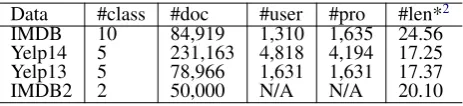
Table 1 list the statistics of the datasets in-cluding number of classes, number of docu-ments, and average length of sentence. We split
train/development/test set in the rate of 8:1:1. The best configuration of the development dataset is used in the test set to obtain the final result.
Data #class #doc #user #pro #len*2
IMDB 10 84,919 1,310 1,635 24.56
Yelp14 5 231,163 4,818 4,194 17.25
Yelp13 5 78,966 1,631 1,631 17.37
[image:5.595.308.540.111.164.2]IMDB2 2 50,000 N/A N/A 20.10
Table 1: Statistics of three benchmark datasets
Two commonly used performance evaluation metrics are used. The first one is accuracy and the second one is rooted mean square error (RMSE)3.
LetGRibe the golden sentiment ratings,P Ri be
the predicted sentiment rating, andT be the num-ber of documents whereGRi = P Ri. Accuracy
is then defined by
Accuracy = T
N, (15)
and RMSE is defined by
RMSE =
v u u tXN
i=1
(GRi−P Ri)2∗ N1. (16)
We train the skip-gram word embedding (Mikolov et al.,2013) on each dataset separately to initialize the word vectors. All embedding sizes on the model are set to 200, a commonly used size. Three sets of experiments are conducted. The first is on the selection of the regression model for reading time prediction. The second set of experi-ments compares our proposed CBA with another sentiment analysis method which use text only. The third set of experiments evaluates the effec-tiveness of combining different attention models. 4.1 Reading time prediction
The training for the regression model for reading time prediction using eye-tracking data requires the learning from text and context features as dis-cussed in Section3.1. We compare our regression model with more complex deep learning based re-gression models in each of the three eye-tracking datasets.4
3Normally accuracy is a problematic measure in highly unbalanced data sets. But in In IMDB, the largest class only takes less than 20% of all instances out of classes. The most imbalanced data are Yelp 13 whose largest class is 41% among 5 classes and second largest is about 30%. IMDB has a 50/50 split for 2-classes.
[image:5.595.309.528.299.397.2]We take the first 90% of sentences as training data and the rest 10% as test data. The configu-ration that performs the best is selected and pred-icated on the document sentiment analysis dataset to obtain estimated reading time. Ideally, an eye-tracking corpus built from on-line reviews is more suitable for our experiments. But, we can only work with what is available.
In addition to the linear regression model(LL) and the Ridge regression model(RR), we also choose the Recurrent Neural Network (RNN) model and the Long Short Time Memory (LSTM) model for regression learning. For both models, there are two versions. The basic version inputs the extracted feature sets as word representation, labeled as RNN-1 and LSTM-1, respective. The second version takes word embedding ( Penning-ton et al., 2014) as the initial word representa-tion input, labeled as RNN-2 and LSTM-2, respec-tively. The RMSE results are listed in Table2.
GECO DUNDEE Mishra
LR 72.47 73.52 87.25
RR 69.47 70.52 84.22
RNN-1 75.47 83.52 96.23
LSTM-1 79.47 84.52 114.25
RNN-2 79.57 86.47 101.25
LSTM-2 83.88 95.88 122.27
Table 2: RMSE for reading time predic-tion(Unit:Milliseconds)
Note that Ridge Regression(RR) has the best performance on all the three datasets because reg-ularization in RR reduces over-fitting problem.In three eye tracking datasets, the RR can achieve co-efficient of determination5 of 0.32, 0.30 and 0.27
in three eye tracking datasets. The features, their types and the corresponding coefficients in RR are shown in Table3.
The more complicated deep learning models suffer from serious over-fitting problem. And the result of Deep learning model with word embed-ding initialization partly supports the fact that the reading time are more depend on the micro level syntax and semantic feature for the word, such as number of letters in word and complexity score of the word instead of the deep level context features. 4.2 Comparison of different sentiment
classification methods
Because the features used in our model are all text based, we compare CBA with two groups
5https://en.wikipedia.org/wiki/Coefficient
ofdetermination
Feature Name Type Cofficient
Number of letters Num 22.441
Start with capital letter Bool 1.910 Capital letters only Bool 161.580 Have alphanumeric letters Bool 6.020
Is punctuation Bool -8.930
Is abbreviation Bool 10.551
Is entity-critical word Bool 7.612 Number of dominated nodes Num 0.980 Max dependency distance Num 1.982 Inverse document frequency Num -9.291 Number of senses in wordnet Num 7.494
Complexity score Num 57.240
Constant Num 239.910
Table 3: Major features used by the Ridge Regres-sion Model
of baseline methods which also only use review text for learning. Group 1 methods include com-monly known linguistic and context features for SVM classifiers. Group 2 includes recent senti-ment classification algorithms which are top per-formers using review text for training including one method that uses local attention model. Be-low is the list of Group1 methods.
• Majority— A simple majority based classi-fier based on sentence labels.
• Trigram — A SVM classifier using uni-grams/bigrams/trigram as features.
• Text feature— A SVM classifier using word level and context level features, such as n-gram and sentiment lexicons.
• AvgWordvec — A SVM classifier that takes the average of word embeddings in Word2Vec as document embedding.
Here is a list of Group 2 methods:
• SSWE (Tang et al., 2014) — A SVM clas-sifier using sentiment specific word embed-ding.
• RNTN+RNN(Socher et al.,2013) — A Re-cursive Neural Tensor Network(RNTN) to represent sentences and trained using RNN.
• Paragraph vector (Le and Mikolov, 2014) — A SVM classifier using document embed-ding as features.
IMDB Yelp13 Yelp14
ACC RMSE ACC RMSE ACC RMSE
General baseline (Group 1)
Majority 0.196 2.495 0.411 1.060 0.392 1.097
Trigram 0.399 1.783 0.569 0.814 0.577 0.804
TextFeature 0.402 1.793 0.556 0.845 0.572 0.801 AveWord2vec 0.304 1.985 0.526 0.898 0.531 0.893
Recently developed methods
(Group 2)
SSWE+SVM 0.312 1.973 0.549 0.849 0.557 0.851
Paragraph Vector 0.314 1.814 0.554 0.832 0.564 0.802
RNTN+RNN 0.401 1.764 0.574 0.804 0.582 0.821
CLSTM 0.421 1.549 0.592 0.769 0.594 0.766
B-CLSTM 0.462 1.453 0.619 0.705 0.592 0.741
LSTM 0.443 1.465 0.627 0.701 0.637 0.686
LSTM+LA 0.487 1.381 0.631 0.706 0.631 0.715
CBA based models LSTM+CBA
M 0.447 1.495 0.610 0.746 0.613 0.768
LSTM+CBAD 0.468 1.419 0.623 0.706 0.628 0.702
[image:7.595.88.514.61.281.2]LSTM+CBAG 0.489 1.365 0.638 0.697 0.641 0.678
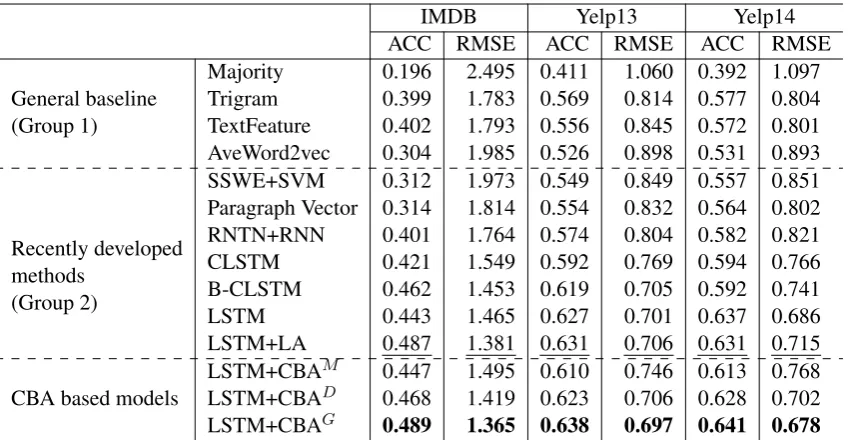
Table 4: Evaluation on sentiment classification using review text for training
• CLSTM(Xu et al.,2016) — Cached LSTM to capture the overall semantic information in long text. The two variations include regular CLSTMand bi-directionalB-CLSTM.
• LSTM+UPA (Chen et al., 2016) — State-of-the-art LSTM including LA as well as user/product as attention mechanism at both sentence level and document level.
Our proposed CBA model has several variations as explained below.
• LSTM+CBA — The LSTM classifier us-ing only CBA model at sentence level and document level. Based on the three eye-tracking datasets(GECO, DUNDEE and Mishra’s) for reading time prediction, we label the same model by different training data as LSTM+CBAG,LSTM+CBAD and
LSTM+CBAM.
• LSTM+CBA+LAG — The LSTM based
classifier using both the CBA model and the local text context based attention model(LA) (Chen et al.,2016). Since combining method can either be serial or in parallel, there are actually two corresponding variations: LSTM+CBA+LAG
s and LSTM+CBA+LAGp.
• LSTM+CBA+UPAG — The same
frame-work toLSTM+CBA+LAG with additional
user/product attention. The two correspond-ing variations are LSTM+CBA+UPAG
s and
LSTM+CBA+UPAG p.
Table 4 shows the performance of the three groups using review text without user/product in-formation on only the first three datasets meth-ods in Group 1 and Group 2 do not have evalua-tions on IMDB2. Among all the reference meth-ods that do not use any attention mechanism in-cluding all methods in Group 1 and Group 2(ex-cept LSTM+LA), LSTM is the best performer. LSTM+LA (2016), which is the state-of-the-art method, uses local attention mechanism to im-prove performance significantly. Among our CBA based variations, using the GECO dataset gives the best result outperforming LSTM+LA in all three datasets. LSTM+CBAG has significant
improve-ment over LSTM+LA withpvalues ofp <0.016 on IMDB, p < 0.0019 on Yelp 13, and p < 0.00023on Yelp 14. LSTM+CBAG has the best
result compared to the other two variations be-cause GECO has larger participant size. Its text genre is also closer to the review datasets for sen-timent analysis.
In the third set of experiment, we compare our LSTM+CBA model with the combination of other attention models including the LA model and the UPA model as shown in Table5. In the second set of experiment, since the GECO dataset gives the best performance, Table5shows the performance of LSTM+CBA using only the GECO dataset including LSTM+CBAG, LSTM+CBA+LAG
s,
LSTM+CBA+LAG
p, LSTM+CBA+UPAGs,and
LSTM+CBA+UPAG
p. Note that UPA is build
IMDB Yelp13 Yelp14 IMDB2 ACC RMSE ACC RMSE ACC RMSE ACC RMSE
LSTM+LA 0.487 1.381 0.631 0.706 0.631 0.715 0.885 0.337
LSTM+CBAG 0.489 1.365 0.638 0.697 0.641 0.678 0.894 0.332
LSTM+CBA+LAG
s 0.488 1.369 0.633 0.706 0.643 0.672 0.898 0.328
LSTM+CBA+LAG
p 0.492 1.362 0.639 0.696 0.639 0.675 0.901 0.322
LSTM+UPA 0.533 1.281 0.650 0.692 0.667 0.654 N/A N/A
LSTM+CBA+UPAG
s 0.523 1.277 0.654 0.693 0.664 0.645 N/A N/A
LSTM+CBA+UPAG
[image:8.595.88.511.62.189.2]p 0.521 1.278 0.655 0.685 0.668 0.644 N/A N/A
Table 5: Evaluation on sentiment classification on using dual attention
only if user/product information is available. Such data is provided in the first three sets of data.
Table5shows that among all three single atten-tion models, UPA outperforms both LA and CBA in the first three datasets. This is easier to under-stand as UPA already included LA and it has more explicit information from users and products for its attention model compared to CBA which needs to learn hidden attention information. The com-bined method of CBA with UPA can still further improve performance. When CBA+UPA are com-bined in parallel, it has the best performance for both Yelp13 and Yelp14 (withpvalue of 0.027 and 0.032 respectively compare to LSTM+UPA). In the IMDB dataset, however, UPA has the best per-formance. This may be because user/product in-formation is more effective in movie review IMDB dataset which is more subjective.
However, the UPA model works only if user and product information is available. Thus for IMDB2 where user/product information is not available, only CBA and LA models work and the combined use of CBA+LA gives the best performance.
4.3 Case study
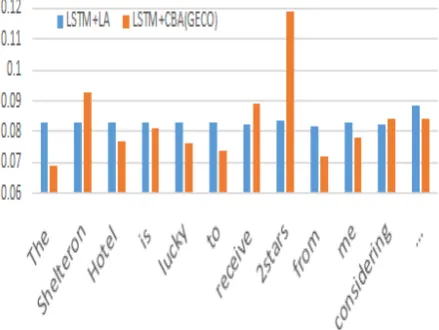
A random sentence sample’The Shelton hotel is lucky to receive 2stars from me considering ...’ is taken from the Yelp13 dataset to demonstrate the difference in the two attention mechanisms, i.e. lo-cal text(LA), and cognition-based(CBA). Figure1
shows visually the difference in attention weights of the two models.
The attention weights of words in the LA model does not change much. CBA, on the other hand, gives higher weights to the sentiment linked word
2stars and the verb receive. This two words do play significant roles as an indirect object and a main verb, respectively. This case shows that CBA does a better job in capturing micro level
informa-tion in the sentence level. This support the experi-mental results in Table4and Table5.
Figure 1: Case Study on attention weights
5 Conclusion and future works
In this paper, we propose a novel cognition based attention model to improve the state-of-the-art neural sentiment analysis model through cognition grounded eye-tracking data. A simple and effec-tive regression model is used to predict reading time using both eye-tracking data and local text features. The predicted reading time is then used to build an attention layer in neural sentiment anal-ysis models. The attention model considers both reading time and other syntactic and context fea-tures. It works in both the sentence level and the document level sentiment analysis.
[image:8.595.310.530.271.436.2]improvement. Future work includes using other eye-tracking information such as saccade and fix-ation. The incorporation of other information such as user-product information can also be explored.
Acknowledgments
The work is partially supported by the research grants from Hong Kong Polytechnic University (PolyU RTVU) and GRF grant( CERG PolyU 15211/14E).
References
Paul D Allopenna, James S Magnuson, and Michael K Tanenhaus. 1998. Tracking the time course of spo-ken word recognition using eye movements: Evi-dence for continuous mapping models. Journal of
memory and language, 38(4):419–439.
Maria Barrett, Joachim Bingel, Frank Keller, and An-ders Søgaard. 2016. Weakly supervised part-of-speech tagging using eye-tracking data. In Proceed-ings of the 54th Annual Meeting of the Association
for Computational Linguistics: Short Papers,
vol-ume 579, page 584.
Yoshua Bengio, Patrice Simard, and Paolo Frasconi. 1994. Learning long-term dependencies with gradi-ent descgradi-ent is difficult. IEEE transactions on neural networks, 5(2):157–166.
Huimin Chen, Maosong Sun, Cunchao Tu, Yankai Lin, and Zhiyuan Liu. 2016. Neural sentiment classifica-tion with user and product attenclassifica-tion. EMNLP.
Chlo´e Clavel and Zoraida Callejas. 2016. Sentiment analysis: from opinion mining to human-agent in-teraction. IEEE Transactions on affective comput-ing, 7(1):74–93.
Uschi Cop, Nicolas Dirix, Denis Drieghe, and Wouter Duyck. 2016. Presenting geco: An eyetracking cor-pus of monolingual and bilingual sentence reading. Behavior research methods, pages 1–14.
Vera Demberg and Frank Keller. 2008. Data from eye-tracking corpora as evidence for theories of syntactic processing complexity. Cognition, 109(2):193–210. Ruihai Dong, Michael P O’Mahony, Markus Schaal, Kevin McCarthy, and Barry Smyth. 2013. Senti-mental product recommendation. InProceedings of
the 7th ACM conference on Recommender systems,
pages 411–414. ACM.
Felix Gers. 2001. Long short-term memory in recur-rent neural networks. Ph.D. thesis, Universit¨at Han-nover.
Lin Gui, Ruifeng Xu, Yulan He, Qin Lu, and Zhongyu Wei. 2016. Intersubjectivity and sentiment: from
language to knowledge. In Proceedings of Inter-national Joint Conference on Artificial Intelligence, pages 2789–2795.
Michael Hahn and Frank Keller. 2016. Modeling hu-man reading with neural attention. arXiv preprint
arXiv:1608.05604.
Ozan Irsoy and Claire Cardie. 2014. Opinion mining with deep recurrent neural networks. In EMNLP, pages 720–728.
Aditya Joshi, Abhijit Mishra, Nivvedan Senthamilsel-van, and Pushpak Bhattacharyya. 2014. Measuring sentiment annotation complexity of text. InACL (2), pages 36–41.
Salil Joshi, Diptesh Kanojia, and Pushpak Bhat-tacharyya. 2013. More than meets the eye: Study of human cognition in sense annotation. In
HLT-NAACL, pages 733–738.
Michael Hahn Frank Keller. 2016. Modeling human reading with neural attention. InProceedings of the Conference on Empirical Methods in Natural Lan-guage Processing, volume 85, page 95.
A Kennedy. 2003. The dundee corpus [cd-rom].
Psy-chology Department, University of Dundee.
Quoc V Le and Tomas Mikolov. 2014. Distributed rep-resentations of sentences and documents. InICML, volume 14, pages 1188–1196.
Andrew L Maas, Raymond E Daly, Peter T Pham, Dan Huang, Andrew Y Ng, and Christopher Potts. 2011. Learning word vectors for sentiment analysis. In Proceedings of the 49th Annual Meeting of the Asso-ciation for Computational Linguistics: Human
Lan-guage Technologies-Volume 1, pages 142–150.
As-sociation for Computational Linguistics.
Christopher D Manning, Mihai Surdeanu, John Bauer, Jenny Rose Finkel, Steven Bethard, and David Mc-Closky. 2014. The stanford corenlp natural lan-guage processing toolkit. In ACL (System Demon-strations), pages 55–60.
Tomas Mikolov, Kai Chen, Greg Corrado, and Jef-frey Dean. 2013. Efficient estimation of word representations in vector space. arXiv preprint arXiv:1301.3781.
Abhijit Mishra, Pushpak Bhattacharyya, Michael Carl, and IBC CRITT. 2013. Automatically predicting sentence translation difficulty. In ACL (2), pages 346–351.
Abhijit Mishra, Aditya Joshi, and Pushpak Bhat-tacharyya. 2014. A cognitive study of subjectivity extraction in sentiment annotation. ACL 2014, page 142.
Abhijit Mishra, Diptesh Kanojia, Seema Nagar, Kun-tal Dey, and Pushpak Bhattacharyya. 2016b. Lever-aging cognitive features for sentiment analysis.
CoNLL 2016, page 156.
Bo Pang, Lillian Lee, and Shivakumar Vaithyanathan. 2002. Thumbs up?: sentiment classification using machine learning techniques. InProceedings of the ACL-02 conference on Empirical methods in natural
language processing-Volume 10, pages 79–86.
As-sociation for Computational Linguistics.
Bo Pang, Lillian Lee, et al. 2008. Opinion mining and sentiment analysis. Foundations and TrendsR in
In-formation Retrieval, 2(1–2):1–135.
Jeffrey Pennington, Richard Socher, and Christopher D Manning. 2014. Glove: Global vectors for word representation. InEMNLP, volume 14, pages 1532– 1543.
Keith Rayner. 1998. Eye movements in reading and information processing: 20 years of research. Psy-chological bulletin, 124(3):372.
Ira J Roseman. 2001. A model of appraisal in the emo-tion system: Integrating theory, research, and appli-cations.
Amir Sadeghian and Ali Reza Sharafat. 2015. Bag of words meets bags of popcorn.
Richard Socher, Jeffrey Pennington, Eric H Huang, Andrew Y Ng, and Christopher D Manning. 2011. Semi-supervised recursive autoencoders for predict-ing sentiment distributions. In Proceedings of the Conference on Empirical Methods in Natural
Lan-guage Processing, pages 151–161. Association for
Computational Linguistics.
Richard Socher, Alex Perelygin, Jean Y Wu, Jason Chuang, Christopher D Manning, Andrew Y Ng, and Christopher Potts. 2013. Recursive deep models for semantic compositionality over a sentiment tree-bank. InProceedings of the conference on empirical
methods in natural language processing (EMNLP),
volume 1631, page 1642. Citeseer.
Duyu Tang, Bing Qin, and Ting Liu. 2015a. Docu-ment modeling with gated recurrent neural network for sentiment classification. In Proceedings of the 2015 Conference on Empirical Methods in Natural
Language Processing, pages 1422–1432.
Duyu Tang, Bing Qin, and Ting Liu. 2015b. Learn-ing semantic representations of users and products for document level sentiment classification. InProc. ACL.
Duyu Tang, Bing Qin, and Ting Liu. 2015c. Learning semantic representations of users and products for document level sentiment classification. In Proceed-ings of the 53rd Annual Meeting of the Association for Computational Linguistics and the 7th Interna-tional Joint Conference on Natural Language
Pro-cessing (Volume 1: Long Papers), pages 1014–1023,
Beijing, China. Association for Computational Lin-guistics.
Duyu Tang, Furu Wei, Nan Yang, Ming Zhou, Ting Liu, and Bing Qin. 2014. Learning sentiment-specific word embedding for twitter sentiment clas-sification. InACL (1), pages 1555–1565.
Katrin Tomanek, Udo Hahn, Steffen Lohmann, and J¨urgen Ziegler. 2010. A cognitive cost model of annotations based on eye-tracking data. In Pro-ceedings of the 48th Annual Meeting of the Asso-ciation for Computational Linguistics, pages 1158– 1167. Association for Computational Linguistics. Andrea Vanzo, Danilo Croce, and Roberto Basili. 2014.
A context-based model for sentiment analysis in twitter. InCOLING, pages 2345–2354.
Jiacheng Xu, Danlu Chen, Xipeng Qiu, and Xuangjing Huang. 2016. Cached long short-term memory neu-ral networks for document-level sentiment classifi-cation. arXiv preprint arXiv:1610.04989.
Zichao Yang, Diyi Yang, Chris Dyer, Xiaodong He, Alex Smola, and Eduard Hovy. 2016. Hierarchi-cal attention networks for document classification.
InProceedings of the 2016 Conference of the North
American Chapter of the Association for