A Structural Support Vector Method for Extracting Contexts and
Answers of Questions from Online Forums
Wen-Yun Yang†∗ Yunbo Cao†‡ Chin-Yew Lin‡
†Department of Computer Science and Engineering Shanghai Jiao Tong University, Shanghai, China
‡Microsoft Research Asia, Beijing, China
[email protected] {yunbo.cao; cyl}@microsoft.com
Abstract
This paper addresses the issue of extract-ing contexts and answers of questions from post discussion of online forums. We propose a novel and unified model by customizing the structural Support Vector Machine method. Our customization has several attractive properties: (1) it gives a comprehensive graphical representation of thread discussion. (2) It designs special inference algorithms instead of general-purpose ones. (3) It can be readily ex-tended to different task preferences by varying loss functions. Experimental re-sults on a real data set show that our meth-ods are both promising and flexible.
1 Introduction
Recently, extracting questions, contexts and an-swers from post discussions of online forums in-curs increasing academic attention (Cong et al., 2008; Ding et al., 2008). The extracted knowl-edge can be used either to enrich the knowlknowl-edge base of community question answering (QA) ser-vices such as Yahoo! Answers or to augment the knowledge base of chatbot (Huang et al., 2007).
Figure 1 gives an example of a forum thread with questions, contexts and answers annotated. This thread containsthree postsandten sentences, among whichthree questions are discussed. The three questions are proposed in three sentences, S3, S5 and S6. The context sentences S1 and S2 provide contextual information for question sentence S3. Similarly, the context sentence S4 provides contextual information for question sen-tence S5 and S6. There are three question-context-answer triples in this example,(S3)−(S1,S2)−
(S8,S9),(S5)−(S4)−(S10)and(S6)−(S4)− ∗This work was done while the first author visited
Mi-crosoft Research Asia.
Post1: <context id=1> S1: Hi I am looking for a pet friendly hotel in Hong Kong because all of my family is going there for vacation. S2:my fam-ily has 2 sons and a dog. </context> <question id=1> S3: Is there any recommended hotel near Sheung Wan or Tsing Sha Tsui? </question> <context id=2, 3>S4:We also plan to go shopping in Causeway Bay. </context> <question id=2>
S5: What’s the traffic situation around those com-mercial areas? </question> <question id=3>S6: Is it necessary to take a taxi?</question>S7:Any information would be appreciated.
Post2: <answer id=1> S8: The Comfort Lodge near Kowloon Park allows pet as I know, and usu-ally fits well within normal budgets. S9: It is also conveniently located, nearby the Kowloon railway station and subway.</answer>
Post3: <answer id=2, 3>S10: It’s very crowd in those areas, so I recommend MTR in Causeway Bay because it is cheap to take you around.</answer>
Figure 1: An example thread with three posts and ten sentences
(S10). As shown in the example, a forum question usually requires contextual information to com-plement its expression. For example, the ques-tion sentence S3 would be of incomplete meaning without the contexts S1 and S2, since the impor-tant keywordpet friendlywould be lost.
The problem of extracting questions, contexts, and answers can be solved in two steps: (1) iden-tify questions and then (2) extract contexts and an-swers for them. Since identifying questions from forum discussions is already well solved in (Cong et al., 2008), in this paper, we are focused on step (2) while assuming questions already identified.
Previously, Ding et al. (2008) employ general-purpose graphical models without any customiza-tions to the specific extraction problem (step 2). In this paper, we improve the existing models in
three aspects: graphical representation,inference algorithmandloss function.
Graphical representation.We propose a more comprehensive and unified graphical representa-tion to model the thread for relarepresenta-tional learning. Our graphical representation has two advantages over previous work (Ding et al., 2008): unifying sentence relationsandincorporating question in-teractions.
Three types of relation should be considered for context and answer extraction: (a) relations be-tween successive sentences (e.g.,contextsentence S2 occurs immediately before question sentence S3); (b) relations between context sentences and answer sentences (e.g., context S4 presents the phraseCauseway Baylinking toanswer which is absent from question S6); and (c) relations be-tween multiple labels for one sentence (e.g., one question sentence is unlikely to be theanswer to anotherquestionalthough one sentence can serve ascontextsfor more than onequestions). Our pro-posed graphical representation improves the mod-eling of the three types of sentence relation (Sec-tion 2.2).
Certain interactions exist among questions. For example,questionsentences S5 and S6 interact by sharingcontextsentence S4. Our proposed graphi-cal representation can naturally model the interac-tions. Previous work (Ding et al., 2008) performs the extraction of contexts and answers in multiple passes of the thread (with each pass corresponding to one question), which cannot address the interac-tions well. In comparison, our model performs the extraction in one pass of the thread.
Inference algorithm. Inference is usually a time-consuming process for structured prediction. We design special inference algorithms, instead of general-purpose inference algorithms used in pre-vious works (Cong et al., 2008; Ding et al., 2008), by taking advantage of special properties of our task. Specifically, we utilize two special properties of thread structure to reduce the inference (time) cost. First, context sentences and question sen-tences usually occur in the same post whileanswer sentences can only occur in the following posts. With this properties, we can greatly reducecontext (or answer) candidate sets of a question, which results in a significant decrease in inference cost (Section 3). Second,contextcandidate set is usu-ally much smaller than the number of sentences in a thread. This property enables our proposal to
have an exact and efficient inference (Section 4.1). Moreover, an approximate inference algorithm is also given (Section 4.2).
Loss function. In practice, different applica-tion settings usually imply different requirements for system performance. For example, we expect a higher recall for the purpose of archiving ques-tions but a higher precision for the purpose of re-trieving questions. A flexible framework should be able to cope with various requirements. We employ structural Support Vector Machine (SVM) model that could naturally incorporate different loss functions (Section 5).
We use a real data set to evaluate our approach to extracting contexts and answers of questions. The experimental results show both the effective-ness and the flexibility of our approach.
In the next section, we formalize the problem of context and answer extraction and introduce the structural model. In Sections 3, 4 and 5 we give the details of customizing structural model for our task. In Section 6, we evaluate our methods. In Section 7, we discuss the related work. Finally, we conclude this paper in Section 8.
2 Problem Statement
We first introduce our notations in Section 2.1 and then in Section 2.2 introduce how we model the problem of extracting contexts and answers for questions with a novel form of graphical represen-tation. In Section 2.3 we introduce the structured model based on the new representation.
2.1 Notations
Assuming that a given thread contains p posts
{p1, . . . , pp}, which are authored by a set of
users {u1, . . . , up}. The p posts can be further
segmented into n sentences x = {x1, . . . , xn}.
Among thensentences,mquestionsentencesq=
{xq1, . . . , xqm} have been identified. Our task is
to identify the context sentences and theanswer sentences for those m question sentences. More formally, we use four types of label{C, A, Q, P}
to stand for context, answer, question and plain la-bels. Then, our task is to predict anm×nlabel matrixy= (yij)1≤i≤m,1≤j≤n, exceptmelements {y1,q1, . . . , ym,qm} which correspond to (known)
questionlabels. The elementyij in label matrixy
y2 y3 y4 y5 y6
y1 y7
{C , P } {C , P } {C , P } {Q } {P } {A, P } {A, P }
x1 x2 x3 x4 x5 x6 x7
(a) Skip-chain model
y2 y3 y4 y5 y6
y1 y7
{C , P } {C , P } {C , P } {Q } {P } {A, P } {A, P }
x1 x2 x3 x4 x5 x6 x7
(b) Complete skip-chain model
y12 y13 y14
y11 y1n
y22 y23 y24
y21 y2n
ym 2 ym 3 ym 4
ym 1 ym n
(c)2D model
y12 y13 y14
y11 y1n
y22 y23 y24
y21 y2n
ym 2 ym 3 ym 4
ym 1 ym n
[image:3.595.79.521.66.324.2](d) Label group model
Figure 2: Structured models
2.2 Graphical Representation
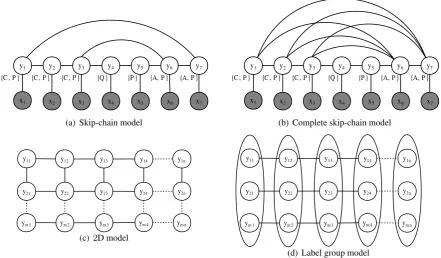
Recently, Ding et al. (2008) use skip-chain and 2D Conditional Random Fields (CRFs) (Lafferty et al., 2001) to perform the relational learning for context and answer extraction. The skip-chain CRFs (Sutton and McCallum, 2004; Galley, 2006) model the long distance dependency between con-text and answer sentences and the2D CRFs (Zhu et al., 2005) model the dependency between con-tiguous questions. The graphical representation of those two models are shown in Figures 2(a) and 2(c), respectively. Those two CRFs are both extensions of the linear chain CRFs for the sake of powerful relational learning. However, di-rectly using the skip-chain and 2D CRFs with-out any customization has obvious disadvantages: (a) the skip-chain model does not model the de-pendency between answer sentence and multiple context sentences; and (b) the2D model does not model the dependency between non-contiguous questions.
To better model the problem of extracting con-texts and answers of questions, we propose two more comprehensive models,complete skip-chain model andlabel group model to improve the ca-pability of the two previous models. These two models are shown in Figures 2(b) and 2(d).
In Figures 2(a) and 2(b), each label node is
an-notated with its allowed labels and the labels C, A, Q and P stand for context, answer, question and plain sentence labels, respectively. Note that the complete skip-chain model completelylinks each two context and answer candidates and the label group model combines the labels of one sentence into onelabel group.
2.3 Structured Model
Following the standard machine learning setup, we denote the input and output spaces byX and
Y, then formulate our task as learning a hypoth-esis function h : X → Y to predict a y when givenx. In this setup,xrepresents a thread of n sentences andmidentified questions.yrepresents them×nlabel matrix to be predicted.
Given a set of training examples, S =
{(x(i),y(i)) ∈ X × Y : i = 1, . . . , N}, we
restrict ourselves to the supervised learning sce-nario. We focus on hypothesis functions that take the formh(x;w) = arg maxy∈YF(x,y;w) with discriminant function F : X × Y → R
where F(x,y;w) = wTΨ(x,y). As will be
performance (Tsochantaridis et al., 2005; Nguyen and Guo, 2007). Second, it allows flexible choices of loss functions to users. Moreover, in general, it has theoretically proved convergence in polyno-mial time (Joachims et al., 2009).
To use structural SVMs in relational learning, one needs to customize three steps according to specific tasks. The three steps are (a)definition of joint feature mapping for encoding relations, (b) algorithm of finding the most violated constraint (inference)for efficient trainings and (c)definition of loss functionfor flexible uses.
In the following Sections 3, 4 and 5, we describe the customizations of the three steps for our con-text and answer extraction task, respectively.
3 Encoding Relations
We use a joint feature mapping to model the rela-tions between sentences in a thread. For context and answer extraction, the joint feature mapping can be defined as follows,
Ψ(x,y) =
ΨΨnh((xx,,yy))
Ψv(x,y) ,
where the sub-mappingsΨn(x,y),Ψh(x,y), and
Ψv(x,y)encode three types of feature mappings,
node features, edge featuresandlabel group fea-tures. The node features provide the basic infor-mation for the output labels. The edge features consist of the sequential edge features and skip-chain edge features for successive label dependen-cies. The label group features encode the relations within each label group.
Before giving the detail definitions of the sub-mappings, we first introducethe context and an-swer candidate sets, which will be used for the definitions and inferences. Each row of the label matrixycorresponds to one question. Assuming that the ith row yi. corresponds to the question
with sentence index qi, we thus have two
candi-date sets of contexts and answers for this question denoted byC andA, respectively. We denote the post indices and the author indices for then sen-tences asp= (p1, . . . , pn)andu= (u1, . . . , un).
Then, we can formally define the two candidate
sets for theyi.as
C=
(
cj ¯¯ ¯¯ ¯
pcj =pqi
| {z } In Question Post
, c| {z }j 6=qi Not Question Sentence
)
,
A=
(
aj ¯¯ ¯¯ ¯
paj > pqi
| {z } After Question Post
, u| {z }aj 6=uqi
Not by the Same User )
.
In the following, we describe formally about the definitions of the three feature sub-mappings.
The node feature mapping Ψn(x,y)encodes
the relations between sentence and label pairs, we define it as follows,
Ψn(x,y) = m X
i=1 n X
j=1
ψn(xj, yij),
whereψn(xj, yij)is a feature mapping for a given
sentence and a label. It can be formally defined as follows,
ψn(xj, yij) = Λ(yij)⊗φqi(xj), (1)
where ⊗ denotes a tensor product, φqi(xj) and
Λ(yij) denote two vectors. φqi(xj) contains
ba-sic information for output label. Λ(yij) is a 0/1
vector defined as
Λ(yij) = [λC(yij), λA(yij), λP(yij)]T,
whereλC(yij)equal to one ifyij =C, otherwise
zero. TheλA(yij) and λP(yij) are similarly
de-fined. Thus, for example, writing outψn(xj, yij)
foryij =Cone gets,
ψn(xj, yij) =
φqi0(xj) 0
←← contextanswer ← plain . Note that the node feature mapping does not in-corporate the relations between sentences.
The edge feature mapping Ψh(x,y) is used
to incorporate two types of relation, the relation between successive sentences and the relation be-tween context and answer sentences. It can be de-fined as follows,
Ψh(x,y) = ·
Ψhn(x,y)
Ψhc(x,y) ¸
,
where Ψhn(x,y) and Ψhc(x,y) denote the two
types of feature mappings corresponding to se-quential edges and skip-chain edges, respectively. Their formal definitions are given as follows,
Ψhn(x,y) = m X
i=1 n−1 X
j=1
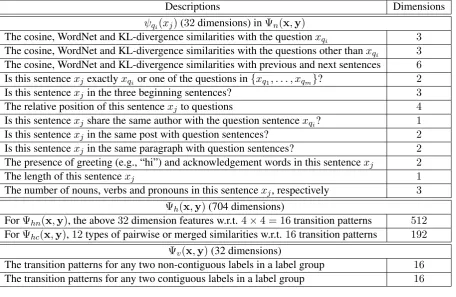
Descriptions Dimensions ψqi(xj)(32dimensions) inΨn(x,y)
The cosine, WordNet and KL-divergence similarities with the questionxqi 3
The cosine, WordNet and KL-divergence similarities with the questions other thanxqi 3
The cosine, WordNet and KL-divergence similarities with previous and next sentences 6 Is this sentencexj exactlyxqi or one of the questions in{xq1, . . . , xqm}? 2
Is this sentencexj in the three beginning sentences? 3
The relative position of this sentencexj to questions 4
Is this sentencexj share the same author with the question sentencexqi? 1
Is this sentencexj in the same post with question sentences? 2
Is this sentencexj in the same paragraph with question sentences? 2
The presence of greeting (e.g., “hi”) and acknowledgement words in this sentencexj 2
The length of this sentencexj 1
The number of nouns, verbs and pronouns in this sentencexj, respectively 3
Ψh(x,y)(704 dimensions)
ForΨhn(x,y), the above32dimension features w.r.t. 4×4 = 16transition patterns 512
ForΨhc(x,y),12types of pairwise or merged similarities w.r.t.16transition patterns 192
Ψv(x,y)(32 dimensions)
[image:5.595.74.531.63.360.2]The transition patterns for any two non-contiguous labels in a label group 16 The transition patterns for any two contiguous labels in a label group 16
Table 1: Feature descriptions and demisions
Ψhc(x,y) = m X
i=1 X
j∈C
X
k∈A
| {z } Complete Edges
ψhc(xj, xk, yij, yik),
ψhn(xj, xj+1, yij, yi,j+1)
= Λ(yij, yi,j+1)⊗φhn(xj, xj+1, yij, yi,j+1),
ψhc(xj, xk, yij, yik)
= Λ(yij, yik)⊗ψhc(xj, xk, yij, yik)
whereΛ(yij, yik)is a16-dimensional vector. It
in-dicates all4×4pairwise transition patterns of four types of labels, the context, answer, question and plain. Note that apart from previous work (Ding et al., 2008) we usecomplete skip-chain (context-answer) edgesinΨhc(x,y).
The label group feature mappingΨv(x,y)is
defined as follows,
Ψv(x,y) = n X
j=1
ψv(xj,y.j),
where ψv(xj,y.j) encodes each label group
pat-tern into a vector.
The detail descriptions and vector dimensions of the used features are listed in Table 1.
4 Structural SVMs and Inference
Given a training set S = {(x(i),y(i)) ∈ X ×
Y : i = 1, . . . , N}, we use the structural SVMs (Taskar et al., 2003; Tsochantaridis et al., 2005; Joachims et al., 2009) formulation, as shown in Optimization Problem 1 (OP1), to learn a weight vectorw.
OP 1 (1-Slack Structural SVM)
min
w,ξ≥0
1
2||w||2+ C Nξ
s.t. ∀(¯y(1), . . . ,¯y(N))∈ Yn, 1
NwT
N X
i=1
[Ψ(x(i),y(i))−Ψ(x(i),¯y(i))]
≥ N1
N X
i=1
∆(y(i),¯y(i))−ξ,
{C , P } {C , P } {C , P } {Q } {P } {A, P } {A, P }
(a) Original graph
{P P P , P P C , P C P , P C C , C P P , C P C , C C P , C C C }
{Q } {P } {A, P } {A, P }
(b) Transformed graph
{P P P }
{Q } {P } {A, P } {A, P }
{C C C }
{Q } {P } {A, P } {A, P }
....
[image:6.595.75.292.190.327.2](c) Decomposed graph
Figure 3: The equivalent transform of graphs
Algorithm 1Exact Inference Algorithm
1: Input:(Ci,Ai)for eachqi,w,x,y
2: fori∈ {1, . . . , m}do 3: forCs⊆ Cido
4: [R(Cs),¯yi.(Cs)]←Viterbi(w,x;Cs)
5: end for
6: Cs∗ = arg maxCs⊆CiR(Cs) 7: ¯y∗i.=¯yi.(Cs∗)
8: end for 9: return¯y∗
structural SVMs, please refer to (Tsochantaridis et al., 2005; Joachims et al., 2009).
The most essential and time-consuming step in structural SVMs is finding the most violated con-straint, which is equivalent to solve
arg max
y∈Y w
TΨ(x(i),y) + ∆(y(i),y). (2)
Without the ability to efficiently find the most vio-lated constraint, the cutting plane algorithm is not tractable.
In the next sub-sections, we introduce the al-gorithms for finding the most violated constraint, also called loss-augmented inference. The algo-rithms are essential for the success of customizing structural SVMs to our problem.
4.1 Exact Inference
The exact inference algorithm is designed for a simplified model with two sub-mappings Ψn and
Ψh, exceptΨv.
One naive approach to finding the most violated constraint for the simplified model is to enumer-ate all the2|C|+|A| cases for each row of the label matrix. However, it would be intractable for large candidate sets.
An important property is that the context can-didate set is usually much smaller than the whole number of sentences in a thread. This property en-ables us to design efficient and exact inference al-gorithm by transforming from the original graph
representation in Figure 2 to the graphs in Fig-ure 3. This graph transform merges all the nodes in the context candidate setCto one node with2|C| possible labels.
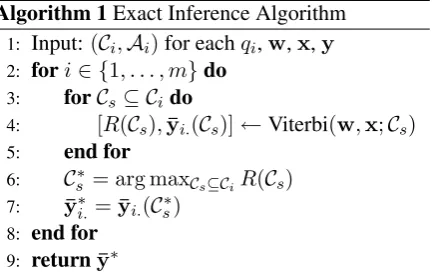
We design an exact inference algorithm in Algo-rithm 1 based on the graph in Figure 3(c). The al-gorithm can be summarized in three steps: (1) enu-merate all the2|C| possible labels1for the merged
node (line 3). (2) For each given label of the merged node, perform the Viterbi algorithm (Ra-biner, 1989) on the decomposed graph (line 4) and store the Viterbi algorithm outputs in R and ˆyi..
(3) From the2|C| Viterbi algorithm outputs, select the one with highest score as the output (lines 6 and 7).
The use of the Viterbi algorithm is assured by the fact that there exists certain equivalence be-tween the decomposed graph (Figure 3(c)) and a linear chain. By fixing the the label of the merged node, we could remove the dashed edges in the decomposed graph and regard the rest graph as a linear chain, which results in the Viterbi decoding.
4.2 Approximate Inference
The exact inference cannot handle the complete model with three sub-mappings, Ψn, Ψh, and
Ψv, since the label group defeats the graph
trans-form in Figure 3. Thus, we design two ap-proximate algorithms by employing undergener-atingandovergeneratingapproaches (Finley and Joachims, 2008).
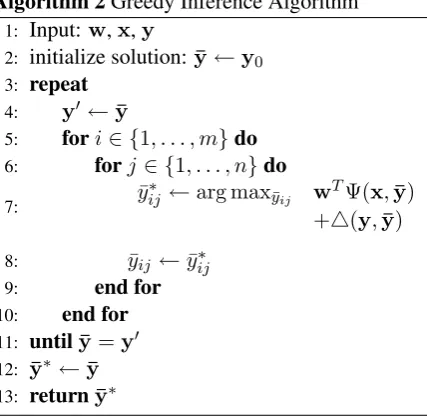
First, we develop an undergenerating local greedy search algorithm shown in Algorithm 2. In the algorithm, there are two loops, inner and outer loops. The outer loop terminates when no labels change (steps 3-11). The inner loop enumerates the whole label matrix and greedily determines each label (step 7) by maximizing the Equation (2). Since the whole algorithm terminates only if
1Since the merged node is from context candidate setC, enumerating its label is equivalent to enumerating subsetsCs
Algorithm 2Greedy Inference Algorithm
1: Input:w,x,y
2: initialize solution:¯y←y0
3: repeat 4: y0 ←¯y
5: fori∈ {1, . . . , m}do
6: forj∈ {1, . . . , n}do
7: y¯ij∗ ←arg maxy¯ij wTΨ(x,¯y)
+4(y,¯y) 8: y¯ij ←y¯ij∗
9: end for 10: end for
11: until¯y=y0 12: ¯y∗ ←¯y 13: return¯y∗
the label matrix does not change during the last outer loop. This indicates that at least a local opti-mal solution is obtained.
Second, an overgenerating method can be designed by using linear programming relax-ation (Finley and Joachims, 2008). To save the space, we skip the details of this algorithm here. 5 Loss Functions
Structural SVMs allow users to customize the loss function4: Y × Y → R according to different system requirements. In this section, we introduce the loss functions used in our work.
Basic loss function.The simplest way to quan-tify the prediction quality is counting the number of wrongly predicted labels. Formally,
4b(y,¯y) =
m X
i=1 n X
j=1
I[yij 6= ¯yij], (3)
whereI[.]is an indicative function that equals to one if the condition holds and zero otherwise.
Recall-vs-precision loss function. In practice, we may place different emphasis on recall and pre-cision according to application settings. We could include this preference into the model by defining the following loss function,
4p(y,y¯) =
m X
i=1 n X
j=1
I[yij 6=P,y¯ij =P]·cr
+I[yij =P,y¯ij 6=P]·cp. (4)
This function penalizes the wrong prediction de-creasing recall and that dede-creasing precision with
Items in the data set #items
Thread 515
Post 2,035
[image:7.595.341.492.61.181.2]Sentence 8,500 questionannotation 1,407 contextannotation 1,962 answerannotation 4,652 plainannotation 18,198
Table 2: The data statistics
two weights cr andcp respectively. Specifically,
we denote the loss function with cp/cr = 2 and
that withcr/cp = 2by4pp and4rp, respectively.
Various types of loss function can be defined in a similar fashion. To save the space, we skip the definitions of other loss functions and only use the above two types of loss functions to show the flex-ibility of our approach.
6 Experiments
6.1 Experimental Setup
Corpus. We made use of the same data set as introduced in (Cong et al., 2008; Ding et al., 2008). Specifically, the data set includes about 591 threads from the forum TripAdvisor2. Each
sentence in the threads is tagged with the labels ‘question’, ‘context’, ‘answer’, or ‘plain’ by two annotators. We removed 76 threads that have no question sentences or more than40sentences and 6 questions. The remaining 515 forum threads form our data set.
Table 2 gives the statistics on the data set. On average, each thread contains3.95posts and2.73 questions, and each question has1.39context sen-tences and 3.31 answer sentences. Note that the number of annotations is much larger than the number of sentences because one sentence can be annotated with multiple labels.
Experimental Details. In all the experiments, we made use of linear models for the sake of com-putational efficiency. As a preprocessing step, we normalized the value of each feature value into the interval [0,1]and then followed the heuristic used in SVM-light (Joachims, 1998) to set C to 1/||x||2, where||x||is the average length of input
samples (in our case, sentences). The tolerance pa-rameter²was set to0.1(the value also used in (Cai
2TripAdvisor (http://www.tripadvisor.com/
[image:7.595.76.290.69.277.2]and Hofmann, 2004)) in all the runs of the experi-ments.
Evaluation. We calculated the standard preci-sion (P), recall (R) and F1-score (F1) for both tasks
(context extraction and answer extraction). All the experimental results were obtained through5-fold cross validation.
6.2 Baseline Methods
We employed binary SVMs (B-SVM), multiclass SVMs (M-SVM), and C4.5 (Quinlan, 1993) as our baseline methods:
B-SVM.We trained two binary SVMs for con-text extraction (concon-text vs. non-concon-text) and an-swer extraction (anan-swer vs. non-anan-swer), respec-tively. We used the feature mapping φqi(xj)
de-fined in Equation (1) while training the binary SVM models.
M-SVM. We extended the binary SVMs by training multiclass SVMs for three category labels (context,answer,plain).
C4.5. This decision tree algorithm solved the same classification problem as binary SVMs and made use of the same set of features.
6.3 Modeling Sentence Relations and Question Interactions
We demonstrate in Table 3 that our approach can make use of the three types of relation among sen-tences well to boost the performance.
In Table 3, S-SVM represents the structural SVMs only using the node featuresΨn(x,y). The
suffixes H, C, and V denote the models using horizontal sequential edges, complete skip-chain edgesandvertical label groups, respectively. The suffixes C* and V* denote the models using in-complete skip-chain edgesandvertical sequential edges proposed in (Ding et al., 2008), as shown in Figures 2(a) and 2(c). All the structural SVMs were trained using basic loss function∆bin
Equa-tion (3). From Table 3, we can observe the follow-ing advantages of our approaches.
Overall improvement.Our structural approach steadily improves the extraction as more types of relation (corresponding to more types of edge) are included. The best results obtained by using the three types of relation together improve the base-line methods binary SVMs by about6%and20% in terms of F1 values for context extraction and
answer extraction, respectively.
The usefulness of relations. The relations encoded by horizontal sequential edges and
la-Method 4b P(%) R(%) F1(%)
Context Extraction
C4.5 − 74.2 68.7 71.2 B-SVM − 78.3 72.2 74.9 M-SVM − 68.0 77.6 72.1 S-SVM 8.86 75.6 71.7 73.4 S-SVM-H 8.60 77.5 75.5 76.3 S-SVM-HC* 8.65 77.9 74.1 75.8 S-SVM-HC 8.62 77.5 75.2 76.2 S-SVM-HCV* 8.08 79.5 79.6 79.5 S-SVM-HCV 7.98 79.7 80.2 79.9
Answer Extraction
[image:8.595.307.532.61.355.2]C4.5 − 61.3 45.2 51.8 B-SVM − 69.7 42.0 51.8 M-SVM − 63.2 51.5 55.8 S-SVM 8.86 67.0 48.0 55.6 S-SVM-H 8.60 66.9 49.7 56.7 S-SVM-HC* 8.65 66.5 49.4 56.4 S-SVM-HC 8.62 65.7 51.5 57.4 S-SVM-HCV* 8.08 65.5 58.7 61.7 S-SVM-HCV 7.98 65.1 61.2 63.0
Table 3: The effectiveness of our approach
bel groups are useful for both context extraction and answer extraction. The relation encoded by complete skip-chain edges is useful for answer extraction. The complete skip-chain edges not only avoid preprocessing but also boost the per-formance when compared with the preprocessed skip-chain edges. The label groups improve the vertical sequential edges.
Interactions among questions. The interac-tions encoded by label groups are especially use-ful. We conducted significance tests (sign test) on the experimental results. The test result shows that S-SVM-HCV outperforms all the other methods without vertical edges statistically significantly (p-value< 0.01). Our proposed graphical represen-tation in Figure 2(d) eases us to model the complex interactions. In comparison, the2D model in Fig-ure 2(c) used in previous work (Ding et al., 2008) can only model the interaction between adjacent questions.
6.4 Loss Function Results
We report in Table 4 the comparison between structural SVMs using different loss functions. Note that∆pp prefers precision and∆rpprefers
Method P (%) R (%) F1(%)
Context Extraction
S-SVM-HCV-4b 79.7 80.2 79.9
S-SVM-HCV-4pp 82.0 70.3 75.6
S-SVM-HCV-4r
p 75.7 84.2 79.7
Answer Extraction
S-SVM-HCV-4b 65.1 61.2 63.0
S-SVM-HCV-4pp 71.8 52.2 60.2
S-SVM-HCV-4r
[image:9.595.78.287.61.195.2]p 61.8 66.1 63.7
Table 4: The use of different loss functions
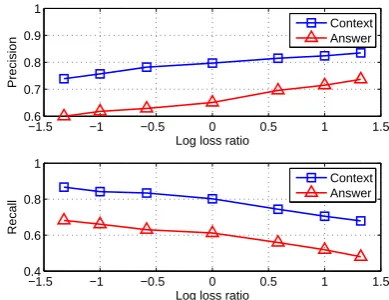
preference. Moreover, we further demonstrate the capability of the loss function∆pin Figure 4. The
curves are achieved by varying the ratio between two parameterscp/crin Equation (4). The curves
confirm our intuition: when log(cp/cr) becomes
larger, the precisions increase but the recalls de-crease and vice versa.
7 Related work
Previous work on extracting questions, answers and contexts is most related with our work. Cong et al. (2008) proposed a supervised approach for question detection and an unsupervised approach for answer detection without considering contexts. Ding et al. (2008) used CRFs to detect contexts and answers of questions from forum threads.
Some researches on summarizing discussion threads and emails are related to our work, too. Zhou and Hovy (2005) segmented internet re-lay chat, clustered segments into sub-topics, and identified responding segments of the first ment in each sub-topic by assuming the first seg-ment to be focus. In (Nenkova and Bagga, 2003; Wan and McKeown, 2004; Rambow et al., 2004), email summaries were organized by extracting overview sentences as discussion issues. The work (Shrestha and McKeown, 2004) used RIP-PER as a classifier to detect interrogative questions and their answers then used the resulting question and answer pairs as summaries. We also note the existing work on extracting knowledge from dis-cussion threads. Huang et al. (2007) used SVMs to extract input-reply pairs from forums for chat-bot knowledge. Feng et al. (2006) implemented a discussion-bot which used cosine similarity to match students’ query with reply posts from an an-notated corpus of archived threaded discussions.
Moreover, extensive researches have been done within the area of question answering (Burger et
−1.5 −1 −0.5 0 0.5 1 1.5 0.6
0.7 0.8 0.9 1
Log loss ratio
Precision
Context Answer
−1.5 −1 −0.5 0 0.5 1 1.5 0.4
0.6 0.8 1
Log loss ratio
Recall
Context Answer
Figure 4: Balancing between precision and recall
al., 2006; Jeon et al., 2005; Harabagiu and Hickl, 2006; Cui et al., 2005; Dang et al., 2006). They mainly focused on using sophisticated linguistic analysis to construct answer from a large docu-ment collection.
8 Conclusion and Future Work
We have proposed a new form of graphical rep-resentation for modeling the problem of extract-ing contexts and answers of questions from online forums and then customized structural SVM ap-proach to solve it.
The proposed graphical representation is able to naturally express three types of relation among sentences: relation between successive sentences, relation between context sentences and answer sentences, and relation between multiple labels for one sentence. The representation also enables us to address interactions among questions. We also developed the inference algorithms for the tural SVM model by exploiting the special struc-ture of thread discussions.
Experimental results on a real data set show that our approach significantly improves the baseline methods by effectively utilizing various types of relation among sentences.
Our future work includes: (a) to summa-rize threads and represent the forum threads in question-context-answer triple, which will change the organization of online forums; and (b) to en-hance QA services (e.g., Yahoo! Answers) by the contents extracted from online forums.
Acknowledgement
[image:9.595.314.509.71.221.2]References
John Burger, Claire Cardie, Vinay Chaudhri, Robert Gaizauskas, Sanda Harabagiu, David Israel, Chris-tian Jacquemin, Chin-Yew Lin, Steve Maiorano, George Miller, Dan Moldovan, Bill Ogden, John Prager, Ellen Riloff, Amit Singhal, Rohini Shrihari, Tomek Strzalkowski, Ellen Voorhees, and Ralph Weishedel. 2006. Issues, tasks and program struc-tures to roadmap research in question and answering (qna).ARAD: Advanced Research and Development Activity (US).
Lijuan Cai and Thomas Hofmann. 2004. Hierarchi-cal document categorization with support vector ma-chines. InProceedings of CIKM, pages 78–87.
Gao Cong, Long Wang, Chin-Yew Lin, and Young-In Song. 2008. Finding question-answer pairs from online forums. InProceedings of SIGIR, pages 467– 474.
Hang Cui, Renxu Sun, Keya Li, Min-Yen Kan, and Tat-Seng Chua. 2005. Question answering passage re-trieval using dependency relations. InProceedings of SIGIR, pages 400–407.
Hoa Dang, Jimmy Lin, and Diane Kelly. 2006. Overview of the trec 2006 question answering track. InProceedings of TREC, pages 99–116.
Shilin Ding, Gao Cong, Chin-Yew Lin, and Xiaoyan Zhu. 2008. Using conditional random field to ex-tract contexts and answers of questions from online forums. InProceedings of ACL, pages 710–718.
Donghui Feng, Erin Shaw, Jihie Kim, and Eduard H. Hovy. 2006. An intelligent discussion-bot for an-swering student queries in threaded discussions. In
Proceedings of IUI, pages 171–177.
Thomas Finley and Thorsten Joachims. 2008. Training structural SVMs when exact inference is intractable. InProceedings of ICML, pages 304–311.
Michel Galley. 2006. A skip-chain conditional random field for ranking meeting utterances by importance. InProceedings of the 2006 Conference on Empiri-cal Methods in Natural Language Processing, pages 364–372.
Sanda M. Harabagiu and Andrew Hickl. 2006. Meth-ods for using textual entailment in open-domain question answering. InProceedings of ACL, pages 905–912.
Jizhou Huang, Ming Zhou, and Dan Yang. 2007. Ex-tracting chatbot knowledge from online discussion forums. InProceedings of IJCAI, pages 423–428.
Jiwoon Jeon, W. Bruce Croft, and Joon Ho Lee. 2005. Finding similar questions in large question and an-swer archives. InProceedings of CIKM, pages 84– 90.
Thorsten Joachims, Thomas Finley, and Chun-Nam Yu. 2009. Cutting-plane training of structural SVMs.
Machine Learning.
Thorsten Joachims. 1998. Text categorization with support vector machines: Learning with many rele-vant features. InProceedings of ECML, pages 137– 142.
John Lafferty, Andrew McCallum, and Fernando Pereira. 2001. Conditional random fields: Prob-abilistic models for segmenting and labeling se-quence data. In Proceedings of ICML, pages 282– 289.
Ani Nenkova and Amit Bagga. 2003. Facilitating email thread access by extractive summary genera-tion. InProceedings of RANLP, pages 287–296. Nam Nguyen and Yunsong Guo. 2007. Comparisons
of sequence labeling algorithms and extensions. In
Proceedings of ICML, pages 681–688.
John Quinlan. 1993. C4.5: programs for machine learning. Morgan Kaufmann Publisher Incorpora-tion.
Lawrence Rabiner. 1989. A tutorial on hidden markov models and selected applications in speech recogni-tion. InProceedings of IEEE, pages 257–286. Owen Rambow, Lokesh Shrestha, John Chen, and
Chirsty Lauridsen. 2004. Summarizing email threads. InProceedings of HLT-NAACL, pages 105– 108.
Lokesh Shrestha and Kathleen McKeown. 2004. De-tection of question-answer pairs in email conversa-tions. InProceedings of COLING, pages 889–895. Charles Sutton and Andrew McCallum. 2004.
Collec-tive segmentation and labeling of distant entities in information extraction. Technical Report 04-49. Benjamin Taskar, Carlos Guestrin, and Daphne Koller.
2003. Max-margin markov networks. InAdvances in Neural Information Processing Systems 16. MIT Press.
Ioannis Tsochantaridis, Thorsten Joachims, Thomas Hofmann, and Yasemin Altun. 2005. Large margin methods for structured and interdependent output variables. Journal of Machine Learning Research, 6:1453–1484.
Stephen Wan and Kathy McKeown. 2004. Generating overview summaries of ongoing email thread discus-sions. InProceedings of COLING, pages 549–555. Liang Zhou and Eduard Hovy. 2005. Digesting
vir-tual ”geek” culture: The summarization of technical internet relay chats. In Proceedings of ACL, pages 298–305.