Towards Conversation Entailment: An Empirical Investigation
Chen Zhang Joyce Y. Chai
Department of Computer Science and Engineering Michigan State University
East Lansing, MI 48824, USA
{zhangch6, jchai}@cse.msu.edu
Abstract
While a significant amount of research has been devoted to textual entailment, automated entailment from conversational scripts has re-ceived less attention. To address this limi-tation, this paper investigates the problem of conversation entailment: automated inference of hypotheses from conversation scripts. We examine two levels of semantic representa-tions: a basic representation based on syntac-tic parsing from conversation utterances and an augmented representation taking into con-sideration of conversation structures. For each of these levels, we further explore two ways of capturing long distance relations between lan-guage constituents: implicit modeling based on the length of distance and explicit mod-eling based on actual patterns of relations. Our empirical findings have shown that the augmented representation with conversation structures is important, which achieves the best performance when combined with ex-plicit modeling of long distance relations.
1 Introduction
Textual entailment has received increasing attention in recent years (Dagan et al., 2005; Bar-Haim et al., 2006; Giampiccolo et al., 2007; Giampiccolo et al., 2008; Bentivogli et al., 2009). Given a segment from a textual document, the task of textual entailment is to automatically determine whether a given hypoth-esis can be entailed from the segment. The capa-bility of such kind of inference can benefit many text-based applications such as information extrac-tion and quesextrac-tion answering.
Textual entailment has mainly focused on infer-ence from written text in monologue. Recent years also observed an increasing amount of conversa-tional data such as conversation scripts of meetings, call center records, court proceedings, as well as on-line chatting. Although conversation is a form of language, it is different from monologue text with several unique characteristics. The key distinctive features include turn-taking between participants, grounding between participants, different linguistic phenomena of utterances, and conversation impli-catures. Traditional approaches dealing with tex-tual entailment were not designed to handle these unique conversation behaviors and thus to support automated entailment from conversation scripts.
Example 1:
Conversation Segment:
B: My mother also was very very independent. She had her own, still had her own little house and still driving her own car,
A: Yeah.
B: at age eighty-three.
Hypothesis:
(1) B’s mother is eighty-three. (2) B is eighty-three.
To address this limitation, our previous work (Zhang and Chai, 2009) has initiated an investigation on the problem of conversation en-tailment. The problem was formulated as follows: given a conversation discourseD and a hypothesis
Hconcerning its participant, the goal was to identify whether D entails H. For instance, as in Example 1, the first hypothesis can be entailed from the
conversation segment while the second hypothesis cannot. While our previous work has provided some interesting preliminary observations, it mostly focused on data collection and initial experiments and analysis using a small set of development data. It is not clear whether the previous results are generally applicable, how different components in the entailment framework interact with each other, and how different representations may influence the entailment outcome.
To reach a better understanding of conversation entailment, we conducted a further investigation based on the larger set of test data collected in our previous work (Zhang and Chai, 2009). We specifi-cally examined two levels of representations: a basic representation based on syntactic parsing from con-versation utterances and an augmented representa-tion taking into considerarepresenta-tion of conversarepresenta-tion struc-tures. For each of these levels, we further explored two ways of capturing long distance relations: (1) implicit modeling based on the length of distance and (2) explicit modeling based on actual patterns of relations. Our empirical findings have shown that augmented representation with conversation struc-tures is important in conversation entailment. Com-bining conversation structures with explicit model-ing of long distance relations results in the best per-formance.
2 Related Work
Our work here is related to recent advances in tex-tual entailment, automated processing of conversa-tion scripts, and our initial investigaconversa-tion on conver-sation entailment.
There is a large body of work on textual en-tailment initiated by the Pascal Recognizing Tex-tual Entailment (RTE) Challenges (Dagan et al., 2005; Bar-Haim et al., 2006; Giampiccolo et al., 2007; Giampiccolo et al., 2008; Bentivogli et al., 2009). Different approaches have been developed, for example, based on logic proving (Tatu and Moldovan, 2005; Bos and Markert, 2005; Raina et al., 2005) and graph match (Haghighi et al., 2005; de Salvo Braz et al., 2005; MacCartney et al., 2006). Supervised learning approaches have also been ap-plied to measure the similarities between training and testing pairs (Zanzotto and Moschitti, 2006). In
the most recent RTE Challenge (Bentivogli et al., 2009), the best system achieves 73.5% of accuracy, while the median performance among all partici-pants is 60.4%. These results indicate that, while progress has been made, textual entailment remains a challenging problem.
As more and more conversation data becomes available, researchers have investigated automated processing of conversation data to acquire useful information, for example, related to opinions (So-masundaran et al., 2007; So(So-masundaran et al., 2008; Somasundaran et al., 2009), biographic at-tributes (Garera and Yarowsky, 2009), social net-works (Jing et al., 2007), and agreements and disagreements between participants (Galley et al., 2004). Recent studies have also developed ap-proaches to summarize conversations (Murray and Carenini, 2008) and to model conversation struc-tures (dialogue acts) from online Twitter conversa-tions (Ritter et al., 2010). Here we address a dif-ferent angle regarding conversation scripts, namely conversation entailment.
In our previous work (Zhang and Chai, 2009), we started an initial investigation on conversation entailment. We have collected a dataset of 875 instances. Each instance consists of a conversa-tion segment and a hypothesis (as described in Sec-tion 1). The hypotheses are statements about conver-sation participants and are further categorized into four types: about their profile information, their be-liefs and opinions, their desires, and their commu-nicative intentions. We developed an approach that is motivated by previous work on textual entailment. We use clauses in the logic-based approaches as the underlying representation of our system. Based on this representation, we apply a two stage entailment process similar to MacCartney et al. (2006) devel-oped for textual entailment: an alignment stage fol-lowed by an entailment stage.
potential solutions.
3 Overall Framework
In our previous work (Zhang and Chai, 2009), con-versation entailment is formulated as the follow-ing: given a conversation segmentD which is rep-resented by a set of clauses D = d1 ∧. . .∧ dm,
and a hypothesis H represented by another set of clauses H = h1 ∧ . . . ∧ hn, the prediction on
whetherD entailsH is determined by the product of probabilities that each hypothesis clause hj is
entailed from all the conversation segment clauses
d1. . . dm as follows. This is based on a simple
as-sumption that whether a clause is entailed from a conversation segment is conditionally independent from other clauses.
P(DH|D, H)
=P(Dh1, . . . , Dhn|D, h1, . . . , hn) =
n
Y
j=1
P(Dhj|D=d1. . . dm, hj)
= n
Y
j=1
P(d1. . . dm hj|d1, . . . , dm, hj) (1)
A clause here is similar to a sentence in first-order predicate calculus. It is made up by terms
and predicates. A term is either: 1) an entity described by a noun phrase, e.g., John Lennon,
mother, or she; or 2) an action or event de-scribed by a verb phrase, e.g., marry in “John married Eva in 1940”. A predicate represents either: 1) a property (i.e., unary) for a term, e.g., Russian(company), or recently(visit); or 2) a relation (i.e., binary) between two terms, e.g., subj(visit, P rime M inister) and
obj(visit, Brazil)in “Prime Minister recently vis-ited Brazil”.
Given the clause representation, we follow the idea similar to MacCartney et al. (2006), and predict the entailment decision in two stages of processing: (1) an alignment model aligns terms in the hypothe-sis to terms in the conversation segment; and (2) an inference model predicts the entailment based on the alignment between the hypothesis and the conversa-tion segment.
3.1 Alignment Model
An alignment is defined as a mapping function g
between a termxin the conversation segment and a termyin the hypothesis. g(x, y) = 1ifxandyare aligned; otherwiseg(x, y) = 0. It is possible that multiple terms from the segment are mapped to one term in the hypothesis (g(x1, y) = g(x2, y) = 1), or vice versa (g(x, y1) =g(x, y2) = 1). To predict these alignments, the problem is formulated as bi-nary classification: given any two termsxfrom the conversation andyfrom the hypothesis, decide the value of their alignment functiong(x, y).
3.2 Inference Model
Once an alignment between a hypothesis and a con-versation segment is established, an inference model is applied to predict whether the conversation seg-ment entails the hypothesis given such alignseg-ment. More specifically, as shown in Equation 1, given a clause from the hypothesishj, a set of clauses from
the conversation segmentd1, . . . , dm, and an
align-mentgbetween them, the goal is to predict whether
d1, . . . , dmentailshjunder the alignmentg.
The prediction is treated differently according to different types of clauses. Ifhj is a property clause
(i.e., takes one argumenthj(·)), a property inference
model is applied; otherwise (i.e., relational clauses with two argumentshj(·,·)), a relational inference
model is applied.
In this paper we follow the same framework. However our focus here is on the new question that how different levels of semantic representation and different approaches of modeling long distance rela-tionship affect the alignment and inference models as well as the overall entailment performance.
4 Semantic Representation
acts). Next we use Example 2 to illustrate these rep-resentations.
Example 2:
Conversation Segment:
B: Have you seenSleeping with the Enemy? A: No. I’ve heard that’s really great, though. B: You have to go see that one.
Hypothesis:
B suggests A to watchSleeping with the Enemy.
4.1 Basic Representation
The first representation is based on the syntactic parsing from conversation utterances and we call it abasicrepresentation. Figure 1(a) shows an exam-ple of dependency structures for several utterances that are derived from the Stanford parser (Klein and Manning, 2003), and Figure 1(b) shows the corre-sponding clause representation. In the dependency structure, the vertices represent entities (e.g.,x1) and actions (e.g., x3) within an utterance. They corre-spond to terms in the clause representation. An edge between vertices captures a dependency relation and is represented as predicates in the clause representa-tion. For example, the edge betweenx1andx3 indi-catesx1is the subject ofx3, which is represented by the clause representationsubj(x3, x1). Similar rep-resentation also applies to the hypothesis as shown in Figure 1(c), 1(d).
4.2 Augmented Representation
The second representation is built upon the basic representation and incorporates conversation struc-ture across turns and utterances. We call it an aug-mented representation. Figure 2(a) shows the aug-mented structures of the conversation segment and Figure 2(b) shows the corresponding clause repre-sentation. Compared to the basic representation, there are two additional types of vertices (i.e., terms) highlighted in the figures:
• Vertices representing utterances (e.g.,
u1. . . u4). Their corresponding terms capture the dialogue acts for the utterances (e.g.
u1 = yes no question). To focus our effort, currently we only apply annotated dialogue acts provided in the Switchboard corpus (God-frey and Holliman, 1997). Two edges are
added to connect different utterances. The first edge connects each utterance vertex to the head of the corresponding utterance to indicate the specific content of the utterance (e.g.,content(u1, x3)). The second edge con-nects an utterance to its succeeding utterance to indicate the temporal progression of the conversation (e.g.,f ollow(u2, u1)).
• Vertices representing speakers or participants (e.g., sA, sB). One edge is added to
connect each utterance to its speaker (e.g.,
speaker(u1, sB)).
Note that since our clause representations are mainly based on the dependency relations, they are mostly syntactic-driven. However, it does capture some shallow semantics such as who is the agent (i.e., subject) or the patient (i.e., object) of an event. The incorporation of speakers and dialogue acts in our augmented representations provides additional semantics of conversation discourse.
5 Modeling LDR
A critical part in predicting entailment is to recog-nize the semantic relationship between two language constituents, especially when these two constituents are not directly related. In Figure 2(a), for exam-ple, we want to recognize thatx9 (You) is the (log-ical) subject of x11 (see). Here we experimented two ways of modeling such long distance relations (LDR).
5.1 Implicit Modeling of LDR
The first method characterizes the relationship sim-ply by the distance between two constituents in the dependency structure (or augmented structure). For example, in Figure 2(a) the distance between x11 andx9 is 3. We call this method an implicit mod-eling of long distance relationship.
The advantage of implicit modeling is that it is easy to implement based on the dependency struc-ture. However, its limitation is that the distance mea-sure does not capture sufficient information of se-mantic relations between language constituents.
5.2 Explicit Modeling of LDR
B: Have you seen Sleeping with the Enemy?
A: No. I've heard that's really great, though.
B: You have to go see that one.
x9
x13
x12
x11
x10
x4 x1
x3 x2 x5 x8 x6 x7
obj(x3,x2)
subj(x3,x1)
aux(x3,x4)
x1=A
x2=Sleeping with the Enemy x3=seen, x4=have
obj(x11,x10)
obj(x12,x11)
obj(x13,x12)
subj(x13,x9) x9=A, x10=one,
x11=see, x12=go,
x13=have
subj(x7,x6)
obj(x8,x7)
subj(x8,x5) x5=A, x6=that
x7=is really great
x8=have heard
Clauses Terms
(a) dependency structure of the conversation utterances
B: Have you seen Sleeping with the Enemy?
A: No. I've heard that's really great, though.
B: You have to go see that one.
x9 x13
x12 x11
x10
x4 x1
x3 x2 x5 x8 x6 x7
obj(x3,x2) subj(x3,x1)
aux(x3,x4)
x1=A
x2=Sleeping with the Enemy x3=seen, x4=have
obj(x11,x10) obj(x12,x11) obj(x13,x12)
subj(x13,x9)
x9=A, x10=one, x11=see, x12=go, x13=have
subj(x7,x6) obj(x8,x7)
subj(x8,x5) x5=A, x6=that
x7=is really great
x8=have heard
Clauses Terms
(b) basic representation of the conver-sation segment x1 x2 x5 x4 x3
B suggests A to watch Sleeping with the Enemy.
subj
subj
obj
obj B: Have you seen Sleeping with the Enemy?
A: No. I've heard that's really great, though.
B: You have to go see that one.
x9
x13
x12
x11
x10
x4 x1
x3 x2 x5 x8 x6 x7 u1 u2 u3 u4 sB sA
(c) dependency structure of the hypothesis
obj(x3,x2), subj(x3,x1)
aux(x3,x4)
x1=A, x3=seen, x4=have
x2=Sleeping with the Enemy
obj(x11,x10), obj(x12,x11) obj(x13,x12), subj(x13,x9) x9=A, x10=one, x11=see
x12=go, x13=have
speaker(u4,sB) content(u4,x13)
follow(u4,u3) u4=viewpoint
subj(x7,x6), obj(x8,x7) subj(x8,x5)
x5=A, x7=is really great x6=that, x8=have heard
speaker(u3,sA) content(u3.x8)
follow(u3,u2) u3=statement
speaker(u2,sA) follow(u2,u1) u2=no_answer
speaker(u1,sB) content(u1, x3) sA, sB
u1=yes_no_question
Clauses Terms
subj(x4,x2) obj(x4,x3) subj(x5,x1) obj(x5,x4)
x1=B, x2=A x3=Sleeping with the Enemy
x4=watch x5=suggests
Clauses Terms
[image:5.612.158.454.61.340.2](d) representation of the hy-pothesis
Figure 1: The dependency structures and corresponding basic representation of Example 2
x1
x2
x5
x4
x3
B suggests A to watch Sleeping with the Enemy.
subj
subj
obj
obj B: Have you seen Sleeping with the Enemy?
A: No. I've heard that's really great, though.
B: You have to go see that one.
x9 x13
x12 x11
x10 x4 x1
x3 x2 x5 x8 x6 x7 u1 u2 u3 u4 sB sA
(a) dependency and conversation structures of the conversation segment
obj(x3,x2), subj(x3,x1)
aux(x3,x4)
x1=A, x3=seen, x4=have
x2=Sleeping with the Enemy
obj(x11,x10), obj(x12,x11)
obj(x13,x12), subj(x13,x9)
x9=A, x10=one, x11=see
x12=go, x13=have
speaker(u4,sB) content(u4,x13)
follow(u4,u3)
u4=viewpoint
subj(x7,x6), obj(x8,x7) subj(x8,x5)
x5=A, x7=is really great x6=that, x8=have heard
speaker(u3,sA) content(u3.x8)
follow(u3,u2)
u3=statement
speaker(u2,sA) follow(u2,u1)
u2=no_answer
speaker(u1,sB) content(u1, x3)
sA, sB
u1=yes_no_question
Clauses Terms
subj(x4,x2)
obj(x4,x3)
subj(x5,x1)
obj(x5,x4)
x1=B, x2=A
x3=Sleeping
with the Enemy
x4=watch x5=suggests
Clauses Terms
(b) augmented representation of the conversation seg-ment
[image:5.612.98.520.430.651.2]describe the path from one constituent to the other:
v1e1. . . vl−1el−1vl, wherev1, . . . , vlare the vertices
on the path ande1, . . . , el−1 are the edges. Eachvi
describes the type of the vertex in the dependency structure, which is either a noun (N), a verb (V), or an utterance (U). Eachei describes whether the
edge is forward (→) or backward (←). For ex-ample, in Figure 2(a), the path from x11 to x9 is V →V →V ←N.
This kind of string representation of paths in syn-tactic parse is known as a way of modeling “shal-low semantics” between any two constituents in a language structure. It is largely used in other NLP tasks such as semantic role labeling (Pradhan et al., 2008). The difference here is our paths are extracted from dependency parses as opposed to traditional constituent parses, and our paths also incorporate the representation of conversation structures (e.g., utter-ances and speakers).
6 Applications in Entailment Models
In this section we describe how different representa-tions and modeling of LDR are used in the alignment and inference models.
6.1 Applications in Alignment Model
Although a noun and a verb can potentially be aligned, to simplify the problem, we restrict the problem to the alignment between two nouns or two verbs. We trained an alignment model for nouns and one for verbs separately.
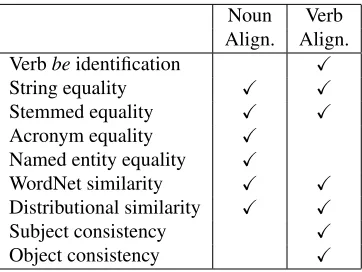
Table 1 summarizes a set of features used in the alignment models. Most of these features are shared by the model for noun alignment and the model for verb alignment. These features include whether the two strings are the same, two terms have the same stem, the similarity between the two terms either based on WordNet or distributional statistics (Lin, 1998).
To learn the alignment model for nouns, we anno-tated the noun alignments for the development data used in PASCAL RTE-3 Challenge (Giampiccolo et al., 2007) and trained a logistic regression model based on the features in Table 1. Cross-validation on the same dataset shows relatively satisfying per-formance (96.4% precision and 94.9% recall). In this paper, we focus on the alignment between verbs
Noun Verb
Align. Align.
Verbbeidentification X
String equality X X
Stemmed equality X X
Acronym equality X
Named entity equality X
WordNet similarity X X
Distributional similarity X X
Subject consistency X
[image:6.612.337.518.53.189.2]Object consistency X
Table 1: Features for alignment models
since it appears more difficult.
A major difference between noun alignment and verb alignment is that, for verb alignment the con-sistency of their arguments is also important. For two events (described by two verbs) to be aligned, at least their subjects (usually denoting the executers of actions) and objects (usually denoting the receivers of actions) should match to each other respectively. Note that, although actions/events also depend on other arguments or adjuncts, here we only consider the subjects and objects and leave the consistency check of other arguments/adjuncts to downstream processes. Based on two different ways of model-ing long distance relationship (as described in Sec-tion 5), we explored two methods for modeling ar-gument consistency (AC) in verb alignment models.
6.1.1 Implicit Modeling of AC
The first approach models argument consistency based on implicit modeling of the relationship be-tween a verb and its aligned subject/object. Specif-ically, given a pair of verb terms(x, y) wherex is from the conversation segment andyis from the hy-pothesis, let sy be the subject of y and sx be the
aligned entity of sy in the conversation (in case of
multiple alignments,sxis the one closest tox). The
subject consistency of the verbs(x, y)is then mea-sured by the distance between sx and x in the
de-pendency structure. Similarly, the distance between a verb and its aligned object is used as a measure of the object consistency.
x2’s alignments in the conversation segment, among which x9 (You) is the closest to x11 (see). In Fig-ure 2(a), we find the distance betweenx11andx9is 3.
Using the implicit modeling of argument consis-tency, we follow the same approach as in our pre-vious work (Zhang and Chai, 2009) and trained a logistic regression model to predict verb alignment based on the features in Table 1.
6.1.2 Explicit Modeling of AC
The second approach captures argument consis-tency based on explicit modeling of the relationship between a verb and its aligned subject (or object). Given a pair of verb terms(x, y), letsy be the
sub-ject of y and sx be the aligned entity of sy in the
conversation closest tox, we use the string describ-ing the path fromx to sx as the feature to capture
subject consistency. For example, in Figure 2(a), the path fromx11tox9isV →V →V ←N.
This string representation of paths is used to cap-ture both the subject consistency and the object con-sistency. Since they are non-numerical features, and the variability of their values can be extremely large, so we applied an instance-based classification model (e.g., k-nearest neighbor) to determine alignments between verb terms. We measure the distance be-tween two path features by their minimal string edit distance, and then simply use the Euclidean distance to measure the closeness between any two verbs. Again this model is trained from our development data described in Zhang and Chai (2009).
Figure 3 shows an example of alignment between the conversation terms and hypothesis terms in Ex-ample 2. Note that in this figure the alignment between x5 = suggests from the hypothesis and u4 = opinion from the conversation segment is a
pseudo alignment, which directly maps a verb term in the hypothesis to an utterance term represented by its dialogue act. This alignment is obtained by following the same set of rules learned from the de-velopment dataset as in (Zhang and Chai, 2009).
6.2 Applications in Inference Model
As mentioned earlier, once an alignment is estab-lished, the inference model is to predict whether each clause in the hypothesis is entailed from the conversation segment. Two separate models were
x4=have
x5=A
x2=Sleeping with the Enemy x1=A
x7=is really great
x10=one
u4=opinion
Conversation Segment
x3=Sleeping
with the Enemy
x5=suggests x2=A x1=B
x4=watch
Hypothesis
x6=that
x11=see x12=go
x13=have x8=have heard
u3=statement u2=no_answer u1=yes_no_question x3=seen
[image:7.612.323.530.53.332.2]x9=A sB sA
Figure 3: The alignment result for Example 2
used to handle the inference of property clauses (hj(x)) and and the inference of relational clauses
(hj(x, y)). Property clauses involve less variables
and are relatively simple, so we used the same prop-erty inference model as in (Zhang and Chai, 2009). Here we focus on relational inference model and ex-amine how different modeling of long distance rela-tionship may affect relation inference.
For a relation h betweenx and y to be entailed from a conversation segment, we need to find a same or similar relation in the conversation segment be-tweenx’s andy’s counterparts (i.e., aligned entities ofxandyin the conversation segment).
More specifically, given a relational clause from the hypothesis, hj(x, y), we find the sets of
terms X0 = {x0|x0 ∈D, g(x0, x) = 1} and Y0 = {y0|y0 ∈D, g(y0, y) = 1}, which are aligned withx
con-versation segment are X0 = {u4=viewpoint} and Y0 = {x3=seen, x11=see}. So the closest pair of terms between these two sets isu4andx11. Conse-quently, whether the target relational clausehj(x, y)
is entailed is determined by the relationship between
x∗ andy∗. Such relationship can be modeled either implicitly or explicitly.
6.3 Implicit modeling of relation inference
In this model we follow the simple idea that the shorter a path is between two terms, the more likely these two terms have a direct relationship. So we predefine a threshold,λL. We predict thathj(x, y)is
entailed if the distance betweenx∗andy∗is smaller thanλL. However, as can be seen, this distance does
not reflect whether the type of relationship between
x∗andy∗is similar to the relationship that holds be-tweenxandy.
6.4 Explicit modeling of relation inference
In order to capture more semantics from the rela-tion between two terms, we use explicit modeling of the relationship between terms x∗ and y∗. In the previous example, the relationship between u4 and x11 is modeled by the path from u4 to x11, U ←V ←V ←V.
Given this characterization, the prediction of whether hj(x, y) is entailed from the conversation
segment is formulated as a binary classification problem, using a k-nearest neighbor classification model with following features:
1. Explicit modeling of long distance relationship, i.e., the path fromx∗ toy∗ in the dependency structure of the conversation segment;
2. The types (N,V, orU) ofx,y,x∗, andy∗; 3. The type of relation betweenx andy, for
ex-ample,objinobj(x, y);
4. The order (i.e., before or after) betweenx and
y, and betweenx∗andy∗;
5. The specific type of the hypothesis.
7 Evaluation and Analysis
We evaluated different model configurations using our data1. This dataset consists of 291 development instances and 584 testing instances. The hypotheses
1The data is available for download at http:
//links.cse.msu.edu:8000/lair/projects/ conversationentailment_data.html.
(a) Based on basic representation
[image:8.612.335.517.53.281.2](b) Based on augmented representation
Figure 4: Evaluation of verb alignment
were categorized into four types: (1) fact: profile and social relations of conversation participants (ac-counted for 47% of the development data and 49% of the testing data); (2) belief: participants’ beliefs and opinions (34% and 35%); (3) desire: partici-pants’ desire of certain actions or outcomes (11% and 4%); (4) intent: communicative intent that cap-tures some perlocutionary force from one participant to the other (e.g. A stops B from doing something; A disagreees with B on something, 8% and 12%)
Note that in our original work (Zhang and Chai, 2009), only development data were used to show some initial observations. Here we trained our mod-els on the development data and results shown are from the testing data.
7.1 Evaluation of Alignment Models
The evaluation of alignment models is based on pair-wise decision. For each pair of terms(x, y), where
x is from a conversation segment and y is from a hypothesis, we measure whether the model cor-rectly predicts that the two terms should or should not be aligned. Because the alignment classification has extremely unbalanced classes, we use precision-recall of true alignments as evaluation metrics.
align-Figure 5: Evaluation of inference models based on different representations
ment, based on the basic representation and the aug-mented representation, respectively. Note that we cannot directly compare the results between these two figures since they involve different number of alignment instances2. Nevertheless, we can see the overall trend within each figure: the explicit model outperforms the implicit model. This suggests that the explicit modeling of semantic relationship be-tween verbs and arguments works better than the im-plicit modeling used in previous work. Furthermore, the improvement is most noticeable when hypothe-ses are facts (24.8% with the basic representation and 24.1% with the augmented representation), and least when hypotheses are intents(12.2% with the basic representation and 6.2% with the augmented representation).
7.2 Evaluation of Inference Models
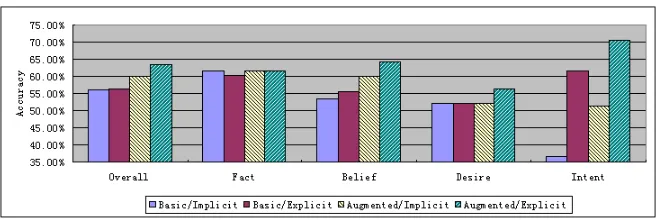
In order to compare different inference models, in this section (and this section only) we use gold-standard alignment results. They are obtained from manual annotation in our evaluation. We evaluated two inference models, one with implicit modeling of long distance relationship and one with explicit modeling. Evaluations were conducted based on both the basic representation and the augmented rep-resentation. Figure 5 shows the four groups of eval-uation results.
Overall speaking, the augmented representation outperforms the basic representation for both im-plicit modeling and exim-plicit modeling of long dis-tance relationship (McNemar’s tests,p <0.05). The explicit model performs better than implicit model only based on augmented representation (McNe-mar’s test,p <0.05).
2
The alignment based on the augmented representation in Figure 4(b) also includes pseudo alignments.
Clause Rep- Relation modeling Improve-resentation Implicit Explicit ment
Basic 53.9% 53.9% 0
Augmented 54.8% 58.7% 3.9%
Table 2: Entailment performance with different represen-tations and LDR modeling
The results were further broken down by different hypothesis types. For the fact type of hypotheses, there is no difference between different represen-tations and modeling of long distance relationship. This is not surprising since most hypotheses about partipants’ profiling information can be inferred di-rectly from the utterances. The augmented repre-sentation affects theintent type of hypothesis most significantly, so does the explicit modeling of long distance relationship.
7.3 Interaction between Clause
Representations and LDR Modeling
It was shown in previous sections that the aug-mented representation helps entailment prediction compared to the basic representation. Here we want to study how they interact with other entailment components and what is their effect in the enhanced modeling of long distance relations. Specifically, we test the performance of implicit and explicit mod-eling of long distance relations under two different representation settings: the basic representation and the augmented representation.
[image:9.612.142.472.54.164.2]is an interaction between clause representations and semantic modeling of long distance relations: the modeling of long distance relations between lan-guage constituents appears only effective when con-versation structure is incorporated in the representa-tion.
It is interesting to see the difference in the predic-tion performances onfacthypotheses andintent hy-potheses. Forfact, the most benefit of incorporating explicit modeling of long distance relationship ap-pears at the alignment stage, but not much at the in-ference stage. However, this situation is different for
intent, where the benefit of explicitly modeling long distance relationship mostly happened at the infer-ence stage. This observation suggests that the effects of different types of modeling may vary for different types of hypotheses, which indicates that hypothesis type dependent models may be beneficial.
8 Discussion and Conclusion
This paper presents an empirical investigation on conversation entailment. We specifically examine two levels of representation of conversation seg-ments and two different ways of modeling long dis-tance relations between language constituents. Our findings indicate that, although traditional architec-ture and approaches for textual entailment remain important, additional representation and processing that address conversation structures is critical. The augmented representation with conversation struc-tures, together with explicit modeling of semantic relations between language constituents, results in the best performance (58.7% accuracy).
The work here only represents an initial step to-wards conversation entailment. Conversation phe-nomena are rich and complex. Conversation entail-ment is extremely difficult. Besides the same chal-lenges faced by textual entailment, it is further com-plicated by conversation implicature. Although our current data enables us to start an initial investiga-tion, its small size poses significant limitations on technology development and evaluation. For ex-ample, our studies have indicated hypothesis type-dependent approaches may be beneficial, however we do not have sufficient data to yield reasonable models. A more systematical approach to collect and create a larger set of data is crucial.
Inno-vative community-based approaches (e.g., through web) for data collection and annotation can be pur-sued in the future. As more techniques in semantic processing (e.g., semantic role) become available, future work should also capture deeper semantics, address pragmatics, and incorporate richer world knowledge.
Finally, as the technology in conversation entail-ment is developed, its applications in NLP problems should be explored. Example applications include information extraction, question answering, summa-rization from conversation scripts, and modeling of conversation participants. These applications may provide new insights on the nature of the conversa-tion entailment problem and its potential soluconversa-tions.
Acknowledgments
This work was supported by grant IIS-0347548 from the National Science Foundation. We thank the anonymous reviewers for their valuable comments and suggestions.
References
Roy Bar-Haim, Ido Dagan, Bill Dolan, Lisa Ferro, Danilo Giampiccolo, Bernardo Magnini, and Idan Szpektor. 2006. The second pascal recognising textual entail-ment challenge. In Proceedings of the Second PAS-CAL Challenges Workshop on Recognising Textual Entailment, Venice, Italy.
Luisa Bentivogli, Ido Dagan, Hoa Trang Dang, Danilo Giampiccolo, and Bernardo Magnini. 2009. The fifth pascal recognizing textual entailment challenge. In Proceedings of the Second Text Analysis Conference (TAC 2009).
Johan Bos and Katja Markert. 2005. Recognising textual entailment with logical inference. InProceedings of HLT-EMNLP, pages 628–635.
Ido Dagan, Oren Glickman, and Bernardo Magnini. 2005. The pascal recognising textual entailment chal-lenge. InPASCAL Challenges Workshop on Recognis-ing Textual Entailment.
Rodrigo de Salvo Braz, Roxana Girju, Vasin Pun-yakanok, Dan Roth, and Mark Sammons. 2005. An inference model for semantic entailment in natural lan-guage. InProceedings of AAAI.
Nikesh Garera and David Yarowsky. 2009. Modeling la-tent biographic attributes in conversational genres. In Proceedings of the Joint Conference of the 47th An-nual Meeting of the ACL and the 4th International Joint Conference on Natural Language Processing of the AFNLP, pages 710–718, Suntec, Singapore, Au-gust.
Danilo Giampiccolo, Bernardo Magnini, Ido Dagan, and Bill Dolan. 2007. The third pascal recognizing tex-tual entailment challenge. InProceedings of the ACL-PASCAL Workshop on Textual Entailment and Para-phrasing, pages 1–9.
Danilo Giampiccolo, Hoa Trang Dang, Bernardog Magnini, Ido Dagan, Elena Cabrio, and Bill Dolan. 2008. The fourth pascal recognizing textual entail-ment challenge. InProceedings of the First Text Anal-ysis Conference (TAC 2008).
John J. Godfrey and Edward Holliman. 1997.
Switchboard-1 Release 2. Linguistic Data Consor-tium, Philadelphia.
Aria Haghighi, Andrew Ng, and Christopher Manning. 2005. Robust textual inference via graph matching. In Proceedings of HLT-EMNLP, pages 387–394. Hongyan Jing, Nanda Kambhatla, and Salim Roukos.
2007. Extracting social networks and biographical facts from conversational speech transcripts. In Pro-ceedings of ACL, pages 1040–1047.
Dan Klein and Christopher D. Manning. 2003. Accu-rate unlexicalized parsing. InACL ’03: Proceedings of the 41st Annual Meeting on Association for Compu-tational Linguistics, pages 423–430, Morristown, NJ, USA.
Dekang Lin. 1998. An information-theoretic definition of similarity. InProceedings of International Confer-ence on Machine Learning, pages 296–304.
Bill MacCartney, Trond Grenager, Marie-Catherine de Marneffe, Daniel Cer, and Christopher D. Man-ning. 2006. Learning to recognize features of valid textual entailments. InProceedings of HLT-NAACL, pages 41–48.
Gabriel Murray and Giuseppe Carenini. 2008. Summa-rizing spoken and written conversations. In Proceed-ings of the 2008 Conference on Empirical Methods in Natural Language Processing, pages 773–782, Hon-olulu, Hawaii, October.
Sameer S. Pradhan, Wayne Ward, and James H. Martin. 2008. Towards robust semantic role labeling. Compu-tational Linguistics, 34(2):289–310.
Rajat Raina, Andrew Y. Ng, and Christopher D. Man-ning. 2005. Robust textual inference via learning and abductive reasoning. In Proceedings of AAAI, pages 1099–1105.
Alan Ritter, Colin Cherry, and Bill Dolan. 2010. Unsu-pervised modeling of twitter conversations. InHuman
Language Technologies: The 2010 Annual Conference of the North American Chapter of the Association for Computational Linguistics, pages 172–180, Los An-geles, California, June.
Swapna Somasundaran, Josef Ruppenhofer, and Janyce Wiebe. 2007. Detecting arguing and sentiment in meetings. InProceedings of the 8th SIGdial Workshop on Discourse and Dialogue, Antwerp, September. Swapna Somasundaran, Janyce Wiebe, and Josef
Rup-penhofer. 2008. Discourse level opinion interpreta-tion. InProceedings of the 22nd International Con-ference on Computational Linguistics (Coling 2008), pages 801–808, Manchester, UK, August.
Swapna Somasundaran, Galileo Namata, Janyce Wiebe, and Lise Getoor. 2009. Supervised and unsupervised methods in employing discourse relations for improv-ing opinion polarity classification. InProceedings of the 2009 Conference on Empirical Methods in Natu-ral Language Processing, pages 170–179, Singapore, August.
Marta Tatu and Dan Moldovan. 2005. A semantic ap-proach to recognizing textual entailment. In Proceed-ings of HLT-EMNLP, pages 371–378.
Fabio Massimo Zanzotto and Alessandro Moschitti. 2006. Automatic learning of textual entailments with cross-pair similarities. InACL-44: Proceedings of the 21st International Conference on Computational Lin-guistics and the 44th annual meeting of the Associ-ation for ComputAssoci-ational Linguistics, pages 401–408, Morristown, NJ, USA.