A Semi-Supervised Method to Learn and Construct Taxonomies using the
Web
Zornitsa Kozareva and Eduard Hovy USC Information Sciences Institute
4676 Admiralty Way Marina del Rey, CA 90292-6695
{kozareva,hovy}@isi.edu
Abstract
Although many algorithms have been devel-oped to harvest lexical resources, few organize the mined terms into taxonomies. We pro-pose (1) a semi-supervised algorithm that uses a root concept, a basic level concept, and re-cursive surface patterns to learn automatically from the Web hyponym-hypernym pairs sub-ordinated to the root; (2) a Web based concept positioning procedure to validate the learned pairs’ is-a relations; and (3) a graph algorithm that derives from scratch the integrated tax-onomy structure of all the terms. Comparing results with WordNet, we find that the algo-rithm misses some concepts and links, but also that it discovers many additional ones lacking in WordNet. We evaluate the taxonomization power of our method on reconstructing parts of the WordNet taxonomy. Experiments show that starting from scratch, the algorithm can reconstruct 62% of the WordNet taxonomy for the regions tested.
1 Introduction
A variety of NLP tasks, including inference, tex-tual entailment (Glickman et al., 2005; Szpektor et al., 2008), and question answering (Moldovan et al., 1999), rely on semantic knowledge derived from term taxonomies and thesauri such as Word-Net. However, the coverage of WordNet is still lim-ited in many regions (even well-studied ones such as the concepts and instances below Animals and Peo-ple), as noted by researchers such as (Pennacchiotti and Pantel, 2006) and (Hovy et al., 2009) who per-form automated semantic class learning. This
hap-pens because WordNet and most other existing tax-onomies are manually created, which makes them difficult to maintain in rapidly changing domains, and (in the face of taxonomic complexity) makes them hard to build with consistency. To surmount these problems, it would be advantageous to have an automatic procedure that can not only augment existing resources but can also produce taxonomies for existing and new domains and tasks starting from scratch.
The main stages of automatic taxonomy induc-tion are term extracinduc-tion and term organizainduc-tion. In recent years there has been a substantial amount of work on term extraction, including semantic class learning (Hearst, 1992; Riloff and Shepherd, 1997; Etzioni et al., 2005; Pasca, 2004; Kozareva et al., 2008), relation acquisition between entities (Girju et al., 2003; Pantel and Pennacchiotti, 2006; Davi-dov et al., 2007), and creation of concept lists (Katz and Lin, 2003). Various attempts have been made to learn the taxonomic organization of concepts (Wid-dows, 2003; Snow et al., 2006; Yang and Callan, 2009). Among the most common is to start with a good ontology and then to try to position the miss-ing concepts into it. (Snow et al., 2006) maximize the conditional probability of hyponym-hypernym relations given certain evidence, while (Yang and Callan, 2009) combines heterogenous features like context, co-occurrence, and surface patterns to pro-duce a more-inclusive inclusion ranking formula. The obtained results are promising, but the problem of how to organize the gathered knowledge when there is no initial taxonomy, or when the initial tax-onomy is grossly impoverished, still remains.
The major problem in performing taxonomy con-struction from scratch is that overall concept po-sitioning is not trivial. It is difficult to discover whether concepts are unrelated, subordinated, or parallel to each other. In this paper, we address the following question: How can one induce the taxo-nomic organization of concepts in a given domain starting from scratch?
The contributions of this paper are as follows:
• An automatic procedure for harvesting hyponym-hypernym pairs given a domain of interest.
• A ranking mechanism for validating the learned is-a relations between the pairs.
• A graph-based approach for inducing the taxo-nomic organization of the harvested terms start-ing from scratch.
• An experiment on reconstructing WordNet’s taxonomy for given domains.
Before focusing on the harvesting and taxonomy induction algorithms, we are going to describe some basic terminology following (Hovy et al., 2009). A
termis an English word (for our current purposes, a noun or a proper name). Aconceptis an item in the classification taxonomy we are building. Aroot conceptis a fairly general concept which is located on the high level of the taxonomy. A basic-level concept corresponds to the Basic Level categories defined in Prototype Theory in Psychology (Rosch, 1978). For example, adog, not a mammal or a col-lie. Aninstanceis an item in the classification tax-onomy that is more specific than a concept. For ex-ample,Lassie, not a dog or collie .
The rest of the paper is organized as follows. Sec-tion 2 reviews related work. SecSec-tion 3 describes the taxonomization framework. Section 4 discusses the experiments. We conclude in Section 5.
2 Related Work
The first stage of automatic taxonomy induction, term and relation extraction, is relatively well-understood. Methods have matured to the point of achieving high accuracy (Girju et al., 2003; Pantel and Pennacchiotti, 2006; Kozareva et al., 2008). The produced output typically contains flat lists of terms
and/or ground instance facts (lion is-a mammal) and general relation types (mammalis-aanimal). Most approaches use either clustering or patterns to mine knowledge from structured and unstructured text. Clustering approaches (Lin, 1998; Lin and Pan-tel, 2002; Davidov and Rappoport, 2006) are fully unsupervised and discover relations that are not di-rectly expressed in text. Their main drawback is that they may or may not produce the term types and granularities useful to the user. In contrast, pattern-based approaches harvest information with high ac-curacy, but they require a set of seeds and surface patterns to initiate the learning process. These meth-ods are successfully used to collect semantic lex-icons (Riloff and Shepherd, 1997; Etzioni et al., 2005; Pasca, 2004; Kozareva et al., 2008), encyclo-pedic knowledge (Suchanek et al., 2007), concept lists (Katz and Lin, 2003), and relations between terms, such as hypernyms (Ritter et al., 2009; Hovy et al., 2009) and part-of (Girju et al., 2003; Pantel and Pennacchiotti, 2006).
However, simple term lists are not enough to solve many problems involving natural language. Terms may be augmented with information that is required for knowledge-intensive tasks such as textual entail-ment (Glickman et al., 2005; Szpektor et al., 2008) and question answering (Moldovan et al., 1999). To support inference, (Ritter et al., 2010) learn the se-lectional restrictions of semantic relations, and (Pen-nacchiotti and Pantel, 2006) ontologize the learned arguments using WordNet.
(and hence not a Mammal) to a fisherman or anyone building or visiting an aquarium. More confusingly, a tiger and a puppy are both Mammals and hence belong close together in a typical taxonomy, but a tiger is a WildAnimal (in the perspective of Animal-Function) and a JungleDweller (in the perspective of Habitat), while a puppy is a Pet (as function) and a HouseAnimal (as habitat), which would place them relatively far from one another. Attempts at pro-ducing a single multi-perspective taxonomy fail due to the complexity of interaction among perspectives, and people are notoriously bad at constructing tax-onomies adherent to a single perspective when given terms from multiple perspectives. This issue and the major alternative principles for taxonomization are discussed in (Hovy, 2002).
It is therefore not surprising that the second stage of automated taxonomy induction is harder to achieve. As mentioned, most attempts to learn tax-onomy structures start with a reasonably complete taxonomy and then insert the newly learned terms into it, one term at a time (Widdows, 2003; Pasca, 2004; Snow et al., 2006; Yang and Callan, 2009). (Snow et al., 2006) guide the incremental approach by maximizing the conditional probability over a set of relations. (Yang and Callan, 2009) introduce a taxonomy induction framework which combines the power of surface patterns and clustering through combining numerous heterogeneous features.
Still, one would like a procedure to organize the harvested terms into a taxonomic structure starting fresh (i.e., without using an initial taxonomic struc-ture). We propose an approach that bridges the gap between the term extraction algorithms that focus mainly on harvesting but do not taxonomize, and those that accept a new term and seek to enrich an al-ready existing taxonomy. Our aim is to perform both stages: to extract the terms of a given domain and to induce their taxonomic organization without any ini-tial taxonomic structure and information. This task is challenging because it is not trivial to discover both the hierarchically related and the parallel (per-spectival) organizations of concepts. Achieving this goal can provide the research community with the ability to produce taxonomies for domains for which currently there are no existing or manually created ontologies.
3 Building Taxonomies from Scratch
3.1 Problem Formulation
We define our task as:
Task Definition: Given a root concept, a basic level concept or an instance, and recursive lexico-syntactic patterns, (1) harvest in bootstrapping fashion hy-ponyms and hypernyms subordinated to the root; (2) filter out erroneous information (extracted concepts
and isa relations); (3) organize the harvested
con-cepts into a taxonomy structure.
!"#!$%&
'%$()%*& +%#!%,#-!%*&.-#)(+0#%*&./0#1-!%*&2-22-$*& /%#,(+0#%*& -)(2-$&
103&
10)4%5& %$%6/-)!&
./%%!-/&
1%%#& 73%#&
[image:3.612.320.538.232.375.2]6"2-& $(0)&
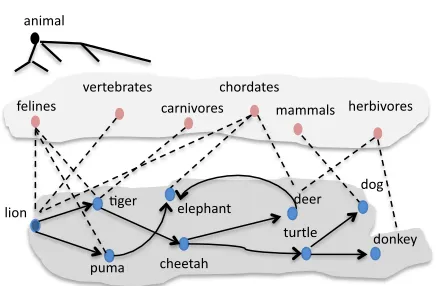
Figure 1:Taxonomy Induction from Scratch.
Figure 1 shows an example of the task. Start-ing with the root concept animal and the basic level concept lion, the algorithm learns new terms like tiger, puma, deer, donkey of class animal. Next for each basic level concept, the algorithm harvests hypernyms and learns that a lion is-a vertebrate, chordate, feline and mammal. Finally, the taxonomic structure of each basic level concept and its hypernyms is induced: ani-mal→chordate→vertebrate→mammal→feline→lion.
3.2 Knowledge Harvesting
We are interested in using this approach, because it is: (1) simple and easy to implement; (2) requires minimal supervision using only one root concept and a term to learn new hyponyms and hypernyms associated to the root; (3) reports higher precision than current semantic class algorithms (Etzioni et al., 2005; Pasca, 2004); and (4) adapts easily to dif-ferent domains.
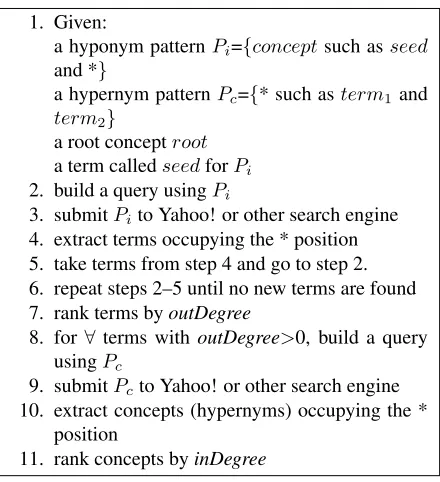
The general framework of the knowledge harvest-ing algorithm is shown in Figure 2.
1. Given:
a hyponym patternPi={conceptsuch asseed
and *}
a hypernym patternPc={* such asterm1 and
term2}
a root conceptroot
a term calledseedforPi
2. build a query usingPi
3. submitPito Yahoo! or other search engine
4. extract terms occupying the * position 5. take terms from step 4 and go to step 2. 6. repeat steps 2–5 until no new terms are found
7. rank terms byoutDegree
8. for ∀ terms with outDegree>0, build a query
usingPc
9. submitPcto Yahoo! or other search engine
10. extract concepts (hypernyms) occupying the * position
[image:4.612.73.293.200.441.2]11. rank concepts byinDegree
Figure 2:Knowledge Harvesting Framework.
The algorithm starts with a root concept, seed term1 of type root and a doubly-anchored pattern (DAP) such as ‘<root> such as <seed> and *’ which learns on the * position new terms of type root. The newly learned terms, which can be either instances, basic level or intermediate concepts, are placed into the position of theseedin the DAP pat-tern, and the bootstrapping process is repeated. The process ceases when no new terms are found.
To separate the true from incorrect terms, we use a graph-based algorithm in which each vertex u is a term, and an each edge (u, v) ∈ E corresponds to the direction in which the termu discovered the term v. The graph is weighted w(u, v) according
1The input term can be an instance, a basic level or an
in-termediate concept. An inin-termediate concept is the one that is located between the basic level and root concepts.
to the number of times the term pair u-v is seen in unique web snippets. The terms are ranked by
outDegree(u)= P
∀(u,v)∈Ew(u,v)
|V|−1 which counts the
number of outgoing links of nodeu normalized by the total number of nodes in the graph excluding the current. The algorithm considers as true terms with
outDegree>0.
All harvested terms are automatically fed into the hypernym extraction phase. We use the natural or-der in which the terms discovered each other and place them into an inverse doubly-anchored pattern (DAP−1) ‘* such as <term1> and<term2>’ to
learn hypernyms on the * position. Similarly we build a graph with nodeshdenoting the hypernyms and nodest1-t2 denoting the term pairs. The edges
(h, t1 −t2) ∈ E0 show the direction in which the
term pair discovered the hypernym. The hypernyms are ranked byinDegree(h)=P
∀(t1−t2,h)∈E0w(t1− t2, h)which rewards hypernyms that are frequently
discovered by various term pairs. The output of the algorithm is a list of is-a relations between the learned terms (instances, basic level or intermediate concepts) and their corresponding hypernyms. For example, deer is-a herbivore, deer is-a ruminant, deer is-a mammal.
3.3 Graph-Based Taxonomy Induction
In the final stage of our algorithm, we induce the overall taxonomic structure using information about the pairwise positioning of the terms. In the knowl-edge harvesting and filtering phases, the algorithm learned is-a relations between therootand the terms (instances, basic level or intermediate concepts), as well as the harvested hypernyms and the terms. The only missing information is the positioning of the in-termediate concepts located between the basic level and therootsuch asmammals,vertibrates,felines, chordates, among others.
We introduce a concept positioning (CP) proce-dure that uses a set of surface patterns: “Xsuch as
Y”, “XareYthat”, “XincludingY”, “XlikeY”, “suchXasY” to learn the hierarchical relations for all possible concept pairs. For each concept pair, saychordates and vertebrates, we issue the two following queries:
If (a) returns more web hits than (b), thenchordates
subsumes (or is broader than) vertebrates, other-wise vertebrates subsumes chordates. For this pair the such as pattern returned 7 hits for (a) and 0 hits for (b), so that the overall magnitude of the direction of the relation is weak. To accumulate stronger evidence, we issue web queries with the remaining patterns. For the same concept pair, the overall magnitude of “Xincluding Y” is 5820 hits for (a) and 0 for (b).
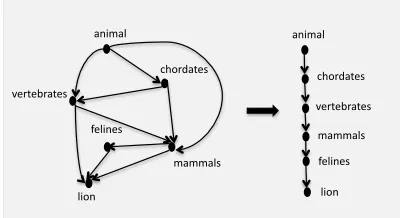
As shown in Figure 3, the concept positioning pat-terns cannot always determine the direct taxonomic organization between two concepts as in the case of felines and chordates, felines and vertebrates. One reason is that the concepts are located on dis-tant taxonomic levels. We humans typically exem-plify concepts using more proximate ones. There-fore, the concept positioning procedure can find ev-idence for the relation “mammals→felines”, but not for “chordates→felines”.
!"#$!%&
'()*(+)!*(,&
-(%#"(,&
$!$$!%,&
%#."&
/0.)1!*(,&
!"#$!%&
/0.)1!*(,&
'()*(+)!*(,&
$!$$!%,&
-(%#"(,&
[image:5.612.87.287.341.450.2]%#."&
Figure 3:Concept Positioning and Induced Taxonomy.
After the concept positioning procedure has ex-plored all concept pairs, we encounter two phenom-ena: (1) direct links between some concepts are missing and (2) multiple paths can be taken to reach from one concept to another.
To surmount these problems, we employ a graph based algorithm that finds the longest path in the graph G00=(V00, E00). The nodes
V00={it1, h1, h2, .., hn, r} represent the input term,
its hypernyms, and theroot. An edge(tm, tn)∈E00
indicates that there is a path between the termstm
andtn. The directiontm → tn indicates the term
subordination discovered during the CP procedure. The objective is to find the longest path in G00 be-tween therootand the input term. Intuitively, find-ing the longest paths is equivalent to findfind-ing the
tax-onomic organization of all concepts.
First, if present, we eliminate all cycles from the graph. Then, we find all nodes that have no prede-cessor and those that have no sucprede-cessor. Intuitively, a node with no predecessorsp is likely to be posi-tioned on the top of the taxonomy (e.g. animal), while a node with no successorsis likely to be lo-cated at the bottom (e.g. terms likelion,tiger,puma, or concepts likekrill predatorsthat could not be re-lated to an instance or a basic level concept during the CP procedure). We represent the directed graph as an adjacency matrixA = [am,n], wheream,n is
1 if(tm, tn)is an edge ofG00, and 0 otherwise. For
each(p, s)pair, we find the list of all paths connect-ingp with s. In the end, from all discovered can-didate paths, the algorithm returns the longest one. The same graph-based taxonomization procedure is repeated for the rest of the basic level concepts and their hypernyms.
4 Experiments and Results
To evaluate the performance of a taxonomy induc-tion algorithm, one can compare against a simple taxonomy composed of 2–3 levels. However, one cannot guarantee that the algorithm can learn larger hierarchies completely or correctly.
Animalsprovide a good example of the true com-plexity of concept organization: there are many types, they are of numerous kinds, people take nu-merous perspectives over them, and they are rela-tively well-known to human annotators. In addition, WordNet has a very rich and deep taxonomic struc-ture for animals that can be used for direct compar-ison. We further evaluate our algorithm on the do-mains ofPlantsandVehicles, which share some of these properties.
4.1 Data Collection
We have run the knowledge harvesting algorithm on the semantic classes Animals, Plants and Vehicles starting with only one seed example such aslions, cucumbersandcarsrespectively.
queries DAP−1. In this step, the algorithm harvested the hypernyms associated with each term. We kept all unique triples composed of a hypernym and the term pairs that extracted it. The algorithm ran until complete exhaustion for 8 iterations forAnimals, 10 iterations forPlantsand 18 iterations ofVehicles.
Table 1 shows the total number of terms extracted by the Web harvesting algorithm during the first stage. In addition, we show the number of terms that passed theoutDegreethreshold. We found that the majority of the learned terms forAnimalsare basic level concepts, while forPlantsandVehiclesthey are a mixture of basic level and intermediate concepts.
Animals Plants Vehicles #Extracted Terms 1855 2801 1425 #outDegree(Term)>0 858 1262 581
Table 1:Learned Terms.
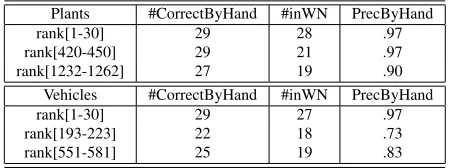
Since human based evaluation of all harvested terms is time consuming and costly, we have se-lected 90 terms located at the beginning, in the mid-dle and in the end of theoutDegreeranking. Table 2 summarizes the results.
Plants #CorrectByHand #inWN PrecByHand rank[1-30] 29 28 .97 rank[420-450] 29 21 .97 rank[1232-1262] 27 19 .90
Vehicles #CorrectByHand #inWN PrecByHand rank[1-30] 29 27 .97 rank[193-223] 22 18 .73 rank[551-581] 25 19 .83
Table 2:Term Evaluation.
Independently, we can say that the precision of the harvesting algorithm is from 73 to 90%. In the case ofVehicles, we found that the learned terms in the middle ranking do not refer to the meaning of vehi-cle as a transportation devise, but to the meaning of vehicle as media (i.e. seminar, newspapers), com-munication and marketing. For the same category, the algorithm learned many terms which are missing from WordNet such asBMW,bakkies,two-wheeler, all-terrain-vehicleamong others.
The second stage of the harvesting algorithm con-cerns hypernym extraction. Table 3 shows the total number of hypernyms harvested for all term pairs. The top 20 highly ranked concepts byinDegreeare the most descriptive terms for the domain. However,
if we are interested in learning a larger set of hy-pernyms, we found thatinDegreeis not sufficient by itself. For example, highly frequent but irrele-vant hypernyms such as meats, others are ranked at the top of the list, while low frequent but rele-vant ones such asprotochordates,hooved-mammals, homeotherms are discarded. This shows that we need to develop additional and more sensitive mea-sures for hypernym ranking.
Animals Plants Vehicles #Extracted Hypernyms 1904 8947 2554 #inDegree(Hypernyms)>10 110 294 100
Table 3:Learned Hypernyms.
Table 4 shows some examples of the learned an-imal hypernyms which were annotated by humans as: correct but not present in WordNet; borderline which depending on the application could be valu-able to have or exclude; and incorrect.
CorrectNotInWN {colony|social}insects, grazers, monogastrics camelid,{mammalian|land|areal}predators
{australian|african}wildlife, filter feeders hard shelled invertebrates, pelagics bottom dwellers
Borderline prehistoric animals, large herbivores pocket pets, farm raised fish, roaring cats endangered mammals, mysterious hunters top predators, modern-snakes, heavy game Incorrect frozen foods, native mammals, red meats
[image:6.612.72.299.384.468.2]furry predators, others, resources, sorts products, items, protein
Table 4:Examples of Learned Animal Hypernyms.
The annotators found that 9% of the harvested is-a relis-ations is-are missing from WordNet. For exis-ample, cartilaginous fish → shark;colony insects→ bees; filter feeders→tube anemonesamong others. This shows that despite its completeness, WordNet has still room for improvement.
4.2 A Test: Reconstructing WordNet
Given a domain, we select from 140 to 170 of the harvested terms. For each term, we retrieve all WordNet hypernyms located on the path between the input term and therootthat isanimal, plantor ve-hicledepending on the domain of interest. We have found that 98% of the WordNet terms are also har-vested by our knowledge acquisition algorithm. This means that being able to reconstruct WordNet’s tax-onomy is equivalent to evaluating the performance of our taxonomy induction approach.
Table 5 summarizes the characteristics of the tax-onomies for the regions tested. For each domain, we show the total number of terms that must be or-ganized, and the total number of is-a relations that must be induced.
Animals Plants Vehicles #terms 684 554 140
[image:7.612.340.511.92.167.2]#is-a 4327 2294 412 average depth 6.23 4.12 3.91 max depth 12 8 7 min depth 1 1 1
Table 5:Data for WordNet reconstruction.
Among the three domains we have tested, An-imals is the most complex and richest one. The maximum number of levels our algorithm must in-fer is 11, the minimum is 1 and the average taxo-nomic depth is6.2. In total there are three basic level concepts (longhorns, gaurandbullock) with maxi-mum depth, twenty terms (basic level and intermedi-ate concepts) with minimum depth and ninety-eight terms (wombat,viper,rat,limpkin) with depth 6.
Plantsis also a very challenging domain, because it contains a mixture of scientific and general terms such asmagnoliopsidaandflowering plant.
4.3 Evaluation
To evaluate the performance of our taxonomy induc-tion approach, we use the following measures:
P recision=#is−a f ound in W ordN et and by system#is−a f ound by system
[image:7.612.101.270.266.332.2]Recall= #is−a f ound in W ordN et and by system#is−a f ound in W ordN et
Table 6 shows results of the taxonomy induction of the Vehiclesdomain using different concept po-sitioning patterns. The most productive ones are: “XareYthat” and “XincludingY”. However, the
highest yield is obtained when we combine evidence from all patterns.
Vehicles Precision Recall X such as Y .99 (174/175) .42 (174/410) X are Y that .99 (206/208) .50 (206/410) X including Y .96 (165/171) .40 (165/410) X like Y .96 (137/142) .33 (137/410) such X as Y .98 (44/45) .11 (44/410) AllPatterns .99 (246/249) .60( 246/410)
Table 6:Evaluation of the Induced Vehicle Taxonomy.
Table 7 shows results of the taxonomization of the Animalsand Plants domains. Overall, the ob-tained results are very encouraging given the fact that we started from scratch without the usage of any taxonomic structure. Precision is robust, but we must further improve recall. Our observation for the lower recall is that some intermediate concepts re-late mostly to the high level ones, but not to the basic level concepts.
Precision Recall Animals .98 (1643/1688) .38 (1643/4327)
[image:7.612.344.507.337.367.2]Plants .97 (905/931) .39 (905/2294)
Table 7:Evaluation of the Induced Animal and Plant
Tax-onomies.
Figure 4 shows an example of the taxonomy in-duced by our algorithm for the vipers, rats, wom-bats, ducks, emus, moths and penguins basic level concepts and their WordNet hypernyms.
animals
aquatic_vertebrates chordates invertebrates
vertebrates arthropods
aquatic_birds
ducks penguins
insects
moths birds
emus
mammals reptiles
marsupials rodents placentals
wombats rats metatherians
snakes
vipers
Figure 4:Induced Taxonomy for Animals.
[image:7.612.323.558.493.641.2]per-spectives (adeeris agrazerin BehaviorByFeeding, awildlifein BehaviorByHabitat, aherdin Behavior-SocialGroup and aneven-toed ungulatein Morpho-logicalType) into a single hierarchy.
5 Conclusions and Future Work
We are encouraged by the ability of the taxonomiza-tion algorithm to reconstruct WordNet’sAnimal hi-erarchy, which is one of its most complete and elab-orated. In addition, we have also evaluated the per-formance of our algorithm with thePlantand Vehi-cleWordNet hierarchies.
Currently, our automated taxonomization algo-rithm is able to build some of the quasi-independent perspectival taxonomies (Hovy et al., 2009). How-ever, further research is required to develop methods that reliably (a) identify the number of independent perspectives a concept can take (or seems to take in the domain text), and (b) classify any harvested term into one or more of them. The result would greatly simplify the task of the taxonomization stage.
We note that despite this richness, WordNet has many concepts like camelid, filter feeder, mono-gastrics among others which are missing, but the harvesting algorithm can provide. Another promis-ing line of research would investigate the combina-tion of the two styles of taxonomizacombina-tion algorithms: first, the one described here to produce an initial (set of) taxonomies, and second, the term-insertion algo-rithms developed in prior work.
Acknowledgments
We acknowledge the support of DARPA contract number FA8750-09-C-3705. We thank Mark John-son for the valuable discussions on taxonomy evalu-ation. We thank the reviewers for their useful feed-back and suggestions.
References
Dmitry Davidov and Ari Rappoport. 2006. Efficient un-supervised discovery of word categories using
sym-metric patterns and high frequency words. In
Proceed-ings of the 21st International Conference on Compu-tational Linguistics and the 44th annual meeting of the
ACL, pages 297–304.
Dmitry Davidov, Ari Rappoport, and Moshel Koppel.
2007. Fully unsupervised discovery of
concept-specific relationships by web mining. InProceedings
of the 45th Annual Meeting of the Association of Com-putational Linguistics, pages 232–239.
Oren Etzioni, Michael Cafarella, Doug Downey, Ana-Maria Popescu, Tal Shaked, Stephen Soderland, Daniel S. Weld, and Alexander Yates. 2005. Unsuper-vised named-entity extraction from the web: an
exper-imental study. Artificial Intelligence, 165(1):91–134,
June.
Roxana Girju, Adriana Badulescu, and Dan Moldovan. 2003. Learning semantic constraints for the automatic
discovery of part-whole relations. InProceedings of
the 2003 Conference of the North American Chapter of the Association for Computational Linguistics on Hu-man Language Technology, pages 1–8.
Oren Glickman, Ido Dagan, and Moshe Koppel. 2005. A probabilistic classification approach for lexical
tex-tual entailment. In Proceedings, The Twentieth
Na-tional Conference on Artificial Intelligence and the Seventeenth Innovative Applications of Artificial Intel-ligence Conference, pages 1050–1055.
Marti Hearst. 1992. Automatic acquisition of hyponyms
from large text corpora. In Proceedings of the 14th
conference on Computational linguistics, pages 539– 545.
Eduard H. Hovy, Zornitsa Kozareva, and Ellen Riloff. 2009. Toward completeness in concept extraction and
classification. InProceedings of the 2009 Conference
on Empirical Methods in Natural Language Process-ing, EMNLP 2009, pages 948–957.
Eduard Hovy. 2002. Comparing sets of semantic
rela-tions in ontologies. The Semantics of Relationships:
An Interdisciplinary Perspective, pages 91–110. Boris Katz and Jimmy Lin. 2003. Selectively using
rela-tions to improve precision in question answering. InIn
Proceedings of the EACL-2003 Workshop on Natural Language Processing for Question Answering, pages 43–50.
Zornitsa Kozareva, Ellen Riloff, and Eduard Hovy. 2008. Semantic class learning from the web with hyponym
pattern linkage graphs. In Proceedings of ACL-08:
HLT, pages 1048–1056.
Dekang Lin and Patrick Pantel. 2002. Concept discovery
from text. In Proceedings of the 19th international
conference on Computational linguistics, pages 1–7. Dekang Lin. 1998. Automatic retrieval and clustering
of similar words. InProceedings of the 17th
interna-tional conference on Computainterna-tional linguistics, pages 768–774.
Dan I. Moldovan, Sanda M. Harabagiu, Marius Pasca, Rada Mihalcea, Richard Goodrum, Roxana Girju, and Vasile Rus. 1999. Lasso: A tool for surfing the answer
net. InTREC.
Patrick Pantel and Marco Pennacchiotti. 2006. Espresso: Leveraging generic patterns for automatically
harvest-ing semantic relations. InProceedings of 21st
44th Annual Meeting of the Association for Computa-tional Linguistics, ACL 2006.
Marius Pasca. 2004. Acquisition of categorized named
entities for web search. In Proceedings of the
thir-teenth ACM international conference on Information and knowledge management, pages 137–145.
Marco Pennacchiotti and Patrick Pantel. 2006.
Ontolo-gizing semantic relations. InACL-44: Proceedings of
the 21st International Conference on Computational Linguistics and the 44th annual meeting of the Associ-ation for ComputAssoci-ational Linguistics, pages 793–800. Ellen Riloff and Jessica Shepherd. 1997. A
Corpus-Based Approach for Building Semantic Lexicons. In
Proceedings of the Second Conference on Empirical Methods in Natural Language Processing, pages 117– 124.
Alan Ritter, Stephen Soderland, and Oren Etzioni. 2009. What is this, anyway: Automatic hypernym discovery. InProceedings of AAAI Spring Symposium on Learn-ing by ReadLearn-ing and LearnLearn-ing to Read.
Alan Ritter, Mausam, and Oren Etzioni. 2010. A la-tent dirichlet allocation method for selectional
prefer-ences. Into appear in Proceedings of the Association
for Computational Linguistics ACL2010. Eleanor Rosch. 1978. Principles of categorization. Rion Snow, Daniel Jurafsky, and Andrew Y. Ng. 2006.
Semantic taxonomy induction from heterogenous
ev-idence. InProceedings of 21st International
Confer-ence on Computational Linguistics and 44th Annual Meeting of the Association for Computational Linguis-tics, ACL.
Fabian M. Suchanek, Gjergji Kasneci, and Gerhard Weikum. 2007. Yago: a core of semantic knowledge. In WWW ’07: Proceedings of the 16th international conference on World Wide Web, pages 697–706. Idan Szpektor, Ido Dagan, Roy Bar-Haim, and Jacob
Goldberger. 2008. Contextual preferences. InACL
2008, Proceedings of the 46th Annual Meeting of the Association for Computational Linguistics, pages 683–691.
Dominic Widdows. 2003. Unsupervised methods for de-veloping taxonomies by combining syntactic and
sta-tistical information. InProceedings of HLT-NAACL.
Hui Yang and Jamie Callan. 2009. A metric-based
framework for automatic taxonomy induction. In