Sharing and Comparing: How Comparing Shared Goals Broadens Goal Understanding in Development
Sarah A. Gerson
Radboud University Nijmegen
Donders Institute for Brain, Cognition, and Behaviour
Abstract
How we recognize the goals of others is a critical question for those interested in social, cognitive, and linguistic development. The origins of goal understanding exist early in life—that is, infants recognize the intentional relations (e.g., between actor and goal) that underlie intentional actions. In this article, I propose one
mechanism through which these initially narrow goal representations can be generalized: comparison. I briefly review evidence that comparison facilitates detection of relational similarities across several domains, then address theoretical and neural findings consistent with the notion that comparison plays a role in social-cognitive development. I discuss more direct evidence that infants can and do expand their recognition of others’ goals through comparison and then propose several hypotheses concerning the ways in which the benefits of comparison (and facilitative cues to compare) may influence the generalization of action
Social interactions drive learning and development across a variety of domains. We learn from and about others by observing and engaging with them. Recognizing others’ goals and intentions is critical to this learning. Intentional relations, the links between actors and their goals, underlie and define intentional actions and are critical to recognizing the goals of others’ actions (Barresi & Moore, 1996). Goal recognition begins early in development: Six-month-olds recognize the relation between an actor and the object for which she reaches as measured in a habituation paradigm (see Figure 1A; Woodward, 1998). By seven months, infants can act on this knowledge and imitate the choice of a reaching action by choosing the same toy as an experimenter in an imitation paradigm (Hamlin, Hallinan, & Woodward, 2008). And at 11 months, infants anticipate the target of intentional relations by looking to the expected goal (object) of a reach before the action occurs (Cannon & Woodward, 2012). Across these paradigms, infants’ analysis of intentional relations is specific to the well-formed actions of agents. Infants recognize the intentional relations inherent in actions that involve using tools (Biro & Leslie, 2007; Jovanovic et al., 2007; Sommerville &
development (see Woodward et al., 2009 for a summary) and raise a question: What are the developmental origins and the generalization mechanisms involved in broadening infants’ capacity to apprehend the intentional structure of human
actions?
One source of insight into intentional relations comes from infants’ own actions. For example, 3-month-olds are not yet proficient at producing efficient object-directed reaches wherein they direct their actions toward an object and retrieve it. When 3-month-olds are given Velcro mittens to play with Velcro-covered toys, they produce more efficient, object-directed reaches. This exercise affects infants’ perception of people (attention to faces; Libertus & Needham, 2011), events (causal perception; Rakison & Krogh, 2012), and intentional
relations (Sommerville et al., 2005; Figure 1). Active training has yielded similar effects for means-end actions at 8 and 10 months (Gerson et al., under review; Sommerville, Hildebrand, & Crane, 2008). Neural evidence for the link between action production and perception is also growing. Shared neurocognitive
representations (mirror systems) indicate that motor areas of the brain are activated both when a person produces and observes a motorically familiar, goal-directed action (Rizzolatti & Craighero, 2004).
individual differences in pointing are related to recognizing pointing, but not gaze, as object directed (Brune & Woodward, 2007). The question of how we move beyond these initial ties is not negligible. However, the problem of generalization is not unique to this domain. Across a variety of fields, spanning verb learning to science education, specificity can sometimes be helpful and informative (e.g., the past tense of run is not runned), but it can also be limiting if never extended. In the domain of intention understanding, we must come to recognize the goals of actions we have never produced ourselves; generalization can help when applied
appropriately (e.g., recognizing common goals across varying physical manifestations).
an opportunity for the motor system to adapt to a broader array of actions--shifting from responses to the hand reach alone to both the hand and the tool-use actions. Such simultaneous perception of actions that babies have seen but not yet produced may play an important role in the generalizing intention understanding.
Comparison as a Mechanism of Change
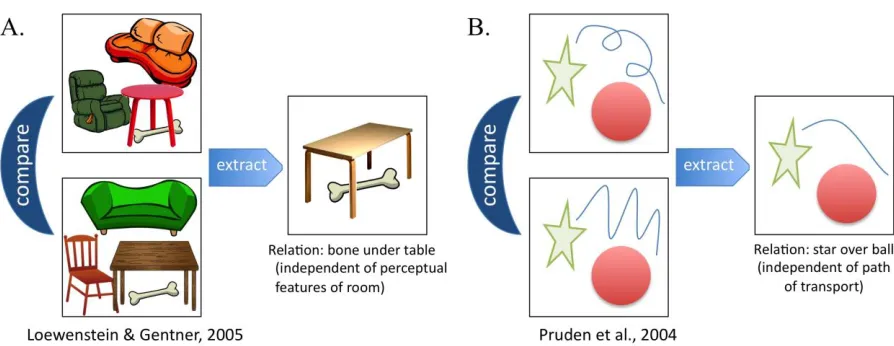
Comparison, a domain-general mechanism that aids recognition of relational similarities across exemplars, may provide an avenue through which intentional relations can be generalized. Structure mapping, the mapping of relational similarities between exemplars, may occur via comparison processes and may facilitate the creation of inferences based on relational similarities (Gentner, 2003). The influence of comparison on adults’ and preschoolers’ identifying matching relations has been shown in domains of spatial representations (Loewenstein & Gentner, 2005), verb learning (Childers, 2011), and problem solving (Rittle-Johnson & Star, 2009). For example, when 3-year-olds played a hiding game in which they needed to map a spatial relation (e.g., the bone is under the chair next to the bed) from one exemplar to another, they were more proficient at extending the relation to a new scenario when they first compared two exemplars side by side (Loewenstein & Gentner, 2005; see Figure 2A). In the domain of intention
out similarities between them. Joint actions, in which two people act on a common goal, are one case in which comparing the intentional relations in two peoples’ actions could facilitate intention understanding.
Comparison may similarly support learning during infancy. For example, in one study (Oakes & Ribar, 2005), infants were shown exemplars of a category (i.e., dogs and cats) either simultaneously or sequentially. Categorical extension was then tested in a paired comparison task. The 4-month-olds in the study detected the categorical information when exemplars from familiarization were presented simultaneously but not when presented sequentially. The young infants could compare simultaneously presented exemplars and abstract relevant
information from these exemplars (see also Casasola, 2005; Pruden, Hirsh-Pasek, Maguire, & Meyer, 2004; Figure 2B).
Comparison in the Action Domain
Across a variety of perspectives concerning the emergence of intention understanding, a common theme is that comparisons between self and other support recognition of others’ intentional actions. For example, the “like me” hypothesis (Meltzoff, 2005) suggests that the bodily mapping between an infant’s actions and the actions of others provides the basis for extending knowledge about the self to others, and vice versa. Moreover, infants may learn about others’
these views, the role and nature of comparison processes in the domain of intention understanding has not been examined empirically in infants.
Imitation is important in understanding others’ intentions because it may facilitate comparison between one’s own and another’s goals (Meltzoff, 2005). In addition, comparison during the physical alignment of one’s own and others’ actions during joint attention allows infants to form an analogy between self and other (Barresi & Moore, 1996). In shared attention, the infant’s action and
attentional state co-occur with the actions and attentional states of another individual; the infant can compare these states and infer that the other likely possesses attentional and intentional states that are similar to his or her own . However, joint attention is not the only context in which infants’ and others’ intentions are aligned. Alignment of one’s own and others’ actions could occur while acting on an object at the same time as another individual or engaging in a joint action with another; these scenarios may provide opportunities for
comparison (see Reddy, Markova, & Wallot, 2013).
but do not recognize the goal of another person’s tool use without extra cues or training (Biro & Leslie, 2007; Sommerville & Woodward, 2005). Woodward and I hypothesized that allowing infants to compare simultaneously produced grasping and tool-use actions would help them discern the similar intentional -relation (between actor and goal object) between the two actions. We assessed this possibility in a goal imitation paradigm.
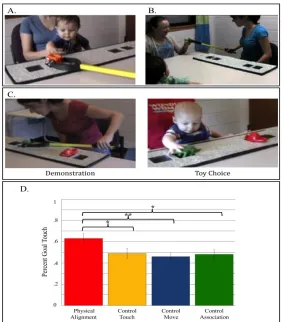
In one study, 7-month-olds were familiarized with a set of toys, an experimenter, and a tool in one of several ways. In the critical case (alignment condition), infants reached for a toy at the same time the experimenter held the toy
with a tool (see Figure 3A). In this way, infants could simultaneously perceive the familiar action they produced (the grasp) and the unfamiliar (tool-use) action produced by the experimenter. In the familiarization period of the control
conditions, infants were given information about either the association between the tool and toys for which they reached or the functional properties of the tool, as both of these have been hypothesized to facilitate goal analysis (e.g., Biro & Leslie, 2007; see Figure 3D).
After familiarization, we assessed whether infants viewed the experimenter’s tool-use actions as directed to a goal, using a method that assessed infants’
themselves. In previous studies (e.g., Hamlin et al., 2008), 7-month-olds imitated the experimenter’s toy choice (goal) when the experimenter previously acted on her goal in a manner the infant recognized as goal-directed (e.g., grasping) but not when she acted on it in an unfamiliar manner (e.g., touching with back of hand). In the current study, we expected that infants would imitate the experimenter’s tool-use action if they recognized the intention of her action but would choose
randomly if they did not. Only infants in the alignment condition chose the same toy as the experimenter more often than would be expected by chance (see Figure 3D). Lack of imitation in the control conditions, despite similar attentional patterns across all conditions, suggests that associations between the toys and tool, attention to the two toys, and functional information about the tool were insufficient to lead to imitation. Thus, without any experience using the tool, infants were able to discern the goal of the experimenter’s tool-use action by comparing their own goal when grasping and the experimenter’s goal when using a tool.
Implications of the Comparison Process in the Action Domain The proposed perspective leads to several hypotheses concerning the
emergence of action understanding and the mechanisms that facilitate this process. For example, the relational information to be transferred must be known for one of the exemplars being compared for the exemplar to be used as a basis of
beyond initially context-specific intentional-relations. That is, initial active
experience may create portable knowledge about intentional-relations that can then be applied to new contexts via comparison. In the work described previously
(Gerson & Woodward, 2012), being able to produce and understand the goal of the grasping action was necessary for infants to benefit from comparing this action with the novel tool-use action.
Additional indirect evidence for the hypothesis that active experience may act as a base of comparison comes from the studies that used Velcro mittens with 3-month-olds. When the infants played with toys without mittens and then
observed mittened actions produced by an experimenter, infants did not later recognize the goal of an actor’s mittened grasping action. However, infants who produced more unmittened object-directed activity prior to watching the mittened adult were more likely than their less active peers to later recognize the goal of the mittened action (Gerson & Woodward, under review). Unmittened activity was unrelated to goal recognition for infants who did not see the mittened adult’s
should examine whether this mechanism can and does play a direct role in extending information about intentional relations to new contexts.
Perceptual similarity facilitates comparing and detecting relational
similarities between exemplars (Gentner, 1988). Thus, comparison of perceptually similar objects and actions may facilitate recognition of a broader array of
between the unmittened and mittened actions (with the smiley and box toys) may have helped infants detect the intentional-relation independent of the specific objects involved (allowing infants to extend this relation from mittened reaches for boxes and smileys to mittened reaches for bears and balls).
Until now, comparison was most frequently studied in domains requiring comparison of two external exemplars (e.g., spatial relations of two rooms). In contrast, comparison in the social-cognitive domain emphasizes comparisons between oneself and another. For example, in the study described previously (Gerson & Woodward, 2012), 7-month-olds compared their own action (and goal) with an experimenter’s action (i.e. second-person perspective). Given the
importance of active experience in action perception, we examined whether comparing the tool-use action with a familiar action (grasp) produced by another actor would provide the same benefits as comparing the novel action with one’s own (familiar) actions (see Figure 3B; Gerson & Woodward, 2013b). Ten-month-old infants initially benefited from engaging in but not from observing alignment (as measured through imitation). To examine whether cues that facilitate
actors use the same label to identify their goal. Woodward and I hypothesized that this labeling would lead to increased attention to the relevant aspects of the aligned actions (i.e., the relation between the actors and their common goal) and facilitate recognition of the similar intentional relations. Infants imitated the experimenter’s goals after observing the labeled alignment, consistent with work showing that labels facilitate comparison across exemplars (e.g., Fulkerson & Waxman, 2006). Thus, early support for comparison processes can take many forms: in
simultaneous (vs. successive) presentation of exemplars, in active (vs. observational) engagement in the interaction, and in labels that promote comparison of the relevant aspects.
Comparison between intentional relations is one mechanism through which understanding of initial intention can be generalized. Comparison processes likely interact and work in parallel with a variety of other mechanisms throughout
To uncover the intricacies of the role of comparison processes in intention understanding, research should examine the particular aspects of social interactions that are critical to learning and generalization, the role language plays in the
Acknowledgments
References
Astington, J. W. E., & Baird, J. A. (2005). Why language matters for theory of mind. Toronto, ON, Canada: Oxford University Press.
Baldwin, D. A., Baird, J. A., Saylor, M. M., & Clark, M. A. (2001). Infants parse dynamic action. Child development, 72, 708-717. doi:
10.1111/1467-8624.00310
Barresi, J., & Moore, C. (1996). Intentional relations and social understanding. Behavioral and Brain Sciences, 19, 107-122.
doi:10.1017/S0140525X00041790
Biro, S., & Leslie, A. M. (2007). Infants' perception of goal-directed actions: development through cue-based bootstrapping. Developmental Science, 10, 379-398. doi:10.1111/j.1467-7687.2006.00544.x
Brune, C. W., & Woodward, A. L. (2007). Social cognition and social responsiveness in 10-month-old infants. Journal of Cognition and Development, 8, 133. doi:10.1080/15248370701202331
Casasola, M. (2005). When less is more: How infants learn to form an abstract categorical representation of support. Child Development, 76, 279-290. 10.1111/j.1467-8624.2005.00844.x
Childers, J. B. (2011). Attention to multiple events helps two- 1/2-year-olds extend new verbs. First Language, 31, 3-22. 10.1177/0142723710361825
Ferrari, P. F., Rozzi, S., & Fogassi, L. (2005). Mirror neurons responding to observation of actions made with tools in monkey ventral premotor cortex. Journal of Cognitive Neuroscience, 17, 212-226.
doi:10.1162/0898929053124910
Fulkerson, A. L., & Waxman, S. R. (2007). Words (but not tones) facilitate object
categorization: Evidence from 6-and 12-month-olds. Cognition, 105, 218-228. doi: 10.1016/j.cognition.2006.09.005
Gazzola, V., van der Worp, H., Mulder, T., Wicker, B., Rizzolatti, G., & Keysers, C. (2007). Aplasics born without hands mirror the goal of hand actions with their feet. Current Biology, 17, 1235-1240. doi: 10.1016/j.cub.2007.06.045
Gergely, G., & Csibra, G. (2003). Teleological reasoning in infancy: The naïve theory of rational action. Trends in Cognitive Sciences, 7, 287-292. doi:10.1016/S1364-6613(03)00128-1
Gerson , S., & Woodward , A. (2013). Infants’ learning from their own actions: Effects of trained and untrained actions on infants’ action understanding.
Unpublished manuscript.
Gerson. S., & Woodward, A. (in press). Learning from their own actions: The unique effect of producing actions on infants’ action understanding. Child Development.
Gerson, S. A., & Woodward, A. L. (2013a). The goal trumps the means:
Alignment of goals is more beneficial than alignment of means in means-end training. Infancy, 18, 289-302. doi: 10.1111/j.1532-7078.2012.0012.x
Gerson, S., & Woodward, A. (2013b). Labels facilitate infants’ comparison of action goals. Journal of Cognition and Development. doi:
10.1080/15248372.2013.777842
Gerson, S. A., & Woodward, A. L. (2012). A claw is like my hand: Comparison supports goal analysis in infants. Cognition, 122, 181-192. doi:
Gerson, S., & Woodward, A. L. (2010). Building intentional action knowledge with one’s hands. In S. P. Johnson (Ed.), Neo-constructivism (pp. 295-313). New York, NY. Oxford University Press.
Gredebäck, G., & Kochukhova, O. (2010). Goal anticipation during action observation is influenced by synonymous action capabilities, a puzzling developmental study. Experimental Brain Research, 202, 493-497. doi: 10.1007/s00221-009-2138-1
Hamlin, J. K. (2013). Moral judgment and action in preverbal infants and toddlers: Evidence for an innate moral core. Current Directions in Psychological Science, 22, 186-193. doi: 10.1177/0963721412470687
Hamlin, J. K., Hallinan, E. V., & Woodward, A. L. (2008). Do as I do: 7-month-old infants selectively reproduce others' goals. Developmental Science, 11, 487-494. doi:10.1111/j.1467-7687.2008.00694.x
Jovanovic, B., Király, I., Elsner, B., Gergely, G., Prinz, W., & Aschersleben, G. (2007). The role of effects for infants' perception of action goals.
Psychologia: An International Journal of Psychology in the Orient,
Libertus, K., & Needham, A. (2011). Reaching experience increases face
preference in 3-month-old infants. Developmental Science, 14, 1355-1364. doi: 10.1111/j.1467-7687.2011.01084.x
Loewenstein, J., & Gentner, D. (2005). Relational language and the development of relational mapping. Cognitive Psychology, 50, 315-353.
doi:10.1016/j.cogpsych.2004.09.004
Luo, Y. (2011). Three-month-old infants attribute goals to a non-human agent.
Developmental Science, 14, 453-460. doi:
10.1111/j.1467-7687.2010.00995.x
Meltzoff, A. N. (2005). Imitation and other minds: The 'Like Me' hypothesis. In S. Hurley & N. Chater (Eds.), Perspectives on Imitation: From Neuroscience to Social Science: Vol. 2: Imitation, Human Development, and Culture (pp.
55-77). Cambridge, MA: MIT Press.
Oakes, L. M., & Ribar, R. J. (2005). A comparison of infants' categorization in paired and successive presentation familiarization tasks. Infancy, 7, 85-98. doi:10.1207/s15327078in0701_7
Pruden, S.M., Hirsh-Pasek, K., Maguire, M.J., & Meyer, M.A. (2004). Foundations of verb learning: Infants form categories of path and manner in motion
28th Annual Boston University Conference on Language Development (pp.
461-472). Somerville, MA: Cascadilla Press.
Rakison, D. H., & Krogh, L. (2012), Does causal action facilitate causal perception in infants younger than 6 months of age? Developmental Science, 15, 43–53. doi: 10.1111/j.1467-7687.2011.01096.x
Reddy, V., Markova, G., & Wallot, S. (2013) Anticipatory adjustments to being picked up in infancy. PLoS One, 8. doi: e65289. ISSN 1932-6203
10.1371/journal.pone.0065289
Rittle-Johnson, B., & Star, J. (2007). Does comparing solution methods facilitate conceptual and procedural knowledge? An experimental study on learning to solve equations. Journal of Educational Psychology, 99, 561-574. doi:
10.1037/0022-0663.99.3.561
Rizzolatti, G., & Craighero, L. (2004). The mirror neuron system. Annual Review of Neuroscience, 27, 169-192.
doi:10.1146/annurev.neuro.27.070203.144230
Sommerville, J. A., & Woodward, A. L. (2005). Pulling out the intentional structure of action: the relation between action processing and action production in infancy. Cognition, 95, 1-30.
Sommerville, J. A., Woodward, A. L., & Needham, A. (2005). Action experience alters 3-month-old infants' perception of others' actions. Cognition, 96, B1-B11. doi:10.1016/j.cognition.2004.07.004
Sommerville, J. A., Hildebrand, E. A., & Crane, C. C. (2008). Experience matters: The impact of doing versus watching on infants' subsequent perception of tool-use events. Developmental Psychology, 44, 1249-1256.
doi:10.1037/a0012296
Tomasello, M. (1999). The cultural origins of human cognition. Cambridge, MA: Harvard University Press.
Woodward, A. L. (1998). Infants selectively encode the goal object of an actor's reach. Cognition, 69, 1-34. doi:10.1016/S0010-0277(98)00058-4
[image:25.612.82.529.117.290.2]
Figure 3. (A) Familiarization of active alignment condition in Gerson &
[image:26.612.165.447.69.391.2]