REVIEW ARTICLE
2B–PL1–02
ISBT Science Series published by John Wiley & Sons Ltd on behalf of International Society of Blood TransfusionPlasmodium knowlesi
–
an emerging pathogen
M. A. Ahmed1& J. Cox-Singh2
1School of Medicine, University of St Andrews, St Andrews, UK
2
Department of Parasitology, Faculty of Medicine, University of Malaya, Kuala Lumpur, Malaysia
Ten years have passed since the publication of a large focus of Plasmodium knowlesi infections in the human population. The discovery was made during a molecular investigation of atypical P. malariae cases in the Kapit Health Divi-sion, Sarawak, Malaysian Borneo. Patients were more symptomatic with higher parasite counts than expected in P. malariae infections. The investigation found onlyP. knowlesiDNA present in patient blood samples. Morphological similarity had allowed P. knowlesi to masquerade asP. malariae during routine diagnostic microscopy for malaria. P. knowlesi, a malaria parasite of macaque monkeys, had entered the human population. The subsequent development of P. knowlesi species-specific PCR assays soon demonstrated that the entry was not confined to the Kapit Division but extended across island and mainland Southeast Asia. Relevant clinical descriptions and guidelines for the treatment and management of patents with P. knowlesimalaria were not available. Nor was it clear whether P. knowlesi had undergone a host switch event into the human population or if infections were zoonotic. The outputs of studies on P. knowlesi malaria during the past 10 years will be summarized, highlighting major findings within the context of pathophysiology, virulence, host switch events, treatment, control and importantly malaria elimination.
Key words:Plasmodium, knowlesi, malaria, pathophysiology, virulence, zoonosis
Introduction
Malaria parasites, member species of the genus
Plasmo-dium, are blood-borne and pose a substantial risk in
blood transfusion related infection [1–5]. Donor blood
infected with any of the human-host-adaptedPlasmodium
species, P. falciparum, P. vivax, P. ovale and P. malariae
or newly emergent species such as P. knowlesi would
cause malaria in the untreated non-immune recipient. Most medical texts and guidelines for malaria provide
detailed information on the human–host-adapted malaria
parasites but not on emergent species.P. knowlesi, a
par-asite of the long and pig-tailed macaques of Southeast Asia, is not vertebrate host restricted, and humans, under
experimental conditions, were permissive to infection [6]. Clinical information collected from therapeutically induced
P. knowlesi infections in patients with tertiary syphilis
provides information on human–parasite interaction using
blood passage of laboratory lines ofP. knowlesi[6].
How-ever, naturally acquiredP. knowlesimalaria was not
recog-nized and therefore clinically overlooked, until a large focus of P. knowlesiwas described in the human population in
Sarawak, Malaysian Borneo, in 2004 [7]. P. knowlesi is
morphologically indistinguishable fromP. malariae, one of
the more benign human-host-adaptedPlasmodiumspecies,
and infections were misdiagnosed until the recent
develop-ment of P. knowlesi-specific PCR-based assays [7–9]. The
use of these assays indicate that zoonotic malaria, caused by P. knowlesi, is widespread in Southeast Asia and, in
stark contrast toP. malariae,is not benign [10–13].
Plasmodium knowlesi pathophysiology
Serial blood passage of a limited number of experimental
lines of P. knowlesi in neurosyphilis patients,
pre-antibi-otic pyretic treatment in the 1950s, was associated with Correspondence:Janet Cox-Singh, School of Medicine, University of St
Andrews, Medical and Biological Sciences Building, North Haugh, St Andrews KY16 9TF, UK.
E-mail: [email protected]
increased parasite virulence [6]. The next account of
P. knowlesi pathophysiology came with the first
docu-mented case of naturally acquired P. knowlesi published
in 1965 [14]. The case was diagnosed retrospectively and, while the patient was symptomatic, he recovered fully following treatment and no other cases were confirmed.
In fact, when we published the large focus ofP. knowlesi
in patients with single-species P. knowlesi infections in
Kapit, Sarawak, we stated that P. knowlesi caused the
usual symptoms of malaria; all patients responded to treatment and no deaths were reported [7]. This changed during a subsequent study when four P. knowlesi deaths were confirmed retrospectively. Only one of these was reported as a malaria death, P. falciparum, the others were attributed to other causes [11]. There was no infor-mation on severe knowlesi malaria in the literature or medical texts to guide healthcare professionals towards
correct diagnosis and treatment of these patients.
P. knowlesi malaria was new to the medical field, clini-cians and other healthcare professionals were unaware
that they were dealing with a newly described virulent form of malaria that, in practice, was most often
misdiag-nosed as the more benignP. malariae. A prospective
clin-ical study on PCR-confirmed single-species P. knowlesi
infected patients confirmed the need for knowlesi-specific treatment and management guidelines [12]. In that study
107 patients had P. knowlesi malaria, ten had
complica-tions and two died [12]. Complicacomplica-tions included>100 000
parasites/ll blood, acute renal impairment, jaundice,
hypotension, lactate acidosis, acute and late onset respira-tory distress syndrome. All of these complications are included in the WHO guidelines for severe falciparum malaria in the non-immune [15]. Notably in this and subse-quent studies, severe malaria with coma was not described
in severe P. knowlesi infections [11, 12, 16, 17]. Severe
malarial anaemia was reported in children but not adults
and was not as severe as in theP. falciparumcomparator
group [18]. In a recent study, 232 adult patients with
PCR-confirmed single-species P. knowlesi infections were
[image:2.595.60.524.353.699.2]recruited in Sarawak Malaysian Borneo [19]. Twenty-eight
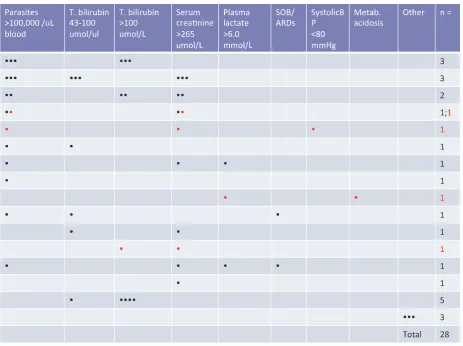
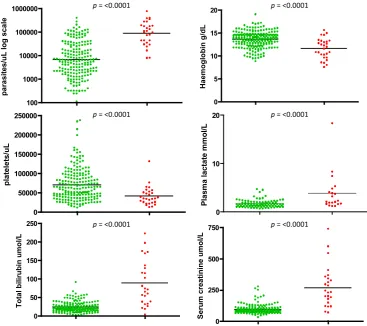
(12%) of these had complications and four (17%) patients died, Table 1. Parasitaemia, total bilirubin, serum creati-nine and plasma lactate were significantly higher in the complicated group, Fig. 1. Parasitaemia was not used as a
criterion to score severe disease. The study ofP. knowlesi
malaria is relatively new, and markers of severe disease are preliminary but suggest that patients with parasitaemia
>35 000 parasites/ll, bilirubin>43lmol/l, serum
creati-nine>256lmol/l or platelets <45 000/ll are at risk [12,
19].P. knowlesiis unusual among the parasites that infect human and non-human primates because the asexual part of the life cycle, the erythrocytic cycle associated with clin-ical signs and symptoms, takes 24 h to complete rather than 48 and 72 h in other types of malaria. Therefore,
para-sitaemia increases daily inP. knowlesiinfections, increased
parasitaemia is associated with disease severity, and while multiplication rates are probably variant specific and the number of merozoites produced will need to be factored in,
patients with suspected P. knowlesi infection require
urgent diagnosis and rapid access to optimal treatment.
Virulence
Plasmodium knowlesiisolates collected from human infec-tions are genetically diverse [7, 9]. Parasitaemia is associ-ated with disease severity and we asked the question are someP. knowlesivariants more virulent than others? We
sequenced two P. knowlesi genes responsible for parasite
invasion of erythrocytes and found two genetically distinct
clusters of one of theP. knowlesigenes encoding
erythro-cyte invasion proteins,P. knowlesi normocyte binding
pro-tein xa(Pknbpxa) [19, 21]. We found that 44% and 56% of
patients were infected withPknbpxacluster 1 andPknbpxa
cluster 2, respectively. The clusters contained single nucle-otide polymorphisms that allowed for differentiation of haplotype groups with 2 or three alleles among the
P. knowlesiisolates. Analysis of the alleles with the clini-cal and laboratory variables in the patient cohort found that patients infected with particular allelic forms of clus-ter 2 had increased markers of disease severity including parasitaemia [19]. Not all patients with complications were
p = <0.0001 p = <0.0001
p = <0.0001 p = <0.0001
p = <0.0001 p = <0.0001
[image:3.595.121.489.82.408.2]infected with cluster 2 parasites but there were more patients than expected with complications in this cluster
(Fig. 2). This suggests that, in nature, some P. knowlesi
variants may be more virulent in the human-host popula-tion than others. This study was conducted in Sarawak, Malaysian Borneo, and may explain some of the apparent
differential susceptibility of humans to P. knowlesi
infec-tion in Malaysia and other areas within the region. More work is required to determine genetic diversity of
P. knowlesiacross the Southeast Asian region and associ-ated parasite virulence.
Host switch events
Plasmodium knowlesi infections occur throughout the Southeast Asian region. The region is separated by high mountain ranges and large expanses of water including the South China Sea, the Sulu Sea and Andaman Sea
[21]. P. knowlesi is a parasite of non-human primates
that do not cross oceans and rural human populations at risk tend to be local. It seems likely that, following the
primary emergence of P. knowlesi and ancient dispersal
events, P. knowlesi, populations have evolved in local
geographical isolation. Each location reporting human infections is most likely dealing with different genetic
variants of P. knowlesl [22]. The recent discovery of
P. knowlesi malaria in humans was in Kapit, Malaysian
Borneo, and further study found that naturally acquired
P. knowlesi infections occurred throughout Malaysian Borneo, Peninsular Malaysia, all geographically distinct areas, and subsequently in most parts of Southeast Asia [7, 11, 21, 23]. Therefore, it is important not to extrapo-late studies on genetic diversity and virulence between geographically distinct transmission sites.
Even so the multiple entry events recorded across South-east Asia may have been the result of parasite adaptation to the human host and clonal expansion but the infections are not clonal or related to any one index case or location [7].
A study onP. knowlesiisolated from the natural macaque
hosts and human infections in Sarawak did not identify genetic clustering of parasites to either host, strongly sug-gesting a zoonotic origin for the infections in Sarawak [9]. However, children in Sabah were infected without any obvious risk behaviour for acquiring a zoonotic infection, such as spending time in the forest [23]. Also, and perhaps
most worrying, Anopheles balabacensis is a vector of
P. knowlesiin Sabah [16].An balabacensisis better known
as a vector of P. falciparum in Sabah and therefore well
placed to channel a host switch event forP. knowlesifrom
macaque-to-human to human-to-human malaria transmis-sion at this location [24, 25]. In Vietnam, another geo-graphically distant and distinct location, children have
asymptomatic low-levelP. knowlesiinfections mixed with
P. falciparum and P. vivax [26]. Anopheles dirus is the main malaria vector in this region of Vietnam and
trans-mits all three parasite species, P. knowlesi, P. falciparum
and P. vivax, concurrently [26, 27].P. knowlesi warrants careful observation to pre-empt or at least contain a host
switch event in any number of Southeast Asian locations–
quite a monumental task.
Treatment
Earlier studies reported that P. knowlesi responds well to
currently available antimalarial compounds including chloroquine [7, 12, 28]. The level of sensitivity supports an absence of drug selection pressure implying a recent
emergence or zoonotic origin for P. knowlesi.Studies
designed to properly assess clinical and parasitological
responses of P. knowlesi to treatment highlight some
important differences in response. In 2005, inherent
me-floquine resistance of P. knowlesi in experimentally
infected Rhesus macaques was reported [29]. Also,
P. knowlesi isolates from human infections responded
poorly to mefloquineex vivo[30]. Furthermore, the
para-sitaemia in a patient, who presented with severe
P. knowlesi malaria during a second infection, increased following mefloquine treatment [31]. Nonetheless, other
patients with uncomplicated P. knowlesi infections
responded to mefloquine treatment [32, 33].
Fig. 2 The number of expected and observed cases ofPlasmodium knowlesimalaria infected with parasites withPlasmodium knowlesi nor-mocyte binding protein (pknbp) xacluster 1 or cluster 2 parasites.
Pknbpxahaplotypes were generated for 138 patient isolates in a subset of 147 patients. In the study, 44% of patients were infected with
Pknbpxacluster 1 type parasites and 56% withPknbpxacluster 2 type parasites. The patients were then grouped into uncomplicated (UC)
[image:4.595.61.281.83.231.2]Plasmodium knowlesi responds to chloroquine albeit
with a higher IC50 ex vivo [30]. Chloroquine should be
used with caution because in the absence of species-spe-cific diagnostic tests in most regions, the risk of
misdiag-nosing P. falciparum, mostly chloroquine resistant, as
P. knowlesiwould put patients at risk.
The most compelling evidence supports the use of arte-misinin derivatives either as intravenous artesunate or as oral combination therapies to treat complicated and
uncomplicated P. knowlesi infections. Patients in Sabah
with severe knowlesi malaria were more likely to survive when given intravenous artesunate than quinine [28]. In another study in Sabah patients with all cause, malaria were given oral artemisinin combination therapy or artesu-nate IV immediately on diagnosis. Most of the patients had knowlesi malaria, 39% had severe symptoms and all sur-vived [16]. Both studies report shorter parasite clearance times for the artemisinin based therapies than chloroquine
or quinine. AlsoP. knowlesiresponded better to
artemisi-nin derivatives than all other compoundsex vivo[30]. In
other studies, IV artesunate performed better than quinine in treating severe falciparum malaria [34]. It should be
noted that patients with P. knowlesi infections can be
symptomatic at low parasitaemia, lower than the sensitivity of thick film microscopy [12]. Currently, there is no specific
or sensitive diagnostic test forP. knowlesimalaria [35].
Control of zoonotic malaria
Human cases ofP. knowlesi malaria occur across
South-east Asia [10]. This region is known for human, animal, plant, insect, geographical and geological diversity [36]. Apart from parts of Malaysia and Vietnam, there is little
information on P. knowlesi transmission, reservoirs of
infection, vectors and risk of human infection [27, 37, 38]. Without this information, it will be difficult to design
control measures for zoonoticP. knowlesiacquired in the
jungle setting, over and beyond use of prophylaxis when
spending time in areas where other patients with
P. knowlesi have been infected. The pragmatic solution would be to encourage location-specific vector, parasite and natural host monitoring and surveillance. These mea-sures are currently costly, require manpower and are logistically difficult. Perhaps a meeting of minds is required to develop alternative sampling and monitoring methods for forest settings that would capture the required data on parasite prevalence, vector capacity, nat-ural hosts but using minimal manpower. Not an easy problem to solve on the backdrop of competing public
health problems at each location. In areas where
P. knowlesi is transmitted in human settlements or even
human-to-human, existing malaria control measures
would be expected to be effective.
Malaria elimination
According to the World Health Organization ‘Malaria
elimination is the interruption of local mosquito-borne malaria transmission, i.e. the reduction to zero of the incidence of malaria infection in a defined geographical area.’ [39]. Malaysia has an excellent record in malaria control; however, Malaysia and other countries in South-east Asia, pursuing malaria elimination, need to carefully
consider P. knowlesi. There is some evidence that
P. knowlesi enters human populations where national human-host-adapted, malaria control initiatives are suc-cessful, a good example of this is Malaysia [13, 40]. This poses two questions: (i) Will removal of the
human-host-adapted species open a new host niche for P. knowlesi?
or (ii) By removing human host challenge, particularly withP. vivax, are humans more susceptible toP. knowlesi
through loss of cross protection?
Both scenarios are worth taking seriously. The
rela-tively large number of P. knowlesi cases was discovered
in Malaysia [7]. The study was prompted by the report of
atypical cases of P. malariae in the area. It is possible
that these cases were more visible as cases ofP.
falcipa-rumandP. vivaxwere controlled. Or were there more of these cases as immunity to malaria declined along with
P. vivax and P. falciparum? Returning to P. knowlesi
induced pyretic therapy in tertiary syphilis. Patients who
were previously treated withP. vivaxwere partially
resis-tant to subsequent P. knowlesi infection suggesting a
degree cross immunity [6].
There is some debate about the prevalence of zoonotic
malaria –Is P. knowlesi being better recognized because
of heightened awareness and PCR identification? If so,
then the prevalence of P. knowlesi may not have
increased, we are simply looking harder, difficult to argue
against. However, the number of cases ofP. knowlesi in
Sabah do seem to be increasing [13]. Regardless, aware-ness brings the opportunity to deal with a large entry and host switch events that might threaten malaria elimina-tion in the area.
If the ultimate goal is malaria eradication, the WHO
definition is much more specific ‘Malaria eradication is
defined as the permanent reduction to zero of the world-wide incidence of malaria infection caused by a particular malaria parasite species.’ [39]. If eradication is the goal,
then it would be possible to eradicate P. falciparum,
P. vivax, P. malariae and P. ovale while still tolerating
P. knowlesiin Southeast Asia.
Summary
transmission sites are at risk. P. knowlesi remains largely zoonotic, but transmission near human settlements is
sus-pected in Sabah.P. knowlesi is diverse and causes severe
disease in at least 10% of those infected in Sabah and
Sarawak. Patients with severe and fatalP. knowlesi
infec-tions fulfil the WHO criteria for severe falciparum malaria but without coma or severe adult anaemia. Healthcare
professionals should suspect P. knowlesi in patients and
blood donors with a history of time spent in the jungles of Southeast Asia. Blood donor screening protocols, to
detect malaria exposure, use recombinant P. falciparum
and P. vivax antigen. While there may be some cross
reactivity between P. knowlesi and the phylogenetically
relatedP. vivax, these reagents could not be used reliably
to detect antibodies to P. knowlesi. At the moment, the
risk of donor blood infection with P. knowlesi would be
expected to be low; however, a history of time spent in the jungles of Southeast Asia may warrant donor referral for a 1-year period.
Importantly, evidence suggests that rapid diagnosis and
immediate treatment with artemisinin derivatives is
appropriate for this potentially virulent parasite with a short erythrocytic life cycle.
Acknowledgements
JCS and MAA were solely responsible for this review arti-cle.
Con
fl
icting interests
The authors have no conflicts to report.
Funding
Data in Table 1, Figs 1 and 2 MRC grant G0801971.
References
1 Freimanis G, Sedegah M, Owusu-Ofori S,et al.: Investigating the prevalence of transfusion transmission of Plasmodium
within a hyperendemic blood donation system.Transfusion
2013;53:1429–1441
2 Owusu-Ofori AK, Bates I: Impact of inconsistent policies for transfusion-transmitted malaria on clinical practice in Ghana.
PLoS ONE2012;7:e34201
3 Noubouossie D, Tagny CT, Same-Ekobo A,et al.: Asymptom-atic carriage of malaria parasites in blood donors in Yaounde.
Transfus Med2012;22:63–67
4 Tagny CT, Owusu-Ofori S, Mbanya D,et al.: The blood donor in sub-Saharan Africa: a review.Transfus Med2010;20:1–10 5 Owusu-Ofori AK, Parry C, Bates I: Transfusion-transmitted
malaria in countries where malaria is endemic: a review of
the literature from sub-Saharan Africa.Clin Infect Dis2010;
51:1192–1198
6 Coatney GR, Collins WE, Warren M, et al.: Plasmodium knowlesi; in Coatney GR (ed.):The Primate Malarias. Wash-ington, DC, USA, Government Printing Office, 1971:317– 333.
7 Singh B, Kim Sung L, Matusop A, et al.: A large focus of naturally acquiredPlasmodium knowlesiinfections in human beings.Lancet2004;363:1017–1024
8 Divis PC, Shokoples SE, Singh B, et al.: A TaqMan real-time PCR assay for the detection and quantitation ofPlasmodium knowlesi.Malar J2010;9:344
9 Lee KS, Divis PC, Zakaria SK, et al.:Plasmodium knowlesi:
reservoir hosts and tracking the emergence in humans and macaques.PLoS Pathog2011;7:e1002015
10 Cox-Singh J: Zoonotic malaria: Plasmodium knowlesi, an emerging pathogen.Curr Opin Infect Dis2012;25:530–536 11 Cox-Singh J, Davis TM, Lee KS, et al.:Plasmodium knowlesi
malaria in humans is widely distributed and potentially life threatening.Clin Infect Dis2008;46:165–171
12 Daneshvar C, Davis TM, Cox-Singh J,et al.: Clinical and lab-oratory features of human Plasmodium knowlesi infection.
Clin Infect Dis2009;49:852–860
13 William T, Rahman HA, Jelip J,et al.: Increasing incidence of
Plasmodium knowlesimalaria following control ofP. falcipa-rumandP. vivaxMalaria in Sabah, Malaysia.PLoS Negl Trop Dis2013;7:e2026
14 Chin W, Contacos PG, Coatney GR,et al.: A naturally acquit-ed quotidian-type malaria in man transferable to monkeys.
Science1965;149:865
15 2013: World Health Organization: Management of Severe malaria–A Practical Handbook, 3rd edn. http://www.who.int/ malaria/publications/atoz/9789241548526/en/ [last accessed 15th September 2014].
16 Barber BE, William T, Grigg MJ, et al.: A prospective com-parative study ofknowlesi,falciparum, andvivaxmalaria in Sabah, Malaysia: high proportion with severe disease from
Plasmodium knowlesiandPlasmodium vivaxbut no mortality with early referral and artesunate therapy. Clin Infect Dis
2013;56:383–397
17 Cox-Singh J, Hiu J, Lucas SB,et al.: Severe malaria–a case of fatal Plasmodium knowlesi infection with post-mortem findings: a case report.Malar J2010;9:10
18 Barber BE, William T, Jikal M, et al.:Plasmodium knowlesi
malaria in children.Emerg Infect Dis2011;17:814–820 19 Ahmed MA, Pinheiro MM, Divis PC, Siner A, Zainudin R,
et al.: Disease progression inPlasmodium knowlesimalaria is linked to variation in invasion gene family members.PLoS neglected tropical diseases2014;8: e3086.
20 Willmann M, Ahmed A, Siner A, et al.: Laboratory markers of disease severity inPlasmodium knowlesiinfection: a case– control study.Malar J2012;11:363
22 Moyes CL, Henry AJ, Golding N, et al.: Defining the geo-graphical range of thePlasmodium knowlesireservoir.PLoS Negl Trop Dis2014;8:e2780
23 Silva JC, Egan A, Friedman R, et al.: Genome sequences reveal divergence times of malaria parasite lineages. Parasi-tology2011;138:1737–1749
24 Barber BE, William T, Dhararaj P,et al.: Epidemiology of Plas-modium knowlesimalaria in north-east Sabah, Malaysia: fam-ily clusters and wide age distribution.Malar J2012;11:401 25 Hii JL, Chew M, Sang VY,et al.: Population genetic analysis
of host seeking and resting behaviors in the malaria vector,
Anopheles balabacensis (Diptera: Culicidae). J Med Entomol
1991;28:675–684
26 Vythilingam I, Chan ST, Shanmugratnam C, et al.: The impact of development and malaria control activities on its vectors in the Kinabatangan area of Sabah, East Malaysia.
Acta Trop2005;96:24–30
27 Marchand RP, Culleton R, Maeno Y, et al.: Co-infections of
Plasmodium knowlesi, P. falciparum, and P. vivax among Humans and Anopheles dirus Mosquitoes, Southern Vietnam.
Emerg Infect Dis2011;17:1232–1239
28 Nakazawa S, Marchand RP, Quang NT,et al.: Anopheles dirus co-infection with human and monkey malaria parasites in Vietnam.Int J Parasitol2009;39:1533–1537
29 William T, Menon J, Rajahram G,et al.: SeverePlasmodium knowlesimalaria in a tertiary care hospital, Sabah, Malaysia.
Emerg Infect Dis2011;17:1248–1255
30 Tripathi R, Awasthi A, Dutta GP: Mefloquine resistance rever-sal action of ketoconazole – a cytochrome P450 inhibitor, against mefloquine-resistant malaria. Parasitology 2005;
130:475–479
31 Fatih FA, Staines HM, Siner A,et al.: Susceptibility of human
Plasmodium knowlesi infections to anti-malarials. Malar J
2013;12:425
32 Lau YL, Tan LH, Chin LC,et al.:Plasmodium knowlesi rein-fection in human.Emerg Infect Dis2011;17:1314–1315 33 Bronner U, Divis PC, Farnert A,et al.: Swedish traveller with
Plasmodium knowlesi malaria after visiting Malaysian Bor-neo.Malar J2009;8:15
34 Tanizaki R, Ujiie M, Kato Y,et al.: First case ofPlasmodium knowlesi infection in a Japanese traveller returning from Malaysia.Malar J2013;12:128
35 Dondorp A, Nosten F, Stepniewska K,et al.: Artesunate ver-sus quinine for treatment of severe falciparum malaria: a randomised trial.Lancet2005;366:717–725
36 Foster D, Cox-Singh J, Mohamad DS, et al.: Evaluation of three rapid diagnostic tests for the detection of human infec-tions withPlasmodium knowlesi.Malar J2014;13:60 37 Woodruff DS: Biogeography and conservation in Southeast
Asia: how 2.7 million years of repeated environmental fluctu-ations affect today’s patterns and the future of the remaining refugial-phase biodiversity.Biodivers Conserv 2010;19:919– 941
38 Tan CH, Vythilingam I, Matusop A, et al.: Bionomics of Anopheles latens in Kapit, Sarawak, Malaysian Borneo in relation to the transmission of zoonotic simian malaria para-sitePlasmodium knowlesi.Malar J2008;7:52
39 Vythilingam I:Plasmodium knowlesiin humans: a review on the role of its vectors in Malaysia.Trop Biomed2010; 27:1– 12
40 WHO: Malaria. World Health Organization. Overview of malaria elimination, 2014. http://www.who.int/malaria/areas/ elimination/overview/en/ [last accessed 15th September 2014].