Disambiguating past events: Accurate source memory for time and context de-pends on different retrieval processes
Bjorn M. Persson, James A. Ainge, Akira R. O’Connor
PII: S1074-7427(16)30056-9
DOI: http://dx.doi.org/10.1016/j.nlm.2016.05.002
Reference: YNLME 6439
To appear in: Neurobiology of Learning and Memory Received Date: 15 December 2015
Revised Date: 6 April 2016 Accepted Date: 8 May 2016
Please cite this article as: Persson, B.M., Ainge, J.A., O’Connor, A.R., Disambiguating past events: Accurate source memory for time and context depends on different retrieval processes, Neurobiology of Learning and Memory (2016), doi: http://dx.doi.org/10.1016/j.nlm.2016.05.002
TITLE: Disambiguating past events: Accurate source memory for time and context depends on
different retrieval processes
RUNNING HEAD: Disambiguating the past using time and context
AUTHORS:
(1) Bjorn M. Persson a
(2) James A. Ainge a
(3) Akira R. O’Connor a
a School of Psychology & Neuroscience, University of St Andrews
St Mary's Quad, South Street
St Andrews, Fife
KY16 9JP
Scotland, United Kingdom
CORRESPONDING AUTHOR: James Ainge, School of Psychology and Neuroscience, University of
St Andrews, St Mary's College, South Street, St Andrews, Fife, KY16 9JP, Scotland, UK. email:
Abstract
Current animal models of episodic memory are usually based on demonstrating
integrated memory for what happened, where it happened, and when an event took place.
These models aim to capture the testable features of the definition of human episodic memory
which stresses the temporal component of the memory as a unique piece of source information
that allows us to disambiguate one memory from another. Recently though, it has been
suggested that a more accurate model of human episodic memory would include contextual
rather than temporal source information, as humans’ memory for time is relatively poor. Here,
two experiments were carried out investigating human memory for temporal and contextual
source information, along with the underlying dual process retrieval processes, using an
immersive virtual environment paired with a ‘Remember-Know’ memory task. Experiment 1 (n
= 28) showed that contextual information could only be retrieved accurately using recollection,
while temporal information could be retrieved using either recollection or familiarity.
Experiment 2 (n = 24), which used a more difficult task, resulting in reduced item recognition
rates and therefore less potential for contamination by ceiling effects, replicated the pattern of
results from Experiment 1. Dual process theory predicts that it should only be possible to
retrieve source context from an event using recollection, and our results are consistent with this
prediction. That temporal information can be retrieved using familiarity alone suggests that it
may be incorrect to view temporal context as analogous to other typically used source contexts.
This latter finding supports the alternative proposal that time since presentation may simply be
reflected in the strength of memory trace at retrieval – a measure ideally suited to trace
strength interrogation using familiarity, as is typically conceptualised within the dual process
framework.
1. Introduction
The episodic memory system has been proposed to underpin our abilities to retrieve
temporal-spatial relations between events, the subjective experience of reliving an event,
autonoetic consciousness (Tulving, 1983), and mental time travel (Suddendorf & Busby, 2003).
As conscious recollection and mental time travel are difficult to demonstrate in non-human
animals, some researchers have suggested that episodic memory is a uniquely human cognitive
ability (Suddendorf & Busby, 2003; Tulving, 2002). The utility of animal models is clear, as they
allow for the study of episodic memory on a cellular and neural level currently not attainable in
humans. Consequently a broad body of research has focused on the content, rather than the
experience, of episodic memory to develop animal models (Clayton & Dickinson, 1998; Eacott &
Easton, 2012) with almost exclusive emphasis placed on the integration of what happened,
where it happened, and when (Clayton & Dickinson, 1998) or on which occasion it happened
(Eacott & Easton, 2010; Eacott & Norman, 2004). According to these criteria, episodic memory
and has been reported in rats (Eacott & Norman, 2004; Langston & Wood, 2010; Ergorul &
Eichenbaum, 2004; Babb & Crystal, 2005, 2006; Kart-Teke et al. 2006), mice (Davis et al. 2013),
birds (Clayton & Dickinson, 1998), chimpanzees (Martin-Ordas et al. 2013) and cuttlefish
(Jozet-Alves et al. 2013). In the absence of a demonstration of subjective experience to definitively
show correspondence across animal and human memory systems, the memory capability
demonstrated in the what-where-when (WWWhen) and what-where-which (WWWhich)
memory paradigms has been termed episodic-like memory (Clayton & Dickinson, 1998).
The use of these episodic-like memory paradigms has led to further debate as to
whether events are separated in memory using solely temporal information, as suggested by
WWWhen memory (Babb & Crystal, 2005, 2006; Clayton & Dickinson, 1998; Ergorul &
Eichenbaum, 2004; Roberts et al., 2008; Zhou & Crystal, 2009) or by the occasion in which they
took place using either temporal or non-temporal identifiers, suggested by WWWhich memory
(Eacott & Easton, 2010, 2012; Easton & Eacott, 2008). In spite of their central role within the
widely used WWWhen paradigm, humans rarely use specific temporal cues when remembering
episodes, relying instead on non-temporal information e.g. information about the weather,
people who were there, and environmental context (Friedman, 1993; Wagenaar, 1986; Wells et
al. 2014). Clearly, both temporal and non-temporal identifiers of an event can be thought of as
sources that specify conditions under which memories were encoded (Johnson et al. 1993), and
can be interrogated using standard human memory paradigms.
To date, relatively few attempts have been made to assess the construct validity of the
WWWhen or WWWhich paradigms by testing them within humans. Previous research with
information can be accurate (Easton, Webster, & Eacott, 2012; Holland & Smulders, 2011), the
two models engage different retrieval processes within the dual process framework (Easton et
al., 2012). Dual process theory states that memory can be retrieved using two processes,
recollection and/or familiarity (for reviews, see Vilberg & Rugg, 2008, and Yonelinas, 2002).
Within this framework, a memory supported by recollection is retrieved alongside its source,
which unambiguously supports the recognition judgement. Familiarity, on the other hand, does
not result in source retrieval—merely the awareness that the recognised stimulus relates to
something from the past. These processes are often assessed using what is known as a
Remember/Know (R/K) procedure in which participants are given a recognition memory test
for items and/or sources seen during a study phase (c.f. Jacoby, 1991). For correctly identified
items Remember and Know responses are given, where Remember corresponds to the process
of recollection and Know to the process of familiarity (Dewhurst et al. 2009). Given this
established operationalisation of the dual processes, the only retrieval process capable of
supporting source information is recollection. Melding the two discussed sets of frameworks, it
should therefore be expected that the temporal source component of WWWhen memories, and
the contextual source component of WWWhich memories would both necessarily recruit
recollection. This has led some researchers to suggest that recollection is truly episodic, while
familiarity, which does not require the retrieval of an integrated memory of multiple features of
an event, is not (Clayton & Dickinson, 1998; Easton et al., 2012)1.
Easton et al. (2012) examined retrieval processes in human participants by projecting
images of abstract figures on either a zebra or a checked background on to a large screen in a
lecture theatre. They showed that accurate retrieval of contextual information was possible only
using recollection. They also showed that, contrary to what would be expected within the dual
process framework, memory for the order of stimulus presentation could be retrieved
accurately using either recollection or familiarity. This finding questions the WWWhen model’s
assumptions of the integrity of temporal source cues to episodic memory, at least in humans.
Moreover, it suggests that retrieval of temporal sources should not be treated as equivalent to
contextual sources within the WWWhich model. There was an alternative explanation for the
familiarity-supported temporal source component which is that familiarity judgments can be
supported using memory strength (i.e. how little the encoding episode had decayed from
memory indicating how recently it was encountered) rather than the retrieval of a true
temporal source. We sought to conceptually replicate these findings using a longer sequence of
1
time points both during study and test (6 time points compared to 2). This allowed us to
examine the nature of the errors produced when attempting to use temporal source
judgements. If temporal source questions were being solved using memory strength rather than
retrieval of the precise temporal source then we would expect incorrect responses to cluster
around the position of the correct response within the sequence of presentation at encoding. We
additionally used an immersive testing environment to more closely match the conditions under
which temporal source has been shown to be integral to episodic memory in animals.
To this end, we assessed time and context retrieval in an immersive virtual environment
using an amended version of the standard Remember-Know procedure (Dewhurst et al., 2009;
Donaldson et al. 1996), with the only difference being that we asked for ‘Familiar’ instead of
‘Know’ responses in order to distinguish between the two familiarity processes suggested by
Dewhurst et al. (2009). Over two experiments, we used a paradigm, in which participants
moved through, and encountered a series of 3D objects in a virtual environment. We made the
environment as immersive as possible by projecting it onto a wall in a darkened room, which
was intended to give a strong sense of being present within the environment. During the study,
participants encountered objects in different weather contexts and at different times (points in
a sequence). Their memory for the items and their temporal or contextual sources was assessed
alongside a judgement of recollective experience: Remember judgements indicating that
participants could retrieve details surrounding the event when the object was presented,
indicative of retrieval using recollection; and Familiar judgements indicating that participants
only knew that an object had been seen without memory for surrounding information,
indicative of retrieval using familiarity. Based on Easton et al. (2012) as well as a recent paper
by Saive and colleagues (2015), we predicted that contextual source memory would be more
accurate following self-reported engagement of recollection compared to familiarity, but that
temporal source memory would be equally accurate across judgements that engaged
recollection or familiarity.
2. Materials and Methods
2.1. Experiment 1
2.1.1. Virtual Environment and stimuli
The virtual environment was created using the Valve Hammer World Editor (Valve
Software, 2006), was projected onto a 375 cm x 250 cm screen at 1024 x 768 resolution, and
was navigated through using a games console controller (Xbox 360, Microsoft). Participants
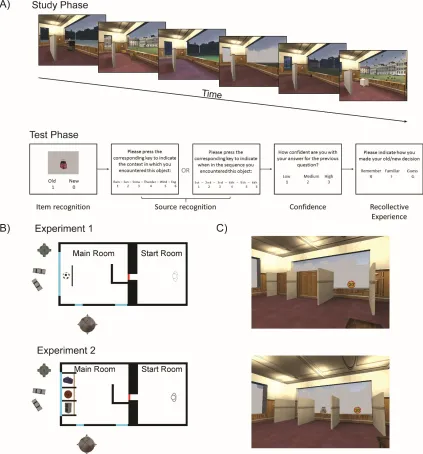
were seated 420 cm from the wall. The virtual environment consisted of two rooms connected
they encountered stimuli, (Figure 1A). The Main Room had three windows facing a Courtyard.
The Courtyard contained landmarks consisting of a sculpture, a car and a perimeter of buildings.
Context was manipulated by altering the weather conditions in the Courtyard whilst keeping
the landmarks constant. Six different contexts were used: sun, snow, lightning, rain, fog, and
wind (Figure 1B). Rain used the appearance and sound of rain hitting the windows. Wind used
leaves blowing in the courtyard and the sound of howling wind. Lightning used flashes and the
sound of thunder. Sun used clear blue skies and bird song. Fog used grey mist and was silent.
Snow used falling snowflakes and snow-covered ground and was silent.
A pool of 186 3D stimuli from the Valve Hammer and Garry’s mod databases
representing a range of everyday objects (see Figure 1A for examples) was used, from which 72
were randomly drawn for each participant. 36 objects were presented in the virtual
environment and the recognition test (targets), while the remaining 36 were only presented
during the recognition test (lures). Instructions and memory test were displayed on a laptop
using Psychophysics Toolbox version 3 (Brainard, 1997; Kleiner et al. 2007) for Matlab (Natick,
MA, 2013).
2.1.2. Participants
There were 32 participants (22 female) with an average age of 21.8 years. Four
participants stopped the study early, two due to feelings of nausea brought about by the high
level of immersion, and two due to technical errors. The results from the remaining 28 (19
female) participants with an average age of 22.0 years were used for analysis. Ethical approval
for the study was obtained from the University of St Andrews’ University Teaching and
Research Ethics Committee. All participants gave informed consent prior to taking part in the
study.
2.1.3. Procedure
Each Study Phase consisted of six self-paced trials. During a single trial, participants
made their way from the Start Room to the Main Room and located the stimulus behind the
barrier. They were instructed to identify the object and judge its size relative to the surrounding
furniture and give their response verbally, this response was not recorded but served as a
measure to ensure that participants attended to the stimuli. Participants then navigated back to
the start room. This procedure was repeated until six objects had been encountered. Each time
participants entered the Main Room a new object was presented and the context was changed
(randomised according to a Latin Square design). Within each Study Phase, each stimulus was
Each Test Phase consisted of 12 self-paced trials. Memory for the information seen in
the virtual environment was assessed using four different questions per trial. First, to assess
object recognition participants were first shown an image of an item on the screen and asked
whether it was ‘old’ (seen in the Virtual Environment; indicated using the ‘1’ key) or whether it
was ‘new’ (not seen in the Virtual Environment; indicated using the ‘0’ key).
Following the object recognition participants were asked about the source of the item.
Source questions either asked for the context the item was seen in or when in the presentation
sequence the item was seen. There was a 50:50 ratio of context and sequence question in each
test phase and the questions were randomised within participants. For both questions all
response options were displayed on the screen simultaneously. Responses were given using the
keys 1-6 on the keyboard. The order of the context response alternatives during the test phase
did not map on to the sequence in which they were presented during study. This was to reduce
the probability of participants using temporal information to retrieve context, and vice versa.
Source questions were asked regardless of whether participants responded that the item was
old or new. This was to allow for the analysis of source judgments in the absence of object
recognition. If participants were certain that an item was new they were instructed to pick a
source response at random. Participants subsequently rated their confidence in their source
response on a scale from 1 (low confidence) to 3 (high confidence). Finally, having participants
give a Remember (R), Familiar (F) or Guess (G) response, where Remember corresponded to
recollection and Familiar to familiarity, assessed recollective experience. This question was
asked last so as not to influence confidence assignment (Williams et al. 2013). Definitions for
these judgements, adapted from Gardiner et al. (1996), were provided at the beginning of the
experiment. Participants also had the option to review these definitions before each new test
phase:
• Remember - Recognition of the object brings back details of the experience when the object
was encountered in the virtual world.
• Familiar - Knowing that the object was encountered because of a feeling of familiarity,
without recollecting the particular occurrence.
• Guess - A decision strategy used when object information does not elicit either the
experience of remembering or that of familiarity.
There were six Study-Test Phases giving a total of 72 trials: 36 target trials (18 context trials
and 18 sequence trials); and 36 lure trials.
2.2.1. Virtual Environment and stimuli
The virtual environment was altered in Experiment 2 to create three stalls along the
short wall of the main room in which the objects were placed (see Figure 1C and 1D).
Items were drawn from the same pool as in Experiment 1, with 144 items randomly
selected for each participant. 108 of these were seen in the Virtual Environment and 36 acted as
lures in the test phase.
2.2.2. Participants
29 participants (20 female) with an average age of 22.7 were recruited. 5 participants
stopped the study early due to technical errors. This left 24 participants (16 female) with an
average age of 23.0 years whose data were analysed.
2.2.3. Procedure
The Study Phase in Experiment 2 followed the same structure as in Experiment 1, with
the exception that three objects were seen in each trial, which across 6 study-test blocks of 6
trials gave 108 to-be-remembered objects. In each trial an object was placed in each of the 3
individual stalls with a barrier in front of each one. Participants were instructed to navigate to
one stall at a time, on arrival at the stall the barrier would disappear and the object would be
visible for five seconds before disappearing (Figure 3).
Each Test Phase consisted of 12 self-paced trials, only 1 of the 3 to-be-remembered
items from each study trial was presented. Aside from this the Test Phase was identical to that
in Experiment 1. There were 6 study-test blocks resulting in a total of 36 target trials (18
context and 18 sequence trials) and 36 new lure trials over the entire experiment.
2.3. Statistics
Due to some missing values, a linear mixed model (LMM) was used to analyse the effect
of source (context/sequence) and recollective experience (Remember/Familiar) on accuracy of
retrieval in both Experiment 1 and 2. The LMM was selected by fitting models with different
covariance structures and choosing the most appropriate based on the model with the lowest
Akaike’s Information Criterion (AIC) and Bayesian Information Criterion (BIC). The covariance
structures assessed were first-order autoregressive (AR1), unstructured, and compound
symmetry. The LMM had source (context/sequence) and recollective experience
(Remember/Familiar judgments) as repeated measures. Source and recollective experience
The model evaluation found that the AR1 covariance structure resulted in the lowest
AIC and BIC values compared to compound symmetry and unstructured covariance structures,
where lower AIC and BIC values indicate a better model fit (see Table 1 and 2 in Supplementary
Materials for a comparison of covariance structures).
Accuracy was further compared to chance level using one-sample t-tests in order to see
whether performance in the context or sequence would be significantly above what would be
expected if participants were merely guessing. Chance level performance was calculated as 1/6,
as in each trial there was a 1 in 6 chance of getting the correct answer by simply guessing.
To examine the possibility that retrieval of temporal information using familiarity was
due to trace strength we examined serial position curves, plotting the proportion of error
responses for both sequence and context questions. The aim was to characterise each source
retrieval task as operating via a discrete threshold process, i.e. with randomly distributed
errors, or via continuous trace strength process, i.e. error rates gradually dropping off as with
increasing dissimilarity to the correct response option. For the sequence condition, this was
carried out by examining the proportion of responses around items presented in the 3rd and
4th sequence positions (3rd and 4th sequence position items, those in the middle of lists, were
chosen to provide maximal opportunity to examine the tails of the serial position curves). For
the context condition, serial position of incorrect responses was ordered according to frequency
of incorrect response within each context. These distributions were then averaged across all
contexts. It should be noted that the serial position ordering of the context condition items was
carried out to give the greatest opportunity to uncover a gradual drop-off serial position curve,
should one be present in the data.
The proportion of error responses were compared to chance levels using one-sample
t-tests in order to see whether the frequency with which they were made differed from what
would have been expected if participants were making errors at random. Here chance levels
were calculated as 1 minus the proportion of correct responses, divided by the number of
Figure 1. A) Schematic of the Study and Test Phase in both experiments. Images in the Study
Phase are from Experiment 1 where only one object was presented per trial. B) Overviews of the virtual environment and the outside landmarks for both Experiment 1 (top) and Experiment
2 (bottom). C) Screenshots showing the stalls in which objects were found in Experiment 2. The
top image shows one stall being opened while the other two remain unexplored. Bottom image
[image:11.612.128.551.74.528.2]3. Results
3.1. Experiment 1
3.1.1. Object Recognition
Object recognition accuracy was high, with the proportion of correctly identified targets
(hits) and correctly identified lures (correct rejections) at .94 (SD=0.13) and 0.95 (SD=0.14)
respectively. The proportion of R, F, and G responses was similar across context and sequence
questions. R responses followed context hits at a rate of 0.81 (SD=0.29), with F at 0.15
(SD=0.26) and G at 0.04 (SD=0.07). For sequence questions, R responses succeeded sequence
hits at a rate of 0.86 (SD=0.26) F at 0.11 (SD=0.20) and G at 0.03 (SD=0.09). G responses,
included to remove contamination of R and F responses by actual guesses (Gardiner et al.,
1996), were not analysed any further. A 2 (recollective experience: R/F) x2 (source:
context/sequence) ANOVA comparing the R and F response rates for context and sequence,
presented above, found a main effect of recollective experience, F(1,27)=65.20, p<0.001, ƞp2=0.71,
meaning that R responses were given at a significantly higher rate than F responses. The main
effect of source was nonsignificant, F(1,27)=0.40, p=0.84, ƞp2=0.001, as was the recollective
experience by source interaction, F(1,27)=1.46, p=0.24, ƞp2=0.05, suggesting that the R and F
response rates were not significantly different across context and sequence questions.
3.1.2. Source memory by recollective experience
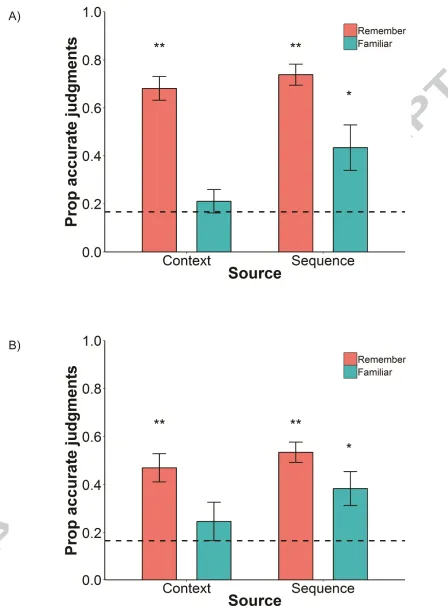
For questions about contextual information, participants were more accurate when
giving R judgments, 0.68 (SD=0.25), compared to when giving F judgments, 0.21 (SD=0.19).
Responses for sequence questions followed a similar pattern with higher accuracy for R
judgments, 0.74 (SD=0.23), than for F judgments, 0.43 (SD=0.33). The LMM showed that there
was a significant effect of recollective experience (R/F judgments), β=-0.37, SE=0.79, p<0.001,
indicating that source questions followed by R judgments were more accurate compared to F
judgments across both context and sequence. The effect of source (context/sequence) was not
significant, β=-0.57, SE=0.55, p=0.30, meaning that accuracy was not different between context
and sequence questions. Nor was the source by recollective experience interaction significant,
β=-0.11, SE=0.10, p=0.26.
We hypothesised that accurate retrieval of contextual information could only be
achieved using recollection and not familiarity, whereas sequence information could be
retrieved accurately using both recollection and familiarity. However, to fully assess this,
performance using the different retrieval strategies must be compared to chance performance
performance against chance levels using one-sample t-tests it was found that for context
questions, performance was only above chance for R, t(25)=10.37, p<0.001, d=2.01, but not for F,
t(15)=0.90, p=0.38, d=0.08. On the other hand, performance was above chance for both R,
t(27)=12.99, p<0.001, d=1.85, and F for sequence questions, t(11)=2.82, p=0.02, d=0.80. This
analysis indicates that context questions could only be answered above chance levels when
based on recollection-based retrieval, whereas sequence judgments can be made correctly using
either recollection or familiarity.
3.1.3. Trace strength
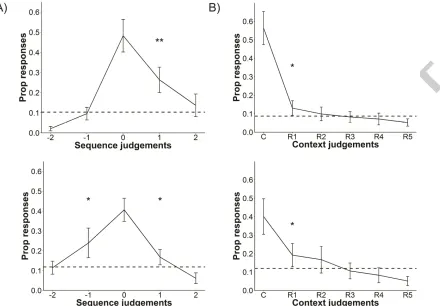
In the trace strength analysis for sequence errors (Figure 3A) in Experiment 1 only the
proportion of errors for pos-1 (that is one sequential position behind the correct response)
were significantly higher than chance level, t(27)=5.21, p<0.001. This indicates some forward
asymmetry in error judgments where participants tended to make errors that were one step
ahead of the correct option in the sequence. Analysis of context errors (Figure 3B) showed that
the proportion of errors for Rank 1, which is the average of the most common error made for
each context question, was above chance level, t(27)=2.26, p=0.032. None of the other ranks were
above chance.
3.1.4. Confidence judgments
Examining confidence judgments, R judgments tended to be given high levels of
confidence at 2.72 (SD=0.29) for context and 2.76 (SD=0.30) for sequence questions. F
judgments, on the other hand, had somewhat lower confidence levels with 1.96 (SD=0.30) for
context and 2.00 (SD=0.44) for sequence questions. A 2 (recollective experience: R/F) x2
(source: context/sequence) ANOVA revealed a significant effect of recollective experience ,
F(1,8)=49.59, p<0.001, ƞp2=0.86, while no significant effect was found for source , F(1,8)=0.48,
p=0.51, ƞp2=0.05, nor the source by recollective experience interaction, F(1,8)=0.002, p=0.96,
ƞp2<0.001. This suggests that participants were making R judgments with significantly higher
3.2. Experiment 2
3.2.1. Object recognition
Experiment 2 addressed the high object recognition scores and relatively low
proportion of Familiar responses in Experiment 1. Object discrimination remained relatively
high, with hits at 0.85 (SD=0.19), and correct rejections at 0.92 (SD=0.18). Similar to Experiment
1, proportions of R-F-G responses for correct source judgments were roughly equal following
context hits, with R judgments being given 0.89 (SD =0.17) of the time and F 0.11 (SD =0.17),
and sequence hits, where R judgments had a rate of 0.84 (SD =0.16) and F at 0.16 (SD =0.16).
There were no G judgments for either context or sequence questions in Experiment 2. As there
were no G judgments, the proportions of R and F judgments were not independent meaning that
an ANOVA could not be carried out. Instead a paired sample t-test was used to compare the
proportion of R responses between context and sequence questions. This t-test was
non-significant, t(22)=1.49, p=0.15, indicating that the proportions of R judgments given to context
and sequence questions were not different, and in extension neither were the proportions of F
judgments for context and sequence significantly different.
3.2.2. Source memory by recollective experience
Context accuracy was higher when justified by R judgments, 0.47 (SD=0.29) compared
to when justified by F judgments, 0.25 (SD=0.34). The same pattern, although attenuated, was
seen for sequence questions where accuracy followed by R judgments were 0.53 (SD=0.21)
relative to an accuracy of 0.38 (SD=0.32) for sequence questions followed by F judgments.
Results from the LMM revealed that there was no significant effect of recollective experience in
Experiment 2, β=-0.15, SE=0.82, p=0.07, suggesting that accuracy was not difference between R
and F judgments across context and sequence questions. Furthermore, the effect of source, β
=-0.06, SE=0.69, p=0.35, as well as the source by recollective experience interaction, β=-0.07,
SE=0.11, p=0.48, were non-significant.
As in Experiment 1, accurate retrieval of source information was examined using one
sample t-tests. These demonstrated that for context questions performance was above chance
for R, t(23)=5.16, p<0.001, d=1.05, but not for F, t(17)=1.01, p=0.33, d=0.24. For time questions,
performance was above chance for both R, t(23)=8.70, p<0.001, d=1.77, and F, t(19)=3.07, p=0.006,
d=0.67. This again demonstrates that participants could only answer context questions
accurately using recollection, but not familiarity. Sequence questions, on the other hand, could
3.2.3. Trace strength
In the trace strength analysis In Experiment 2, the proportion of errors were above
chance for pos1, t(23)=2.62, p=0.015, and neg1, t(23)=3.35, p=0.003. Here errors cluster around
the correct temporal position which could argue for the use of trace strength to retrieve
temporal information. Having a general idea of when in the sequence an item was presented
this could narrow the correct temporal accuracy down to a scale of +1 to -1 position, in line with
trace strength spanning the most temporal proximal positions.
For context errors in Experiment 2, only the proportion of error judgments for Rank 1
was above chance level, t(23)=2.34, p=0.028. Similar to the sequence errors, the proportions of
context errors were not randomly distributed across all response options. Instead incorrect
responses tended to cluster in the most common error response category.
3.2.4. Confidence levels
Confidence judgments, R judgments for context and sequence were 2.43 (SD=0.58) and
2.39 (SD=0.46) respectively. For F judgments confidence levels were lower at 1.55 (SD=0.36) for
context questions and 1.64 (SD=0.41) for sequence. A 2 (recollective experience: R/F) x2
(source: context/sequence) ANOVA was run, again showing a main effect of recollective
experience, F(1,14)=61.08, p<0.001, ƞp2=0.81, but not for source, F(1,14)=0.27, p=0.61, ƞp2=0.02, nor
the interaction between source and recollective experience, F(1,14)=0.87, p=0.36, ƞp2=0.06. As in
Experiment 1 this demonstrates that R judgments were overall more confident than F
Figure 3. A) Proportion of error responses for sequence judgments for Experiment 1 (top) and Experiment 2 (bottom). 0 corresponds to correct responses, while positive and negative
integers indicate the temporal position of responses after or before the correct response. B)
Proportion of error responses for context questions in Experiment 1 (top) and Experiment 2
(bottom). C indicates the proportion of correct responses across contexts. Rank 1 (R1)
corresponds to the average of the most frequent error for each type of context, Rank 2 (R2) is
the average of the 2nd most frequent error, etc. Dotted lines indicate chance level. Error bars
represent confidence intervals.
4. Discussion
Our hypothesis, based on the operationalisation of recollection within the dual process
model (Yonelinas, 2001) and a previous study examining retrieval processes underpinning the
WWWhich and WWWhen paradigms (Easton et al., 2012; Saive et al., 2015), was that accurate
memory for objects in context would only be possible using a recollection strategy, while
accurate memory for objects within a sequence would be supported by either recollection or
familiarity. Results from the two experiments presented here support this hypothesis. We
demonstrated that while context can only be accurately retrieved using recollection (the
accurately using either recollection or familiarity (the retrieval process underpinning F
responses).
There are two ways in which these data can be interpreted. The first is that the time an
event took place (here defined as its place in a sequence) cannot be used as a source as this
would mean it should only be possible to retrieve that information using recollection. This
would have implications for using temporal information as a basis for the definition of episodic
memory and for using the WWWhen paradigm to model it in animals. Alternatively these data
could show that familiarity can be used to retrieve some kinds of source information
(time/sequence) and as such should be considered to be as ‘episodic’ as recollection.
While these results do not discount time as a valid source in episodic memory as it can
be retrieved using recollection, they do highlight that there are instances in which the retrieval
of temporal information violates the assumptions of source memory under the dual process
theory, where memory for a source is argued to rely on recollection alone (Yonelinas, 1999).
What is clear from our data is that context information does conform to the accepted view of
source information in that it can only be retrieved using recollection and as such this supports a
more inclusive model of episodic memory in which events are defined by their occasion,
including both time and context (Eacott & Easton, 2010; Eacott & Norman, 2004), rather than by
temporal information alone as suggested by what-where-when memory (Cheke & Clayton,
2010; Eichenbaum & Fortin, 2003).
These results can also be viewed in relation to the unitization of stimulus-source
associations. In some instances an item and its source, can be encoded as a unit and be retrieved
without reference to other units using familiarity. However, for other events sources are
encoded as separate units from the item and so memory of the event requires an association to
be made between item and source. Retrieval of this integrated memory requires recollection
(Diana et al. 2011; Diana et al. 2008; Yonelinas, 1999). In the case of the present study,
item-context associations might have been encoded through the latter process, where weather
conditions were encoded as a separate unit to the object. On the contrary, sequence information
might instead be encoded as a feature of the item itself similar to colour and size, thus enabling
the use of familiarity in correct retrieval (Yonelinas, 1999, 2002). It has been suggested that
some associative memory might be influenced by a degree of familiarity, such as temporal order
judgments relying on the trace strength of an item to be placed in time (Yonelinas, 2002). While
we asked participants for specific temporal judgments (i.e. the exact temporal position an item
was presented) rather than a relative judgment, it is unlikely that our task could have been
solved solely by the use of trace strength. Trace strength could, however, have contributed
towards an accurate judgment by distinguishing the correct option from more distant
evidence supporting this was found in the trace strength analysis where it was shown that
errors in temporal judgments tended to cluster around the correct response, and that the
proportions of such error judgments were significantly greater than expected by chance. The
use of familiarity to accurately retrieve sequential information might pose a problem for
theories of temporal memory where time is seen as an entirely separate component to item and
space (Eichenbaum & Fortin, 2003; Kraus et al., 2013). The current findings suggest that in
some circumstances time might not be encoded separately from the object or event, but rather
as another feature.
Another interesting finding is that participants did not use temporal information
supported by familiarity to retrieve contexts, for example by knowing that an item was the third
in the sequence and that snow was the third context. This is consistent with Easton et al. who
showed that even when participants only need to remember the order of two contexts they do
not combine this with familiarity supported temporal information to solve the task. This is
perhaps not surprising as this strategy would be much harder to use in the current experiments
as participants would need to remember the order of the 6 context presentations at encoding.
However, this reinforces the finding that familiarity supported temporal judgement are not
combined with other information to help remember specific episodes.
It has recently been suggested that recollection of associations between objects and the
contexts in which they were experienced is aided by semantic links between the two (Saive et
al., 2015). For example, recollection of finding a beach ball on a beach may be aided by the
semantic link. However, semantic information cannot be used to recall the time at which (or
place within a sequence) the beach ball was experienced. In the current study this could mean
that semantic links between the objects and the contexts would make retrieval of contextual
sources easier. This was not found to be the case, however, as participants’ ability to accurately
recollect time at which an object was experienced was better than their ability to recollect the
context in which objects were experienced suggesting that semantic links to context do not
increase participants’ ability to recognise an object.
A further consideration is what our findings tell us about the use of time to disambiguate
previously experienced events. Counter to the widespread acceptance in the human cognitive
literature of familiarity and recollection as complementary episodic retrieval processes (Diana,
Yonelinas, & Ranganath, 2007; Yonelinas, 1994, 2002), some authors have suggested that
familiarity is a less episodic process than recollection (Easton et al., 2012; Holland & Smulders,
2011). According to this view, the fact that tasks using time to disambiguate events can be
solved using familiarity would call into question the validity of using time in tests of episodic
memory. However, one important consideration here is that there are many ways to think of
have used place in a sequence to define time of an event but other studies have utilised
measures of time, such as how long ago (Clayton & Dickinson, 1998; Roberts et al., 2008) or
what time of day an event took place (Zhou & Crystal, 2009). While it is clear that place in a
sequence can be remembered using familiarity it could be that these other measures of time
might require recollection for accurate retrieval.
Nevertheless, sequence memory has successfully been implemented in models of
episodic-like memory (Ergorul & Eichenbaum, 2004), and been demonstrated to rely on the
hippocampus (Agster, Fortin, & Eichenbaum, 2002; Devito & Eichenbaum, 2011; Fortin, Agster,
& Eichenbaum, 2002), which has been shown to be a critical part of the network that processes
episodic memory (Burgess, Maguire, & O’Keefe, 2002; Squire & Zola-Morgan, 1991;
Vargha-Khadem, 1997). Data from the current experiment might help to explain these findings. Our data
show that while sequence memory can be solved using familiarity the most accurate and
common process used to recall sequence information is recollection. Given that the
hippocampus has been implicated in accurate use of recollection (Fortin, Wright, & Eichenbaum,
2004; Sauvage, Fortin, Owens, Yonelinas, & Eichenbaum, 2008; Diana et al., 2007; for review see
Eichenbaum et al., 2007), it is not surprising that humans and animals with damage to the
hippocampus are impaired at remembering position within a sequence. Damage to the
hippocampus would remove participants’ ability to use recollection to solve the task resulting in
a deficit. However, these participants would still be able to use familiarity to solve the task even
though it is less accurate. This is consistent with the fact that animals with hippocampal lesions
are above chance in some measures of sequence memory even though they are impaired
relative to controls (Fortin et al. 2002).
5. Conclusions
The current data support the hypothesis that the contextual features of an event can
only be retrieved from memory using a recollection strategy. This is consistent with context
information being used as a source for episodic memory and supports a more inclusive
definition that does not rely solely on temporal information to disambiguate events. They also
suggest that while temporal information can be used as a source in some circumstances there
are occasions in which it can be retrieved using a strategy based on familiarity. This could be
interpreted as showing that time is not always a source, that time can be encoded as an intrinsic
feature of an item or that familiarity can sometimes be used to retrieve source information.
Acknowledgements
References
Agster, K. L., Fortin, N. J., & Eichenbaum, H. (2002). The hippocampus and disambiguation of overlapping sequences. The Journal of Neuroscience : The Official Journal of the Society for Neuroscience, 22(13), 5760–8. http://doi.org/20026559
Babb, S. J., & Crystal, J. D. (2005). Discrimination of what, when, and where: Implications for episodic-like memory in rats. Learning and Motivation, 36(2), 177–189.
http://doi.org/10.1016/j.lmot.2005.02.009
Babb, S. J., & Crystal, J. D. (2006). Episodic-like memory in the rat. Current Biology : CB, 16(13), 1317–21. http://doi.org/10.1016/j.cub.2006.05.025
Burgess, N., Maguire, E. a, & O’Keefe, J. (2002). The human hippocampus and spatial and episodic memory. Neuron, 35(4), 625–41. Retrieved from
http://www.ncbi.nlm.nih.gov/pubmed/12194864
Cheke, L. G., & Clayton, N. S. (2010). Mental time travel in animals. Wiley Interdisciplinary Reviews: Cognitive Science, 1(6), 915–930. http://doi.org/10.1002/wcs.59
Clayton, N. S., & Dickinson, A. (1998). Episodic-like memory during cache recovery by scrub jays.
Nature, 395(September), 272 – 274.
Crystal, J. D. (2010). Episodic-like memory in animals. Behavioural Brain Research, 215(2), 235– 43. http://doi.org/10.1016/j.bbr.2010.03.005
Davis, K. E., Easton, A., Eacott, M. J., & Gigg, J. (2013). Episodic-like memory for what-where-which occasion is selectively impaired in the 3xTgAD mouse model of Alzheimer’s disease.
Journal of Alzheimer’s Disease : JAD, 33(3), 681–98. http://doi.org/10.3233/JAD-2012-121543
Devito, L. M., & Eichenbaum, H. (2011). Memory for the order of events in specific sequences: contributions of the hippocampus and medial prefrontal cortex. The Journal of
Neuroscience : The Official Journal of the Society for Neuroscience, 31(9), 3169–75. http://doi.org/10.1523/JNEUROSCI.4202-10.2011
Dewhurst, S. A., Conway, M. A., & Brandt, K. R. (2009). Tracking the R-to-K shift: Changes in memory awareness across repeated tests. Applied Cognitive Psychology, 23(6), 849–858. http://doi.org/10.1002/acp.1517
Diana, R. A., Van den Boom, W., Yonelinas, A. P., & Ranganath, C. (2011). ERP correlates of source memory: unitized source information increases familiarity-based retrieval. Brain Research,
1367, 278–86. http://doi.org/10.1016/j.brainres.2010.10.030
Diana, R. A., Yonelinas, A. P., & Ranganath, C. (2007). Imaging recollection and familiarity in the medial temporal lobe: a three-component model. Trends in Cognitive Sciences, 11(9), 379– 86. http://doi.org/10.1016/j.tics.2007.08.001
Diana, R. A., Yonelinas, A. P., & Ranganath, C. (2008). The effects of unitization on familiarity-based source memory: testing a behavioral prediction derived from neuroimaging data.
Journal of Experimental Psychology. Learning, Memory, and Cognition, 34(4), 730–40. http://doi.org/10.1037/0278-7393.34.4.730
Donaldson, W., Mackenzie, T. M., & Underhill, C. F. (1996). A comparison of recollective memory and source monitoring. Psychonomic Bulletin & Review, 3(4), 486–90.
http://doi.org/10.3758/BF03214551
Eacott, M. J., & Easton, A. (2010). Episodic memory in animals: remembering which occasion.
Neuropsychologia, 48(8), 2273–80.
http://doi.org/10.1016/j.neuropsychologia.2009.11.002
http://doi.org/10.1016/j.lmot.2012.05.012
Eacott, M. J., & Norman, G. (2004). Integrated memory for object, place, and context in rats: a possible model of episodic-like memory? The Journal of Neuroscience : The Official Journal of the Society for Neuroscience, 24(8), 1948–53. http://doi.org/10.1523/JNEUROSCI.2975-03.2004
Easton, A., & Eacott, M. J. (2008). A new working definition of episodic memory : replacing “‘when’” with “‘which.’” Handbook of Episodic Memory, 18(08).
http://doi.org/10.1016/S1569-7339(08)00211-7
Easton, A., Webster, L. A. D., & Eacott, M. J. (2012). The episodic nature of episodic-like memories. Learning & Memory (Cold Spring Harbor, N.Y.), 19(4), 146–50.
http://doi.org/10.1101/lm.025676.112
Eichenbaum, H., & Fortin, N. (2003). Episodic memory and the hippocampus: it’s about time.
Current Directions in Psychological Science, 12(2), 53–57. http://doi.org/10.1111/1467-8721.01225
Eichenbaum, H., Yonelinas, A. P., & Ranganath, C. (2007). The medial temporal lobe and recognition memory. Annual Review of Neuroscience, 30, 123–52.
http://doi.org/10.1146/annurev.neuro.30.051606.094328
Ergorul, C., & Eichenbaum, H. (2004). The Hippocampus and Memory for “ What ,” “ Where ,” and “ When .” Learning & Memory (Cold Spring Harbor, N.Y.), 11(13), 397–405.
http://doi.org/10.1101/lm.73304.mals
Fortin, N. J., Agster, K. L., & Eichenbaum, H. B. (2002). Critical role of the hippocampus in memory for sequences of events. Nature Neuroscience, 5(5), 458–62.
http://doi.org/10.1038/nn834
Fortin, N. J., Wright, S. P., & Eichenbaum, H. (2004). Recollection-like memory retrieval in rats is dependent on the hippocampus. Nature, 431(7005), 188–91.
http://doi.org/10.1038/nature02853
Friedman, W. J. (1993). Memory for the time of past events. Psychological Bulletin, 113(1), 44– 66.
Gardiner, J. M., Java, R. I., & Richardson-Klavehn, A. (1996). How level of processing really influences awareness in recognition memory. Canadian Journal of Experimental Psychology/Revue Canadienne de Psychologie Expérimentale, 50(1), 114–122. http://doi.org/10.1037/1196-1961.50.1.114
Holland, S. M., & Smulders, T. V. (2011). Do humans use episodic memory to solve a What-Where-When memory task? Animal Cognition, 14(1), 95–102.
http://doi.org/10.1007/s10071-010-0346-5
Jacoby, L. L. (1991). A process dissociation framework: Separating automatic from intentional uses of memory. Journal of Memory and Language, 30(5), 513–541.
http://doi.org/10.1016/0749-596X(91)90025-F
Johnson, M. K., Hashtroudi, S., & Lindsay, D. S. (1993). Source Monitoring.pdf. Psychological Bulletin, 114, 3–28.
Jozet-Alves, C., Bertin, M., & Clayton, N. S. (2013). Evidence of episodic-like memory in cuttlefish.
Current Biology : CB, 23(23), R1033–5. http://doi.org/10.1016/j.cub.2013.10.021
Kart-Teke, E., De Souza Silva, M. a, Huston, J. P., & Dere, E. (2006). Wistar rats show episodic-like memory for unique experiences. Neurobiology of Learning and Memory, 85(2), 173–82. http://doi.org/10.1016/j.nlm.2005.10.002
http://doi.org/10.1016/j.neuron.2013.04.015
Langston, R. F., & Wood, E. R. (2010). Associative recognition and the hippocampus: differential effects of hippocampal lesions on object-place, object-context and object-place-context memory. Hippocampus, 20(10), 1139–53. http://doi.org/10.1002/hipo.20714
Martin-Ordas, G., Berntsen, D., & Call, J. (2013). Memory for distant past events in chimpanzees and orangutans. Current Biology : CB, 23(15), 1438–41.
http://doi.org/10.1016/j.cub.2013.06.017
Roberts, W. A., Feeney, M. C., Macpherson, K., Petter, M., McMillan, N., & Musolino, E. (2008). Episodic-like memory in rats: is it based on when or how long ago? Science (New York, N.Y.), 320(5872), 113–5. http://doi.org/10.1126/science.1152709
Saive, A.-L., Royet, J.-P., Garcia, S., Thévenet, M., & Plailly, J. (2015). “What-Where-Which” Episodic Retrieval Requires Conscious Recollection and Is Promoted by Semantic Knowledge. PloS One, 10(12), e0143767. http://doi.org/10.1371/journal.pone.0143767
Sauvage, M. M., Fortin, N. J., Owens, C. B., Yonelinas, A. P., & Eichenbaum, H. (2008). Recognition memory: opposite effects of hippocampal damage on recollection and familiarity. Nature Neuroscience, 11(1), 16–8. http://doi.org/10.1038/nn2016
Squire, L., & Zola-Morgan, S. (1991). The medial temporal lobe memory system. Science,
253(5026), 1380–1386. http://doi.org/10.1126/science.1896849
Suddendorf, T., & Busby, J. (2003). Mental time travel in animals? Trends in Cognitive Sciences,
7(9), 391–396. http://doi.org/10.1016/S1364-6613(03)00187-6
Tulving, E. (2002). Episodic Memory: From Mind to Brain. Annual Review of Psychology, 53, 1– 25.
Vargha-Khadem, F. (1997). Differential Effects of Early Hippocampal Pathology on Episodic and Semantic Memory. Science, 277(5324), 376–380.
http://doi.org/10.1126/science.277.5324.376
Vilberg, K. L., & Rugg, M. D. (2008). Memory retrieval and the parietal cortex: a review of evidence from a dual-process perspective. Neuropsychologia, 46(7), 1787–99. http://doi.org/10.1016/j.neuropsychologia.2008.01.004
Wagenaar, W. A. (1986). My Memory : A Study of Autobiographical over Six Years. Cognitive Psychology, 18, 225–252.
Wells, C., Morrison, C. M., & Conway, M. a. (2014). Adult recollections of childhood memories: What details can be recalled? Quarterly Journal of Experimental Psychology (2006), 67(7), 1249–61. http://doi.org/10.1080/17470218.2013.856451
Williams, H. L., Conway, M. a, & Moulin, C. J. a. (2013). Remembering and knowing: using another’s subjective report to make inferences about memory strength and subjective experience. Consciousness and Cognition, 22(2), 572–88.
http://doi.org/10.1016/j.concog.2013.03.009
Yonelinas, A. P. (1994). Receiver-operating characteristics in recognition memory: evidence for a dual-process model. Journal of Experimental Psychology. Learning, Memory, and Cognition,
20(6), 1341–54. Retrieved from http://www.ncbi.nlm.nih.gov/pubmed/7983467
Yonelinas, A. P. (1999). The contribution of recollection and familiarity to recognition and source-memory judgments: a formal dual-process model and an analysis of receiver operating characteristics. Journal of Experimental Psychology. Learning, Memory, and Cognition, 25(6), 1415–34. Retrieved from
http://www.ncbi.nlm.nih.gov/pubmed/10605829
Sciences, 356(1413), 1363–74. http://doi.org/10.1098/rstb.2001.0939
Yonelinas, A. P. (2002). The Nature of Recollection and Familiarity: A Review of 30 Years of Research. Journal of Memory and Language, 46(3), 441–517.
http://doi.org/10.1006/jmla.2002.2864
Disambiguating past events: Accurate source memory for time and context depends on different retrieval
processes, NLM-15-378
Highlights:
Context of encoding events can only be retrieved from memory using recollection.
Time of encoding events can be retrieved using either recollection or familiarity.