Letter Genome-wide patterns of DNA methylation in wild samples of two morphotypes of the threespine stickleback (Gasterosteus aculeatus)
Gilbert Smitha1
, Carl Smithb
, John G. Kennyc
, Roy R. Chaudhuric
& Michael G. Ritchieb
a
Department of Ecology and Evolutionary Biology, University of California, Irvine, CA 92697, USA; b
School of Biology, University of St Andrews, St. Andrews, Fife, KY16 8LB, UK; c
Centre for Genomic Research, Institute of Integrative Biology, University of Liverpool, Liverpool, L69 7ZB, UK.
1
Corresponding author: Gilbert Smith, Department of Ecology and Evolutionary Biology, University of California, Irvine, CA 92697, USA; telephone: (949) 824-7158; fax: (949) 824-2181, email: [email protected]
Running head: Divergent DNA methylation between stickleback morphs
Abstract
Epigenetic marks such as DNA methylation play important biological roles in gene expression regulation and cellular differentiation during development. To examine whether DNA methylation patterns are potentially associated with naturally occurring phenotypic differences we examined genome-wide DNA methylation patterns within G. aculeatus, using reduced representation bisulfite sequencing (RRBS). First, we identified highly methylated regions of the stickleback genome, finding such regions to be located predominantly in gene encoding regions, and associated with genes functioning in metabolism and biosynthetic processes, cell adhesion, signaling pathways and blood vessel development. Next, we identified putative differentially methylated regions (DMRs) of the genome between complete and low lateral plate morphs of G. aculeatus. We detected 77 DMRs that were positioned predominantly in intergenic regions. Annotations of genes associated with these DMRs revealed potential functions in a
number of known divergent adaptive phenotypes between G. aculeatus ecotypes, including cardiovascular development, growth and neuromuscular development.
DNA methylation is a chemical modification to DNA that occurs at cytosine residues (Cs), and in vertebrates is most often associated with CpG motifs. DNA methylation plays several important biological roles, including gene expression control, the regulation of transposable elements, cell type differentiation during development and allele-specific imprinting (Jones 2012). The effects of DNA methylation on gene expression regulation depend on the genomic context in which they occur (Song et al. 2005; Jones 2012). For example, promoter methylation is most often associated with repression of gene expression, whereas gene body methylation is correlated with gene expression, the latter playing a role in regulating alternative promoters (Maunakea et al. 2010). Contiguous regions of methylated CpGs often regulate gene expression, although even a single CpG within a transcription factor binding site could potentially influence gene regulation (Ziller et al. 2013). DNA methylation patterns can be environmentally responsive suggesting that epigenetic marks could underlie phenotypic plasticity, contributing to rapid adaptive evolution by bridging short-term plastic responses and more slowly accumulating adaptive genotypic changes (Pal and Miklos 1999; Jaenisch and Bird 2003; Bossdorf et al. 2008; Johnson and Tricker 2010; Richards et al. 2010; Smith et al. 2013).
2002). Stickleback ecotypes differ in body shape and size, number of lateral plates, osmoregulatory processes, life-history variables and mating behavior; traits that have
evolved convergently across populations numerous times. Phenotypic plasticity has also
played a role in the formation of G. aculeatus ecotypes and likely contributes to the high level of phenotypic variation seen globally (Boughman 2007). Freshwater ecotypes can evolve rapidly, in as few as ten generations (Klepaker 1993; Bell and Foster 1994), and plasticity has been demonstrated in a number of traits, including trophic morphology, allometry, behavior and aggression (Day et al. 1994; Day and McPhail 1996; Scotti and Foster 2007; Wund et al. 2008; Garduno-Paz et al. 2010; Svanbäck and Schluter 2012; Wund et al. 2012).
encompassing the epidermal, dermal and subcutaneous tissue, including muscle layers, allowing for the detection of differential methylation across multiple tissue types.
Each of the eight sequencing libraries were mapped to the stickleback genome (assembly BROADS1). On average, 92.8 million sequenced cytosines were methylated (sequenced as Cs), representing methylation of 58% of all sequenced cytosines. Only CpG context cytosine methylation was considered further because CpG methylation is the most common functional methylation in vertebrates. To confirm this, we quantified methylation at non-CpG motifs and found on average only 1% of the total non-CpG cytosines were methylated, suggesting a high C to T conversion efficiency. Patterns of DNA methylation data were examined in two ways: (1) to determine highly methylated CpGs within the stickleback genome, and (2) to look for putatively differentially methylated CpGs between complete and low morphotypes of stickleback. Differential methylation was carried out with three replicates of completely plated, and three replicates of the low plated morphs because two samples exhibited very divergent genome-wide methylaton patterns from all other individuals (Figure S1), and thus were excluded from the analysis.
region was obtained using the R package GenomicRanges (Lawrence et al. 2013), representing the nearest gene to a region containing highly methylated DNA. The positions of methylated regions within genomic features (promoter/exon/intron/intergenic) was determined, giving precedence to promoters > exons > introns > intergenic regions when features overlapped. Enrichment tests of the nearest genes to each highly methylated CpG region was carried out using the R package GOstats (Falcon and Gentleman 2007), using genome annotations from the G. aculeatus genome (Jones et al. 2012). GOstats uses a gene set enrichment test to examine significantly overrepresented gene functions based on biological process (BP), molecular function (MF) and cellular component (CC) gene ontology (GO) terms from the annotated G. aculeatus genome. P-values were corrected using a false discovery rate (FDR) calculated by two methods; q-value as per Storey and Tibrishani (2003) and a FDR calculated using SGoF (Carvajal-Rodriguez et al. 2009).
highly methylated regions, as measured by distance to their TSSs, which were located on average 7,172 bp away from the nearest TSS (Table S2, Figure S2).
Functional enrichment was performed in GOstats to determine the broad functions of genes near highly methylated regions of DNA. In general the patterns of functional enrichment was weak with no GO terms being significant after multiple test correction using the qvalue method of Storey and Tibrishani (2003). However, using corrected p-values from SGoF, 20 biological process, 17 molecular function and 3 cellular component GO terms were significant at a threshold of FDR < 0.05 (Table S3). Biological process GO terms included several metabolic and biosynthetic processes, cell adhesion, signaling pathways and blood vessel development and morphogenesis. Molecular function GO terms included protein binding, metal ion binding, DNA binding, and enzyme regulatory activity. Several genes were involved in epigenetic processes such as acyltransferase and methyltransferase activity involving histones.
DMR to trim regions and define the DMR boundary. DMRs were defined using an FDR cut-off of 0.15 for DMR choice and 0.15 for DMR trimming, and DMRs were also filtered to retain those with > 15% median methylation difference between morphs.
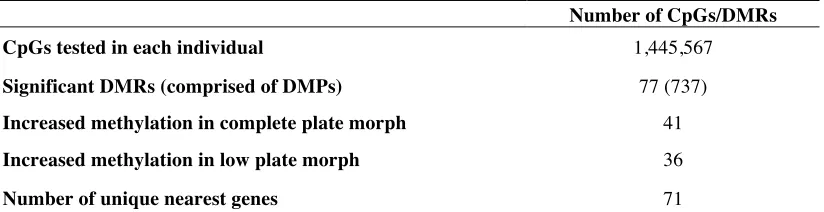
In total, 77 DMRs, comprising 737 differentially methylated positions, were detected between the morphotypes (Figure 1; Table 1; Tables S4-S6; Figure S3). A total of 41 DMRs demonstrated increased methylation in the complete morph and 36 in the low plate morph (Table 1). These must be very conservative estimates of likely levels of differential methylation given the number of samples analysed. The mitochondrial genome (chromosome MT, Figure 1) is not expected to show a strong signal of DNA methylation in vertebrates, due to the underrepresentation of CpG motifs in mitochondrial genes (Cardon et al. 1994). This underrepresentation was verified here, with low levels of methylation across mitochondrial genes and small differences in mitochondrial methylation between morphs.
DMRs were associated with their nearest genes, as measured from the transcription start site (TSS), resulting in 71 unique gene associations. The median distance to the nearest TSS was 9,754 bp (Table S5; Figure S4). DMRs predominantly lay within intergenic regions (assessed with precedence: promoters > exons > introns > intergenic regions, Figure 2b). Significantly more DMRs were discovered within intergenic regions (G test; p < 0.001), and fewer in promoter regions (G test; p < 0.001), than expected by chance (Figure 2b). Smoothed methylation proportions for each DMP within DMRs are available in Table S6.
significant biological process GO terms using a FDR threshold of < 0.05 (Table 2; Table S7), and 12 molecular function terms. Cellular component GO terms were not significant at this level. Significant biological process terms involved a range of functions including cardiovascular system development, regulation of cell migration, Notch signaling pathway, insulin-like growth factor pathway, cytoplasmic microtuble organization, amine catabolic process, response to stimulus and developmental growth. Molecular function GO terms included enzyme regulation and metabolic processes (Table S7).
Functional enrichment of significant DMRs was consistent with phenotypes that differ between marine and freshwater G. aculeatus ecotypes. Although our sampling was necessarily based on lateral plate phenotypes, these morphological differences are often consistent between marine and freshwater ecotypes. The population we surveyed is geographically distinct from the best-studied groups, however recent work has demonstrated a remarkable level of repeated genetic evolution in stickleback freshwater ecotype formation (Jones et al. 2012).
link between the F-actin cytoskeleton and the extracellular matrix (Ervasti and Campbell 1993; Hack et al. 2000). DMR-associated genes were also annotated with functions in cardiovascular system development such as forkhead box C1b, delta-like 4, T-box 3a, kringle containing transmembrane protein 1 and pleckstrin homology domain containing, family A member 7b.
environment-induced changes in growth rates might be epigenetically mediated and differ between stickleback morphotypes.
Several DMR-associated genes involved neuromuscular processes including katanin, NCAM2 and voltage-gated ion channel genes. Katanin plays a role in the regulation of synaptic growth at neuromuscular junctions in Drosophila (Mao et al. 2014) and NCAM2 is a neural cell adhesion molecule. Two voltage-gated ion channels were associated with DMRs, which are expressed in neuronal and muscle tissues (potassium voltage-gated channel, Shaw-related subfamily, member 3b and chloride channel 5). The Protocadherin alpha subfamily C, 2 (PCDHAC2) gene was associated with a single DMR. PCDH proteins are calcium-dependent neural cell adhesion molecules and are important for segmental plate development, a region of unsegmented paraxial mesoderm from which somites form (embryonic cells giving rise to dermal layers; Murakami et al. 2006). Additionally, two genes (jagged a1 and delta-like 4) were annotated with the Notch signaling pathway, which plays a role in neural differentiation.
Lande 2009; Scoville and Pfrender 2010). Genetic contributions to epigenetic variation between morphotypes, including allele-specific DNA methylation, may contribute to the patterns we detect, but our results do suggest that natural populations of stickleback are often highly methylated and that variation in patterns of methylation may be associated with ecologically important phenotypic differentiation.
Materials and Methods
G. aculeatus were collected from Loches Pool, a man-made pond in the University of St Andrews botanic gardens (Latitude 56.3359, Longitude -2.8075) (Spence et al. 2012). A census of 369 fish in 2012 showed that 18% of the population expressed the complete plate phenotype.
quantitative PCR and pooled for sequencing. Illumina reads for each library are available as fastq files in the ArrayExpress database (http://www.ebi.ac.uk/arrayexpress) under accession number X-XXXX-XXXX.
Illumina sequencing produced libraries of 100 bp paired-end reads, with an average library size of 59 million reads. Reads were trimmed to remove adaptor sequences and low quality regions using Trim Galore! (http://www.bioinformatics.babraham.ac.uk/projects/trim_galore/) and aligned to the stickleback genome using Bismark (Krueger and Andrews 2011). CpG positions were filtered to remove those with < 5× coverage in all eight samples. Per base methylation ratios (frequency of Cs and Ts aligned at each cytosine position), for each sample, were quantified, smoothed and analyzed in the R package BiSeq (Hebestreit et al. 2013).
Acknowledgements
We would like to thank St Andrews Botanic Garden for access to the sample site and
Margaret A. Hughes for sequencing assistance, Katja Hebesteit for advice on the
analysis, Daniel Barker for comments and two anonymous reviewers for their
constructive and insightful comments. This work was supported by the Natural
References
Bell MA, Foster SA. 1994. The evolutionary biology of the threespine stickleback: Oxford University Press, USA.
Bossdorf O, Richards CL, Pigliucci M. 2008. Epigenetics for ecologists. Ecol Lett. 11:106-115.
Boughman JW. 2007. Speciation in sticklebacks. In: Ostlund-Nilsson S, Mayer I, Huntingford FA, editors. Biology of the threespine stickleback. Boca Raton, FL: CRC Press. p. 83-126.
Cardon LR, Burge C, Clayton DA, Karlin S. 1994. Pervasive CpG suppression in animal mitochondrial genomes. Proc Natl Acad Sci USA. 91:3799-3803.
Carvajal-Rodriguez A, de Una-Alvarez J, Rolan-Alvarez E. 2009. A new multitest correction (SGoF) that increases its statistical power when increasing the number of tests. BMC Bioinformatics. 10:209-222.
Dai W, Bai Y, Hebda L, Zhong X, Liu J, Kao J, Duan C. 2014. Calcium deficiency-induced and TRP channel-regulated IGF1R-PI3K-Akt signaling regulates abnormal epithelial cell proliferation. Cell Death & Differentiation. 21:568-581. Dalziel AC, Ou M, Schulte PM. 2012. Mechanisms underlying parallel reductions in
aerobic capacity in non-migratory threespine stickleback (Gasterosteus aculeatus) populations. J Exp Biol. 215:746-759.
Day T, McPhail JD. 1996. The effect of behavioural and morphological plasticity on foraging efficiency in the threespine stickleback (Gasterosteus sp). Oecologia. 108:380-388.
Day T, Pritchard J, Schluter D. 1994. A comparison of two sticklebacks. Evolution. 48:1723-1734.
Ervasti JM, Campbell KP. 1993. A role for the dystrophin-glycoprotein complex as a transmembrane linker between laminin and actin. J Cell Biol. 122:809-823. Falcon S, Gentleman R. 2007. Using GOstats to test gene lists for GO term association.
Bioinformatics. 23:257-258.
Garduno-Paz MV, Couderc S, Adams CE. 2010. Habitat complexity modulates phenotype expression through developmental plasticity in the threespine stickleback. Biol J Linn Soc. 100:407-413.
Hack AA, Lam MY, Cordier L, Shoturma DI, Ly CT, Hadhazy MA, Hadhazy MR, Sweeney HL, McNally EM. 2000. Differential requirement for individual sarcoglycans and dystrophin in the assembly and function of the dystrophin-glycoprotein complex. J Cell Sci. 113:2535-2544.
Hebestreit K, Dugas M, Klein H-U. 2013. Detection of significantly differentially
methylated regions in targeted bisulfite sequencing data. Bioinformatics. 29:1647-1653.
Jaenisch R, Bird A. 2003. Epigenetic regulation of gene expression: How the genome integrates intrinsic and environmental signals. Nat Genet. 33:245-254.
Johnson LJ, Tricker PJ. 2010. Epigenomic plasticity within populations: Its evolutionary significance and potential. Heredity. 105:113-121.
Jones PA. 2012. Functions of DNA methylation: islands, start sites, gene bodies and beyond. Nat Rev Genet. 13:484-492.
Klepaker T. 1993. Morphological changes in a marine population of threespined
stickleback, Gasterosteus aculeatus, recently isolated in fresh water. Can J Zool. 71:1251-1258.
Krueger F, Andrews SR. 2011. Bismark: A flexible aligner and methylation caller for Bisulfite-Seq applications. Bioinformatics. 27:1571-1572.
Lande R. 2009. Adaptation to an extraordinary environment by evolution of phenotypic plasticity and genetic assimilation. J Evol Biol. 22:1435-1446.
Lawrence M, Huber W, Pages H, Aboyoun P, Carlson M, Gentleman R, Morgan MT, Carey VJ. 2013. Software for computing and annotating genomic ranges. PLoS Comp Biol. 9:e1003118.
Lira-Medeiros CF, Parisod C, Fernandes RA, Mata CS, Cardoso MA, Ferreira PCG. 2010. Epigenetic variation in mangrove plants occurring in contrasting natural environment. PLoS One. 5:e10326.
Mao CX, Xiong Y, Xiong Z, Wang Q, Zhang YQ, Jin S. 2014. Microtubule-severing protein Katanin regulates neuromuscular junction development and dendritic elaboration in Drosophila. Development. 141:1064-1074.
Maunakea AK, Nagarajan RP, Bilenky M, Ballinger TJ, D'Souza C, Fouse SD, Johnson BE, Hong C, Nielsen C, Zhao Y, et al. 2010. Conserved role of intragenic DNA methylation in regulating alternative promoters. Nature. 466:253-257.
McKinnon JS, Rundle HD. 2002. Speciation in nature: The threespine stickleback model systems. Trends Ecol Evol. 17:480-488.
Murakami T, Hijikata T, Matsukawa M, Ishikawa H, Yorifuji H. 2006. Zebrafish protocadherin 10 is involved in paraxial mesoderm development and somitogenesis. Dev Dyn. 235:506-514.
Nikoshkov A, Sunkari V, Savu O, Forsberg E, Catrina SB, Brismar K. 2011. Epigenetic DNA methylation in the promoters of the Igf1 receptor and insulin receptor genes in db/db mice. Epigenetics. 6:405-409.
Pal C, Miklos I. 1999. Epigenetic inheritance, genetic assimilation and speciation. J Theor Biol. 200:19-37.
Richards CL, Bossdorf O, Pigliucci M. 2010. What role does heritable epigenetic variation play in phenotypic evolution? Bioscience. 60:232-237.
Robinson BW. 2013. Evolution of growth by genetic accommodation in Icelandic freshwater stickleback. Proc Biol Sci. 280:20132197.
Roof DJ, Hayes A, Adamian M, Chishti AH, Li T. 1997. Molecular characterization of abLIM, a novel actin-binding and double zinc finger protein. J Cell Biol. 138:575-588.
Scotti MAL, Foster SA. 2007. Phenotypic plasticity and the ecotypic differentiation of aggressive behavior in threespine stickleback. Ethology. 113:190-198.
Scoville AG, Pfrender ME. 2010. Phenotypic plasticity facilitates recurrent rapid adaptation to introduced predators. Proc Natl Acad Sci USA. 107:4260.
Song F, Smith JF, Kimura MT, Morrow AD, Matsuyama T, Nagase H, Held WA. 2005. Association of tissue-specific differentially methylated regions (TDMs) with differential gene expression. Proc Natl Acad Sci USA. 102:3336-3341.
Spence R, Wootton RJ, Przybylski M, Zieba G, Macdonald K, Smith C. 2012. Calcium and salinity as selective factors in plate morph evolution of the three-spined stickleback (Gasterosteus aculeatus). J Evol Biol. 25:1965-1974.
Storey JD, Tibshirani R. 2003. Statistical significance for genomewide studies. Proc Natl Acad Sci USA. 100:9440-9445.
Svanbäck R, Schluter D. 2012. Niche specialization influences adaptive phenotypic plasticity in the threespine stickleback. Am Nat. 180:50-59.
West-Eberhard MJ. 2005. Phenotypic accommodation: Adaptive innovation due to developmental plasticity. J Exp Zool B Mol Dev Evol. 304:610-618.
Wund MA, Baker JA, Clancy B, Golub JL, Fosterk SA. 2008. A test of the "Flexible stem" model of evolution: Ancestral plasticity, genetic accommodation, and morphological divergence in the threespine stickleback radiation. Am Nat. 172:449-462.
Wund MA, Valena S, Wood S, Baker JA. 2012. Ancestral plasticity and allometry in threespine stickleback reveal phenotypes associated with derived, freshwater ecotypes. Biol J Linn Soc. 105:573-583.
Figure legends
Figure 1. Methylation differences between complete and low plate morphotypes. Methylation differences are the mean smoothed proportion of methylated Cs at CpG positions across three replicates of each morph. Positive change indicates increased methylation within the complete plate morph, and negative change increased methylation within the low plate morph. All chromosomes are presented, including the mitochondrial genome (MT) and genes positioned on scaffolds with unknown chromosomal locations (SCAF). Extreme differences are seen for chromosomes V and XVIII.
Supplementary figure legends are in Supplementary Figures document.
Supplementary table legends:
Table S1. Location of highly methylated regions within genomic features.
Cluster ID is the ID of each cluster of CpGs within a ‘CpG region’ (at least 10 CpGs within 100 bp distance). Each CpG region has at least 10 CpGs with > 90% methylation. Chromosomal locations of each cluster are 0-based coordinates. The width and location of the highly methylated region are included.
Table S2. Nearest TSS, gene and gene name to each highly methylated regions. Details of each CpG region are as Table S1. Ensembl transcript ID and the distance to the nearest TSS are provided, along with the Ensembl gene ID and gene name.
Table S3. Functional enrichment results of genes associated with highly methylated regions.
Enrichment tests were performed in GOstats, FDR adjustments of p-values for each term are provided, along with the number of genes within the gene list (Genes) and total in genome for each GO term. Separate tests were performed for biological process, molecular function and cellular component GO terms.
Table S4. Location of DMRs within genomic features.
Chromosomal coordinates of each DMR are provided and are 0-based coordinates, alongside the position of each DMR within genomic features. p-values, smoothed methylation proportion and median difference between morphs (complete minus low) are all median values of each DMP within DMRs.
Table S5. Nearest TSS, gene and gene name to DMRs.
Details of coordinates and methylation proportions of each DMR are as Table S4. Ensembl transcript ID and the distance to the nearest TSS are provided, along with the Ensembl gene ID, gene name and the functions of each gene if known.
Table S6. Smoothed methylation values of each DMP within DMRs.
The coordinates of each DMP are provided, as well as the CpG region (Cluster ID) and smoothed methylation proportions for each sample labeled as per Figure S1.
Table S7. Functional enrichment results for genes associated with DMRs.
Table 1. Differential methylation results.
Table includes the full number of CpG positions (CpGs) considered in the differential methylation analysis, the resulting number of significant differentially methylated regions (and positions; DMPs), the number of DMRs with increased methylation in each morphotype and the number of unique nearest genes to each DMR.
Number of CpGs/DMRs
CpGs tested in each individual 1,445,567
Significant DMRs (comprised of DMPs) 77 (737)
Increased methylation in complete plate morph 41
Increased methylation in low plate morph 36