micro-system
Yue Wang, Bruce R. Rae, Robert K. Henderson, Zheng Gong, Jonathan Mckendry, Erdan Gu, Martin D. Dawson , Graham A. Turnbull, and Ifor D. W. Samuel
Citation: AIP Advances 1, 032115 (2011); doi: 10.1063/1.3624456 View online: http://dx.doi.org/10.1063/1.3624456
AIP ADVANCES1, 032115 (2011)
Ultra-portable explosives sensor based on a CMOS
fluorescence lifetime analysis micro-system
Yue Wang,1Bruce R. Rae,2Robert K. Henderson,2Zheng Gong,3Jonathan Mckendry,3Erdan Gu,3Martin D. Dawson,3Graham A. Turnbull,1,aand Ifor
D. W. Samuel1,a
1Organic Semiconductor Centre, SUPA, School of Physics and Astronomy, University of St.
Andrews, North Haugh, St. Andrews, Fife KY16 9SS, United Kingdom
2Institute for Integrated Micro and Nano Systems, School of Engineering, University of
Edinburgh, King’s Buildings, Edinburgh, EH9 3JL, United Kingdom
3Institute of Photonics, SUPA, University of Strathclyde, Wolfson Centre, 106 Rottenrow,
Glasgow, G4 0NW, United Kingdom
(Received 23 May 2011; accepted 14 July 2011; published online 29 July 2011)
This work explores the use of a green-light-emitting copolymer as a chemosen-sor to detect nitroaromatic-based explosive vapors by recording photoluminescence (PL) and time-resolved PL decay. We show successful detection of 10 ppb 1,4-dinitrobenzene (DNB) vapor. Both a conventional time-correlated single photon counting (TCSPC) device and CMOS time-resolved fluorescence lifetime micro-system are used in the DNB detection. An ultra-portable on-site explosive sensor based on the micro-system has also been demonstrated. This gives rise to the poten-tial for real-time, reliable, inexpensive organic/inorganic hybrid explosives detection.
Copyright 2011 Author(s). This article is distributed under a Creative Commons Attribution 3.0 Unported License. [doi:10.1063/1.3624456]
I. INTRODUCTION
There is currently a critical need for rapid in-field methods of sensing explosive compounds due to the increased security issues and threats across the world. Non-biological sensors1are being developed to help us detect these dangerous materials. These sensors must fulfill a number of criteria, namely sensitivity, stability, reversibility and a capability for real-time signal processing. For nitroaromatic explosives, sensing of a few parts per billion or less of the analyte is required, with rapid and ideally reversible signal changes in the sensor. For in-field applications, a portable system would be advantageous.
Conjugated polymers have emerged as a promising chemosensory material for detecting nitro-aromatic explosive vapours, as they readily transform a chemical interaction into an easily measured optical output with high sensitivity.2,3 The explosive vapour analyte consists of nitrated molecules
which are strongly deficient, while the conjugated polymer sensing materials are electron-rich. This means that the lowest unoccupied molecular orbital (LUMO) of the explosive vapour is at lower energy (further from the vacuum) than the LUMO of the polymer. As a result, photoexcitation of the conjugated polymer is followed by electron transfer to the explosive vapour, leading to quenching of the light-emission from the conjugated polymer. Based on this process, several sensing mechanisms such as photoluminescence (PL), amplified spontaneous emission (ASE), and lasing have been explored for explosives detection.4
All of these fluorescence-based sensing techniques measure a reduction in the output power of the light-emission. An alternative approach would be to measure a change in the PL lifetime, because the quenching process increases the non-radiative relaxation of the photo-excited polymer.
aCorresponding author. E-mail address:[email protected];[email protected].
This provides a powerful way of measuring dynamic quenching, in which excitations move to a quencher. Measurements of PL lifetime are more readily quantifiable so can be less affected by internal and external environmental factors (for example the number of excited states in the poly-mer, excitation intensity, collection efficiency and stray light). Recently time-resolved fluorescence lifetime measurements have been reported for detecting nitro-aromatic molecules co-dissolved in
solution with conjugated polymers and dendrimers.5However, using thin films enables a quenching
enhancement, as a single analyte molecule is able to quench many chromophores not only on the
same but also on the neighboring polymer chains.3In this work, we demonstrate PL lifetime
detec-tion of low pressure explosive vapours of 1,4-dinitrobenzene (DNB) using thin films of a fluorescent conjugated copolymer combined with a very compact CMOS time-resolved fluorescence lifetime
micro-system.6The fluorescent conjugated copolymer is a fluorene based copolymer “CDT Green
(CDTG)” supplied by Cambridge Display Technology Limited (CDT Ltd). In addition to standard
TCSPC measurements, we also use a two-gate rapid-lifetime determination (RLD) algorithm7 to
compute the PL lifetime in real time. This offers a potentially powerful approach for portable and rapid on-site explosives detection.
II. MATERIALS AND METHODS
A. Photophysical study of the conjugated polymer
The CDT Green (CDTG) copolymer films were spin-coated onto fused silica substrates from toluene solutions (5 – 30 mg/ml) to achieve a range of film thickness varying from 30 nm to 400 nm. The film thicknesses were measured with a Veeco Dektak 150 surface profiler. Absorption spectra were measured with a Cary 300 Bio UV-Vis absorption spectrometer. The PL spectra were measured with a Jobin-Yvon Horiba FluoroMax2 fluorimeter with excitation at a wavelength of 379 nm which is the peak of the absorbance of the films. The solid-state photoluminescence quantum yield (PLQY)
was measured with the same excitation wavelength using an integrating sphere8 in a Hamamatsu
Photonics C9920-02 measurement system.9
The fluorescence decay lifetime of the solid-state CDTG copolymer was first measured with
a conventional time-correlated single photon counting (TCSPC) system (shown in Figure 1(a)).
Excitation was provided by a pulsed nitride LED (Picoquant PLS-8-2-066) which provided pulses of duration 1.2 ns at a wavelength of 457 nm, with a repetition rate of 100 kHz. The emitted light was collected by a lens and passed through a monochromator to a micro-channel plate photomultiplier tube (MCP-PMT, Hamamatsu RU-3809U-50). The output of the MCP-PMT passed through an amplifier; a constant fraction discriminator (CFD) connected to a time to amplitude converter (TAC) linked to a multi channel analyzer (MCA); and a PC loaded with analysis software. The full width at half maximum (FWHM) of the instrument response function (IRF) was 1.1 ns. The time-resolved data were fitted using iterative reconvolution to a bi-exponential decay:
y(t)=A1exp(−t/τ1)+A2exp(−t/τ2) (1)
An average fluorescence lifetime is defined by:
τavg=(A1τ1+A2τ2)/(A1+A2) (2)
The fitting was performed using IBH Ltd. decay analysis software FMAS DAS6.
B. Fluorescence lifetime measurement with the CMOS micro-system
The design of the CMOS-based micro-system and its application for time-resolved fluorescence lifetime measurements of colloidal quantum dot and Rhodamine dyes in solution was previously
reported in reference6. The system combines a CMOS-driven LED-array excitation source,
photode-tector and lifetime signal processing circuitry, providing a compact, potentially low-cost approach for measuring the fluorescence decay lifetime of the polymer (see Figure1(b)).
All results from the micro-system were performed with an excitation peak at 450 nm achieved
032115-3 Wanget al. AIP Advances1, 032115 (2011)
FIG. 1. Experimental set-up configuration of (a) conventional TCSPC measurement; (b) CMOS micro-TCSPC system.
72μm. The CMOS-driven LED pulse width was adjusted to be 1.2 ns (FWHM). The time-resolved
analysis system on a second CMOS chip includes a fully addressable array of 16×4 single-photon
FIG. 2. (a) Illustration of a fluorescence lifetime decay histogram; (b) Illustration of the two-gate rapid-lifetime determination technique, using two equal time gates.
windows. The time-gate width was selected to be approximately 460 ps. The photon count values obtained in each time gate were captured and used to build a histogram of the decay curve (shown in Figure2(a)); this was then displayed on a laptop computer. The IBH software was used to fit the measured decay curves as described in section IIA.
A rapid lifetime determination (RLD) method was developed in which it is assumed the transient PL of the polymer sample can be approximated by a single-exponential decay, the lifetimeτof which is determined by:
I(t)=I0exp(−t/τ) (3)
whereI(t)is fluorescence intensity at timet,I0is initial fluorescence intensity (t=0). In the RLD mea-surements with the two-chip micro-system, the accumulated counts (A1andA2shown in Figure2(b)) detected in two equal-time windowst(t=4×460 ps time-gate in this experiment) were recorded,
taking into account a background reading measured beforehand. The starting time forA1was set to
be immediately after the excitation pulse. The decay lifetimeτ is calculated using Equation(4).
τ =t/ln(A1/A2) (4)
For an exposure time for each window of 4 s, the RLD measurement takes approximately 15 s. The program-controlled system can take 20 RLD measurements continuously, allowing lifetime changes to be observed in near real-time.
C. Ex-situ sensing of explosives based on PL (as a reference) and lifetime
The explosive nitroaromatic analyte, 1,4-dinitrobenzene (DNB), was used during this investiga-tion as it is chemically similar to the explosive TNT and highly electron-deficient. In the PL sensing experiments, the CDTG copolymer thin films were placed inside a chamber with a valve-controlled gas port, allowing the flow of DNB vapor or clean nitrogen into the chamber. A valve-controlled
exhaust port from the chamber was connected to a bubbler.10 With this configuration the
cham-ber can either be filled with∼10 ppb by volume DNB vapor and sealed, or be ‘cleaned’ using a
nitrogen flow. The films were excited by a 355 nm pulsed Nd:YVO4 laser at 500 Hz repetition
rate with an average power of 80 μW. Light emission spectra from the samples, before and after
[image:5.612.107.505.69.260.2]032115-5 Wanget al. AIP Advances1, 032115 (2011)
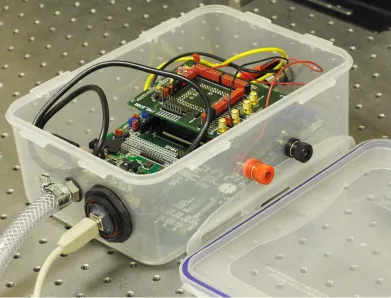
FIG. 3. A photo of the customized sensing box. Consisting of two ports for gas flow, two wires for connection to an external DC power supply and a USB connection, with the CMOS system sitting inside (Inset: Illustration of the experimental setup).
A conventional TCSPC system was used to measure the fluorescence lifetime before and after the 15-minute exposure. To recover the fluorescence lifetime, clean nitrogen with a similar flow-rate to that used in the exposure process, was flowed through the chamber for a further 15 minutes. The CMOS lifetime analysis micro-system was also used to detect the DNB vapor. The CDTG copolymer films were sandwiched between the micro-LED and SPAD chip. A histogram of the time-resolved decay curve of the pre-exposed, post-exposed and recovered CDTG copolymer films was recorded respectively, under the same exposure and recovery conditions as that in the conventional TCSPC sensing measurements.
D. Ultra-portable explosive sensing using the CMOS micro-system
To measure the dynamic response of the sensing process, a two-gate RLD method was used to monitor the fluorescence lifetime in real time using the two-chip system. The whole
micro-system with CDTG films was all placed in a 20×13×7 cm3customized sensing box (shown in
Figure3). Several CDTG films of different thicknesses were exposed to∼10 ppb DNB vapor one
at a time, allowing us to study the effect that film thickness has on sensing efficiency. The lifetime of each film was calculated on-chip every 15 seconds for 15 minutes continuously. Following exposure, the gas port of the box was switched to clean nitrogen allowing the kinetics of the lifetime recovery to be monitored. All this suggests the micro-system has the potential to perform a near-real-time on-site detection of low vapor pressure explosives.
III. RESULTS AND DISCUSSION
FIG. 4. Absorption (dash line) and PL spectra (solid line) of a 250 nm thick film of CDTG copolymer.
are peaked at 379 nm and 538 nm, respectively. The solid-state PLQY was measured to be 61%±
6% when excited at 379 nm. The PL lifetime was measured with a conventional TCSPC system with an excitation from a 457 nm LED. By fitting the time-resolved PL decays to a bi-exponential decay curve, we measured a steady-state PL lifetime with a fast component 1.3 ns±0.5 ns (pre-exponential
factor 0.80) and a slow component 3.5 ns±0.2 ns (pre-exponential factor 0.20). We note that the
fast component is less accurate because it is close to the IRF.
The PL emission was found to be quenched when the CDTG films were exposed to the 10 ppb DNB vapor (results shown in TableI). After a 15-minute continuous exposure, the
spectrally-integrated emission intensity dropped by 38% on average (PL) over the three different thickness
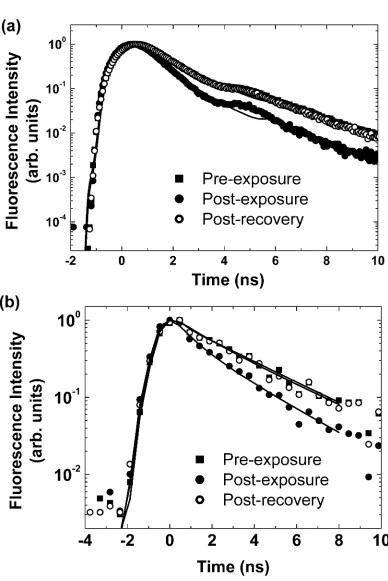
samples. Figure 5(a)shows the PL decay curves from the same sample #3 (150 nm thick)
mea-sured with a conventional TCSPC system; again quenching was observed under the influence of
the DNB molecules. The lifetime values in Table Iwere extracted from the decay curves by the
fitting of double-exponential expressions deconvolved with the instrument response individually. After a 15-minute exposure the average lifetime of the 150 nm thick sensor measured with the
conventional TCSPC decreased from 1.78 ns to 1.11 ns, dropping by 38% (τavg), in good
agree-ment with the change in PL intensity (PL). After exposure, the PL intensity and lifetime were
fully recovered by the flowing of clean nitrogen through the optical chamber (data not shown in TableI).
Corresponding TCSPC measurements were also performed using the CMOS micro-system.
From TableIwe can see that the lifetimes measured with the two different methods are relatively
consistent, showing that the CMOS micro-system can provide a compact and easy-to-operate
ap-proach for fluorescence lifetime measurements. Figure5(b), the PL decay as measured by the CMOS
032115-7 Wanget al. AIP Advances1, 032115 (2011)
[image:8.612.110.498.73.654.2]TABLE I. Comparison of the change in emission intensity (PL) and lifetime measured with both the conventional TCSPC and the CMOS micro-system, before exposure (pre-exp) and after a 15-minute exposure to DNB (post-exp).
Pre-exponential factor are shown in brackets. Also shown is the change of average lifetime in percentage (τavg). The film
thicknesses of sample #1, #2 and #3 are 50 nm, 95 nm and 150 nm, respectively.
PL Conventional TCSPC CMOS
τpre-exp τpost-exp τavg τpre-exp τpost-exp τavg
#1 36% 1.3 ns (0.80) 0.97 ns (0.89) 32% 0.55 ns (0.30) 0.36 ns (0.53) 39%
3.4 ns (0.20) 2.9 ns (0.11) 3.3 ns (0.70) 2.8 ns (0.47)
#2 40% 1.3 ns (0.84) 1.0 ns (0.89) 30% 0.51 ns (0.34) 0.40 ns (0.58) 43%
3.5 ns (0.16) 3.0 ns (0.11) 3.4 ns (0.66) 2.7 ns (0.42)
#3 38% 1.3 ns (0.76) 0.91 ns (0.90) 38% 0.68 ns (0.24) 0.53 ns (0.50) 38%
3.3 ns (0.24) 2.9 ns (0.10) 3.3 ns (0.76) 2.7 ns (0.50)
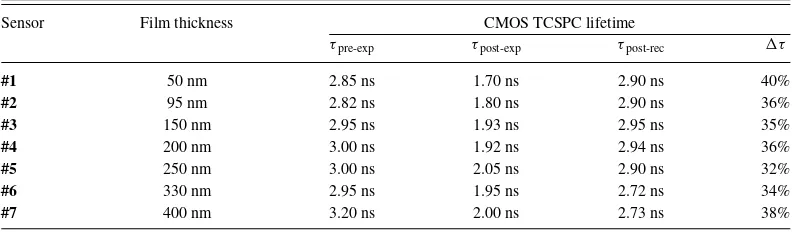
TABLE II. In-situ CMOS lifetime results both before exposure (pre-exp) and after a 15-minute exposure to 10 ppb DNB vapor (post-exp), and after a 15-minute recovery (post-rec), also shown the change of lifetime (τ) during the 15 minute periods.
Sensor Film thickness CMOS TCSPC lifetime
τpre-exp τpost-exp τpost-rec τ
#1 50 nm 2.85 ns 1.70 ns 2.90 ns 40%
#2 95 nm 2.82 ns 1.80 ns 2.90 ns 36%
#3 150 nm 2.95 ns 1.93 ns 2.95 ns 35%
#4 200 nm 3.00 ns 1.92 ns 2.94 ns 36%
#5 250 nm 3.00 ns 2.05 ns 2.90 ns 32%
#6 330 nm 2.95 ns 1.95 ns 2.72 ns 34%
#7 400 nm 3.20 ns 2.00 ns 2.73 ns 38%
excited state moves to a quencher. We observe similar reductions in steady-state and time-resolved PL, which indicates that dynamic quenching dominates.
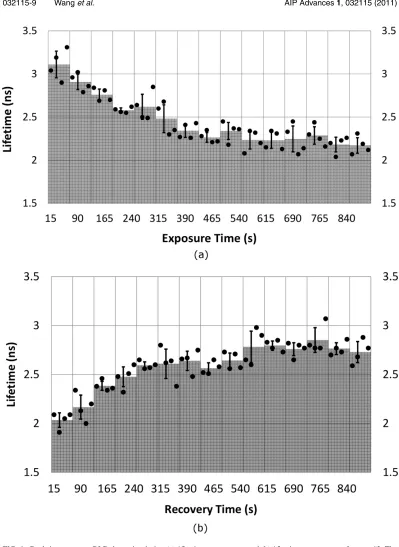
We next demonstrated real-time explosive sensing experiments with the CMOS micro-system during an exposure and recovery cycle for seven different thicknesses CDTG films (sensors); results are summarized in TableII(sensor #1 - #3 are the same as the ones in TableI). It should be noted that as the rapid-lifetime determination method assumes the fluorescence decay is single-exponential, the CDTG lifetime values are slightly overestimated in the RLD scheme, but in an acceptable range -the longer lifetime component contributes more to -the on-chip calculation of -the average lifetime value. Taking sensor #3 for example, Figure6shows that the dynamics of the PL lifetime of a 150 nm film in 15-minute exposure to 10 ppb DNB vapor (decreasing from 2.95 ns to 1.93 ns) and 15-minute recovery in nitrogen (increasing back to 2.93 ns). The sensing efficiency (i.e. change in average
lifetimeτavg) of sensor #3 in the total 15 minutes is 35%. Additionallyτ values in TableII
were found to be independent of the variation of the thickness of the CDTG films, suggesting that the DNB molecules can penetrate into both thin and thick CDTG films in the 15-min period of the measurements.
IV. CONCLUSIONS
[image:9.612.107.503.289.405.2]032115-9 Wanget al. AIP Advances1, 032115 (2011)
FIG. 6. Real-time two gate RLD dynamics during (a) 15-minutes exposure, and (b) 15-minutes recovery, of sensor #3. The scatter points in the figures represent the RLD lifetime values every 15 seconds, the background individual bars represent the average lifetime value every 60 seconds with standard deviation error bars.
ACKNOWLEDGEMENTS
We are grateful to CDT Ltd, UK, for supplying us with the green light-emitting polymer. We acknowledge the financial support from the UK Engineering and Physical Sciences Research Council and the Scottish Universities Physics Alliance. This work was funded by the EPSRC under the ‘HYPIX’ programme.
1A. W. Czarnik, “A sense for landmines,”Nature394(6692), 417-418 (1998); D. S. Moore, “Instrumentation for trace detection of high explosives,”Rev Sci Instrum75(8), 2499-2512 (2004).
2S. J. Toal and W. C. Trogler, “Polymer sensors for nitroaromatic explosives detection,”J Mater Chem16(28), 2871-2883 (2006).
3S. W. Thomas, G. D. Joly, and T. M. Swager, “Chemical sensors based on amplifying fluorescent conjugated polymers,”
Chem Rev107(4), 1339-1386 (2007).
4J. S. Yang and T. M. Swager, “Fluorescent porous polymer films as TNT chemosensors: Electronic and structural effects,”J
Am Chem Soc120(46), 11864-11873 (1998); A. Rose, Z. G. Zhu, C. F. Madiganet al., “Sensitivity gains in chemosensing by lasing action in organic polymers,”Nature434(7035), 876-879 (2005); Y. Yang, G. A. Turnbull, and I. D. W. Samuel, “Sensitive Explosive Vapor Detection with Polyfluorene Lasers,”Adv Funct Mater20(13), 2093-2097 (2010); C. M. Deng, Q. G. He, C. Heet al., “Conjugated Polymer-Titania Nanoparticle Hybrid Films: Random Lasing Action and Ultrasensitive Detection of Explosive Vapors,” J Phys Chem B114(13), 4725-4730 (2010); M. S. Meaney and V. L. McGuffin, “Luminescence-based methods for sensing and detection of explosives,”Anal Bioanal Chem391(7), 2557-2576 (2008); G. He, G. F. Zhang, F. T. Luet al., “Fluorescent Film Sensor for Vapor-Phase Nitroaromatic Explosives via Monolayer Assembly of Oligo(diphenylsilane) on Glass Plate Surfaces,”Chem Mater21(8), 1494-1499 (2009).
5D. A. Olley, E. J. Wren, G. Vamvouniset al., “Explosive Sensing with Fluorescent Dendrimers: The Role of Collisional Quenching,”Chem Mater23(3), 789-794 (2011); H. Cavaye, P. E. Shaw, X. Wanget al., “Effect of Dimensionality in Dendrimeric and Polymeric Fluorescent Materials for Detecting Explosives,”Macromolecules43(24), 10253-10261 (2010).
6B. R. Rae, J. B. Yang, J. McKendryet al., “A Vertically Integrated CMOS Microsystem for Time-Resolved Fluorescence Analysis,”IEEE T Biomed Circ S4(6), 437-444 (2010).
7R. J. Woods, S. Scypinski, L. J. C. Loveet al., “Transient Digitizer for the Determination of Microsecond Luminescence Lifetimes,”Anal Chem56(8), 1395-1400 (1984).
8N. C. Greenham, I. D. W. Samuel, G. R. Hayeset al., “Measurement of Absolute Photoluminescence Quantum Efficiencies in Conjugated Polymers,”Chem Phys Lett241(1-2), 89-96 (1995).
9K. Suzuki, A. Kobayashi, S. Kanekoet al., “Reevaluation of absolute luminescence quantum yields of standard solutions using a spectrometer with an integrating sphere and a back-thinned CCD detector,”Phys Chem Chem Phys11(42), 9850-9860 (2009).