Fluctuations in the open time of synaptic channels:
an application to noise analysis based on charge
Hinnerk Feldwisch-Drentrup1, Adam B. Barrett2, Michael T. Smith, Mark C.W. van
Rossum∗
Institute for Adaptive and Neural Computation School of Informatics
University of Edinburgh 10 Crichton Street Edinburgh, EH8 9AB UK
Abstract
Synaptic channels are stochastic devices. Even recording from large ensembles of channels, the uctuations, described by Markov transition matrices, can be used to extract single channel properties. Here we study uctuations in the open time of channels, which is proportional to the charge owing through the channel. We use the results to implement a novel type of noise analysis that uses the charge rather than the current to extract fundamental channel parameters. We show in simulations that this charge based noise analysis is more robust if the synapse is located on the dendrites and thus subject to cable ltering. However, we also demonstrate that when multiple synapses are distributed on the dendrites, noise analysis breaks down. We nally discuss applications of our results to other biological processes. Keywords: synaptic transmission, noise analysis, stochastic channels, neural variability
∗Corresponding author
Email address: [email protected] (Mark C.W. van Rossum)
Introduction
Neural activity and neural transmission rely on ion channels (Hille, 2001). Ion channels ux ions depending on either the presence of some neurotransmitter (ligand-gated channels, such as the AMPA channel), or the voltage across the channel (voltage-gated channels, such as the Na-channel). Ion channels are stochastic devices and are commonly described by Markov state diagrams. Typical states are the closed resting state and an open state, but many more intermediate states might be needed to accurately describe the kinetics. The actual transitions between states are stochastic, and the transition probabilities between the various states can depend on voltage or ligands. Ion channels are one of the main noise sources in the nervous system, and noise from channels can manifest itself in many ways, such as variations in spike timing or variability in the synaptic current.
In this study we consider stochastic synaptic channels, which are rapidly opened by some neurotransmitter. The uctuations in the amplitude of the current through such a channel have been studied extensively. Typically there is one open state and thus the current is either maximal or zero. As a result the current through multiple independent parallel channels is distributed according to the binomial distribution. This observation forms the basis for noise analysis. Noise analysis extracts the unitary conductance of single channels from the noise in the current from an ensemble of channels.
As important as the current is the temporally integrated current, i.e. the total charge transported through the channelQ=RI(t)dt. Its uctuations have physiological importance. In an integrate-and-re neuron a spike is generated whenever the voltage reaches a threshold. Hence if inputs are much faster than the leak time-constant, the spiking occurs when the net charge inux has reached a threshold. Here we calculate the mean charge and its uctuations, rst for a simple two-state model, and then for arbitrary state diagrams. We use these results to gain insight to the charge noise of synaptic channels, and to introduce a novel noise analysis technique based on charge.
Fluctuations in single two-state channels Fluctuations in currents
We start with the simplest synaptic channel, a 2-state channel. We assume that at time 0 it is in the open state (due to the action of some transmitter), and subsequently closes at a random time with a rate constantk= 1/τ,
C ( O
whereC denotes the closed state, and O the open state. In the open state a currenti0 ows
which we will call the unitary current of the channel, Fig. 1A shows the setup. Assuming Ohmic conductance the current is the product of the unitary conductance and the dierence between membrane and synaptic potential,i0 =g0(V−Vsyn). Throughout we will assume that
0 10 20 30 Mean current (pA) 0
10 20
Current variance (pA
2 )
Current based noise analysis
0 10 20 30
Mean charge (fC) 0
20 40
Charge variance (fC
2 )
Charge based noise analysis Trial 1
Trial 2
current
Q(T) i0
A
B
C
current
T
time
time
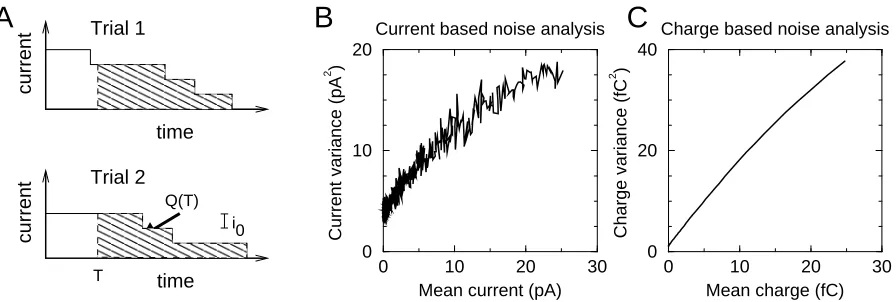
Figure 1: A). Schematic of the synaptic currents. After transient application of transmitter at time zero, a certain number of channels opens, each with a unitary current i0. They close independently at a random
time. The chargeQ(T) is dened as the integral of the current from timeT until all channels close (shaded area). B+C). Current based noise analysis (B) and charge based noise analysis (C). When the variance of the current or charge is plotted against its mean, a parabola results, albeit with dierent parameters. Both analysis techniques lead to a reliable extraction of the number of channels in the synapse and the single channel properties (see text).
membrane so that this assumption no longer holds (the space-clamp problem) (Spruston et al., 1993).
At some random time the channel will close and it will not open again until transmitter is again released and binds to the channel. At any instance the channel will have a certain open probabilityp(t), where t denotes the time since the neurotransmitter pulse. When averaged over many trials, the average current ishI(t)i = i0p(t), where the angular brackets denotes
the average over multiple trials. Because the dierent trials are independent the variance is
hδI(t)2i = hI(t)2i − hI(t)i2
= i20p(t)− hI(t)i2
= i20p(t)[1−p(t)]. (1) where we denote the variance of a variablex ashδx2i, dened ashδx2i=hx2i − hxi2.
When N parallel, independent channels are present in the synapse, both the average and variance areN times larger. Thus the mean is hI(t)i =N i0p(t) and the variance hδI(t)2i =
N i2
0p(t)[1−p(t)], which equals the well-known binomial variance. Eliminatingp(t) yields,
hδI(t)2i=i0hI(t)i − 1
NhI(t)i
2. (2)
[image:3.595.89.537.84.235.2]Fluctuations in charge
We now calculate the average charge and its uctuations for this two-state channel. The time of the switch to the closed state is a random (Poisson) process, therefor the open-time of the channel has an exponential distributionP(topen) = 1τexp(−topen/τ), whereτ is the mean
open time of the channel. The charge follows directly from the open-time asQ=R0∞dt I(t) =
i0topen. (For practical application the upper integration bound is taken so that all channels are very likely to have closed). Like the open time, the charge thus also has an exponential distribution, with a mean q0 and a standard deviation that is equal to the mean, where we
dene the mean unitary charge as
q0=i0τ.
The mean unitary charge is the average charge that uxes through a single channel following a single synaptic event. ForN parallel channels the total charge follows a gamma distribution of orderN,
P(Q) = 1 (N −1)!
1
q0
µ
Q q0
¶N−1
exp(−Q/q0). (3)
This result can be easily understood. The gamma distribution describes the total waiting time of waiting for N subsequent Poisson events. Due to the direct relation between charge and time, Fig. 1A, the total charge behaves as the total waiting time.
Next, we generalize two-fold. First we consider that the transmitter opens the single channel at time zero with only a limited probabilityp(0). Secondly, we measure the charge as measured from an arbitrary timeT until all channels have closed, that is Q(T) =RT∞I(t)dt, see Fig. 1A. One nds for the mean of this quantity
hQ(T)i=p(T)q0,
and for the variance
δQ2(T)®=q02p(T)[2−p(T)]. (4) It is of interest to compare this to the equation for the current noise. The term in the square brackets in Eq.4 is larger than in the corresponding equation for the current, Eq. 1. In other words, the charge in this kinetic scheme is for any open probability noisier than the current. This can be understood easiest in the case that at peak the channel is always opened by the transmitter, i.e. p(0) = 1. In that case there will be no uctuations at all in the peak
amplitude hδI2i = 0. In contrast, Eq.4 yields δQ2(0)® = q2
0, as the charge will still show
uctuations as the decay back to the rest-state occurs randomly. Equivalently, we can use the Coecient of Variation to quantify the noise relative to the mean. The squared Coecient of Variation of the charge is CV2
Q = 2/p(0)−1, hence minimally CVQ = 1, but for the current
onlyCV2
I = 1/p(0)−1.
It is again possible to express the variance as a function of the mean, which forN channels
becomes
δQ2(T)®= 2q0hQ(T)i −N1hQ(T)i2 (5)
In analogy with the non-stationary current noise analysis, this relation can be used to extract the unitaryq0 and the number of channels from a set of records of synaptic currents. For this
Noise analysis based on charge
The above result can be used to do noise analysis based on the noise in the charge. The procedure is to plot the variance versus the mean charge as the timeT is varied parametrically. The linear and quadratic coecients of the polynomial t will yield q0 and N, respectively.
This charge-based noise analysis is illustrated in Fig. 1C and compared to the current based noise analysis, Fig. 1B. For the gure we simulated 50 channels with 50% open probability at time zero, 1pA unitary current and 1ms time constant, so that the unitary charge was 1fC. A perfect clamp was assumed. White noise with a standard deviation of 2pA was added to mimic experimental noise (code online, see Appendix). Averages and variances of currents and charges were measured across 200 simulated events. To determine the accuracy and reliability of the method, we ran the simulation 50 times. The charge based analysis estimatedN = 51±25,
q0 = (1.03±0.10)fC, while the current based analysis yieldedN = 55±14,i0 = (0.98±0.09)pA.
So both methods are comparable, however, there are dierences to point out:
1) In contrast with the current based analysis, the equation for the charge uctuation is only valid for the simple kinetic scheme used here (see below for the generalization). The underlying reason is that the charge is determined not only by the instantaneous state of the channel but also by the future states. Thus the dynamics of the channel will matter.
2) The curve of the charge variance versus mean charge is much smoother than the curve for the current, compare Fig. 1B to Fig. 1C. The reason is that neighboring data points in the charge curve are highly correlated;Q(t) and Q(t+δt) share a large part of the time integral
over the current. As a practical issue, most tting algorithms assume independent noise and might over-estimate the condence intervals of the ts. Fitting on subsets of the data as we did above will give reliable error bars.
3) Although the estimates for unitary current/charge are of comparable accuracy, the charge based analysis gave more variable results for the estimate ofN. The reason is that es-timatingN corresponds to estimating how strongly the parabola in Fig. 1C bends over, which is harder for the current than for the charge parabola. Estimating the unitary current/charge corresponds to estimating the slope near the origin, which is equally easy in both cases. In an eort to reduce the variability we tried tting algorithms that correct for the correlation in the data (Heinemann and Conti, 1992; Stean and Heinemann, 1997). However, neither a weighted least squares t (assuming uncorrelated data with unequal variance), nor a general least squares t (assuming correlations in the data), lead to marked improvement.
Charge uctuations for arbitrary channels
In the appendix we derive the charge uctuations for channels with an arbitrary state diagram. In case there is just one conducting state, it turns out that the variance in the charge behaves as
δQ2(T)® = γhQ(T)i − 1
NhQ(T)i
2 (6)
Independently of the channel's kinetic scheme, the number of channels can be extracted from the quadratic term.
Examples of charge uctuations in various state diagrams
As an illustration of the results above and in the Appendix, we analyze three simple state diagrams. For compactness we set N = 1 and i0 = 1. In the rst state diagram there are
two closed states: the resting state C, and an intermediate closed state C0 which can have
transitions back and forth to the open state. This channel will icker before nally closing.
C ( C0 O
For this state diagram, the mean charge ishQ(0)i= [kC0Oπ2(0)+(kC0O+kC0C)π3(0)]/kOC0kC0C,
whereπ2(0)is the probability that the channel is in theC0state at time zero, andk
C0Odenotes
the rate for the transition from C0 to O. The charge noise constant is γ = 2kC0O+kC0C
kC0CkOC0 . The
CV2 = 2(kC0O+kC0C)
kC0Oπ2(0)+(kC0O+kC0C)π3(0) −1. It can be seen that min(CV) = 1, as in the two-state
channel above. So the charge of the channel is equally noisy as the two-state channel.
In the second example the open state can decay to the resting state and a desensitized state,C0.
C ( OC0
For this case, the mean charge ishQ(0)i= [π2(0) +π3(0)]/kOC and the charge noise constant
isγ = 2/kOC. TheCV2 = 2
π2(0)+π3(0)−1, which again is minimally one. Although we haven't
proven this, these results suggest that a minimal CV of one for channels with one open state. Finally, we consider a multi-step shuto channel. There are two open states, with identical conductance
C ( O ( O0
In addition we assume that both transitions are equal kOC = kO0O = k. In analyzing this
scheme one nds that the Markov matrixM can not be diagonalized if both transitions are identical. We have ignored this case so far, as its treatment is standard, but somewhat tedious (Greenberg, 1998). One can simply set the transition rates arbitrarily only to equate them in the nal formulae.
In this case the charge is the sum of an exponential and an alpha-function hQ(T)i =
1
k(2 +kT)e−kT, whilehQ2(T)i= 26+2k+kkT2T i0hQ(T)i. Importantly, the relation betweenhQ2(T)i
andhQ(T)inow depends on time (Eq. 10 in the Appendix is violated). As a result the mean-variance plot in noise analysis will not yield a parabola. This due to the fact that there are two open states.
Interestingly, theCV2= 2π2(0)+6π3(0)
[π2(0)+2π3(0)]2−1, which reaches a minimum of1/2for π2(0) = 0,
π3(0) = 1. Hence the multi-step shut-o reduces the variability in the charge. For n open
states with identical rates, the charge will have a gamma-distribution withCV2 = 1/n. A very
0 500 1000
Distance of synapse from soma (µm)
0 0.5 1 1.5
Normalized estimates
Charge based noise analysis Current based noise analysis
0 0.02 0.04 0.06
Mean charge 0 5e−05 0.0001 0.00015 0.0002 Charge variance
0 2 4 6 8
Mean current
0
Current variance
0 10 20 30
Time (ms) 0 50 100 Charge (fC) 0 15 30 Current (pA)
0µm distance 250µm distance 500µm distance
[image:7.595.90.535.83.233.2]A
B
C
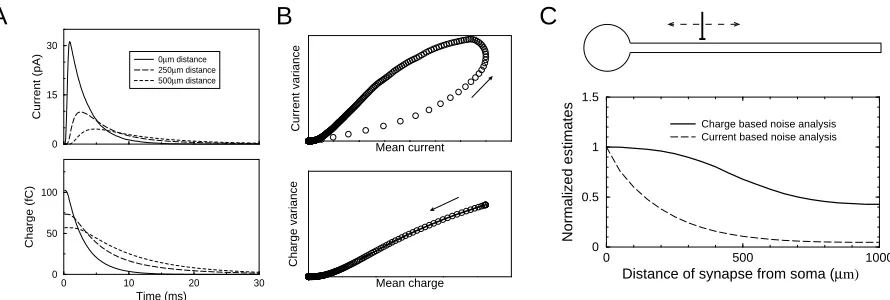
Figure 2: Current and charge uctuations in a simulated dendrite with a single synapse at a varying location. A) The average synaptic currents (top) and charge,R∞
T I(t)dt(bottom) for a synapse located 0, 250 and 500µm
from the voltage clamped soma. B) The variance versus mean relation of current (top) and charge (bottom) for a synapse located 250µm from the soma. The cable ltering distorts the parabolas (compare to Fig. 1). The arrow denotes increasing time. The solid line in the bottom panel is the quadratic t to the restricted data. C) Normalized estimates of the unitary current and charge noise constant as a function of distance from the soma. The charge-based analysis is less biased by cable ltering.
Noise analysis of cable ltered events
We now return to channels with one open state and the application to noise analysis. The formulation of the noise in the charge rather than the noise in the currents has advantages when performing noise analysis for synapses on the dendrite far away from the clamping site. The rapidly changing synaptic currents are strongly ltered by the cable, but the charge is ltered much less. This is shown in Fig. 2A where current and charge are plotted for synapses located at dierent positions along a dendrite. The peak current is much more attenuated by the cable ltering than the charge. The underlying reason is that the electrotonic length is frequency dependent; high frequency signals, including transients are ltered more strongly than DC components (e.g. Koch, 1999).
We simulated a simplied setup with one dendritic passive cable connected to a soma, using the NeuronC simulator (Smith, 1992). Although this is a simplied model, it is not unrealistic as under certain conditions dendritic trees can be collapsed into a single equivalent cable (e.g. Koch, 1999). The soma had a diameter of 10µm, the dendrite had a diameter of 1µm and a length of 1000µm. The membrane resistance was 20kΩ/cm2 and the internal
resistance was 200Ωcm (electrotonic length at zero frequency was 707µm). An AMPA type synapse was positioned at varying locations along the dendrite. The AMPA synapse was modeled according to the 7-state diagram with a single open state provided in (Jonas et al., 1993), but de-sensitization was turned o to ensure stationarity (for details see AMPA type 5 in the NeuronC documentation). The synapse contained 50 channels with a conductance of 20pS each. The peak open probability was about 50%. At every synapse location 200 synaptic events were simulated, while the soma was clamped at -70mV. As the synaptic currents were rather small, the local voltage excursion was maximally 10mV above the clamping voltage.
0 0.02 0.04 0.06
Mean charge
0 0.0001 0.0002 0.0003 0.0004 0.0005
Charge variance
0 5 10 15
Mean current
0 50 100 150
Current variance
Mixed synaptic locations
0 200 400 600 800 1000
Distance of second synapse (µm)
−10 −5 0 5
Normalized estimates
Current based noise analysis Charge based noise analysis
[image:8.595.103.534.85.282.2]A
B
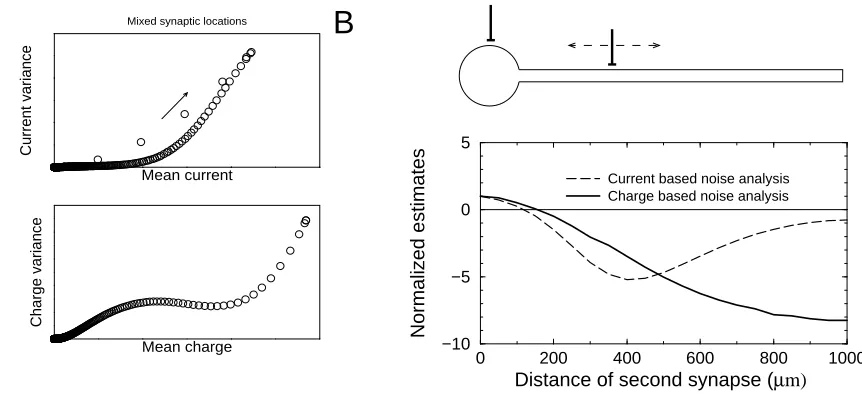
Figure 3: Break down of noise analysis when multiple synapses are distributed along dendrite. The synapses are asynchronously activated. A) Variance versus mean plots in one synapse is at the soma and the other synapse is located 500µm away on the dendrite. Top graph: current, bottom graph: charge B) Normalized estimates of the unitary current and charge noise constant versus the location of the second synapse, the rst synapse being at the soma. Only when the two synapses are close the estimate is reasonable, otherwise even negative estimates can result.
a poor t to the parabola. However, the concave parabola is still apparent for larger mean currents. An ad hoc cut-o restricting the t above 30% of the maximal charge leads to a good t (solid line in bottom panel).
The results of the both noise analysis techniques are shown in Fig. 2C. For ease of com-parison both are plotted relative to the estimate obtained when the synapse is located at the soma. The unitary current is strongly underestimated away from the soma, because the current noise is strongly ltered and the reduced noise is interpreted as stemming from many, small conductance channels. In contrast the estimated charge noise constant is much less aected by the ltering. Note, that both estimates atten out at the end of the cable. This is due to the sealed end at the end of the dendrite.
Pooling from synapses with dierent locations
Finally we consider a situation with two synapses located at dierent positions on the cell. The synapses are assumed to be independently active so that compound events are negligible. The charge based as well as the traditional current based analyses break down in this case. This is illustrated in Fig.3, where one synapse was located at the soma and the location of the other synapse was on the dendrite. Both variance versus mean plots in Fig.3A deviate considerably from the ideal downwards curved parabola (cf. Fig.1). In Fig.3B, the location of the second synapse was varied systematically, and the channel properties were estimated. Only when the second synapse is close to the rst one, the estimates are reasonable (Benke et al., 2001). If the synapses are located further apart, negative estimates result, which are clearly non-sense.
idealized case it might still be possible to separate the events based on their shape and carry out the analysis on for each synapse individually. When recording from multiple synapses distributed over the tree, that would be likely impossible.
Discussion
We have considered the open state of synaptic channels and derived expressions for its mean open time and its uctuations. For channels with a single open state, the variance of the charge uctuation is a quadratic function of the mean charge, characterized by the charge noise constant γ. The result has a number of applications: First, it poses fundamental constraints on the noise in neurons, as it calculates the charge noise given the channel's state diagram. One can wonder if neural ring is more aected by current noise or by charge noise. There is no easy answer to this question, and the two noise sources are related. For instance, if the input is much faster than the membrane time-constant, the membrane voltage is determined by the charge inux, and the neuron has a charge threshold. But for a very slowly varying input, the integrate-and-re neuron has a current threshold. For the Hodgkin-Huxley model the situation is even more complicated and follows an intermediate behavior, for a discussion see (Koch, 1999). However, it should also be noted that simulations suggest that noise stemming from the stochastic nature of synaptic channels is negligibly small, compared to for instance probabilistic vesicle release which aects all channels in the synapse collectively (van Rossum et al., 2003).
Secondly, the results can be used to extract fundamental synaptic parameters in a way that is relatively insensitive to cable ltering. It thereby overcomes some of the problems with current based noise analysis, which is applied mostly to inhibitory synapses believed to be close to the soma (e.g. Kilman et al., 2002). We note that current based noise analysis has been further developed: Peak-scaled noise analysis of synaptic currents can be used to estimate unitary currents when pooling from a population of synapses with dierentN (Traynelis et al., 1993; De Koninck and Mody, 1994). It is not obvious how the charge based noise analysis is to be extended for this purpose.
Importantly, when synaptic events stemming from dierent parts of the dendrite are pooled, any noise analysis is likely to fail, because it will confuse deviations from the mean due to noise with deviations due to the dierential ltering. We nd that both the current and the charge method break down. This means that the method is best applied to situations in which always the same synapse is stimulated, e.g. using glutamate uncaging.
We note that in principle in our formalism it should be possible to calculate the exact eect of cable ltering on both current and charge uctuations. This is outside of the scope of this paper, but might eventually provide even better results and remove the reliance on the somewhat arbitrary restriction in the charge t.
Acknowledgments:
HFD was supported by the German Federal Ministry of Education and Research (grant 01GQ0420). ABB was supported by the HFSP.
Appendix: Charge uctuations for arbitrary channels
Here we derive a general expression for the charge uctuations, assuming that the channel dynamics are described by a Markov process. The evolution of the states of the channel obeys
dπ(t)
dt =Mπ(t), where M is the Markov matrix (zero column sum), which is constructed from
the transition rates between states cij as Mij = cij −δij
P
kckj. For reviews with example
state diagrams, see e.g. Destexhe et al. (1998); Roth and van Rossum (2009). The probability π(t)is the occupancy probability for each state, written as vector (we use boldface to denote vectors and capital letters from matrices). Of particular relevance are the distribution right after transmitter application,π(t= 0)and the equilibrium distribution π(t=∞).
Each state has a certain current associated with it. This is denoted by the vector s, so that the mean current through a single channel at any instant is given byi(t) =s.π(t), where the dot stands for the dot product. Typically only one of the states will be an open state. So for a 3-state channel with only the 3rd state conducting, s takes the form s = (0,0, i0) and
i(t) =i0π3(t). However, the formalism presented here allows for state-diagrams in which there
are multiple open states, potentially with dierent conductances.
Mean current and charge
We rst calculate the mean current and charge through a single channel. The time evolu-tion of the states is best described in the eigenspace of the transievolu-tion matrixM. The matrixM is diagonalized asV−1M V =diag(λ
1,λ2,. . . λN). The matrix V transforms from eigenvector
space to regular space; each column is an eigenvector of theM matrix3. The Perron-Frobenius theorems warrant that there is one zero eigenvalue, and the others are negative, although they can be complex (e.g. van Kampen, 1992). Each eigenvector decays exponentially according to its eigenvalueλi. The trick is to transform to the eigenspace, evolve the dynamics, and
trans-form back. That means that the occupancy at timetobeys π(t) =V D(eλt)V−1π(0), where
D(eλt) = diag(eλ1t, eλ2t, . . .) denotes a diagonal matrix with the exponentiated eigenvalues
eλit on the diagonal. From this the mean current at timet follows
hI(t)i = s.π(t)
= s.V D(eλt)V−1π(0).
As one eigenvalue is zero, this means that the current is in general the sum of (S−1) expo-nentials, whereS is the number of states. The mean charge follows as
hQ(T)i =
Z ∞
T
hI(t)idt
= −s.V D
µ
eλT
λ

V−1π(0). (7)
whereD
³
eλT
λ ´
=diag(eλ1T/λ
1, eλ2T/λ2, . . .).
An acute reader might have noticed that because the matrix M always has a zero eigen-value, this expression might diverge. However, as long as the equilibrium state π(∞) does
not conduct, this divergence does not show up in the outcome of Eq. 7. For the numerical calculation one can replace the zero eigenvalue by an arbitrary number; its value should not matter.
Variance in current and charge
The variance of the charge can be written as hQ2(T)i = hR∞
T dt
R∞
T dt0I(t)I(t0)i. Thus
we need to knowhI(t)I(t0)i, which is again calculated by using the evolution in eigenspace. Assumingt0 > t,
hI(t)I(t0)i = X
ij
sjP(j, t0|i, t)siπi(t)
= s.V D(eλ(t0−t))V−1D(s)π(t)
= s.V D(eλ(t0−t))V−1D(s)V D(eλt)V−1π(0),
whereD(s) =diag(s0, s1, . . .). Note that the time-dependent variance of the current follows
from this expression as
hδI(t)2i=sD(s).π(t)−[s.π(t)]2. (8)
If there is just one open state s = (0,0, . . . , i0, . . .0) with an associated probability p(t), we
retrieve the well-known binomial variancehδI(t)2i=i2
0p(t)[1−p(t)]of a single channel derived
above.
Continuing with the calculation of the variance of the charge, the second moment of the charge is given by
hQ2(T)i = 2
Z ∞
T
dt
Z ∞
t
dt0hI(t)I(t0)i
= 2s.V D(1/λ)V−1D(s)V D(eλT/λ)V−1π(0), (9) from which the variance follows as hδQ2(T)i = hQ2(T)i − hQ(T)i2, and for N channels hδQ2(T)i =hQ2(T)i − N1hQ(T)i2. Eq.(9) is the main result of this section. Analytic results for channels with 4 or more states becomes quickly unwieldy, however despite the complicated appearance, numerical evaluation is straightforward.
Channels with a single open state
If there is one open state, the calculation simplies considerably. Suppose that only state mconducts, si =i0δi,m. Now from Eq.(9),
hQ2(T)i = γhQ(T)i, (10)
with the constantγ = 2i0[V D(1/λ)V−1]
mm, where[A]mm indicates the matrix elementAm,m.
The constantγ is completely determined by the kinetics of the channel and is independent of the initial state of the channel, i.e. the value ofπ(0). Furthermore, because this constant is
channel above one hasγ =q0. However, in general, the charge noise constant is not equal to q0. This is where the charge noise diers from current noise; for currents the linear term in
the parabola, Eq.(2), equals the unitary current independent of kinetics. ForN channels we nd
δQ2(T)®=γhQ(T)i − 1
NhQ(T)i
2.
Independent of the channel's kinetic scheme, the number of channels can be extracted from the quadratic term.
If more than one state is conducting the simplication does not hold and variance-mean data will in generally not fall on a parabola. Note that in that case, also the current based noise analysis Eq. (2) breaks down, and instead Eq.(8) should be used.
Computer code
The computer code for both the simulation and the analysis is available on homepages. inf.ed.ac.uk/mvanross/code.
References
Benke, T.A., Lüthi, A., Palmer, M.J., Wikström, M.A., Anderson, W.W., Isaac, J.T., Collingridge, G.L.. Mathematical modelling of non-stationary uctuation analysis for study-ing channel properties of synaptic ampa receptors. J Physiol 2001;537(Pt 2):407420. De Koninck, Y., Mody, I.. Noise analysis of miniature IPSCs in adult rat brain slices:
prop-erties and modulation of synaptic GABAa receptor channels. J Neurophysiol 1994;71:1318 1335.
Destexhe, A., Mainen, Z.F., Sejnowski, T.J.. Kinetic models of synaptic transmission. In: Koch, , Segev, , editors. Methods in neuronal modeling (2nd ed.). Cambridge: MIT Press; 1998. .
Field, G.D., Rieke, F.. Mechanisms regulating variability of the single photon response of mammalian rod photoreceptors. Neuron 2002;35:733747.
Greenberg, M.D.. Advanced Engineering Mathematics. New York: Prentice Hall, 1998. Hayer, A., Bhalla, U.S.. Molecular switches at the synapse emerge from receptor and kinase
trac. PLoS Comput Biol 2005;1(2):137154.
Heinemann, S.H., Conti, F.. Nonstationary noise analysis and application to patch clamp recordings. Methods Enzymol 1992;207:131148.
Hille, B.. Ionic Channels of excitable membranes. Sunderland, MA: Sinauer, 2001.
Jonas, P., Major, G., Sakmann, B.. Quantal components of unitary EPSCs at the mossy bre synapse on CA3 pyramidal cells of rat hippocampus. J Physiol 1993;472:615663. Kilman, V., van Rossum, M.C.W., Turrigiano, G.G.. Activity Deprivation Reduces mIPSC
Koch, C.. Biophysics of computation. New York: Oxford University Press, 1999.
van Rossum, M.C.W., O'Brien, B.J., Smith, R.G.. The eects of noise on the timing precision of retinal ganglion cells. J Neurophysiol 2003;89:24062419.
Roth, A., van Rossum, M.. Modeling synapses. In: Schutter, E.D., editor. Computational Modeling Methods for Neuroscientists. MIT Press; 2009. .
Sigworth, F.J.. The variance of sodium current uctuations at the node of Ranvier. J Physiol 1980;307:97129.
Smith, R.G.. NeuronC: a computational language for investigating functional architecture of neural circuits. Journal of Neuroscience Methods 1992;43:83108.
Spruston, N., Jae, D.B., Williams, S.H., Johnston, D.. Voltage- and space-clamp errors associated with the measurement of electrotonically remote synaptic events. J Neurophysiol 1993;70:781802.
Stean, R., Heinemann, S.H.. Error estimates for results of nonstationary noise analysis derived with linear least squares methods. J Neurosci Methods 1997;78(1-2):5163.
Traynelis, S.F., Jaramillo, F.. Getting the most out of noise in the central nervous system. Trends in Neurosci 1998;21:137145.
Traynelis, S.F., Silver, R.A., Cull-Candy, S.G.. Estimated conductance of glutamate receptor channels activated during EPSCs at the cerebellar mossy ber-granule cell synapse. Neuron 1993;11:279289.