ISSN Online: 2153-1242 ISSN Print: 2153-1234
DOI: 10.4236/jis.2019.104012 Oct. 14, 2019 199 Journal of Information Security
Design and Development of a Novel Symmetric
Algorithm for Enhancing Data Security in Cloud
Computing
Mohammad Anwar Hossain, Ahsan Ullah, Newaz Ibrahim Khan, Md Feroz Alam
Department of Computer Science and Engineering, World University of Bangladesh, Dhaka, Bangladesh
Abstract
Cloud computing is a kind of computing that depends on shared figuring as-sets instead of having nearby servers or individual gadgets to deal with appli-cations. Technology is moving to the cloud more and more. It’s not just a trend, the shift away from ancient package models to package as service has steadily gained momentum over the last ten years. Looking forward, the fol-lowing decade of cloud computing guarantees significantly more approaches to work from anyplace, utilizing cell phones. Cloud computing focused on better performances, better scalability and resource consumption but it also has some security issue with the data stored in it. The proposed algorithm in-tents to come with some solutions that will reduce the security threats and ensure far better security to the data stored in cloud.
Keywords
Data Security, Cloud Computing, Encryption, Decryption, Secret Key, Symmetric Algorithm, 192 Bits, Hashing, Permutation, SHA-512
1. Introduction
1.1. Research Background
Cloud computing is a general term for anything that involves delivering hosted services over the Internet [1]. These services are broadly divided into three cate-gories: Infrastructure-as-a-Service (IaaS), Platform-as-a-Service (PaaS) and Software-as-a-Service (SaaS). There are total three principles of cloud computing and they are, on demand computing resources, founding a pay-as-you-go busi-How to cite this paper: Hossain, M.A.,
Ullah, A., Khan, N.I. and Alam, M.F. (2019) Design and Development of a Novel Symmetric Algorithm for Enhancing Data Security in Cloud Computing. Journal of Information Security, 10, 199-236.
https://doi.org/10.4236/jis.2019.104012
Received: August 30, 2019 Accepted: October 11, 2019 Published: October 14, 2019
Copyright © 2019 by author(s) and Scientific Research Publishing Inc. This work is licensed under the Creative Commons Attribution International License (CC BY 4.0).
DOI: 10.4236/jis.2019.104012 200 Journal of Information Security
ness model for computing and information technology services that can be used for elastic scaling, and elimination of up-front capital and operational expenses [2].
As the rate of cybercrimes increasing rapidly throughout the internet, and cloud computing is an enchanting target for many reasons that’s why data secu-rity plays the most key role in the cloud and the major concern over the internet in order to serve all the services and benefits of it. Data secrecy over the network could be achieved by using cryptographic technique that is the process of en-cryption and deen-cryption.
Encryption is the method by which plaintext is converted from a readable form to an encoded version (cipher text) that can only be decoded by another entity if they have access to a decryption key. Decryption is the reverse process encryption to convert the encrypted text into plain text. There are three most common types of encryption and decryption methods and they are Symmetric, asymmetric, and hybrid algorithms that can be used to encrypt and decrypt data in cloud computing storage [3].
Symmetric encryption is an encryption system in which the sender and re-ceiver of a message share a single common key that is used to encrypt and de-crypt the message. Symmetric algorithm that is used in cloud computing are Data Encryption Standard (DES), Advanced Encryption Standard (AES). Asymmetric Encryption uses two distinct yet related keys, one key is a Public key which is used for encryption and the other key is the Private key used for decryption. The private key is intended to be private so that only the authenti-cated recipient can decrypt the message. An example of asymmetric algorithm used in cloud computing is RSA algorithm. Hybrid encryption is a method of encryption that combines two or more encryption schemes and includes a com-bination of symmetric and asymmetric encryption to take advantage of the stre- ngths of each type of encryption [4].
It’s a research where authors are developing novel a symmetric algorithm which will be used for the encryption and decryption of data stored in the cloud thus enhancing the data security of the cloud. In this paper, authors used several permutation to increase the complexity and security.
The reason behind choosing symmetric encryption is that symmetric key en-cryption doesn’t require as many CPU cycle as asymmetric key enen-cryption, so it can be said that it’s generally faster. Thus, when it comes to speed, symmetric is much faster than asymmetric.
For encrypting private and sensitive data or information symmetric encryp-tion trumps the asymmetric encrypencryp-tion, as symmetric encrypencryp-tion uses the same key for both encryption and decryption. So unless the sender himself tells the secret key to the receiver, the receiver will never be able to decrypt the message.
1.2. Objective
DOI: 10.4236/jis.2019.104012 201 Journal of Information Security
1.3. Justification of Study
Cloud computing is perhaps the most flamboyant technological innovation of the 21st century. Because Cloud computing facilitates the access of applications and data from any location worldwide and from any device with an internet connection. But the security of client’s data is a major responsibility of a cloud provider. To be secured information needs to hidden from unauthorized access (Confidentiality), protected from unauthorized change (integrity), and available to the authorized entity when it is needed (availability). And it not uncommon that many cloud servers have been under attack by hackers and lost valuable da-ta for the lack of security.
As the world progresses people are becoming more and more dependent on these sort of services to store their data and information and it has become ut-most important to protect the data that are stored in the cloud. Our algorithm mainly works to improve the security and overcome these problems.
The most important services that our algorithm will provide are:
*Confidentiality: The algorithm aims to unauthorized disclosure of the pro-tected data.
*Integrity: Protect against illegal modification and deletion.
*Authorization: Algorithm will prevent the access of unauthorized users. By providing these services, algorithm ensures more security in cloud compu-ting.
1.4. Scope of Study
Data security is one of the biggest challenges at the current time. The security of client’s data is major responsibility of cloud provider. Cloud computing is likely to suffer from a number of known and unknown vulnerabilities, enabling at-tackers to either obtain computing services for free or steal information from cloud. To solve this problem, we have proposed a symmetric algorithm that will provide safest data security and will prevent the unauthorized access of dada. It will provide data to the authorized user without any loss of data or theft of data.
1.5. Contribution of the Proposed Work
DOI: 10.4236/jis.2019.104012 202 Journal of Information Security
1.6. Brief Introduction of the Paper
In the literature review chapter, the authors have reviewed the existing related works that have been done by other authors and also showed the key difference. In the methodology section, the authors have written about the method of the proposed work. In the research design and analysis section the authors talk about the SHA-512 for message authentication, encryption and decryption process, the flowchart of encryption and decryption and has theoretically proven the algorithm. There is also a security analysis of the algorithm and the imple-mentation of the algorithm which is done in Java is showed. The author also showed a model to use the algorithm in cloud. The next section is the result dis-cussion, where the authors compare the proposed algorithm with existing algo-rithm. The next section is the conclusion.
2. Literature Review
Cloud Computing is transforming information technology. As information and processes are migrating to the cloud, it is transforming not only where compu-ting is done, but also fundamentally, how it is done. As increasingly more cor-porate and academic worlds invest in this technology, it will also drastically change IT professionals’ working environment. Cloud Computing solves many problems of conventional computing, including handling peak loads, installing software updates, and, using excess computing cycles.
Cloud computing has significantly impacted every section of our lives and business structure. Securing the cloud data is the major concern in the cloud computing environment. Many research works are being proposed to secure cloud data.
In [5], the author proposed a hybrid cryptography model for cloud data secu-rity which combines the symmetric key (AES) and asymmetric key (Hyper Ellip-tic Curve Cryptography (HECC)) techniques. The AES and HECC algorithms are used for the key generation, encryption and decryption processes. To en-hance the level of data security in cloud she used Hyper Elliptic Curve Crypto-graphy (HECC). The HECC in cloud environment typically have encrypted with the public key and decrypted with a private key. The reviewed paper works with block size of 128 bit whereas the proposed work provides the facility to take 192 bits as block size.
sig-DOI: 10.4236/jis.2019.104012 203 Journal of Information Security
nature concept, on the other hand, the proposed algorithm used SHA-512 for message authentication.
In [7], the authors proposed a model to secure user data in cloud computing using encryption algorithms in which they used different algorithms. They pro-posed several different algorithms to eliminate the concerns regarding data loss, segregation and privacy. They used RSA, DES, AES and Blowfish algorithm to encrypt and decrypt data in cloud and compare the accuracy of each algorithm. They use different key size for each algorithm. The key length of DES algorithm is 56 bits. The key size of AES algorithm is 128, 192 and 256 bits. The key size of Blow-fish algorithm is 128 - 448 bits. The key size of RSA algorithm is 1024 bits. They found that AES algorithm takes the least time to execute cloud data. Blow-fish algorithm has the least memory requirement. DES algorithm takes least encryption time. RSA takes longest memory size and encryption time. The re-viewed work did a survey on four different algorithms by comparing them considering their advantages and disadvantages, on the other hand, the pro-posed algorithm specifically works for encrypting data in cloud in a secure way.
In [8], the authors developed an encryption algorithm to enhance data securi-ty in cloud storage. Their algorithms suggest the encryption of the files to be up-loaded on the cloud. The security of the data upup-loaded by the user is ensured by doubly. The algorithm encrypts the data as well provides access to the data only on successful authentication. In this algorithm, the uploaded file will be en-crypted by using AES algorithm. The AES key is enen-crypted by RSA Algorithm. The reviewed algorithm works for encrypting file and store it in cloud but the proposed work encrypt text and store it in cloud.
In [9], the authors have developed an algorithm to enhance data security in cloud computing. They developed a Lightweight cryptographic algorithm. The algorithm mainly works in three steps. Firstly, key exchange. This step has two parts: key generation and key exchange. Secondly, Data storage in which the en-crypted data is stored in cloud. Thirdly, data access by which the user requests the data from the cloud storage. To do this the authors used asymmetric and symmetric cryptographic algorithm. The data is encrypted by a symmetric algo-rithm and then the symmetric key distribution between cloud provider and the user is done by using an asymmetric algorithm. The reviewed paper used a Light weight cryptographic algorithm which works in three steps where the proposed algorithm is a customized symmetric algorithm.
sym-DOI: 10.4236/jis.2019.104012 204 Journal of Information Security
metric encryption.
In [11], the authors have developed a model to prevent the threats in cloud. They build a model to share data in cloud using RSA and for data integrity used MD5 algorithm. The difference between the reviewed work and the proposed work is that they used RSA for encryption and MD-5 for integrity, on the contrary, a new symmetric algorithm and SHA-512 is used for encryption and integrity in this proposed work.
In [12], the authors proposed a simple data protection model where data is encrypted using Advanced Encryption Standard (AES) before it is launched in the cloud, thus ensuring data confidentiality and security, a privacy-preserving public auditing system for data storage security in cloud computing is intended, although the computational time is increased but the privacy is preserved where data is stored in the cloud by using the most prominent algorithm AES. The dif-ference between the reviewed work and the proposed work is that the reviewed work used a data protection model before storing data in cloud which takes more time than the proposed algorithm.
In [13], the authors proposed a model where they provide architecture and guidelines to increase the security as well as the privacy of the data owner by transferring the process of encryption and decryption from the cloud to self. For maximizing the security of data, user segments and encrypts the data using a se-cured co-processor. This work provides guideline and architecture to increase security using a secured co-processor and the proposed work uses a symmetric algorithm to secure the cloud data.
In [14], the authors proposed a model for a privacy-preserving public auditing system for data storage security in cloud computing is intended, although the computational time is increased but the privacy is preserved where data is stored in the cloud by using the most prominent algorithm AES. The reviewed work is based on a model for privacy-preserving public system where the privacy is pre-sented using AES algorithm. The proposed work uses a totally new symmetric encryption for encrypting and decrypting cloud data.
In [15], the authors proposed a model for data security in cloud computing using AES under Heroku cloud. The implementation for deploying Heroku as a cloud platform consists of several steps. Then, they implement a website as an application to data security. In the website, they implement AES as data security algorithm. The performance evaluation shows that AES cryptography can be used for data security. Moreover, delay calculation of data encryption shows that larger size of data increases the data delay time for encrypting data. The re-viewed algorithm used AES algorithm under Heroku cloud whereas the pro-posed algorithm is not specified for any cloud platform.
DOI: 10.4236/jis.2019.104012 205 Journal of Information Security
with others including new joining users. Unfortunately, each user had to com-pute revocation parameters to protect the confidentiality from the revoked users in the dynamic broadcast encryption scheme, which results in that both the computation overhead of the encryption and the size of the cipher text increase with the number of revoked users. The reviewed work is a system for securely sharing data in dynamic group of cloud. The proposed algorithm is for securely storing data in cloud.
In [17], the author proposed ploud architecture is enhanced security model for data storage within cloud environment. It consists of various users with local availability of mail server and cryptographic application. A cryptographic appli-cation installed on client side will connect user with storage and allows for en-cryption and deen-cryption operation on data. As the cryptographic application is installed on client’s machine it will increase speed-up ratio and mean processing for encryption and decryption process. The authentication server used for au-thenticating users to enter into server environment and use available functional-ities. The reviewed work allows a limited number of user having a local availabil-ity of email server and cryptographic application to store data in cloud where the proposed algorithm has no limitation on user to store data in cloud.
In [18], the authors proposed that cloud customers may form their expecta-tions based on their past experiences and organizaexpecta-tions needs. They are likely to conduct some sort of survey before choosing a cloud service provider. Custom-ers are expected also to do security checks that are centered on three security concepts: confidentiality, integrity and availability. Access controls to ensure that only authorized users gain access to applications, data and the processing environment and is the primary means of securing cloud-based services. Service providers are able to inspect activity in their environment and provide reports to clients. Ya-Qin Zang proposed that Computing. The reviewed work provides security to cloud according to customers expectation based on their experience. On the contrary, the proposed algorithm is developed based on all the risk fac-tors and threats on cloud data.
DOI: 10.4236/jis.2019.104012 206 Journal of Information Security
are tools to ensure authorized user can access and to prevent unauthorized access to information systems. Such mechanisms should cover all stages in the lifecycle of user access, from the initial registration of new users to the final de-registration of users who no longer require access to information systems and services. Special attention should be given, where appropriate, to the need to control the allocation of privileged access rights, which allow users to override system controls. The third layer supports the faster user data recovery by using Byzantine fault tolerance algorithm methods. The reviewed work is a three layer-based cloud security data model. The proposed algorithm is a data encryp-tion algorithm for enhancing data security in cloud.
In [20], the authors proposed a model to protect the data from attackers by using two essential processes. These processes are listed as Encryption and De-cryption. Encryption is the process of converting the data to stop it from attack-ers to read the original data clearly. Encryption involves convattack-ersion of plain text to unreadable format. It is known as cipher text. The user cannot read the above format. Hence, the next process that is carried out by the user is Decryption. In the world of computing, there exist security issues for storing the data in cloud. In order to secure data in cloud AES encryption technique is used in this project. Advanced Encryption Standard is a block cipher with a block length of 128 bits. It permits three different key lengths: 256, 192,128 or bits. The reviewed work uses AES algorithm for encrypting and decrypting data. The proposed algorithm uses a new symmetric algorithm that is more secure and less time consuming than AES.
The main difference between the proposed work and the existing related works that have been reviewed this section are that most of these papers work with block size of maximum 128 bits. Whereas, the proposed algorithm works with 192 bits. The key size of the proposed algorithm is also 192 bits where the maximum reviewed papers work with key size of 128 bits.
3. Methodology
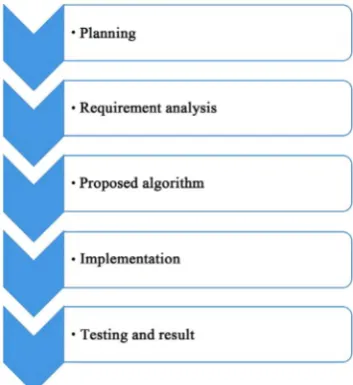
In this research paper, authors used 5 phases to describe the procedure. These phases are planning, requirement analysis, proposed algorithm, implementation, testing and result. Figure 1 shows the method of the proposed work.
3.1. Planning
DOI: 10.4236/jis.2019.104012 207 Journal of Information Security
Figure 1. Proposed methodology.
3.2. Requirement Analysis
Every work has some requirements according to needs. The proposed work does require some specific resources.
1) System Requirements: system requirement can be isolated into two types: a) Software requirement.
b) Hardware requirement.
Software Requirements
i) Language—Java.
ii) Environment—JDK and JRE.
iii) Operating System—Windows, Linux, MAC. iv) Cloud Server.
v) External Algorithm—AES, DES, SHA.
Hardware Requirements
i) Laptop or Desktop with processor. ii) USB cable.
2) User Requirements: user requirement includes what the user expects from the system. For this, the user wants the security of data including integrity, con-fidentiality and authentication.
3.3. Proposed Algorithm
DOI: 10.4236/jis.2019.104012 208 Journal of Information Security
3.4. Implementation
The programming language used to design the proposed algorithm is java. In java, for encrypting data, the algorithm works in two steps. At first, it takes in-put, secondly it requires a 192-bit secret key to encrypt, after providing key, the algorithm encrypts the data and gives a cipher text as output and a hash code is also generated. For decrypting data, the algorithm works in three steps, at first, it receives the cipher text, secondly it requires the same secret key and thirdly it receives the hash code and then it decrypts the data and provides the original text. After implementing the algorithm in java, the authors propose to use the algorithm in cloud.
3.5. Testing and Result
After implementation, the authors got the result that satisfies the conditions. After that, they compared it with other similar existing algorithm and found that the algorithm fulfills all the conditions of enhancing security of the cloud in a better way than the other existing algorithm.
4. Research Design and Analysis
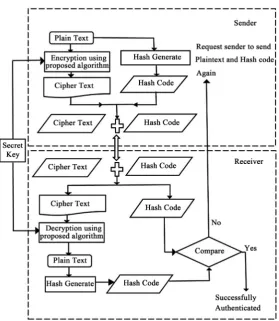
[image:10.595.235.515.385.707.2]In Figure 2, the authors showed the overview of Encryption and Decryption Process:
DOI: 10.4236/jis.2019.104012 209 Journal of Information Security
4.1. Hashing
4.1.1. SHA 512 Logic
SHA 512 is a cryptographic hashing algorithm that input as a message with a maximum length of less than 2128 and provides output as a 512-bit massage
di-gest. The algorithm process the input in 1024 bits blocks. Figure shows the over-all processing of a message to produce a digest [21].
4.1.2. Features of SHA-512 Hashing Algorithm Plaintext Block Size = 1024 bits.
No. of Rounds/steps = 80.
Each Round-Qword = 64 bits.
Each Round-constant K Buffer—8 buffers (a, b, c, d, e, f, g, h).
Store Intermediate result. Each buffer size—64 bits.
4.1.3. Message Digest Generation Using SHA-512-
Step 1: Append padding bits—pad the bits 100… so that length of plain text is 128 < multiple of 1024 bits.
Step 2: Append length—append 128-bit representation of original plain text such that length = Multiple of 1024 bits.
Step 3: Initialize hash buffer—initialize the buffers (a, b, c, d, e, f, g, h) in 64 bit in Hexadecimal.
Step 4: Process each block of plain text in 80 rounds. Step 5: Output—hash code of 512 bits.
[image:11.595.221.526.479.693.2]In Figure 3 and Figure 4, the authors showed how message digest generation and processing of a single 1024-bit block data in SHA-512.
Figure 3. Message digest generation using SHA-512 (“message digest generation using
DOI: 10.4236/jis.2019.104012 210 Journal of Information Security
Figure 4. Processing of a single 1024-bit block in SHA-512 (“processing of a Single
1024-bit block in SHA 512-Google search”) [23].
4.2. Encryption Process
4.2.1. Encryption Process Flow Chart
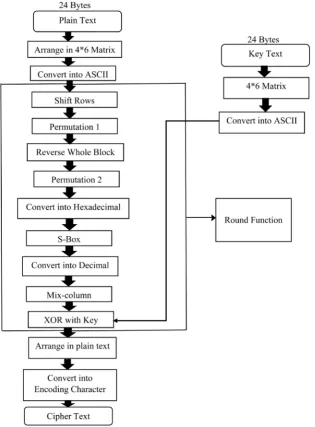
Figure 5 shows the encryption process flowchart.
4.2.2. Block Diagram of Encryption Process Round Function
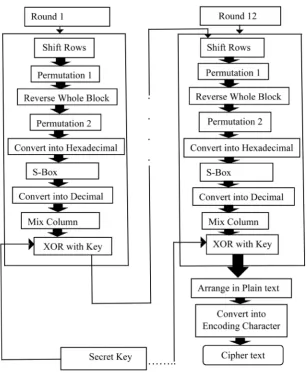
In Figure 6, the authors showed the round function of encryption process.
4.2.3. Encryption Process Description
1) Take an input or plaintext message of any size and key text of 24 bytes. 2) Generate 4 * 6 block matrix, which is denoted by M, Initially i = 0, j = 0, which is shown in Table 1.
3) Convert the messages characters into ASCII equivalent. 4) Perform Shift Rows using following steps:
DOI: 10.4236/jis.2019.104012 211 Journal of Information Security
Figure 5. Encryption process flowchart.
Table 1. Generation of 4 * 6 matrix.
C1 C2 C3 C4 C5 C6
M=
R1 Ai, j Ai, j+1 Ai, j+2 Ai, j+3 Ai, j+4 Ai, j+5 R2 Ai+1, j Ai+1, j+1 Ai+1, j+2 Ai+1, j+3 Ai+1, j+4 Ai+1, j+5 R3 Ai+2, j Ai+2, j+1 Ai+2, j+2 Ai+2, j+3 Ai+2, j+4 Ai+2, j+5 R4 Ai+3, j Ai+3, j+1 Ai+3, j+2 Ai+3, j+3 Ai+3, j+4 Ai+3, j+5
7) Enact Permutation 2 using following steps: Step i: Interchange column-C5 by C6 and C6 by C5. Step ii: Interchange Row-R1 by R4 and R4 by R1.
Step iii: XOR between column C1 and column C3 i.e. C1 ⊕ C3 = X.
DOI: 10.4236/jis.2019.104012 212 Journal of Information Security
Figure 6. Round function of encryption process.
Step v: Replace C1 by X and C2 by Y.
8) Convert the values into equivalent Hexadecimal value. 9) Apply Substitution Box (S-box).
10) Convert the values into ASCII equivalent.
11) Perform mix column operation that is to XOR the constant matrix with the result of step 10. Table 2 shows the predefined constant matrix.
12) Calculate the key using the following steps:
* Generate 4 * 6 block matrix from key text which contains fixed-length size of 24 bytes or (192 bits) each.
* Convert the key characters into ASCII equivalent.
13) Perform XOR between the resultant mix column and the calculated key matrix.
14) Arrange the matrix values as plain text.
15) Convert the plain text into corresponding encoding characters using base 64 encoders [24].
AES SubBytes transformation Table.
DOI: 10.4236/jis.2019.104012 213 Journal of Information Security
Table 2. Constant matrix.
Constant Matrix=
2 3 1 1 2 3
1 2 3 1 1 2
1 1 2 3 1 1
3 1 1 2 3 1
Table 3. AES SubBytes transformation (“Rijndeal S-box”, 2019) [25].
0 1 2 3 4 5 6 7 8 9 A B C D E F 0 63 7C 77 7B F2 6B 6F C5 30 01 67 2B FE D7 AB 76 1 CA 82 C9 7D FA 59 47 F0 AD D4 A2 AF 9C A4 72 C0 2 B7 FD 93 26 36 3F F7 CC 34 A5 E5 F1 71 D8 31 15 3 04 C7 23 C3 18 96 05 9A 07 12 80 E2 EB 27 B2 75 4 09 83 2C 1A 1B 6E 5A A0 52 3B D6 B3 29 E3 2F 84 5 53 D1 00 ED 20 FC B1 5B 6A CB BE 39 4A 4C 58 CF 6 D0 EF AA FB 43 4D 33 85 45 F9 02 7F 50 3C 9F A8 7 51 A3 40 8F 92 9D 38 F5 BC B6 DA 21 10 FF F3 D2 8 CD 0C 13 EC 5F 97 44 17 C4 A7 7E 3D 64 5D 19 73 9 60 81 4F DC 22 2A 90 88 46 EE B8 14 DE 5E 0B DB A E0 32 3A 0A 49 06 24 5C C2 D3 AC 62 91 95 E4 79 B E7 C8 37 6D 8D D5 4E A9 6C 56 F4 EA 65 7A AE 08 C BA 78 25 2E 1C A6 B4 C6 E8 DD 74 1F 4B BD 8B 8A D 70 3E B5 66 48 03 F6 0E 61 35 57 B9 86 C1 1D 9E E E1 F8 98 11 69 D9 8E 94 9B 1E 87 E9 CE 55 28 DF F 8C A1 89 0D BF E6 42 68 41 99 2D 0F B0 54 BB 16
4.2.4. Theoretical Proof of Encryption Process
The proposed algorithm encrypts the data in 12 rounds. For theoretical proof, the authors showed the calculation of just one round.
Insert a plaintext.
→ Anwar Newaz Feroz from 34c.
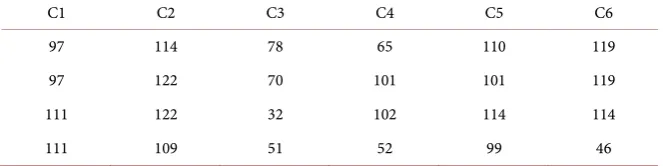
Arrange the plain text in 4 * 6 matrix (see Table 4). Convert into equivalent ASCII value (see Table 5). Perform Shift Rows (see Table 6).
Enact Permutation 1:
Interchange column-C1 by C2 and C2 by C1 (see Table 7). Interchange column-C3 by C4 and C4 by C3 (see Table 8). Interchange column-C5 by C6 and C6 by C5 (see Table 9). Interchange Row-R1 by R3 and R3 by R1 (see Table 10). Interchange Row-R2 by R4 and R4 by R2 (see Table 11). After Permutation 1 the result is (see Table 12).
DOI: 10.4236/jis.2019.104012 214 Journal of Information Security
Table 4. 4*6 matrix of plaintext.
A n w a r N
e w a z F e
r o z _ f r
0 m 3 4 c .
Table 5. ASCII conversion.
65 110 119 97 114 78
101 119 97 114 70 101
114 111 122 32 102 114
[image:16.595.209.541.293.376.2]111 109 51 52 99 46
Table 6. Shift Row operation.
C1 C2 C3 C4 C5 C6
97 114 78 65 110 119
97 122 70 101 101 119
111 122 32 102 114 114
[image:16.595.209.538.409.493.2]111 109 51 52 99 46
Table 7. Interchange column.
C1 C2 C3 C4 C5 C6
114 97 78 65 110 119
122 97 70 101 101 119
122 111 32 102 114 114
[image:16.595.208.538.528.618.2]109 111 51 52 99 46
Table 8. Interchange column.
C1 C2 C3 C4 C5 C6
114 97 65 78 110 119
122 97 101 70 101 119
122 111 102 32 114 114
109 111 52 51 99 46
Table 9. Interchange column.
R1 114 97 65 78 119 110
R2 122 97 101 70 119 101
R3 122 111 102 32 114 114
DOI: 10.4236/jis.2019.104012 215 Journal of Information Security
Table 10. Interchange row.
R1 122 111 102 32 114 114
R2 122 97 101 70 119 101
R3 114 97 65 78 119 110
R4 109 111 52 51 46 99
Table 11. Interchange row.
122 111 102 32 114 114
109 111 52 51 46 99
114 97 65 78 119 110
122 97 101 70 119 101
Table 12. Result of permutation 1.
122 111 102 32 114 114
109 111 52 51 46 99
114 97 65 78 119 110
122 97 101 70 119 101
Table 13. Reverse the whole block.
C1 C2 C3 C4 C5 C6
101 119 70 101 97 122
110 119 78 65 97 114
99 46 51 52 111 109
114 114 32 102 111 122
Enact Permutation-2:
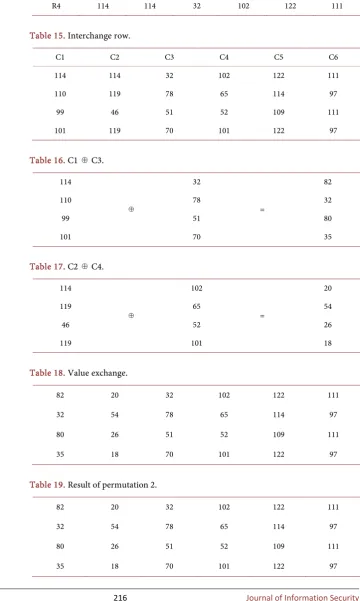
Interchange column-C5 by C6 and C6 by C5 (see Table 14). Interchange Row-R1 by R4 and R4 by R1 (see Table 15). Perform C1 ⊕ C3 = X (see Table 16).
Perform C2 ⊕ C4 = Y (see Table 17).
Replace C1 by X and C2 by Y (see Table 18). After Permutation-2 the result is (see Table 19).
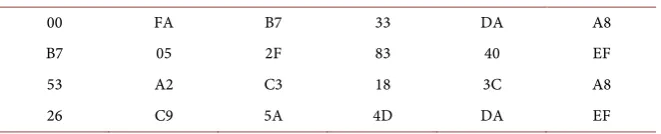
Convert into equivalent Hexadecimal Value (see Table 20). Replace the value using S-Box (see Table 21).
Convert into equivalent Decimal Value (see Table 22). Mix column operation (see Table 23).
Tables 24-29 show the XOR operation between each column of Mix column operation.
Resultant mix column (see Table 30). Key Generation
DOI: 10.4236/jis.2019.104012 216 Journal of Information Security
Table 14. Interchange column.
R1 101 119 70 101 122 97
R2 110 119 78 65 114 97
R3 99 46 51 52 109 111
[image:18.595.177.538.148.750.2]R4 114 114 32 102 122 111
Table 15. Interchange row.
C1 C2 C3 C4 C5 C6
114 114 32 102 122 111
110 119 78 65 114 97
99 46 51 52 109 111
101 119 70 101 122 97
Table 16. C1 ⊕ C3.
114
⊕
32
=
82
110 78 32
99 51 80
101 70 35
Table 17. C2 ⊕ C4.
114
⊕
102
=
20
119 65 54
46 52 26
119 101 18
Table 18. Value exchange.
82 20 32 102 122 111
32 54 78 65 114 97
80 26 51 52 109 111
35 18 70 101 122 97
Table 19. Result of permutation 2.
82 20 32 102 122 111
32 54 78 65 114 97
80 26 51 52 109 111
DOI: 10.4236/jis.2019.104012 217 Journal of Information Security
Table 20. Hexadecimal conversion.
52 14 20 66 7A 6F
20 36 4E 41 72 61
50 1A 33 34 6D 6F
[image:19.595.210.541.181.248.2]23 12 46 65 7A 61
Table 21. Value replacement using S-box.
00 FA B7 33 DA A8
B7 05 2F 83 40 EF
53 A2 C3 18 3C A8
26 C9 5A 4D DA EF
Table 22. Decimal conversion.
0 250 183 51 218 168
183 5 47 131 64 239
83 162 195 24 60 168
38 201 90 77 218 239
Table 23. Mix column.
0 250 183 51 218 168
⊕
2 3 1 1 2 3 183 5 47 131 64 239 1 2 3 1 1 2 83 162 195 24 60 168 1 1 2 3 1 1 38 201 90 77 218 239 3 1 1 2 3 1
Table 24. XOR operation.
0
⊕
2
=
2
183 1 182
83 1 82
38 3 37
Table 25. XOR operation.
250
⊕
3
=
249
5 2 7
162 1 163
201 1 200
Table 26. XOR operation.
183
⊕
1
=
182
47 3 44
195 2 193
DOI: 10.4236/jis.2019.104012 218 Journal of Information Security
Table 27. XOR operation.
51
⊕
1
=
50
131 1 130
24 3 27
77 2 79
Table 28. XOR operation.
218
⊕
2
=
216
64 1 65
60 1 61
218 3 217
Table 29. XOR operation.
168
⊕
3
=
171
239 2 237
168 1 169
239 1 238
Table 30. Result of Mix column operation.
2 249 182 50 216 171
182 7 44 130 65 237
82 163 193 27 61 169
37 200 91 79 217 238
→ This key is symmetric.
Arrange this plaintext in a 4 * 6 matrix table (see Table 31). Convert into equivalent ASCII value (see Table 32). Back to Encryption
XOR between the last resultant mix column table and the key text table (see
Table 33).
Tables 34-39 show the XOR between the last resultant mix column table and the key text table.
Resultant matrix is (see Table 40). Arrange in plain text:
86 145 223 65 248 192 211 126 12 235 50 205 33 218 172 118 88 221 87 161 56 97 233 222.
Convert into Cipher text:
DOI: 10.4236/jis.2019.104012 219 Journal of Information Security
Table 31. 4*6 matrix of key text.
T h i s _ k
e y _ i s _
s y m m e t
r i c . 0 0
Table 32. ASCII conversion.
84 104 105 115 32 107
101 121 32 105 115 32
115 121 109 109 101 116
[image:21.595.210.542.280.345.2]114 105 99 46 48 48
Table 33. XOR between resultant mix column and key text table.
2 249 182 50 216 171
⊕
84 104 105 115 32 107 182 7 44 130 65 237 101 121 32 105 115 32 82 163 193 27 61 169 115 121 109 109 101 116 37 200 91 79 217 238 114 105 99 46 48 48
Table 34. XOR operation.
2
⊕
84
=
86
182 101 211
82 115 33
37 114 87
Table 35. XOR operation.
249
⊕
104
=
145
7 121 126
163 121 218
200 105 161
Table 36. XOR operation.
182
⊕
105
=
223
44 32 12
193 109 172
91 99 56
Table 37. XOR operation.
50
⊕
115
=
65
130 105 235
27 109 118
DOI: 10.4236/jis.2019.104012 220 Journal of Information Security
Table 38. XOR operation.
216
⊕
32
=
248
65 115 50
61 101 88
217 48 233
Table 39. XOR operation.
171
⊕
107
=
192
237 32 205
169 116 221
238 48 222
Table 40. Resultant matrix.
86 145 223 65 248 192
211 126 12 235 50 205
33 218 172 118 88 221
87 161 56 97 233 222
4.3. Decryption Process
4.3.1. Decryption Process Flow Chart
Figure 7 shows the decryption process flowchart.
4.3.2. Block Diagram of Decryption Process Round Function
In Figure 8, the authors showed the round function of decryption process.
4.3.3. Decryption Process Description
1) Received the cipher text from the encryption process. 2) Decode the cipher text using base 64 decoders [24].
3) Generate 4 * 6 block matrix of the decoded value, which is denoted by Md.
Initially I = 0, j = 0, which is shown in Table 41. 4) Calculate the key using following steps:
*Generate 4 * 6 block matrix from key text which contains fixed-length size of 24 bytes or (192 bits) each.
*Convert the key characters into ASCII equivalent.
5) Perform XOR between the result generated block matrix Md and the
calcu-lated key matrix.
6) Perform mix column operation that is to XOR the constant matrix with the result of step 5.
Table 42 shows the predefined constant matrix:
7) Convert the matrix values into equivalent Hexadecimal. 8) Apply Reverse Substitution Box (S-Box).
9) Convert the Hexadecimal values into Decimal value. 10) Enact Permutation 4 using following steps:
DOI: 10.4236/jis.2019.104012 221 Journal of Information Security
Figure 7. Decryption process flowchart.
Table 41. Generation of 4 * 6 matrix.
C1 C2 C3 C4 C5 C6
Md=
R1 Ai, j Ai, j+1 Ai, j+2 Ai, j+3 Ai, j+4 Ai, j+5 R2 Ai+1, j Ai+1, j+1 Ai+1, j+2 Ai+1, j+3 Ai+1, j+4 Ai+1, j+5 R3 Ai+2, j Ai+2, j+1 Ai+2, j+2 Ai+2, j+3 Ai+2, j+4 Ai+2, j+5 R4 Ai+3, j Ai+3, j+1 Ai+3, j+2 Ai+3, j+3 Ai+3, j+4 Ai+3, j+5
Table 42. Constant matrix.
Constant Matrix=
2 3 1 1 2 3
1 2 3 1 1 2
1 1 2 3 1 1
DOI: 10.4236/jis.2019.104012 222 Journal of Information Security
Figure 8. Round function of decryption process.
Step ii: XOR between column C2 and column C4 i.e. C2 ⊕ C4 = Y.
Step iii: Replace C1 by X and C2 by Y.
Step iv: Interchange Row-R1 by R4 and R4 by R1. Step v: Interchange column-C5 by C6 and C6 by C5. 11) Reverse the whole block of matrix.
12) Enact Permutation 3 using the following steps: Step i: Interchange Row-R2 by R4 and R4 by R2. Step ii: Interchange Row-R1 by R3 and R3 by R1. Step iii: Interchange column-C5 by C6 and C6 by C5. Step iv: Interchange column-C3 by C4 and C4 by C3. Step v: Interchange column-C1 by C2 and C2 by C1. 13) Perform inverse Shift Rows.
14) Convert the decimal values into equivalent ASCII character. 15) Finally Arrange the ASCII equivalent into plaintext.
AES inverse SubBytes transformation table.
DOI: 10.4236/jis.2019.104012 223 Journal of Information Security
Table 43. AES Inverse SubBytes transformation (“Rijndeal S-box”, 2019) [25].
0 1 2 3 4 5 6 7 8 9 A B C D E F 0 52 09 6A D5 30 36 A5 38 BF 40 A3 9E 81 F3 D7 FB 1 7C E3 39 82 9B 2F FF 87 34 8E 43 44 C4 DE E9 CB 2 54 7B 94 32 A6 C2 23 3D EE 4C 95 0B 42 FA C3 4E 3 08 2E A1 66 28 D9 24 B2 76 5B A2 49 6D 8B D1 25 4 72 F8 F6 64 86 68 98 16 D4 A4 5C CC 5D 65 B6 92 5 6C 70 48 50 FD ED B9 DA 5E 15 46 57 A7 8D 9D 84 6 90 D8 AB 00 8C BC D3 0A F7 E4 58 05 B8 B3 45 06 7 D0 2C 1E 8F CA 3F 0F 02 C1 AF BD 03 01 13 8A 6B 8 3A 91 11 41 4F 67 DC EA 97 F2 CF CE F0 B4 E6 73 9 96 AC 74 22 E7 AD 35 85 E2 F9 37 E8 1C 75 DF 6E A 47 F1 1A 71 1D 29 C5 89 6F B7 62 0E AA 18 BE 1B B FC 56 3E 4B C6 D2 79 20 9A DB C0 FE 78 CD 5A F4 C 1F DD A8 33 88 07 C7 31 B1 12 10 59 27 80 EC 5F D 60 51 7F A9 19 B5 4A 0D 2D E5 7A 9F 93 C9 9C EF E A0 E0 3B 4D AE 2A F5 B0 C8 EB BB 3C 83 53 99 61 F 17 2B 04 7E BA 77 D6 26 E1 69 14 63 55 21 0C 7D
4.3.4. Theoretical Proof of Decryption Process
The proposed algorithm decrypts the data in 12 rounds. For theoretical proof, the authors showed the calculation of just one round.
Cipher text:
ODYgMTQ1IDIyMyA2NSAyNDggMTkyIDIxMSAxMjYgMTIgMjM1IDUwI DIwNSAzMyAyMTggMTcyIDExOCA4OCAyMjEgODcgMTYxIDU2IDk3IDIz MyAyMjI=.
Decode Character:
86 145 223 65 248 192 211 126 12 235 50 205 33 218 172 118 88 221 87 161 56 97 233 222
Arrange the cipher text into 4 * 6 matrix table (see Table 44). Key Generation
Key text:
→ This key is symmetric.
Arrange this plaintext in a 4 * 6 matrix table (see Table 45). Convert into equivalent ASCII value (see Table 46). Back to Decryption
XOR between the arranged cipher text matrix table and the key text table (see
Table 47).
Tables 48-53 show the XOR between the arranged cipher text matrix table and the key text table.
DOI: 10.4236/jis.2019.104012 224 Journal of Information Security
Table 44. 4 * 6 matrix of decoded value.
86 145 223 65 248 192
211 126 12 235 50 205
33 218 172 118 88 221
87 161 56 97 233 222
Table 45. 4 * 6 matrix of key text.
T h i s _ k
e y _ i s _
s y m m e t
r i c . 0 0
Table 46. ASCII conversion.
84 104 105 115 32 107
101 121 32 105 115 32
115 121 109 109 101 116
[image:26.595.213.540.376.437.2]114 105 99 46 48 48
Table 47. XOR between arranged cipher text and key text table.
86 145 223 65 248 192
⊕
84 104 105 115 32 107 211 126 12 235 50 205 101 121 32 105 115 32 33 218 172 118 88 221 115 121 109 109 101 116 87 161 56 97 233 222 114 105 99 46 48 48
Table 48.XOR operation.
86
⊕
84
=
2
211 101 182
33 115 82
87 114 37
Table 49. XOR operation.
145
⊕
104
=
249
126 121 7
218 121 163
161 105 200
Table 50. XOR operation.
223
⊕
105
=
182
12 32 44
172 109 193
DOI: 10.4236/jis.2019.104012 225 Journal of Information Security
Table 51. XOR operation.
65
⊕
115
=
50
235 105 130
118 109 27
97 46 79
Table 52. XOR operation.
248
⊕
32
=
216
50 115 65
88 101 61
233 48 217
Table 53. XOR operation.
192
⊕
107
=
171
205 32 237
221 116 169
222 48 238
Table 54. Resultant matrix.
2 249 182 50 216 171
182 7 44 130 65 237
82 163 193 27 61 169
37 200 91 79 217 238
Mix column operation (see Table 55).
Tables 56-61 show the XOR operation between each column of Mix column operation.
Resultant mix column (see Table 62).
Convert into equivalent Hexadecimal Value (see Table 63). Replace the value using Reverse S-Box (see Table 64). Convert into equivalent Decimal Value (see Table 65). Enact Permutation-4:
Perform C1 ⊕ C3 = X (see Table 66).
Perform C2 ⊕ C4 = Y (see Table 67).
Replace C1 by X and C2 by Y (see Table 68).
Interchange Row-R1 by R4 and R4 by R1 (see Table 69). Interchange column-C5 by C6 and C6 by C5 (see Table 70). After Permutation 4 the result is (see Table 71).
Reverse the whole block of matrix (see Table 72). Enact Permutation 3:
DOI: 10.4236/jis.2019.104012 226 Journal of Information Security
Table 55. Mix column.
2 249 182 50 216 171
⊕
2 3 1 1 2 3 182 7 44 130 65 237 1 2 3 1 1 2 82 163 193 27 61 169 1 1 2 3 1 1 37 200 91 79 217 238 3 1 1 2 3 1
Table 56. XOR operation.
2
⊕
2
=
0
182 1 183
82 1 83
37 3 38
Table 57. XOR operation.
249
⊕
3
=
250
7 2 5
163 1 162
200 1 201
Table 58. XOR operation.
182
⊕
1
=
183
44 3 47
193 2 195
91 1 90
Table 59. XOR operation.
50
⊕
1
=
51
130 1 131
27 3 24
79 2 77
Table 60. XOR operation.
216
⊕
2
=
218
65 1 64
61 1 60
217 3 218
Table 61. XOR operation.
171
⊕
3
=
168
237 2 239
169 1 168
DOI: 10.4236/jis.2019.104012 227 Journal of Information Security
Table 62. Result of mix column operation.
0 250 183 51 218 168
183 5 47 131 64 239
83 162 195 24 60 168
[image:29.595.210.542.182.248.2]38 201 90 77 218 239
Table 63. Hexadecimal conversion.
00 FA B7 33 DA A8
B7 05 2F 83 40 EF
53 A2 C3 18 3C A8
[image:29.595.209.541.280.343.2]26 C9 5A 4D DA EF
Table 64. Value replacement using reverse s-box.
52 14 20 66 7A 6F
20 36 4E 41 72 61
50 1A 33 34 6D 6F
23 12 46 65 7A 61
Table 65. Decimal conversion.
C1 C2 C3 C4 C5 C6
82 20 32 102 122 111
32 54 78 65 114 97
80 26 51 52 109 111
35 18 70 101 122 97
Table 66. C1 ⊕ C3.
82
⊕
32
=
114
32 78 110
80 51 99
35 70 101
Table 67. C2 ⊕ C4.
20
⊕
102
=
114
54 65 119
26 52 46
18 101 119
Table 68. Value exchange.
R1 114 114 32 102 122 111
R2 110 119 78 65 114 97
R3 99 46 51 52 109 111
DOI: 10.4236/jis.2019.104012 228 Journal of Information Security
Table 69. Interchange row.
C1 C2 C3 C4 C5 C6
101 119 70 101 122 97
110 119 78 65 114 97
99 46 51 52 109 111
114 114 32 102 122 111
Table 70. Interchange column.
101 119 70 101 97 122
110 119 78 65 97 114
99 46 51 52 111 109
114 114 32 102 111 122
Table 71. Result of permutation 4.
101 119 70 101 97 122
110 119 78 65 97 114
99 46 51 52 111 109
114 114 32 102 111 122
Table 72. Reverse the whole block.
R1 122 111 102 32 114 114
R2 109 111 52 51 46 99
R3 114 97 65 78 119 110
R4 122 97 101 70 119 101
Table 73. Interchange row.
R1 122 111 102 32 114 114
R2 122 97 101 70 119 101
R3 114 97 65 78 119 110
R4 109 111 52 51 46 99
Interchange Row-R1 by R3 and R3 by R1 (see Table 74). Interchange column-C5 by C6 and C6 by C5 (see Table 75). Interchange column-C3 by C4 and C4 by C3 (see Table 76). Interchange column-C1 by C2 and C2 by C1 (see Table 77). After Permutation-3 the result is (see Table 78).
Perform inverse shift rows (see Table 79).
Convert into equivalent ASCII value (see Table 80). Arrange in Plain text/Decrypted text:
DOI: 10.4236/jis.2019.104012 229 Journal of Information Security
Table 74. Interchange row.
C1 C2 C3 C4 C5 C6
114 97 65 78 119 110
122 97 101 70 119 101
122 111 102 32 114 114
[image:31.595.210.537.208.292.2]109 111 52 51 46 99
Table 75. Interchange column.
C1 C2 C3 C4 C5 C6
114 97 65 78 110 119
122 97 101 70 101 119
122 111 102 32 114 114
109 111 52 51 99 46
Table 76. Interchange column.
C1 C2 C3 C4 C5 C6
114 97 78 65 110 119
122 97 70 101 101 119
122 111 32 102 114 114
109 111 51 52 99 46
Table 77. Interchange column.
97 114 78 65 110 119
97 122 70 101 101 119
111 122 32 102 114 114
111 109 51 52 99 46
Table 78. Result of Permutation 3.
R1 97 114 78 65 110 119
R2 97 122 70 101 101 119
R3 111 122 32 102 114 114
R4 111 109 51 52 99 46
Table 79. Inverse shift row operation.
65 110 119 97 114 78
101 119 97 122 70 101
114 111 122 32 102 114
DOI: 10.4236/jis.2019.104012 230 Journal of Information Security
Table 80. ASCII conversion.
A n w a r N
e w a z F e
r o z _ f r
o m 3 4 c .
4.4. Security Analysis
Cloud is being used for storing sensitive and important data so it is very impor-tant to use a strong key that will provide security to the data stored in cloud. If we used a key of 10 characters using alphanumeric character. There are total 26 alphabets in English and if we count the upper and lower cases the total numbers are 26 + 26 = 52 and if we count the numeric digits the total number is 62. For a 10 character key, it will be 6210 or 8.39 * 1017 or 8.4 quintillion combination
al-most. A computer would take almost 257,201,646.091 years to crack a 10 digits key. A super computer will take 800,000,000 seconds or 133,333,333.333 minutes or 2,222,222.22222 hours or simply we can say it will take almost 257 years to crack the key. This calculation is for 10 digits key and if we take 48 digits key al-so count the special characters then it will take a numerous amount of time to crack the key which sounds almost impossible.
4.5. Implementation of the Algorithm in Java
Figure 9 shows the Starting of the program:
When a user wants to encrypt a text, he had to type his text in “Input: (Text/ Encrypted Text)” panel. Then he had to give a secret key of 192 bits in “Key:” panel. Then he had to click on “Encrypt” button (see Figure 10).
After clicking on “Encrypt” button the encryption will be done and user will get a “Cipher text” as output in “Output: (Text/Encrypted Text)” panel and a “Hash code” is also generated in “Hash:” panel (see Figure 11).
To get the plain text from the cipher text, user had to copy the cipher text from “Output: (Text/Encrypted Text)” and paste it in “Input: (Text/Encrypted Text)” panel and copy and paste the “Hash code” in “Hash:” panel.
After that he had to enter the same secret key in “Key:” panel and then he had to click on “Decrypt” button (see Figure 12).
After clicking on “Decrypt” button, the decryption process will be done and user will get the original text in “Output: (Text/Encrypted Text)” panel (see Fig-ure 13).
User also can see the execution time of the encryption and decryption process.
4.6. Proposed Model of Data Storage in Cloud Using the Proposed
Algorithm
DOI: 10.4236/jis.2019.104012 231 Journal of Information Security
Figure 9. Interface of the algorithm in JAVA.
Figure 10. Encryption of data in Java interface.
Figure 11. Encrypted text and hash value.
[image:33.595.237.509.566.708.2]DOI: 10.4236/jis.2019.104012 232 Journal of Information Security
Figure 13. Original plain text.
Figure 14. Proposed model of data storage in cloud using the proposed algorithm.
the cipher text in cloud, the key and hash code are stored in a database which is also stored in cloud. When a receiver request the data, he gets the cipher text from cloud, then he request for key and hash code from data base, after getting the hash code and key, the receiver decrypts the data using the proposed algo-rithm and gets the original plain text.
5. Result Discussion
The result has tested by: Windows 10Pro64-bit.
Intel®Core™[email protected] GHz 2.71 GHz. 8 GB RAM.
In Table 81, the authors analyze the algorithm with the same key and same message size for different types of data.
[image:34.595.234.514.237.482.2]DOI: 10.4236/jis.2019.104012 233 Journal of Information Security
Graphical Representation of Encryption and Decryption time for 192-bit data among the proposed algorithm, AES and DES (see Figure 15).
Graphical Representation of Encryption and Decryption time for 384-bit data among the proposed algorithm, AES and DES (see Figure 16).
[image:35.595.244.501.174.305.2]Graphical Representation of Encryption and Decryption time for 576-bit data among the proposed algorithm, AES and DES (see Figure 17).
[image:35.595.244.499.338.478.2]Figure 15. Encryption and decryption for 192-bit data.
Figure 16. Encryption and decryption for 384-bit data.
Table 81. Algorithm analysis with the same key and same message size.
Data
Key size
Runtimes (sec)
Type No Size Encryption Decryption Average Average
Numeric
1 192-bit 192-bit 0.089 s
0.086 s
0.056 s
0.053 s 2 192-bit 192-bit 0.090 s 0.051 s
3 192-bit 192-bit 0.081 s 0.052 s
Alphabetic
1 192-bit 192-bit 0.092 s
0.086 s
0.074 s
0.080 s 2 192-bit 192-bit 0.086 s 0.085 s
3 192-bit 192-bit 0.078 s 0.078 s
Alphanumeric
1 192-bit 192-bit 0.087 s
0.088 s
0.082 s
0.081 s 2 192-bit 192-bit 0.086 s 0.078 s
[image:35.595.211.539.528.725.2]DOI: 10.4236/jis.2019.104012 234 Journal of Information Security
Figure 17. Encryption and decryption for 576 bit data.
Table 82. Comparison of proposed algorithm with AES, DES.
Data
Key Size Run Time
Algorithm Message Size Encryption Decryption
Proposed Algorithm
192-bit
192-bit
0.092 s 0.075 s 384-bit 0.141 s 0.107 s 576-bit 0.271 s 0.174 s
AES
192-bit
128-bit
0.530 s 0.005 s 384-bit 0.660 s 0.006 s 576-bit 0.730 s 0.006 s
DES
192-bit
64-bit
0.380 s 0.006 s 384-bit 0.410 s 0.006 s 576-bit 0.450 s 0.007 s
6. Conclusions
6.1. Conclusion
The main purpose of the algorithm is to provide security to data stored in cloud. For this purpose, the authors used a symmetric algorithm. They used various methods to further enhance the algorithm which can easily be used for encrypt-ing data stored in cloud. The algorithm works on block wise. The algorithm takes up to 192 bits block of data at a time and encrypts them into cipher text. The algorithm encrypts and decrypts the data in 12 rounds. The algorithm used 192-bit key that’s why it provides better security. Symmetric algorithms are used widely around the world to store private data and since this algorithm will also be used to encrypt private data, that’s why authors thought of using a symmetric algorithm. The algorithm developed by the authors ensures data confidentiality, integrity and authenticity for data stored in cloud.
6.2. Limitations
[image:36.595.209.540.279.466.2]DOI: 10.4236/jis.2019.104012 235 Journal of Information Security
2) Key and Hash code exchange is not much secure.
6.3. Future Works
1) Audio, video, image and file encryption.
2) Providing better security on Key and Hash code exchange.
Conflicts of Interest
The authors declare no conflicts of interest regarding the publication of this pa-per.
References
[1] Definition of Cloud Computing.
https://searchcloudcomputing.techtarget.com/definition/cloud-computing
[2] What Is Cloud Computing.
https://searchcloudcomputing.techtarget.com/definition/cloud-computing
[3] What Is Encryption and Decryption.
https://www.tutorialspoint.com/internet_technologies/data_encryption
[4] What Is the Types of Encryption Technique.
https://www.zettaset.com/blog/types-of-encryption-underlying-algorithms
[5] Selvi, S. (2017) An Efficient Hybrid Cryptography Model for Cloud Data Security.
International Journal of Computer Science and Information Security, 15, 307-313. [6] AbdElnapi, N.M.M., Omara, F.A. and Omran, N.F. (2016) A Hybrid Hashing
Secu-rity Algorithm for Data Storage on Cloud Computing. International Journal of Computer Science and Information Security, 14, 175-181.
[7] Arora, R. and Parashar, A. (2013) Secure User Data in Cloud Computing Using En-cryption Algorithms. International Journal of Engineering Research and Applica-tions, 3, 1922-1926.
[8] Kartit, Z. and El Marraki, M. (2015) Applying Encryption Algorithm to Enhance Data Security in Cloud Storage. Engineering Letters, 23, 277-282.
[9] Belguith, S., Abderrazak, J. and Attia, R. (2015) Enhancing Data Security in Cloud Computing Using a Lightweight Cryptographic Algorithm. The 11th International Conference on Autonomic and Autonomous Systems, Rome, 24-29 May, 98-103. [10] Singh, N. and Singh, N.K. (2014) Information Security in Cloud Computing Using
Encryption Techniques. International Journal of Scientific & Engineering Research, 5, 1111-1113.
[11] Agarwal, A. and Agarwal, A. (2011) The Security Risks Associated with Cloud Computing. International Journal of Computer Applications in Engineering Sciences, 1, 257-259.
[12] Pancholi, V.R. and Patel, B.P. (2016) Enhancement of Cloud Computing Security with Secure Data Storage Using AES. International Journal for Innovative Research in Science & Technology, 2, 18-21.
[13] Sachdev, A. and Bhansali, M. (2013) Enhancing Cloud Computing Security Using AES Algorithm. International Journal of Computer Applications, 67, 19-23.
https://doi.org/10.5120/11422-6766
DOI: 10.4236/jis.2019.104012 236 Journal of Information Security
Computer Science and Information Technologies, 8, 582-585.
[15] Lee, B.-H., FaridWajdi, M. and Dewi, E.K. (2018) Data Security in Cloud Compu-ting Using AES under HEROKU Cloud. 27th Wireless and Optical Communica-tions Conference, Hualien, 30 April-1 May 2018.
[16] Sathana, V. and Shanthini, J. (2014) Automated Security Providence for Dynamic Group in Cloud. International Journal of Innovative Research in CE, 2.
[17] BhavaniBai, B. (2014) Ensuring Security at Data Level in Cloud Using Multi Cloud Architecture. International Journal of Science and Technology.
[18] Mounica, D. and Rani, R. (2013) Optimized Multi-Clouds Using Shamir Shares. In-ternational Journal for Development of Computer Science & Technology, 1, 83-87. [19] Jose, N. and Kamani, C. (2013) A Data Security Model Enhancement in Cloud
En-vironment. Journal of Computer Science and Engineering, 10, 1-6.
[20] Delfin, S., et al. (2018) Cloud Data Security Using AES Algorithm. International Research Journal of Engineering and Technology, 5, 1189-1192.
[21] Hash Function.pdf, n.d
[22] Message Digest Generation Using SHA 512.
https://www.google.com/search?client=firefox-b-d&channel=trow&biw=1536&bih =750&tbm=isch&sa=1&ei=mbZBXfvJNdHhz7sP6d-SyAM&q=message+digest+gener ation+using+SHA+512+&oq=message+digest+generation+using+SHA+512+&gs_l =img.3..35i39.2548.3808..4778...0.0..0.148.2391.8j14...0....1..gws-wiz-img.zrg5K-Xs XAU&ved=0ahUKEwi7-pWkv9_jAhXR8HMBHemvBDkQ4dUDCAY&uact=5#img
rc=piLEnVVNqsKcMM
[23] Processing of a Single 1024-Bit Block in SHA 512.
https://www.google.com/search?q=Processing+of+a+single+1024-+bit+block+in+S HA+512-&client=firefox-b-d&channel=trow&source=lnms&tbm=isch&sa=X&ved =0ahUKEwidv6a-v9_jAhVp8XMBHfUQAToQ_AUIEigC&biw=1536&bih=750#im
grc=SUvuOD_TXhzHvM
![Figure 3. Message digest generation using SHA-512 (“message digest generation using SHA 512-Google search”) [22]](https://thumb-us.123doks.com/thumbv2/123dok_us/8932195.392385/11.595.221.526.479.693/figure-message-digest-generation-message-digest-generation-google.webp)
![Figure 4. Processing of a single 1024-bit block in SHA-512 (“processing of a Single 1024-bit block in SHA 512-Google search”) [23]](https://thumb-us.123doks.com/thumbv2/123dok_us/8932195.392385/12.595.215.537.67.329/figure-processing-single-block-processing-single-google-search.webp)