jmmce.org Printed in the USA. All rights reserved
67
A New Application For Flotation
Of Oxidized Copper Ore
Recep Ziyadanogullari, Firat Aydin*
Dicle University, Faculty of Science and Art, Chemistry Department, 21280, Diyarbakır-TURKEY
Abstract:
In this study, the flotation of oxidized copper ore obtained from Ergani Copper Mining Company in Turkey was performed. This ore contains 2.03% copper, 0.15% cobalt and 3.73% sulfur. An effective processing method has not been found to recover copper and cobalt from this ore, which has been stockpiled for 40-45 years in the idled plant. It was established that recovery of copper and cobalt from this ore with hydrometallurgical treatment is not economical, so using flotation to increase the concentration of copper and cobalt was chosen. When flotation of the oxidized copper ore was performed under standard operating conditions in the plant, good results were not obtained. Because of this, the flotation of samples obtained from sulfurized medium containing different ratios of H2S+ H2O gases was done under the same conditions.
Following flotation, it was seen that copper, cobalt and sulfur present in the medium were concentrated. In this solution, concentration of copper and cobalt were found five times higher than normal level.
Key Words: Oxidized copper ore, sulfurization, flotation, copper, cobalt, sulfur
INTRODUCTION
Many researchers have tried to recover copper and cobalt hydrometallurgically from the currently unusable ores of the Ergani Copper Mining Co. However, it has been reported that these operations were not economic, and removal efficiency was low (3, 11, 17, 18).
In addition to hydrometallurgical tests, flotation studies (1, 4-8, 10, 12-16) of the oxidized copper ore and different structures of copper ore have been carried out by many researchers using various flotation conditions.
Oxidized copper ores are found in many places in the world. Formation of this type of ore occurs in the same locations as other copper ores. Due to this, the economical evaluation of oxidized copper ore is important today. In another study, sulphidising flotation of oxide copper-cobalt ores, using sodium hydrosulphide as the sulphidising agent, has been practiced in Katanga, Democratic Republic of Congo. With sodium hydrosulphide, nearly 77% of the copper and 75% of the cobalt were recovered with a
concentration ratio of 3.0. Using a 1/1 combination of NaHS and (NH4)2S, about 80% of
the copper and cobalt have been recovered with a concentration ratio of 3.5 (9).
In this study, we attempted flotation of oxidized copper ore. When this was unsuccessful, we used a sulfurization process developed in our previous studies. As a result of this process a new surface forms on the oxidized copper particles and flotation experiments were carried out using these samples (2-3).
As was seen in the previous studies, successful results can not be obtained by direct flotation of the original oxidized ore. However, in this study, we obtained good results by flotation of a sample obtained from an appropriate sulfurization process.
EXPERIMENTAL DESIGN
Material
In this study, the oxidized copper ore used was supplied from the Ergani Copper Mining Co. Turkey. Ergani, which is in southeast Turkey, is a leading copper and pyrite ore production area.
Analyses show that the ore obtained from the Ergani Region contains 2.03% copper, 0.15% cobalt and 3.73% sulfur. Pyrite, chalcopyrite and oxidized copper ore are the main ore minerals present. In addition to this, carbonate, calcite, and clay minerals as gangue, and some important rare minerals are found in the orebody.
The K-Amil xanthate and Dowfroth 250 used in flotation were taken from the Ergani Copper Mining Co. in Turkey.
In our studies, 96% (w/v) H2SO4, 37% (w/v) HCl, 65% (w/v) HNO3 and KClO3
were purchased from Merck.
The experiments were conducted in a laboratory equipped with facilities for carrying out hydrometallurgical operations such as autoclave leaching. The composition of all solutions and samples were determined using a Unicam 929 Model AAS. Sulfur identification was also made by gravimetric methods.
Denver mark flotation apparatus, Heraus Model Furnace and Nel 890 Model pH meter were used for flotation, roasting and determination of pH of samples, respectively.
Method
The bulk sample was split into 100 gram fractions, ground to –100 mesh and dried at 110°C. These samples were used in chemical analyses and flotation studies. H2S was
produced by addition of H2SO4 to FeS (2) obtained from pyrite. The sulfurization process
RESULTS AND DISCUSSION
The Flotation of Oxidized Copper Ore:
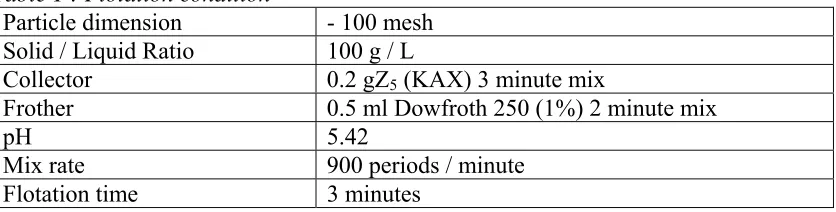
This study was carried out under the conditions indicated in table 1. Flotation time was 3 minutes. In the first test with a run of mine ore sample, it was determined that the concentrate (copper and cobalt) obtained from this study was 5.07 g while the tailing was 92.53 g. In untreated samples, 14.90 % of the copper and 4.40 % of the cobalt reported to the concentrate phase, which are not acceptable concentrations. In the second series of tests, oxidized copper ore was first sulfurized at 110° C by using various ratios of H2S +
[image:3.612.112.530.248.354.2]H2O. The sample after sulfurization was floated under the conditions stated above.
Table 1 : Flotation condition
Particle dimension - 100 mesh
Solid / Liquid Ratio 100 g / L
Collector 0.2 gZ5 (KAX) 3 minute mix
Frother 0.5 ml Dowfroth 250 (1%) 2 minute mix
pH 5.42
Mix rate 900 periods / minute
Flotation time 3 minutes
The Flotation of Samples with Sulfurization of Oxidized Copper Ore
For the sulfurization process, two samples were prepared in two different autoclave mediums: Sample A containing 18.37g H2S +120.00 g H2O for one kg of
copper ore, and Sample B containing 24.50 g H2S + 160.00 g H2O for one kg of ore.
These samples were floated under the same conditions described previously.
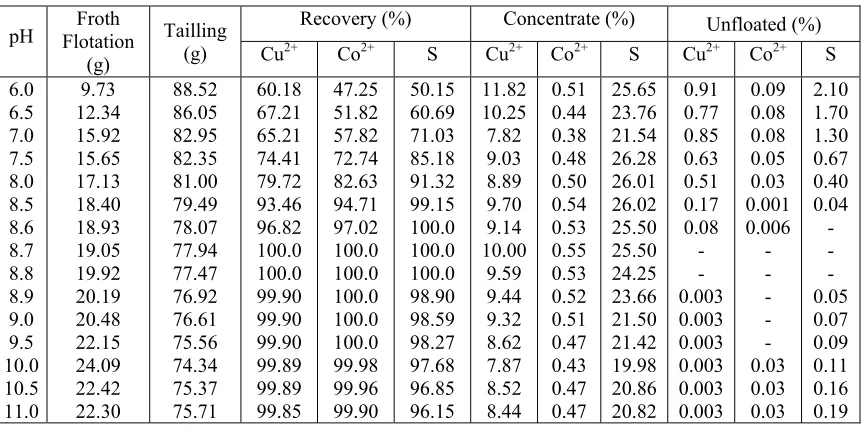
The results presented in Table 2 and Table 3 show that the flotation efficiency varies considerably depending on pH of the medium and sulfurization of the oxidized copper ore.
Since the flotation efficiency increased more in sample B, additional flotation tests using sample B were performed using an activator (CuSO4). This appeared to result
in no difference in flotation efficiency. Therefore, the sulfurization process was applied to another one kg oxidized copper ore sample using the medium containing 30.63g H2S +
200.00 g H2O (Sample C). The flotation was done under the same conditions. Sulfur
Table 2: The results obtained from the flotation of sample A**
Recovery (%) Concentrate (%) Unfloated (%) PH Froth Flotation (g) Tailling (g)
Cu2+ Co2+ Cu2+ Co2+ Cu2+ Co2+
6.0 6.5 7.0 7.5 8.0 8.5 10.0 11.0 8.71 10.11 11.22 11.71 12.29 13.00 15.63 14.79 89.43 87.15 85.02 85.29 84.75 84.01 81.34 83.34 59.77 61.62 62.85 63.12 65.15 66.82 68.98 67.12 40.23 38.38 37.15 36.87 34.75 33.18 31.02 32.88 13.86 12.64 11.85 11.64 10.99 10.25 9.28 9.01 0.68 0.56 0.52 0.51 0.48 0.45 0.42 0.41 0.91 0.89 0.89 0.88 0.83 0.80 0.77 0.80 0.10 0.11 0.11 0.11 0.12 0.12 0.13 0.12
Table 3: The results obtained from the flotation of sample B**
Recovery (%) Concentrate (%) Unfloated (%) PH FlotationFroth
(g)
Tailling
(g) Cu2+ Co2+ Cu2+ Co2+ Cu2+ Co2+
[image:4.612.110.541.453.667.2]6.0 6.5 7.0 7.5 8.0 8.5 10.0 11.0 9.12 11.13 12.00 12.16 12.99 13.45 17.00 15.78 88.06 86.07 85.19 85.02 84.19 83.73 80.19 81.40 59.88 66.74 65.82 70.38 75.21 82.44 94.15 94.82 47.01 51.17 56.64 70.63 79.18 85.17 90.33 91.15 13.75 12.47 11.82 11.33 10.76 10.12 9.76 9.28 0.65 0.56 0.52 0.51 0.46 0.45 0.43 0.42 0.92 0.78 0.81 0.71 0.60 0.43 0.15 0.13 0.09 0.09 0.08 0.05 0.04 0.03 0.02 0.02
Table 4: The results obtained from flotation of Sample C**
Recovery (%) Concentrate (%) Unfloated (%) pH FlotationFroth
(g)
Tailling
(g) Cu2+ Co2+ S Cu2+ Co2+ S Cu2+ Co2+ S
6.0 6.5 7.0 7.5 8.0 8.5 8.6 8.7 8.8 8.9 9.0 9.5 10.0 10.5 11.0 9.73 12.34 15.92 15.65 17.13 18.40 18.93 19.05 19.92 20.19 20.48 22.15 24.09 22.42 22.30 88.52 86.05 82.95 82.35 81.00 79.49 78.07 77.94 77.47 76.92 76.61 75.56 74.34 75.37 75.71 60.18 67.21 65.21 74.41 79.72 93.46 96.82 100.0 100.0 99.90 99.90 99.90 99.89 99.89 99.85 47.25 51.82 57.82 72.74 82.63 94.71 97.02 100.0 100.0 100.0 100.0 100.0 99.98 99.96 99.90 50.15 60.69 71.03 85.18 91.32 99.15 100.0 100.0 100.0 98.90 98.59 98.27 97.68 96.85 96.15 11.82 10.25 7.82 9.03 8.89 9.70 9.14 10.00 9.59 9.44 9.32 8.62 7.87 8.52 8.44 0.51 0.44 0.38 0.48 0.50 0.54 0.53 0.55 0.53 0.52 0.51 0.47 0.43 0.47 0.47 25.65 23.76 21.54 26.28 26.01 26.02 25.50 25.50 24.25 23.66 21.50 21.42 19.98 20.86 20.82 0.91 0.77 0.85 0.63 0.51 0.17 0.08 -0.003 0.003 0.003 0.003 0.003 0.003 0.09 0.08 0.08 0.05 0.03 0.001 0.006 -0.03 0.03 0.03 2.10 1.70 1.30 0.67 0.40 0.04 -0.05 0.07 0.09 0.11 0.16 0.19 **
The original sample (oxidized copper ore) was also floated at pH 8.7, which was determined as optimum conditions (all other parameters were held constant). Flotation of
a 100.00 g sample resulted in 13.51 g reporting to the concentrate, while 85.50 g remained as tailing. The concentrate grade was 20.33% copper and 16.77% cobalt, enrichment was not achieved.
[image:5.612.154.468.135.320.2]In the next step, flotation procedure was performed to test the effects of pulp density. The studies were carried out at pH 8.7 (holding other parameters constant) and floating 150 g, 200 g, 250 f and 300 g samples of sample C. The experimental results are given in Table 5.
Table 5: The results obtained from flotation of Sample C**
Recovery (%) Concentrate (%) Unfloated (%) Sam
ple FlotationFroth (g)
Tailling
(g) Cu Co S Cu Co S Cu Co S
150 200 250 300
29.03 38.94 48.10 56.13
119.75 158.11 199.77 240.98
100.0 100.0 100.0 98.71
100.0 100.0 100.0 99.52
100.0 100.0 100.0 97.8
9.89 9.93 9.94 10.18
0.55 0.55 0.54 0.50
24.98 24.99 25.02 25.71
-0.003
-0.034
[image:5.612.106.543.526.611.2]As seen in Table 5, the results from the flotation of the samples up to 300 g/l pulp density are fairly good. Then, coarser particles, 1-2 cm compared to 150um, of the oxidized copper ore were subjected to the sulfurization process. The resulting sulfurized sample was then more easily ground to the finer size. In this series of tests, one kilogram of oxidized copper ore was subjected to the sulfurization process in mediums containing
Figure 1: Alterations in flotation efficiency according to pH in flotation of sample C.
0 20 40 60 80 100
6 7 8 9 10 11
pH
Recovery (%) Cu
Co
30.62g H2S + 200.00 g H2O (S1), 30.46g H2S + 225.00 g H2O (S2) and 38.29g H2S +
250.00 g H2O (S3) mixtures, respectively. The samples obtained were ground to – 100
[image:6.612.107.544.162.245.2]mesh, and then flotation was performed at a pH of 8.7 under the same conditions as the previous flotation tests. The results are given in Table 6.
Table 6: The Results of Flotation of Ore Sulfurized without being ground**
Recovery (%) Concentrate (%) Unfloated (%)
Am
ou
nt Froth
Flotation (g)
Tailling
(g) Cu Co S Cu Co S Cu Co S
S1
S2
S3
18.97 19.23 19.77
78.15 77.96 77.25
93.16 96.95 99.52
92.85 97.81 99.99
99.02 99.97 99.98
9.36 9.48 9.66
0.52 0.52 0.53
25.21 25.12 24.87
0.18 0.08 0.013
0.014 0.004
-0.047 0.001
-As seen in Table 6, for the sulfurization of coarse ore, more H2S was needed than
for finer ore particles. So, in order to sulfurize one kg of ore, the medium, containing 38,30g H2S + 250.00 g H2O was used. The ore sulfurized this way ground more easily
with respect to the original ore. In addition to that, the flotation efficiency is fairly higher.
Particle Size
When the sulfurized sample was analyzed by using flotation process, the following results were found.
+ 120 mesh = 25.91 % +200 mesh = 38.82 % + 140 mesh = 32.51% - 200 mesh = 4.80 %
Flotation studies were done using this particle size distribution.
CONCLUSIONS
The findings of this study are as follows:
1. Enrichment can not be achieved with the flotation of original ore.
2. The recovery of copper and cobalt is not economical using hydrometallurgical methods.
3. For enrichment with flotation, it was understood that a new surface is required. 4. It was determined that the efficiency increased with the flotation of the sample
obtained from sulfurization of oxidized copper ore, sized to –100 mesh, with the appropriate amount of H2S. e.g. for sulfurization of one kg of sieved ore, 30.70g
H2S + 200.00 g H2O is enough; while for coarser ore samples, 38.30g H2S +
250.00 g H2O should be used.
5. When the flotation of copper, cobalt and sulfur is performed at pH 8.7, maximum efficiency was obtained (approximately 100% for three elements).
achieved with high efficiency. The amount of H2S used according to the
composition of copper ore must be determined experimentally.
7. We didn’t need to use selective flotation following collective flotation because we developed a new economic method to recover copper and cobalt from the concentrated phase after using collective flotation.
8. Some alterations occurred in the composition of the ore during the sulfurization process. These included degradation in the spinal structure, reduction of ions at some high state orders and differences in crystalline structure. As a result, sulfide compounds were formed, and degrees of freedom were increased after the treatments. Sulfide compounds formed in this way will more easily adsorb collector and attach to the foam more readily, and will float. For these reasons, the sulfurization process was applied before flotation.
REFERENCES
1 Acherman P. K., Harris G. H., Klimpel R.R., Aplan F. F., Int. J. Miner. Process (Elsevier), 58, 1 (2000).
2 Aydın F., Ph.D Thesis, University of Dicle, Turkey (2002). 3 Aydın I., Ph.D Thesis, University of Dicle, Turkey (2001) .
4 Basak S., Charewicz W. A., I. Chem. Tech. Biotech., 36, 74 (1986) . 5 Cöcen İPh.D Thesis, University of Dokuz Eylül Turkey (1986). 6 Fornari P., Abbruzzese C., Hydrometallurgy, 52(3), 209 (1999).
7 Gaballah I., Djona M., Metallurgical and Materials Transactions B ,25B, 481(1994). 8 Ghodsi M., Detournay J., Schrabiltgen J–M., Naessens G., J. Chem. Tech.
Biotechnol. 37, 133 (1987).
9 Kongolo K., et all., Minerals Engineering ,16, 1023-1026 (2003).
10 Mainza N., Simukanga S., Witika L.K., Minerals Engineering ,12(9), 1033 (1999). 11 Maurice D., Hawk J. A., Hydrometallurgy, 49 (1–2), 103 (1998).
12 Ngoc N.V., Shamsuddin M., Prasad P. M., Hydrometallurgy, 21, 359 (1989). 13 Özer A., MSc Thesis, University of Fırat, Turkey (1991)
14 Özönder Ö, MSc Thesis University of METU, Turkey (1994).
15 Shen W.Z., D. Fornasiero, J.Ralston, Int.J. Miner. Process, 63, 17 (2001).
16 Shu J., Lakshmanan V.I., Convey J., Canadian Metallurgical Quarterly, 38(4), 215 (1999).
17 Tadeusz Stefanowicz, Malgorzata Osinska, Stefania Napieralska Zagozda, Hydrometallurgy, 47(1), 69 (1997).