Separation of oil/water emulsions in continuous
flow using microwave heating
Eleanor R. Binner, John P. Robinson*, Sam W. Kingman, Ed H. Lester, Barry J. Azzopardi,
Georgios Dimitrakis, John Briggs
Process & Environmental Research Division, Faculty of Engineering, University of Nottingham
Abstract
Introduction
The demulsification of stable oil/water emulsions is a key process in the removal of water from crude oil. These emulsions are formed during the production of oil downstream from the well. Water is present with the oil, particularly when water injection is used to enhance the production rate. On leaving the well the mixture, at high pressure, is let down through a choke valve so that it can be further processed at moderate pressures. The pressure reduction valve creates significant shear within the fluid and it is this pressure drop that causes the emulsions to form. The emulsions can contain more than 20% water [1], which must be separated before further downstream transport and processing can commence. As the world’s oil production comes from increasingly heavy oil reserves, these emulsions are becoming more stable and therefore costly to separate [2].
Demulsification is based on the density difference between oil and water. Droplets of oil rise through water to the top whereas droplets of water fall through oil to the bottom. The rise and fall of droplets in a continuous medium can be quantified according to Stokes’ Law, which is given by Equation 1:
2 2 1 2 1
18
D g
uS (1)
where us is the terminal settling velocity of the droplet (m/s), D1 the droplet diameter (m), g the
acceleration due to gravity(m/s2), 1 the droplet density (kg/m3), 2 the density of the continuous
medium (kg/m3), and 2 the viscosity of the continuous medium (kg/m.s). The separation of the
two phases is governed by the settling velocity, uS. If uS is small then a large residence time is
required for the separation to occur, hence separation vessels need to be very large. Conversely if
uS is large then the separation occurs in a short time and separation equipment can be relatively
Equation 1 shows that uS can be manipulated by changing the properties of the emulsion system.
The densities of liquids are largely independent of changes in temperature, varying by only 6% over a 100°C rangefor water [3], hence the two main governing parameters are the viscosity and droplet diameter. Increased settling velocities will result from an increase in droplet diameter and a reduction in the viscosity of the continuous medium. The viscosity of a substance can be reduced by increasing its temperature, typically in an exponential fashion. Droplet size can be increased by a process known as coalescence, where smaller droplets join together to produce larger ones. The probability of coalescence is a function of the droplet size distribution, number of droplets and dispersion density and the surface properties of the interface between the droplet and the continuous medium, namely the interfacial tension.
Improving the separation of water-in-oil emulsions – enhancing settling velocity
Gravity separation is a slow process requiring large residence times, and there are several ways to speed up the process. Heat treatment reduces both the interfacial tension of the oil/water and viscosity of the oil [4]. Centrifugal separation effectively increases g and hence us in Equation 1.
Coalescence can be promoted by using chemical additives, which lower interfacial tension, or by applying a physical force to move the droplets together, which can be achieved using ultrasound or an electrostatic force [5]. There are several disadvantages with these methods:
1. Heating the whole process stream requires a significant amount of energy 2. Centrifugation has high operating and maintenance costs
3. Chemical demulsifiers can add a significant cost and environmental impact
One technique that has received attention from previous researchers is microwave heating. There are two main advantages of microwave heating over conventional heating of emulsions:
(i) The water phase of the emulsion can be heated selectively, thus reducing the overall energy requirements
(ii) Microwave heating is volumetric, meaning that the entire dispersed water phase is heated instantaneously, without the limitations of conductive and convective heat transfer.
The extent to which a material will undergo microwave heating is quantified according to Equation 2:
2 0
2 f E
Pd (2)
where Pd is the power density (W/m3), i.e. the power dissipated within a given volume of
material, f the frequency of the applied electromagnetic wave (Hz), o is the permittivity of free
space (8.85×10⁻¹² F/m), ″ is the dielectric loss factor and E the electric field strength (V/m). The dielectric loss factor is a physical property of the material to be heated, and can be used to quantify the degree to which a material dissipates stored microwave energy as heat; materials with a low (<0.05) value of ″ can be considered to be effectively microwave transparent since the power dissipated will be very low according to Equation 2. Substances with a higher loss factor are good microwave absorbers as the power density is significantly higher than in low loss materials. Oil is microwave transparent compared with water, with a dielectric loss of two orders of magnitude smaller [6]. It has been shown that, with the exception of emulsions with very small water droplets (<256 nm), microwave heating will result in selective heating of the water when an oil water emulsion is exposed to a microwave field [5].
they used commercially available microwave systems that operate at constant temperature, and therefore the incident (and absorbed) power varied between runs, making assessment of the effect of different parameters difficult. Furthermore, the temperature in these systems is measured at the sample surface and so may not be representative of the bulk temperature. Tan et al.[12] report the use of chemical demulsifiers along with batch microwave heating. They found that that the use of emulsifiers along with microwave heating significantly improved separation over microwave treatment alone. They also observed that the demulsification efficiency decreased with decreasing water content in the emulsion, and this was attributed to the decrease in microwave absorbing material in the microwave cavity. This problem could be overcome however in a system with an optimised microwave cavity, which would enable a high degree of absorbed power. Guzmán-Lucero et al. [13] found that ultra-heavy oil emulsions could not be ‘broken’ by microwave treatment alone, but that microwaves could be used in conjunction with a chemical demulsifier to aid the separation process.
understand how microwave power, liquid flowrate and energy input effect the separation of oil/water emulsions of different composition, and to understand the opportunities and limitations for an industrial process.
Methodology
The crude oil used in this study was Azeri crude supplied by BP. The assay and physical properties can be downloaded from the BP website [15].
Emulsion formation
A known amount of distilled water (10 or 20%) was added to the Azeri crude resulting in an emulsion with a total volume of 3 L. Fluorescein was also added (2ppm in water) to improve the tracking of the separation interface during data analysis. After this procedure, each mixture was homogenised for 2 minutes using a double stirrer at 600 rpm.
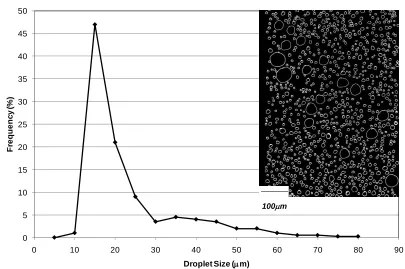
Figure 1. Size distribution of water droplets formed during emulsification. Inset image shows the water droplets after thresholding from the background oil using image analysis.
Microwave Heating & Interface tracking
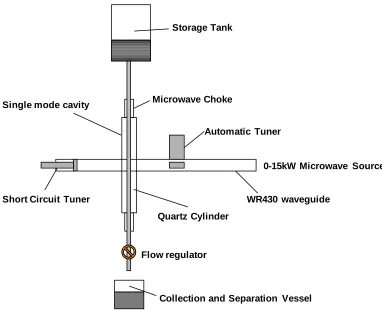
Once prepared the emulsions were immediately pumped through the continuous flow microwave treatment system into a 600 mL settling beaker, as shown in Figure 1. The emulsion was pumped through a 20 mm diameter microwave transparent pipe at flow rates from 1 – 12 L/min. The microwave system featured a TE01n single mode cavity and a Sairem 0-15 kW microwave
generator operating at 2.45GHz. An automatic E-H tuner was used to match the impedance of the generator to the transmission line in order to minimise the reflected power. The absorbed power was recorded throughout the experiment through logging the data output port of the generator using a specifically created program based on Labview. Once in the settling beaker, the emulsion was filmed using a Sony HDR-FX7 camcorder. An image analysis method was used to
0 5 10 15 20 25 30 35 40 45 50
0 10 20 30 40 50 60 70 80 90
F re q u e n c y ( % )
Droplet Size (m)
examine the camcorder video, still by still to track the oil-water interface with time. The reproducibility of the demulsification tests using microwave heating was evaluated through the repetition of tests at fixed conditions. One sample within each set of the separation experiments was repeated at least twice. The maximum fluctuation in the separation time results, for a given set of experimental conditions, was found to be <10%.
Figure 2 – Schematic of experimental set-up
Results and Discussion
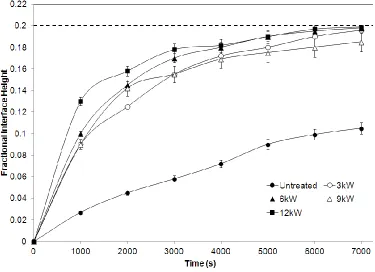
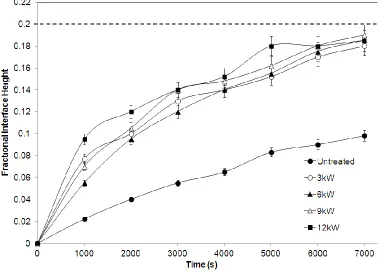
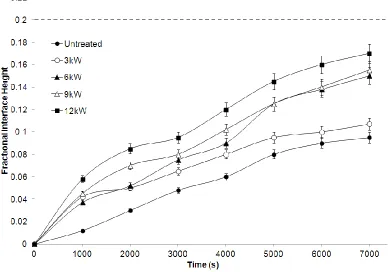
The settling behaviour of the emulsions with time is shown in Figure 3 - Figure 5.
0-15kW Microwave Source
Short Circuit Tuner
Flow regulator Storage Tank
Quartz Cylinder Microwave Choke
Collection and Separation Vessel Automatic Tuner
Figure 3 - Interface height plotted against time for 80/20 oil/water emulsions treated at 6 L/min
Figure 4 - Interface height plotted against time for 80/20 oil/water emulsions treated at 9 L/min
Figure 5 - Interface height plotted against time for 80/20 oil/water emulsions treated at 12 L/min
There are two competing physical effects that can explain the sequences of data shown in Figure
3 - Figure 5, which are net energy input and turbulence.
1. Energy Input
The power absorbed by the emulsion in kW (𝑃𝑎) and the net energy input into the system in kJ/L
(𝛥𝑄) are given in Equations 3 and 4 respectively, where 𝑃𝑖 is the incident power in kW, 𝑃𝑟 is the
reflected power in kW and 𝑞 is the emulsion flow rate in L/min.
𝑃𝑎 = 𝑃𝑖 − 𝑃𝑟 (3)
𝛥𝑄 =𝑃𝑎𝑥60
𝑞 (4)
An autotuner was used in these experiments, which minimized reflected power (typical values of x were recorded), and therefore 𝑃𝑎. approached 𝑃𝑖 in these experiments. . It is clear from
system. Since only the water phase of the emulsion absorbs microwave energy to any significant degree, the temperature of the water will be highest at the lower flow rates or higher powers. The higher temperature of the water leads to two physical effects that enhance the separation of the emulsions according to Equation 1; (i) a reduction in droplet surface tension, which promotes coalescence to form larger droplets, and (ii) a reduction in the viscosity of the oil at the droplet surface due to heat transfer. The larger droplet diameter, D1, and the lower oil viscosity, 2,
increases the droplet settling velocity and therefore reduces the time taken for the emulsion to separate.
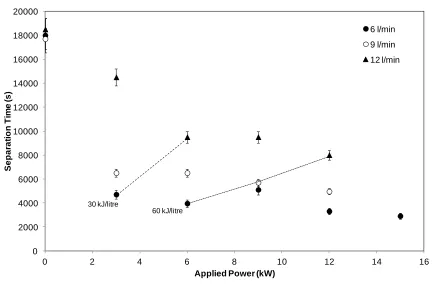
The image analysis technique was used to identify the total separation time, i.e. the time at which the interface of the emulsion reached its maximum height. This data is shown in Figure 6.
Figure 6 – Effect of power and flow rate on the separation of 80/20 Azeri crude emulsions. Dashed lines are contours of constant energy input
0 2000 4000 6000 8000 10000 12000 14000 16000 18000 20000
0 2 4 6 8 10 12 14 16
S e p a ra ti o n T im e ( s )
Applied Power (kW)
6 l/min 9 l/min 12 l/min
30 kJ/litre
[image:13.612.91.537.353.638.2]The data in Figure 6 show the general trend that increasing the applied power leads to a decrease in the separation time at all three flow rates studied. From Equation 4, the net energy input (𝛥𝑄) can be calculated from absorbed power (𝑃𝑎) and flow rate (𝑞). In order to attain the same net energy input at higher powers, the flow rate must be decreased. Several of the experiments were carried out at an equivalent net energy input as shown by the contours in Figure 6. This data indicates that increasing the flow rate, at the same energy input, leads to an increase in the separation time of the emulsions. This behaviour can be attributed to turbulence within the system.
2. Turbulence
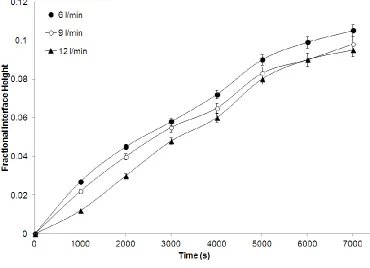
Figure 7 – Effect of flow rate on the separation of untreated 80/20 emulsions
It is clear from Figure 7 that increasing the flow rate causes an increase in the separation time for untreated emulsions, as the interface height takes longer to increase. Since there is no heating taking place the data must be caused by the extra turbulence associated with the higher flow rate as the emulsion expands from the pipe to the vessel.
Emulsion Water Content (%)
Absorbed Power (kW)
Flow rate (L/min)
Net Energy Input (kJ/L)
Power Density in Water Phase (x108 W/m3)
20 0.6 1.0 36 2.4
20 0.9 1.5 36 3.6
20 1.05 1.75 36 4.2
10 0.3 1.0 18 2.4
10 0.45 1.5 18 3.8
[image:16.612.103.510.71.201.2]10 0.6 2 18 4.8
Table 1 – Parameters studied in lower flow rate experiments
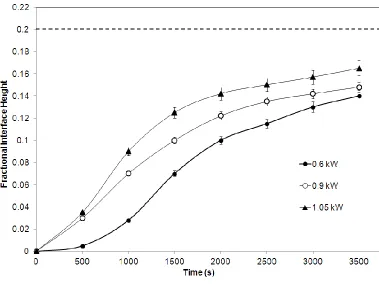
The data from the lower flow rate experiments are divided according to the energy absorbed by the emulsion. Figure 8 shows the interface height data for 36 kJ/L and Figure 9 shows the corresponding data at 18 kJ/L.
[image:16.612.116.495.337.623.2]Figure 9 - Interface height plotted against time for 90/10 oil/water emulsions treated with a total energy input of 18 kJ/L
The data shown in Figure 8 and Figure 9 show an opposite trend to the experiments carried out at higher flow rates. In this case the separation time decreases with increasing power (and flow rate) and constant energy input. Given that the turbulence is minimised at these lower flow rates, the explanation for this data lies in the power density within the water phase, and the subsequent role of heat transfer. The power density in each case is shown in Table 1, and it can be related to the dielectric heating rate (ΔT/Δt) according to Equation 5:
p C Pd t T
(5)
where Pd is the power density and ρ and Cp are the density and heat capacity of the heated phase
net temperature attained by a water droplet suspended within an oil phase is a function of the rate of energy input (i.e. that due to power density) and the rate of energy loss due to heat transfer. To maximise the effect of microwave heating for emulsion separation it is necessary to maximise the temperature of the water droplets as this leads to:
(i) A lower droplet surface tension, leading to a higher probability of coalescence (ii) A lower localised oil viscosity at the droplet interface.
The results presented in this paper show that increasing power density (and hence dielectric heating rate as given in Equation 5) improves separation. This leads to the conclusion that if the droplets are heated slowly (at low power density), the rate at which energy dissipates from the droplet to the surrounding oil becomes significant relative to the rate of energy input and therefore the temperature attained by the droplet is low. Conversely, at high power densities the rate of energy input can be much higher than the rate of energy dissipation, meaning that much higher droplet temperatures are obtained. It is therefore the selective heating ability of microwaves that lead to improved separation efficiencies when a higher power density is used at the same energy input. Although the bulk emulsion temperature will be the same at a constant energy input, the temperature gradients will be significantly different during and immediately after microwave heating, and it is this phenomenon which leads to the experimentally observed power-density dependence.
Conclusions
settling vessels. Settling times have the potential to be less than half that of untreated emulsions. The results have established that this is a power density driven process; the higher temperature gradients that can be achieved at higher powers with the same energy inputs promote coalescence and settling velocity. Optimal energy requirements for the system have not been established, but would be less than the heat required to heat the water to 100°C (67 kJ/L for a 80/20 emulsion).
The major limitation of this process is the potential for turbulence at an industrial scale. The minimisation of Reynolds Number must be paramount in the design of any larger scale systems.
AUTHOR INFORMATION Corresponding Author
*John P. Robinson, Process and Environmental Research Division, Faculty of Engineering, University of Nottingham, NG7 2RD, UK; Tel: +44 115 951 4092; e-mail:
Author Contributions
The manuscript was written through contributions of all authors. All authors have given approval to the final version of the manuscript.
ACKNOWLEDGMENT
REFERENCES
1. Eow, J. S.; Ghadiri, M., Electrostatic enhancement of coalescence of water droplets in oil: A review of the technology. Chemical Engineering Journal 2002, 85 (2-3), 357-368.
2. Lemos, R. C. B.; Da Silva, E. B.; Dos Santos, A.; Guimarães, R. C. L.; Ferreira, B. M. S.; Guarnieri, R. A.; Dariva, C.; Franceschi, E.; Santos, A. F.; Fortuny, M., Demulsification of water-in-crude oil emulsions using ionic liquids and microwave irradiation. Energy and Fuels
2010, 24 (8), 4439-4444.
3. Perry, R. H.; Green, D. W., Perry's Chemical Engineers Handbook. Seventh Edition ed.; McGraw Hill: London, 1998.
4. Arnold, K.; Stewart, M., Surface Production Operations - Design of Oil Handling Systems and Facilities. 3rd Edition ed.; Elsevier: 1998; Vol. Volume 1.
5. Holtze, C.; Sivaramakrishnan, R.; Antonietti, M.; Tsuwi, J.; Kremer, F.; Kramer, K. D., The microwave absorption of emulsions containing aqueous micro- and nanodroplets: A means to optimize microwave heating. Journal of Colloid and Interface Science 2006, 302 (2), 651-657. 6. Erle, U.; Regier, M.; Persch, C.; Schubert, H., Dielectric properties of emulsions and suspensions: Mixture equations and measurement comparisons. Journal of Microwave Power and Electromagnetic Energy 2000, 35 (3), 185-190.
7. Fang, C. S.; Lai, P. M. C., Microwave heating and separation of water-in-oil emulsions.
Journal of Microwave Power and Electromagnetic Energy 1995, 30 (1), 46-57.
8. Fang, C. S.; Lai, P. M. C.; Chang, B. K. L.; Klaila, W. J., Oil recovery and waste reduction by microwave radiation. Environmental Progress 1989, 8 (4), 235-238.
9. (a) Xia, L.; Lu, S.; Cao, G., Demulsification of Emulsions Exploited by Enhanced Oil Recovery System. Separation Science and Technology 2003, 38 (16), 4079-4094; (b) Xia, L. X.; Lu, S. W.; Cao, G. Y., Salt-assisted microwave demulsification. Chemical Engineering Communications 2004, 191 (8), 1053-1063.
10. Fortuny, M.; Oliveira, C. B. Z.; Melo, R. L. F. V.; Nele, M.; Coutinho, R. C. C.; Santos, A. F., Effect of salinity, temperature, water content, and pH on the microwave demulsification of crude oil emulsions. Energy and Fuels 2007, 21 (3), 1358-1364.
11. Kovaleva, L. A.; Minnigalimov, R. Z.; Zinnatullin, R. R., Destruction of water-in-oil emulsions in radio-frequency and microwave electromagnetic fields. Energy and Fuels 2011, 25
(8), 3731-3738.
12. Tan, W.; Yang, X. G.; Tan, X. F., Study on demulsification of crude oil emulsions by microwave chemical method. Separation Science and Technology 2007, 42 (6), 1367-1377. 13. Guzmán-Lucero, D.; Flores, P.; Rojo, T.; Martínez-Palou, R., Ionic liquids as demulsifiers of water-in-crude oil emulsions: Study of the microwave effect. Energy and Fuels
2010, 24 (6), 3610-3615.
14. Nour, A. H.; Yunus, R. M., A continuous microwave heating of water-in-oil emulsions: An experimental study. Journal of Applied Sciences 2006, 6 (8), 1868-1872.
15. Azeri (Ceyhan) Assay.