M
ASTER’
ST
HESISDesign and validation of a Software
Requirements Specification evaluation
checklist
Author:
MartinDELAAT
Supervisors:
dr. M. Daneva(University of Twente)
Prof. N. Madhavji(University of Western Ontario)
Graduation Committee:
dr. M. Daneva(University of Twente)
dr. Faiza Allah Bukhsh(University of Twente)
A thesis submitted in fulfilment of the requirements for the degree of Master of Science
Services and Cybersecurity (SCS)
Electrical Engineering, Mathematics and Computers Science
Declaration of Authorship
I, MartinDELAAT, declare that this thesis titled, ‘Design and validation of a Software
Requirements Specification evaluation checklist’ and the work presented in it are my own. I confirm that:
• This work was done wholly or mainly while in candidature for a research
de-gree at this University.
• Where any part of this thesis has previously been submitted for a degree or
any other qualification at this University or any other institution, this has been clearly stated.
• Where I have consulted the published work of others, this is always clearly
attributed.
• Where I have quoted from the work of others, the source is always given. With
the exception of such quotations, this thesis is entirely my own work.
• I have acknowledged all main sources of help.
• Where the thesis is based on work done by myself jointly with others, I have
made clear exactly what was done by others and what I have contributed my-self.
Signed:
UNIVERSITY OF TWENTE
Abstract
Electrical Engineering, Mathematics and Computer Sciences
Master of Science
Design and validation of a Software Requirements Specification evaluation checklist
by MartinDELAAT
The quality of a Software Requirements Specification (SRS) can be a major contrib-uting factor to the overall success of the software project, possibly more so for (Gov-ernment) IT procurement and/or when tendering is involved. SRS evaluation via in-spection techniques can be an effective method for quality assurance purposes. An artefact is developed to support the RE practitioner during the Software Require-ments Specification evaluation process with the goal to improve both the process and the outcome of the evaluation. The artefact is developed in an iterative mat-ter based on results from a limat-terature study, feedback from supervisors Prof. Nazim Madhavji and Dr. Maya Daneva and the results from an interview sessions with RE practitioners. The format chosen is that of a checklist combined with a handbook consisting of supportive materials to be used during the SRS evaluation process. The
artefact is validated using a mixed method approach during a Live Study [21] at the
REFSQ 2018conference in Utrecht. The artefact is found to be a comprehensive tool
Preface
Before you lies the thesis ‘Design and validation of a Software Requirements Specification evaluation checklist’. This research is an attempt to contribute to bet-ter software quality by making the job of evaluating (and potentially writing-) re-quirements specification a more manageable and tangible experience, hopefully im-proving the quality of the evaluation and the resulting software product alike. The opportunity provided by Prof. Nazim Madhavji, that is to develop a practical tool in collaboration with a renowned software consultancy firm, seemed like the perfect opportunity to combine my intrinsic goals and values with the graduation require-ments of the university. This thesis marks the end of this research and my journey at the university of Twente, and is the final milestone towards completing the Masters degree Computer Science: Information and Software Engineering.
The unique environment of the university has allowed me to not only discover my interests and develop my technical background but also to discover and develop myself as a person. It has been a place with not only academic, but also social possib-ilities. After finishing the bachelor Business & IT, it became clear to me that I enjoy being in a position that allows me to provide value to people and found I could make this a reality bringing stakeholders and software developers closer together. To properly do so, I felt I needed to improve my social skills as well as my technical skills. The university has allowed me to combine my studies with achieving valu-able work experience via various positions at the university and my work at Nedap, to gain management experience as chairman of the board of the climbing association TSAC and to gain valuable experience as a climbing instructor.
Now, after a long journey with many ups and downs (figuratively ånd literally), the time has come to fully transcend into my role as a contributing member to soci-ety.
Po: Maybe I should just quit and go back to making noodles.
Oogway: Quit, don’t quit? Noodles, don’t noodles? You are too concerned
about what was and what will be. There is a saying: yesterday is history, tomorrow is a mystery, but today is a gift. That is why it is called the present.
Po & Master Oogway, Kung Fu Panda
I would like to express my immense gratitude to my project supervisors Maya Daneva and Nazim Madhavji, as well as my parents and my girlfriend. It is not an understatement to say that without their continuous support and understanding my graduation would not have been a possibility. Furthermore, I’d like to thank Faiza Allah Buksh for offering to be part of the graduation committee and Lilian Spijker, Anne-Marie Hoogland, Barbara Spikker-Sieverink and Marten van Sinderen for their guidance and help in navigating the regulatory waters. Finally, I’d like to thank Nedap for their flexibility and investment in me.
Contents
Declaration of Authorship iii
Abstract v
Preface vii
1 Introduction 1
1.1 About the author . . . 1
1.2 Research initiation . . . 1
1.3 Motivation and Significance . . . 1
1.4 Scope of study . . . 2
1.5 Research Objective . . . 2
1.6 Approach. . . 2
1.7 Results . . . 2
1.8 Structure of the report . . . 2
2 Research Design 5 2.1 Research Methods . . . 5
2.1.1 Method Overview . . . 5
2.1.2 Design Science and the design cycle . . . 6
2.2 Research Goals . . . 8
2.2.1 Technical Research Problem Statement. . . 8
2.2.2 Design science Research Goals . . . 8
3 Investigation 11 3.1 The Social context . . . 11
3.1.1 Problem context. . . 11
3.1.2 Social context goals. . . 11
3.1.3 Requirements . . . 13
3.2 The Knowledge context . . . 13
3.2.1 Requirements in the product life cycle[KQ 1] . . . 13
3.2.2 The importance of the requirements specification . . . 15
3.2.3 Context-dependency . . . 16
3.2.4 SRS quality [KQ 2] . . . 16
3.2.5 SRS challenges [KQ 3] . . . 17
3.2.6 SRS evaluation [KQ 4] . . . 17
3.2.7 SRS inspection techniques [KQ 5]. . . 18
3.2.8 Checklist design [KQ 6] . . . 19
4 Instrument Design 21
4.1 Instrument versioning overview . . . 21
4.2 Design process summary. . . 21
4.3 Instrument structure . . . 22
4.3.1 Anticipated flow of the evaluation process . . . 22
4.3.2 Division of sections. . . 23
4.4 Design decisions. . . 23
4.4.1 Format . . . 24
4.4.2 Variability and acknowledging the reviewer’s expertise. . . 24
4.4.3 Rating scheme and judgement . . . 24
5 Semi-structured interviews with expert practitioners 27 5.1 Introduction . . . 27
5.1.1 Research goals and Research Questions . . . 27
5.2 Methods . . . 28
5.2.1 Interview Design . . . 28
5.2.2 Logistics . . . 28
5.2.3 Materials . . . 29
5.2.4 Participants . . . 29
5.2.5 Procedure . . . 29
5.2.6 Analysis . . . 30
5.3 Results . . . 32
5.3.1 Participants’ background . . . 32
5.3.2 RG 1: To better understand the Problem Context . . . 33
5.3.3 RG 2: To assess and improve the quality of the checklist . . . . 38
5.3.4 Answering the Research Questions. . . 39
5.4 Discussion & Conclusion . . . 42
5.4.1 Trade-off between comprehensiveness and usability. . . 42
5.5 Changes incorporated to the instrument resulting the interview sessions 44 6 Live Study Validation at REFSQ’18 45 6.1 Background . . . 45
6.1.1 About REFSQ . . . 45
6.2 Study design . . . 45
6.2.1 Research objectives and research questions . . . 45
6.2.2 Methodology . . . 46
6.2.3 Logistics . . . 46
6.2.4 Course of the live study . . . 47
6.3 Results and analysis . . . 48
6.3.1 Gathering of the results and handling of the data . . . 48
6.3.2 Categorisation of collected data and their purpose . . . 48
6.3.3 Usage and purpose of the data collected. . . 49
6.3.4 Participants’ experience within the domain . . . 49
6.3.5 Quality of the Instrument . . . 49
6.3.6 Anticipated effect of instrument application in the problem context . . . 52
6.3.7 Improving the instrument . . . 52
6.4 Discussion . . . 53
6.5 Conclusion . . . 55
6.5.2 RQ2: What is the anticipated effect of applying the artefact in
practice? (PG 1) . . . 55
6.6 Changes to the instrument . . . 56
7 Recommendations, conclusion & future work 59 7.1 Reflection on the research process. . . 59
7.2 Challenges faced during the research . . . 59
7.3 Recommendations for practitioners . . . 60
7.3.1 State of the checklist . . . 60
7.3.2 Adjusting the checklist to context. . . 60
7.3.3 Required expertise to use the checklist. . . 61
7.4 Future research . . . 61
A SRS Evaluation Checklist 63 A.1 Evaluation sheet . . . 64
A.2 Handbook . . . 65
B Interview sessions - analysis 77 B.1 Interview Scheme . . . 77
B.2 Code Skeletons . . . 78
B.2.1 High-level . . . 78
B.2.2 Complete . . . 79
B.3 Code Tree . . . 80
B.3.1 Problem Investigation . . . 80
B.3.2 Instrument Validation . . . 81
B.4 Code Table . . . 82
C Live Study Materials 87 C.1 Checklist sheet versions . . . 87
C.1.1 Version 1 . . . 88
C.1.2 Version 2 . . . 89
C.1.3 Version 3 . . . 90
C.1.4 Version 4 . . . 91
C.2 Post-Use Questionnaire. . . 92
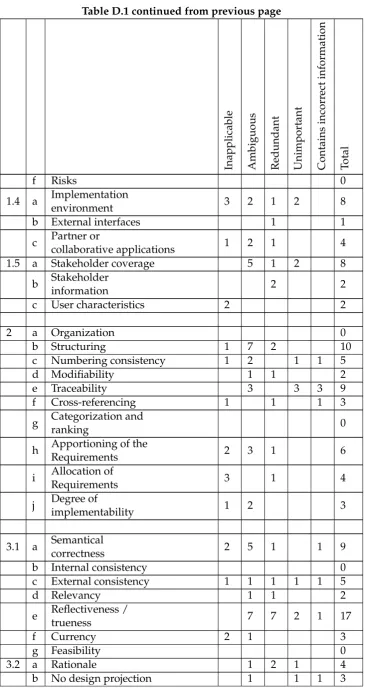
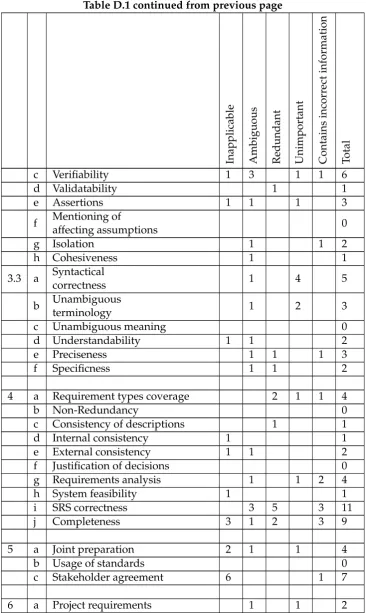
D Live Study results 93 D.1 Checklist sheet fault detection . . . 93
List of Figures
2.1 A framework for design science . . . 6
2.2 The Engineering Cycle . . . 6
2.3 Goal structure of a design science research project . . . 8
3.1 Requirements in the product life cycle . . . 13
5.1 Positively perceived content during the interview sessions . . . 40
5.2 Negatively perceived content during the interview sessions . . . 41
5.3 Suggested improvements during the interview sessions . . . 41
6.1 Distribution of participants’ indicated experience measured in years . 49 6.2 Box plot of the results displayed in Table 6.1 . . . 50
6.3 Bubble plot of the net strength and mean score . . . 51
List of Tables
5.1 Interview details . . . 29
5.2 Materials used during the interview sessions . . . 29
6.1 Results of Critical Feedback Survey questions set 1-a . . . 50
6.2 Net strength score . . . 51
6.3 Results of Critical Feedback Survey questions set 2 . . . 52
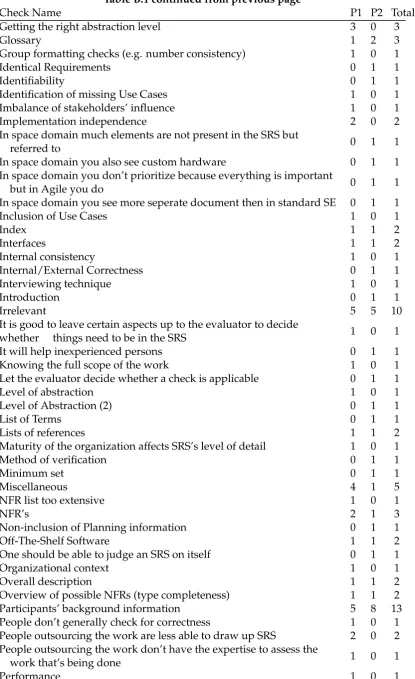
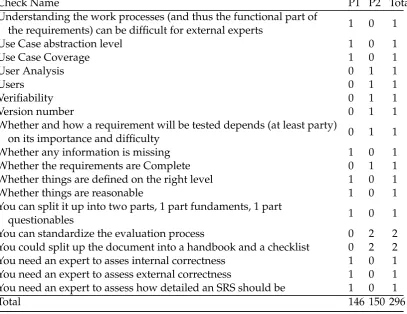
6.4 Top 10 checks with most indicated faults. . . 53
List of Abbreviations
Comlist Criteria Of Merit checklist.
DBR Default-BasedReading
FR FunctionalRequirement
NFR Non-FunctionalRequirement
PBR Process-BasedReading
RE RequirementsEngingeering
RFP RequestForProposal
SIG SoftwareImprovementGroup
SRS SoftwareRequirementsSpecification
UBR Usage-BasedReading
Chapter 1
Introduction
1.1 About the author
The researcher, Martin de Laat, has a bachelor degree inBusiness & ITand this thesis
is the final milestone towards completing the MasterComputer Sciencewith sub-track
Information and Software Engineeringat the University of Twente in The Netherlands.
Next to his studies the author has over over two years experience as Product De-veloper / Product Owner / Software DeDe-veloper in an agile work environment at
Nedap Health care1and developing SaaS solutions in the healthcare domain.
1.2 Research initiation
This research started as a research project for the courseAdvanced Requirements
En-gineeringat the University of Twente. This project was initiated by -then visiting
Professor- Nazim Madhavji in collaboration with the Software Improvement Group (SIG), a software consultancy firm located in Amsterdam, the Netherlands. The goal was simple: to design an instrument to help their expert practitioners in evaluat-ing Software Requirement Specifications. The company wished to improve the cost and quality of their evaluations whilst still leaning on the experience of their ex-perts to set them apart from competitors. After initial meeting and discussions it was realised that the scope of this project went beyond the scope of the course and the decision was made by the use this research as part of the Master’s graduation project.
1.3 Motivation and Significance
The author is interested in the field of Requirements Engineering and the challenges that it faces with the industry’s embracement of agile practices. Idealistically speak-ing, better communication between the software developer and the users should make parts of the extensive Requirements Engineering phase unnecessary. The re-searcher is under the opinion that preferably requirements should only be written down when they serve a purpose and are going to be used. In many scenarios, such as governmental projects, public contracts and tenders, specifications and interme-diary parties are a ’necessary evil’ to convey system requirements and contextual information between system beneficiaries and builders. The quality of these specific-ations is an important factor in making sure not only that the right product is build, but also that it is built right. Writing these specifications and making sure they are of sufficient quality is a very time-consuming process. Chances are that stakeholders
do not have the right experience in determining whether their demands are correctly written down, and the parties responsible for writing and interpreting the require-ments often miss the domain knowledge to make sure that what they’re building corresponds to the stakeholders’ actual needs. By creating an instrument that will hopefully not only lessen the burden of conducting the evaluation process but also make it more accessible to non-professionals, the researcher hopes to shorten the bridge between domain experts and technical experts.
1.4 Scope of study
The scope of the study is limited to the design and validation of an instrument to as-sist a reviewer with the Software Requirements Validation process. The instrument has not been evaluated in practice.
1.5 Research Objective
The objective of the research is to design an validate an artefact to be used during-, and that will have a positive effect on the Software Requirements Specification eval-uation process. The Technical Research Problem Statement and further sub-goals are
described in section2.2.
1.6 Approach
Following the Design Cycle methodology of Wieringa [75], the problem is
investig-ated, a treatment is designed and the treatment was validated. A literature review was conducted and interview sessions with practitioners were held to familiarise the author with the problem context and solution landscape. A combination of scientific-, technical- and professional literature as well as interview sessions with practitioners formed the basis for the treatment design (the instrument). The instru-ment was validated by 1) reading inspection and semi-structured interview sessions
with practitioners (Section5) and 2) an empirical validation [21] during a
workshop-session at the REFSQ 2018 conference.
1.7 Results
The artefact is found to be a comprehensive tool in evaluating SRSs and, based on a series of 8 quality attributes, is regarded to be of good quality. Indicated challenges are its usability, clarity and applicability to a variety of contexts. A detailed analysis
can be found in section6.3
1.8 Structure of the report
In chapter2the Research Design and Methods used in designing and validating the
artefact are discussed. A series of Research Goals -the Artefact design goal,
Know-ledge Goals and Prediction Goals- are formulated in section2.2.
In chapter3the social context as well as the knowledge context are investigated.
requirements the artefact should confirm to. The knowledge context is explored in
section3.2where the knowledge questions are answered.
Chapter4describes the design process of the artefact. The structure of the
check-list is described as well as the rationale behind the design decisions made during development.
Chapter 5 entails the design, execution and analysis of the interview sessions
with practitioners from the Company. The interview sessions contributed towards understanding the social context, provided valuable input in designing the instru-ment and identified strong and weak points of the version 1 of the artefact.
Chapter6 describes the design, execution and analysis of the live study
valid-ation session at the REFSQ 2018 conference in Utrecht, the Netherlands. Based on a mixed method checklist validation approach where Strengths, Weaknesses and missing items are identified and the quality of the artefact is assessed based on 8 quality criteria. Furthermore, the anticipated effect of applying the artefact in the problem context is determined.
Finally, chapter7reflects on the research process and the current state of the
Chapter 2
Research Design
This chapter describes the goals of the research and the methodology applied in the design and validation of our artefact: the Software Requirements Specification Evaluation Checklist plus accompanying documents.
2.1 Research Methods
This section serves as an overview of the different methods used and applied during this study and the delineation of research goals and -questions.
2.1.1 Method Overview
• As the overarching methodology the Design Cycle by [75] was followed
(Sec-tion2.1.2).
• In answering the Knowledge Questions the Empirical Cycle by the same
au-thor was followed. (Section2.1.2)
• In designing and validating the checklist the guidelines for developing
evalu-ation checklists by [67] were followed.
• Validation was done in four stages, the last two validation stages were based
on Expert Opinion.
1. (internal) Written and oral feedback by project supervisor
2. (internal) Validation by comparing checklist to The Evaluation Centre’s1
validation standards [68]
3. (external) Semi-structured interview with 2 expert practitioners
4. (external) Live study at REFSQ’18 [22]
• In designing the materials during the live study the guidelines by [67] was
followed.
• In analysing the results of the live studies the methodology proposed by [54]
was followed.
1A Research Center at the Western Michigan University, USA (https://www.wmich.edu/
2.1.2 Design Science and the design cycle
This subsection serves as an introduction to Wieringa’s Design Cycle Methodology and the prescribed Design Cycle.
Design Science centres around the study of an artefact in context and its activities consist of the design and investigation of this artefact in context. As illustrated in
Figure2.1, these activities interact between the social context (where the artefact will
make a contribution) and the knowledge context (which will help shape the design).
FIGURE2.1: A framework for design science [75, Fig. 1.3]
The Design Cycle is part of a larger cycle -the engineering cycle as illustrated
in Fig2.2- in which the result is a validated treatment. In this illustration, the
ques-tion marks indicate knowledge quesques-tions and the exclamaques-tion marks indicate design problems.
The design cycle only consists of the first three tasks of the engineering cycle: problem investigation, treatment design and treatment validation. The cycle em-phasizes an iterative approach in developing instruments and typically in a research project you iterate over design and validation tasks multiple times.
Artefacts and treatments
Artefacts are creations made by humans for humans that serve a practical purpose. The term will henceforward be used interchangeably with the word ’instrument’. In designing an artefact, one is essentially envisioning this artefact to be used as a
treat-ment for a given problem context. Many engineers speak ofsolutionsbut Wieringa
avoids this term as ‘it may blind us for the possibility that an artefact may solve a problem only partially or maybe not at all’ and defines a treatment as ‘the interaction between the artefact and the problem context’.
In this research the SRS Evaluation Checklist is considered the artefact and the use of the artefact during the validation of a SRS is seen as the treatment.
Treatment validation v.s. -evaluation
Depending on the context, slight nuances exists for defining the concepts of veri-fication, validation and Evaluation. In the context of validating c.q. evaluating an artefact (c.q. ‘treatment’), validations is the investigation whether-, and justifications that the treatment will contribute to the stakeholder goals if implemented. Evalu-ation is the investigEvalu-ation of the implementEvalu-ation when implemented by stakeholders in the field. The distinction becomes clearer by asking the following questions:
Treatment validation Would this treat the problem c.q. contribute to stakeholder goals if implemented?
Treatment evaluation How successful has the treatment been?
See section3.2.1regarding the distinction between verifying, validating and
2.2 Research Goals
The goal of this research is to develop an artefact in the form of a Checklist to help during the SRS evaluation process. As we are dealing with a design problem, instead of describing a series of Research Questions, a series of goals and knowledge
ques-tions are defined as described by [75]. As illustrated in Figure2.3, the design science
research aim contribute to a given problem context. The goals are thus categorised
into Design science research goals (Section2.2.2) and Social context goals3.1.2and
are summarised into the Technical Research Problem Statement (Section2.2.1). It is
important to note that artefact design is an iterative, on-going process. This means that the stated goals have evolved over time whilst more insight is gained.
FIGURE2.3: Goal structure of a design science research project ([75,
Fig 2.1])
2.2.1 Technical Research Problem Statement
In summary, the aims for this design research effort can be summed up as follows:
• Improve the Software Requirements Specification Evaluation process
• by designing an evaluation checklist
• that satisfies the requirements listed in Section3.1.3
• so that the stakeholder goals listed in Section3.1.2can be achieved
• for the context problem described in Section3.1.1
2.2.2 Design science Research Goals
Artefact design goal
The Artefact Design Goal (ADG), or technical research goal is to improve the Soft-ware Requirement Specification evaluation process and -outcome.
• ADG 1: The design of an artefact that improves the SRS evaluation process and
[image:26.595.163.458.253.418.2]Knowledge- and Prediction goals
The knowledge goals (KG) require answering a set of knowledge questions (KQ).
The knowledge goals and knowledge questions are defined as follows2:
• KG 1: To understand the SRS evaluation process
– KQ 1: How are SRSs used in the software product life-cycle?
– KQ 2: What entails a quality SRS?
– KQ 3: What are commonly found defects in SRSs?
– KQ 4: What SRS quality assessment techniques exist?
– KQ 5: What SRS evaluation/validation artefacts currently exist?
• KG 2: To understand the process of developing an evaluation checklist
– KQ 6: How to create an evaluation checklist?
– KQ 7: How to validate an evaluation checklist?
– KQ 8: What is the quality of the created artefact?
Apart from the quality of the artefact, there is a desire to predict the effect of the artefact on the evaluation process. This translates into the following Prediction Goal (PG):
• PG 1: What is the anticipated effect of applying the artefact in practice?
2Note: by clicking on abbreviated code, you are hyper-linked to the part where the question is
Chapter 3
Investigation
3.1 The Social context
3.1.1 Problem context
The process of eliciting, validating and maintaining software requirements can be a daunting task for many organisations under pressure to launch their products fast. For areas such as Government IT Procurement, the Software Requirements Specific-ation (SRS) often forms the basis for a public procurement where its quality is of ma-jor importance. A problem in writing these specifications is that the possession of the domain knowledge is often mutually exclusive to the possession of the required technical knowledge and experience. The company SIG indicated being routinely contracted to evaluate a given Software Requirement Specification. The consultancy firm is motivated to improve their evaluation process. In their case, a third party -frequently a municipality or governmental organisation- requests the services of an independent and experienced consultancy firm to evaluate a given Software Re-quirements Specification. In the case of larger projects, this evaluation is done before specifications are being sent out for a public contract where interested tenders can offer their competing services based on the distributed specification(s). This evalu-ation can also be done in advance of contract negotievalu-ations where the specificevalu-ations are an important factor in the formation of the contract. Finally, for IT projects where the client is convinced that the supplier failed to meet the stated expectations, and court battles might ensue. For these cases, an independent consultancy firm can be contracted to investigate the agreements and share their expert opinion for the court. Having these specifications validated by an experienced, independent third party not only provides the requesting party with a way of ensuring its quality, it is also a safeguard to to ensure and demonstrate that due process is followed. In the de-scribed problem context, the consultancy firm wishes to provide a cost-effective ser-vice in validating these specifications whilst upholding a certain quality standard.
If we extrapolate from this scenario, an artefact that improves the process of eval-uating a Software Requirements Specification can be of high value. Not only for situations as described above, but possibly also during the specification of the re-quirements or different contexts such as where the applicants are less experienced in the field of Requirements Engineering.
3.1.2 Social context goals
involved and delineate any relevant stakeholder goals. Section3.1.1is dedicated to describing the problem context.
• SDG: To improve the Software Requirements Specification evaluation process
The social context goal can be divided into a series of stakeholder goals.
External stakeholder goals
From the Problem Context the following list of stakeholders were elicited:
The product beneficiary The party benefiting from the resultant information sys-tem and often the party responsible for writing the Software Requirements Specification.
The evaluation service provider The party that offers the evaluation service and who is responsible for the quality of the evaluation. This can be an external party such as the consultancy company or an in-house department.
The evaluator The person tasked with conducting the evaluation process.
The stakeholders identified above each have their own interests in the evaluation process and outcome, why is why the
• The product beneficiary
– SG 1: Indication of the quality of the SRS
– SG 2: Indication of faults in the SRS
• The evaluation service provider
– SG 3: An improved evaluation outcome
(a) Improved fault detection (b) Reduced evaluation costs
(c) Improved assessment quality
(d) Improved consistency in assessment quality
• The evaluator
– SG 4: An improved evaluation process
(a) Improved Work Flow
(b) Reduced levels of task saturation
(c) Improved guidance during evaluation process
Social context goals v.s. goals researcher
3.1.3 Requirements
Naturally, the artefact should meet some requirements. From the problem context, the following requirements c.q. constraints were elicited:
• Requirement 1: The artefact should be self-explanatory
• Requirement 2: The artefact should be usable in an office environment
• Requirement 3: The artefact should not overly restrict the SRS evaluator
• Requirement 4: The artefact should respect project diversity and the
evalu-ator’s experience
• Requirement 5: The artefact should not significantly affect the time it takes to
evaluate an SRS in a negative way
3.2 The Knowledge context
3.2.1 Requirements in the product life cycle[KQ 1]
Requirements play a role in many parts of the product life cycle. Figure3.1
illus-trates a general outline of the involvement of requirements in a product’s life cycle as described by Lauesen.
FIGURE3.1: Requirements in the product life cycle as described by
Lauesen [50, p. 291]
Theproject inceptionprocess describes the start of the project. Here, usually the business opportunities, -goals and the project scope are identified.
Elicitationc.q. requirements gathering, describes the process of researching and discovering the requirements through consultation with stakeholders, from system
documents, domain knowledge and market studies [65, p.11]. Whilst eliciting the
requirements it is important to employ a variety of techniques and balance the de-sires of all relevant stakeholders, including the end users. Involving and engaging communication with an adequate representation of said stakeholders can be
import-ant in negotiating requirements to assure the acceptance of the resultimport-ant system. [16]
It is common for the supplier to be heavily involved during the eliciting phase and
share their expertise but this is not the case with tendering projects [50, p. 290]. This
stresses the importance of the SRS being of adequate quality.
Formulation, or specification describes the process of writing down the require-ments. Doing this in a verifiable way allows for a shared and test-able consensus between the actors involved. The outcome of this process would be the Software
Requirements Specification. stakeholders’ expectations[50, p. 374]
Checkingdetermines whether the SRS is of sufficient quality and/or ready to be sent out.
Validation, VerificationThere seem to be some inconsistencies c.q. ambiguities
regarding to what is considered as validation and verification. As Figure3.1shows,
Lauesen sees validation as the process of evaluating whether the SRS correctly re-flects what is desired of the product (i.e. the needs of the business and the stakehold-ers) and verification as evaluating whether the product under development meets the requirements.
IEEE standard 1012 [25], however, advocates the following definitions:
Validation: The process of evaluating a system or component during or at the end of
the development process to determine whether it satisfies specified requirements (..)
and satisfy intended use and user needs.[25]
Verification: (A) The process of evaluating a system or component to determine
whether the products of a given development phase satisfy the conditions imposed at the start of that phase (..) and its associated products conform to requirements
(e.g., for correctness, completeness, consistency, and accuracy)(..).[25]
In this thesis, the definitions by Boehm [10] are prefered:
Validation:to establishing the truth of the correspondence between a software product
and its specification. Or: ’Are we building the right product?’ [10]
Verification:to establish the fitness or worth of a software product for its operational
mission [9]. Or: ’Are we building the product right?’ [10]
In the stated Problem Context, where an actor is tasked with evaluating a SRS, the following definition is used:
Evaluation: to assess c.q. judge the quality of an SRS.
The Contractis a written agreement between two or more parties (i.e the cus-tomer and the supplier) where the obligations of each party involved are described. In case of in-house development these parties can be two departments within the company, such as the sales- and the IT department. In a tendering process, a request for proposal (RFP) is generally send out, requesting suppliers to send in their pro-posals.
Designing & developing the product should take place based on the SRS. In
practice however, this does not always happen (5.3.2). Ideally speaking, the
require-ments should be traced into the growing product and be updated as the project goes on (see requirements management).
Acceptance testingdescribes the process of having the product used by the users and verifying whether the resultant product corresponds to the SRS and/or the stakeholders’ expectations. One can imagine the scenario where the product con-firms to the SRS but does not meet the expectations of the stakeholders.
Maintaining/managing Requirementshelps keep track of changing requirements when new insights occur, stakeholders’ expectations evolve and uncertainties get re-solved.
Future releases Future releases serve to deliver further improvements to the product and requires further communications, requirements management and re-lease planning. In waterfall-style processes there is usually a clear line between delivering the product and maintenance/enhancement of the product, with agile and continuous development less so. Naturally, not all software projects involve tendering and the writing of a contract, just as not all projects involve a scrutinous process of specifying and validating requirements. However, most software projects will incorporate some form of requirements elicitation which will have to be shared between actors involved in the development of the product in some way or another.
3.2.2 The importance of the requirements specification
For many software projects, requirements engineering and -specification is an in-tegral part of the development process and crucial to project success. Requirement Specifications help to create ’a common view of what the software they are
develop-ing should do’ [47].
In many large-scale IT projects there’s no direct communication between the
de-velopers and the users [1]. Stakeholders’ needs and relevant domain knowledge
are communicated via IT consultants. This is especially problematic when SRS’s are
not always consolidated during the development process [8] or kept up to date [51].
There’s the obvious vicious circle where an SRS is not kept up-to-date because it’s not used and it’s not used because it’s not up-to-date. The lack of a sufficiently func-tioning mechanism to share what the system is supposed to do across the people involved can cause communication gaps, which in turn can lead to increased
imple-mentation cost and higher test effort [1,8].
However, it is flawed to assess (and appreciate) the quality of the RE effort solely
based on the product of the process (e.g. the SRS). In [34], Gorschek and Davis
the company and even society. To complicate matters, ‘applying good requirements practices will not guarantee you success, nor will applying bad requirements
prac-tices guarantee failure.’ ([20])
Assessing the importance of a qualitative SRS is therefor not an easy endeavour and in extension, the effect of the SRS’s quality. Furthermore, assessing the quality of an SRSs is at least partly depended on subjective aspects (e.g. what is seen as ’good RE’) and one should, in the author’s opinion, be wary of approaching the
subject as an exact science. As nicely described by Davis and Zowghi in [20], we
should be wary of getting too over- confident in our quest to develop or apply good requirements practices.
The SRS is seen both as a result of the act of trying to understand what the product should do, and as a communication tool to share this knowledge across stakeholders. This mechanism contributes to a common understanding and con-sensus across stakeholders and as a bonus that expectations are managed. The cre-ation and existence of an SRS serves an important role in the product development life cycle but, in the end, should be viewed as a variable -or even interchangeable-method/tool. And a tool should fit the job.
3.2.3 Context-dependency
Although various approaches for gathering, writing and assuring the quality of re-quirement specifications exist, the degree to which the quality of said specification affects the quality of the resultant product are context-dependent. The domain, char-acteristics of the project and the chosen development process all affect the import-ance of the SRS’s quality. Effective requirement specification and quality assurimport-ance of the SRS must take contextual circumstances into consideration and should be
meaningful to the engineering endeavour [56]. A more traditional, waterfall
ap-proach typically places more emphasis on the specification of detailed requirement up-front than agile approaches would, and for banking software different quality criteria would apply than for, let’s say, a web shop.
On a more general note, [56] highlights the importance of semantic quality and
SRS understandability, irrespective of the context.
3.2.4 SRS quality [KQ 2]
In [19], Davis et al. define a quality SRS as one that ‘contributes to successful,
cost-effective creation of software that solves real user needs.’
Writing and assessing requirements specifications is mostly based on best prac-tices. Attempts to describe what constitutes as good requirement specification
in-clude: defining a series of qualities / criteria [19,6,44,10,9,43] to which (parts of)
the SRS should adhere to, developing standards [39, 41, 40] and even prescribing
complete document templates [61] to follow. These criteria c.q. recommendations
vary in scope from addressing f.e. ambiguities and phrasing, to the span of a series of requirements to the structure and content of the overall document.
3.2.5 SRS challenges [KQ 3]
Requirements specifications (most notably contract-style requirements specifications) run the risk of becoming overly large. This severely limits the reader-friendliness and usability of the requirement specification and everything that comes with it. It becomes difficult to assure a mutual understanding and agreement from the stake-holders, to embrace new or changing requirements that emerge in the development process, to keep the requirement specification up-to-date and, more generally, to as-sure you’re building the right product.
But, even a specification that correctly identifies all requirements does not
guar-antee those requirements will be satisfied. In [32], Gause describes the five most
important sources of requirements failure as:
• failure to effectively manage conflict
• lack of clear statement of the design problem to be solved
• too much unrecognised disambiguation
• not knowing who is responsible for what, and
• lack of awareness of requirements risk.
In [72], Walia and Carver developed a taxonomy of requirements’ errors in the
requirements phase. They identified fourteen types of errors and classified them
intoPeople Errors,Process ErrorsandDocumentation Errors. Their results highlight the
significance of people and processes involved in the cause of requirement errors. Often multiple requirement artefacts (e.g. specifications, diagrams, or user stor-ies) are employed to support requirement-related activities. The employment of multiple different artefacts imposes ’challenges like scattering of information,
in-complete translations, or inconsistencies between artefacts’ [53].
Resultant requirements are generally stated in a natural language, which enables the writer of the requirement to chose the desired abstraction level and enabling all stakeholders to read and understand what shall be delivered. A major drawback is that natural languages are inherently ambiguous.
These findings indicate that for Quality Assurance, one must not only consider the requirement specification itself, but also the people, processes and context ex-ternal to the document, which is why a chapter devoted to aspects exex-ternal to the document under review was included in the resultant checklist.
3.2.6 SRS evaluation [KQ 4]
In the SRS evaluation process an SRS is evaluated based on its quality. Apart from the question what constitutes as a quality SRS it is worthwhile to ascertain what aspects of the SRS are empirically evaluated, by using which research method and
in what environmental context. Condori-Fernandez et al. [15] provide a systematic
mapping study on empirical evaluation of SRS techniques and found that under-standability, followed up by completeness are the most commonly evaluated aspect of an SRS, that experiments are the most commonly used research methods and that the academic environment is where most empirical evaluations take place. A similar study performed by Pekar, Felderer and Breu also show a primary focus in research effort in Ambiguity (31%) followed by completeness (24%).
Interestingly, the results from [15], seem to implicate that what academics
important and that our knowledge of these aspects might be skewed based on one-sidedly accumulated research. In their results, in the academic environment a high emphasis is placed on Understandability (84.2%) and Correctness (83.3%) whilst in the Industrial environment seems to favour Efficiency (22.2%) over Understandab-ility (10.5%) and Correctness (0.0%). Furthermore, empirical studies were found to be rarely undertaken in government setting. One explanation might be that they’re either not done, or are outsourced to academic institution or the industry. Some
automated evaluation approaches [49,38] are proposed in literature that show
prom-ise but require more experimentation.
3.2.7 SRS inspection techniques [KQ 5]
Software inspections ([24]) are generally considered ’best practice ’[73] and, much
like software inspections, a software requirements inspection is the process of ana-lysing all or a part of an SRS to uncover faults c.q. weaknesses. Generally these are done by one or multiple reviewers with the aim of identifying faults early on in the development life-cycle, where they’re cheaper to address. The nature of the inspec-tion process naturally calls for a checklist to guide the reviewer in his or her process and provide the reviewer with hints and recommendations for finding defects. SRS inspections are not evaluative in nature, but their findings can be used in forming an evaluation.
Requirements Smells
In [29], Femmer et al. have transferred the concept of Code Smells to Requirements
Smellsas indicators of a quality violation for requirements. Based on this concept and
the ISO/IEC/IEEE 29148:2011 standard [41], they developed a relatively effective
[29,28], light-weight static requirements analysis approach based on that allows for
rapid requirements checking.
Defect-based reading
Defect-based reading (DBR) [58] techniques are techniques that focus on detecting
specific types of faults by defining a set of scenarios that the reviewer follows during the inspection. Here, defects are classified and a set of questions is posed for each class. Scenarios, collections of procedures for detecting particular classes of defects are created and assigned to a reviewer to detect particular type of defects.
Perspective-based reading
Perspective-based reading (PBR) techniques, on the other hand, focus on examin-ing parts of the requirements specification from different perspectives that depend upon the roles people have within the software development process. This allows reviewers to be more focused, systematic and goal-oriented whilst allowing different reviewers with different expertise to analyse the same document with less overlap.
Usage-based reading
Usage-based reading (UBR) techniques differ from the other techniques in the sense that it focuses on detecting the most critical faults, instead of attempting to uncover
allfaults. They do so with a prioritised, requirements-level use case model. In the
priority, and verifying whether the use case is satisfactory full-filled by the document under inspection.
Checklist-based reading techniques
Surprisingly, despite Checklist-Based Reading (CBR) techniques being heavily
dis-cussed in literature (i.e. [12, 59, 50, 4, 64, 77, 2]), no mature, completed and
suffi-ciently validated checklists were found, both in literature or elsewhere. Identified
checks or checklists in literature include [61, 5,9,10, 52, 55, 44, 45,27,31,5, 30, 6]
checklists analysed in [12] and checklists found online which are used in industry
or as teaching material at universities [17,14,74,26,18]. Most checklists that were
found were developed before the creation of various standards [41, 40] and were
developed with traditional software development in mind. For these reasons, the decision was made to develop a new checklist based on newer standards and check-list design methodology and more tailored to the work flow of the applicant.
Comparisons
Research seem to indicate [58, 59, 48,70,4] that DBR, PBR or UBR methods show
significant improvements in fault detection rates and cost per fault found compared to checklist-based reading (CBR) methods. However, the checks applied during the experiments questions omitted many potential types of defects, were quite broad in nature and did not seem to give enough attention to the recommendations of the
ISO/IEEE standards for software quality. The results are not conclusive [36,70] and
more experimentation is required to determine the most efficient inspection-based
technique and whether this differs between f.e. software domains [4]. Most notably,
hybrid approaches are suggested.
3.2.8 Checklist design [KQ 6]
Checklists are mnemonic devices that can present complex theory in a simple, con-densed and structured way to guide applicants along a process. Checklists can be of use in a variety of applications. Be it a simple grocery list, a pre-flight checklist to see if an aircraft is cleared for take-off or as a scoring system for an annual car inspections. Checklists can implore users to apply them in certain sequence (e.g. sequentially as opposed to in-sequentially), or require users to make multiple pass-throughs, a.k.a. an iterative checklist. Diagnostic checklists typically result in some
form of diagnoses or classification and evaluative checklists such as thecriteria of
meritchecklist (comlist) can result in a score, or series of scores to rate an evaluand.
Although a checklist can be considered less "ambitious" than alternative solutions, it
is often good enough for evaluative purposes [63].
Strengths
Checklists can serve a series of benefits and have demonstrated to be very valuable in industries where the welfare of a human being is at risk and promising in other
areas [35]. Checklists can reduce the chances of forgetting important steps, they are
generally easier to understand, develop and apply than alternative solutions, they reduce the effect of personal biases such as the halo effect and the Rorschach effect and they can incorporate huge amounts of specific knowledge and extreme
complex-ity in an economical format [63, 33]. Furthermore, checklists have shown in other
safety and have shown to have a positive effect on compliance with guidelines [11,
71].
Considerations
One has to be careful with expecting the success stories and design principles from other industries to translate across domains. ‘A checklist is a complex socio-technical intervention that requires careful attention to design, implementation and basic skills
required for the task’ ([13]).
Software requirement inspections are good ways to validate requirement spe-cifications, but it is important to note that the effectiveness of the process (and ac-companying instruments) relies on the expertise of the reviewer which can impact
the effectiveness of the requirement inspection [3]. Experienced reviewers on the
other hand, can feel (over)confident in their ability and divert from procedure/instructions
[37]. Issues may arise with strictly ’yes/no’ answers on checklists with no room for
supporting details as this may lead to critical problems in ambiguity of which the
reviewers themselves might not even be aware [37].
Design
Western Michigan University’s Evaluation Center1runs a project designed to provide
evaluators with a growing set of useful evaluation checklists [66]. Besides these
sample checklists, the group has put out several documents on checklist design [67]
[62] [7] and -validation c.q. -evaluation [68] [23] [69]. In the Checklist Checklist
De-velopment Checklist (CDC) [67], Stufflebeam describes a 12-step list of designing
and evaluating a checklist and is included in Section4.2In [12] a series of heuristics
that are commonly suggested for creating effective inspection is listed (discussed in
section4.4.1)
3.2.9 Checklist validation [KQ 7]
Although critical feedback based on repeated use of the checklist should be con-sidered the preferred method for validating c.q. evaluating and improving an eval-uative checklist, Martz offers a feasible, low-cost alternative of validating a checklist
by suggesting a mixed methods approach [54], which is also one of the validation
methods used in this research.
Chapter 4
Instrument Design
4.1 Instrument versioning overview
Version 0.XThis is considered Work In Progress versioning for the draft version of the artefact. This version was developed based on the results from literary research and con-tained uncategorised series of checks and quality criteria along with informational pieces of texts.
Version 1.X
Under guidance from Prof. Nazim Madhavji and based on written and verbal feed-back from both Prof. Nazim Madhavji and the contact person at the Company, the checks were organised and categorised. The resulting document similar was similar in style to what is now described as ‘the handbook’ and was approved to be used
during the interview sessions (Section5)
Version 2.X
Contains the changes (5.5) resulting from the interview sessions. The updated
ver-sion was used during the live study (Section6) at REFSQ 2018.
Version 3.X
Contains the changes (6.6) resulting from the live studies, of which v3.2 is the most
current version.
4.2 Design process summary
In designing the instrument, the steps described in the Checklist Development
Check-list (CDC) [67] were followed.
1. Focus the checklist task
2. Make a candidate list of checkpoints
3. Classify and sort the checkpoints
4. Define and flesh out the categories
5. Determine the order of categories
7. Revise the checklist content
8. Delineate and format the checklist to serve the intended uses
9. Evaluate the checklist1
10. Finalise the checklist
11. Apply and disseminate the checklist2
12. Periodically review and revise the checklist2
Multiple sessions with supervisor Nazim Madhavji and supervisors from SIG were held to ascertain the goals and intended uses of the instrument. Relevant liter-ature was studied to answer the knowledge questions.
Based on the results from the literature study, a series of checks were distilled as well as a general impression of both the structure of Requirements Specifications as well as the anticipated work flow of the evaluator. The individual checks were then grouped where possible and categorised based on the parts of the Requirements Specification they would be applicable to.
The categories were then ordered and hierarchized based on the stages the evalu-ator would go through whilst evaluating the document. The grouping, ordering and hierarchisation of the checks was done in an iterative manner and evolved through-out the project.
Initial reviews were gathered from supervisor Prof. Nazim Madhavji and the first major version of the instrument was shown during the Interview Sessions (Chapter
5). The participants were interviewed to gain an in-depth understanding of their
concerns and suggestions and these were used to improve the instrument.
A checklist sheet containing the item numbers, the names of the checks and the
three validation criteria:Satisfactory,UnsatisfactoryandNot Applicable.
Major version 2 was then used during the live study validation sessions6with
the goals of validating the instrument as well as gain further information to improve the instrument. Based on the results the instrument was then finalised into Major version 3.
4.3 Instrument structure
The structure of the checklist is designed to emulate the work flow of the evaluator and can act as a guide. Nevertheless, the instrument is not designed to restrict the evaluator in his process.
4.3.1 Anticipated flow of the evaluation process
When first presented with the evaluand, the evaluator is expected to first observe the document and its lay-out and possibly skim through the document to get a broad picture of what is and isn’t in the document. He is then expected to attempt to try to understand what product is being described. Why the product is being build, how the the product will accomplish the specified tasks and goals and who the stake-holders involved are. After this, the evaluator is expected to scan the requirements and gradually go into them more detailed, analysing them and comparing them to
the product’s description and other requirements. This process is anticipated to dif-fer between evaluators and, in fact, type of requirements specification. Only after actually going through the document and its requirements can the evaluator con-clusively say something about the overall wording in the document and criteria such as consistency and the correctness of the collective requirements. The evalu-ator is expected to asses whether he sees any red flags in the way the SRS is create. Whether indeed the stakeholders’ relevant requirements are properly accounted for and agreed upon. Finally, any undesired elements in the SRS (e.g. implementation details) are expected to be addressed.
4.3.2 Division of sections
1. Document structure and contents
This section consists of checks to validate the SRS’s structure and its contents. It checks for the presence of elements such as a table of contents, appendices and consistent numbering and referencing but also the inclusion of the neces-sary information to understand the specified product. The business and the environment the product will be used in, what is demanded of the product and who will benefit from the product (i.e. the stakeholders involved).
2. Requirement structure and contents
This section consists of checks for which all requirements are anticipated to either confirm to. For example, there is no need to validate for each spe-cific requirement whether it is numbered properly. Either all requirements are numbered satisfactory or they are not.
3. Specification of individual requirements
This section consists of checks that can be performed on individual require-ments. To what extend each requirement should be analysed will be left up to the applicant c.q. agreements made by the parties involved.
4. Validity of the document as a whole
This section consists of checks that validate aspects of the SRS that can only be done after having gaining a thorough understanding of the SRS. Apart from a final verdict on the wording of the content of the SRS, aspects such as the valid-ity, coverage, consistency of the requirements and feasibility of the product can be assessed. These checks are limited to information that resides in the SRS.
5. Context surrounding the document under review This section consists of those checks that involve the world surrounding the SRS, e.g. the business and the stakeholders involved. The SRS should be a fair representation of the demands and ideally the stakeholders should agree on what is in the document.
6. Absence of unwanted elements This section consists of checks that check for aspects and elements that should not be in the document.
4.4 Design decisions
4.4.1 Format
In [12], Brykczynski summarises the following heuristics that are commonly
sugges-ted for creating effective inspection checklists:
1. Checklists should be regularly updated based on defect analysis.
2. Checklists should not be longer than a single page
3. Checklist items should be phrased in the form of a question
4. Checklist items should not be too general
5. Checklist items should not be used for conventions better enforced through other means.
When developing the first iterations it was found that when phrasing the checks as questions and keeping the granularity of the checks at a level that would not over-generalise the checklist would result in an oversized document. Furthermore, based
on the interview sessions (section5) the decision was made to split the instrument
into two parts: a checklist sheet that contains all the checks, and an accompanying handbook where the reviewer will find more information about how to evaluate this check. Because the checklist will be used during an evaluation process, the checks
on the checklist sheet are formulated as ’judgement points’ (i.e. Completeness,
Ambi-guity,Feasibility, etc.) and the ’judgement criteria’ c.q. checks phrased as questions
are included in the handbook (‘Is the specified system feasible? A specification is feasible when: 1) All individual requirements are feasible, 2) a solution to the set of requirements exists and is achievable, ...’)
4.4.2 Variability and acknowledging the reviewer’s expertise
Early on the design process the decision was made that the artefact should be a sup-portive tool that guides the reviewer without taking away the reviewer’s autonomy. There are many variables involved in evaluating a SRS, many of which are context-based and these are not always described in the SRS. What might be acceptable in some domains might not be acceptable in others. What might be acceptable in an agile development approach might not acceptable in cases where tendering is in-volved. These variables are seen as too broad and difficult to address. We can assist the reviewer in the process and provide data for him to base his judgement on (i.e. identification of faults), but the actual judgement should, at this point in time, be left to the reviewer.
4.4.3 Rating scheme and judgement
Continuing the discussion from the section above, when a reviewer is inspecting the SRS the following scenario’s can be imagined:
• An element is present..
– but not described ’correctly’3
∗ and the reviewer finds that acceptable.
∗ and the reviewer finds that not acceptable.
– and described ’correctly’
∗ and the reviewer finds that acceptable
∗ and the reviewer finds that not acceptable4
• An element is not present..
– and that’s acceptable
– and that’s not acceptable
Listing each option on the checklist sheet would make the sheet overly large. The decision is made to look at the possible outcomes and the following ratings are de-duced:
Satisfactory For this check, what is in the SRS is satisfactory
Unsatisfactory For this check, what is in the SRS is not satisfactory
Not Applicable This check is not applicable given the context
Chapter 5
Semi-structured interviews with
expert practitioners
5.1 Introduction
Given the exploratory state and nature of the research at this moment in time and the desire for impressions regarding the feasibility and quality of the instrument thus far, interview sessions with expert practitioners were organised. The company Soft-ware Improvement Group (SIG, from here on referred to as The Company) agreed to facilitate interview sessions with two practitioners with substantial experience with both software development and the writing and evaluation of software requirements specifications. Because of the scarcity of the practitioners’ availability, the interview sessions were limited to one-hour time slots per practitioner.
It is important to note that at this point of the design, the instrument solely con-sisted of -what is now called- the handbook. At this point in time, the handbook consisted of 13 pages with checks and small written descriptions and there was no separate checklist sheet. The handbook was considered Work In Progress and con-tained unfinished items but the overall structure, contents and flow of the document was similar to the current c.q. latest iteration.
5.1.1 Research goals and Research Questions
The goal of the interview was to see how the research effort compares to the opinions and experiences of the expert practitioners. In the understanding of the problem context, the way to address this, but also to get an indication of the quality and viability of the instrument. Apart from gaining insights on the problem context and the quality of the instrument, the interviews were to bring ways to improve the instrument to light. These goals are broken down as follows:
RG 1 To better understand the problem context
RG 1.1 To better understand the environment the SRS is used in
RG 1.2 To better understand the way the SRS is created and used
RG 1.3 To better understand the evaluation process performed by the practi-tioner
RG 1.4 To better understand which aspects in the problem context can be stand-ardised
RG 2 To assess and improve the quality of the checklist
RG 2.2 To validate the flow of the checklist
RG 2.3 To validate contents of the instrument
RG 2.4 To predict its effect on the problem context
RG 2.5 To gather information on ways to improve the instrument To this end, the following Research Questions are delineated.
RQ 1 To what extent will a checklist help in evaluating SRS’s?
RQ 1.1 Is a checklist a suitable form for an instrument?
RQ 1.2 What elements of the evaluation process can and can not be standard-ised?
RQ 2 What is the quality of the instrument as-is?
RQ 2.1 What are its strengths?
RQ 2.2 What are its weaknesses?
RQ 3 How can the instrument be improved?
5.2 Methods
5.2.1 Interview Design
The nature of the interview sessions was exploratory. The interview sessions were held to gain a better understanding of the problem context, to assess the quality of the developed instrument as well as to gather information on how to improve said instrument. The style adopted was that of a semi-structured interview with
open-ended questions [46] as it suits the research context of this project. New insights
were usually rebounded with a follow-up question and elaborate answers were en-couraged. The involvement of the expert practitioners allowed the Researcher to draw from the participants’ experience and to validate aspects of the designed in-strument and the decisions made whilst creating it. A Semi-Structured interview approach was determined to be the best fit given the nature of the research, the available time and participants and the stated research goals. In designing the inter-views, the underlying rationale was to take the participants along steps taken from the problem context to the designed instrument. The flow of the interview was to go from conceptual to tangible and concrete. The first part of the interview focused on the background and experience of the participants. The second part focused on the experiences of the practitioners in working with SRS’s, e.g., "What is easy to as-sess when validating SRS’s and what is difficult?". The third part consisted of giving the participants a sample SRS and asking the them to describe how they would go about validating this specification. The fourth and last part consisted of showing the participants the developed instrument and asking them for their impression of the instrument. To minimise the factor of response biases, the sample SRS and the designed instrument were introduced as late as possible. The resulting Interview
Scheme can be found in AppendixB.1.
5.2.2 Logistics
General information
The interview sessions were held at the 14thof December 2014 at SIG headquarters
TABLE5.1: Interview details
Date 2014-12-14
Location SIG hq, Amsterdam
Interview style Semi-structured
Number of participants 2
Duration 60 minutes per interview
Language spoken English
5.2.3 Materials
The materials involved during the interview sessions are described in Table5.2The
SRS that was provided by The Company was a real requirements document used in a software tendering process they were involved with. As per the wishes of The Company, any details regarding the contents of the requirements document are re-moved from the transcriptions. The participants had not seen any documents used during the session beforehand.
TABLE5.2: Materials used during the interview sessions
Materials Provided for by
Printed copies of the checklist document The Researcher
Laptop with voice recording functionality The Researcher
A sample Software Requirements Specification The Company
Availability of two expert practitioners The Company
Private room with chairs and a table The Company
Specific instructions for the participants
The participants were asked if they were comfortable with speaking in English, they indicated that they were. The participants were instructed to speak out loud any thoughts they had whilst looking at either the SRS or the instrument. participants were asked to not to speak any specific c.q. identifiable details regarding the sample SRS out loud.
5.2.4 Participants
The interview sessions were conducted in December 2014 and focused on practi-tioners with vast experience with different types of software projects as well as the drafting and validation of Software Requirements Specifications. Furthermore, the participants were to be proficient in the English language. Two senior practitioners from The Company were interviewed. They described that they had broad exper-ience with both more structured, traditional software projects as well as agile ap-proaches. They described having been involved with drafting and validating Soft-ware Requirements Specifications for numerous projects. The participants consen-ted to being recorded and for recordings to be used for analysis purposes within the scope of this research.
5.2.5 Procedure
![FIGURE 2.3: Goal structure of a design science research project ([75,Fig 2.1])](https://thumb-us.123doks.com/thumbv2/123dok_us/9630190.465519/26.595.163.458.253.418/figure-goal-structure-design-science-research-project-fig.webp)