Original citation:
Laory, Irwanda, Trinh, Thanh N., Smith, Ian F.C. and Brownjohn, James M.W.. (2014) Methodologies for predicting natural frequency variation of a suspension bridge. Engineering Structures, Volume 80 . pp. 211-221.
Permanent WRAP URL:
http://wrap.warwick.ac.uk/66480
Copyright and reuse:
The Warwick Research Archive Portal (WRAP) makes this work by researchers of the University of Warwick available open access under the following conditions. Copyright © and all moral rights to the version of the paper presented here belong to the individual author(s) and/or other copyright owners. To the extent reasonable and practicable the material made available in WRAP has been checked for eligibility before being made available.
Copies of full items can be used for personal research or study, educational, or not-for-profit purposes without prior permission or charge. Provided that the authors, title and full bibliographic details are credited, a hyperlink and/or URL is given for the original metadata page and the content is not changed in any way.
Publisher’s statement:
© 2014, Elsevier. Licensed under the Creative Commons Attribution-NonCommercial-NoDerivatives 4.0 International http://creativecommons.org/licenses/by-nc-nd/4.0/
A note on versions:
The version presented here may differ from the published version or, version of record, if you wish to cite this item you are advised to consult the publisher’s version. Please see the ‘permanent WRAP URL’ above for details on accessing the published version and note that access may require a subscription.
Methodologies for predicting natural frequency variation of a suspension
1
bridge
2
Irwanda Laory1, Thanh N. Trinh2, Ian F. C. Smith2 and James M. W. Brownjohn3 3
1School of Engineering, University of Warwick, Coventry, United Kingdom 4
Email: [email protected]
5
2Applied Applied Computing and Mechanic Laboratory, Swiss Federal Institute of 6
Technology Lausanne (EPFL), Lausanne, Switzerland
7
3Vibration Engineering Section, College of Engineering, Mathematics and Physical Sciences, 8
The University of Exeter, Exeter, United Kingdom
9 10 11
Abstract
12
In vibration-based structural health monitoring, changes in the natural frequency of a structure 13
are used to identify changes in the structural conditions due to damage and deterioration. 14
However, natural frequency values also vary with changes in environmental factors such as 15
temperature and wind. Therefore, it is important to differentiate between the effects due to 16
environmental variations and those resulting from structural damage. In this paper, this task is 17
accomplished by predicting the natural frequency of a structure using measurements of 18
environmental conditions. Five methodologies - multiple linear regression, artificial neural 19
networks, support vector regression, regression tree and random forest - are implemented to 20
predict the natural frequencies of the Tamar Suspension Bridge (UK) using measurements 21
taken from three years of continuous monitoring. The effects of environmental factors and 22
traffic loading on natural frequencies are also evaluated by measuring the relative importance 23
of input variables in regression analysis. Results show that support vector regression and 24
random forest are the most suitable methods for predicting variations in natural frequencies. 25
In addition, traffic loading and temperature are found to be two important parameters that 26
need to be measured. Results show potential for application to continuously monitored 27
structures that have complex relationships between natural frequencies and parameters such as 28
KEY WORDS:Environmental effect, artificial neural network, support vector regression,
30
regression tree, random forest, variable importance, suspension bridge.
31
32
1. Introduction
33
Many vibration-based approaches in structural health monitoring have been designed to 34
identify changes in natural frequency values for the purpose of detecting changes in structural 35
conditions that may indicate structural damage and degradation. In reality, however, civil 36
engineering structures are subject to environment and operating effects caused by changes in 37
temperature, traffic, wind, humidity and solar-radiation [1-5]. Such environmental effects also 38
change natural frequency values, hence concealing changes due to structural damage [6-10]. 39
Therefore, it is important to distinguish between changes due to structural damage and 40
changes resulting from environmental effects. This task is managed observing then modeling 41
dependencies of natural frequencies on environmental parameters [11]. The prediction of 42
natural frequencies of structures under environmental changes has been studied using methods 43
such as linear regression analysis, artificial neural networks and support vector regression. 44
Multiple linear regression (MLR) was employed to predict changes in natural 45
frequencies of the Alamosa Canyon Bridge (USA) due to environmental temperature variation 46
[9] with natural frequencies formulated as a linear function of temperature data. It was found 47
that the changes in the frequencies were linearly correlated with temperature taken from 48
different locations on the bridge. Peeters et al. [12] conducted a one-year monitoring study for 49
the Z24-Bridge (Switzerland) before it was deliberately damaged, applying a linear regression 50
analysis to distinguish normal frequency changes from abnormal changes due to damage. 51
Also, for this concrete box girder bridge, Peeters and Roeck [13] applied an autoregressive 52
method with exogeneous inputs (ARX) to predict the bridge natural frequencies, where no 53
Dewolf [3] simulated the varying natural frequencies under temperature changes using a 55
linear regression analysis, concluding that the long-term variations of natural frequencies are 56
closely related to the variation in in-situ concrete temperature for the three frequencies they 57
measured. The MLR method has also been used to predict natural frequencies of suspension 58
bridges and a footbridge using long-term monitoring data [11, 14]. 59
Artificial neural networks (ANNs) have been successfully applied in fields such as 60
pattern recognition [15], artificial intelligence [16] and civil engineering [17-20]. For long-61
term monitoring of structures, ANNs have been employed to predict time-dependent natural 62
frequencies of a structure in order to eliminate the environmental effects on vibration-based 63
damage detection procedures. For example, Ni et al. [21] applied an ANN to formulate the 64
correlation between the natural frequencies and environmental temperatures taken from the 65
cable-stayed Ting Kau Bridge (Hong Kong). Zhou et al [22] further investigated the 66
performance of the ANNs formulated using the early stopping technique by constructing 67
three different kinds of input, including mean temperatures, effective temperatures and 68
principle components (PCs) of temperatures. The results indicated that when a sufficient 69
number of PCs were taken into account, the ANN using temperature PCs as inputs predicted 70
natural frequencies more accurately than that when using the mean temperatures. More 71
studies on ANNs for the prediction of structural responses are found in references [22-25]. 72
Support vector regression (SVR) is an application form of support vector machines that 73
is a learning system using a high dimension feature space [26-27]. An attractive characteristic 74
of SVR is that instead of minimizing the observed training error such as with MLR and 75
ANNs, SVR involves minimizing the generalized error bound in order to achieve good 76
performance. The generalized error bound is the combination of the training error and a 77
regularization term that controls the complexity of prediction functions. A good overview of 78
categorization and pattern recognition as well as structural health monitoring [27, 30]. Ni et 80
al. [31] applied SVR to predict natural frequencies of the cable-stayed Ting Kau Bridge 81
(Hong Kong) subjected to temperature variations taken from one-year measurement data, the 82
method exhibiting better prediction capability than the MLR method. Also using 83
measurement data of this bridge, Hua et al. [32] combined principle component analysis 84
(PCA) and SVR to simulate temperature-frequency correlations. It was found that the SVR 85
method trained using the PCs of measured temperature data outperformed that trained using 86
measured temperature data directly. 87
The methodologies used above are based on parametric functions that specify the form 88
of the relationship between inputs and a response (output) but in many cases, the form of the 89
relationship is unknown. Regression tree (R_Tree) methods offer a non-parametric 90
alternative [33] that has been used extensively in a variety of fields. The method has been 91
found to be especially useful in biomedical and genetic research, speech recognition and other 92
applied sciences [34]. Recent studies in the machine-learning field found that significant 93
improvements in prediction accuracy have resulted from growing an ensemble of trees in a 94
random way, a methodology called random forest (RF)[35]. It has been demonstrated that RF
95
has improved prediction accuracy in comparison to other regression methods [36] but 96
additionally provides measures of variable importance for each input variable [37-38]. This 97
method has not been evaluated for its applicability to structural health monitoring, so this 98
paper investigates the performance of RF on predicting natural frequencies through a case 99
study of a suspension bridge. 100
The studies mentioned above have proposed methodologies for predicting the dynamic 101
responses of bridges, but none has compared methodologies for prediction accuracy. This 102
paper compares five methodologies – multiple linear regression, artificial neural networks, 103
predict natural frequencies of a suspension bridge. Confidence intervals are then defined for 105
the best method to differentiate the effects due to environmental changes from those caused 106
by structural damage. Furthermore, the individual effects of temperature, wind and traffic 107
loading on the natural frequency responses of the bridge are evaluated using the variable 108
importance metric in regression analysis. 109
2. Methodologies for predicting natural frequencies of the bridge
110
2.1. Multiple linear regression (MLR)
111
Assuming that a response variable y (for example natural frequency) is linearly related 112
to the p input variables (for example temperature, wind and traffic loading) x1,...xp so that 113
0 1
p
i i
i
y x e
. (1)114
This relationship is known as a linear regression analysis, where i is the regression 115
coefficient associated with the th
i input variable xi and e the random error with mean zero 116
and variance 2
. Using the dataset of n observations in measurement time series, the 117
unknown coefficients i are determined using the least-squares method. 118
2.2. Artificial neural networks (ANNs)
119
Artificial neural networks can be used as a nonlinear regression method to predict the 120
natural frequency of a bridge. ANN is a two-stage regression in which the first stage is to 121
create derived features Zm, represented by hidden layer, from linear combinations of the 122
inputs and the second stage is to model the output Ym as a function of linear combinations of 123
0 0
, 1,..., ,
, 1,..., ,
, 1,..., ,
T
m m m
T
k k k
k k
Z X m M
T Z k K
f X T e k K
(2)
125
where Z
Z1,Z2,...,ZM
, ( )v is the activation function which is usually chosen to be the 126sigmoid ( ) 1/ (1v ev), e the random error, i and i are unknown parameters. Given a 127
training set
x yi, i
i1,...,N
, the ANN regression model is formulated by searching these 128unknowns so that the sum-of-squared errors as a measure of fit reaches a minimum value. 129
2 1 1,
K N
ik k i
k i
R y f x
(3)130
The generic approach to minimizing, R
, , is by gradient descent, called back-131propagation. A two-layer back-propagation neural network (BPNN) is employed to predict 132
the natural frequencies of a structure. BPNN is first trained using the training set in order to 133
formulate the relationship between the natural frequencies and environmental factors 134
including direct loading such as traffic. BPNN is composed of one hidden layer and one 135
output layer with a tan-sigmoid transfer function in the hidden layer and a linear transfer 136
function in the output layer. The tan-sigmoid transfer function is capable of capturing the 137
nonlinear relationship between input variables (in our example three of them) and output 138
variables (in our example individual natural frequencies). 139
An important parameter to be determined when using BPNN for prediction tasks is the 140
optimal number of hidden nodes in the hidden layer. A network with too few hidden nodes 141
might not have enough flexibility to capture the nonlinearities in the relationship while a 142
2.3. Support vector regression (SVR)
144
The strategy of SVR is to transform nonlinear relationships from the original space into 145
linear relationships in a new space (or feature space) defined using a kernel function so as to 146
discover relationships more easily [27, 36]. The linear function in the new space is given by 147
T
y x w x b e (4)
148
where w is the weight vector; b is the bias constant and
x is the mapping function that 149transfers the input vector x into the new space. Given a training set
x yi, i
i1,...,N
, a 150SVR model is obtained by minimizing the following objective function [39] 151
2 , ,
1
1 1
min ,
2 2
subject to , 1,..., .
N T
i w b e
i
T
i i i
J w e w w e
y w x b e i N
(5)
152
where is the regularization parameter and ei is the error. Such optimization that is subject 153
to a condition is solved using the Lagrangian function 154
1
, , , ,
N
T
i i i i
i
L w b e J w e w x b e y
(6)155
1 1 0 0 00 , 1,..., .
0 0, 1,..., .
N i i i N i i i i T
i i i
L w x w L b L
e i N
e
L
w x b e y i N
(7) 157Elimination of w and e yields a set of linear equations that are written in the matrix form 158 1 0 0 1 1 T N N N b Y I
(8)
159
where Y
y1,...,yN
T, 1N
1,...,1
T and
1,...,N
T. IN is an NN identity matrix 160and is a NN kernel matrix defined by a kernel function as 161
T
,
ij xi xj K x xi j
. (9)
162
The kernel function is designed to compute inner-products in the new space using only the 163
original input data. The choice of K implicitly determines and the new space. Thus, the 164
advantage of kernel functions is that if a kernel function K is given, it is not necessary to 165
know the explicit form of the mapping function
x . The selection of the kernel function 166generally depends on the application domain. It has been shown that Gaussian radial-basis 167
function (RBF) is a reasonable first choice of kernel functions since it has only a single 168
parameter (standard deviation, ) to be determined [27, 40]. The Gaussian RBF is expressed
169
2 22
, xi xj
i j
K x x e . (10)
171
Solving Equation (8) identifies the values of and b. Then, substituting these values into 172
Equation (4) leads to the prediction 173
1
,
N
i i
i
y x K x x b
. (11)174
There are only two tuning parameters, and , that need to be determined when using the
175
RBF kernel function and their optimal values are determined using the grid search method . 176
Possible intervals for the two parameters are first defined. Then all grid points are tried to find 177
the one giving the best accuracy. For each combination of the two parameters, SVR is trained 178
using the training data and their performance is evaluated by a ten-fold cross-validation 179
scheme. 180
2.4. Regression tree (R_Tree)
181
Regression tree is a nonparametric statistical method [33] that offers an alternative to 182
parametric regression methods which usually require assumptions and simplifications to form 183
the relationship. A regression tree is built by recursively partitioning the entire dataset, 184
represented by a root node, into more homogeneous groups with each to be represented by a
185
node. When the splitting process terminates, each resulting group is referred to as a terminal 186
node. Splitting at each node is based on one value of an input variable that leads to the most 187
homogeneous resulting nodes. Assuming that we have a partition into M regions R1, R2, ..., 188
M
R the system model is identified as 189
( ) ( j j m)
y x ave y x R e (11)
Where yj and xj represent the response and input variables at jth observation respectively. 191
Equation 10 shows that the predicted response is the average of yj in region Rm with the 192
errore. 193
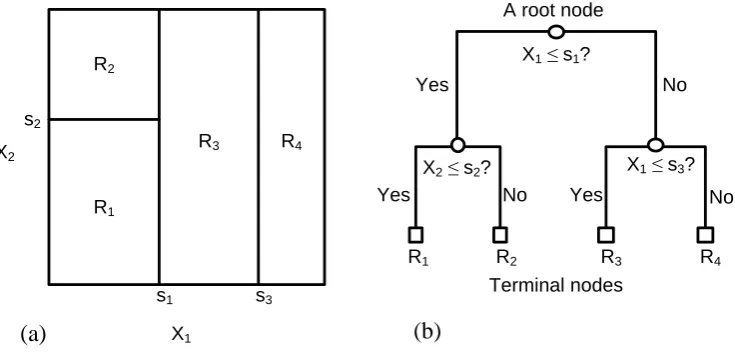
A simple regression tree is built with two input variables x1 and x2 and a response y
194
by considering a recursive partition as shown in Figure 1(a). First, we select the splitting
195
variable (for example, x1) and the split point (for example s1) in order to achieve the most 196
homogeneous splitting groups and split the space of the dataset into two groups. The selected 197
variable and point solve 198
1 2
2 2
1 2
,
( , ) ( , )
min ( ) ( )
i i
i i
j s
x R j s x R j s
y c y c
(11)199
1
c and c2 are the mean value of all the responses in the corresponding groups. Then, each of 200
these groups is further split into two more groups. As shown in Figure 1(a), the group x1s1
201
is split at x2 s2 and finally the group x1 s1 is split at x1 s3. The process results in four 202
groups R1, …, R4. This process can be represented by the binary tree (Figure 1(b)). The 203
entire dataset sits at the top of the tree, as a so-called root node. Observations (data points) 204
satisfying the condition at each node are assigned to the left branch, and the others to the right 205
branch. The terminal nodes of the tree correspond to the groups, R1, .., R4. Once a tree has 206
been built, the response for any new observation can be predicted by following the path from 207
the root node down to the appropriate terminal node of the tree, based on the observed values 208
of the splitting variables. 209
When determining tree size, note that a small tree may not capture a nonlinear 210
relationship that may exist while a very large tree may over-fit the data. Therefore, tree size is 211
preferred strategy is to gradually increase the tree size and evaluate the accuracy of each tree 213
size until each node contains fewer than a given number of observations (for example, 5). 214
Then this large tree is pruned by sequentially cutting off branches that add the smallest 215
capability to predictive performance of the tree according to a specified pruning criterion. 216
2.5. Random forest (RF)
217
A random forest is a combination of regression trees that are grown in random ways 218
[35]. The idea behind the random forest method is to generate an ensemble of low-correlated 219
regression trees and average results in order to reduce variance. The low-correlated trees are 220
generated by adding randomization in two steps: (i) each tree is grown using a random sub-221
dataset of observations and (ii) each node of a tree is split using a random subset of input 222
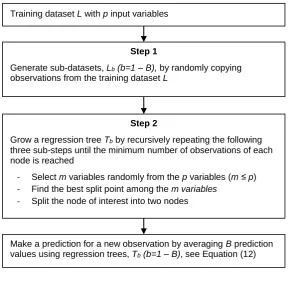
variables. Figure 2 shows the layout of the random forest method. 223
The first step is to generate B sub-datasets of observations by randomly copying 224
observations from the original training set L until each sub-dataset has the same number of
225
observations N as the original training set. Some observations can be chosen several times
226
for each sub-dataset, whereas others are not chosen at all. It has been proved that about 37% 227
of the observations in the original training set are not chosen for each sub-dataset [38, 41]. 228
The collection of non-chosen observations corresponding to each sub-dataset functions as a 229
validation set. Each sub-dataset is denoted Lb where b1, 2,...,B. 230
The second step involves growing a regression tree
Tb using a sub-dataset
Lb . This 231step is to reduce further the correlation between the regression trees that enter into the 232
averaging step later. This is achieved during the tree-growing process by randomly selecting 233
a subset of m input variables from all p input variables
m p
before splitting each node. 234A regression tree is grown by recursively repeating the following three sub-steps for each 235
- Randomly select a subset of m variables from all p variables. 237
- Find the best split among the m variables. 238
- Split the selected node into two resulting nodes. 239
After B regression trees are grown from B sub-datasets, an ensemble of these B trees 240
is called a random forest. The random forest makes a prediction for a new observation x by
241
using each regression tree Tb in the forest to obtain a prediction yb
x and then averaging B242
prediction values from the B trees: 243
1
1 B
b b
y x y x e
B
(12)244
3. Case study subject: The Tamar suspension bridge
245
The Tamar Suspension Bridge, as shown in Figure 3, is a road bridge connecting 246
Saltash to Plymouth in southwest England. The original bridge was designed as a 247
conventional suspension bridge with symmetrical geometry and was first opened in 1961. The 248
total length is 642 m with a main span of 335 m and side spans of 114 m and the tower height 249
is 73 m. Trusses are 4.9 m deep with chords of welded hollow box structures. To meet the 250
requirement that bridges should be capable of carrying lorries up to 40 tons, the Tamar Bridge 251
was strengthened and widened in March 1999 and the upgrading was completed in December 252
2001[42-43]. The upgrading included replacing the original composite main deck by a three-253
lane orthotropic steel deck, adding single lane cantilevers at each side of the truss and 254
installing sixteen new cables acting as additional stays to carry the additional dead load of 255
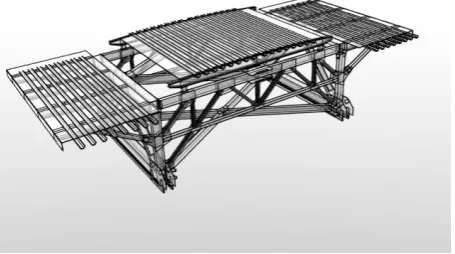
new cantilever lanes and associated temporary works. Figure 4 shows the layout of one of the 256
truss sections with the main orthotropic deck and two cantilever lanes. 257
Many types of sensors were installed during and subsequent to the strengthening and 258
displacement sensors, thermometers, load cells and accelerometers. Most recently, a robotic 260
total station was added to monitor the deflection of the bridge deck and a pair of 261
extensometers installed to track relative movement across the single expansion joint located 262
around the Saltash Tower [45]. Measurement data have been collected continuously since 263
February 2007. 264
These data used in this study include air temperature, wind velocity, the measured 265
natural frequencies of the bridge and the number of vehicles crossing the bridge every hour. 266
Vehicle crossing data were available from the bridge toll reports, temperature and wind values 267
are 30-minute averages of data sampled at either 1Hz from four thermistors on the cable and 268
deck and an anemometer close to midspan, while frequencies are derived from modal analysis 269
of 64-Hz sampled acceleration signals from a pair of accelerometers located near mid span. 270
Locations of these sensors are shown in Figure 5. The covariance-driven stochastic subspace 271
identification (SSI-COV) procedure operated automatically on the acceleration data after 8-272
fold decimation, reporting frequency and damping estimates at 30 minute intervals. 273
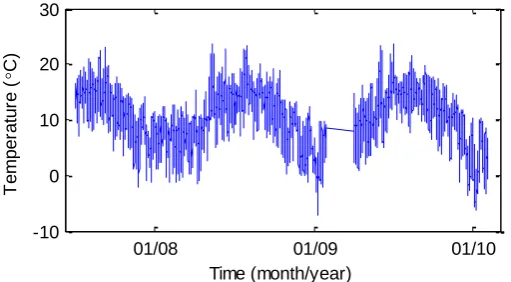
Figure 6 shows the time history of air temperature for three years, including daily and 274
seasonal temperature variations. The temperature ranges from -5 °C to 25 °C between winter 275
and summer. The first five natural frequencies of the bridge are summarized in Table 1. 276
4. Results
277
The five regression methodologies presented in the previous section are applied to 278
predict the natural frequency variation of the Tamar Bridge based on environmental factors as 279
well as traffic loading. The prediction is performed for each natural frequency separately. The 280
measurement data taken from July 2007 to January 2010 on the Tamar Bridge are divided into 281
two non-overlapping and independent data sets: a training set of 70% and a test set of 30%. 282
natural frequencies, the test set is used for assessing prediction accuracy (from June 2009 to 284
January 2010). 285
4.1. Multiple linear regression
286
The relationship between natural frequency responses and air temperature, wind and 287
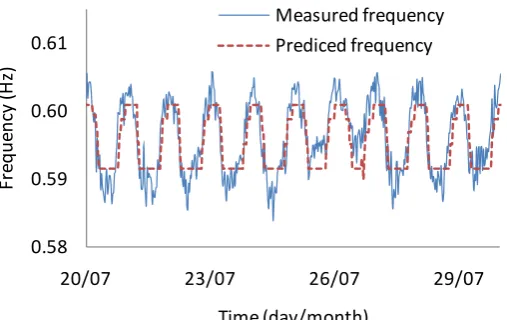
traffic loading are first formulated for each frequency using the least square method. Figure 7 288
shows the prediction of the 10-day time histories (from 20 to 30 July 2009) of the third 289
frequency that is compared with the measured frequency in the test phase. This figure 290
indicates that the predicted frequency is unable to capture the high variation in the natural 291
frequency. Table 2 presents the mean square error (MSE) values in the training and test sets, 292
where the error is the difference between the measured frequency value and its corresponding 293
predicted value. For frequency 1 and 3, MSE values in the training set are somewhat larger 294
than those in the test set. This is because there are more outliers in the training data than in 295
the test set. 296
4.2. Artificial neural networks
297
The optimal number of hidden nodes in the hidden layer is determined so that the 298
validation error reaches the minimum value. To do this, a set of neural networks with respect 299
to the increasing number of hidden nodes from 1 to 50 are trained using training data. The 300
number of hidden nodes of the neural network that gives the minimum error is taken as the 301
optimal number. 302
Table 3 presents the optimal numbers of hidden nodes for five natural frequencies, 303
together with MSE values of the training set and the test set. The optimal number of hidden 304
nodes for five frequencies ranges from 10 to 33 nodes. These values are close to the optimal 305
value (19 hidden nodes) for the first natural frequency of the Ting Kau cable-stayed bridge 306
[46]. Figure 8 shows the predicted natural frequency along with the measured frequency. 307
prediction value than multiple linear regression. Comparing the prediction capability of ANN 309
with other methods is further discussed in Section 4.6. 310
4.3. Support vector regression
311
Table 4 presents the optimal values of and that give the best performance (lowest 312
MSE) of SVR for five natural frequencies. The corresponding MSEs are also listed in this 313
table. Comparing the MSE values in Table 4 with Table 2 and Table 3 indicates that the SVR 314
method has a better performance than the MLR and ANN methods in both the training set and 315
the test set. For example, the prediction error (in the test set) for frequency 5 using SVR is 316
reduced by 20% when compared with the prediction error using MLR. Figure 9 shows the 317
predicted and measured time histories of frequency 3 from July 20 to 30, 2009. It is shown 318
that the predicted frequencies closely match the measured ones. 319
4.4. Regression tree
320
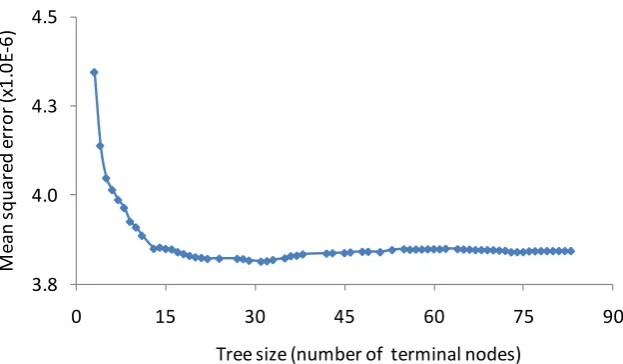
Figure 10 shows the mean squared error with respect to the increasing number of 321
terminal nodes (i.e. tree size) of the pruned tree for the first natural frequency. The optimal 322
tree size (i.e. the point where increasing tree size only leads to minor decrease of MSE) for 323
this frequency is composed of 31 terminal nodes. The optimal tree sizes for the second and 324
third frequencies are 44 and 35 terminal nodes respectively (Table 5). It is observed that the 325
higher frequency requires more terminal nodes, leading to a larger tree size, i.e. higher tree 326
complexity. Table 5 also presents the mean squared errors in the training and test sets. The 327
prediction of the R_Tree method is better than that of the ANN and MLR methods but it is not 328
as good as that of the SVR method. 329
Figure 11 shows the 10-day time histories of measured and predicted frequencies from 330
July 20 to July 30, 2009. For both sets, the predicted frequency time history reasonably 331
is because the observations at the peaks fall into the same groups where the predicted 333
responses are equal to the mean of measured responses within the corresponding group. 334
4.5. Random forest
335
When applying the random forest method for regression analysis, three parameters need 336
to be determined: (i) the sufficient number B of trees, (ii) the optimal number of observations 337
in each terminal node and (iii) the number m of input variables randomly chosen as 338
candidates for splitting at each node. For the Tamar Bridge, there are three input variables (i.e. 339
3
p ) including temperature, wind and traffic. For this case study, to reduce the correlation 340
between regression tress, the number of input variables chosen for splitting at each node is 2 341
(i.e. m2). 342
Figure 12 shows that when the number of trees increases, the mean squared error 343
computed from the validation set decreases. The prediction is stable at about 100 trees for 344
both cases of 1 and 50 observations in each terminal node. It is seen that the tree with 50 345
observations in terminal nodes performs better than that with only one observation in terminal 346
nodes. This is attributable to the over-fitting situation when growing a tree to its maximum 347
size (i.e. one observation in terminal nodes). 348
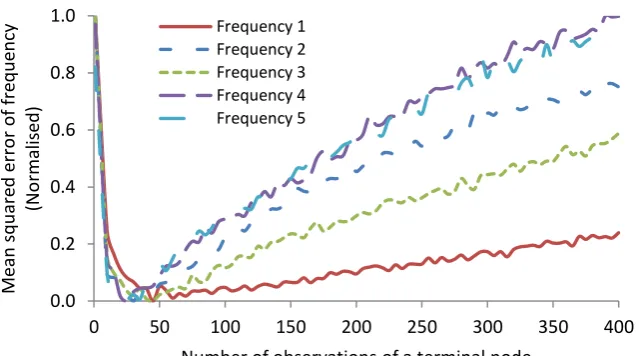
Figure 13 shows the change in the normalised mean squared error with respect to the 349
increase in the number of observations in terminal nodes for 5 frequencies. For each 350
frequency, the normalised MSE is calculated by dividing the MSE by the difference between 351
maximum and minimum MSE. When the number of observations in terminal nodes starts 352
increasing, initially the normalised MSE of all five frequencies drops dramatically to a 353
minimum and then it increases gradually. The optimal number of observations in terminal 354
nodes ranges from 10 to 50 observations. Table 6 presents the optimal number of 355
observations for each frequency together with its mean squared errors computed from the 356
errors as compared with those from the previous four methods. Figure 14 compares the 358
predicted natural frequency with the measured frequency. The predicted frequency closely 359
matches the measured one. 360
4.6. Performance comparisons and discussions
361
In order to find a suitable method to predict the natural frequency responses from 362
environmental measurement data for a suspension bridge, the prediction capability of five 363
regression methods are compared. The result of a regression method can have a very good fit 364
to the training data; however, it may poorly predict the response for a new observation. Thus, 365
the prediction capability of these methods is evaluated through prediction error that is defined 366
as the mean squared error from the test set, with a smaller prediction error indicating a better 367
prediction capability. When comparing the prediction error of the five regression methods 368
from Table 2 to Table 6, it can be seen that the four nonlinear regression methods (ANNs, 369
SVR, R_Tree and RF) predict frequencies more accurately than the MLR method. Table 7 370
presents the reduction in the prediction error for these methods when using the prediction 371
error of the MLR method as a basis. For frequency 5, SVR and RF can reduce the prediction 372
error up to 20% when compared with MLR. The good performances of SVR and RF indicate 373
the possibility of existence of non-linear correlations between natural frequency responses and 374
environmental factors as well as traffic loading for the Tamar Suspension Bridge. In addition, 375
comparing Figure 11 and Figure 14 demonstrates that RF employing multiple trees, which are 376
grown in a random way, can lead to better predictions than the R_Tree method that employs a 377
single tree. RF is able to capture the high variations at peaks of frequency time histories. 378
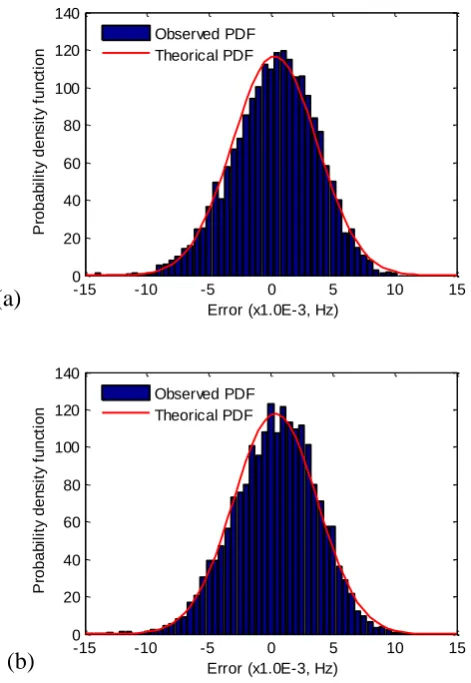
The performance of SVR and RF are further assessed through a normality test [47]. 379
From a statistical point of view the error, which is the difference between the predicted value 380
and the corresponding measured frequency value, complies with a normal distribution with 381
with the corresponding theoretical curves of the normal distribution obtained using the mean 383
and standard deviation values computed from error values. The figure shows the observed 384
probability distribution of the error for SVR and RF methods is in good agreement with a 385
normal distribution with zero mean. 386
SVR and RF are used to define the confidence intervals around the predicted natural 387
frequencies for a new observation. It is found that the error in the training data for SVR and 388
RF also have a normal distribution with zero mean. Thus, the confidence interval is defined 389
based on the error variance of the training data. Figure 16 shows the identified and predicted 390
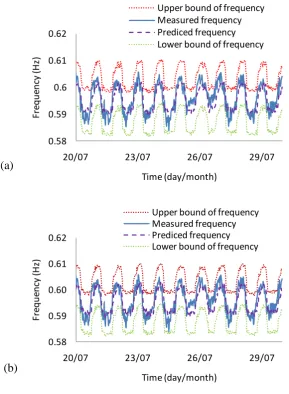
natural frequencies for RF between July 20 and July 30 (2009), together with the 95% 391
confidence interval for the second natural frequency. For the test set, the ratio of the data that 392
falls within the 95% confidence level to the full set of the data is referred to as the success 393
rate. For SVR, the success rates for frequencies 1 to 5 are 98%, 91%, 98%, 94% and 91%, 394
respectively. The corresponding success rates for RF are 98%, 91%, 98%, 94% and 89%. 395
These high success rates indicate that the variations in bridge natural frequencies can be 396
accounted for by measuring temperature, wind and traffic loading. These rates also 397
demonstrate the consistency of continuously monitored data from 2007 to 2010, thereby 398
establishing a baseline data for continuous health monitoring of the bridge. In addition, the 399
success rate can be used as a damage-detection index. If the success rates for future natural 400
frequencies change, it is likely that the bridge has experienced some kind of structural change. 401
5. Effects of environmental factors and traffic loading on natural frequencies of the
402
bridge
403
The changes in bridge natural frequencies are adequately accounted for by three factors: 404
temperature, wind and traffic loading. This study identifies the degree to which each factor 405
has an effect on the frequency change. Simultaneous effects of these factors on the first five 406
importance of input variables in regression analysis. The measure of relative importance 408
indicates the variables that are highly related to the response for interpretation purposes. 409
5.1. Evaluation of effects using relative importance metrics of the multiple linear regression
410
method
411
Multiple linear regression can be used to evaluate the contribution of an individual input 412
variable xj
j1,..,p
to the prediction of a response y. The contribution of each variable is 413compared with that of other variables using a metric of so-called relative importance. Several 414
relative importance metrics have been proposed to assess the amount of variation in the 415
response that is explained by each individual variable [48-49]. In this study, since the 416
correlation between input variables is negligible, the relative importance of each individual 417
variable is defined as the squared correlation coefficient of an input variable xj with the 418
response y. 419
Figure 17 shows the relative importance of temperature, wind and traffic loading using 420
MLR for the first five natural frequencies of the bridge. The effects of temperature, wind and 421
traffic loading on the first frequency are 8%, 18% and 74%. Such effects correspond to 34%, 422
10% and 56% for the second frequency. They are 28%, 10% and 62% for the third frequency 423
and 22%, 10% and 68% for the fifth frequency. Except for the fourth frequency (i.e. 70%, 424
21% and 9%), based on relative importance metrics defined using MLR, traffic loading is the 425
main factor that affects the natural frequencies. 426
5.2. Evaluation of effects using relative importance metrics of the random forest method
427
The random forest method has improved the prediction accuracy in comparison to other 428
prediction methods. Besides, RF also evaluates the relative importance of variables in a 429
dataset in order to measure the prediction strength of each variable. 430
chosen observations (about 37%) are utilized as validation observations for that tree. The 433
computation of the importance of an input variable xj is carried out one tree at a time. First, 434
when the bth tree Tb is grown, the validation observations are then used to determine the mean 435
squared error from the validation data MSEb. Next, the values of variable xj in the validation 436
data are randomly permutated while leaving the values of all other variables unchanged. Then, 437
the permuted observations are used in the tree Tb and the mean squared error from the 438
permuted validation data MSEb
xj is computed. If xj is important, permuting its observed 439values will reduce the prediction accuracy of each observed value in the validation data. Thus, 440
b j
MSE x from the permuted validation data is larger than MSEb from the un-permuted 441
data. 442
Finally, a measure of the importance of the jth variable xj is obtained by averaging the 443
mean squared errors from the permuted validation data over all of the trees: 444
1
1 B
j b j b
b
imp x MSE x MSE
B
. (13)445
The relative importance of each variable is computed by normalizing its importance to 446
the summation of the importance of all variables. The relative importance metrics are 447
expressed in percentage. Figure 18 shows the relative importance of temperature, wind and 448
traffic loading on the natural frequency responses of the bridge. There is a significant effect 449
of traffic loading on the frequency. Figure 18 also indicates that while the effect of traffic 450
loading decreases from frequencies 1 to 5, the effect of temperature increases respectively. 451
Both effects are almost similar for frequency 5 and the effect of temperature is more dominant 452
5.3. Discussion
454
Comparing Figure 17 and Figure 18 shows that although variable importance metrics 455
are defined in two different ways using multiple linear regression and random forest, the 456
importance rankings for temperature, wind and traffic are identical. For the first frequencies, 457
the averaged percentages of the effects taken from both variable importance metrics are about 458
8%, 17% and 75% respectively. Such percentages correspond to 26%, 15% and 59% for the 459
second frequency, 24%, 9% and 66% for the third frequency, 60%, 22% and 18% for the 460
fourth frequency and 31%, 11% and 58% for the fifth frequency. A possible reason for the 461
effect of traffic loading is that there is a significant contribution of the traffic mass to the total 462
mass of the truss-span suspension bridge. Despite the strong influence on other frequencies, 463
the relative effect of the traffic on the fourth frequency is quite small. This could be due to the 464
fact that the fourth frequency refers to a torsional vibration mode while other frequencies refer 465
to vertical and lateral modes. 466
As for temperature effects, the influence on the variation of the fourth and fifth 467
frequencies is larger than that of the other frequencies. This could be caused by the non-linear 468
temperature distribution due to solar radiation. In general, for successful data interpretation 469
when monitoring natural frequency responses of suspension bridges, the effects of both traffic 470
loading and temperature need to be taken into account. 471
6. Conclusions
472
This paper compares five methodologies to predict the natural frequency responses of a 473
suspension bridge using measurements of temperature, wind and traffic loading. The 474
following conclusions are drawn 475
Random forest and support vector regression are the most appropriate methods for
476
predicting the natural frequencies of a suspension bridge using measurement data of 477
The relative importance of input variables of regression analysis is a useful metric to 479
evaluate the simultaneous effects of environmental factors and traffic loading on the 480
long-term natural frequency responses of a bridge. 481
Traffic loading and temperature are the most influential parameters on natural frequencies
482
of the suspension bridge studied. Obtaining these parameters should be a priority when 483
using natural frequency changes to detect damage. 484
Acknowledgements
485
The authors are grateful to Dr. Minh-Hai Pham and Dr. Ki-Young Koo for their contributions 486
to this research. 487
References
488
[1] Wahab MA, De Roeck G. Effect of temperature on dynamic system parameters of a highway
489
bridge. Structural Engineering International. 1997;7:266-70.
490
[2] Yuen K-V, Kuok S-C. Ambient interference in long-term monitoring of buildings. Engineering
491
Structures. 2010.
492
[3] Liu C, DeWolf JT. Effect of temperature on modal variability of a curved concrete bridge under
493
ambient loads. Journal of Structural Engineering. 2007;133:1742-51.
494
[4] Xu Z-D, Zhishen Wu. Simulation of the effect of temperature variation on damage detection in a
495
long-span cable-stayed bridge. Structural Health Monitoring. 2007;6:177-89.
496
[5] Brownjohn JM. Thermal effects on performance on tamar bridge. in 4th International
497
Conference on Structural Health Monitoring of Intelligent Infrastructure (SHMII-4). Zurich,
498
Swirzerland. 2009.
499
[6] Laory I, Trinh TN, Smith IFC. Evaluating two model-free data interpretation methods for
500
measurements that are influenced by temperature. Adv Eng Inform. 2011;25:495-506.
501
[7] Posenato D, Lanata F, Inaudi D, Smith IFC. Model-free data interpretation for continuous
502
monitoring of complex structures. Advanced Engineering Informatics. 2008;22:135-44.
503
[8] Posenato D, Kripakaran P, Inaudi D, Smith IFC. Methodologies for model-free data
504
interpretation of civil engineering structures. Computers & Structures. 2010;88:467-82.
505
[9] Sohn H, Dzwonczyk M, Straser EG, Kiremidjian AS, Law K, Meng T. An experimental study
506
of temperature effect on modal parameters of the alamosa canyon bridge. Earthquake
507
Engineering and Structural Dynamics. 1999;28:879-97.
508
[10] Trinh TN, Koh CG. An improved substructural identification strategy for large structural
509
systems. Structural Control and Health Monitoring. 2011:doi: 10.1002/stc.463.
510
[11] Moser P, Moaveni B. Environmental effects on the identified natural frequencies of the dowling
511
hall footbridge. Mechanical Systems and Signal Processing. 2011;25:2336-57.
512
[12] Peeters B, Maeck J, Roeck GD. Vibration-based damage detection in civil engineering:
513
Excitation sources and temperature effects. Smart Materials and Structures. 2001;10:518.
[13] Peeters B, De Roeck G. One-year monitoring of the Z24-bridge: Environmental effects versus
515
damage events. Earthquake Engineering & Structural Dynamics. 2001;30:149-71.
516
[14] Yang D, Youliang D, Aiqun L. Structural condition assessment of long-span suspension bridges
517
using long-term monitoring data. Earthquake Engineering and Engineering Vibration.
518
2010;9:123-31.
519
[15] Bishop C. Neural networks for pattern recognition: Oxford University Press, USA; 1996.
520
[16] Raphael B, Smith IFC. Fundamentals of computer-aided engineering: West Sussex, England :
521
Wiley; 2003.
522
[17] Chan THT, Ni YQ, Ko JM. Neural network novelty filtering for anomaly detection of tsing ma
523
bridge cables in The 2nd International Workshop on Structural Health Monitoring. Stanford
524
University, Stanford, CA, USA. 1999.
525
[18] Fernandez B, Parlos AG, Tsai WK. Nonlinear dynamic system identification using artificial
526
neural networks (anns). New York, NY, USA: IEEE. 1990.
527
[19] Huang C-C, Loh C-H. Nonlinear identification of dynamic systems using neural networks.
528
Computer-Aided Civil and Infrastructure Engineering. 2001;16:28-41.
529
[20] Adeli H. Neural networks in civil engineering: 1989–2000. Computer-Aided Civil and
530
Infrastructure Engineering. 2001;16:126-42.
531
[21] Ni YQ, Zhou HF, Ko JM. Generalization capability of neural network models for
temperature-532
frequency correlation using monitoring data. J Structural Engineering. 2009;135:1290.
533
[22] Zhou HF, Ni YQ, Ko JM. Constructing input to neural networks for modeling
temperature-534
caused modal variability: Mean temperatures, effective temperatures, and principal components
535
of temperatures. Engineering Structures. 2010;32:1747-59.
536
[23] Zhou HF, Ni YQ, Ko JM. Performance of neural networks for simulation and prediction of
537
temperature-induced modal variability. in Smart Structures and Materials 2005: Sensors and
538
Smart Structures Technologies for Civil, Mechanical, and Aerospace Systems, 7 March 2005.
539
USA: SPIE-Int. Soc. Opt. Eng. 2005.
540
[24] Freitag S, Graf W, Kaliske M, Sickert JU. Prediction of time-dependent structural behaviour
541
with recurrent neural networks for fuzzy data. Computers & Structures.In Press, Corrected
542
Proof.
543
[25] Graf W, Freitag S, Sickert J-U, Kaliske M. Prediction of time-dependent structural behavior
544
with recurrent neural networks. in The Sixth International Structural Engineering and
545
Construction Conference. Zürich, Switzerland. 2011. 789-94.
546
[26] Vapnik V, Golowich S, Smola A. Support vector method for function approximation, regression
547
estimation, and signal processing. in Advances in Neural Information Processing Systems 9.
548
1996.
549
[27] Saitta S, Kripakaran P, Raphael B, Smith IFC. Feature selection using stochastic search: An
550
application to system identification. Journal of Computing in Civil Engineering. 2010;24:3-10.
551
[28] Smola AJ, Schölkopf B. A tutorial on support vector regression. Statistics and Computing.
552
2004;14:199-222.
553
[29] Basak D, Pal S, Patranabis D. Support vector regression. Neural Information Processing –
554
Letters and Reviews. 2007;11.
555
[30] Zhang J, Sato T. Experimental verification of the support vector regression based structural
556
identification method by using shaking table test data. Structural Control and Health
557
Monitoring. 2008;15:505-17.
[31] Ni YQ, Hua XG, Fan KQ, Ko JM. Correlating modal properties with temperature using
long-559
term monitoring data and support vector machine technique. Engineering Structures.
560
2005;27:1762-73.
561
[32] Hua XG, Ni YQ, Ko JM, Wong KY. Modeling of temperature-frequency correlation using
562
combined principal component analysis and support vector regression technique: ASCE; 2007.
563
[33] Breiman L, Friedman J, Stone C, Olshen RA. Classification and regression trees: Chapman &
564
Hall/CRC; 1984.
565
[34] Izenman A. Modern multivariate statistical techniques : Regression, classification, and manifold
566
learning: Springer New York; 2008.
567
[35] Breiman L. Random forests. Machine Learning. 2001;45:5-32.
568
[36] Zheng L, Watson DG, Johnston BF, Clark RL, Edrada-Ebel R, Elseheri W. A chemometric
569
study of chromatograms of tea extracts by correlation optimization warping in conjunction with
570
pca, support vector machines and random forest data modeling. Analytica Chimica Acta.
571
2009;642:257-65.
572
[37] Archer KJ, Kimes RV. Empirical characterization of random forest variable importance
573
measures. Computational Statistics & Data Analysis. 2008;52:2249-60.
574
[38] Grömping U. Variable importance assessment in regression: Linear regression versus random
575
forest. The American Statistician. 2009;63:308-19.
576
[39] Suykens JAK, Gestel TV, Brabanter JD, Moor BD, Vandewalle J. Least squares support vector
577
machines. Singapore: World Scientific; 2002.
578
[40] Hsu C, Chang C, Lin C. A practical guide to support vector classification. 2010.
579
[41] Hastie T, Tibshirani R, Friedman J. The elements of statistical learning: Data mining, inference
580
and prediction. 2 ed: Springer; 2009.
581
[42] Koo KY, Brownjohn JMW, List D, Cole R. Innovative structural health monitoring for
582
suspension bridges by total positioning system. in IABMAS10. Philadelphia, USA. 2009.
583
[43] Westgate R, Brownjohn JMW. Development of a tamar bridge finite element model. in IMAC
584
XXVIII. Florida, USA. 2010.
585
[44] Koo KY, Brownjohn JMW, Cole R, List DI. Structural health monitoring of tamar suspension
586
bridge. Submitted to Journal of Structural Control and Health Monitoring. 2011.
587
[45] Koo KY, Brownjohn JMW. Robotic total station for long-term structural health monitoring of
588
the tamar bridge. Submitted to Engineering Structures. 2011.
589
[46] Ni YQ, Zhou HF, Ko JM. Generalization capability of neural network models for
temperature-590
frequency correlation using monitoring data: ASCE; 2009.
591
[47] Freund RJ, Wilson WJ, Mohr D. Statistical methods. London: Academic Press; 2010.
592
[48] Chao Y-CE, Zhao Y, Kupper LL, Nylander-French LA. Quantifying the relative importance of
593
predictors in multiple linear regression analyses for public health studies. Journal of
594
Occupational and Environmental Hygiene. 2008;5:519 - 29.
595
[49] Groemping U. Relative importance for linear regression in r: The package relaimpo. Journal of
596
Statistical Software. 2006;17.
597
598 599 600
602 603 604
s2
s1 s3
X1
X2
Terminal nodes
X1≤ s1?
X2≤ s2?
Yes No
No Yes
Yes No
X1≤ s3?
R1
R2
R3 R4
R1 R2 R3 R4
A root node
Figure 1. (a) The partitioning of a two-dimensional feature space into four regions, R1-R4; (b) a decision tree with three splits and four terminal nodes corresponding to the four partitions.
[image:26.595.115.483.55.236.2]605
[image:27.595.160.449.48.336.2]606
Figure 2. A layout of the random forest analysis method.
Training dataset L with p input variables
Step 1
Generate sub-datasets, Lb (b=1 – B), by randomly copying observations from the training dataset L
Step 2
Grow a regression tree Tbby recursively repeating the following three sub-steps until the minimum number of observations of each node is reached
- Select m variables randomly from the p variables (m ≤ p)
- Find the best split point among the m variables - Split the node of interest into two nodes
607
608
609
610
611
[image:28.595.185.411.107.274.2]612
[image:28.595.185.413.459.586.2]613 614
[image:29.595.69.526.97.179.2]615
Figure 5 Sensor locations (circle for accelerometers, square for thermistors and triangle for anemometer)
01/08 01/09 01/10
-10 0 10 20 30
Time (month/year)
T
e
m
p
e
ra
tu
re
(
C
)
[image:29.595.175.431.547.688.2]616
617
[image:30.595.117.394.111.282.2]618
Figure 7. Measured and predicted natural frequencies between July 20 and July 30, 2009 using the multiple linear regression method.
0.58 0.59 0.6 0.61
20/07 23/07 26/07 29/07
Fr
eq
u
en
cy
(H
z)
Time (day/month)
Measured frequency Prediced frequency
Figure 8. Measured and predicted natural frequencies between July 20 and July 30, 2009 using the artificial neural network method.
0.58 0.59 0.6 0.61
20/07 23/07 26/07 29/07
Fr
eq
u
en
cy
(H
z)
Time (day/month)
[image:30.595.138.394.505.667.2]619
620
621
[image:31.595.139.394.95.263.2]622
Figure 10. Mean squared errors versus the number of terminal nodes of a tree.
3.8 4.0 4.3 4.5
0 15 30 45 60 75 90
M
ea
n
s
q
u
ar
ed
e
rr
o
r
(x
1
.0
E-6)
[image:31.595.143.455.505.687.2]Tree size (number of terminal nodes)
Figure 9. Measured and predicted natural frequencies between July 20 and July 30, 2009 using the support vector regression method.
0.58 0.59 0.6 0.61
20/07 23/07 26/07 29/07
Fr
eq
u
en
cy
(H
z)
Time (day/month)
623
624
625
[image:32.595.170.424.96.256.2]626
Figure 12. Mean squared errors versus number of trees for two cases of 1 and 50 observations in terminal nodes.
3.0 4.0 5.0 6.0 7.0 8.0
0 30 60 90 120
M
ea
n
s
q
u
ar
ed
e
rr
o
r
(x
1
.0
E-6)
Number of trees
1 50
[image:32.595.141.408.506.688.2]Number of observations in terminal nodes
Figure 11. Measured and predicted natural frequencies between July 20 and July 30, 2009 using the regression tree method.
0.58 0.59 0.60 0.61
20/07 23/07 26/07 29/07
Fr
eq
u
en
cy
(H
z)
Time (day/month)
627
Figure 13. Mean squared errors versus the number of observations in a terminal node
0.0 0.2 0.4 0.6 0.8 1.0
0 50 100 150 200 250 300 350 400
Me
an
squ
ar
ed
error
o
f fre
q
u
en
cy
(No
rm
alis
ed
)
Number of observations of a terminal node
[image:33.595.136.456.94.272.2]Frequency 1 Frequency 2 Frequency 3 Frequency 4 Frequency 5
Figure 14. Measured and predicted natural frequencies between July 20 and July 30, 2009 using the random forest method
0.58 0.59 0.6 0.61
20/07 23/07 26/07 29/07
Fr
eq
u
en
cy
(H
z)
Time (day/month)
628
629
[image:34.595.167.403.85.427.2]630
Figure 15. Probability distribution of errors for (a) support vector regression and (b) random forest
-15 -10 -5 0 5 10 15
0 20 40 60 80 100 120 140
Error (x1.0E-3, Hz)
P
ro
b
a
b
il
it
y
d
e
n
si
ty
fu
n
ct
io
n
Observed PDF Theorical PDF
-15 -10 -5 0 5 10 15
0 20 40 60 80 100 120 140
Error (x1.0E-3, Hz)
P
ro
b
a
b
il
it
y
d
e
n
si
ty
fu
n
ct
io
n
Observed PDF Theorical PDF (a)
631
632
633
634
[image:35.595.131.421.83.478.2]635
Figure 16. Measured and predicted natural frequencies (20 – 30 July, 2009) together with the 95% confidence interval using (a) support vector regression and (b) random forest
0.58 0.59 0.6 0.61 0.62
20/07 23/07 26/07 29/07
Fr
eq
u
en
cy
(H
z)
Time (day/month)
Upper bound of frequency Measured frequency Prediced frequency Lower bound of frequency
0.58 0.59 0.60 0.61 0.62
20/07 23/07 26/07 29/07
Fr
eq
u
en
cy
(H
z)
Time (day/month)
Upper bound of frequency Measured frequency Prediced frequency Lower bound of frequency
(a)
636
637
638
[image:36.595.153.420.94.251.2]639
Figure 18. Evaluating simultaneous effects of temperature, wind, and traffic loading on the modal frequency responses through the relative importance of variables using the RF method.
0 25 50 75 100
1 2 3 4 5
R
e
lat
ive
im
p
o
rta
n
ce
(
%
)
Frequency number
[image:36.595.171.439.520.676.2]Temperature Wind Traffic
Figure 17. Evaluating simultaneous effects of temperature, wind, and traffic loading on the natural frequency responses through the relative importance of variables using the MLR method.
0 25 50 75 100
1 2 3 4 5
R
e
lat
ive
im
p
o
rta
n
ce
(
%
)
Frequency number
640
Table 1. Parameters of measured natural frequencies of the bridge.
641
Mode number
Average frequency
(Hz)
Frequency range (Hz) Maximum
difference (%)
Standard deviation
(Hz)
minimum maximum
1 0.39 0.38 0.41 8 0.00
2 0.47 0.41 0.57 34 0.01
3 0.60 0.58 0.61 5 0.01
4 0.69 0.67 0.70 4 0.00
5 0.73 0.71 0.75 6 0.01
[image:37.595.64.299.311.412.2]642 643 644
Table 2. Results of the MLR method for the first five modes of the bridge
645
Frequency number
Mean squared error (×10-6)
Training set Test set
1 4.0 2.8
2 84.4 99.1
3 20.5 13.7
4 11.7 11.6
5 18.5 23.1
646 647
Table 3. Results of the ANN method for the first five modes of the bridge
648
Frequency number Number of hidden
nodes
Mean squared error (×10-6)
Training set Test set
1 11 3.9 2.7
2 10 87.6 95.7
3 21 22.8 12.3
4 33 15.7 18.6
5 21 19.5 20.0
649 650
Table 4. Results of the SVR method for the first five modes of the bridge
651
Frequency number Mean squared error (×10
-6)
Training set Test set
1 20 0.8 3.7 2.5
2 9 0.17 69.5 96.7
3 20 0.56 16.6 11.8
4 12 0.28 9.4 10.6
5 14 0.36 15.7 18.6
[image:37.595.62.524.472.571.2] [image:37.595.63.525.634.733.2]