warwick.ac.uk/lib-publications
Original citation:
Basık, Fuat, Gedik, Buğra, Ferhatosmanoglu, Hakan and Kalender, Mert Emin. (2015) S3 -TM :
scalable streaming short text matching. The VLDB Journal, 24 (6). pp. 849-866.
Permanent WRAP URL:
http://wrap.warwick.ac.uk/92827
Copyright and reuse:
The Warwick Research Archive Portal (WRAP) makes this work by researchers of the
University of Warwick available open access under the following conditions. Copyright ©
and all moral rights to the version of the paper presented here belong to the individual
author(s) and/or other copyright owners. To the extent reasonable and practicable the
material made available in WRAP has been checked for eligibility before being made
available.
Copies of full items can be used for personal research or study, educational, or not-for profit
purposes without prior permission or charge. Provided that the authors, title and full
bibliographic details are credited, a hyperlink and/or URL is given for the original metadata
page and the content is not changed in any way.
Publisher’s statement:
“The final publication is available at Springer via
http://dx.doi.org/10.1007/s00778-015-0404-3
”
A note on versions:
The version presented here may differ from the published version or, version of record, if
you wish to cite this item you are advised to consult the publisher’s version. Please see the
‘permanent WRAP url’ above for details on accessing the published version and note that
access may require a subscription.
(will be inserted by the editor)
S
3
-TM: Scalable Streaming
Short Text Matching
Fuat Basık · Bu˘gra Gedik ·
Hakan Ferhatosmano˘glu· Mert Emin Kalender
Received: date / Accepted: date
Abstract Micro-blogging services have become ma-jor venues for information creation, as well as chan-nels of information dissemination. Accordingly, moni-toring them for relevant information is a critical capa-bility. This is typically achieved by registering content-based subscriptions with the micro-blogging service. Such subscriptions are long running queries that are evaluated against the stream of posts. Given the popu-larity and scale of micro-blogging services like Twitter and Weibo, building a scalable infrastructure to evalu-ate these subscriptions is a challenge. To address this challenge, we present the S3-TM system for streaming short text matching. S3-TM is organized as a stream
processing application, in the form of a data parallel flow graph designed to be run on a data center environ-ment. It takes advantage of the structure of the publica-tions (posts) and subscrippublica-tions to perform the matching in a scalable manner, without broadcasting publications or subscriptions to all of the matcher instances. The ba-sic design of S3-TM uses a scoped multicast for
publica-tions and scoped anycast for subscrippublica-tions. To further improve throughput, we introduce publication routing algorithms that aim at minimizing the scope of the mul-ticasts. First set of algorithms we develop are based on partitioning the word co-occurrence frequency graph, with the aim of routing posts that include commonly co-occurring words to a small set of matchers. While ef-fective, these algorithms fell short in balancing the load. To address this, we develop the SALB algorithm, which provides better load balance by modeling the load more accurately using the word-to-post bipartite graph. We
F. Basık·B. Gedik·H. Ferhatosmano˘glu·M. E. Kalender
Bilkent University Computer Engineering Department
Ankara, Turkey. E-mail: [email protected]
also develop a subscription placement algorithm, called LASP, to group together similar subscriptions, in order to minimize the subscription matching cost. Further-more, to achieve good scalability for increasing number of nodes, we introduce techniques to handle workload skew. Finally, we introduce load shedding techniques for handling unexpected load spikes with small impact on the accuracy. Our experimental results show that S3-TM is scalable. Furthermore, the SALB algorithm
provides more than 2.5×throughput compared to the baseline multicast and outperforms the graph partition-ing based approaches.
1 Introduction
Micro-blogging has enjoyed wide adoption among Inter-net users and became a popular form of communication. Services like Twitter and Weibo enable users to create and share short updates to the public or to a selected group of contacts. Microblog posts, known as tweets, are up to 140 characters in length and short in compar-ison to regular blog posts. Users of these services can subscribe to the posts of other users, which is known as following a user. The content of a post is irrelevant to the subscription event and that means a user receives all the posts from the users it follows, no matter what the content is. In this respect, micro-blogging services resemble the traditional topic-based publish/subscribe (pub/sub) systems [7], in which tweets correspond to publications and user ids are analogous to topics.
Micro-blogging services also provide APIs for sub-scribing to streams of posts, where the matching is based on the content. For instance, Twitter has a
Streaming API [27], which takes subscriptions in the form of a set of words and delivers matching tweets in a streaming manner. This model of service resem-bles the content-based pub/sub systems [7]. However, the backbone for this kind of service is typically imple-mented within a data center [2], and not using brokers over a wide-area network as in pub/sub systems [8, 4, 1]. Considering that the popular micro-blogging services receive hundreds of millions of posts per day, imple-menting this matching in a scalable manner is a key re-quirement. In this work, we present S3-TM — a stream
processing based solution to scalable short text match-ing under the content-based subscription model. We develop effective techniques and algorithms for publi-cation routing and subscription placement, which yield an overall scalable solution.
house together, rather than following the officialWhite House microblog account. This model can capture a broader range of relevant information, with less effort on the part of the subscriber.
S3-TM is organized as a stream processing
applica-tion in the form of a data parallel flow graph designed to be run on a data center environment. The system aims at parallelizing the task of matching publications against the subscriptions. For this purpose, it creates multiple instances of the matcher module and performs smart routing to avoid broadcasting publications or subscriptions to the matchers, so that scalability can be achieved as the number of replicas is increased in response to increasing volume of publications.
There are a number of challenges faced by S3-TM:
Publication Routing. The core issue in achieving scalability for streaming short text matching within a data center environment is the routing of publica-tions and placement of subscrippublica-tions to the machines where the matching is to be performed. Previous at-tempts at this have been limited to publication unicast – subscription broadcast, publication broadcast – sub-scription unicast, or a combination of these two fun-damental approaches [2]. However, in order to achieve good scalability as the workload (and thus the number of machines) increases, we need to avoid any kind of broadcast. To address this challenge, we take advan-tage of the problem domain. In particular, the word based publications and subscriptions in micro-blogging enable us to apply hashing to multicast (as opposed to broadcast) publications to the machines responsible for matching the words they contain. This way, subscrip-tions can be placed on any one of the machines that are responsible for one of the words forming the sub-scription. However, this brings an additional challenge, which is to minimize the number of machines a publica-tion is multicast to, which we refer to as thespread. To address this challenge, we develop effective word par-titioning algorithms (which replace the hashing based partitioning) that keep the spread low.
Load Balancing.Another major obstacle to scalabil-ity is load imbalance. At one extreme, one way to min-imize spread is to assign all words to a single machine. Obviously, this is the worst case scenario for load bal-ance. In general, there is a trade-off between reduced spread and better load balance. To address this chal-lenge, we integrate load-awareness into our word parti-tioning algorithms. We develop several graph partition-ing based solutions that work on the co-occurrence fre-quency graph of words, where vertex and edge weights are used to create balanced partitions (words to be as-signed to machines). However, graph partitioning based approaches fell short, as they cannot accurately
rep-resent the load of a partition as the sum of edge or vertex weights. Therefore, we develop the SALB algo-rithm, which works on the word-to-post bipartite graph, rather than the word co-occurrence graph. SALB in-corporates mechanisms to create a spread-aware load-balanced word partitioning.
Subscription Placement & Matching. The word partitioning based routing leaves open the problem of placing subscriptions to machines, as a subscription can be placed on any one of the machines that is responsible for at least one of the words in it. Furthermore, given a number of subscriptions assigned to a machine, pub-lications need to be matched efficiently against them. To solve the subscription placement problem we first model the load imposed on a machine for handling the subscriptions placed on it, using a trie-based subscrip-tion matching technique. We then use this model to develop a placement algorithm that attempts to mini-mize the load, while at the same time keeping the load imbalance under control. Importantly, the subscription placement algorithm is incremental by nature, making it easy to admit streaming subscriptions.
Skew Handling. While the SALB algorithm we in-troduce strives to balance the load, as the number of machines keeps increasing, the skew in the word fre-quencies starts inhibiting scalability. For instance, when the the load due to a particular hot word exceeds the average load on a machine (average load reduces as the number of machines increases), it becomes increasingly difficult to achieve good load balance. We solve this problem by detecting hot words and applying a word splitting mechanism, which is adaptive to the number of machines, to break the hot words apart.
Overload & Load Shedding. Finally, under unex-pected spikes in load, such as during rare events caus-ing significant increase in post traffic, the streamcaus-ing text matching service can experience overload. To ad-dress this, we develop simple yet effective techniques to limit the load, with little impact on the matching ac-curacy. We achieve this by putting a hard limit on the spread, and selectively multicasting posts based on the expected value of their words in terms of the matching accuracy and the amount of load shed.
We evaluate S3-TM through an extensive
subscriptions are anycast to matchers publications are multicast to
[image:4.595.41.536.76.316.2]matchers
Fig. 1: Overall architecture of the S3-TM system
all and can increase throughput by a factor of 2.5×
compared to a baseline multicast approach.
In summary, we make the following contributions:
•We present the S3-TM system for scalable
stream-ing short text matchstream-ing, which relies on a distributed stream processing architecture to run at scale in a data center environment.
•We present algorithms for smart publication rout-ing, including variants based on partitioning of the word co-occurrence graph and a novel algorithm called SALB that uses the word-to-post bipartite graph to perform spread-aware load-balanced word partitioning.
• We develop a subscription placement algorithm, called LASP, that takes into account the trie-based matching to minimize load, while at the same time pre-serving load balance.
•We develop simple yet effective techniques to han-dle skew in the publication workload, as well as load shedding techniques to handle overload situations.
2 Architecture
In this section, we present the general architecture of the S3-TM system, which is illustrated in Figure 1. We
mainly focus on the scalable matching infrastructure that receives publications and subscriptions, and per-forms the matching between the two. Publications are the micro-blogging posts, which are treated as sets of words. An example is a tweet. Subscriptions are con-tinuous queries [14] that are long running requests to receive all publications that match a given monitoring condition. Specifically, the monitoring condition is a set of words. For instance, if a subscription is [“Obama”, “health”], then any post that contains both of the words
“Obama” and “health” will be considered a match for this subscription. The results for a subscription con-stitute a stream, and this stream is delivered to the subscriber client that owns the subscription, as new matches take place. We assume that the publications arrive at a much higher rate compared to subscriptions, which is typical in practice for micro-blogging appli-cations. As such, the system aims at maximizing the publication processing throughput.
S3-TM is organized as a distributed data stream processing application that runs on a data center with multiple machines. The main flow of the application consists of two unique stages, namely the Router & Placer stage and the Matcher & Dispatcher stage. These are shown in the middle of Figure 1. The system is de-signed to scale via data parallel execution, thus there will be many copies of these stages, depending on the scale of the deployment (dashed lines in the figure).
In what follows, we detail the two stages that con-stitute the core of the scalable matching logic.
Router & Placer.This stage contains three operators within. The first one is called the Receiver, which re-cieves publications and subscriptions from the clients. Recall that both publications and subscriptions con-sist of words. The Receiver operator performs stemming and stop word removal on both publications and sub-scriptions. Publications are then forwarded to the Pub-lication Routing operator, whereas the subscriptions are forwarded to the Subscription Placement operator. The Publication Routing operator is responsible for multicasting each publication to a set of Matcher & Dis-patcher stages. It routes a publication to those stages that are responsible for one or more of the words con-tained in the publication. As an optimization, only sub-scribed words, that is words contained in at least one subscription, are used for the multicast. For the pur-pose of routing, words are partitioned over the Matcher & Dispatcher stages, such that for a given word, there is one stage responsible for it. The default partitioning policy is to hash words to stages. This default scheme has two undesirable properties. First, the spread of a hashing based approach can be high, as it does not take into account the co-occurrence frequency of words. Ide-ally, words that commonly appear together should be assigned to the same stage. Second, the words might exhibit high skew, as some words are highly popular. Under skew, it becomes difficult for hashing to maintain load balance. As a result, we develop several alternative techniques for partitioning words over stages. The par-titioning of words is kept as a mapping in memory as part of the Router & Placer stage and is used by the Publication Routing operator to quickly determine the target stages of a multicast for a given publication. This mapping is computed off-line and is kept as a read-only replicated copy in memory.
The Subscription Placement operator is responsible for anycasting each subscription to a set of Matcher & Dispatcher stages. A given subscription can be sent to any one of the stages that are responsible for at least one of the words in the subscription. For example, if a subscription is [x, y], then the stage that is responsi-ble forx, sayS, would receive all the publications that contain the wordx. Since the subscription is interested publications that contain both x and y, S is capable of evaluating the subscription. Similarly, if stage P is responsible for word y, it is also capable of evaluating the subscription. As a result, anycasting the subscrip-tion to one of the eligible stages is sufficient. The de-fault anycast policy is to send the subscription to one of the eligible Matcher & Dispatcher stages at random. However, this policy suffers from two problems as well.
First, it may not balance the load properly, as the set of eligible downstream stages is often a subset of the entire set of Matcher & Dispatcher stages and it is pos-sible that this eligible set is skewed. Second, to reduce load, we should group together similar subscriptions as much as possible [2, 11, 13].
To address these issues we develop subscription placement algorithms that run as part of the Sub-scription Placement operator. These algorithms use the word partitioning information kept within the Router & Placer stage (as it was used for publication routing as well), in addition to the list of currently subscribed words for each one of the Matcher & Dispatcher stages. This latter information is updated as a result of each subscription placement made, and the changes are sent to all other Router & Placer stages. This is not a perfor-mance bottleneck, as the subscription rate is expected to be much lower compared to the publication rate.
Matcher & Dispatcher.This stage contains two op-erators within. These are the Matcher and the Dis-patcher operators. The Matcher operator is responsible for matching streaming publications against the sub-scriptions placed at the stage. For this purpose, we use a trie-based subscription organization, which takes ad-vantage of similar subscriptions assigned to the same stage to reduce the overall matching load. Finally, the dispatcher stage is responsible for sending the matching publications to the subscribers.
In a typical deployment, each stage corresponds to a process that can be distributed over machines. Mul-tiple stages can be placed on a single machine as well, such as having one stage per processor core. In what remains, we introduce the techniques and algorithms used in publication routing, subscription placement, and matching in more detail.
3 Publication Routing
In this section, we formalize the problem of publica-tion routing and present our solupublica-tions. The goal is to come up with routing strategies that reduce spread and improve load balance. Reducing spread results in less load on the matchers, whereas improving load balance results in better utilizing the available resources. Both factors directly impact the throughput.
3.1 Formalization
Let P ∈ P be a publication, which is a set of words. Here, P denotes the set of all publications. Each word
w ∈ P comes from a domain of words W, where
W =S
P∈PP. We don’t make assumptions about the
subscriptions until later in Section 4, but we denote the set of subscribed words asWs. We denote the number
is to learn a mappingM :W 7→[1..N] that maximizes the throughput. This mapping maps each word to one of the matchers. The throughput, denoted byT(M) for a given mapping, depends on the spread and the load imbalance. We formalize these first, and define through-put as a function of them later.
Spread.LetR(M) denote the spread for a given map-ping M. The spread can be informally defined as the average number of times a publication will be routed, that is the average size of a publication multicast. Recall that a publication is routed to a matcher iff the map-ping M maps a subscribed word w∈Ws contained in the publication P to matcheri, i.e., the publication P
is routed to matcheriiff∃w∈(P∩Ws) s.t.M(w) =i.
We denote the set of matchers a publicationP is routed to asK(P, M). Formally:
K(P, M) = [
w∈P∩Ws
{M(w)} (1)
Given this definition, we can formally define spread,
R(M), as follows:
R(M) = X
P∈P
|K(P, M)|/|P| (2)
Imbalance.We denote load imbalance as B(M) for a mapping M and define it as the ratio of the maximum load on a matcher to the average load. In a perfectly load balanced system, the imbalance will be 1. The worst case is when all the load is on a single matcher, in which case the imbalance will beN, that is the num-ber of matcher stage instances. Let us denote the load imposed on a matcheriasL(i, M). Formally, we have:
L(i, M) = X
P∈P
X
w∈P
[w∈Ws∧M(w) =i] (3)
Here,[...]is the Iverson bracket that evaluates to 1 when the Boolean condition it encloses is true, to 0 otherwise. It is important to note that here we make a simplifying assumption, that is, all publications impose an equiv-alent load of cost 1 unit on a matcher. We will revise this assumption when we introduce subscriptions into the picture in Section 4.
With the definition of load imposed on a matcher at hand, load imbalance,B(M), is easily formalized as:
B(M) = maxP i∈[1..N](L(i, M)) i∈[1..N]L(i, M)/N
(4)
Throughput. We can define throughput T simply as being proportional to the inverse of the maximum load:
T(M)∝(maxi∈[1..N]L(i, M))−1 (5)
This is because in a data parallel streaming system with a split, the throughput is bounded by the slowest branch due to backpressure [23]. Letpi be the fraction
of the publications sent to matcheri and letC be the capacity of each matcher. Assuming a unit cost of 1 for publication processing, the throughput is bounded by
C/(pi·1). We havepi=L(i, M)/|P|, and thus we have:
T(M) = mini∈[1..N](C· |P|/L(i, M)) (6)
Equation 5 follows directly from Equation 6 after re-moving the constant terms.
While Equation 6 is useful to estimate the through-put of a matching M, during the learning of a map-ping, as we will see later in this section, a more flexi-ble throughput estimation method is required to avoid getting stuck at local maximas. Intuitively, throughput can also be expressed in terms of spread and imbalance. In particular, throughput is inversely proportional to spread, since the load on the system increases linearly with the spread. If we consider load imbalance, we see that maximum load appears as the nominator, so the throughput is also inversely proportional to the load im-balance. Thus, we can formulate an estimate through-put, denoted by ˆT(M), as follows:
ˆ
T(M)∝(R(M)·B(M))−1 (7)
The final problem can be formalized as finding the best mapping M∗ that maximizes the through-put, that isM∗ = argmin
MT(M) or, alternatively, as
argminMTˆ(M).
In the remaining of this section, we develop tech-niques to learn an effective mapping M. First, we introduce several alternatives based on partitioning the word co-occurrence graph. Then we introduce the greedy SALB algorithm that makes use of the word-to-publication bipartite graph. In all approaches, we as-sume that the system starts with the simple hash based routing. After an initial training period, the publica-tions data collected so far is analyzed to generate the new mappingM, and the routing is updated to use it. While not updating the mapping on-the-fly might seem like a drawback, our evaluation in Section 6.4 shows that frequent mapping updates are not required to keep the throughput high. Adding more servers would require re-computation of the mapping M as well. Thus, changes in the number of servers can be coincided with the periodic mapping updates.
It is worth mentioning that the mappingM may not contain mappings for every possible word we may see in the future. Even though we haveW =S
P∈PP, a new
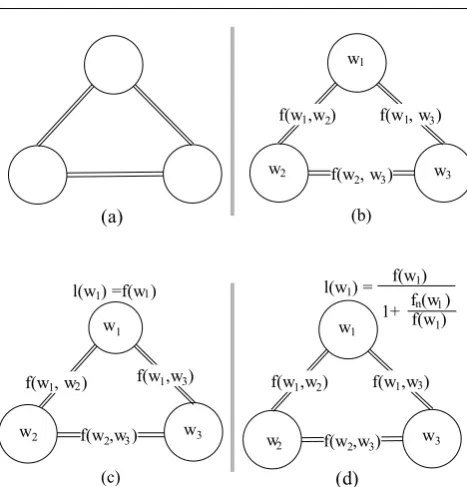
Fig. 2: Word network partitioning algorithms: (a) Cut minimizing (gC), (b) Co-frequency cut minimizing (gFC), (c) Co-frequency cut minimizing, frequency load balancing (gFCL), (d) Co-frequency cut minimizing, normalized
frequency and co-frequency load balancing (gNFCL).
Also note that the same mapping M is used by all the Router & Placer instances. Recall that any Router & Placer can handle any publication or sub-scription. Furthermore, publications and subscriptions are assigned to Receivers uniformly at random. Thus, one can consider each Router & Placer to instance be observing a sampled subset of the publications and sub-scriptions. This motivates using the same mapping for all Router & Placer instances. This requires mapping
M to be replicated to all instances. Since the size of the mapping is limited by the number of words, it is compact enough to fit into the main memory (typically less that 200K words, where only the word id is kept, taking less than 2MBs).
3.2 Word Network Partitioning
The word network partitioning algorithms construct a mapping M by partitioning the set of words W
over the N matchers. The main intuition is to place words that frequently appear together in publications into the same partition, while at the same time bal-ancing the load incurred on each partition. We map this problem to a traditional graph partitioning one, where the words are the vertices and the edges are the co-occurring words. Let us represent this undi-rected graph as G(W, E) and refer to it as the word network. We define the edge set as E = {(w1, w2) |
w1, w2 ∈ W ∧f(w1, w2) > 0}. Here, f(w1, w2) is the
co-occurrence frequency of the wordsw1andw2. Thus, any two words that appear together in at least one
pub-lication is represented as an edge in the word network. We have:
f(w1, w2) =|{P | {w1, w2} ⊆P∧P ∈ P}|/|P|.
The co-occurrence frequencies serve as the edge weights. We also define the frequency of a word asf(w) =|{P |
w ∈ P ∈ P}|/|P|. The word frequencies serve as the vertex weights.
Graph partitioning algorithms are well studied in the literature [22] with well-established implementa-tions, such as Metis [12]. These algorithms aim at min-imizing the edge cut, defined as the total weight of the edges that go across partitions. This matches our goal of co-locating commonly co-occurring words within the same partition. It is easy to see that such a partitioning will reduce the spread, as several words within a pub-lication will be mapped to the same matcher, reducing the size of the multicast. However, we also need to main-tain the load balance. Graph partitioning is able take into account load balance as well. Yet, the load is ex-pressed as vertex or edge weight sums. Unfortunately, it is not possible to express the processing load, as defined in Equation 3, using such a sum. Thus, we investigate several alternative graph partitioning approaches that differ in how load balancing is formulated, all of them being heuristics. We also look at simple partitionings that serve as baselines. Figure 2 gives an overview of these alternatives, which are further detailed below:
Cut minimization (gC), Figure 2(a). This is a base-line partitioning that does not consider load balanc-ing. It aims at minimizing the cut, using an unweighted word network. Thus, any pair of words that appear at least once together would contribute the same amount towards the total cut.
Co-frequency cut minimization (gFC), Fig-ure 2(b). This is another baseline approach that does not perform load balancing. However, it considers the co-occurrence frequencies when minimizing the cut. Thus, words that appear commonly together are ex-pected to be placed within the same partitions as much as possible. Since this baseline does not consider load balance, and since load balance and spread are at odds, we expect gFC to provide a very low (good) spread and a high imbalance.
As a simple scenario, consider a small partition that contains three words that always appear together in publications. In this case, the overall partition load will be three times the correct value. The real load depends on the number of publications routed to the partition, which is lower than the sum of the word frequencies for that partition, due to co-occurrences.
Co-frequency cut minimization, normalized fre-quency and co-frefre-quency load balancing (gN-FCL), Figure 2(d). This partitioning approach im-proves upon gFCL by trying to compensate for the overestimation of the partition load. Since using the word frequency as the vertex load results in overesti-mation, it uses a normalized vertex load for computing the overall partition load. Specifically, it uses the ver-tex load formulationl(w) =1+f f(w)
n(w)/f(w), wherefn(w)
is the sum of co-occurrence frequencies for the wordw. That is, fn(w) = P(w,w0)∈Ef(w, w0). To understand
the logic behind this normalization, let us consider two extreme cases. In one extreme case, a word may always appear by itself in publications. In this case, we have
fn(w) = 0, and thus l(w) = f(w). This is the correct
load contribution to the partition for word w. As an-other extreme, we can consider a similar example from the gFCL discussion, that is k words that always ap-pear together in all publications. In this case, we have
l(w) =f(w)/k, since we have fn(w) = (k−1)·f(w).
The total load of the k words would be f(w), which is again correct. Despite these nice features, there are many scenarios for which the partition load is not ex-act. As a result, this is just a heuristic too, albeit one that is more accurate than gFCL.
Once the word network partitioning is performed, the results are easily converted into a global mapping
M by mapping each word in a partition to the matcher associated with that partition.
3.3 SALB: Spread-Aware Load Balancing
The SALB algorithm aims at explicitly modeling the notion of load, rather than relying on some approxi-mation of it as done by the word network partitioning based approaches. With a more accurate model of load, it better balances it across matchers. However, a good load balance does not necessarily imply a low overall load, since words are not independent and to achieve low average load one needs to locate commonly co-occurring words. This latter can be achieved by trying to minimize spread. Accordingly, SALB tries to min-imize both imbalance and spread. Note that this also matches with our intuition of approximate throughput as expressed in Equation 7.
The SALB algorithm is given in Algorithm 1. It is a greedy algorithm that assigns words to matchers
one-Alg. 1:SALB, Spread-Aware Load Balancing
Data:P, set of publications Data:N, number of matchers
Result:M, word to matcher mapping
M← {} .Initialize the mapping
R←0 .Initialize the spread
∀i∈[1..N], Li←0 .Initialize loads
W ←S
P∈PP .Collect words
.Form the word-to-publication bipartite graph G(W,P, E) s.t.E={(w, P)|w∈W∧P ∈ P ∧w∈P} forw∈W in desc. order off(w)do .For each word
u∗← −∞ .Initialize utility for the best mapping
l∗←0 .Initialize delta load for the best mapping
k←0 .Initialize the best mapping index
fori∈[1..N]do .For each matcher
.Compute the extra loadwbrings to matcheri
l←P
P∈nbrG(w)[@w
0∈P s.t.M(w0) =i]
r←R+l/|P| .Compute spread
L ←S
j∈[1..N]\{i}{Lj} ∪ {Li+l} .Union loads
b←p
var(L)/avg(L) .Compute imbalance
u← −r·b .Compute utility
if u > u∗then .If a better mapping
u∗←u .Update the best utility
l∗←l .Update the delta load
k←i .Update the best mapping
Lk←Lk+l∗ .Update the load of the matcher
R←R+l∗/|P| .Update the spread
M(w)←k .Add the new mapping
returnM .Return the constructed mapping
by-one. It considers words in decreasing order of ap-pearance frequency (f(w) forw∈W). Frequent words are assigned a mapping first, as this provides additional flexibility to balance the load later. For each word, each matcher is considered as a candidate mapping and the one with the highest utility is picked as the one to be added to the mapping. The process continues until all words are assigned a mapping. The utility used for pick-ing the best among all matchers is defined as spread times load imbalance times -1 (making higher values better), where spread and imbalance are computed as if the candidate mapping is already applied.
To compute the spread and load imbalance incre-mentally as words are assigned to matchers, we first build a bipartite graphG(W,P, E), whereW is the set of words and P is the set of publications. There is an edge (w, P) inEif and only if the wordwis contained in the publication P, that is w∈ P. We use nbrG(w)
to denote the set of neighbors of the word win graph
G, i.e., the set of publications that contain the wordw.
Consider a candidate mapping of wordwto matcher
i. In order to compute the new spread and imbalance incrementally, a key quantity we need to compute is the additional load this mapping will introduce on the matcher. This amount is denoted vialin the algorithm. We havel=P
P∈nbrG(w)[@w
0∈P s.t.M(w0) =i]. That
P ∈nbrG(w)) and for each such publicationP, we add
1 to the load if the publication does not contain any other word that is already mapped to matcher i (i.e.,
@w0∈P s.t.M(w0) = i). Given this quantity, we can
incrementally compute the new spread by addingl/|P|
to the existing spread, as l gives the increase in the number of publications that are routed as a result of adding a new mapping.
Recall that we define utility in terms of spread times imbalance. We already discussed how spread is incre-mentally updated. Similarly, we update the load im-balance incrementally. For imim-balance, we use a slightly different formulation than the ratio of maximum load to average load. Using the maximum term in the for-mulation results in a highly insensitive metric during the initial iterations of the algorithm, as mappings to matchers other than the one that changes the maximum load makes a very small impact. Thus, as an imbalance metric, we use coefficient of variance of the matcher loads. Since we have computed the extra load brought by the new mapping, that is l, we can easily come up with the new set of loads on the matchers. This is de-noted as the setLin the algorithm. Then the imbalance is given bypvar(L)/avg(L), which is the standard de-viation of the loads divided by the average load (aka. coefficient of variance). The normalization via the av-erage load is included in the formulation (the denom-inator), since different candidate mappings may result in different total loads.
Complexity. The outer loop of the algorithm iterates
|W|times and the inner loop iterates|N|times. Assum-ing there are k words per publication on average and there are dpublications containing a word on average, the inner loop performsO(d·k+N) operations. TheN
part comes from the computation of the imbalance. In practice, both variance and average can be computed incrementally, yet for brevity we have not shown that in the algorithm. So the inner loop’s body can complete in O(d·k) time. This results in an overall complexity of O(d·k·N · |W|). We know that k is a small con-stant irrespective of dataset size, so we can represent the complexity simply as O(d·N · |W|). The average number of publications a word appears in is bounded by
|P|, so an even simpler time complexity formula can be given byO(N·|P|·|W|), even though this bound will be rather loose. Also note that we can add the log|W|·|W|
term that comes from the sorting, but this is not nec-essary as the other multiplicative terms in front of|W|
are larger than log|W|in practice.
Our experimental results show that SALB algorithm performs favorably in terms of the running time com-pared to graph partitioners on large datasets.
Alg. 2:LASP, Load-Aware Subscription Placement
Data:S, subscription to be placed Data:N, number of matchers Data:M, word to matcher mapping Data:H, subscription word map
Result:k, the matcher where the subscription is placed
u∗← −∞ .Initialize utility for the best placement
k←0 .Initialize the matcher for the best placement
B(P, M) ={i| ∃w∈Ss.t.M(w) =i} .Eligible ones
fori∈B(P, M)do .For each eligible matcher
l←f(|S\H(i)|) .Compute subs. delta load .Union all load lists
L ←S
j∈{1..N}\{i}{f(|H(j)|)} ∪ {f(|S∪H(i)|)}
b←p
var(L)/avg(L) .Compute imbalance
u← −l·b .Compute utility
if u > u∗then .If a better mapping
u∗←u .Update the best utility
k←i .Update the best placement
H(i)←H(i)∪S .Update subscription word map
returnk .The matcher for the best placement
4 Subscription Matching and Placement
The default policy used for placing subscriptions on matchers is to anycast them to one of the eligible match-ers. LetSbe a subscription, which is a set of words. We denote the set of eligible matchers asB(P, M) under a given mappingM and define it asB(P, M) ={i| ∃w∈
S s.t.M(w) =i}. This policy is sub-optimal as it does not attempt to group together similar subscriptions and doing so can significantly reduce the load. However, in order to do such a grouping, we need a better under-standing of the matching process.
4.1 Matching
We perform the matching using a trie data structure. We sort each subscription before it is inserted into the trie, so that its words are in lexicographic order. The trie takes advantage of common prefixes within the sub-scriptions. Each trie node has zero or more child nodes, each associated with a word, and a potentially empty list of subscriptions. For trie nodes that have large num-ber of children, the child nodes are kept in a hash table. We make use of these hash tables for fast search. For instance, the root node has as many children as there are unique start words in sorted subscriptions.
4.2 Load-Aware Subscription Placement
For placing subscriptions we introduce an algorithm called Load-Aware Subscription Placement, LASP for short. The LASP algorithm is executed within the Sub-scription Placement operator as part of the Router & Placer stage instances. Any stage instance can place any subscription. To facilitate this, we keep a repli-cated data structure called thesubscription word map, denoted as H. For each matcher i, the subscription word map contains the set of unique words that appear in subscriptions assigned to that matcher, denoted as
H(i). This structure is potentially updated every time a new subscription is placed. Since the subscription rate is much lower than the publication rate, propagating up-dates regarding the changes on this structure is cheap. Alternatively, this structure can be kept centralized.
The LASP algorithm, given in Algorithm 2, is struc-tured similar to the SALB algorithm’s inner loop. It iterates over all possible placements, each correspond-ing to placcorrespond-ing the subscription on one of the eligible matchers. For each eligible matcher (i ∈ B(P, M)), it computes a utility metric and picks the one with the highest utility as the matcher to place the publication on. The utility is defined as the increase in the sub-scription load of the matcher times the load imbalance times -1 (making higher values better).
Subscription load is proportional to the cost of matching a publication against the set of subscribers placed on the matcher. We make a simplifying assump-tion here: we assume that the matching cost (repre-sented via thef function in the algorithm) is linear in the number of unique words in the trie. This assumption is motivated by the observation that the higher amount of overlap in the subscriptions reduces the size of the trie, which is equal to the number of unique words in it (|H(i)|for matcheri).
0 5K 10K 15K 20K 25K 30K 35K number of unique words 0
1M 2M 3M 4M 5M 6M
n
u
mbe
r
o
f
o
pe
rat
io
n
s
[image:10.595.100.220.589.688.2]y=171*x+344959
Fig. 3: Number of lookup ops.
Figure 3 plots the number of operations performed in our trie implementation as a function of the number of unique words, using the workload setup described in Section 6. We fit a linear line on this graph and employ it as thef function used by the LASB algorithm.
5 Extensions
In this section, we present extensions to the base S3-TM
system to solve two problems commonly encountered in practice, namely: skew in publication workload and unexpected spikes in load.
Skew in word frequencies causes high load imbal-ance and results in limited scalability. The skew be-comes more pronounced when the number of machines increases, as the load brought by a single word on a matcher may exceed the average load per machine. By handling skew via the help of a word splitting mecha-nism that is adaptive to the number of machines used, we reach near-linear scalability.
A micro-blogging service may experience unex-pected load spikes, often due to a sudden mass reaction from the user base. Without any special mechanism, these spikes may result in randomly dropping incoming publications, significantly reducing the match quality. We develop load shedding techniques that aim at min-imizing the impact of load spikes on match quality.
5.1 Skew Handling
When scaling up to large number of nodes, load im-posed by some of the words might exceed the average load of a node. Suchhot words cause skew, since pro-posed algorithms have the limitation that any given word can be assigned to only a single matcher. Our ini-tial experiments showed that SALB scales linearly up to 64 nodes with many of the real-world tweet datasets. After 64 nodes, linear scalability is lost, and after 128 nodes, no additional speedup is achieved.
re-quired during subscription placement. For the second category (both hot and regular words), since the LASP algorithm already selects the least frequent words dur-ing placement, hot words are eliminated already and subscription is anycast to one of the nodes that are responsible for a regular word from the subscription. Finally, for the last category (all hot words), the hot word with the least frequency is selected and the sub-scription is multicast to all nodes that are responsible for a version of the selected hot word. The multicast is needed, because multiple nodes may be handling the different versions of the selected hot word. Luckily, the third category of subscriptions is small in size.
Splitting words into versions is performed during the learning phase. It impacts both the creation of the mapping used for routing, as well as the assignment of subscriptions to machines. When the learning phase is repeated, the mapping is updated and the subscriptions are replaced.
5.2 Load Shedding
Micro-blogging services may experience unexpected spikes in load due to mass reaction from the users to rare and noteworthy world events. In such scenarios, the input publication rate may exceed the maximum throughput that can be handled by the system. This re-quires shedding some load to avoid lengthy delays and eventual random dropping of the publications.
There are two aspects to load shedding in streaming systems [25]: how much load to shed and and what load to shed. The former typically changes as the workload and resource availability varies, and as such, requires an adaptive solution. In what follows, we first describe how we resolve the ‘what’ question, and then we describe the adaptive load shedding technique we use to handle the spikes in load (the ‘how’ question).
5.2.1 What load to shed
The most straightforward way to shed load is to ran-domly drop publications. An alternative and more ef-fective way is to limit the number of matchers they are multicast to. This reduces the spread, and thus load. We perform load shedding by limiting the maximum num-ber of matchers a publication is routed to, saym. If the publication at hand has more than mtarget matchers it ideally should be routed to, then we only route it to themmatchers that have the highest utility metric. We use two such metrics:
• Consensus shedding: Forward to the matchers with the highest number of publication words mapping to them. The main idea is to reduce the number of publi-cation words for which forwarding is not performed, as this may improve the overall match quality.
•Subscription shedding: Forward to the matchers that contain the highest number of subscriptions for the words in the publication. The main idea is to mini-mize the impact of load shedding on the match quality, as the publication is routed to mathcers that are more likely to produce matches.
5.2.2 How much load to shed
The Publication Routing operator keeps a buffer of publications. When a new publication is received, it is enqueued into this buffer. A separate thread pulls publications from this buffer and routes them to the matchers. The overload is detected when the buffer is full. The size of the buffer, sayb, can be adjusted based on the latency requirements of the system.
We perform dynamic load shedding by making use of this buffer. In particular, we extend it with two addi-tional segments, resulting in a total of three segments. The front of the buffer is called theidealsegment, which represents the ideal mode of operation in terms of the buffer fullness. The next segment is called the stable
segment, and the one following it is called theoverload
segment. The idea is that the system will increase the level of load shedding when the buffer fullness is in the overload segment, and reduce the level of load shedding when the buffer is in the ideal segment. No changes will be made when in the stable segment. The goal of the stable segment is to avoid oscillation.
We define lowest shedding level asl= 0, which cor-responds tom=∞. Levell= 1 corresponds tom=k, where k is 7 based on our experimentation (see Sec-tion 6). Each successive level has m decreased by ∆, such as m =k−∆ and m =k−2·∆ for l = 2 and
l = 3, respectively. ∆ could be less than 1, which cor-responds to probabilistic forwarding for the last word selected for forwarding.
Let bi andbs be the sizes of the ideal and the
sta-ble segments. We haveb=bs+bi and we ensure that
the system operates such that the overload segment is avoided via increasing the shedding level. One impor-tant point is that, we need to avoid oscillation in the system. In particular, the system should not jump from the ideal segment into the overload segment as a re-sult of a single level reduction in the shedding level. We achieve this by adjusting the ratio r = bi/bs. Let us represent the load in the system for shedding level
l as L(l). Modeling the system as a queueing one and applying Little’s Law, we say that the queue length is proportional to the input rate times the processing time (roughly inverse of the load level). This gives the following inequality:
This ensures that reducing the load shedding level never takes the buffer fullness from the ideal segment to the overload segment. We have:
r= 1−max
l L(l)/L(l−∆) (9)
We also need to ensure that the system does not move from the overload segment to the ideal segment when the shedding level is increased. That condition is already satisfied by Equation 9. Finally, theLfunction is easily computed experimentally, as we will show in Section 6.5.
It is important to note that we may increase (de-crease) the load shedding level due to being in the over-load (ideal) segment, yet when the next adaptation time comes, we might still be in the same segment. In this situation, we continue to decrease (increase) the load shedding level if and only if the buffer fullness level has not went down (up) since the last adaptation time. Given this, we can set the adaptation period low, con-servatively. In our system, we set the adaptation period to 1 second.
6 Experimental Evaluation
In this section, we evaluate the scalability and per-formance of the S3-TM system, with a particular
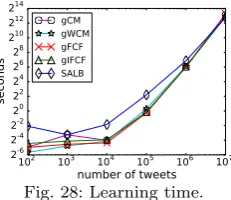
fo-cus on the effectiveness of our publication routing and subscription placement algorithms. The evaluation in-cludes five sets of experiments. The first set of exper-iments studies scalability, presenting performance as a function of the number of nodes. The second set stud-ies subscription-awareness, presenting performance as a function of the number of subscriptions. The third set studies concept drift, that is how the performance of the system is impacted by the temporal changes in the contents of the publications. The fourth set studies the efficacy of the load shedding algorithms. Finally, the last set of experiments study the learning time of alter-native algorithms used for learning the word to matcher mapping. In most of our experiments, we make use of the spread, load imbalance, and throughput metrics. All experiments are performed using 10-fold cross val-idation and error bars showing the standard deviation are included in the plots.
The word network partitioning based algorithms make use of Metis 5.1.0 [12] for graph partitioning. In contrast, the SALB algorithm does not make use of graph partitioning. Mallet [15] implementation of La-tent Dirichlet Allocation (LDA) [3] is used for creating topic-based subscriptions, as we will detail later.
The S3-TM system is implemented in Python. We use CPython 2.7 series for learning the word to matcher mapping and PyPy 2.7 series (which includes a JIT) for runtime subscription matching. All experiments are
Datasets⇒ April-2013 Sparse
# of tweets (sampled) 979,442 979,442
# of words (sampled) 100,310 198,887
total word freq. (sampled) 3,874,826 10,190,479
# of word pairs (sampled) 5,507,437 7,559,671
[image:12.595.298.536.79.281.2]# of tweets (unsampled) 9,791,543 10,467,110
Table 1: Properties of the attributes in the learning corpus.
100 101 102 103 104
frequency
100
101
102
103
104
105
#
of
wo
rd
s April 2013
(a) April 2013
100 101 102 103 104 frequency 100
101
102 103 104
105
106
#
of
wo
rd
s Sparse
(b) Sparse
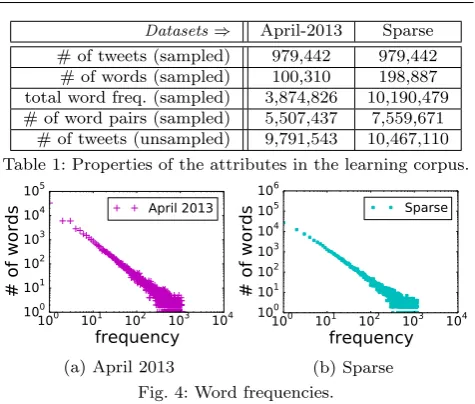
Fig. 4: Word frequencies.
executed on Linux machines with 2 Intel Xeon E5520 2.27GHz CPUs and 48GB of RAM per machine. In the rest of this section, we use the termnode to refer to a core on a machine. Since we go up to 256 nodes and since each machine has 12 cores in total, we use 1 to 24 machines, depending on the experimental setup.
6.1 Experimental Workload
Experiments are performed using two different datasets, details of which are shown in Table 1. Both datasets contain public tweets in the English language, collected using the Twitter Streaming API [27]. These tweets are used for learning the word to matcher map-ping. Before learning, we perform pre-processing, in-cluding cleaning, stemming, and stop word removal. Cleaning involves removing any non- word tokens (num-bers are kept), links starting with the word “http”, words starting with @ (screen names), and punctu-ations. Each word is stemmed using Porter’s algo-rithm [18]. Stop word removal is performed based on a common stop words list taken from the Mallet library. The first dataset consists of tweets we collected in April, 2013. We used random sampling to create a learn-ing corpus of around 1 million tweets. The learnlearn-ing cor-pus contains about 100 thousand unique words after pre-processing. Counting multiple occurrences of those words, there are around 3.8 million word occurrences and those words create 5.5 million pairs.
The second dataset is a publicly available tweet dataset called Sparse [6]. We also sampled this dataset to create a learning corpus of around 1 million tweets. The learning corpus contains about 200 thousand unique words, 10.2 million total word occurrences, and 7.6 million word pairs. Figure 4 shows the word fre-quency distributions of the learning corpus we extracted from the two datasets.
21 22 23 24 25 26 27 28 number of nodes 0.0 0.2 0.4 0.6 0.8 1.0 1.2 1.4 relative throug hput Hashing gC gFC gFCL gNFCL SALB
Fig. 5: Relative throughput, tweet based subscriptions.
21 22 23 24 25 26 27 28 number of nodes
210 211 212 213 214 215 216 throug hput Hashing gC gFC gFCL gNFCL SALB
Fig. 6: Throughput, tweet based subscriptions.
21 22 23 24 25 26 27 28 number of nodes 20 21 22 23 spread Hashing gC gFC gFCL gNFCL SALB
Fig. 7: Spread, tweet based subscriptions.
21 22 23 24 25 26 27 28 number of nodes 2-13
22-11 -9 2-7 2-5 2-3 22-1 1 23 25 27 loa d imbala nce Hashing gC gFC gFCL gNFCL SALB
Fig. 8: Load Imbalance, tweet based subscriptions.
21 22 23 24 25 26 27 28 number of nodes 0.0 0.2 0.4 0.6 0.8 1.0 1.2 relative throug hput Hashing gC gFC gFCL gNFCL SALB
Fig. 9: Relative throughput, topic based subscriptions.
21 22 23 24 25 26 27 28 number of nodes 213 214 215 216 217 218 219 throug hput Hashing gC gFC gFCL gNFCL SALB
Fig. 10: Throughput, topic based subscriptions.
21 22 23 24 25 26 27 28 number of nodes 20 21 spread Hashing gC gFC gFCL gNFCL SALB
Fig. 11: Spread, topic based subscriptions.
21 22 23 24 25 26 27 28 number of nodes 2-7 2-6 2-5 2-4 2-3 2-2
22-1 0 21 22 23 24 25 26 27 loa d imbala nce Hashing gC gFC gFCL gNFCL SALB
Fig. 12: Load Imbalance, topic based subscriptions.
[image:13.595.43.528.72.422.2]0 .125M .25M .5M 1M 2M 4M training data size, 16 nodes 2.5K 3K 3.5K 4K 4.5K 5K 5.5K 6K 6.5K 7K tthr oughpu t SALB 8M
Fig. 13: Throughout vs. the learning corpus size.
of the word to matcher mapping is impacted by the fre-quent words and it is sufficient to capture those words with a sample of size 1 million. However, increasing the learning corpus size unnecessarily significantly increases the learning time (see Section 6.6). To verify the sam-pling claim, we used the Sparse dataset to measure the impact of increasing the learning corpus sample size on the throughput. The results are depicted in Figure 13. We observe that increasing the learning corpus size be-yond 0.5 million brings diminishing returns in terms of throughout. The main intuition behind this is that, only words with a significantly high frequency are im-portant enough to impact the spread and load balance. As such, a sample of 1 million tweets is as good as 10 million for the purpose of learning.
We generated the subscriptions using two alterna-tive methods. The first one is called tweet-based sub-scriptions and the second one is calledtopic-based sub-scriptions. To create tweet-based subscriptions, we pick random tweets from the dataset and register them as subscriptions to the system. To create topic-based sub-scriptions, we model the interests of the users. Specif-ically, we created a topic extractor using LDA [3] im-plementation of the Mallet library. We extracted 100 topics from each dataset. For each topic we selected
5 words related to it. Alpha and Beta parameters of LDA are set to 0.1, which is the Mallet default. Since the length of the subscriptions may show variability, we used a Zipf distribution to decide how many predicates a subscription contains. Each subscription selects one topic, decides its length using a Zipf distribution with a skew parameter of 0.5, and gets that number of words from the topic at random. Shortest publication contains a single word and the longest contains 5 words. Overall, the tweet-based model represents the scenario where we have relatively long subscriptions, with low popularity, whereas the topic-based model represents the scenario where we have relatively short subscriptions, with high popularity.
In the rest of this section we present our experimen-tal results. For brevity, we use the April 2013 dataset for the throughput, spread, and load imbalance exper-iments, as the results from the other dataset are very similar. For the relative throughput experiments, we use the average values computed using both datasets.
6.2 Scalability
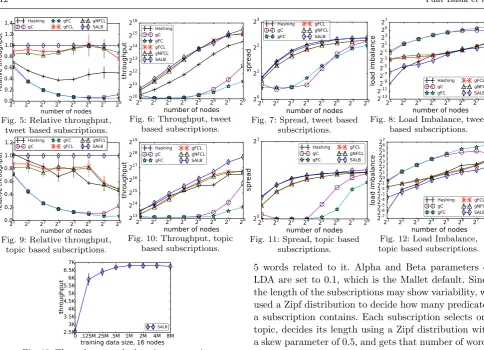
Figures 5 and 9 plot the relative throughput tweet-and topic-based subscriptions, respectively. We observe that SALB performs up to 130% and 150% better than the baseline hash based routing, for tweet- and based subscriptions, respectively. Overall, for topic-based subscriptions the improvement relative to hash-ing is more lasthash-ing as the number of nodes increases.
Our main concern is the throughput of the system and Figure 6 plots it as a function of the number of nodes, which ranges from 2 to 256. We observe that gC and gFC perform more than an order of magni-tude worse than the best approach, so they are not contenders. For the remaining algorithms, we see close to linear scalability up to 128 nodes. After 128 nodes the throughput starts to decrease, except for SALB. We observe that SALB provides the best throughput and scalability, where gFCL and gNFCL are second, with the former being slightly better than the latter, and hash based routing is the last. The results for the topic-based subscriptions, shown in Figure 10, are even more pronounced. In particular, for a 256 node sys-tem, SALB provides 2.56 times better throughput than the baseline hash based routing, and 2.2 times better throughput than the gFCL and gNFCL approaches.
Figure 7 plots the spread of the routed publications using the tweet-based subscription model. Note that the minimal spread value that can be achieved is 1. We ob-serve that as the number of nodes increases, the spread increases as well, but the rate of increase decreases and eventually the line flattens. This is expected, as we know that the spread is bounded by the maximum number of words in a publication. We also observe that the cut-based graph partitioning algorithms that do not care about load balance (gC and gFC) provide the low-est spread. This is because these algorithms place fre-quently co-occurring words to the same matchers. But as we will see soon, the load imbalance of these algo-rithms will result in poor throughput, which is the ul-timate metric we care about. The graph partitioning approaches that consider load (gFCL and gNFCL) pro-vide lower spread than the hashing based routing and SALB algorithms. SALB provides slightly lower spread than hashing, but higher than that of gFCL and gN-FCL. Interestingly, as the number of nodes in the sys-tem increases, the spread converges to the same number for gFCL and gNFCL, yet hashing and SALB converge to a slightly higher spread.
Figure 11 plots the spread for the topic-based sub-scription model. The results are similar, with a few notable differences. First, the spread is much lower in general, not crossing 2. Second, the spread differ-ence between the hashing based routing and SALB is much smaller. Since non-subscribed words are not
for-warded to matcher nodes, we observe that spread of the topic based subscriptions are much lower than the tweet based ones. As we will see shortly, the story is quite different for load imbalance.
Figure 8 plots the load imbalance using the tweet-based subscription model. We observe that gC and gFC approaches suffer a very high load imbalance, and as we will later observe in throughput experiments, this im-balance causes their throughput to be non-competitive. The SALB algorithm provides the best load imbalance among all. The hash based routing has imbalance val-ues that are mostly between those of gFCL/gNFCL and SALB. As the number of nodes in the system in-creases, the imbalance of hashing gets closer to that of gFCL/gNFCL and eventually passes it. This is because for a skewed workload, load balancing becomes increas-ingly difficult with more nodes. We also observe that gNFCL has slightly higher imbalance than gFCL. De-spite considering load balance explicitly, both of these algorithms still fall short in balancing the load and SALB has 6 and 4 times better lower imbalance in an 8 node configuration compared to gNFCL and gFCL, re-spectively. As the number of nodes reach higher values, like 256, the difference between load imbalance values gets smaller, but SALB still performs the best.
Figure 12 plots the load imbalance for the topic-based subscription model. The results are very similar. The load imbalance is higher in general for topic-based subscriptions, but its rate of increase with increasing number of nodes is lower. Also, for topic-based subscrip-tions, gFCL has slightly higher imbalance than gNFCL (reversed from tweet-based subscriptions).
6.3 Subscription Awareness
We look at the spread, load imbalance, and throughput as a function of the number of subscriptions in the sys-tem. We experiment with number of subscriptions that range from 100 to 10 million. The number of nodes is fixed to 16 for this set of experiments. We perform ex-periments with both tweet-based and topic-based sub-scriptions. It is important to note that for tweet-based subscriptions, registering 107 random tweets gets close
to an all-words-subscribed system, which is the worst case scenario for the S3-TM architecture. This is a
highly unlikely scenario in a real-world system, and we use it as a stretch test.
subscrip-102 103 104 105 106 107
number of subscriptions 0.0 0.2 0.4 0.6 0.8 1.0 1.2 relative throug hput Hashing gC gFC gFCL gNFCL SALB
Fig. 14: Relative Throughput, tweet based subscriptions.
102 103 104
105 106 107
number of subscriptions
29 210 211 212 213 214 215 216 throug hput Hashing gC gFC gFCL gNFCL SALB
Fig. 15: Throughput, tweet based subscriptions.
102 103 104
105 106 107 number of subscriptions
20 21 22 23 spread Hashing gC gFC gFCL gNFCL SALB
Fig. 16: Spread, tweet based subscriptions.
102 103 104 105 106 107 number of subscriptions 2-4 2-3 2-2 2-1 20 21 22 23 24 loa d imbala nce Hashing gC gFC gFCL gNFCL SALB
Fig. 17: Load Imbalance, tweet based subscriptions.
102 103 104 105 106 107
number of subscriptions 0.0 0.2 0.4 0.6 0.8 1.0 1.2 relative throug hput Hashing gC gFC gFCL gNFCL SALB
Fig. 18: Relative Throughput, topic based subscriptions.
102 103 104 105 106 107
number of subscriptions
213 214 215 216 217 throug hput Hashing gC gFC gFCL gNFCL SALB
Fig. 19: Throughput, topic based subscriptions.
102 103 104 105 106 107
number of subscriptions
20 21 spread Hashing gC gFC gFCL gNFCL SALB
Fig. 20: Spread, topic based subscriptions.
102 103 104 105 106 107 number of subscriptions 2-1 20 21 22 23 24 loa d imbala nce Hashing gC gFC gFCL gNFCL SALB
Fig. 21: Load Imbalance, topic based subscriptions.
0 5 10 15 20 25
# of weeks from learning
0.1 0.2 0.3 0.4 0.5 0.6 0.7 0.8 0.9 1.0 relati ve throu ghput Hashing gC gFC gFCL gNFCL SALB
Fig. 22: Relative throughput, topic-based subscriptions.
0 5 10 15 20 25
# of weeks from learning
215 216 217 218 219 throu ghput Hashing gC gFC gFCL gNFCL SALB
Fig. 23: Throughput, topic-based subscriptions.
0 5 10 15 20 25 # of weeks from learning 20 21 sprea d Hashing gC gFC gFCL gNFCL SALB
Fig. 24: Spread, topic-based subscriptions.
0 5 10 15 20 25
# of weeks from learning 2-3 2-2 2-1 20 21 22 23 load imba lance Hashing gC gFC gFCL gNFCL SALB
Fig. 25: Load imbalance, topic-based subscriptions.
tions, SALB still outperforms other approaches. As we mentioned earlier, at this point the system converges to an all-words-subscribed system and minimizing spread becomes critically important. As we have seen from most of the experiments so far, SALB is better at min-imizing load imbalance than minmin-imizing spread. That being said, the all-words-subscribed scenario is highly unlikely to be encountered in practice. We also observe that with increasing number of tweet-based subscrip-tions, the performance of the hash based routing de-grades. For topic-based subscriptions, SALB provides 22% and 18% better throughput compared to gNFCL and gFCL, and 42% better throughput compared to hashing, respectively.
Figures 15 and 19 plot the throughput for tweet- and topic-based subscriptions, respectively. For tweet-based subscriptions, there is an almost linear decrease in the throughput until 1 million subscriptions, whereas for topic-based subscriptions, the rate of throughput reduc-tion quickly diminishes after 10 thousand subscripreduc-tions. The latter can be easily explained by the high amount of overlap across the subscriptions for the topic-based model. The former can be explained by the reverse, that is low overlap among the tweet-based
subscrip-tions. This effect shows the importance of the LASP algorithm for grouping together similar subscriptions.
For both subscription models, SALB algorithm out-performs the alternatives. The gap between the SALB algorithm and hashing initially increases as the number of subscriptions increases. Interestingly, for tweet-based subscriptions the gap continues to widen, whereas for topic-based ones it stabilizes. SALB outperforms hash-ing by more than 4.2 times and 1.42 times for and topic-based subscriptions, respectively. For tweet-based subscriptions, SALB is only marginally better than gFCL and gNFCL, whereas for topic-based sub-scriptions the difference is more pronounced.
in-0 1 2 3 4 5 6 7
shedding threshold
0.0 0.2 0.4 0.6 0.8 1.0
Ac
cu
ra
cy consensusShedding
subscriptionShedding randomShedding
10 20 30 40 50 60 70 80 90 100
%
of
Lo
ad
Sh
[image:16.595.42.281.78.193.2]ed
Fig. 26: Accuracy and amount of load shed
200 400 600 800 1K 1.2K1.4K1.6K1.8K2K
time
5K 10K 15K 20K 25K 30K
throu
ghput
tweet/sec shedding level
0 2 4 6 8
shed
ding
level
Fig. 27: Input rate and shedding level
creases with increasing number of subscriptions, but with a decreasing rate that diminishes quickly. The load imbalance increases with increasing number of subscrip-tions, but again with a decreasing rate that diminishes eventually. SALB keeps its load imbalance advantage across the range, having up to 3.3× lower imbalance than the hashing approach for the tweet-based subscrip-tions and 1.7×times lower for the topic-based ones.
6.4 Concept Drift
Figures 22, 23, 25, and 24 plot relative throughput, throughput, load imbalance, and spread as a function of time. Time corresponds to the number of weeks passed since the learning was performed using the word to matcher mapping. We use the tweets from week 0 to build the word to matcher mapping, and use it for evaluating the performance for the following weeks. We report average metrics for 5 week intervals to reduce noise. For this set of experiments 100K topic-based sub-scriptions were used. To be able to track the concept drift of subscriptions as well, for each week we extracted new topics and created a new subscription set.
We observe that the throughput is markedly higher for week 0. This is expected, as the model is specif-ically built for the that week, and certain amount of overfitting exists. The throughput decreases by a factor of 2 after the first week and Figures 24 and 25 show that this is due to both the increase in the spread as well as the load imbalance. However, the increase in load imbalance is sharper for all contender approaches. Even though the increase in imbalance is most steep for SALB, it still has better imbalance compared to all oth-ers, and we observe from Figures 23 and 22 that it main-tains the throughput advantage over other approaches across the entire time range. Importantly, while there is an initial decrease in throughput after week 0, there is no decreasing trend afterwords. This can be explained by the nature of the spoken languages. Irrespective of the current topics of interest, there is a common struc-ture of the spoken language that makes certain words appear together and learning that structure is sufficient to achieve better scalability and throughput.
6.5 Load Shedding
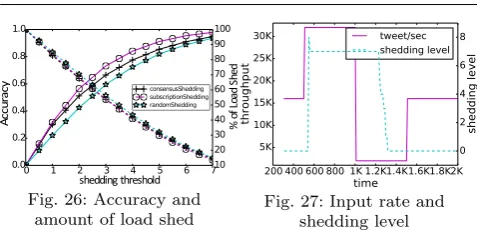
Figure 26 plots the accuracy of matching (on the left
y-axis using solid lines) as well as the percentage of load shed (on the righty-axis using dashed lines), as a function of the load shedding threshold (the maximum number of matcher instances a publication is forwarded to). Accuracy is defined as the fraction of the correct matches produced by the system. Note that perform-ing load sheddperform-ing cannot result in superfluous matches, but only missing matches. As we decrease the shedding threshold, the accuracy initially decreases by a small amount. But as the shedding threshold gets smaller, the rate of decrease in the quality increases. In general, the shape of the quality curve is friendly to load shed-ding. However, the curve for the percent of load shed is not as friendly. This is because the amount of load shed is low for large thresholds and the rate of increase is initially slow when the threshold is high and increases later as the threshold gets smaller. Still, the load shed-ding is effective. For instance, it is possible to shed close to 25% of the load, while still maintaining 90% accu-racy. Among the two load shedding approaches we have proposed, that is subscription shedding and consensus shedding, the former is more effective, as it can provide higher accuracy for the same amount of load shed.
Figure 27 plots the input throughput (tweets/sec, on the left y-axis using solid lines) as well as the load shedding levels (on the right y-axis using dashed lines), as a function of time. Increased load shedding level im-plies a lower shedding threshold. Note that, this exper-iment does not start from time 0, since we wait for the buffer that holds the publications to stabilize. Also, in this experiment, we display the throughput and load shedding values for a single Router & Placer machine. Starting with 16K publications per second input rate, at time 500 we increase the input throughput to 32K, and at time 1000 we decrease it down to 2K. After time 1500, we again go back to 16K publications per second. Using this setup, we show how the shedding level adapts to the changes in the input throughput.