Original citation:
Banegas, Dario Luis. (2016) Teachers develop CLIL materials in Argentina: a workshop experience. Latin American Journal of Content and Language Integrated Learning, 9 (1). pp. 17-36.
Permanent WRAP URL:
http://wrap.warwick.ac.uk/80223
Copyright and reuse:
The Warwick Research Archive Portal (WRAP) makes this work of researchers of the University of Warwick available open access under the following conditions.
This article is made available under the Creative Commons Attribution 3.0 (CC BY 3.0) license and may be reused according to the conditions of the license. For more details see:
http://creativecommons.org/licenses/by/3.0/
A note on versions:
The version presented in WRAP is the published version, or, version of record, and may be cited as it appears here.
Received: 2015-05-08 / Sent for peer review: 2015-06-04 / Accepted by peers: 2015-09-11 / Approved: 2015-09-20
To reference this article in APA style / Para citar este artículo en APA / Para citar este artigo
Banegas, D. (2016). Teachers develop CLIL materials in Argentina: A workshop experience. LACLIL, 9(1), 17-36. doi:10.5294/laclil.2016.9.1.2
* Warwick University, Coventry, UK & Ministerio de Educación del Chubut, Argentina. Corresponding author: [email protected]
A Workshop Experience
Darío Luis Banegas*
Abstract
Content and language integrated learning (CLIL) is a Europe-born approach. Ne-vertheless, CLIL as a language learning approach has been implemented in Latin America in different ways and models: content-driven models and language-dri-ven models. As regards the latter, new school curricula demand that CLIL be used in secondary education in Argentina and that teacher pedagogies and materials match the L1 curriculum and overall context. Therefore, teachers initially educa-ted in other paradigms need professional development opportunities to unders-tand CLIL as an innovative language teaching approach. The aim of this article is to reflect on CLIL materials produced by a group of Argentinian teachers as part of a professional development workshop. In this article, I shall first conceptuali-ze CLIL and review the literature around CLIL materials. Then, I describe the work-shop and offer content analysis of participants’ lesson plans. I shall conclude with emergent working principles based on these participants’ practices and sugges-tions for further research.
Los docentes desarrollan materiales de aICLe en argentina:
una experiencia-taller
Resumen
El AICLE es un enfoque que nació en Europa; sin embargo, el AICLE como enfoque para el aprendizaje de lenguas ha sido implementado en Latinoamérica a través de diferentes maneras y modelos: modelos enfocados en contenidos y modelos enfocados en la lengua. En referencia a estos últimos, los nuevos diseños curri-culares argentinos esperan que el CLIL sea empleado en la educación secunda-ria y que las pedagogías docentes y matesecunda-riales reflejen el contenido curricular y el contexto total. En consecuencia, los docentes entrenados en otros paradigmas necesitan oportunidades de desarrollo profesional que les permitan entender el AICLE como un enfoque innovador para la enseñanza de la lengua. El objetivo de este artículo es reflexionar sobre los materiales para el AICLE desarrollados por un grupo de docentes argentinos como parte de un taller de desarrollo profesio-nal. En este texto se conceptualiza sobre el AICLE y se revisa la literatura corres-pondiente. También, se describe el taller en cuestión y se ofrece un análisis de las secuencias y los materiales de los docentes participantes; finalmente, se conclu-ye con los principios de trabajo emergentes de los trabajos de los participantes y son sugeridas rutas para investigaciones futuras.
Desenvolvimento de materiais de aprendizagem
Integrada de Conteúdos e de Língua na argentina:
experiência de uma oficina
Resumo
A Aprendizagem Integrada de Conteúdos e de Língua (AICL) é uma abordagem que nasceu na Europa e, na América Latina, tem sido implantada de diferentes maneiras e modelos: modelos enfocados em conteúdos e modelos enfocados na língua. A respeito deste último, os novos desenhos curriculares argentinos espe-ram que a AICL seja empregada no ensino médio e que as pedagogias docentes e materiais reflitam o conteúdo curricular e o contexto total. Em consequência, os docentes capacitados em outros paradigmas precisam de oportunidades de des-envolvimento profissional que lhes permitam entender a AICL como uma aborda-gem inovadora para o ensino de língua. O objetivo deste artigo é refletir sobre os materiais para a AICL desenvolvidos por um grupo de docentes argentinos como parte de uma oficina de desenvolvimento profissional. Neste artigo, conceitua-se a AICL e revisa-se a literatura correspondente. Além disso, descreve-se a oficina em questão e oferece-se uma análise das sequências e dos materiais dos docentes par-ticipantes. Finalmente, conclui-se com os princípios de trabalho emergentes dos tra-balhos dos participantes e sugerem-se caminhos para pesquisas futuras.
InTRoDuCTIon
Materials development in foreign language teaching is an area richly ex-amined in the literature from perspectives such as design, implementation, ideologies, and contexts of production and circulation (see Garton & Graves, 2014; Gray, 2013; McGrath, 2013; Tomlinson, 2013). In Latin America, reports on materials development are also frequent in different fora (see Bane-gas, 2013a; Barboni & Simón, 2013; López Barrios et al., 2008; Moirano, 2012). This article reflects on the CLIL (content and language integrated learning) materials produced by a group of Argentinian teachers as part of a professional development workshop. I first provide an abbreviated state-of-the-art view of CLIL. Secondly, I offer a brief account of CLIL materials with an emphasis on teachers’ involvement. Third, I describe a workshop I delivered at the Universidad Nacional de La Pampa (Santa Rosa, Argen-tina) as part of a programme aimed at in-service teacher development in response to new curricular guidelines in the province of La Pampa, Argen-tina (Braun, Cabral & Cheme Arriaga, 2013). Lastly, I analyse samples of ma-terials produced by some of the teachers who attended this workshop.
DEfInIng CLIL
CLIL first appeared in the early 1990s as a ‘pragmatic European solution to a European need’ (Marsh, 2002, p. 11); that is, pluringualism for market, academic, and social mobility. However, CLIL is not only circumscribed to Europe (see Pérez Cañado, 2011; Ruiz de Zarobe and Cenoz, 2015) since it is also found in Africa (see Gustaffson, 2011), Asia (e.g Lin, 2015; Robertson & Adamson, 2013) and Latin America (see Banegas, 2013b; Mariño Avila, 2014).
anoth-er language. Convanoth-ersely, in Latin Amanoth-erica, CLIL is sometimes introduced in the English language classroom by dealing with curricular contents. While the former type of implementation is usually in the hands of a non-foreign language teacher, the latter is delivered by the foreign language teacher (for CLIL in primary education, see Braun & Cheme Arriaga, 2011).
Due to this multiplicity of interpretations, CLIL is also referred to as an ‘umbrella term’, but this conceptualisation has generated controversies as researchers highlight the lack of conceptual clarity (Cenoz et al., 2013). Consequently, there have been attempts to distinguish CLIL from its coun-terpart in Canada and the USA, CBI (content-based instruction), and from immersion education (Cenoz et al., 2013). However, similarities between CBI and CLIL, and the fuzzy line between CLIL and immersion, have been late-ly discussed (Banegas, 2012; Cenoz, 2015; Cenoz et al., 2013; Somers & Sur-mont, 2012). More recently, some authors have stressed the content side of CLIL (see Llinares et al., 2012), but there is wide recognition that although the research reports on language gains realized through CLIL, little has been said about content learning. With regard to languages, Dalton-Puffer (2011) signals that no matter the focus, English is the dominant language in CLIL implementation—with a few exceptions, such as Basque or Spanish. Cenoz (2013a, 2013b) makes the case that CLIL definitions and inter-national implementations are an invitation to examine whether CLIL is taken as a foreign language approach or a broader educational approach. In addition, the more CLIL is defined, the more it may be isolated from re-lated approaches that also aim at multilingualism. Therefore, integration as opposed to isolation is suggested in order to benefit from research that originates from similar traditions.
CLIL MATERIALs
CLIL pedagogies, models, and materials rest on sociocultural pillars. Con-cepts such as scaffolding, zone of proximal development, and mediation signal that CLIL stresses the need to construct knowledge socially through tools that help learners develop their language competence and non-lan-guage content knowledge. In addition, CLIL is also supported by cognitivist views, as CLIL lessons and materials are expected to evolve from
lower-or-der thinking skills, such as describing, to higher-order thinking skills, such
as evaluating (see Banegas, 2012).
One of the challenges—but, at the same time, opportunities—of CLIL is the limited number of context-responsive materials available. The lit-erature, however, does offer lists of criteria to follow in order to increase resources for teachers. For example, Mehisto (2012) has produced a list of ten criteria:
1. Make the learning intentions (language, content, learning skills) and
process visible to students.
2. Systematically foster academic language proficiency.
3. Foster learning skills development and learner autonomy.
4. Include self, peer and other types of formative assessment.
5. Help create a safe learning environment.
6. Foster cooperative learning.
7. Seek ways of incorporating authentic language and authentic
lan-guage use.
8. Foster critical thinking.
9. Foster cognitive fluency through scaffolding of a) content, b)
lan-guage, c) learning skills development helping student to reach well beyond what they could do on their own.
10. Help make learning meaningful.
Morton (2013) discusses CLIL materials based on a group of Europe-an teachers’ practices Europe-and perspectives. In his contribution, he defines CLIL materials as:
Any L2 texts used for the teaching of non-language subject matter, presented to the students in paper-based and/or di-gital form, and the tasks and activities built around them. (2013, p. 115).
Morton’s definition stresses the content component of CLIL but also recognises that materials involve sources of input either in physical or digital format and activities based on these. He moves on to suggest that teachers who cannot use commercial materials for different reasons can produce their own materials (sources and activities), use authentic mate-rials without any modifications, or adapt authentic matemate-rials to respond to their settings. Adaptation does not only mean simplification; it also in-cludes elaboration and discursification (Moore & Lorenzo, 2007).
According to Morton (2013), a key question is how to ensure that materials provide opportunities for both language learning and content learning. He proposes a set of can-do statements, emphasizing that CLIL materials:
l can avoid underestimating learners linguistically and
cognitively, by, for example, not treating linguistically low level learners as cognitively low level learners;
l include listening and reading activities that are not used to
teach language features but are content meaning focused;
l can avoid the use of bland, safe and harmonious texts by
engaging students affectively and intellectually with sti-mulating texts relating to aspects of content;
l can involve learners in activities in which they cognitively
Through a survey that Morton administered to 52 CLIL teachers, he found that they tended not to use materials (e.g. textbooks) designed for native speakers, as they were aware of the mismatch between the mate-rials’ underlying curriculum and teachers’ curriculum. Nearly 50% of the teachers reported adapting authentic non-textbook materials and 90% answered that they produced their own materials from scratch. Reasons for such practices included appropriateness of language and content for learners, appropriateness for educational and cultural context, flexibility, design and pedagogic approach, and availability and convenience.
Based on a collaborative experience of teacher–developed CLIL ma-terials, Banegas (2013c) considers that one of the advantages of teach-ers adapting or devising CLIL materials is that coherence may be easily achieved, as it derives from possible areas of content such as academ-ic subjects or learner-contributed content. Furthermore, flexibility may be sought through the negotiation of these contents and the freedom to start with any given unit of work. However, due to the nature of this flexi-ble approach, principles such as sequencing and evolving complexity may be affected, as the sequence of contents could be arbitrary. In relation to this, I believe that teachers can reduce this tension if they think of devel-oping materials as building blocks that, when assembled, fulfil the overall aims of a given course. Differently put, each block, with its specific set of subject-related contents, would follow the principles listed above. Teach-ers might start with any given block, since any of them, whatever the se-quence, would contribute to the main aims established.
METhoD
In the first part of the workshop, the participants watched a video (UTV Motion Pictures, 2012) and were asked to discuss how such a resource could be used to integrate language and content learning. Based on their contributions, I introduced definitions of CLIL, followed by its theoretical underpinnings (for a recent summary, see Ruiz de Zarobe & Cenoz, 2015). Based on recent CLIL literature (Coyle et al., 2010; Mehisto et al., 2008), such underpinnings included sociocultural theory, Bloom’s revised taxonomy of thinking skills, Cummins’ BICS and CALP, autonomy, authenticity and mo-tivation, and different CLIL models placed along a CLIL continuum.
In the second part of the workshop, we discussed and explored dif-ferent working frameworks for developing CLIL lessons. In this regard, we agreed that our lessons should move from familiar language and familiar content to new content and new language. We also agreed that our
ac-tivities should consider the language triptych (Coyle et al., 2010, p. 36) to
ensure that learners had opportunities to explore the language of/for/ through learning in a lesson. In relation to activities, we discussed the value of graphic organisers and the use of L1 (Spanish, in this context) as another scaffolding tool (Lin, 2015). Finally, in groups, the participants drafted a lesson plan together with activities and materials. This lesson plan was to be assessed in order to pass each workshop of this in-service teacher development programme.
I based the lesson plan analysis on content analysis (Mayring, 2000). My content analysis specifically centred on the materials found in 32 lesson plans: sources of input and activities in relation to the top-ics selected. Categorisation was based on the concepts introduced in the workshop. Nonetheless, there was room for the inclusion of emergent cat-egories from the data under analysis.
REsuLTs
Teacher-developed materials: topics and sources
In relation to content and language learning, Table 1 condenses teach-ers’ choices.
Table 1. Teachers’ selected content and language items
Content learning
Government. Road safety and rules. Museums. Temperatures. US independence. Abraham Lincoln. Discrimination and slavery. Inventions. Teenage health. Natural disasters. Rainforests. Chil-dren’s rights. WWII. French Revolution. Marijuana.
Language learning
Regular and irregular verbs. Simple past and past continu-ous. Present simple. Passive voice. Discourse markers. Modal verbs. Describing and narrating. Giving opinions. Subject-spe-cific vocabulary.
Readers will notice that content items correspond broadly to con-tent subjects such as history, biology, geography, and citizenship. Such subjects and topics are present in the official curricula in Argentina. This shows that teachers can make use of a wide variety of curriculum-relat-ed contents that they can accommodate to meet the motivations, necurriculum-relat-eds, and possibilities in their contexts.
In relation to language, the selected language items attest to three main areas of interest or concern: 1) grammar (e.g. passive voice) and tex-tual grammar (e.g. discourse markers), 2) functions (e.g. describing and narrating), and 3) lexis.
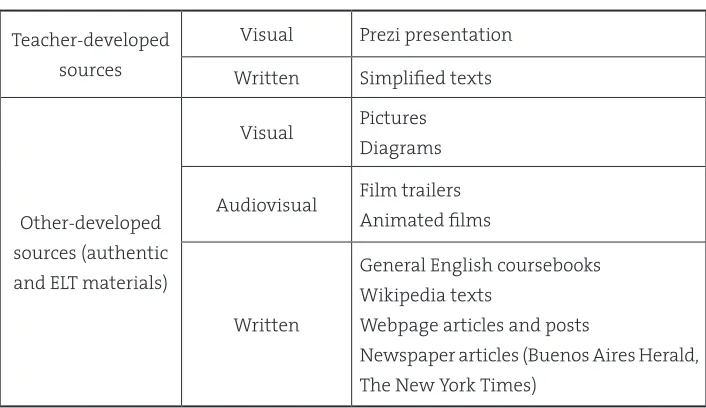
In terms of the sources of input chosen, I categorised these accord-ing to agency: 1) sources developed or modified by teachers, and 2) sources used as found regardless of their level of authenticity. Table 2 summarises the sources of input that teachers selected.
under focus. This seems to contradict the findings from Morton’s (2013) survey. One plausible reason for such a difference may be due to the fact that CLIL was envisaged as language-driven, rather than content-driven, as in Morton’s study.
Teacher-developed materials: activities
With regard to activities, teachers did not depart from the typical kinds of activities featured in ELT course-books. In some cases, they used sourc-es and activitisourc-es found in course-books. However, they did include the use of pictures for labelling and graphic organisers for summarising or com-paring and contrasting information. In many lesson plans, learners were asked to complete charts, tables, and timelines.
At the level of skills development, teachers attempted to offer bal-anced lesson plans even when their main sources of input signalled a preference for written skills. For example, written skills were encouraged through activities such as “read and complete”, “read and label a picture”, or “write sentences based on cues”. On the other hand, oral skills were rep-resented through activities such as “listen and tick the information you hear”, “watch and answer”, “survey: ask your peers …”, and “present survey results aided by a PowerPoint presentation”.
Teacher-developed sources
Visual Prezi presentation
Written Simplified texts
Other-developed sources (authentic and ELT materials)
Visual PicturesDiagrams
Audiovisual Film trailers
Animated films
Written
General English coursebooks Wikipedia texts
Webpage articles and posts
[image:12.482.72.425.85.289.2]Newspaper articles (Buenos Aires Herald, The New York Times)
Some of the teachers included their own developed activities based on different sources of input. In the subsequent Samples (1-5), I offer ex-amples and brief analyses of such activities.
sample 1
RAINFORESTS TYPES
LAYERS ANIMALS
As the final task of the class I will ask my students to summarize in a graph-ic organizer the characteristgraph-ics of rainforests. They will find the information in the texts we’ve worked with so far.
In Sample 1, the teacher had previously provided learners with texts taken from a general ELT course-book. However, the activity to be devel-oped aimed at presenting an integrated view of the content addressed. To this effect, the activity also made use of a graphic organiser. Learners were able to focus on content without the pressure of elaborating com-plex stretches of discourse. Elsewhere, the teacher clarified that the task could be completed in pairs, thus encouraging collaborative learning for the development of writing and summarising skills.
sample 2
DRAMA (last activity of a lesson on children’s rights)
Sample 2 shows an activity designed by two teachers based on cards they developed themselves. The activity sought to encourage speaking skills together with identifying and remembering children’s rights, pro-moting interaction and negotiation through roleplaying.
sample 3
5. Read the text following the link and decide if the statements are True or False.
http://www.buenosairesherald.com/article/127803/la-plata-remains-under-water-as-death-toll-climbs-to-48
a) The heavy rains started on Tuesday night. ___
b) President CFK was born in the city of Buenos Aires. ___ c) She met Governor Scioli to find a solution to the problems. ___ d) More than 100 people died because of the floods. ___
e) Some people got trapped in their cars. ___
6. This is what a resident told the journalist in the street. Complete the di-alogue using past simple or past continuous.
J: Here’s Mario, a neighbour from La Plata who´s lost everything he had. What were you doing when the heavy rain started?
R: Well, I ………...… (watch) TV when it all …………...…………...…. (start), I ………. (can) believe it!
J: And what time ………. the rainpour ……….. (begin)?
R: I´m not certain about it. I think it ……….. (begin) late in the afternoon. [the dialogue continues].
sample 4
3. You are going to watch a video about Magellan’s voyage round the world. http://www.youtube.com/watch?v=0SVJKXCLooE Match the dates with the name of the places Magellan and his men reached during his voyage.
1) September 20, 1519 left Spain
2) November 27, 1519 ____ crossed the Equator
3) December 6, 1519 ____ Got to Cape Verde
4) January 10,1520 ____ Reached Guam and Marianas
5) March 30, 1520 ____ Reached Spice Island
6) October 21, 1520 ____ Arrived in Cape Virgenes
7) November 1, 1520 ____ Got to Rio de la Plata
8) November 28, 1520 ____ Entered the South Pacific
9) March 6, 1521 ____ Navigated the Straits of Magellan
10) March 16, 1521 ____ Reached The Philippines
11) June 21, 1521 ____ Reached Brunei
12) November 16, 1521 ____ Arrived at Puerto San Julian
13) May 6 1522 ____ Arrived in Cape of Good Hope
14) July 9, 1522 ____ Reached Rio de Janeiro
15) September 6, 1522 Arrived in Spain
Overall, the five Samples above illustrate ways that teachers can de-velop their own materials in order to respond to both aspects of CLIL: con-tent and language. In so doing, teachers need to ensure that the activities and overall lessons match their learners’ language development needs and scaffold further language and cognitive development.
Furthermore, these activities, as recommended by Mehisto (2012), promote:
sample 5
I will ask the students if they know when the gauchos’ lifestyle is celebrated in our country. Then, I will give the students a description of the Tradition Day cut into pieces so the students will have to put them in the correct order. I will also explain that the all the paragraphs refer to the description of the Tradi-tion Day celebrated on November 10th. I will ask students to read the differ-ent sdiffer-entences and I will make sure they understand the new vocabulary (e.g. parades, horseman). After that, students (in pairs) will put the ideas in order taking into account the concepts of coherence and cohesion.
1. The Tradition Day (Día de la Tradición) is celebrated, in my country (Argen-tina), on November 10th in commemoration of the poet José Hernandez’s birth date, who wrote Martin Fierro, a traditional gaucho song (payada). 2. People, from different towns along Argentina, usually participate in big
gaucho parades, parties (known as peñas), concerts where they listen to some folk music and dance. They also celebrate with several acts, such as asados, tamings, different races, among others.
3. On the November 10th people dress in their best gaucho clothes and go to the peñas. They dance, eat typical Argentine meals like locro or empana-das and have fun. In the evening there is a criollo horsemanship show and a rodeo. They listen to many singers (payadores) reciting and /or singing along the streets. People also stand and watch the parades or they join a fogón where musicians tune their guitars until well after midnight. 4. The Tradition Day is a wonderful national holiday. Everyone has fun and
• Cooperative learning.
• Skills development.
• Holistic learning.
Through these features, a socioconstructivist approach emerges, and varied scaffolding tools are incorporated in the process of CLIL materials development. When teachers develop language-driven CLIL materials, the following working principles appear:
• Inclusion of multimodal sources.
• Text simplification.
• Text enhancement through the inclusion of visual support.
• Knowledge structuring through graphic organisers.
• Promotion of cooperative learning strategies.
• Focus on lower-order thinking skills.
DIsCussIon
Although this experience is limited in terms of its time frame and the number of participants, it may serve as an exploration of how teachers enact and actualise CLIL through context-responsive materials develop-ment. In some educational systems, CLIL has been implemented as a for-eign-language teaching approach (Cenoz, 2013a) through top-down official curricula. This has led to the development of in-service professional de-velopment opportunities that provide practicing teachers with CLIL ra-tionale and practices.
opportunities and teachers’ understanding and practices with consider-ation of specific classes, learner characteristics, and curricular demands in contexts outside Europe.
REfEREnCEs
Banegas, D. L. (2012). Integrating content and language in English language teaching in secondary education: Models, benefits, and challenges.
Studies in Second Language Learning and Teaching, 2(1), 111–136. Banegas, D. L. (2013a). Teacher, what page today? A look at materials
development. In A. Leceta & R. I. Cúneo (Eds.), V Jornadas en
actualización de la enseñanza del inglés (pp. 6–13). San Juan, Puerto Rico: Universidad Nacional de San Juan.
Banegas, D. L. (2013b). The integration of content and language as a driving
force in the EFL lesson. In E. Ushioda (Ed.), International perspectives
on motivation: Language learning and professional challenges (pp.
82–97). Basingstoke, UK: Palgrave Macmillan.
Banegas, D. L. (2013c). Teacher developing language-driven CLIL through
collaborative action research in Argentina (Unpublished doctoral dissertation). University of Warwick, Coventry, UK.
Barboni, S. & Simón, L. (2013). Designing intercultural and bilingual e-material for primary and secondary schools. In L. Renart & D.
L. Banegas (Eds.), Roots & routes in language education:
Bi-multi-plurilingualism, interculturality and identity. Selected papers from
the 38th FAAPI Conference (pp. 56–72). Buenos Aires, Argentina:
APIBA.
Braun, E., Cabral, V. & Cheme Arriaga, R. (2013). Materiales curriculares. Lengua extranjera: Inglés. Ciclo orientado de la educación secundaria. Santa Rosa, Argentina: Ministerio de Cultura y Educación, Gobierno de La Pampa.
Braun E. N. & Cheme Arriaga, R. (2011). Content and language integrated learning (CLIL): Implementation at primary school level. In E. N.
Braun (Ed.), Hacia una didáctica del Inglés para niños en escuelas
Cenoz, J. (2013a). Discussion: Towards an educational perspective in CLIL
language policy and pedagogical practice. International Journal
of Bilingual Education and Bilingualism,16(3), 389–394.
Cenoz, J. (2013b, June). Integration vs. isolation: Towards a multilingual
approach in CLIL. Plenary talk presented at the ALP-CLIL Conference, 5–8 June, 2013, Madrid, Spain.
Cenoz, J. (2015). Content-based instruction and content and language
integrated learning: The same or different? Language, Culture and
Curriculum, 28(1), 8–24.
Cenoz, J., Genesee, F., & Gorter, D. (2014). Critical analysis of CLIL: Taking stock
and looking forward. Applied Linguistics, 35(3), 243–262.
Coyle, D., Hood, P. & Marsh, D. (2010). Content and language integrated
learning. Cambridge, UK: Cambridge University Press.
Dalton-Puffer, C. (2011). Content-and-language integrated learning: From
practice to principle? Annual Review of Applied Linguistics,31(1),
182–204.
Denman, J., Tanner, R., & de Graaff, R. (2013). CLIL in junior vocational secondary education: Challenges and opportunities for teaching
and learning. International Journal of Bilingual Education and
Bilingualism, 16(3), 285–300.
Garton, S., & Graves, K. (Eds.). (2014). International perspectives on materials
in ELT. Basingstoke, UK: Palgrave Macmillan.
Gray, J. (Ed.). (2013). Critical perspectives on language teaching materials.
Basingstoke, UK: Palgrave Macmillan.
Gustafsson, M. (Ed.). (2011). Collaborating for content and language
integrated learning. Across the Disciplines, 8(3 [Special Issue]).
Retrieved from http://wac.colostate.edu/atd/clil/index.cfm
Ioannou Georgiou, S. (2012). Reviewing the puzzle of CLIL. ELT Journal,66(4),
495–504.
Lin, A. M. Y. (2015). Conceptualising the potential role of L1 in CLIL. Language,
Culture and Curriculum, 28(1), 74–89.
Llinares, A., Morton, T. & Whittaker, R. (2012). The roles of language in CLIL.
López Barrios, M., Villanueva de Debat, E. & Tavella, G. (2008). Materials in use in Argentina and the southern cone. In B. Tomlinson (Ed.),
English language learning materials (pp. 300–316). London, UK:
Continuum.
Mariño Avila, C. M. (2014). Towards implementing CLIL (Content and Language Integrated Learning) at CBS (Tunja, Colombia).
Colombian Applied Linguistics Journal, 16(2), 151–160.
Marsh, D. (2002). CLIL/EMILE - The European dimension: Actions, trends
and foresight potential. Jyväskylä, Finland: UniCOM, Continuing
Education Centre, University of Jyväskylä.
Mayring, P. (2000). Qualitative content analysis. Forum Qualitative
Sozialforschung/Forum: Qualitative Social Research, 1(2). Retrieved from http://nbn-resolving.de/urn:nbn:de:0114-fqs0002204
McGrath, I. (2013). Teaching materials and the roles of EFL/ESL teachers:
Theory and practice. London, UK: Bloomsbury.
Mehisto, P. (2012). Criteria for producing CLIL learning material. Encuentro,
21, 15-33.
Moirano, M. C. (2012). Teaching the students and not the book: Addressing
the problem of culture teaching in EFL in Argentina. GIST Education
and Learning Research Journal, 6, 71–96.
Moore, P. & Lorenzo, F. (2007). Adapting authentic materials for CLIL
classrooms: An empirical study. Vienna English Working Papers,
16(3), 28–35.
Morton, T. (2013). Critically evaluating materials for CLIL: Practitioners’
practices and perspectives. In J. Gray (Ed.), Critical perspectives
on language teaching materials (pp. 111–136). Basingstoke, UK:
Palgrave Macmillan.
Pérez-Cañado, M. L. (2012). CLIL research in Europe: Past, present, and future.
International Journal of Bilingual Education and Bilingualism, 15(3), 315–341.
Robertson, P. & Adamson, J. (Eds.). (2013). CLIL in Asian contexts: Emerging
trends. Asian EFL Journal,15(4).
Ruiz de Zarobe, Y. (2013). CLIL implementation: From policy-makers to
individual initiatives. International Journal of Bilingual Education
Ruiz de Zarobe, Y. & Cenoz, J. (2015). Way forward in the twenty-first century in
content-based instruction: Moving towards integration, Language,
Culture and Curriculum,28(1), 90–96.
Somers, T. & Surmont, J.(2012). CLIL and immersion: How clear-cut are they?
ELT Journal,66(1), 113–116.
Tomlinson, B. (Ed.). (2013). Developing materials for language teaching
(2nd ed.). London, UK: Bloomsbury.
UTV Motion Pictures (2012, October 28). Kurbaan - Classroom Debate Scene
- Vivek Oberoi | Saif Ali Khan [Video file]. YouTube. Retrieved from