Original citation:
Guerry, Paul, Brown, Steven P. and Smith, Mark E.. (2016) Improving the sensitivity of J
coupling measurements in solids with application to disordered materials. AIP Advances, 6
(5). 055008.
Permanent WRAP URL:
http://wrap.warwick.ac.uk/80003
Copyright and reuse:
The Warwick Research Archive Portal (WRAP) makes this work of researchers of the
University of Warwick available open access under the following conditions.
This article is made available under the Creative Commons Attribution 4.0 International
license (CC BY 4.0) and may be reused according to the conditions of the license. For more
details see:
http://creativecommons.org/licenses/by/4.0/
A note on versions:
The version presented in WRAP is the published version, or, version of record, and may be
cited as it appears here.
Improving the sensitivity of J coupling measurements in solids with application to
disordered materials
Paul Guerry, Steven P. Brown, and Mark E. Smith
Citation: AIP Advances 6, 055008 (2016); doi: 10.1063/1.4948965 View online: http://dx.doi.org/10.1063/1.4948965
View Table of Contents: http://scitation.aip.org/content/aip/journal/adva/6/5?ver=pdfcov
Published by the AIP Publishing
Articles you may be interested in
Site-resolved multiple-quantum filtered correlations and distance measurements by magic-angle spinning NMR: Theory and applications to spins with weak to vanishing quadrupolar couplings
J. Chem. Phys. 144, 024201 (2016); 10.1063/1.4938415
Unexpected effects of third-order cross-terms in heteronuclear spin systems under simultaneous radio-frequency irradiation and magic-angle spinning NMR
J. Chem. Phys. 136, 084503 (2012); 10.1063/1.3684879
Spin dynamics in the modulation frame: Application to homonuclear recoupling in magic angle spinning solid-state NMRa)
J. Chem. Phys. 128, 124503 (2008); 10.1063/1.2834732
Satellite transitions acquired in real time by magic angle spinning (STARTMAS): ‘‘Ultrafast’’ high-resolution MAS NMR spectroscopy of spin I = 3 ∕ 2 nuclei
J. Chem. Phys. 128, 034507 (2008); 10.1063/1.2813892
Observation of satellite signals due to scalar coupling to spin- 1 ∕ 2 isotopes in solid-state nuclear magnetic resonance spectroscopy
AIP ADVANCES6, 055008 (2016)
Improving the sensitivity of
J
coupling measurements
in solids with application to disordered materials
Paul Guerry,1,2Steven P. Brown,2and Mark E. Smith2,3,a 1Green Grow Scientific, 21 Montée de l’Observance, 69009 Lyon, France 2Department of Physics, University of Warwick, Coventry CV4 7AL, UK
3Vice-Chancellor’s Office, University House, Lancaster University, Lancaster, LA1 4YW, UK
(Received 26 November 2015; accepted 26 April 2016; published online 4 May 2016)
It has been shown previously that for magic angle spinning (MAS) solid state NMR the refocused INADEQUATE spin-echo (REINE) experiment can usefully quantify scalar (J) couplings in disordered solids. This paper focuses on the two z filter components in the original REINE pulse sequence, and investigates by means of a product operator analysis and fits to density matrix simulations the effects that their removal has on the sensitivity of the experiment and on the accuracy of the extracted
J couplings. The firstz filter proves unnecessary in all the cases investigated here and removing it increases the sensitivity of the experiment by a factor ∼1.1–2.0. Furthermore, for systems with broad isotropic chemical shift distributions (namely
whose full widths at half maximum are greater than 30 times the mean J
coupl-ing strength), the second z filter can also be removed, thus allowing whole-echo acquisition and providing an additional √2 gain in sensitivity. Considering both random and systematic errors in the values obtained, J couplings determined by fitting the intensity modulations of REINE experiments carry an uncertainty of 0.2–1.0 Hz (∼1−10 %). C 2016 Author(s). All article content, except where oth-erwise noted, is licensed under a Creative Commons Attribution (CC BY) license
(http://creativecommons.org/licenses/by/4.0/).[http://dx.doi.org/10.1063/1.4948965]
I. INTRODUCTION
Scalar (J) couplings in NMR are a rich, but relatively under-exploited source of structural information for disordered solids. As an indirect coupling mediated by bonding electrons, the J
coupling is extremely sensitive to the local environment around each atom, revealing the connec-tivity of the network,1–4along with information concerning the length and angle between particular bonds.5–8 The impressive achievements of NMR crystallography9–14 and the ab initio methods developed in parallel for the calculation of J couplings15,16 suggest that a similar
experimental-computational approach, enhanced by medium-range information from the J couplings, could
provide an improved understanding of the structure of non-crystalline solids. However, whereas chemical shifts can be read directly from one-dimensional NMR spectra, in solids, line broadening caused by anisotropic interactions and distributions of isotropic chemical shifts masks the splitt-ing of the peaks induced by the J coupling, whose intensity must therefore be derived from the spin-echo modulations of one- or two-dimensional spectra6,17–20A library of experimentally deter-mined Jcoupling values has thereby been assembled for a wide range of chemical bonds.21–28In particular, the refocused INADEQUATE spin-echo (REINE) experiment has been used to measure
distributionsof Jcoupling strengths in cellulose29 and in a phosphate glass.30These distributions offer far finer structural insights than do the average couplings revealed by simple spin-echo (J
resolved) experiments.30
More than the protracted nature of the measurements however, it is the lower sensitivity of the multidimensional pulse sequences that is the main barrier to their applicability to a wider range
aFor correspondence: email –[email protected]
055008-2 Guerry, Brown, and Smith AIP Advances6, 055008 (2016)
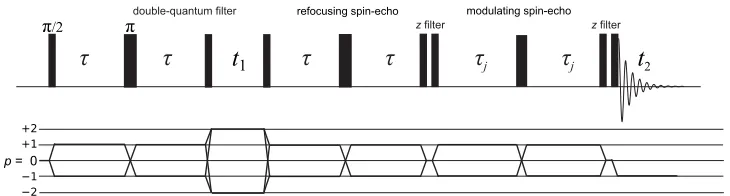
FIG. 1. Pulse sequence and coherence transfer pathway diagram for the refocused INADEQUATE spin-echo (REINE) sequence. Three versions of the experiment are considered here (viz.with bothzfilters, only the second, or nozfilters), and are denoted A, B and C, respectively.
of systems, recent improvements in NMR hardware notwithstanding. In the REINE experiment (Figure1), the double-quantum filter separates the signal from differently bonded pairs according to the sum of their individual chemical shifts. The refocusing spin-echo increases the efficiency of the sequence for disordered solids,1while the final spin-echo element in the sequence encodes the chemical shift-separated signals with theJcoupling strength of the corresponding pairs. Thez
filters either side of the modulating spin-echo ensure that only the in-phase NMR signal is acquired during the detection period. An obvious way to improve the sensitivity of the REINE experiments is simply to remove thez filters. The present report demonstrates that these elements of the pulse sequence are not essential to the accuracy of the associated measurements. In this context, the different sources of error and the intrinsic precision of the spin-echo approach to measuring scalar couplings are also discussed. The different intensity modulations predicted from a product operator analysis of the different versions of the REINE experiment are verified for simulated crystalline, disordered and glassy systems.
II. THEORY
A. Product operator analysis
The J-modulating spin echo in the REINE pulse sequence (Figure 1) is flanked by two z
filters,31whose role is to suppress unwanted anti-phase contributions to the spectra. To ascertain the nature of these distortions, a product operator32analysis is presented, starting from the previously published results for the refocused INADEQUATE experiment.33
The calculations consider isolated spin-1/2 pairs (A and B) interacting via a Jcoupling under solution-like conditions. That is, (i) the spinning frequency is high enough to completely eliminate homonuclear dipolar interactions (over an integer number of rotor cycles), (ii) rotational resonance conditions are avoided, allowing anisotropic chemical shift interactions to be neglected,34and (iii) the decoupling is efficient enough (or the proton content low enough) for heteronuclear dipolar couplings to be neglected. (This is typically the case for 31P or 29Si nuclei in oxide glasses, for instance.) The density matrix at the end of the refocused INADEQUATE sequence is33
σrI= M
A 0 +M
B 0
2 S
2
τ Ay+By+SτCτ(2AxBz+2AzBx)
(1)
where M0AandM0Bare the magnitudes of the transverse magnetization on spins A and B, respec-tively, created by the initial pulse. The following abbreviations have been introduced for the build-up of the in-phase (Ay, By) and anti-phase (2AxBz, 2AzBx) single-quantum coherences over
the fourτdelays in the sequence (see Figure1):
Sτ2=sin2(2πJτ) (2)
055008-3 Guerry, Brown, and Smith AIP Advances6, 055008 (2016)
The same abbreviation scheme is used below for the sine and cosine evolution of the operators during theτjandt2delays.
Assuming that the parameters of the firstzfilter are set so as not affect the in-phase signal, i.e. the delay is not unnecessarily long and the phase cycle removes the anti-phase terms,33Equation (1) becomes,
SτCτ(2AxBz+2AzBx) z f1
−−−−→ Z1SτCτ(2AxBz+2AzBx) (4)
with Z1=0 for a perfect z filter, Z1=1 in the absence thereof. Both in-phase and anti-phase coherences evolve under the scalar coupling during theJ-modulating spin echo,
Sτ2 Ay+By
2πJτj
−−−−−−→ Sτ2Cτj Ay+By
−Sτ2Sτj(2AxBz+2AzBx) (5)
Z1SτCτ(2AxBz+2AzBx)
2πJτj
−−−−−−→ Z1SτCτCτj(2AxBz+2AzBx)
+Z1SτCτSτj Ay+By
(6)
Gathering the terms in Equations (5) and (6), and accounting for the effect (Z2) of the secondzfilter on the anti-phase coherences, the detectable39density matrix evolves during the detection period as:
σ(τ, τjt2)=
M0A+M0B
2 Ay+By
×
( (
Sτ2Cτ
j+Z1SτCτSτj
)
Ct2+
(
Z1Z2SτCτCτj−Z2S
2
τSτj
)
St2
) (7)
Table Icompares the τ build-up, z-filter attenuation, and τj evolution of the different terms
in Eq. (7). Considering first the build-up of each of the four terms, under solution-like conditions, optimal INADEQUATE efficiency will be achieved for Jτ=1/4 and terms 2 and 3 disappear. In this case, the cosine J-modulation of the REINE signal (term 1) will be observed as long as the second zfilter removes anti-phase contributions to the spectra (term 4). In solids however, as described previously by Lesageet al.,1transverse (T′
2) dephasing means that the optimal value of
Jτ (Jτopt) is no longer the root of the cosine build-up terms (see Figure S1 in the supplementary material).35 These therefore become important and contribute sine J-modulated in-phase REINE intensity (term 2 in Table I). In other words, the first z filter eliminates a sizeable proportion of the total in-phase signal. With applications to disordered materials (broad lineshapes) in mind, the hypothesis investigated here regarding the secondzfilter (terms 3 and 4) is that integrated intensity from the anti-phase doublets tends to zero when the chemical shift distribution is much broader than theJsplitting.
B. Sensitivity
Ignoring anti-phase terms, which make a zero net contribution to the spectrum on average, the total intensity accumulated in a REINE experiment at a frequencyΩin theω2domain is
S Ω,τ, τj;ω2
=G(Ω;ω2)
τmax
j
τj=0
σ τ, τj
× exp
−2τj
T2′
[image:5.594.101.499.658.730.2](8)
TABLE I. List of terms contributing to refocused INADEQUATE spin-echo spectra.
Term Signal type Build-up function Jevolution z-filter attenuation
1 SτC2
τjCt2 in-phase sin
2
(2πJτ) cos 2πJτj
none 2 Z1SτCτSτjCt2 in-phase sin(2πJτ)×cos(2πJτ) sin 2πJτj
Z1
3 Z1Z2SτCτCτjSt2 anti-phase sin(2πJτ)×cos(2πJτ) cos 2πJτj
Z1×Z2
4 Z2S2τSτjSt2 anti-phase sin
2(2πJτ) sin 2πJτ
j
055008-4 Guerry, Brown, and Smith AIP Advances6, 055008 (2016)
whereG(Ω;ω2)is the functional form of the NMR spectrum, which for a powder sample under magic angle spinning (MAS) is typically a Gaussian distribution of overlapping Lorentzians. Note that the optimal value of τ will in practice be defined by JT′
2, as described in the supplementary material.35Comparing now versions of the REINE experiment run under identical conditions, but either with or without the secondzfilter, the sensitivity ratio between the two can be written
Sz1+z2 Ω,τ, τj;ω2
Sz1 Ω,τ, τj;ω2
= τmax j
τj=0
Sτ2Cτj+SτCτSτj
S2
τCτj
(9)
where the absolute value taken in Equation (9) ensures that positive and negative intensities are accounted for equivalently.
Evaluating Equation (9) for different (reasonable) values of JT2′(Table IIand Figure S1a)35 shows that omitting the secondzfilter is particularly effective when theJmodulation occursslowly
with respect to the decay of the spin-echo. For the values of JT2′considered here, the simplified version of the REINE experiment is, according to this analysis, up to twice as sensitive.
III. METHODS
A. Strategy
Figure2illustrates the strategy adopted here to investigate the viability of the proposed pulse sequence simplifications. One-dimensional (1D) REINE spectra are simulated for 10 values ofτj
(Figure2(a)). The evolution under theJcoupling of each point in the spectrum is then fit using an appropriate function (Figure2(b),2(c)), based on the theoretical analysis presented in SectionII. (This approach reproduces the experimental workflow for measuringJcoupling distributions using the REINE sequence,29,30the simulated spectra corresponding to slices of 2D spectra) The values obtained from the fits are then compared with those initially simulated (Figure2(d)).
The spectra consist of two Gaussian distributions ofnoverlappingJdoublets, whose splitting is correlated with the chemical shift of the simulated atom pairs. A third atom is included in the simulations, coupled through space, but not bonded to the other two. Starting from parameters representing the interactions between phosphate groups in a glass, several series of simulations are performed for different Gaussian linewidths (withnincreasing/decreasing in proportion) to evaluate the applicability of the proposed simplifications for a variety of physical systems. The three versions of the experiment considered here (viz.with bothzfilters, only the second, or nozfilters) are de-noted A, B and C, respectively, from now on. Note that rotational resonance and multi-spin effects are not considered here.
B. Simulation parameters
[image:6.594.100.495.619.678.2]The different versions of the REINE NMR experiment were simulated using SIMPSON 4.1.1,36 for sets of three dipolar coupled31P nuclei with different isotropic chemical shifts. For 10 values of
TABLE II. Sensitivity of the refocused INADEQUATE spin-echo experiment without versus with the secondzfilter.
JT′
2 Jτopt
a τzc
j
b SτCτc S2
τ Sensitivityd(τmax
j =τ
zc
j) Sensitivity
d(τmax
j =1.5×τ
zc
j)
0.2 0.089 4.6×τopt 0.450 0.281 1.57 (0.18) 2.02 (0.16)
0.5 0.161 2.1×τopt 0.448 0.721 1.46 (0.71) 1.32 (0.52)
1.0 0.201 1.5×τopt 0.289 0.908 1.27 (1.00) 1.11 (0.79)
aThe optimal (in terms of sensitivity) build-up time (τ) for the refocused INADEQUATE block (see Figure1). bThe value ofτ
jat the zero-crossing (ZC)—at which term 1+term 2=0 (see TableI).
cSee Equation (3).
dEquation (9) evaluated for the values ofτmax
055008-5 Guerry, Brown, and Smith AIP Advances6, 055008 (2016)
FIG. 2. (a) Simulated refocused INADEQUATE spin-echo (REINE) spectra with no z filters and the values ofτj(see Figure1) listed in the inset. (b, c) Fits (solid lines) of the evolution as a function ofτjof the intensity at−8.2 ppm in REINE spectra simulated (b) with twozfilters and (c) withoutzfilters. From top to bottom, the values listed on the right of panels (b) and (c) are the simulated and fittedJcoupling, and the correlation coefficients between the fitting parameters. Gaussian noise with a standard deviation of 0.05 was added to the separate intensity modulations (vs.τj, normalized to a maximum of 1.0) obtained for each point in the frequency domain. (d) Simulated (thick black line) and fitted (red dots)J coupling strengths, above the corresponding REINE spectrum (twozfilters) atτj=0.
τj (0–36 ms, in 4 ms increments), simulations of experiments A, B and C were repeatedntimes,
then co-added with Gaussian weighting, with the isotropic chemical shift and scalar coupling of the 31P nuclei increased linearly, the latter from 11.5 to 26.5 Hz, andnbeing proportional to the width
of the chemical shift distribution. The dipolar and (mean) scalar couplings between the spins were set to the values determined by Fayonet al. for crystalline TiP2O7.34 The range of theJcoupling distribution was defined based on the ones measured experimentally for a cadmium phosphate glass.30The chemical shift tensors and distributions of isotropic shifts were defined so as to obtain representative models of crystalline and glassy lead metaphosphates,37and a magnesium metaphos-phate glass.38 The spin system and chemical shift distribution parameters used are listed in Table SI in the supplementary material,35along with a representative SIMPSON input file. Experiments B and C were simulated under 12.5 kHz magic angle spinning. For experiment A however, since the simulations yield identical results whether the anisotropic interactions are considered or not (Table SII),35time consuming magic angle spinning calculations were not required.
C. Analysis
The evolution under the scalar coupling of each point in the resulting spectra was fit using either
I τj
=I0×Cτj×exp
−2τj
T′
2
[image:7.594.116.482.90.373.2]055008-6 Guerry, Brown, and Smith AIP Advances6, 055008 (2016)
for experiment A, or
I τj
=I0×
(
Sτ2Cτj+SτCτSτj
)
×exp
−2τj
T′
2
(11)
for experiments B and C, after normalizing the data and adding Gaussian noise (σ=0.05) and an exponential decay (T2′=15 or 45 ms). The results obtained using custom-written Python 2.7 scripts were confirmed by using the fit command in Gnuplot 4.6.6. for a subset of the data. Fitting errors and the correlations between the fitting parameters were obtained from the associated covariance matrix.
Equation (9) was evaluated for the values ofτmax
j listed in TableII, by calculating the values of
the numerator and denominator for 10,000 points equally spaced fromτj=0 toτjmax. (Doubling the
number of points considered does not modify the sensitivity ratio.)
IV. RESULTS AND DISCUSSION
A. Simplified experiments
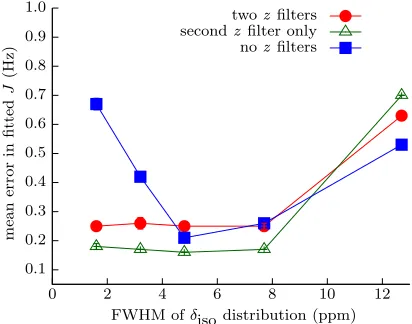
Comparing parts (b) and (c) of Figure2highlights the additional presence of term 2 (TableI) in the J modulation of the REINE intensity in the absence of z filters. Figure 3 shows that this sine modulation can be accounted for accurately by modifying the fitting function according to the product operator analysis (i.e. by using Equation (11) instead of Equation (10)). Indeed for all the linewidths considered here, the scalar couplings fit to the intensity modulations of experiment B are at least as accurate as those obtained from experiment A, the mean errors in the fitted values being low (<0.2 Hz) for all but the broadest chemical shift distribution. (As discussed at greater length below, the fitted values diverge more substantially for the broadest line because of peak overlap.) With experiment C in contrast, the discrepancies between the simulated and fitted scalar couplings are large (>0.6 Hz on average) for the narrowest line, but decrease sharply as the disorder of
the simulated system increases (mean error =0.21 and 0.26 Hz for FWHM of 4.8 and 7.5 ppm,
respectively).
[image:8.594.194.400.502.664.2]This effect is emphasized in Figure S2, which compares the scalar coupling distributions ob-tained from simulations of experiments A and C, with no noise added, for different widths of the chemical shift distribution.35Figure S3 confirms that the deviations stem from the anti-phase terms
055008-7 Guerry, Brown, and Smith AIP Advances6, 055008 (2016)
(3 and 4 in TableI), whose integrated intensity decreases markedly (by up to∼70 %) as the chemi-cal shift distribution broadens.35Note that although the specific values quoted here for the errors are parameter-dependent, the trends with respect to the linewidths and between the different versions of the REINE experiment are reproduced for a wide range of values—namely, of the standard devia-tion of the Gaussian noise (Figure S4a,b), the MAS frequency and magnitude of the dipole-dipole couplings (Figure S5a–c), and the range of the J coupling distribution (Figure S5d).35 In partic-ular, although the zero crossing in the intensity modulation occurs later for experiments B and C, these in fact yield more (not less) accurate values than experiment A when T′
2 is shorter (Figure S4c). Furthermore, the fitting variables remain uncorrelated throughout (Table SIII). In summary, provided the chemical shift distribution is very broad with respect to the meanJcoupling (FWHM >30× J¯), the REINE experiment can be performed withoutzfilters without compromising on the accuracy of the results. In line with the predicted gains in sensitivity (+11–102 %, see TableII), the removal of the firstzfilter makes experiments B and C 1.23 times more sensitive than experiment A, as measured from the total integrated intensity for the set of simulations whose results are summarized in Figure3. Experiment C can moreover be run with whole-echo acquisition, leading to an extra√2 gain in sensitivity.
B. Sources of error
The mean errors in the fitted Jcoupling strengths range from∼0.2 to∼0.7 Hz (Figure3) but the fitting errors range only from 0.2 to 0.3 Hz (see Figure 2(b), 2(c)for example). Indeed, for all versions of the REINE experiment indeed, the modulation of a given point in the spectrum is an average of the intensity variations of several overlapping doublets. This is illustrated in Figure S2a (for which no noise was added to the simulated data),35 where the fitted values are slightly overestimated to the left of the peak maximum, and underestimated to the right, where the neigh-boring doublets toward the center of the distribution have respectively a greater and smaller splitting than that of the underlying doublet, were it to be considered in isolation. Averaging induces more substantial errors when two (or more) chemical shift distributions overlap, as the difference between the mean splitting and those of the individual doublets is likely much greater. Nevertheless, the simulations performed here for overlapping lines suggest that even for large (>15 Hz) differences between the overlapping doublets,±1 Hz is a conservative estimate of the systematic error induced.
Finally, should one wish to trade accuracy for sensitivity and use experiment C for relatively well ordered systems, these results suggest that the distortions from the anti-phase contributions can be covered by simply adding 0.4 Hz to the errors output by the fitting algorithm.
V. CONCLUSION
The simplifications and the corresponding gains in sensitivity discussed in this paper should make the precise measurement of near-pair-specific scalar couplings more routine in a number of disordered systems. In practice furthermore, omitting the two z-filter elements should make the REINE sequence easier to implement, with a higher tolerance for slightly imperfect pulse powers or durations. Comparing experimental values with those calculated from first principles15,16should allow both a refinement of the algorithms and, eventually, a better understanding of the bonding and structural variations in non-crystalline solids, possibly in combination with the precise measures of coherence lifetimes that this approach provides.
ACKNOWLEDGEMENTS
We thank the EPSRC through grant EP/C000633/1 and Lancaster University for supporting this work.
1A. Lesage, M. Bardet, and L. Emsley,J. Am. Chem. Soc.121, 10987 (1999). 2F. Fayon, G. Le Saout, L. Emsley, and D. Massiot, Chem. Commun.1702(2002).
055008-8 Guerry, Brown, and Smith AIP Advances6, 055008 (2016)
4R.M. Shayib, N.C. George, R. Seshadri, A.W. Burton, S.I. Zones, and B.F. Chmelka,J. Am. Chem. Soc.133, 18728 (2011). 5M. Barfield, A.J. Dingley, J. Feigon, and S. Grzesiek,J. Am. Chem. Soc.122, 4014 (2001).
6S.P. Brown, M. Pérez-Torralba, D. Sanz, R.M. Claramunt, and L. Emsley,Chem. Commun.1852 (2002). 7S. Cadars, D.H. Brouwer, and B.F. Chmelka,Phys. Chem. Chem. Phys.11, 1825 (2009).
8T.F. Green and J.R. Yates,J. Chem. Phys.140, 234106 (2014).
9J.R. Yates, S.E. Dobbins, C.J. Pickard, F. Mauri, P.Y. Ghi, and R.K. Harris,Phys. Chem. Chem. Phys.7, 1402 (2005). 10R.K. Harris,J. Pharm. Pharmacol.59, 225 (2007).
11E. Salager, R.S. Stein, C.J. Pickard, B. Elena, and L. Emsley,Phys. Chem. Chem. Phys.11, 2610 (2009). 12C. Martineau, B. Bouchevreau, Z. Tian, S.-J. Lohmeier, P. Behrens, and F. Taulelle,Chem. Mater.23, 4799 (2011). 13E. Davies, M.J. Duer, S.E. Ashbrook, and J.M. Griffin,J. Am. Chem. Soc.134, 12508 (2012).
14M. Baias, J.-N. Dumez, P.H. Svensson, S. Schantz, G.M. Day, and L. Emsley,J. Am. Chem. Soc.135, 17501 (2013). 15S.A. Joyce, J. Yates, C.J. Pickard, and F. Mauri,J. Chem. Phys.127, 204107 (2007).
16S.A. Joyce, J.R. Yates, C.J. Pickard, and S.P. Brown,J. Am. Chem. Soc.130, 12663 (2008). 17A. Kubo and C.A. McDowell,J. Chem. Phys.92, 7156 (1990).
18G. Wu and R.E. Wasylichen,Inorg. Chem.31, 145 (1992).
19L. Duma, W.C. Lai, M. Carravetta, L. Emsley, S.P. Brown, and M.H. Levitt, Chem. Phys. Chem.5, 815 (2004).
20D. Massiot, F. Fayon, M. Deschamps, S. Cadars, P. Florian, V. Montouillout, N. Pellerin, J. Hiet, A. Rakhmatullin, and C.
Bessada,Comptes Rendus Chim.13, 117 (2010).
21S.P. Brown, M. Pérez-Torralba, D. Sanz, R.M. Claramunt, and L. Emsley,J. Am. Chem. Soc.124, 1152 (2002). 22D. Massiot, F. Fayon, B. Alonso, J. Trebosc, and J.-P. Amoureux,J. Magn. Reson.164, 160 (2003).
23T.N. Pham, J.M. Griffin, S. Masiero, S. Lena, G. Gottarelli, P. Hodgkinson, C. Filipe, and S.P. Brown,Phys. Chem. Chem.
Phys.9, 3416 (2007).
24P. Florian, F. Fayon, and D. Massiot,J. Phys. Chem. C113, 2562 (2009).
25C. Bonhomme, C. Gervais, C. Coelho, F. Pourpoint, T. Azaïs, L. Bonhomme-Coury, F. Babonneau, G. Jacob, M. Ferrari,
D. Canet, and others,Magn. Reson. Chem.48, S86 (2010).
26R.M. Claramunt, M. Pérez-Torralba, D.S. María, D. Sanz, B. Elena, I. Alkorta, and J. Elguero,J. Magn. Reson.206, 274
(2010).
27X. Xue and M. Kanzaki,J. Phys. Chem. C116, 10714 (2012).
28P. Thureau, G. Mollica, F. Ziarelli, and S. Viel,J. Magn. Reson.231, 90 (2013).
29S. Cadars, A. Lesage, M. Trierweiler, L. Heux, and L. Emsley,Phys. Chem. Chem. Phys.9, 92 (2007). 30P. Guerry, M.E. Smith, and S.P. Brown,J. Am. Chem. Soc.131, 11861 (2009).
31O.W. Sørensen, M. Rance, and R.R. Ernst, J. Magn. Reson. 196956, 527 (1984).
32O.W. Sørensen, G.W. Eich, M.H. Levitt, G. Bodenhausen, and R.R. Ernst,Prog. Nucl. Magn. Reson. Spectrosc.16, 163
(1983).
33S. Cadars, J. Sein, L. Duma, A. Lesage, T.N. Pham, J.H. Baltisberger, S.P. Brown, and L. Emsley,J. Magn. Reson.188, 24
(2007).
34F. Fayon, D. Massiot, M.H. Levitt, J.J. Titman, D.H. Gregory, L. Duma, L. Emsley, and S.P. Brown,J. Chem. Phys.122,
194393 (2005).
35See supplementary material athttp://dx.doi.org/10.1063/1.4948965for more information about simulation and
experi-mental parameters and the effect of anisotropic interactions.
36M. Bak, J.T. Rasmussen, and N.C. Nielsen,J. Magn. Reson.147, 296 (2000). 37F. Fayon, C. Bessada, J.-P. Coutures, and D. Massiot,Inorg. Chem.38, 5212 (1999). 38F. Fayon, D. Massiot, K. Suzuya, and D.L. Price,J. Non-Cryst. Solids283, 88 (2001).
39Anti-phase single-quantum coherences are not directly detected as they do not induce a voltage in the NMR coil
(T r[I−A
xBz]=0), but during the t2 acquisition period, they evolve into sine-modulated in-phase magnetization