warwick.ac.uk/lib-publications
Original citation:
Stanway, Elizabeth R., Eldridge, J. J. and Becker, George D.. (2016) Stellar population effects
on the inferred photon density at reionization. Monthly Notices of the Royal Astronomical
Society, 456 (1). pp. 485-499.
Permanent WRAP URL:
http://wrap.warwick.ac.uk/83179
Copyright and reuse:
The Warwick Research Archive Portal (WRAP) makes this work by researchers of the
University of Warwick available open access under the following conditions. Copyright ©
and all moral rights to the version of the paper presented here belong to the individual
author(s) and/or other copyright owners. To the extent reasonable and practicable the
material made available in WRAP has been checked for eligibility before being made
available.
Copies of full items can be used for personal research or study, educational, or not-for profit
purposes without prior permission or charge. Provided that the authors, title and full
bibliographic details are credited, a hyperlink and/or URL is given for the original metadata
page and the content is not changed in any way.
Publisher’s statement:
This is a pre-copyedited, author-produced PDF of an article accepted for publication in
Monthly Notices of the Royal Astronomical Society following peer review. The version of
record Stanway, Elizabeth R., Eldridge, J. J. and Becker, George D.. (2016) Stellar population
effects on the inferred photon density at reionization. Monthly Notices of the Royal
Astronomical Society, 456 (1). pp. 485-499.
Link to final published version : http://dx.doi.org/10.1093/mnras/stv2661
A note on versions:
The version presented here may differ from the published version or, version of record, if
you wish to cite this item you are advised to consult the publisher’s version. Please see the
‘permanent WRAP URL’ above for details on accessing the published version and note that
access may require a subscription.
Stellar population effects on the inferred photon density at reionization
Elizabeth R. Stanway,
1‹J. J. Eldridge
2and George D. Becker
3,41Department of Physics, University of Warwick, Gibbet Hill Road, Coventry, CV4 7AL, UK 2Department of Physics, University of Auckland, Private Bag 92019, Auckland, New Zealand 3Space Telescope Science Institute, 3700 San Martin Drive, Baltimore, MD 21218, USA
4Department of Physics & Astronomy, University of California, Riverside, 900 University Avenue, Riverside, CA 92521, USA
Accepted 2015 November 10. Received 2015 November 2; in original form 2015 June 19
A B S T R A C T
The relationship between stellar populations and the ionizing flux with which they irradiate their surroundings has profound implications for the evolution of the intergalactic medium (IGM). We quantify the ionizing flux arising from synthetic stellar populations which incor-porate the evolution of interacting binary stars. We determine that these show ionizing flux boosted by 60 per cent at 0.05≤Z≤0.3 Zand a more modest 10–20 per cent at near-solar metallicities relative to star-forming populations in which stars evolve in isolation. The rela-tion of ionizing flux to observables such as 1500 Å continuum and ultraviolet spectral slope is sensitive to attributes of the stellar population including age, star formation history and initial mass function (IMF). For a galaxy forming 1 Myr−1, observed at>100 Myr after the onset
of star formation, we predict a production rate of photons capable of ionizing hydrogen,Nion
=1.4×1053 s−1 atZ=Z and 3.5×1053 s−1 at 0.1 Z, assuming a Salpeter-like IMF.
We evaluate the impact of these issues on the ionization of the IGM, finding that the known galaxy populations can maintain the ionization state of the Universe back toz∼9, assuming that their luminosity functions continue toMUV= −10, and that constraints on the IGM atz∼
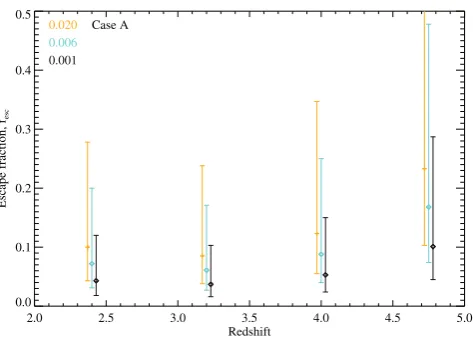
2–5 can be satisfied with modest Lyman-continuum photon escape fractions of 4–24 per cent depending on assumed metallicity.
Key words: binaries: general – stars: evolution – galaxies: high-redshift.
1 I N T R O D U C T I O N
The epoch of reionization, during which the cold neutral intergalac-tic medium (IGM) of the cosmic dark ages was photoionized by the flux from the earliest luminous sources, is growing ever more accessible to observation. Colour-selected galaxy samples now in-clude candidate galaxies atz∼10 (Ellis et al.2013; Bouwens et al.
2015), with rare spectroscopically confirmed examples out toz= 7.7 (Oesch et al.2015). A small but growing number of quasar host galaxies are also known atz >7 (Mortlock et al.2011) while gamma-ray bursts have been identified atz > 8, and their host galaxies constrained (Tanvir et al.2009,2012; Berger et al.2014). Observations both of the galaxy population and the IGM probed along sightlines to these distant ‘lighthouses’ have suggested that the number density of neutral hydrogen clouds rises sharply atz > 6, resulting in absorption in distant spectra, and so fewer galaxies observable in the Lymanαtransition of hydrogen (Stark et al.2010; Caruana et al.2014; Mesinger et al.2015). Meanwhile, increasingly precise measurements of the cosmic microwave background
E-mail:[email protected]
ation have measured the extent to which it has been modified by neutral hydrogen along the line of sight, constraining the Thomp-son optical depth to reionization toτ = 0.066± 0.016 (Planck Collaboration XIII2015). If interpreted as arising from a step-wise transition from neutral to ionized IGM, this corresponds to a reion-ization redshift ofz=8.8+−11..74. Together, these constraints suggest a reionization process that probably began aroundz=10 and pro-ceeded rapidly, leading to a Universe with a mean neutral fraction
X<1 per cent byz=6 (Fan, Carilli & Keating2006; Robertson et al.2015).
Given these constraints on the history of reionization, an in-evitable question arises concerning its driving force. The contribu-tion of ionizing photons from AGN is too small to either reionize the Universe or maintain that state against hydrogen recombination, and thus star-forming galaxies are believed to power the process (Fan et al.2006, and references therein). However, the number density of observable star-forming galaxies in the distant Universe falls sharply with cosmic time. Extrapolating the observed luminosity distribution of colour-selected, ultraviolet-luminous galaxies to be-low observable limits, it has been established that this population is likely sufficient to reionize the Universe but only marginally so (Robertson et al.2015). Difficulties remain; it is unclear whether a
at University of Warwick on October 24, 2016
http://mnras.oxfordjournals.org/
sufficient fraction of ionizing photons are capable of escaping the dust and nebular gas within the galaxy in which they are emitted, or whether a sufficient number of small galaxies (predicted from the faint-end slope of observed luminosity functions, e.g. Bouwens et al.2015, and poorly constrained atz >7) exist to power cosmic reionization.
One reason for such uncertainty is the unfortunate necessity of extrapolation below the limits of observational data. Only a few, rare z >5 galaxies are bright enough for detailed spectroscopic analysis. Observations of high-redshift galaxies are typically limited to their broad-band colours in the rest-frame ultraviolet (and sometimes op-tical) and perhaps a measurement of particularly strong emission lines (such as Lymanαat 1216 Å; e.g. Labb´e et al.2013; Caruana et al.2014; Oesch et al.2015; Smit et al.2015). Given a measured rest-frame 1500 Å flux continuum density, usually derived from photometry in a broad bandpass, the number of ionizing photons shortwards of 912 Å (the ionization limit of hydrogen or ‘Lyman break’) must be inferred (e.g. Madau, Haardt & Rees1999; Bunker et al.2004; Robertson et al.2015). This ‘Lyman-continuum’ flux is estimated through the use of stellar population synthesis models, fitted to the available data. For a stellar population of known age, metallicity and ultraviolet flux, the ionizing photon flux can be reli-ably estimated. However, difficulties arise when any of these proper-ties are unknown. A young starburst will contain a larger proportion of hot, massive stars than an older one and so emit more ionizing photons for a given 1500 Å continuum measurement. By contrast, a stellar population that has formed stars continuously over its life-time will show an ultraviolet spectral energy distribution (SED) to which both young stars and older sources contribute, resulting in a modified but far more stable ionizing photon-to-continuum ratio. At low metallicities, different stellar evolution pathways, including those which result from binary star interactions or rotation, become increasingly important — again resulting in a modified ionizing photon output (Eldridge, Izzard & Tout2008; Stanway et al.2014; Zhang et al.2013; Topping & Schull2015). While some of these variations can be inferred from stellar population modelling, this has traditionally been tuned to match the properties of the local galaxy distribution – largely comprising mature galaxies and stellar populations with a near-solar average metallicity.
As discussed in Eldridge & Stanway (2012), the general effect of binary evolution and rotation is to cause a population of stars to appear bluer at an older age than predicted by single-star models. This increase in the lifetime over which star-forming galaxies emit hard ultraviolet spectra may well present an explanation for the observed high [OIII]/Hβemission line ratios in the sub-solar,
low-mass star-forming galaxies of the distant Universe (Stanway et al.
2014), although the evidence for these at intermediate redshifts (z ∼2–3) and whether instead they may represent a shift in nitrogen abundance is still under discussion (e.g. see Sanders et al.2015b, and references therein). Its significance for the epoch of reionization is obvious: a blue spectrum will emit more ionizing photons for a given 1500 Å luminosity than a corresponding red spectrum. Since 1500 Å (rest frame) observations, modified by a model-derived flux ratio, are most frequently used to constrain the ionizing population, it is thus critical to examine the effects of evolutionary pathways on derived constraints on reionization.
In this paper, we consider uncertainties in stellar evolution and population synthesis and how these affect the predicted ionizing flux from distant star-forming galaxies, and the interpretation of the observed galaxy luminosity function, in the context of observa-tional constraints. In Section 2, we present the detailed theoretical stellar population models used for our analysis, and in Section 3 we
explore their behaviour as a function of metallicity, age and other stellar properties. In Section 4, we predict the behaviour of key ob-servables used to constrain the distant galaxy population, while in Section 5 we consider the implications for reionization in the con-text of existing measurements.
Throughout, we calculate physical quantities assuming a standard cold dark matter cosmology withH0=70 km s−1Mpc−1,
=
0.7 andM=0.3. All magnitudes are quoted on the AB system.
2 S T E L L A R P O P U L AT I O N M O D E L S
2.1 The need for stellar population models
Population and spectral synthesis codes are commonly used in as-trophysics when a model for a stellar population is required. These combine theoretical (atmosphere and evolution) models or empiri-cal spectra of individual stars, assuming some initial mass function (IMF) and stellar population age, and process the resultant emission through dust and gas screens to calculate an ‘observed’ spectrum (Leitherer et al.1999,2014). It is important not to overlook the assumptions that go into these models. A comprehensive analysis of some of the uncertainties in population synthesis reveals there is still much to improve in population synthesis (Conroy2013, and references therein), refining models to address a number of physical processes that are currently not included. As Leitherer & Ekstr¨om (2012) discuss, population synthesis is currently a subject in a state of flux. Not only are the stellar atmosphere models being revised to better match the spectra of observed stars across a broad range of metallicities, stellar evolution models are also undergoing an unprecedented increase in accuracy (see e.g. Langer2012).
Factors that affect the output of population synthesis include the effects of mass-loss rates, stellar rotation (e.g. Topping & Schull
2015) and interacting binaries (e.g. Belkus et al.2003; Eldridge et al.
2008) which must be evaluated using detailed modelling of stellar evolution, and which are affected in turn by the IMF and metallicity of the input stellar population. Each of the widely used, publically available population synthesis codes, which includeSTARBURST99
(Leitherer et al.1999) and Binary Population and Spectral Synthesis (BPASS; Eldridge & Stanway2012, see below) treats the above factors
in a different way. An investigation of alternate implementations, stellar population assumptions and their effects is thus warranted.
2.2 Binary Population and Spectral Synthesis (BPASS)
TheBPASSmodels1are a set of publically available stellar population
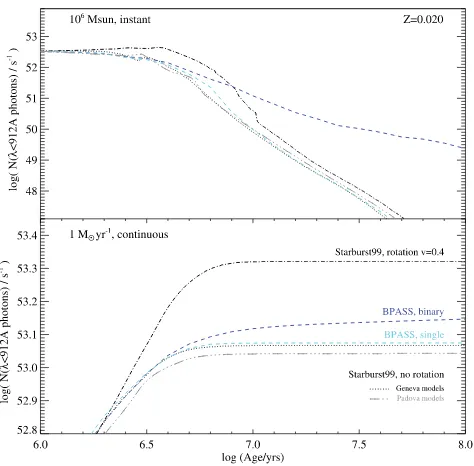
synthesis models which are constructed by combining stellar evolu-tion models with synthetic stellar spectra. Detailed stellar evoluevolu-tion models, described in Eldridge et al. (in preparation) and Eldridge et al. (2008), are combined with the latest stellar atmosphere models and a synthetic stellar population generated according to both an IMF and a distribution of binary separation distances, to produce a stellar population (see Eldridge & Stanway2009,2012). At so-lar metallicities, for mature stelso-lar populations, a standard Salpeter (1955) IMF, and when only single-star evolution pathways are con-sidered, the resultant output spectra are very similar to those of the well-knownSTARBURST99 code, as Fig.1demonstrates. At differing
metallicities and ages, for different IMFs and when binary evolution pathways are included, the treatment of stellar population effects
1http://bpass.auckland.ac.nz
at University of Warwick on October 24, 2016
http://mnras.oxfordjournals.org/
Figure 1. The ionizing flux generated as a function of age by synthetic
stellar populations constructed usingBPASSwith single or binary
evolu-tionary pathways, and also by the widely usedSTARBURST99 code, forming
1 Myr−1at near-solar metallicity. We also show an evolutionary track
constructed usingSTARBURST99 and either the original Padova stellar tracks
or the recent Geneva-group stellar models, a subset of which incorporate
stars with a rotation parameterv=0.4.
in the two codes, and hence the composite spectra they produce, diverge.
Interacting binaries provide a more moderate increase in ion-izing flux but also reduce the rate at which it decreases in older stellar populations (see e.g. Stanway et al.2014; Zhang et al.2013). The three key effects of binary interactions are: removal of the hy-drogen envelope in primary stars – forming more hot helium or Wolf–Rayet stars; the transfer of mass to secondary stars increas-ing their mass and rejuvenatincreas-ing them; and finally the generation of massive stars from stellar mergers (Eldridge et al.2008). The first of these, enhanced mass loss for the primary stars in binaries, does little to increase the total ionizing flux but does allow harder ioniz-ing photons to exist at later times than expected from a sioniz-ingle-star population, beyond∼10 Myr. The transfer of mass to secondary stars and binary mergers result in a more top-heavy effective mass function for the stellar population, as well as creating more massive stars at later ages than would be expected for a single-star popula-tion. These are the major reasons for the enhanced ionizing flux at late times seen for binaries in Fig.1, and causes the slower decline rate for the ionizing flux beyond a few Myr.
Fig.1also illustrates the effect of stellar rotation on the predicted ionizing fluxes. Rotation tends to increase the flux at all ages but the form of evolution with stellar population age remains the same as in the non-rotating case. This is because the primary effects of rotation are to extend main-sequence lifetimes and also to generate stars that are more luminous and hotter during their main-sequence evolution.
When mass is transferred in a binary system, so too is angular momentum. This spin-up of stars by this transfer can result in the rotational mixing of its layers, allowing the more efficient burning of hydrogen in its interior (Cantiello et al.2007; de Mink et al.
2013). At solar metallicity this can mix fresh hydrogen into
main-sequence stars and rejuvenation of their age. However stellar winds are strong in such stars and so they quickly spin-down. As stellar winds weaken at lower metallicities, the stars can remain rapidly rotating over their entire main-sequence lifetimes and evolve as if they are fully mixed. This quasi-homogeneous evolution (QHE) is significant at high stellar masses (20 M) and low metallicities (Z≤0.004; see e.g. Vanbeveren, van Bever & De Donder1997; Eldridge, Langer & Tout2011). We have investigated the effect of QHE on stellar populations and the production of long gamma-ray bursts in Eldridge et al. (2011) and Eldridge & Stanway (2012). Others have also investigated the importance of QHE (Topping & Schull2015) in stellar populations. This extends the stellar lifetime and causes the star to become hotter as it evolves rather than cooler (Yoon & Langer2005).
In our fiducial population of the entire populations only approx-imately 0.04 per cent of the stars experience QHE. The fraction of rotationally mixed stars increases at high masses, ranging from 10 to 20 per cent of the stars above 20 M. As discussed in the above papers, we have constrained the number of QHE-affected stars by ensuring that the relative rates of type Ib/c (hydrogen-free) to type II (hydrogen-rich) supernovae reproduces the observed trend with metallicity. When the first supernova occurs in a binary we calculate whether the system is disrupted or not as discussed in El-dridge et al. (2008,2011). If the system is unbound, the secondary continues its evolution as a single star; otherwise, the remnant mass is estimated and the evolution continues with either a white dwarf, neutron star or black hole as a companion. Again mass transfer can occur but any possible luminous variability from the compact object accreting mass is not currently included. We find that only approx-imately 25 per cent of binary systems survive the first supernova.
The models in use here comprise version 2.0 of theBPASSmodel data set. We employ stellar evolution and atmosphere models with a metallicity mass fraction ranging from Z = 0.001 to 0.040. These metallicities correspond to oxygen abundances spanning log(O/H)+12=7.6 to 9.0, whereZ = 0.020 (log(O/H)+12=8.8) is conventionally assumed to be the value for the present-day cos-mic abundance of local Galactic massive stars as discussed by Nieva & Przybilla (2012). This is preferable to using the solar composition of Asplund et al. (2009) which is closer to a log(O/H)+12=8.7 or
Z=0.014. This is because the Sun with a 4.5 billion-year age is a poor indicator for the composition of massive stars that formed much more recently. A broken power law is used for the IMF in our standard models, with a slope of−1.3 between 0.1 and 0.5 Mand −2.35 at masses above this, extending to 100 Mfor the models used in this study. The shallow slope below a stellar mass of 0.5 M biases our models towards the more massive stellar population, and is now routinely adopted in stellar population synthesis models in-cluding the default parameters forSTARBURST99. The slope above
the break and upper mass limit match those of the Salpeter IMF. We note that recent observations have provided evidence for stellar masses above 100 Min nearby clusters (Crowther et al.2010), and we consider the effects of extending the IMF to higher limits in Section 3.4.
We assume an initial parameter distribution for the binary popu-lation that is flat in the logarithm of the period from 1 to 10 000 d. We also assume a flat distribution in binary mass ratio, defined as
M2/M1. Both of these are consistent with the observations of Sana et al. (2012). We compute binary evolution models from 0.1 to 100 Mhowever we only count the mass of the secondary as a star if its initial mass is greater than 0.1 M, otherwise it is considered a brown dwarf and does not contribute to the total stellar mass. This assumed initial distribution leads to approximately two thirds
at University of Warwick on October 24, 2016
http://mnras.oxfordjournals.org/
of binary systems interacting in some way during their lifetime. We follow mass transfer between the primary to the second star, assuming that the secondary star can only accrete at a rate limited by its thermal time-scale. The remaining mass is lost from the sys-tem. We also account for QHE in the method outlined in Eldridge et al. (2011). If a secondary star accretes more than 5 per cent of its original mass then we assume it is rejuvenated and restart its evolution at its final mass at a later time. If the metallicity isZ≤
0.004 and the star is more massive than 20 Mthen we assume it evolves full mixed during its hydrogen burning lifetime and ex-periences QHE. While there are many uncertainty parameters in binary stellar evolution, as discussed in our previous work and the extensive literature on this topic, we do not vary these to achieve a better fit to data but work with a fiducial parameter set. These lead to a synthetic binary population that reproduces most observational tests for a stellar population and are described in detail in Eldridge et al. (2008,2011) and Eldridge & Stanway (2009,2012). The com-parison of the V2.0 models against the same observational data will be presented in Eldridge et al. (in preparation). In total each metal-licity synthetic stellar population is based on between 15 000 and 19 000 individual detailed stellar evolution models using the Cam-bridge STARS evolution code outlined in Eldridge et al. (2008). Stellar atmosphere models are selected from the BaSeL v3.1 library (Westera et al. 2002), supplemented by O star models generated using the WM Basic code (Smith, Norris & Crowther 2002) and Wolf–Rayet stellar atmosphere models from the Potsdam PoWR group2(Hamann & Gr¨afener2003) where appropriate.
The baseline models track the evolution of a coeval stellar pop-ulation (as discussed in the next section), but can be combined to evaluate the effect of continuous star formation, multiple star formation epochs, or a more complex star formation history (see Section 3.2). They comprise both a model set with a binary distri-bution matching observational constraints as described above, and a single-star model set in which the stars evolve in isolation, with mass loss via stellar winds. Changes in the fraction of binary in-teractions can be accommodated by producing a weighted mean of these models if required.
3 E F F E C T S O F S T E L L A R P O P U L AT I O N U N C E RTA I N T I E S
3.1 Ionizing photon output from binary populations
The key parameter required for calculations of the reionization process is, in principle, a simple one: the flux of photons with sufficient energy to ionize hydrogen (i.e. with wavelengths λ < 912 Å, a spectral region known as the Lyman continuum) arising from a stellar population. This quantity is usually estimated for a given stellar population simply from its continuum luminosity density in the far-ultraviolet, at aroundλ=1500 Å in the galaxy rest frame.
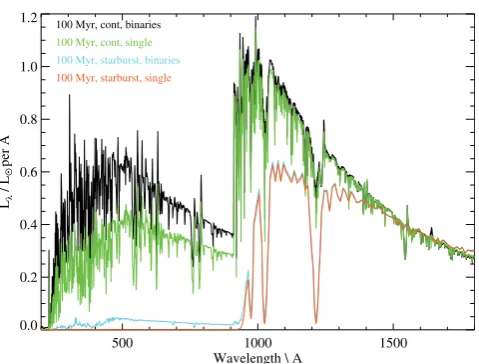
In Fig.2, we illustrate the difficulty with this characterization. We show a range of models normalized to the same far-ultraviolet luminosity, and each at the same metallicity (Z=0.002=0.1 Z). We adopt this as representative as it reproduces the moderately sub-solar, but non-negligible, metallicities inferred for the high-redshift (z∼2–7) galaxy population (Dunlop et al.2013; Cucchiara et al.
2015; Sanders et al.2015a), and we defer discussion of metallicity effects to Section 3.3.
[image:5.595.307.547.52.234.2]2www.astro.physik.uni-potsdam.de/∼wrh/PoWR/powrgrid1.html
Figure 2. The rest-frame ultraviolet spectral region for different stellar pop-ulation models with an identical luminosity at 1500 Å. Binary poppop-ulation synthesis models are compared to single-star models, for either an
instanta-neous starburst or continuous star formation rate of 1 Myr−1, at age of
100 Myr. The stellar mass of the continuous starburst models is 106.0M
,
while that of the starbursts is 106.9M. A stellar metallicity ofZ=0.002
is shown.
In each case the same far-ultraviolet luminosity is generated by stellar populations with similar total stellar mass, but the flux short-wards of the Lyman break at 912 Å differs significantly. Populations which incorporate binary interactions systematically generate more ionizing photons than single-star populations with the same 1500 Å continuum.
We measure the flux of ionizing photons for a stellar population as a function of age of the ongoing starburst, using the simple prescription,
Nion= 912Å
10Å
Fν(h ν)−1dν, (1)
where we set the lower limit as the wavelength below which our models produce negligible flux.
3.2 Star formation history and age
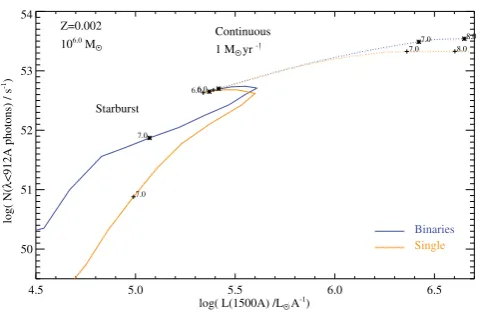
The Lyman-continuum flux for a population with continuous star formation rate 1 Myr−1is dominated by massive stars with life-times of a few Myr (where 1 Myr=106yr). In Fig.3, we show
evolutionary tracks in ionizing photon flux and far-ultraviolet lumi-nosity arising from a galaxy withZ=0.002. For stellar population forming stars as a constant rate, the photon flux remains virtually constant at ages above∼10 Myr in both the single and binary star evolution path cases as the oldest stars fade in the ultraviolet and are replaced. Throughout the lifetime of the star formation event, however, the binary star populations produce a higher number of ionizing photons, exceeding the single-star population flux by 50– 60 per cent in thisZ=0.002 example (see Section 3.3 for metallicity effects).
While the continuous star formation case yields a highly stable photon flux that depends only on star formation rate (after an initial establishment period) rather than stellar mass, it may not be a wholly realistic scenario for all distant galaxies. For galaxies in which star formation is triggered by merger events, or the sudden accretion of gas clouds from the IGM, which drive winds which quench their own star formation, or which have a small gas supply at the onset of
at University of Warwick on October 24, 2016
http://mnras.oxfordjournals.org/
Figure 3. The change in ionizing photon flux over the evolution of single
and binary stellar populations atZ=0.002, for both star formation histories
considered in Section 3. In the case of an ageing instantaneous starburst
(solid lines), a stellar mass of 106M
is created and then allowed to age.
In the case of continuous star formation (dotted line) stars are continuously
added at 1 Myr−1such that the stellar mass is equal to the stellar popular
age. The logarithm of the age is indicated at labelled points. The stellar
masses are identical at 106yr after the onset of star formation.
star formation, star formation could plausibly be a short-lived phase (see Bouwens et al.2010; Verma et al.2007). The star formation history in such systems is usually parametrized as an initial abrupt star formation event, followed by ongoing star formation, the rate of which declines exponentially with a characteristic time-scale,τ. The continuous star formation scenario represents one extreme of such models (τ= ∞), while the other extreme (τ=0) is an instantaneous starburst, in which all stars are formed simultaneously and thereafter evolve without further star formation.
In Fig.2, we show a comparison between the synthetic spectra produced by continuous star formation and a starburst scenario at a stellar population age of 100 Myr, using either single or binary syn-thesis atZ=0.002. By contrast with the continuous star formation event, an ageing starburst emits very few ionizing photons, despite a still healthy 1500 Å continuum. This is significant for the infer-ences drawn from the high-redshift galaxy population. Galaxies at z >4 are typically only detected longwards of the 1216 Å Lymanα feature, and their luminosities are measured around 1500 Å in the rest frame. As Fig.2demonstrates, for a young starburst, this can lead to substantial ambiguity in the estimated 912 Å and ionizing photon flux.
A suggestion that starburst events at high redshift might be short lived can be found in the very high specific star formation rates (sSFRs) of Lyman break galaxies at high redshift. Such systems, observed atz∼7, can form their current stellar mass in as little as 100 Myr, assuming constant star formation at the observed rate (i.e. sSFR∼9.7 Gyr−1; Stark et al.2013). The contribution of these
short-lived bursts to the ionizing flux has largely been ignored in the past, on the basis that single-star models in particular show a rapid decline in luminosity within 10 Myr of the initial burst. In Fig.3, we show the evolution of the photon flux with stellar population age for an instantaneous starburst. In the case of an ageing instantaneous starburst, a stellar mass of 106M
is created and then allowed to age. In the continuous star formation case, stars are continuously added to the model, weighted by IMF and at a rate of 1 Myr−1 such that the stellar mass is equal to the stellar population age. Both single-star and binary evolution synthesis models do indeed show rapid, order of magnitude, drop in ionizing photon flux over the first 10 Myr after star formation. Thereafter, however, the two
Figure 4. The ionizing photon flux for single and binary stellar populations
with a continuous star formation rate of 1 Myr−1, as a function of age
and metallicity. The upper panel shows the ratio between the two stellar
evolution model sets. In both cases, the ionizing photon flux takes∼10 Myr
to establish, and thereafter remains constant, with binary evolution models
predicting∼60 per cent more ionizing photons at low metallicities, but a
more modest 20 per cent at significantly sub-solar metallicities.
populations diverge. The binary models prolong the period over which hot stars dominate the spectrum. As a result, the ionizing photon flux declines far less rapidly for binary synthesis models than that of a single-star population at the same metallicity, and the ratio between the two rises to a factor of 100 at an age of 30 Myr. The ionizing flux from these sources represents a potentially overlooked contribution to the ionizing flux in the distant Universe.
However, we note that the situations shown in Fig.3represent just two snapshots in a rather large parameter space. Both ionizing flux and continuum flux density will scale with star formation rate in the continuous star formation case. The same parameters will scale with mass of the initial starburst in the instantaneous case. Given a far-ultraviolet luminosity density of 106L
Å−1, we might estimate that we have a∼100 Myr old stellar population forming 1 Myr−1,
or a massive instantaneous burst (perhaps a galaxy-wide starburst due to merger activity) of the same total mass, seen at just∼20 Myr. If the latter is in fact a better description, the ionizing photon flux is likely to be lower by an order of magnitude (assuming binary evolution, 2 orders of magnitude for single stars). More complex star formation histories, such as declining exponential starbursts, will lie between these extremes, with a strong dependence on their characteristic time-scales.
3.3 Metallicity
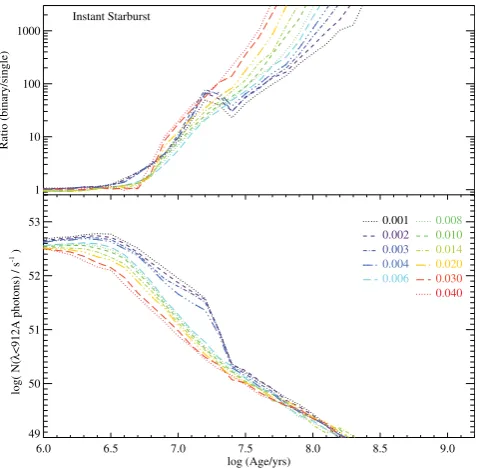
In Figs4and5, we show the effect of metallicity on the ionizing photon production rate as a function of age for the two star forma-tion histories discussed above. As expected, binary stellar evoluforma-tion models produce a higher ionizing flux at all times and metallicities, except within 10 Myr of the onset of star formation in the case of high metallicities. The photon production rate itself shows a clear trend with metallicity in a mature (>10 Myr) continuous starburst,
at University of Warwick on October 24, 2016
http://mnras.oxfordjournals.org/
[image:6.595.308.549.57.293.2]Figure 5. As in Fig.4, for the case of an ageing instantaneous starburst
with a stellar mass of 106M
.
with the lowest metallicities considered here (one twentieth of so-lar) yielding the highest the photon fluxes and the most metal-rich (twice solar) yielding the lowest for a given star formation rate. The binary and single-star model populations diverge most significantly at the lowest metallicities, where the binary population produces ∼60 per cent more ionizing photons than a single-star population, and least at the highest metallicities where the predictions for con-tinuously star-forming populations vary only∼20 per cent between single-star and binary models.
This behaviour with metallicity arises partly from an effect that can be seen in the instantaneous starburst evolution shown in Fig.5. At metallicities below a few tenths of solar, binary evolution path-ways extend the period over which a starburst shows high ionizing flux levels (within 2 orders of magnitude of the zero-age stellar population), from a few million years up to∼20 Myr. By contrast, higher metallicity models show a rapid decline in the ionizing flux from an ageing stellar population, as processes such as QHE (due to rotation) are unable to operate effectively. The result is that in composite populations, at low-to-moderate metallicities, there are a large number of ultraviolet-luminous stars in the 10-20 Myr age range that contribute to binary, but not to single-star, models. This leads to fluxes 1–2 orders of magnitude higher in binary popula-tions at a time immediately after the death of the most massive (and therefore ionizing) stars in the single-star models.
The metallicity dependence of the steady-state photon flux, seen at 100 Myr after the onset of continuous (1 Myr−1) star formation, is shown in Fig.6. The variation between our lowest and highest metallicity models is a factor of almost four in ionizing photon flux. As can be seen, there is a strong trend with metallicity, with metal-poor photons producing a higher ionizing photon flux, at a given star formation rate. This trend is exaggerated at low metallicities (Z
[image:7.595.303.548.56.306.2]<0.004) by the effects of QHE, and we show the photon fluxes for binary models with and without this effect in the figure. We compare the observed trend with that derived from the low-metallicity models by Schaerer (2003), updated by Raiter, Schaerer & Fosbury (2010). As those authors discuss, the extension of their assumed IMF (which unphysically neglects stars below 1 M) requires a correction factor
Figure 6. The steady-state ionizing flux from a continuously star-forming population, observed 100 Myr after the onset of star formation as a function of metallicity. Single-star models are shown in triangles, models incorpo-rating binaries with diamonds. The upper panel shows the ratio of ionizing
flux to continuum luminosity in units of photons s−1 per erg s−1 Å−1.
The dashed line in the lower panel gives photon fluxes from the models of
Schaerer (2003) and Raiter et al. (2010), given the correction factor
nec-essary to match our assumed initial mass function (see Section 3.4). The
dashed line in the upper panel shows the matching Raiter et al (2010) models
for photon-to-continuum flux ratio.
of 2.55 in photon flux, while the break below 0.5 Min the observed IMF requires a further correction factor of 0.77 (see Section 3.4 below). Fig.6demonstrates that, after correction for IMF effects, the models of Schaerer (2003) predicts a comparable photon flux to our models at near-solar metallicities, with larger discrepancies for metal enrichments below∼0.2 Zdue to the effect of binary evolution and rotation. However, our models differ from those of Schaerer (2003) and Raiter et al. (2010) in that we generate this photon flux at a continuum luminosity typically 0.1 dex lower.
3.4 Initial mass function
There is now observational evidence a small number of stars atM=
100–300 Min nearby star-forming regions (Crowther et al.2010). While these are few in number, they are extremely luminous in the ultraviolet and thus provide a correction to the ionizing flux that is modestly metallicity dependent, resulting in a stellar population that is ‘top heavy’ relative to most previous work.
To explore the impact of this and other IMF effects, we have cre-ated model populations with a range of different IMFs as described in Table1. We model the distribution of initial stellar masses as a broken power law, such that:
N(M < Mmax)∝ 0.5
0.1 M
M
α1
dM
+0.5α1 Mmax
0.5 M
M
α2
dM. (2)
at University of Warwick on October 24, 2016
http://mnras.oxfordjournals.org/
Table 1. The range of stellar initial mass functions (IMFs) explored in Section 3.4. Our default IMF is number 3. The final two columns give the mean correction factor applied to the ionizing photon flux such that
Nion(imfn)=bnNion(imf3) for binary evolution models, whilesnprovides
the same factor for single-star populations.
α1 α2
Model (0.1–0.5 M) (0.5 MtoMmax) <bn> <sn>
1 −1.30 −2.00,Mmax=100 M 2.55 2.68
2 −1.30 −2.00,Mmax=300 M 4.05 4.37
3 −1.30 −2.35,Mmax=100 M 1.00 1.00
4 −1.30 −2.35,Mmax=300 M 1.45 1.54
5 −2.35 −2.35,Mmax=100 M 0.77 0.74
6 −1.30 −2.70,Mmax=100 M 0.32 0.30
7 −1.30 −2.70,Mmax=300 M 0.41 0.41
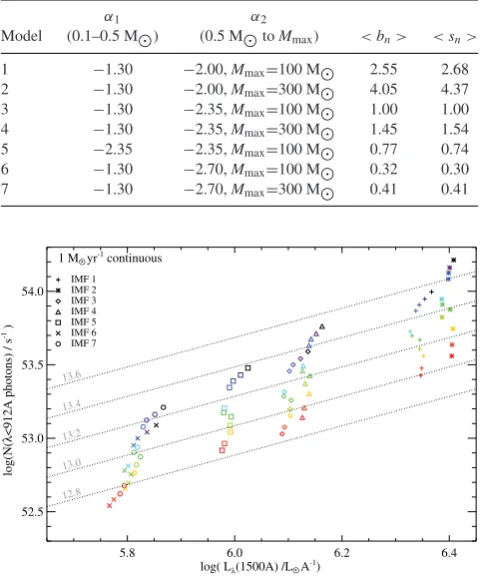
Figure 7. The ionizing photon flux from a continuous star formation
episode, forming 1 Myr−1 and a binary stellar population, observed
108.5yr after the onset of star formation, and its variation with
metallic-ity and initial mass function. The key shows the initial mass function choice
as given in Table1. Dotted lines indicate lines of constant ionizing flux to
continuum flux ratio in units of photons s−1/erg s−1Å−1.
To reproduce the Salpeter-like IMF (as used in e.g. Madau & Dickinson2014), we selectα1=α2= −2.35,Mmax=100 M
(model 5 in Table1), while our standard assumed IMF has a break at
M=0.5 Mwithα1= −1.30,α2= −2.35 and an upper limitMmax
=100 M(number 3). We also explore the effect of increasing the upper stellar initial mass limit, given our assumed power-law slopes (number 4). A steeper slope ofα2= −2.70 models the proposed
IMF of Scalo (1986) (numbers 6 and 7), and we also consider the effect of a shallower ‘top-heavy’ IMF withα2= −2.00 (numbers 1
and 2).
The impact of these variations in IMF on the ionizing flux output for a continuously star-forming population (after the initial stabi-lization phase), is shown in Fig.7. As suggested in Section 3.3, our choice of IMF results in a∼30 per cent excess in ionizing flux over that of model 5 for the same continuous star formation rate, while adopting a higher mass limit would give a flux∼50 per cent higher than our standard model. As Fig.6showed, accounting for the bro-ken power-law IMF, and for the stars withM=0.1–1 Mthat were not included in the Schaerer (2003) models, we find good agree-ment with the predicted ionizing flux in that work for our single-star models, but a divergence in the binary models, particularly at low metallicities, where the effects of QHE are significant.
4 O B S E RVA B L E S
4.1 UV spectral slope
At high redshifts, diagnostic features of stellar populations are red-shifted out of observable wavebands and information may be limited to rest-frame ultraviolet emission. As Fig.3showed, the 1500 Å continuum flux is a reasonable, but not entirely unambiguous pre-dictor of ionizing photon flux. The strong dependence of the latter on star formation history and of the former on stellar mass involved in the most recent starburst suggests that additional information may be required to make a reliable estimate of ionizing photon emission rate. One possible source of such information is the rest-frame ul-traviolet spectral slope, β, defined though a power-law fit to the ultraviolet continuum of the formfλ∝λ−β.
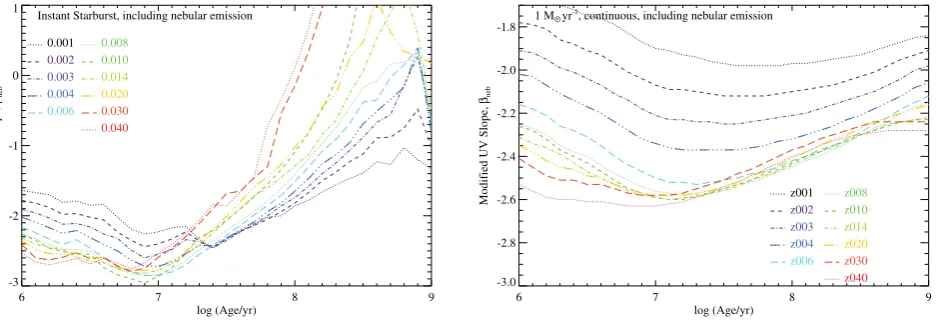
In Fig.8, we examine the behaviour of the intrinsic stellar spectral slope as a function of age, metallicity and star formation history. In the continuous star formation case, the spectral slope (as measured by a linear fit to the 1250–1750 Å spectral region) shows little dependence on metallicity, and only modest dependence on stellar population age. At all metallicities, the ultraviolet spectral slope converges toβ= −2.3±0.10 at an age of∼1 Gyr. In the context of distant galaxies, observed within the first billion years of star formation, it is interesting to note that below this age, the intrinsic spectral slope can reach values as steep asβ= −2.9, with steeper slopes observed at younger ages and lower metallicities, although we note that the nebular continuum effects will modify the observed slope redwards of this value.
The general trend is similar, although more extreme, in the case of an ageing instantaneous starburst. These can reach slopes as steep asβ= −3 in the case of a young, 10 Myr, stellar population atZ<0.006, although such starburst only remains bluer than the continuous star formation case until 15–30 Myr after the starburst occurs, making this a relatively short-lived stage. It is notable that high-metallicity stellar populations redden much more rapidly than those at lower metallicities, which remain bluer thanβ= −2.0 more than 100 Myr after the starburst occurs.
So, ifβ is sensitive to star formation history, the question re-mains: can the rest-frame ultraviolet spectral slope clarify the pre-dicted ionizing photon flux that should be inferred from a given 1500 Å luminosity? In Fig.9, we explore this question, given two measurements of the intrinsic ultraviolet spectral slope – one, as above, based on fitting the 1250–1750 Å spectral region (as might be the case for very high redshift photometric or spectroscopic observations), and a second based on the 1500/2300 Å flux ratio
(as measured, for example by theGALEX FUV−NUVcolour at
low redshift). The 912/1500 Å flux ratio is not strongly dependent on ultraviolet slope, but does vary with metallicity and star for-mation history. Interestingly, the slope between 1500 and 2300 Å may prove to be diagnostic of metallicity in a given star formation case; by contrast, the behaviour of the 1500 Å spectral slope is not strongly correlated with ionizing flux output, yielding a range of possible ionizing photon rates for a givenβ.
The continuum established by emission from hot, young stars as discussed above is modified both by an emission component from photoheated nebular gas, and scattering and absorption by inter-stellar dust before observation, both of which tend to redden the intrinsic stellar spectrum. This effect can lead to a significant dif-ference between the intrinsic and apparent spectral slope, which is itself metallicity dependent. We caution that the results are some-what sensitive to gas density and geometry but estimate the neb-ular emission component by processing our models through the
at University of Warwick on October 24, 2016
http://mnras.oxfordjournals.org/
Figure 8. The intrinsic rest-frame ultraviolet spectral slope, arising from the stellar population and measured at 1500 Å, as a function of age for instantaneous and continuous star formation models (left and right, respectively). Note the two cases are plotted on different scales for clarity.
Figure 9. The 912/1500 Å flux ratios (infλ), shown as a function of intrinsic rest-frame ultraviolet spectral slope measured at 1500 Å (left) and the 1500/2300 Å flux ratio (representative of continuum measurements, right). Starbursts are shown with dotted lines and continuous star formation models with solid lines. Two representative metallicities are shown for clarity.
Figure 10. The modified rest-frame ultraviolet spectral slope, arising from the stellar population, as in Fig.8and processed through a radiative transfer model to include the effects of nebular emission.
publically available radiative transfer and photoionization code
CLOUDY (Ferland et al. 2013), assuming a moderate gas density
of 102cm−2and spherical geometry suitable for H
IIregions (see
Stanway et al.2014, for discussion of the effect of gas density). As shown in Fig.10, for continuously star-forming systems, at near-solar metallicity and older than 10 Myr, the effect of nebular emission is relatively small, reddening the observed slopes by of
orderβ ± 0.05. The effect of the nebular component on low-metallicity spectra is stronger (up toβ±0.6 at 0.1 Z) and per-sists to late times. As a result low-metallicity populations forming stars at a constant rate over time-scales of 100 Myr cannot reproduce the blue colours observed in the distant Universe, and either short lived or rising bursts are necessary to reproduce observations. The recent compilation of observational constraints by Duncan et al.
at University of Warwick on October 24, 2016
http://mnras.oxfordjournals.org/
[image:9.595.64.533.459.619.2](2014) suggests that the Lyman break galaxy population exhibits no clear evidence for a steepening ofβwith redshift, and a statistically significant but weak trend with ultraviolet luminosity, with more luminous (MUV∼ −22) galaxies appearingβ∼0.3 redder than faint galaxies (MUV∼ −17) atz=4. By contrast Bouwens et al. (2014) claim stronger evolution with both luminosity and age, with β∼0.7 over the same luminosity range atz=4.
Observational data thus suggests that either the star-forming galaxies observed in the distant Universe are observed early in their starbursts, when the bluest slopes are expected, or that the evolution in observed rest-frame ultraviolet spectral slope is driven primarily by non-stellar factors - most likely variation in dust ex-tinction (Wilkins et al.2013; Duncan & Conselice2015) - which would compromise inferences regarding ionizing photon flux based on 1500 Å continuum luminosity.
4.2 Helium ionization
Given that spectroscopic observations of high-redshifts systems are currently limited to the rest-frame ultraviolet, several ultraviolet emission lines with high ionization potentials have now been sug-gested as diagnostic. Prominent amongst these is the HeII1640 Å
feature, usually associated with the hard ionization spectra arising from AGN but also potentially indicative of a hard stellar spec-trum such as might arise from metal-free, Population III stars. HeII1640 Å has been observed in the stacked spectra of star-forming
galaxies atz∼3 (Shapley et al.2003) and in individual cases at both higher and lower redshifts (e.g. Erb et al.2010; Cassata et al.
2013), but remains undetected in a number of other cases (e.g. Daw-son et al.2004; Cai et al.2011,2015). If velocity broadened, it is usually interpreted as emission driven by Wolf–Rayet star winds, while narrow line emission may indicate photoionization of nebu-lar gas by a hard, perhaps Population III, spectrum (although this interpretation is not unambiguous; Gr¨afener & Vink2015).
Helium is energetically less favourable to excite into emission than atomic hydrogen, with a critical maximum wavelengths for ionizing photons ofλc=228 Å. Our calculated rates for production of photons with wavelengths shorter than this critical value is shown in Fig.11for both constant and instantaneous starbursts. Unsurpris-ingly, the time evolution of ionizing flux is broadly similar to that of hydrogen-ionizing photons. In the case of continuous, ongoing star formation, the ratio between flux of hydrogen and helium ion-izing photons is fixed within 10 Myr of the onset of star formation. Interestingly, the flux ratio between hydrogen and HeIIionizing
photons is strongly dependent on metallicity, varying by more than a magnitude over the range of metallicities considered here due to the harder spectrum of the ionizing flux at low metallicities in our models (particularly when the effects of QHE boost the population of luminous blue stars at relatively late times).
In the case of an ageing instantaneous starburst, the ionizing flux ratios are far less stable, and difficult to characterize as a function of metallicity and stellar population age. Particularly at young ages, the flux ratios are highly sensitive to metallicity, varying over more than 5 orders of magnitude inNion,HeII/Nion,H, before converging
to a slightly higher ratio at late ages than in the continuous star formation case. If the galaxies we observe at high redshift are in-deed very young coeval starbursts, or are dominated by a single-age population, then the strength of HeIIemission is unlikely to
pro-vide an unambiguous indication of the strength of the photon flux contributing to hydrogen reionization.
5 I M P L I C AT I O N S F O R R E I O N I Z AT I O N
5.1 Critical star formation rate
The initial reionization of the Universe, occurring at the end of the cosmic dark ages and driven by the first ultraviolet-luminous sources, may well have been dominated by stellar populations with metallicities well below those considered here – perhaps metal-free, Population III stars (Schaerer2003). Current indications from the cosmic microwave background radiation suggest that this may have occurred atzreion ∼ 9 (Planck Collaboration XIII2015), beyond
current spectroscopic limits for normal galaxies, and at an epoch where only photometric selection is currently possible. However, the Universe in the tail end of the reionization process, atz∼5–6, is believed to be ionized to better than 99 per cent (Fan et al.2006), and this state must be maintained against the rapid recombination of hydrogen atoms in the cold IGM (Madau et al.1999; Madau &
Dickinson 2014). The SEDs of spectroscopically confirmed
ultraviolet-luminous galaxies in this redshift range are directly ob-servable (e.g. Douglas et al.2010; Stark et al.2013; Dunlop et al.
2013), and the requirement that they maintain ionization of the IGM provides informative constraints on their Lyman-continuum flux.
As discussed in Section 3, the production of hydrogen-ionizing photons is a sensitive function of stellar population age, metallicity and star formation history. However, given reasonable assumptions for these parameters, it is possible to constrain the volume-averaged star formation rate (and 1500 Å flux density) required to maintain the ionization of the IGM as a function of redshift. To do so, we define three models to provide estimates for the photon production rate:
Case A:Constant star formation, seen at an age of 100 Myr with a total stellar mass of 108M
formed at a rate of 1 Myr−1, and
photon production rates ofNion,H=(1.0–3.9)×1053s−1using our
binary star formation models, dependent on metallicity.
Case B:An equal age starburst, with a total stellar mass of 108M
, seen 10 Myr after the onset of star formation, with photon production ratesNion,H=(0.8–8.9)×1053s−1, corresponding to a
time averaged star formation rate of 10 Myr−1.
Case C: An equal age starburst, with a total stellar mass of 108M
, seen 30 Myr after the onset of star formation, with photon production ratesNion,H=(0.10–0.16)×1053s−1, corresponding to
a time averaged star formation rate of 3.3 Myr−1.
While these are, of course, selected snapshots in star formation history, they are indicative of the differences in behaviour between different models. The output properties arising from each scenario is illustrated in Fig.12. In each case, the same total stellar mass would be measured using an SED fitting technique, and the star formation rate would likely be inferred from a combination of that, template-dependent, procedure and a fixed conversion factor applied to the rest-frame ultraviolet luminosity. As the figure demonstrates, the inferred star formation rates and ionizing photon fluxes are far from easy to interpret. Case B (the 10 Myr starburst) shows a rest ultraviolet luminosity only two times higher than that of case A (continuous star formation), despite having a time averaged star formation rate ten times higher over its stellar lifetime. The ionizing photon fluxes in these two scenarios are also similar, differing only by a factor of∼2, but with the higher luminosity case yielding the lower photon flux. By contrast, while cases B and C (the two ageing starbursts) differ by a factor of∼3 in ultraviolet luminosity, similar to the difference in their volume-averaged star formation rate, they differ by a factor of∼12 in ionizing photon flux. Remembering that these represent only three scenarios, and that true star formation
at University of Warwick on October 24, 2016
http://mnras.oxfordjournals.org/
Figure 11. The rates of production of photons with energies exceeding the thresholds for HeIIionization for a range of ages and metallicities. The upper
panels show the ratio of these photon production rates with those capable of ionizing hydrogen photons, i.e.Nion,HeII/Nion,H.
Figure 12. The rates of production of hydrogen-ionizing photons and rest-frame ultraviolet luminosity for three scenarios generating the same
stel-lar mass, 108 M
. The three star formation history cases described in
Section 5.1 are shown with different symbols, with binary models coloured by metallicity. The results of our single-star models are shown in grey-scale for comparison.
histories are likely a more complex combination of continuous, declining or instantaneous star formation, it is clear that a great deal of caution must be exercised in interpreting the ionizing flux based on ultraviolet continuum.
The Madau et al. (1999) criterion for the critical, volume-averaged star formation density, at which the rate of hydrogen-ionizing photon emission precisely balances that of recombination in the IGM, was scaled by Topping & Schull (2015) to produce the following prescription:
˙
ρSFR=(0.012 Myr−1Mpc−3)
×
(1+z) 8
3
CH/3
fesc/0.2
T 104K
1053.3
Nion,H
, (3)
whereNion,His the lifetime-averaged production rate of photons per second per solar mass per year of star formation,T is the aver-age temperature of IGM,fesc is the fraction of Lyman-continuum photons that escape local absorption and reach the IGM andCH
=<n2 > / <n>2is the degree to which the IGM is clumped
and so subject to self-shielding against ionization, given thatnis the hydrogen gas density. Since our models do not constrain these gas parameters, we calculate the volume-averaged star formation required to maintain ionization relative to the scaling above. Any photons produced above this critical threshold at the highest red-shifts (z >7) are available to ionize further hydrogen atoms, and so progress the process of reionization, but this threshold must be met even atz=3–6 in order to maintain the ionization state. At lower redshifts still, the ionization contribution from active galactic nuclei starts to become substantial (Fan et al.2006; Madau & Dickinson
2014).
In Fig.13, we use our three fiducial star formation history cases to calculate the required, volume-averaged 1500 Å continuum lu-minosity density to maintain the ionization of the Universe, as a function of redshift, given our predictions forNion,H, and assuming
CH=3,fesc=0.2 andT=104K atz=7. In all but case A, we
require a higher star formation rate density and luminosity density to maintain the ionization state than those estimated by Madau et al. (1999) or Topping & Schull (2015), due to the short ionizing life-times of ageing starbursts. However, the critical 1500 Å luminosity density is broadly consistent with that of Madau et al. (1999) for the continuous star formation case at near-solar metallicity, and we actually require a lower 1500 Å luminosity density for continuous star formation at the lowest metallicities.
5.2 Lower mass limits
The number density and luminosity distribution of the rest-frame ultraviolet-luminous, star-forming galaxy population is now well established atz∼3–6, and their characteristics constrained (sub-ject to small number statistics and possible contamination and
at University of Warwick on October 24, 2016
http://mnras.oxfordjournals.org/
[image:11.595.43.285.335.502.2]Figure 13. The critical average ultraviolet flux density per unit volume
required to maintain the ionization balance of the Universe atz=7, assuming
CH=3,fesc=0.2 andT=104K (see Section 5.1) and the three fiducial
star formation histories assumed in Fig.12and Section 5.1. The dashed line
indicates the critical luminosity density of Madau et al. (1999), assuming
LUV=8×1027(SFR/Myr−1) erg s−1Hz−1and a Salpeter IMF (Madau
et al 1998).
completeness concerns, see Stanway, Bremer & Lehnert 2008) based on colour-selected candidates atz∼7–10 (Bouwens et al.
2015). While these luminosity functions likely underestimate the number of star-forming galaxies at a given mass, and the intrinsic emission of each, due to the effects of dust extinction, they provide a good measure of the number of galaxies with sufficiently low dust obscuration to irradiate their surroundings with ionizing photons. By summing the volume-averaged flux density emitted by galaxies at each luminosity, down to some minimum luminosity, and consid-ering the relations demonstrated in Section 4, the ionizing photon flux arising from the galaxy’s stellar population can be calculated. The minimum luminosity (or equivalently mass) limit appropriate for this procedure is a matter of some uncertainty, and may well vary with redshift, as galaxies grow sufficiently massive to collapse under their own gravitation and begin star formation, or massive enough to retain their gas supply against the stellar winds driven by intense starbursts. While some authors have chosen only to con-sider galaxies which exceed an absolute magnitudeMUV = −15 (e.g. Madau & Dickinson2014), others integrate down toMUV=
−10 (e.g. Robertson et al.2015) or into the regime at which dwarf galaxies and globular clusters meet (see Mu˜noz & Loeb2011, and discussion therein). Given the steepness of the low-luminosity end of the luminosity functions measured atz >3 (Reddy & Steidel
2009; Bouwens et al.2015), a relatively small difference in mini-mum mass can give rise to a strong difference in ionizing flux.
In Figs14and15, we consider the three star formation scenarios introduced in Section 5.1, and in each case determine the minimum galaxy mass required to produce the critical 1500 Å luminosity den-sities shown in Fig.13and thus maintain the ionization state of the IGM. We continue to assumeCH=3,fesc=0.2 andT=104K, and
[image:12.595.316.544.58.213.2]scale the required flux to each observed redshift as specified in the prescription of Topping & Schull (2015). We use the Lyman break galaxy luminosity functions derived by Bouwens et al. (2015) as a function of redshift, based on the largest currently available set of deep field observational data, and assume these Schechter (1976) function parametrizations extend to lower luminosities, beyond cur-rent observable limits (although note thatz >6 Lymanαemitting
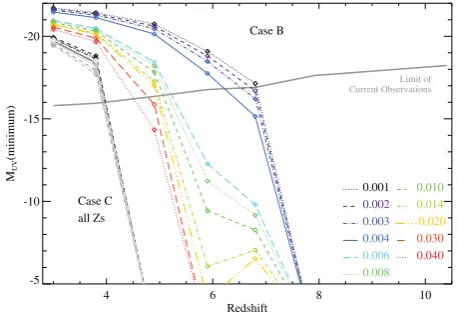
Figure 14. The lowest luminosity galaxies required to maintain the ioniza-tion of the intergalactic medium as a funcioniza-tion of redshift and metallicity, assuming the integrated 1500 Å ultraviolet luminosity density given by the
Lyman break galaxy luminosity functions of Bouwens et al. (2015). The
limit of the deepest observations used by Bouwens et al is shown with a solid line. Models are shown for continuous star formation (case A, see Section 5.1 for details).
Figure 15. As in Fig.14but assuming Lyman break galaxies can typically be described by 10 Myr or 30 Myr old starburst models (i.e. case B or C). Case C is shown in grey-scale and exhibits very little metallicity dependence.
galaxies may deviate from such a Schecter function; Matthee et al.
2015).
If the Lyman break galaxy population is dominated by regions with ongoing, continuous star formation exceeding∼10 Myr in age (case A), our models suggest that the galaxy population already observed in existing deep field observations is sufficient to maintain the ionization state of the Universe atz <7, but that doing so at z∼8 would require both a low-metallicity stellar population (Z<
0.2 Z) and a galaxy luminosity distribution that extends down as far asMUV= −10 to 12. At redshifts higher than this, our models cannot produce the critical ionizing flux, given current galaxy pop-ulation observations, suggesting either that the luminosity function steepens still further, that the conditions in the IGM are evolving with redshift, or that exceptionally low metallicity, Population III stellar populations may become important.
In the case of instantaneous starbursts, ageing passively and typ-ically observed at 10 or 30 Myr after the burst (cases B and C), the maintenance of ionization balance with current galaxy luminosity distributions becomes challenging at redshifts abovez=4.5 and z= 6, respectively, except at the lowest metallicities considered
at University of Warwick on October 24, 2016
http://mnras.oxfordjournals.org/
[image:12.595.314.544.306.462.2]here. While the possibility that young starbursts may dominate atz ∼5–7 remains present (particularly given the blue observed ultra-violet slopes, Section 4.1), this would suggest substantial evolution in the IGM properties (perhaps most likely the escape fraction,fesc, see Section 5.3) or in the metallicity of the stellar population. We note that the critical ionizing flux is usually calculated as a lifetime average for the stars formed, whereas we are taking a somewhat different approach here, directly converting the rest-frame ultra-violet continuum in observed galaxies to a photon flux assuming different conversion factors. Given the vast uncertainty in actual star formation history the detailed conversion factors may well differ, but these calculations give some indication of possible constraints given assumptions about the dominant, observed stellar population.
5.3 Lyman-continuum escape fraction
We have already considered theL912/L1500ratio as a function of ul-traviolet spectral slope, determining in Section 4.1 that it is difficult to predict or extrapolate ionizing flux levels from observations long-wards of the Lyman limit. However measurements of this quantity now exist, both directly through observations of Lyman-continuum photons from distant galaxies and indirectly from the ionization state of the IGM as traced by the Lymanαforest. The interpretation of these measurements in the context of stellar population models is complicated by our lack of knowledge offesc, the fraction of Lyman-continuum photons that escape local absorption and reach the IGM. Most of the ionizing flux emitted by stars will be absorbed by nearby gas and dust and re-emitted at other wavelengths, predominantly in a continuum component and strong emission lines such as Hα. Only a fraction of the intrinsic ionizing radiation arising from the stellar population will escape and this factor is uncertain as we cannot measure the ionizing flux directly. However if a stellar population, or range of stellar populations, is assumed, then constraints can be placed onfesc.
Models of reionization have led to suggestions that the fraction of photons escaping from high-redshift galaxies must be very high. Fontanot et al. (2014) suggestfesc=0.1–0.3 is required for stars in galaxies to reionize the Universe, while Haardt & Madau (2012) use a redshift-dependentfescfor their work which is even greater. Such high escape fractions are contentious. High-resolution simu-lations of galaxy properties, rather than reionization itself, struggle to produce high values, finding a typicalfesc∼5 per cent (Ma et al.
2015).
[image:13.595.311.542.52.386.2]Observations in the local Universe also favour a low value, sug-gesting that only very massive star-forming regions in galaxies leak a significant fraction of photons into the diffuse interstellar medium (Oey & Kennicutt1997; Eldridge & Rela˜no2011). It is unknown what fraction of these can then escape into the IGM. Observa-tions of so-called ‘Lyman break analogues’ – local, ultraviolet-luminous galaxies which mirror the physical conditions of more distant sources (Stanway & Davies2014)– have suggested that the ‘leakiness’ of galaxies to Lyman-continuum photons is strongly correlated to their compactness and the speed of galaxy-scale out-flows driven by the galaxy-wide starburst (Alexandroff et al.2015). Given that both compactness and occurrence of outflows appear to be common in the distant Universe (e.g. Oesch et al.2010; Steidel et al.2010), it might be expected that high escape fractions are pos-sible. However, simulations by Cen & Kimm (2015) suggest that the picture is more complex still, with a broad range of escape frac-tions present within a given galaxy population, and large samples required to accurately recover them.
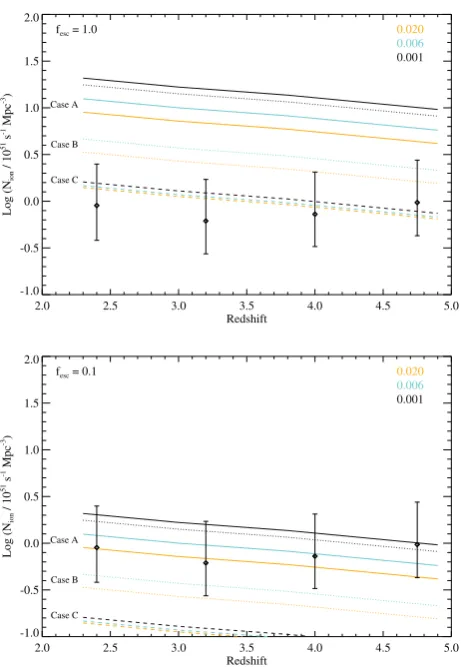
Figure 16. The ionizing photon flux generated by the Lyman break galaxy population, assuming the 1500 Å ultraviolet luminosity density given by
the Lyman break galaxy luminosity functions of Bouwens et al. (2015)
and Reddy & Steidel (2009) and integrated down toMUV= −10,
com-pared to that required to reproduce the observed ionization of the IGM at
intermediate redshift as measured by Becker & Bolton (2013, diamonds).
Models are shown for three representative metallicities, two values of the Lyman-continuum escape fraction and the star formation cases defined in Section 5.1.
At higher redshift (z >2), where the ionizing continuum has red-shifted into the optical, it becomes possible to measure the amount of leaking continuum directly, but, given the difficulty of doing so, only for small samples of galaxies. Unfortunately, byz ∼4 the mean opacity of the IGM becomes very high, leaving a narrow red-shift window in which measurements can be made. Only rarez= 3–4 LBGs have an estimatedfescof 0.25–1, with the majority un-detected in deep Lyman-continuum imaging (Vanzella et al.2012; Vanzella et al.2015). Shapley et al. (2006) detected two sources, with a sample-averagedfesc∼14 per cent, while most studies (e.g. Mostardi et al.2013; Nestor et al.2013) suggest that LBGs atz∼ 2–4 have a relatively modestfescof 0.05–0.07. However such con-clusions are inevitably based on assumptions regarding the emitted spectrum and its comparison with observations.
In Fig.16, we compare the ionizing photon flux predicted by our models, given the integrated flux arising from the observed 1500 Å luminosity functions of Lyman break galaxies as a function of redshift (Reddy & Steidel2009; Bouwens et al.2015), to the ionizing photon flux inferred by Becker & Bolton (2013) based on measurements of the Lymanαforest atz∼2–5. We integrate the galaxy population to an absolute magnitude limitMUV= −10,
at University of Warwick on October 24, 2016
http://mnras.oxfordjournals.org/