June 2019
CAN SOMEONE BURST THE BUBBLE?
An exploration of Industry 4.0 in collaborative settings within the logistic domain, as a first
step towards implementation.
Organization:
University of Twente
Faculty of BMS
Master BA
Committee:
Dr. A.M. Von Raesfeld - Meijer
Ir. B. Kijl
G. Alders (Emons)
M. Wouterse (Emons)
Author:
Dennis Schreinders
I
ACKNOWLEDGEMENTS
This is the master thesis of Dennis Schreinders, written for the master study Business Administration at the University of Twente. The thesis contains a research that has been carried out at Emons Group. The topic of this research/thesis focusses on the trend of Industry 4.0 in collaborative settings. Emons is a SME that is active in the logistic industry. As one of many, Emons perceive a potential for themselves through industry 4.0, while acknowledging their current unpreparedness for implementing these new
technologies. To help companies like Emons with this current unpreparedness within this topic, this research suggests exploring the field of industry 4.0 in collaborative settings as a first step towards implementation. This exploration is carried out at their customers to gain insights on their experience, drivers, barriers and partner preferences within this specific domain.
In the last five months at Emons I became a little familiar in the wide world of logistics. I remember my introduction with Marcel Wouterse at the Logistics and IT fair in Utrecht, where I witnessed a master class in the for me completely new and complex world of control towers within logistics. In the following weeks I tried to become known in this area and noticed soon that my knowledge in logistics in general was not sufficient. Digging deeper into a subject that is relatively new to me during a master thesis, is a true challenge. The urge of overcoming this challenge feels like an adventure to me and that triggers. Over this rollercoaster period of getting to know the subject, determining a solid research direction, adjusting to a new company culture and managing expectations from the university, I feel like I am more than ready for the next chapter in my life.
First of all, I would like to thank Sebastiaan Piest for connecting me with the company Emons at the point I was a little lost in looking for a master thesis subject. Second, I would like to thank the company Emons that provided all the room and hospitality for working on my thesis. A special thanks to my external supervisors Gerard Alders and Marcel Wouterse for their valuable support during my thesis period. I would also like to thank William Emons that assisted me during the interview days and helped me connecting with their customers. At last I would like to thank my internal supervisors Ariane von Raesfeld and Bjorn Kijl at the University of Twente for their advice and support in this research.
II
ABSTRACT
Because of the rapid technological progress, the complexity within the manufacturing industry have steadily increased. Where new trends and catchwords such as digitalization, the internet of things (IoT), internet of services (IoS) and cyber-physical systems (CPS) become more and more relevant, Germany, launched the so-called “Industrie 4.0”. This initiative in 2011 is part of its high-tech strategy, introducing the idea of a (fully) integrated industry. To create a networked and agile integrated value chain, company borders need to be crossed and logistics should be involved. With that, major challenges arise. For a lot of companies (especially SME’s), the increase in complexity leads to uncertainty on the overall impact Industry 4.0 has on their business model. With this uncertainty, a lack on concretization towards the implementation of industry 4.0 rises. To prepare these companies for implementing industry 4.0 in the nearby future, further implementation steps need to be assessed. Hence, this research aims to give these companies a first step on implementing the concept of Industry 4.0, by exploring the field of Industry 4.0 in collaborative settings within the logistic domain. Theory shows that this could best be executed by exploring the collaborative environment. Here the experience, drivers, barriers and partner preferences are discussed regarding Industry 4.0 in collaborative settings. These elements were explored by a multi-method design. By interviewing five top management positions within the logistic domain of the glass industry, the individual insights on their company’s insights towards the research topic became revealed, while a focus group with four top management practitioners within the logistic domain of the retail industry provided collective insight. Analysis of the exploration shows several important insights. First of all, the analysis reveals that within the logistic domain there is little to no experience when it comes to Industry 4.0 in collaborative forms. One best case stood out and provided a clear difference in the analysis of the elements. For example, the analysis shows that respondents with less experience tend to have an internal focus instead of an external focus and do not see a link between sustainability and Industry 4.0, while the case with experience did see a link and had a more external focus. Moreover, the analysis shows that the low level of digitalisation, bounded rationality and the missing of a solid business case keep companies with less experience from engaging with Industry 4.0 collaborations. A lot of companies do not yet feel ‘ready’ to achieve the idea of a fully integrated industry (Industry 4.0). Based on the results an alternative conclusion suggest that a lot of companies have a common misunderstanding towards
Industry 4.0 in the context of possibilities. Ultimately, the paper suggests learning from experienced cases and foresees a huge potential for platform-based collaborations, even in domains where unexperienced companies do not see a link.
III
CONTENT
Acknowledgements ... I Abstract ... II List of figures ... V List of tables ... V
1 Introduction ... 1
Problem statement ... 2
Significance of topic ... 3
Method ... 4
Reading guide ... 4
2 Theoretical framework ... 5
Methodology of literature review ... 5
2.1.1 Narrowing down the literature ... 5
Industry 4.0 ... 7
2.2.1 Industry 4.0 and logistics ... 8
2.2.2 Supply chain visibility ... 9
2.2.3 Control towers ... 9
2.2.4 Collaboration and industry 4.0 ... 10
Exploring collaboration in industry 4.0 settings ... 12
2.3.1 Collaborative experience ... 13
2.3.2 Drivers ... 15
2.3.3 Barriers ... 15
2.3.4 Partner preferences... 17
Exploration model ... 21
2.4.1 Propositions ... 22
3 Methodology ... 23
Research design ... 23
Measurement instrument ... 23
Units of analysis ... 24
3.3.1 Selection methods ... 25
3.3.2 Actual respondents... 25
IV
Analysis methods ... 26
Reliability and validity ... 27
3.6.1 Reliability ... 27
3.6.2 Validity ... 28
Summary ... 28
4 Results ... 29
Interviews ... 29
4.1.1 Respondent A ... 29
4.1.2 Respondent B ... 31
4.1.3 Respondent C ... 33
4.1.4 Respondent D ... 36
4.1.5 Respondent E ... 38
Focus group ... 40
Overall – Cross case ... 42
4.3.1 Collaborative experience ... 42
4.3.2 Drivers for collaboration... 43
4.3.3 Partner preferences... 44
4.3.4 Barriers for collaboration ... 45
5 Discussion ... 46
Conclusions ... 46
Discussion ... 48
Practical implications ... 49
Limitations and future research ... 50
6 References ... 51
Appendix 1: Interview guide ... 55
Appendix 2: Focus group guide ... 58
Appendix 3: Interview invite ... 61
Appendix 4: Informed consent form ... 62
Appendix 5: Interview transcripts ... 63
Appendix 6: Focus group notes ... 92
V
LIST OF FIGURES
Figure 1: Situation sketch ... 2
Figure 2: Interaction between humans and machines via CPS (Brettel et al., 2014) ... 7
Figure 3: Logistic oriented industry 4.0 model (Hofmann et al., 2017) ... 8
Figure 4: The scope of vertical collaboration (Barratt, 2004) ... 11
Figure 5: Type of relationships (Lambert et al. 1996) ... 11
Figure 6: Maturity model to the industry 4.0 vision (Ganzarain et al., 2016) ... 13
Figure 7: PPM maturity model (Gartner, 2014) ... 14
Figure 8: Stage model of manufacturing SME's in industry 4.0 context (Müller et al., 2018) ... 14
Figure 9: Main drives for collaboration based on Palmer et al. (2012) ... 15
Figure 10: Motivation versus role in industry 4.0 (Müller et al., 2018) ... 15
Figure 11: Partner selection for creating product advantage by collaboration (Emden et al., 2012) ... 18
Figure 12: Elements of a collaboration (Barratt, 2004) ... 18
Figure 13: Hierarchical structure for evaluating strategic fit (Naesens et al., 2009) ... 19
Figure 14: Hierarchical structure for evaluating strategic fit (Palmer et al., 2012 based on Naesens et al., 2009) ... 20
Figure 15: Framework for exploring Industry 4.0 in collaborative settings based on Palmer et al. (2012) .. 21
Figure 16: Focus group notes ... 92
LIST OF TABLES
Table 1: Search terms ... 5Table 2: Search criteria ... 6
Table 3: Key articles ... 7
Table 4: Interview respondents... 25
Table 5: Focus group attendees ... 25
Table 6: Summary of analysis respondent A ... 31
Table 7: Summary of analysis respondent B ... 33
Table 8: Summary of analysis respondent C ... 35
Table 9: Summary of analysis respondent D ... 38
Table 10: Summary of analysis respondent E ... 40
1
1 INTRODUCT
ION
In recent years, the complexity andrequirementsin the manufacturingindustry have steadilyincreased. Factors such as growing international competition,increasingmarket volatility, demandfor highly individualized products and shortenedproductlife cycles present serious challenges to companies (Ganschar, O., Gerlach, S., Hämmerle, M., Krause, T., & Schlund, S., 2013). While the complexityin the industryincreases,it also opens new doorsfor a range of new business potentials and opportunities because of the rapid technological progress. According to Hofmann, E., & Rösch, M.(2017), trends and new catchwords such as digitalization, theinternet of things(IoT),internet of services(IoS) and cyber-physical systems (CPS) are becoming more and more relevant.
Against this rapid technological progress and new business potentials,Germany,launched the so-called “Industrie 4.0”initiativein 2011 as part ofits high-tech strategy,introducing theidea of a(fully)
integratedindustry(Barreto, L., Amaral, A., & Pereira, T.,2017).Since the introduction,Industry 4.0 has gained more importance,also beyond the German-speaking area,and has even beenlisted as a main topic on the 2016 WorldEconomic Forum’s agenda. Byintroducing the so-calledfullyintegratedindustry, itrefers tointegration between all business processesin the value chain across hierarchical levels and company boundaries (Liao, Deschamps, Loures, & Ramos, 2017). A definition ofindustry 4.0 thatisinline with theidea of afullyintegratedindustry and illustrate theimportance of crossing company boundaries both horizontal as vertical, will be usedfor this research: “Recent technological advances where the internet and supporting technologies(e.g. embedded systems) serve as a backbone tointegrate physical objects, human actors,intelligent machines, productionlines and processes across organizational
boundaries toform a new kind ofintelligent, networked and agile value chain.”(Schumacher, Erol, & Sihn 2016).
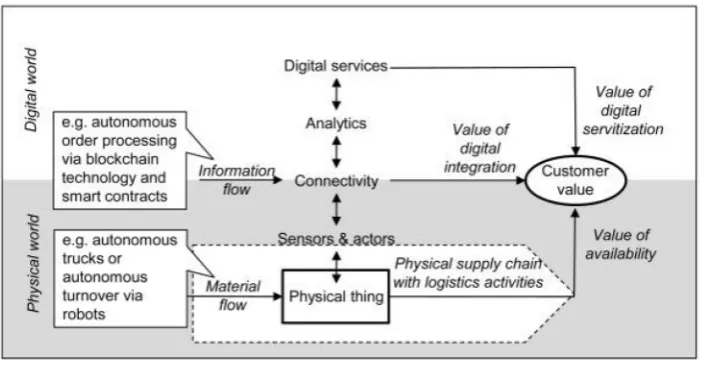
One way to create a networked and agile value chain,is byinvolvinglogistics. Infact,Hofmann et al. (2017)argue thatIndustry 4.0inits pure vision can only become realityiflogisticsis capable of providing production systems with the neededinputfactors at the right time,in the right quality andin the right place. But alsoinlogistics there are big challenges rising because ofindustry 4.0.A two-dimensioned logistic orientedindustry 4.0 modelimplies that there are three customer value components expected fromindustry 4.0: Valueof availability, value of digitalintegration and value of digital servitization
(Hofmann et al., 2017). Whereas the value of digitalintegration rises through a preamble transparency of the supply chain. Barreto et al.(2017) acknowledges this and mentions thatindustry 4.0 challenges might require technological changes such as: high needfor transparency(supply chain visibility) and integrity controlin the supply chains.
2 Vasconcelos, & Kaminski(2014) Control Towers are typically set-up to monitor, measure, manage
transport and manageinventory movements across the supply chain. This requires collaboration on horizontal and verticallevel. “Regarding the supply chain, the digital transformation and the use of intelligent and collaborative systems will make the supply chain smarter, more transparent and more efficientin every stage.”(Barreto et al., 2017).
Prob
lem
statement
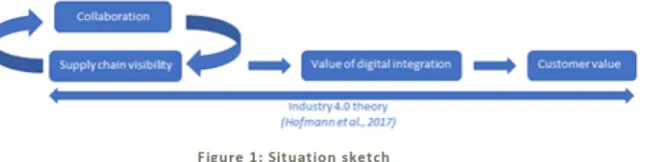
Although the industry 4.0concept is there, the realization ofit on SME scale has notfoundits start. (Müller, Buliga & Voigt, 2017; Hofmann et al., 2017).Emons groupis a small to medium sizelogistic service provider, providing mostlylogistic services to the glassand retail industry.Recognizing the opportunities industry 4.0 has, they are willing to collaborate vertically based onindustry 4.0 theory to raise supply chain visibility.With these solutions they seek to create customer value. Thisisline with the logisticindustry 4.0 model asit concentrates on the mentioned‘value of digitalintegration’, seeFigure 1. (Hofmann et al., 2017). Although theideais there, Emonsis still seeking concretefields of actionin collaborating.Theyfind difficulties with connecting to their customers on this particular subject.
Figure 1: Situation sketch
Emons, as a SME,is not the only company that deals with this problem. Byforming thisfar reaching industry 4.0vision,itis obvious thatit willlead to anincreased complexity of processes on the micro and macrolevel(Schuh, Potente, Varandani, & Schmitz,2014). Thisincreasein complexity canlead to uncertainty. Schumacher et al.(2016) acknowledge this by mentioning that especially small-and medium sized companies are uncertain about thefinancial effort requiredfor the acquisition of such new
technology and the overallimpact on their business model.Müller et al.(2018) elaborate more on these impactsin business models.For SME’s that areinternally motivated to perceive a potentialfor themselves throughindustry 4.0 while acknowledging their current unpreparednessforimplementing new
[image:9.595.80.407.329.410.2]3 Forimplementingindustry 4.0 technologiesinlogistics, company borders need to be crossed.
(Schumacher et al., 2016; Hofmann et al., 2017; Barreto et al., 2017). Crossing company borders means collaborating closely with partners. For example, to create supply chain visibility.(Schumacher et al., 2016). Also, on the research agenda of smartindustry, one of the key action pointsis collaboration. (Smartindustry.nl, 2014).Collaborations need to beformed to eventuallyimplementindustry 4.0 technology inlogistic context.(Hofmann et al., 2017).To prepare preliminary stage planners on implementingindustry 4.0 technologyin the nearbyfuture, exploring the collaborative network about collaboratingin this context could be afirst step. Palmer et al.(2012) describein their collaboration framework thefirst step of collaboration as exploring. Although the paper of Palmer et al.(2012) does not focus collaborationsinindustry 4.0 context,it does seem tofitin with the paper of Müller et al.(2018) who urgefor qualitatively assessing theimplementation steps ofIndustry 4.0in SMEs asfurther research directions. One of theseimplementations steps can beexploring thefield of collaboration inindustry 4.0 settings of their collaborative network.
S
ign
i
f
icance
o
f
top
ic
While theliterature mentioning the key argumentsfor SME’s not engaging withindustry 4.0 relevant solutions and not finding concretefields of actions upon this theme, solutions are ratherleft unspoken. “SME’s seem tofind problemsin determining their state-of-development with regard to theIndustry 4.0 vision and thereforefail toidentify concretefields of action, programs and projects.”(Schumacher et al., 2016). Exploring thefield of collaboration inindustry 4.0 settings of the collaborative network of SME’s finds hisimportance here, asit can be seen as afirst step towardsimplementation(concretisation) of industry 4.0 on the mid-tolong-term for SME’sin thelogistic sector.Also, academicinvestigationinto Industry 4.0 extensivelyfocuses onlarge enterprises(Arnold et al., 2016,Radziwon et al., 2014) and only marginally on SMEs(small and medium-sized enterprises)(Schmidt et al., 2015, Mülleret al., 2018). This while SMEs provide afruitful research sample, as those represent over 99% of the companieslocatedin the EU and hire between 50 and 70% of thefull time equivalent of persons employed.(Müller et al., 2017). From an empirical point of view,looking at the case of Emons, theimportance can befoundin that they can adjust their strategy towards collaboratingin industry 4.0settings to the exploration of their collaborative environment.Therefore, this paper tends to answer thefollowing research question:
What insights forlogistic SME’scomeforward when exploring collaboration inindustry 4.0 settingsof theircollaborative network?
Giving thelack of literature onsolutionsfor SME’s inlogistics that are willing to collaborateinindustry 4.0 settings butfail to concretiseit,this research aims to give these SME’s afirst step onimplementing industry 4.0 technology on the mid-tolong-term. With thisfirst step insights about their collaborative network on collaborating inindustry 4.0 settings will befeasible.
4
Method
This researchis a single case study. Emonsis a SME workingin thelogisticindustry.Therelogistic services arefocussed on the glass and retailindustry.To explore the field of collaborationinindustry 4.0 context of the collaborative network of a SME, the glassindustry and retailindustry will be used as units of analysis. By analysing different companies from adifferent industries, customersand non-customers, a general view/exploration on the field of collaborationtowards industry 4.0tends to arisefor this single case. As said before, these scoping decisions arefurther discussedin section 3.1.
Furthermore, a multi-methods research approach contributes to understand the attitude of different customers towards collaborationsinindustry 4.0 settings. Semi-structured qualitativeinterviews with five top management practitioners within the glass industry seek to provideindividualinsightson their
company’s insightstowards the research topic. Furthermore, afocus group with fourtop management practitioners from different companies within theretail industry seeks to provide acollectiveinsight on theindustry’s thoughtstowards collaborationsinindustry 4.0 settings. How to explore the fieldof collaborationinindustry 4.0 context of a collaborative network,is a theoretical question that will be answeredin the theoreticalframework. Thisforms the content of the semi-structuredinterviews and focus group.
Read
ing
gu
ide
5
2 THEORET
ICAL
FRAMEWORK
The theoreticalframework gives overview ofthe currentliteraturein relation to industry 4.0and collaborations. This resultsinformslikesupply chain visibility, collaboration studies and theories about partner selection. Therefore, this chapter suggestsintegration ofthe concepts to achieve a common understanding servingfurther analysis of the research. The methodology ofliterature reviewis discussed beforehand.Atlast, a researchframeworkis established based on theintegration between the different theories where also some propositions will be arguedlinked to the research question.
Methodo
logy
o
f
l
iterature
rev
iew
To acquire background knowledge on the subject and display the key papers related to, a literature reviewis executedin a systematic way(Webster and Watson, 2002). This means thatfirst, search assignments are determined. Secondly,inclusion and exclusion criteria are stated. These criteria create a scope and are used to shorten thelist of references that are obtained using the search assignments. Thirdly, the search assignments are executed, and duplicates are removedfrom the results. Fourthly, the articles are examined using theinclusion and exclusion criteria. Fifthly, the shortenedlistis read and articles that are not valuable are removed. Also, using backwards reading, otherinteresting articles are added. Lastly, the concepts are merged and usedin the discussion below.
2
.1
.1 NARROW
ING
DOWN
THE
LITERATURE
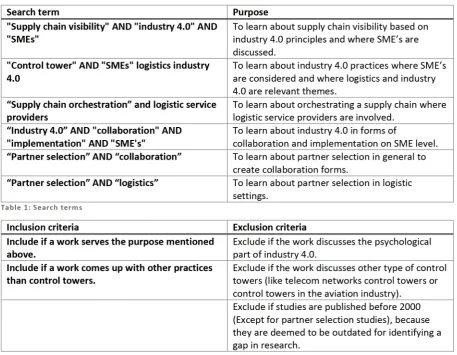
Search assignments and their purposein theliterature review are:
Search term Purpose
"Supply chain visibility" AND "industry 4.0" AND
"SMEs" Toindustrylearn about 4.0 pr suppinciplyles cha andin where visibility SME based’s are on discussed.
"Control tower" AND "SMEs"logisticsindustry
4.0 Toarelearn cons aboutidered industry and where 4.0log practisticsices andwhereindustry SME’s 4.0 are relevant themes.
“Supply chain orchestration” andlogistic service
providers logTolearnistic s aboutervice prov orchestratiders areing ainvo supplvedly. chain where “Industry 4.0” AND "collaboration" AND
"implementation" AND "SME's" Tocollaboratlearn aboution andindustryimplemen 4.0intatformsion on o SMEf level. “Partner selection” AND “collaboration” Tolearn about partner selectionin general to
create collaborationforms.
“Partner selection” AND “logistics” Tolearn about partner selectioninlogistic settings.
Table 1: Search terms
Inclusion criteria Exclusion criteria
Includeif a work serves the purpose mentioned
above. partExclude ofindustryif the work 4.0 d. iscusses the psychological Includeif a work comes up withother practices
than control towers. towersExclude (ilfike the te worklecom d networksiscusses other contro typel towers of contro orl control towersin the aviationindustry).
[image:12.595.70.528.405.760.2]
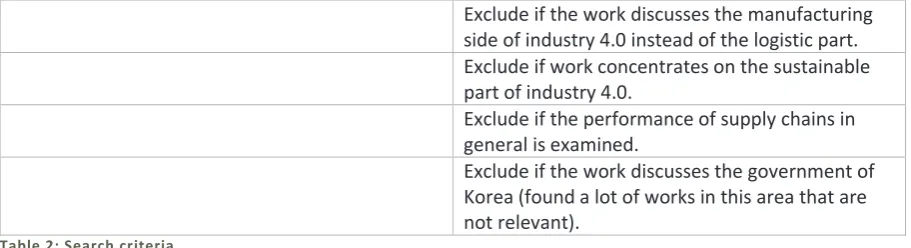
6 Exclude if the work discusses the manufacturing side of industry 4.0 instead of the logistic part. Exclude if work concentrates on the sustainable part of industry 4.0.
Exclude if the performance of supply chains in general is examined.
[image:13.595.71.527.71.195.2]Exclude if the work discusses the government of Korea (found a lot of works in this area that are not relevant).
Table 2: Search criteria
The literature review yielded the following results. With the search terms and criteria, Google scholar and LISA were examined. They provided a total of 378. After removing all the duplicates, 260 remained. These articles were scanned and assessed using the criteria by looking at the title and reading the abstract. By excluding irrelevant papers, 45 remained for reading. After having read these articles up to the point where key findings could be extracted, 27 remained. With snowballing techniques, 11 more studies were added. This resulted in a total of 38 papers that were included in the research and will be seen as the key articles that are central to this study.
Articles Quantity Category
Francis, (2008); Somapa, Cools, & Dullaert (2018); Bartlett, Julien, & Baines (2007); Barratt & Oke (2007); Morgan, Richey JR., & Ellinger (2018); Kaipia, & Hartiala (2006); Vanpoucke, Vereecke & Muylle (2017)
7 Supply chain visibility (characteristics, advantages, measurement techniques, frameworks, etc.)
Co & Barro (2009); Dalmolen, Moonen & van
Hillegersberg (2015); Struiwigh (2012); Barratt (2004)
4 Supply chain collaboration (Characteristics, Frameworks & barriers)
Trzuskawska-Grzesińska (2017); Yan, Tan, Koh, Tan & Zhang (2012); Alias, Goudz, Jawale & Noche (2015); Vasconcelos & Kaminski (2014)
4 Control towers (Business examples, definitions, explaining and business models for implementing)
Brettel, Friederichsen, Keller & Rosenberg (2014); Müller, Buliga & Voigt (2018); Masdefiol, del Mar & Stävmo (2016); Liao, Deschamps, Loures & Ramos (2017)
4 Industry 4.0 & reasoning for and against
Barreto, Amaral & Pereira (2017) 1 Industry 4.0 & supply chain visibility
Kazantsev, Pishchulov, Mehandjiev, Sampaio & Zolkiewski (2018); Ganzarain & Errasti (2016); Kagermann (2015)
3 Industry 4.0 & collaboration & barriers and guidelines
Nieuwenhuize (2016); Hofmann & Rüsch (2017); Schumacher, Erol & Sihn (2016); Strandhagen, Alfnes, Strandhagen & Vallandingham (2017)
4 Industry 4.0 & logistics & implementation
Schuh, Potente, Varandani & Schmitz (2014) 1 Industry 4.0 & SMEs in particular
Bronder & Pritzl (1992), Brouthers K, Brouthers L & Wilkinson (1995), Eisenhardt & Schoonhoven (1996), Whipple & Frankel (1998)
4 Partner selection in general
Audy, Lehoux, D’Amours & Rönnqvist (2012), Naesens, Gelders & Pintelon (2009), Schmoltzi & Wallenburg (2011), Palmer, Saenz, van Woensel, & Ballot (2012), Van Breedam, Krols & Verstrepen (2005), Verstrepen, Cools, Cruijssen & Dullaert (2009)
7
Total: 38
Table 3: Key articles
Industry
4
.0
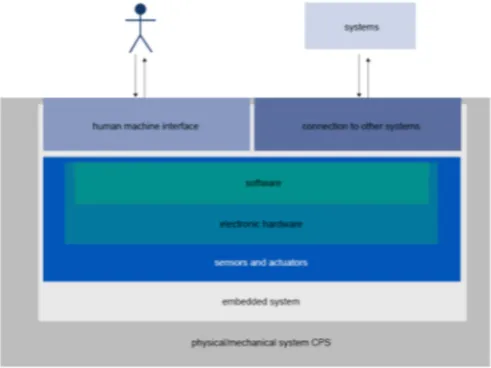
Thefirstinteresting topic to discussisindustry 4.0. According to Hofmann, E., & Rösch, M.(2017), trends and new catchwords such as digitalization, theinternet of things(IoT),internet of services(IoS) and cyber-physical systems (CPS) are becomingmore and more relevant. Against this rapid technological progress and new business potentials, Germany,launched the so-called “Industrie 4.0”initiativein 2011 as part of its high-tech strategy,introducing theidea of a(fully)integratedindustry (Barreto et al. 2017).According to expertsfromindustry and research, the upcomingindustrial revolution will be triggered by the Internet, which allows communication between humans as well as machinesin Cyber-Physical-Systems (CPS)(Brettel et al., 2014). Figure 2 shows an example of a CPS. Ithas beenlisted as a main topic on the 2016 World Economic Forum’s agenda. A joint report by the FraunhoferInstitute and theindustry association Bitkom, shows the huge potential ofindustry 4.0 andsaid that German gross value can be boosted by a cumulative 267 billion euros by 2025 afterintroducingIndustry 4.0. Here we only discuss Germany.If you would spread this over worldfiguresit would be tremendous.
Figure 2:Interaction between humans and machines via CPS (Brettel et al., 2014)
The corefocus ofindustry 4.0find his wayin theidea of afullyintegratedindustry. Byintroducing the so-calledfullyintegratedindustry,it refers tointegration between all business processesin the value chain across hierarchical levels and company boundaries(Liao, Deschamps, Loures, & Ramos, 2017). A definition ofindustry 4.0 thatisinline with theidea of afullyintegratedindustry andillustrate theimportance of crossing company boundaries both horizontal as vertical, will be usedfor this research: “Recent
[image:14.595.75.321.338.522.2]8
2
.2
.1 INDUSTRY
4
.0
AND
LOG
IST
ICS
Although we see the industry 4.0literaturemostlyfocussing on the manufacturingindustry, thelogistic industryfinds his wayin the topic also.Infact,Hofmann et al.(2017) argue thatIndustry 4.0inits pure vision can only become realityiflogisticsis capable of providing production systems with the needed inputfactors at the right time,in the right quality andinthe right place.Whichfallsin place when considering the urgefor crossing company borders (Liao et al., 2017; Brettel et al., 2014; Schumacher et al., 2016).Therefore, some studies refer to the term logistics 4.0. “Logistics 4.0 can be summarized as the optimization ofinbound and outboundlogistics which must be supported byintelligent systems,
embeddedin software and databasesfrom which relevantinformationis provided and shared though Internetof Things(IoT) systems,in order to achieve a major automation degree.”(Strandhagen et al., 2017). But alsoinlogistics there are big challenges rising because ofindustry 4.0. Logistics 4.0 might require for example ahigh needfor transparency(supply chain visibility) and integrity control(right products, at the right time, place, quantity, condition and at the right cost) of the supply chain (Barreto et al., 2017; Strandhagen et al., 2017;Macaulay, Buckalew & Chung,2015).This high needfor transparency is necessary to create afullyintegratedindustryby crossing company borders. This raises theimportance oflogistics adapting toindustry 4.0, as they have the chance tofollow up on the needfor transparency. That industry 4.0isthe main topic of one of the world’s biggestlogistic fairin MünchennextJune stresses this out even more.
Theimportance of logistics adapting toindustry 4.0isframed by Hofmann et al.(2017)as they suggest a two-dimensionedlogistic orientedindustry 4.0 model. This modelimplies that there are three customer value components expectedfromindustry 4.0 inlogistics: Value of availability, value of digitalintegration and value of digital servitization. A visual representation of this modelis shownin Figure 3.
Figure 3: Logistic orientedindustry 4.0 model (Hofmann et al., 2017)
[image:15.595.71.422.452.636.2]9 As a third option, the two worlds together can deliver a veryimportant customer value. Thisis what
Hofmann et al.(2017) call the value of digitalintegration, whereas the value of digitalintegration rises through a preamble transparency of the supply chain. Barreto et al. (2017) acknowledge this by
mentioning that the emerge ofindustry 4.0 technology requiresfor transparency(supply chain visibility). “Furthermore, order processing systems areinterconnected,facilitating seamless business executions (e.g. object self-service, remote usages or condition monitoring).”(Hofmann et al., 2017).The
interconnecting area corresponds with thepaper of Müller, Buliga & Voigt(2018) that emphasize that Industry 4.0 encompasses three dimensions, namely high-grade digitization of processes, smart
manufacturing, andinter-company connectivity. Thelast dimensionisidentical and shows theimportance of the urge to cross company borders when consideringindustry 4.0 theory.
2
.2
.2 SUPPLY
CHA
IN
V
IS
IB
ILITY
The definition of supply chain visibility(SCV)is difficult to describe properly. Francis(2008) elaborated a literature review on the definition of SCV where atleast 20 of them passed by. The definition that describes SCV on both strategic as operationallevel will be usedfor this research: “supply chain visibility means thatimportantinformationis readily available to those who needit,inside and outside the organization,for monitoring, controlling and changing supply chain strategy and operations,from service acquisition to delivery.” (Schoenthaler, 2003). AccordingtoHolweg, Disney, Holmström & Småros (2005) the common goal of supply chain collaborationis to create a transparent, visible demand pattern that paces the entire supply chain. Which aligns supply chain visibility with collaboration.
Somapa, Cools, & Dullaert(2018), tend to subdivide SCVin three characteristics that can be measured: accessibility of theinformation, quality of theinformation and the usefulness of theinformation.
Importantfactorsfor companies notengaging with supply chain visibility other than miscommunication of the definition(Francis, 2008), are mentioned by alot of articles. Poor data quality, trustissues,lack of scalable technology and the unavailability of technology by SMEs are the most mentioned barriers. (McCrea, 2005;Songini, 2000;Huddleston, 2002)Kaipia & Hartiala (2006), react to these barriers as they come up with fiveproposalsforimproving SCV. “They suggest that onlyinformation thatimproves supply chain performance should be shared, demand-supply planning processes must be stabilized and
synchronized, different demand data sources should be usedin parallel, customer collaboration offers a wider view to demand, and that suppliers’ needfor demandinformation differsfromthose of
downstream actors.”(Kaipia et al., 2006).
Theimportance of SCVin a supply chain can be confirmed by an article of Bartlett,Julien, & Baines(2007), whereas their research shows that creating SCVimproves the overall supply chain performance. Although theimportance of SCVis well understood, Barratt & Oke(2007) put the terminto perspective as their research shows thatthelevel of visibility across different externallinkages differs considerably,based on various contributingfactors which are both technology and non-technology based.
2
.2
.3 CONTROL
TOWERS
10 most revealing definitionis givenin a whitepaper by Capgemini: “A central hub with the required
technology, organisation, and processes to capture and use supply chain data to provide enhanced visibilityfor short-andlong-term decision-making thatis aligned with strategic objectives.”(Capgemini, 2017).Important points within the definition are a central hub and the requirement of technology, organisation and processes. Whenlooking at technology,ITinnovationis veryimportant. “ITinterfaces are necessary because the control tower uses real-time datafrom existing transactional systemsin order tointegrate processes and tools across the end-to-end supply chain.”(Bleda 2014).Looking at thefuture, Trzuskawska-Grzesińska(2017) propose three optionsfor manufacturers to work with control towers: develop their own control tower to control own conversion processes, offer control towers as a service (e.g. within 4PL service package),or purchase the control tower servicefrom a specialized service provider.
Also, Alias, Goudz,Jawale & Noche(2015) present a business model canvas that has been developed to examine possible ways of exploiting the potential of Future-Internet-basedlogistics control towersin the transportation andlogistics domain. Both papers(Yan et al. 2012; Alias et al. 2015) can be usedfor designing a control tower. Although this research does not aim to design a control towerinlogistics the concept can be useful as a concrete example of anindustry 4.0 solutioninlogistics.
2
.2
.4 COLLABORAT
ION
AND
INDUSTRY
4
.0
When crossing company borders, collaborationis necessary.Supply chain collaboration has been viewed as a business process whereby two or more supply chain partners work together toward common goals and achieve more mutual benefits than can be achieved by acting alone.(Cao & Zhang,2013;Manthou, Vlachopoulou & Folinas,2004;Sheu, Yen & Chae,2006). Kagermann(2015) shows that one of the two key instrumentsfor enhanced value creationin the Age ofIndustry 4.0 isplatform-based collaboration. Platform-based collaborationfocusses onintegrations across company borders based on data driven platforms. To create data driven platforms,information/data needs to be shared. Sharing informationis confirmed by Ellram(1995) that includes the sharing ofinformation along with sharing of risks and rewards. Connecting companies by data driven platforms agrees upon Muller et al.(2018) that mentions inter-company connectivity as dimensionforindustry 4.0. The inter-company connectivity corresponds again with the urgefor supply chain visibility, as visibility can only arise while collaborating across
company borders.(Brettel, Friederichsen, Keller & Rosenberg,2014; Schumacher et al., 2016; Hofmann et al., 2017; Barreto et al., 2017).
Collaborations across company borders can reachin several directions. Liao et al. (2017) mentionin their paper thatintegrations(horizontal, vertical and end-to-end) are the main research directionforindustry 4.0in the future.Theseintegrations can be established by collaborating. Liao et al.(2017)mention three forms ofintegrations, namely:horizontal, vertical and end-to-end. Collaborations also has these
11 partners raises the chances of a company’s performance. Meaning that the number of partners a
[image:18.595.74.294.111.296.2]company wants to collaborate with is critical.
Figure 4: The scope of vertical collaboration (Barratt, 2004)
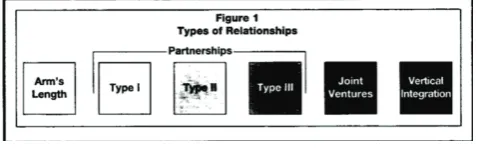
Also, the type of a particular relationship can be determined. Lambert et al. (1996) distinguishes five type of relationships, whereas the most weak relationship is called an arm’s length and the strongest a vertical integration (see Figure 5). The model of Lambert et al. (1996) distinguishes the different partnerships based on basic vs complex products/services and short vs long term decision making. The most interesting types are the type 1 till 3 partnerships as the options like joint ventures and vertical integration are a step further than a typical collaboration. The type 1 relationship typifies itself as organisations that, on a limited basis, coordinate activities and planning. Usually on short-term planning. Type 2 has a more long-term planning, although not ‘forever’. Multiple divisions and functions within the firm are involved in the partnerships. In type 3, organisations share a significant level of operational integration. Each party views the other as an extension of their own firm. Typically, no ‘end date’. “Possible collaborations in industry 4.0 context, will mainly focus on sharing information by data platforms.” (Kagermann, 2015). Based on this industry 4.0 focus, the model of Lambert et al. (1996) falls short. Although the urge of sharing data can be seen as a long-term planning, the relationship itself will not focus on sharing a significant level of operational integration but more on platform-based collaborations. (Schumacher et al., 2016; Hofmann et al., 2017; Barreto et al., 2017). Therefore, collaborations in industry 4.0 settings form a new type of relationship.
[image:18.595.70.309.604.678.2]12
Exp
lor
ing
co
l
laborat
ion
in
industry
4
.0
sett
ings
Although theidea of collaboratinginindustry 4.0 settingsis there, SME’s seem tofind problemsin determining their state-of-development with regard to theIndustry 4.0 vision and thereforefail to identify concretefields of action, programs and projects.”(Schumacher et al., 2016).Palmer et al.(2012) describein their collaborationframework thefirst step of collaboration as exploring. Although the paper of Palmer et al.(2012) does notfocus onindustry 4.0 collaborations,it does seem tofitin with the paper of Müller et al.(2018) who urgefor qualitatively assessing theimplementation steps ofIndustry 4.0in SMEs asfurther research directions. Exploring thefield of collaborationinindustry 4.0 settings of the collaborative network of SME’s can be seen as afirst step towardsimplementation(concretisation) of industry 4.0 on the mid-tolong-termfor SME’sin thelogistic sector. But how can collaborationin
industry 4.0 settingsof the collaborative networkfromlogistic SME’s be explored,sothat firstinsightsfor logistic SME’sabout concretizingindustry 4.0 comeforward?
13 So, can thefield of collaborationinindustry 4.0 context be explored by exploring the collaborative
environmentin industry 4.0 context?Exploring the collaborative environment encompasses drivers and barriers. This isthefirst stepin the exploration phase of Palmer et al.(2012). The second step of the exploration phaseis selecting potential partners on different assessment criteria, whichis also being examined when exploring the collaborative environment.Atlast, exploring the experienceinindustry 4.0 context helps with determining the maturity of industry 4.0of the specific unit of analysis(Ganzarain et al., 2016). Becauseliterature does not sufficein exploring collaborationinindustry 4.0 context of the collaborative network, alternatives need to be considered. Exploring the collaborative environment seems tofitin as the best alternative, asitfillsin two needs of different papers about collaboration andindustry 4.0 maturity.
2
.3
.1 COLLABORAT
IVE
EXPER
IENCE
Ganzarain & Errasti(2016) came up with a three-stage maturity model to help companies determining theirindividualindustry 4.0 vision. The three-stage modelis shownin Figure 6.
Figure 6: Maturity model to theindustry 4.0 vision (Ganzarain et al., 2016)
Ganzarain et al.(2016) come up with thefollowing three stagesin maturity: envision, enable and enact. The envision stageis dedicated to defining a tailoredIndustry 4.0 vision, developingits own
understanding generalIndustry 4.0ideas with company specific capabilities and resources. As afollow up, the enable stage startsfrom a substantialIndustry 4.0 vision and based on this vision, the company try to define the technology portfolio and capabilities neededto give support to the new product-service solutionsidentifiedin the previous stage. Thelast stage, the enact stage, turns thisindustry 4.0 specific strategy into concrete projects that are prioritized wisely.
Ganzarain et al.(2016) defined the model with thefollowinglevels,in order to apply the maturity model toimplementIndustry 4.0 scenario:
1. Initial: There doesn´t exist a company specificindustry 4.0vision 2. Managed: There exist a Roadmap ofindustry 4.0 strategy
3. Defined: Customer segments, value proposition and key resources defined 4. Transform: Transform the strategyinto concrete projects.
[image:20.595.73.378.306.495.2]
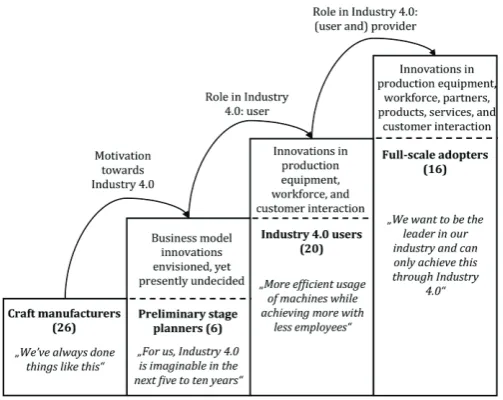
14 While this model is for an individual company to determine their own maturity towards industry 4.0, it looks a lot like project portfolio management maturity levels. For example, see Figure 7. The classic model of Gartner (2014) shows a lot of similarities with the model of Ganzarain et al. (2016). The similarities of the two maturity models is evidently found in the alignment of the strategy with the portfolios/projects further on when the maturity rises. Although the maturity levels are for determining a company’s own level towards industry 4.0, it could also be very useful to determine another company’s maturity towards it. When considering the collaborative experience in industry 4.0 context, the maturity could be a scale level for determining this. Also, the stage model of Müller et al. (2018) gives a clear understanding of manufacturing company’s engaging with industry 4.0 (see Figure 8). Although this model focusses on manufacturing company’s only, it does show an obvious maturity curve from traditional craft
[image:21.595.70.332.311.516.2]manufacturers to full innovative companies. Both the maturity model of Ganzarain et al. (2016) and the stage model of Müller et al. (2018) can be useful in analysing the collaborative experience. The model of Ganzarain et al. (2016), however, will be used as it is more detailed and providing more small steps in-between the stages.
[image:21.595.70.322.544.744.2]Figure 7: PPM maturity model (Gartner, 2014)
15
2
.3
.2 DR
IVERS
Palmer et al.(2012) made animportant contribution to the main drivers forcollaboration, shownin Figure 9. The main driverfor collaboration betweenlogistic providersis cost reduction, but also demanding customers and servicelevel areimportant. Although these drivers are notfocussed on industry 4.0, they arefocussed on collaborationinlogistic context.
Müller et al.(2018) made an important contribution to the driversforcollaboration withindustry 4.0. They suggest a difference betweeninternallymotivated and externally pressuredfor engaging with industry 4.0.Also seeingindustry 4.0 in a user role orina provider role, brings the motivationsin a matrix model shownin Figure 10.Both thefound drivers of Palmer et al.(2012) as the distinction between internally motivated or externally pressured can be usedin analysing the drivers ofcollaborationin industry 4.0 context. Also seeingitfrom a user role, provider role or both can be a good way to analysein cross-case conditions considering the relationship between the maturity androle withinindustry 4.0 found out by Müller et al.(2018).They are suggesting that seeingitfrom both a user as a provider role as a manufacturing company will raise the maturity towardsindustry 4.0. This can also be analysed.
Figure 10: Motivation versus roleinindustry 4.0 (Müller et al., 2018)
2
.3
.3 BARR
IERS
Barriersfor not collaborating inindustry 4.0 context or not are described byliteraturein abundance. Masdefiol, del Mar & Stävmo(2016) show thatfor SMEs not only thelevel thelevel of automation or the technologicalfeatures will determineif the concept ofIndustry 4.0isfeasiblefor them, but also the business strategy and culture, as well as the productfeatures and the leaders’ mind-set. Schumacher et al.(2016) acknowledge this by mentioning that especially small-and medium sized companies are Figure 9: Main drives for collaboration
[image:22.595.78.219.167.277.2] [image:22.595.71.324.481.633.2]16 uncertain about thefinancial effort requiredfor the acquisition of such new technology and the overall impact on their business model.Alias et al. (2015)mention technologicalimpediments and multiple sources of data not being available or combinable as possible reasons. “SME’s seem tofind problemsin determining their state-of-development with regard to theIndustry 4.0 vision and thereforefail to identify concretefields of action, programs and projects.”(Schumacher et al., 2016).
Kazantsev et al. (2018)foundfourbarriers that preventthe uptake of collaborationsinindustry 4.0 settings especiallyfor SMEs: trust, switching costs, knowledge deficits and bounded rationality. Here the focusis more on today’s knowledge that shinelight onindustry 4.0in combination with SME’s.
Building upon the needfor supply chain visibility(SCV), accessibility, quality and usefulness of the information areimportant elementsfor not engaging with the concept.(Somapa et al., 2018). Fourth,in SME context the quality of theinformationis even a moreimportantfactorfor companies not engaging with SCV. Trustissues,lack of scalable technology and unavailability of technology are the other most mentioned barriers. (McCrea, 2005;Songini, 2000;Huddleston, 2002;Kaipia & Hartiala,2006).Also, Alias et al. (2015)mention technologicalimpediments and multiple sources of data not being available or combinable as possible reasons. Putting all the theory together, thisleads to thefollowing overview:
1. Needfor supply chain visibility (Schoenthaler et al., 2003; Holweg et al., 2005; Somapa et al., 2018; Barreto et al., 2017; Strandhagen et al., 2017; Macaulay, Buckalew & Chung,2015)
❖ Bad availability ofinformation (Somapa et al., 2018;McCrea, 2005;Songini, 2000; Huddleston, 2002;Kaipia & Hartiala,2006; Alias et al., 2015)
❖ Bad accessibility ofinformation(Somapa et al., 2018; Kaipa et al., 2006) ❖ Bad quality ofinformation (Somapa et al., 2018; Kaipa et al., 2006) ❖ Bad usefulness ofinformation (Somapa et al., 2018)
2. Culture (McCrea, 2005;Songini, 2000;Huddleston, 2002;Kaipia & Hartiala,2006;Masdefiol et al., 2016; Kazantsev et al., 2018)
❖ Lack of trust (McCrea, 2005;Songini, 2000;Huddleston, 2002;Kaipia & Hartiala,2006; Kazantsev et al., 2018)
❖ No aligning business strategy (Masdefiol et al., 2016) ❖ Missing key people/leaders’ mindset (Masdefiol et al., 2016) ❖ Bounded rationality (Kazantsev et al., 2018)
3. Technological knowledge (McCrea, 2005;Songini, 2000;Huddleston, 2002;Kaipia & Hartiala, 2006;Kazantsev et al., 2018; Alias et al., 2015; Masdefiol et al., 2016)
❖ Technologicalimpediments (McCrea, 2005;Songini, 2000;Huddleston, 2002;Kaipia & Hartiala,2006)
❖ Lack of scalability towards technology (McCrea, 2005;Songini, 2000;Huddleston, 2002; Kaipia & Hartiala,2006; Strandhagen et al., 2017)
❖ Toolowlevel of automation(Masdefiol et al., 2016)
17 ❖ Too muchfinancial effort(Schumacher et al., 2016;Kazantsev et al., 2018; Strandhagen
et al., 2017)
❖ Switching costs (Kazantsev et al., 2018; Strandhagen et al., 2017) ❖ No solid business case/impact(Schumacher et al., 2016)
These barriers can be used to analyse and compare withthefound data when exploring barriers when collaboratinginindustry 4.0 context.Also, they can be used as conversation pointlater on when exploring and collecting data.
2
.3
.4 PARTNER
PREFERENCES
There are many studies concerning partner selection. To asses’ potential partners, a company needs to determine the variablesforits assessment. A broad range of selection criteriais provided byliterature. Hagedoorn(2006)implies that a partnership relationship becomes embedded at a certain point. This means that repeating a collaboration with a known partnerfirmis preferred over starting new
collaborations with strangers. The reasonfor thisis anincreasedfamiliarity and trust with known partners (Dekker, Gulati and Gargiuloin Dekker & Van den Abbeele, 2010), which urges the needfor trust within a possible partner. Besidesfamiliarity and trust there are several other aspects thatinfluence the partner search process.
[image:25.595.73.349.71.242.2]
18
Figure 11: Partner selection for creating product advantage by collaboration (Emden et al., 2012)
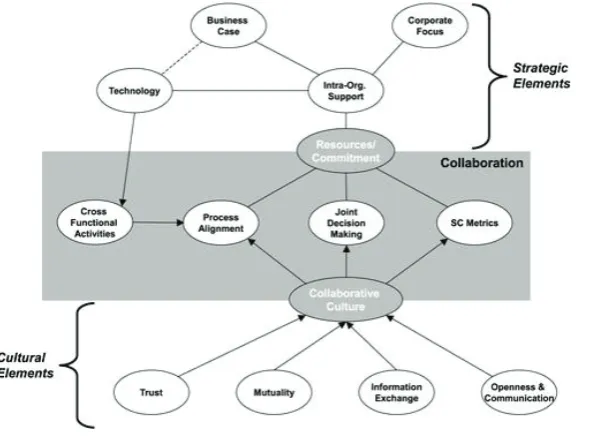
[image:25.595.73.373.409.628.2]Barratt (2004) discusses elements involving a successful collaboration between companies in a supply chain. He distinguishes three broad categories of elements: cultural, strategic and implementation elements, whereas the cultural and strategic elements lead to implementation elements as shown in Figure 12. So based on the cultural elements, both companies that collaborate should have the right trust, focus on mutuality rather than only themselves, are willing to exchange their information and are open in their communication. These cultural elements are in line with Palmer et al. (2012) that mention culture, trust and willingness to share data as the important factors for collaborating horizontally between logistic firms. Also, this corresponds to the paper of Dalmolen et al. (2015).
Figure 12: Elements of a collaboration (Barratt, 2004)
19 Eisenhardt & Schoonhoven (1996) discuss in their paper elements that raise the likeliness of an alliance formation. One of their key findings is that companies that operate from a vulnerable strategic position are most likely to form a strategic alliance. With a vulnerable strategic position, they call for examples like emergent markets, innovative technologies and high competition. This awareness of innovative
technologies is a particular important factor here, as SME’s are dealing with the trend of industry 4.0, which raises again the importance of collaboration/alliances. So technological knowledge is an important factor, which agrees upon the paper of Emden et al., (2006). Second, Eisenhardt & Schoonhoven (1996) found out that top management characteristics also affected the rate of alliance formation. Large,
experienced, and well-connected through former employers and high-level previous jobs formed alliances at higher rates. Such companies would be more likely to gain alliances if they needed them and to be offered attractive alliancing arrangements. Naesens et al. (2008) also pay attention to the importance of key people within a company by forming strategic alliances. One of the elements of a successful
collaboration he distinguishes is key people.
While key people are one important factor Naesens et al. (2009) describe, they also mention several others. In their paper they tend to break down the evaluation of strategic fit between two companies into a hierarchical structure model (see Figure 13). Their model focusses on horizontal collaborations only. This is of course significantly different from vertical collaborations. (Naesens et al., 2009). The completion, importance and the relationship between the elements will differ between horizontal and vertical collaborations. (Naesens et al., 2009; Bronder et al., 1992). Still the elements themselves can be very useful. The subdivision of evaluating strategic fit in criteria is striking. Company characteristics,
[image:26.595.71.464.470.704.2]competitive advantage, internal processes and external parameters are laid-out. Especially the concrete elements that drive the criteria, is something other studies seem to lack. This model gives a more overall decision-making framework for evaluating potential partners.
Figure 13: Hierarchical structure for evaluating strategic fit (Naesens et al., 2009)
20 Figure 14).They reconfiguredis based on other papers and their own data,interviewing and organizing focus groups with top sectorlogistic multinationals.Although thisis still much and still focusingon horizontal collaborations,it does tend tofocus on the mostimportantelements considering a successful collaboration within thelogistic sector.Also, the strategicfit has been subdividedinto other criteria. Putting all the theory together, thisleads to thefollowing overview:
Figure 14: Hierarchical structure for evaluating strategic fit (Palmer et al., 2012 based on Naesens et al., 2009) 1. Cultural/personal fit(Hagedoorn, 2006; Dekker, Gulati and Gargiuloin Dekker & Van den
Abbeele, 2010; Barratt, 2004; Palmer et al., 2012; Dalmolen et al., 2015; Bronder et al., 1992; Emden et al., 2006; Brouthers et al., 1995)
❖ Trust (Hagedoorn, 2006; Dekker, Gulati and Gargiuloin Dekker & Van den Abbeele, 2010; Barratt, 2004; Palmer et al., 2012; Dalmolen et al., 2015; Bronder et al., 1992; Emden et al., 2006)
❖ Familiarity(Hagedoorn, 2006; Dekker, Gulati and Gargiuloin Dekker & Van den Abbeele,
2010)
❖ Mutuality/fundamentalfit (Brouthers et al., 1995; Bronder et al., 1992; Barratt, 2004; Emden et al., 2006; Naesens et al., 2008; Palmer et al., 2012)
❖ Top management characteristics/ key people (Eisenhardt et al., 1996; Barratt, 2004; Naesens et al., 2009)
❖ Information exchange(Barratt, 2004; Naesens et al., 2008; Palmer et al., 2012) ❖ Openness (Barratt, 2004)
2. Strategicfit (Hagedoorn, 2006; Dekker, Gulati and Gargiuloin Dekker & Van den Abbeele, 2010; Barratt, 2004; Palmer et al., 2012; Dalmolen et al., 2015; Bronder et al., 1992; Emden et al., 2006; Brouthers et al., 1995)
❖ Compatible goals/ corporatefocus (Brouthers et al., 1995; Barratt, 2004: Dalmolen et al., 2015; Naesens et al., 2009; Palmer et al., 2012)
❖ Commensuratelevels of risk (Brouthers et al., 1995; Palmer et al., 2012; Emden et al.,
2006)
[image:27.595.74.446.168.352.2]21 ❖ Business case (Barratt, 2004; Dalmolen et al., 2015)
❖ Intra-organisational support (Barrat, 2004)
3. Operationalfit
❖ Size of company (Palmer et al., 2012)
❖ Product characteristics (Naesens et al., 2009; Palmer et al., 2012) ❖ Servicelevels (Naesens et al., 2009; Palmer et al., 2012)
❖ Processes (Naesens et al., 2009; Palmer et al., 2012)
4. Technologicalfit (Eisenhardt et al., 1996; Brouthers et al., 1995; Bronder et al., 1992; Emden et al., 2006; Barrat, 2004; Dalmolen et al., 2015)
❖ Complementary skills (Brouthers et al., 1995) ❖ ICTintegration(Naesens et al., 2009)
❖ Technological ability (Emden et al., 2006; Barratt, 2004; Naesens et al., 2009; Palmer et al., 2012)
❖ Market knowledge (Emden et al., 2006)
These partner selection elements can be used to analyse and compare with the found partner
preferences when exploring partner preferences when collaboratinginindustry 4.0 context. Also, they can be used as conversation pointlater on when exploring and collecting data.
Exp
lorat
ion
mode
l
To explore thefield ofindustry 4.0 in collaborative settings, several theories have beenreviewed with the goal offinding a valid construct formeasuring this specific topic. The reviewed theory revealedfour main elements that seem tofit best: Experience, drivers, barriers and partner preferences. Thesefour elements form together the collaborative environment in the paper of Palmer et al.(2012),that use this construct as part of alarge modelfor analysing a potential collaboration partner. In these specific research settings, this literature review showed that the construct could be used as a way of exploringindustry 4.0in collaborative settings. Figure 15 shows the construct that will be used as researchframework.
[image:28.595.148.444.562.730.2]22
2
.4
.1 PROPOSIT
IONS
Related to the research question, some propositions can be made beforehandbased on the research framework.Namely, severaltheories discuss direct orindirect a possible linkbetween the different elements.First of all, Müller et al.(2018) discusses in anindirect waythe connection between experience and drivers.Companies that haveless experiencein industry 4.0 tend toforesee only a user role within industry 4.0and no provider role.Foreseeing only a user role can be seen as aninternal motivation rather than external pressure, as these companies do notlinkindustry 4.0to other partners directly.Therefore, the firstproposition is:
“Respondents that tend to haveless experienceinindustry 4.0, have a moreinternal motivation towards the trend thanfeeling external pressured.”
Second, as a more of alogical proposition,barriers will most probably be existent at companies where there islittle to no experience.Kazantsev et al.(2018) do mention companies that are coping with
scalabilityissues while having experienceinindustry 4.0, but most of the mentioned barriers are based on companies that are not engaging withindustry 4.0.(Masdefiol et al., 2016; Kazantsev et al., 2018). Therefore, thefollowing proposition arise:
“Respondents withlittle to no experience withIndustry 4.0 tend to experience more barriers than companies with more experience.”
Third, the theory section of barriers and partner preferences show alot of similarities. For example, cultural/human based barriers(Kaipia & Hartiala,2006;Masdefiol et al., 2016; Kazantsev et al., 2018) and preferring to have a culturalfit whenlookingfor partners(Dalmolen et al., 2015; Bronder et al., 1992; Emden et al., 2006; Brouthers et al., 1995). Another example are technological barriers(Kazantsev et al., 2018; Alias et al., 2015; Masdefiol et al., 2016) and preferring to have a partner with a technologicalfit (Brouthers et al., 1995; Bronder et al., 1992; Emden et al., 2006; Barrat, 2004; Dalmolen et al., 2015). As all these similarities arise, thefollowing proposition can be made:
“Respondents give similar answers to their observed barriers as their preferences whenlookingfor a partner.”
23
3 METHODOLOGY
This chapter discusses the approach thatis taken to perform the research. Every sub-section discusses a step within the research design. The research design, measurementinstruments alongside the
operationalisation of the researchframework, units of analysis, the data collection procedures and the data analysis method will be discussed. Afterwards, a short assessment of the reliability and validity take place. Atlast, a summary ofthe methodology will be given.
Research
des
ign
This research aims to answer thefollowing question:
Whatinsightsforlogistic SME’s comeforward when exploring collaborationin industry 4.0 settings of their collaborative network?
To specify an approachfor this research, the type of researchfirst needs to be specified. The research tends tofind deeper understanding about collaborationsinindustry 4.0 context of the collaborative environment. A researchframeworkis proposed alongside argued propositions considering the relative broad research question.This demandsfor underlying reasoning and motivations, whichleads to new or confirmingideas. Thisis aniterative process, which makes this research a qualitative research.
“Qualitative research methods are usefulfor researching unexplored topics.”(Britten,Jones, Murphy & Stacy, 1995). Exploring the collaborative environment with the fourmentioned elementsin theliterature section is ofan explorative nature, sinceit represents a topic wherelittle scientific knowledgeis available about the process that will be examined(Stebbins, 2001). Qualitative research methods are most often (not exclusively) appropriate to explorea conceptual model, while quantitative researchis most often used to test a conceptual model(Verschuren & Doorewaard, 1995).
Measurement
instrument
To explore the collaborative environment,a multi-methods research approach will be used. A mult i-methods research approach contributes to understand the attitude of different customers towards collaborationsinindustry 4.0 settings.First of all, interviews will be used.Harrel and Bradley(2009) stated that researchers can useinterviewsfor a variety of purposes, such as collectinginformationfrom
individuals about their own practices, perception, attitudes, beliefs, or opinions.Three type ofinterviews are suggestedinliterature: Structured, semi-structured and unstructured. This research will use the sem i-structured design. Harrel and Bradley(2009) stated that semi-structuredinterviews are often used when the researcher wants to delve deeplyinto a topic and to thoroughly understand the answers provided(p. 27). This design suits the research best as several topics, provided by the newframework, need to be covered to gain proper understanding on the research question. For this reason, an unstructured design would not suffice. A structured design would also beless appropriate as this research demands for underlying reasoning and therefore does not provide enough spaceforinterrogating on specific topics.
24 flowing and members can usecommentsfrom others to stimulate recall.”(Harrel and Bradley., 2009). Observations would also be aninterestinginstrument, but due to various arguments this also seems out of bounds(time-limit, minimum sample sizefor observation).
The fourelements (collaborative experience, drivers, barriers and partner preferences) that are namedin the researchframework,will be used as main topicsfor the semi structuredinterview design andfocus group.However, partner preferences were not discussed during the focus group due to timelimits. According to theliterature, these elements fitin the best when exploringcollaboratinginindustry 4.0 settingsfrom a SME logisticperspective. Aninterview guideis usedfor the researcher as
operationalisation of the elements andto make sure thelist of topics will be covered. Thisinterview guide can befoundin Appendix 1: Interview guide.Thefocus group guide can befoundin Appendix 2: Focus group guide.With the elements as main topics, theinterpretation of them as well as underlying reasoning and prioritization will be questioned. The prioritization, however,is not discussed during thefocus group due to timelimits. The elements will be discussed withindustry 4.0 context as standpoint. For example, control towers or creating some sort of SCV trough sharing data as mentionedin section 2.2.3.
Un
i
ts
o
f
ana
lys
is
When wanting to conductinterviews, the units of analysis should be determined.In this case a specific unit of analysisis noticeable: Partners of(a) SME(s) operatingin thelogisticindustry and possible partners of(a) SME(s) operatingin thelogisticindustry. As this researchfoundits ground at Emons, this research has the unique opportunity to get access to possible partners. This means the specific unit of analysis can be met. Although this unique opportunityis there,it should be takeninto account that this are only the partners of one SMEin thelogisticindustry. This makes this research asingle case study.Emons also gave knowledge about companies that are not customers at the current moment. Theinterviews will be preferably held with the top-management positions of a partner or possible partner. This specific unitis chosen as these positions are most ofteninvolved orinfluentialin the decision-making process offorming collaborations and technological solutions.(Eisenhardt et al., 1999).
25
3
.3
.1 SELECT
ION
METHODS
Second, the selection method should be selected. To select the sample a combination of purposeful sampling and quota sampling. As mentioned before, this research tends tolookfor a specific unit of analysis. Bearingin mind that not every partneris willingto cooperatein this research, every specific unit of analysis should be used when possible. Due to thefact that a partner of a SMEin thelogisticindustry can have different purposes(customer, supplier, etc.), this research tends tofocus on customers only (forward vertical collaboration).Therefore, makingit purposeful. Subcategories canfor example be formed between customers and non-customers of Emons. Emons provided alist of ten potential persons that work at a company that serves currently as a customer. Also, Emons gave two companies that are currently not a customer. All these companies are companies within the glassindustry and will be selectedfor theinterviews. Emons also provided alist of 20 companies within the retailindustry that are invitedfor thefocus group.
Securing the correct sample sizeis hard to define. “In qualitative studies, sampling typically continues untilinformation redundancy or saturation occurs. Thisis the point at which no newinformationis emergingin the data.”(Maxwell, 2012). Therefore, itisimportant that collection and analysis of the data are occurring simultaneously. For this research, a sample size of atleast fiveunitsis desirable, becauseit strongly depends on the willingness of the partners of Emons to cooperate. Moreover, the most
important taskis that saturation occurs.
3
.3
.2 ACTUAL
RESPONDENTS
For theinterviews,five top managersin the supply chain of the glassindustrywere willing to cooperate. Table 4 illustrates the characteristics of the respondents.
Function Gender Located Contact-type Length Date
Logistic manager Female Germany Face-to-face 58:35 18-04-2019
Transport manager Female Germany Face-to-face 45:25 18-04-2019
Regional supply
chain manager Male Netherlands Face-to-face 60:45 24-04-2019
Logistic manager Male England Face-to-face 50:32 08-05-2019
Centrallogistic
manager Male Netherlands Face-to-face 53:55 09-05-2019
Table 4:Interview respondents
For thefocus group, fourtop managers within the supply chain of the retailindustry attended. Table 5 illustrates the characteristics of the attendees.
Function Gender Located Contact-type Length Date
Head of transport Male Netherlands Face-to-face ≈45:00 16-05-2019
Logistics manager Male Netherlands Face-to-face ≈45:00 16-05-2019
Transport manager Male Netherlands Face-to-face ≈45:00 16-05-2019
Regional transportation manager
Male Netherlands Face-to-face ≈45:00 16-05-2019
[image:32.595.73.539.445.557.2] [image:32.595.70.541.612.707.2]26
Co
l
lect
ion
procedures
To ensure that that the datais collected properly, collection procedures are set upin advance. Several recruitment strategies have been thought out based on the works of Morse, Barrett, Mayan,Olson & Spiers(2002); Marschall(1996) and Strauss & Corbin(1990) to make sure that enough data will be gathered and data saturation will be established.
- The customers will be approached personally with a personal salutation.
- There will be mentioned that the research guarantees confidentiality(No names or company
names)
- For the non-responders, a reminder will be sent.
- The content of the questionnaire and questions of theinterviews will be thought throughfirst, by testing them on colleagues of Emons before sending them to customers.
Theinterviewinvitation can befoundin Appendix 3:Interviewinvite.The data of theinterviews are collected preferableface-to-face. This will raise the chances of getting deeper knowledge on the attitude and motivation towards questions. Theinterviews were heldin different countries(Germany, the Netherlands and England) and together with anemployee of Emons, William Emons. When thisis not possible due to distance or timeissues, skypeis also acceptable.In both scenarios the conversation is completely recorded. This assures that no word will belost during the collection. Theinterviewees were to give permission beforehand. Also, theinterviewees were to sign an informed consentform. Thisform can befoundin Appendix 4:Informed consentform.three days before theinterview,theinterviewees were sent a general topiclist. This was done due to the complexity, so that theinterviewee could get familiar with the subjects.
Afterwards the record will be transcribed. To raise the reliability of the research, thetranscription of the interview will besent to theintervieweeforfeedback and validation. Here theinterviewee can add some words, change things that have not been understood well or approve was has beentranscribed. The interviewees participated on a voluntary basis and were not compensatedforit. All transcripts have been translated to English and cleanedfromfiller words orincomplete sentencesforimproved readability. Identifyinginformation was removed to ensure confidentiality. All transcripts of theinterviews van be foundinAppendix 5:Interview transcripts.
Thefocus group was held during a customer day within the company. 45 minutes were scheduled to do a focus group with the attendees.The attendees were to give permission beforehand. Also, they were to sign an informed consentform. Thisform can befoundinAppendix 4:Informed consentform.Thisfocus group could not be recorded due to permission issues;therefore, the attendees were to write key notes on an A3 paper in a workshopform. This collective paper can befoundinAppendix 6: Focus group notes. The attendees participated on a voluntary basis but were compensated afterwards with a general present from the company Emons and a comprehensivelunch.