http://wrap.warwick.ac.uk
Original citation:
Peters, Evyn M., Balbuena, Lloyd, Marwaha, Steven, Baetz, Marilyn and Bowen, Rudy. (2015) Mood instability and impulsivity as trait predictors of suicidal thoughts.
Psychology and Psychotherapy. doi: 10.1111/papt.12088
Permanent WRAP url:
http://wrap.warwick.ac.uk/75533 Copyright and reuse:
The Warwick Research Archive Portal (WRAP) makes this work by researchers of the University of Warwick available open access under the following conditions. Copyright © and all moral rights to the version of the paper presented here belong to the individual author(s) and/or other copyright owners. To the extent reasonable and practicable the material made available in WRAP has been checked for eligibility before being made available.
Copies of full items can be used for personal research or study, educational, or not-for profit purposes without prior permission or charge. Provided that the authors, title and full bibliographic details are credited, a hyperlink and/or URL is given for the original metadata page and the content is not changed in any way.
Publisher’s statement:
"This is the peer reviewed version of the following article: Peters, E. M., Balbuena, L., Marwaha, S., Baetz, M. and Bowen, R. (2015), Mood instability and impulsivity as trait predictors of suicidal thoughts. Psychology and Psychotherapy: Theo, Res, Pra. doi: 10.1111/papt.12088, which has been published in final form at
http://dx.doi.org/10.1111/papt.12088 . This article may be used for non-commercial purposes in accordance with Wiley Terms and Conditions for Self-Archiving." A note on versions:
The version presented here may differ from the published version or, version of record, if you wish to cite this item you are advised to consult the publisher’s version. Please see the ‘permanent WRAP url’ above for details on accessing the published version and note that access may require a subscription.
Abstract
OBJECTIVES
Impulsivity, the tendency to act quickly without adequate planning or concern for
consequences, is a commonly cited risk factor for suicidal thoughts and behaviour. There
are many definitions of impulsivity and how it relates to suicidality is not well understood.
Mood instability, which describes frequent fluctuations of mood over time, is a concept
related to impulsivity that may help explain this relationship. The purpose of this study
was to determine if impulsivity could predict suicidal thoughts after controlling for mood
instability.
METHODS
This study utilized longitudinal data from the 2000 Adult Psychiatric Morbidity Survey
(N = 2,406). There was a time interval of 18 months between the two waves of the study.
Trait impulsivity and mood instability were measured with the Structured Clinical
Interview for DSM-IV Axis II Personality Disorders. Logistic regression analyses were
used to evaluate baseline impulsivity and mood instability as predictors of future suicidal
thoughts.
RESULTS
Impulsivity significantly predicted the presence of suicidal thoughts but this effect
became nonsignificant with mood instability included in the same model.
CONCLUSIONS
Impulsivity may be a redundant concept when predicting future suicidal thoughts if mood
instability is considered. The significance is that research and therapy focusing on mood
Practitioner points
Mood instability and impulsivity both predict future suicidal thoughts.
Impulsivity does not predict suicidal thoughts after controlling for mood
instability.
Assessing and treating mood instability could be important aspects of suicide
Suicide is the 10th leading cause of death worldwide (Hawton & van Heeringen,
2009), and 90% of people who die from suicide appear to have suffered from a
psychiatric disorder at the time of their death (Hawton, Casañas, Comabella, Haw, &
Saunders, 2013). Among them approximately one half to two thirds have been diagnosed
with depression but many others experience depressive symptoms (Hawton et al., 2013;
(Rhodes & Bethell, 2008). Particularly in people who are depressed (Corruble, Damy, &
Guelfi, 1999; Mann, Waternaux, Haas, & Malone, 1999), impulsivity is often cited (along
with other factors) as an explanation for suicidal thoughts and behaviour (Conner,
Meldrum, Wieczorek, Duberstein, & Welte, 2004; Klonsky & May, 2010). Impulsivity is
a multifaceted construct, generally understood to mean a tendency to act quickly and
unpredictably without apparent concern for consequences (Moeller, Barratt, Dougherty,
Schmitz, & Swann, 2001; Whiteside & Lynam, 2001). While enormous efforts have been
directed at understanding and reducing suicidal behaviour in depression, rates remain
stubbornly high (Kessler, Berglund, Borges, Nock, & Wang, 2005). One reason for this
might be the incomplete understanding of the nature of impulsivity and how it affects
suicidal thinking and behaviour.
The relationship between impulsivity and suicidal behaviour appears intuitive in
the sense that impulsive individuals might be expected to be more likely to act on suicidal
feelings (Mann et al., 1999). Impulsivity and suicidal thinking have been shown to be
linked by decision-making processes, serotonin and frontal-limbic systems (Chistiakov,
Kekelidze, & Chekhonin, 2012). One study that used a multidimensional measure of
impulsivity reported that only urgency, a tendency to behave impulsively when
& May, 2010). A possible connection is that urgency relates to the personality trait
neuroticism (Klonsky & May, 2010), a known correlate of depression and suicidal
ideation (Bowen, Baetz, Leuschen, & Kalynchuk, 2011). Mood instability, defined as
“extreme and frequent fluctuations of mood over time” (Trull et al., 2008), is the essential
component of neuroticism (Bowen, Balbuena, Leuschen, & Baetz, 2012) and is also a
reliable predictor of suicidal thinking (Bowen et al., 2011; Marwaha, Parsons, & Broome,
2013). Mood instability overlaps with emotional dysregulation and impulsivity most
notably in borderline personality disorder (American Psychiatric Association, 2013).
A previous study described the sociodemographic and clinical variables that
influence the development of suicidal thoughts in the same population that we studied
(Gunnell, Harbord, Singleton, Jenkins, & Lewis, 2004). The authors did not examine the
influence of personality traits but implicated mood instability as potentially relevant. Our
study attempted to extend this research by examining mood instability and impulsivity as
possible trait predictors of future suicidal ideation. We also sought to determine if
controlling for mood instability could account for the relationship between impulsivity
and suicidal thoughts. We hypothesized that impulsivity and mood instability would
separately predict suicidal ideation, but only mood instability would remain significant
when both variables were entered into the same regression equation.
Methods
Sample
The sample included questionnaire respondents from the 2000 Adult Psychiatric
Morbidity Survey (APMS; Singleton, Lee, & Meltzer, 2002). The goal of the APMS was
living in England, Scotland, and Wales (Singleton et al., 2002). Data from the 2000
APMS was chosen over the newer 2007 APMS because the 2000 survey included a
longitudinal component in addition to the main sectional survey. The initial
cross-sectional survey utilized structured interviews and screening instruments to assess for
mental illness and related topics (Singleton et al., 2002). For the longitudinal component
a subsample of respondents was reassessed at 18 months. Three groups of participants
were selected for the follow-up survey based on their mental health status at the time of
the initial survey: (1) individuals with a mental disorder (n = 1,685), defined as a score of
12 or higher on the revised Clinical Interview Schedule (CIS-R; Lewis & Pelosi, 1990);
(2) individuals without a mental disorder but with some symptoms of common mental
illnesses (n = 1,032), defined as CIS-R scores between 6 and 11; and (3) individuals
without a mental disorder and few symptoms of common mental illnesses (n = 819),
defined as CIS-R scores between 0 and 5 (Singleton & Lewis, 2003). Therefore, the
respondents eligible to complete the follow-up survey were more likely to have a mental
illness or related symptoms. Of these participants, 3,045 could be contacted and 2,406
were interviewed (Singleton & Lewis, 2003). There were few differences between
responders and nonresponders in terms of their mental health during the initial survey,
although nonresponders were younger, of lower socioeconomic status, more often single,
and slightly more likely to smoke cigarettes or have used illicit drugs in the past year
(Singleton & Lewis, 2003).
Instruments and Measures
Mood instability and impulsivity were assessed at Time 1 with the Structured
Spitzer, Williams, & Benjamin, 1997). Unstable moods and impulsivity are core
symptoms of borderline personality disorder and the SCID-II contains items that directly
assess these traits (American Psychiatric Association, 2013; First et al., 1997). The
presence or absence of mood instability was operationalized as a “Yes” or “No” response
to the question “Do you have a lot of sudden mood changes?” This item has been used
previously as a measure of mood instability that correlates with suicidal thoughts and has
displayed convergent and discriminant validity (Marwaha et al., 2013; Ryder, Costa, &
Bagby, 2007). The presence of impulsivity was operationalized as a “Yes” or “No”
response to the question “Have you often done things impulsively?” This item correlates
with a general measure of personality and has also displayed convergent and discriminate
validity (Ryder et al., 2007).
Suicidal ideation in the past year was assessed at Time 2. The presence or absence
of suicidal ideation was operationalized as a “Yes” or “No” response to the question
“Have you ever thought of taking your life, even though you would not actually do it?” if
the respondent also indicated this had occurred in the past year. The APMS contains
similar items (e.g., “Have you ever felt that life was not worth living?”) that have been
combined into a broad measure of suicidal ideation (Singleton & Lewis, 2003). However,
we restricted our definition of suicidal ideation to the single item because it directly
questions the intended construct (Gunnell et al., 2004).
In addition to age and sex, we controlled for: (1) baseline depression measured by
the CIS-R with a depression score ranging from 0 to 4; (2) living arrangements which had
three levels: married/cohabiting, single, and widowed/divorced/separated; and (3)
inactive. Depression is a well-known predictor of suicidal thinking that correlates with
mood instability (Bowen et al., 2011) and impulsivity (Peluso et al., 2007). Being single
and unemployed are also related to the development of suicidal thoughts (Gunnell et al.,
2004).
Data Analyses
The analyses were conducted using survey estimation commands that took into
account the survey design of the APMS by using survey weights to adjust for different
response rates among respondent groups and loss to follow-up. We used a subpopulation
command so that estimates were calculated using data from only participants who had
complete data for the variables of interest (n = 2,338). Standard errors were calculated
with data from the entire follow-up sample (N = 2,406) using Taylor linearization. All
statistical analyses were carried out with Stata (Stata: Data Analysis and Statistical
Software, Version 12).
We used sequential logistic regression analyses to predict suicidal ideation at
Time 2. Logistic regression was chosen due to the binary nature of the dependent variable.
Time 1 age, sex, living situation, employment status, and depression were included as
predictors in the baseline model (Model 1). Time 1 impulsivity was added in Model 2.
Time 1 mood instability was added in Model 3. In Model 4 we allowed for an interaction
between mood instability and impulsivity. To determine if the results differed across
levels of depression, we estimated two additional models (5 and 6) that excluded
depression as a predictor variable but were restricted to include participants with CIS-R
depression scores of either 0 (n = 1,507) or 1 to 4 (n = 834). We choose to categorize
people who are depressed (Peluso et al., 2007) and appears to increase their risk of
suicide (Corruble et al., 1999). After each model we tested for multicollinearity by
calculating variance inflation factors for each predictor variable.
Results
Demographic and clinical information for the final sample (n = 2,338) is
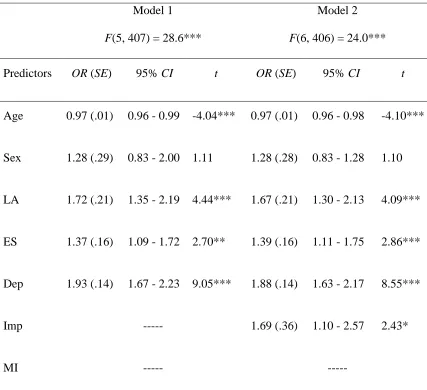
presented in Table 1.Results of the logistic regression analyses are presented in Tables 2
to 4. Time 2 suicidal ideation was significantly predicted by Time 1 impulsivity (OR =
1.69, p = .02) in Model 2 (see Table 2). When mood instability was added in Model 3
(see Table 3), the effect for impulsivity became nonsignificant (OR = 1.42, p = .09),
whereas the effect for mood instability was significant (OR = 3.82; p < .001). The
interaction between mood instability and impulsivity was nonsignificant (OR = 1.54, p
= .31) in Model 4 (see Table 3) and was excluded from subsequent models. Depression
was also a significant predictor in all four models.
--- INSERT TABLE 1 HERE ---
--- INSERT TABLE 2 HERE ---
--- INSERT TABLE 3 HERE ---
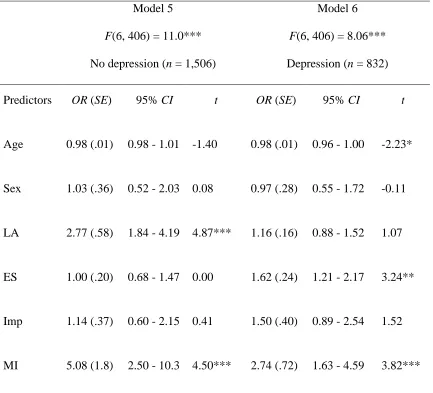
The same pattern of results remained regardless of whether participants had
depressed mood at Time 1 (see Table 4). In Model 5 among participants without
depression the effect for mood instability was significant (OR = 5.08, p < .001) and for
impulsivity nonsignificant (OR = 1.14, p = .68). In Model 6 among participants with
depression the effect for mood instability was significant (OR = 2.74, p < .001) and for
impulsivity nonsignificant (OR = 1.50, p = .13).
For each model the variance inflation factors were less than 2 (results not shown),
suggesting an absence of multicollinearity. Mood instability and impulsivity were
associated χ2(1) = 52.85, p < .001, with 60 percent of respondents with mood instability
reporting impulsivity as well.
Discussion
The main finding from this study is that although impulsivity predicts suicidal
ideation this effect becomes nonsignificant after mood instability is controlled. This
suggests that most of the correlation between impulsivity and suicidal ideation occurs
indirectly because both variables are related to mood instability. It should be noted,
however, that the significant effect for impulsivity was not much larger than the
nonsignificant effects. Therefore, it is difficult to say that controlling for mood instability
fully accounted for the relationship between impulsivity and suicidal ideation. What
remains clear from the results is that impulsivity did not provide any significant
predictive utility after mood instability had been considered. In arriving at this conclusion
we used longitudinal data with a time interval of 18 months and controlled for severity of
depression. The cross-sectional association of mood instability with suicidal ideation
(Bowen et al., 2011; Marwaha et al., 2013) and attempts (Palmier-Claus, Taylor, Varese,
& Pratt, 2012) has already been established. Our results advance this literature by
showing that mood instability predicts future suicidal ideation as well, and might be a
more useful concept than impulsivity.
There are many possible links between mood instability and impulsive behaviour.
consideration for long-term consequences and are therefore labelled “impulsive” (Bowen
et al., 2012). It has also been proposed that impulsive behaviours are often attempts to
control dysregulated emotions (Anestis et al., 2009; Selby, Anestis, & Joiner, 2008).
Accordingly, mood instability has been found to predict impulsive behaviours in a
clinical sample even after controlling for trait impulsivity (Anestis et al., 2009).
The clinical significance of this study is that it would be helpful for clinicians to
assess and treat mood instability as well as impulsivity in managing patients with suicidal
thoughts. This strategy may be more effective because there are indications that mood
instability responds to treatment with mood stabilizers (Bowen, Balbuena, & Baetz,
2014), and adequate sleep and exercise (Bowen, Balbuena, Baetz, & Schwartz, 2013), as
well as several psychological therapies (Jones, Sellwood, & McGovern, 2005). Obviously
more research is needed on other interventions that stabilize mood. Our findings are
consistent with evidence that impulsive aggression responds to mood stabilizers (Jones et
al., 2011) and suicidal tendencies respond to lithium (Cipriani, Hawton, Stockton, &
Geddes, 2013). The underlying mechanism may actually involve a main effect on mood
instability as well as depression. Several large national studies have shown that suicidal
ideation is strongly associated with suicide attempts (Bebbington et al., 2010; Kessler et
al., 2005). Therefore, further research into the association between mood instability and
suicidal thinking and acts might provide answers to the conundrum about the stable
suicide rate despite efforts to treat depression (Johnson, Hayes, Brown, Hoo, & Ethier,
2014).
There are other reasons for emphasizing research on mood instability rather than
immediate frequent repeated reports of mood in written diaries (Bowen, Baetz, Hawkes,
& Bowen, 2006) or electronic devices (Trull et al., 2008). Because mood is recorded
immediately, the retrospective distortions associated with mood rating scales are avoided
(Anestis et al., 2010; Ben-Zeev & Young, 2010). Similarly, retrospective summary
diagnoses of depression may occlude the existence of mood instability (Solhan, Trull,
Jahng, & Wood, 2009).
The main limitation of this study was the use of single-item measures for
impulsivity, mood instability and suicidal behaviour. Ecological momentary assessment
is not feasible for large national studies, and therefore we used relevant questions that are
embedded as symptoms in diagnostic clusters in the SCID-II (Marwaha, Broome,
Bebbington, Kuipers, & Freeman, 2014). The questions directly query the intended
constructs and seemed readily comprehensible given that very few participants declined
to answer them (Marwaha et al., 2014). Specific questions on mood instability yield
results that are comparable to prospective ratings (Anestis et al., 2010; Solhan et al.,
2009). A single-item assessment of suicidal thinking has also been shown to be a valid
measure compared across scales (Desseilles et al., 2012). The findings are therefore
preliminary but are noteworthy because of the seriousness and apparent impenetrability
of the worldwide suicide problem (Hawton & van Heeringen, 2009). The use of older
data may be seen as a limitation, although our concern was not with prevalence but with
the relationships between constructs that would not necessarily be expected to change
over time. Accordingly, mood instability remained associated with suicidal ideation in the
addresses suicidal thinking and not suicide attempts. Further research is needed on
whether mood instability also predicts future suicidal acts.
Conclusions
Impulsivity and mood instability predict future suicidal ideation. However, when
included in the same model only mood instability remains a significant predictor. This
suggests that impulsivity mostly relates to suicidal ideation indirectly by being related to
References
American Psychiatric Association. (2013). Diagnostic and statistical manual of mental
disorders (5th ed.). Arlington, VA: American Psychiatric Publishing.
Anestis, M. D., Peterson, C. B., Bardone-Cone, A. M., Klein, M. H., Mitchell, J. E.,
Crosby, R. D., . . . Joiner, T. E. (2009). Affective lability and impulsivity in a
clinical sample of women with bulimia nervosa: The role of affect in severely
dysregulated behavior. International Journal of Eating Disorders, 42, 259-266.
doi:10.1002/eat.20606
Anestis, M. D., Selby, E. A., Crosby, R. D., Wonderlich, S. A., Engel, S. G., & Joiner, T.
E. (2010). A comparison of retrospective self-report versus ecological momentary
assessment measures of affective lability in the examination of its relationship
with bulimic symptomatology. Behaviour Research and Therapy, 48, 607-613.
doi:10.1016/j.brat.2010.03.012
Bebbington, P. E., Minot, S., Cooper, C., Dennis, M., Meltzer, H., Jenkins, R., & Brugha,
T. (2010). Suicidal ideation, self-harm and attempted suicide: Results from the
British psychiatric morbidity survey 2000. European Psychiatry, 25, 427-431.
doi:10.1016/j.eurpsy.2009.12.004
Ben-Zeev, D., & Young, M. A. (2010). Accuracy of hospitalized depressed patients’ and
healthy controls’ retrospective symptom reports: An experience sampling study.
Journal of Nervous and Mental Disease, 198, 280–285.
Bowen, R. C., Baetz, M., Hawkes, J., & Bowen, A. (2006). Mood variability in anxiety
disorders. Journal of Affective Disorders, 91, 165-170.
doi:10.1016/j.jad.2005.12.050
Bowen, R., Baetz, M., Leuschen, C., & Kalynchuk, L. E. (2011). Predictors of suicidal
thoughts: Mood instability versus neuroticism. Personality and Individual
Differences, 51, 1034–1038. doi:10.1016/j.paid.2011.08.015
Bowen, R. C., Balbuena, L., & Baetz, M. (2014). Lamotrigine reduces affective
instability in depressed patients with mixed mood and anxiety disorders. Journal
of Clinical Psychopharmacology. Advance online publication.
doi:10.1097/JCP.0000000000000164
Bowen, R., Balbuena, L., Baetz, M., & Schwartz, L. (2013). Maintaining sleep and
physical activity alleviate mood instability. Preventive Medicine, 57, 461-465.
doi:10.1016/j.ypmed.2013.06.025
Bowen, R. C., Balbuena, L., Leuschen, C., & Baetz, M. (2012). Mood instability is the
distinctive feature of neuroticism. Results from the British health and lifestyle
study (HALS). Personality and Individual Differences, 53, 896-900.
doi:10.1016/j.paid.2012.07.003
Chistiakov, D. A., Kekelidze, Z. I., & Chekhonin, V. P. (2012). Endophenotypes as a
measure of suicidality. Journal of Applied Genetics, 53, 389-413.
doi:10.1007/s13353-012-0113-1
Cipriani, A., Hawton, K., Stockton, S., & Geddes, J. R. (2013). Lithium in the prevention
of suicide in mood disorders: Updated systematic review and meta-analysis. BMJ,
Conner, K. R., Meldrum, S., Wieczorek, W. F., Duberstein, P. R., & Welte, J. W. (2004).
The association of irritability and impulsivity with suicidal ideation among 15-to
20-year-old males. Suicide and Life-Threatening Behavior, 34, 363-373.
doi:10.1521/suli.34.4.363.53745
Corruble, E., Damy, C., & Guelfi, J. D. (1999). Impulsivity: A relevant dimension in
depression regarding suicide attempts? Journal of Affective Disorders, 53,
211-215. doi:10.1016/S0165-0327(98)00130-X
Desseilles, M., Perroud, N., Guillaume, S., Jaussent, I., Genty, C., Malafosse, A., &
Courtet, P. (2012). Is it valid to measure suicidal ideation by depression rating
scales? Journal of Affective Disorders, 136, 398-404.
doi:10.1016/j.jad.2011.11.013
First, M. B., Gibbon, M., Spitzer, R. L., Williams, J. B. W., Benjamin, L. S. (1997).
Structured clinical interview for DSM-IV axis II personality disorders, (SCID-II).
Washington, D.C.: American Psychiatric Press.
Gunnell, D., Harbord, R., Singleton, N., Jenkins, R., & Lewis, G. (2004). Factors
influencing the development and amelioration of suicidal thoughts in the general
population: Cohort study. British Journal of Psychiatry, 185, 385-393.
doi:10.1192/bjp.185.5.385
Hawton, K., Casañas, I., Comabella, C., Haw, C., & Saunders, K. (2013). Risk factors for
suicide in individuals with depression: A systematic review. Journal of Affective
Disorders, 147, 17–28. doi:10.1016/j.jad.2013.01.004
Hawton, K., & van Heeringen, K. (2009). Suicide. The Lancet, 373, 1372–1381.
Jacobs, N., van Os, J., Derom, C., Thiery, E., Delespaul, P., & Wichers, M. (2011).
Neuroticism explained? From a non-informative vulnerability marker to
informative person-context interactions in the realm of daily life. British Journal
of Clinical Psychology, 50, 19-32. doi:10.1348/014466510X491397
Johnson, N. B., Hayes, L. D., Brown, K., Hoo, E. C., & Ethier, K. A. (2014). CDC
national health report: Leading causes of morbidity and mortality and associated
behavioral risk and protective factors-United States, 2005-2013. MMWR Surveill
Summ, 63(Suppl 4), 3-27.
Jones, R. M., Arlidge, J., Gillham, R., Reagu, S., van den Bree, M., & Taylor, P. J. (2011).
Efficacy of mood stabilisers in the treatment of impulsive or repetitive aggression:
Systematic review and meta-analysis. British Journal of Psychiatry, 198, 93-98.
doi:10.1192/bjp.bp.110.083030
Jones, S. H., Sellwood, W., & McGovern, J. (2005). Psychological therapies for bipolar
disorder: The role of model-driven approaches to therapy integration. Bipolar
Disorders, 7, 22-32. doi:10.1111/j.1399-5618.2004.00157.x
Kessler, R. C., Berglund, P., Borges, G., Nock, M., & Wang, P. S. (2005). Trends in
suicide ideation, plans, gestures, and attempts in the United States, 1990-1992 to
2001-2003. JAMA: The Journal of the American Medical Association, 25,
2487-2495. doi:10.1001/jama.293.20.2487
Klonsky, E. D., & May, A. (2010). Rethinking impulsivity in suicide. Suicide and
Life-Threatening Behavior, 40, 612-619. doi:10.1521/suli.2010.40.6.612
Lewis, G. & Pelosi, A. J. (1990). Manual of the revised clinical interview schedule CIS-R.
Mann, J. J., Waternaux, C., Haas, G. L., & Malone, K. M. (1999). Toward a clinical
model of suicidal behavior in psychiatric patients. Amican Journal of Psychiatry,
156, 181-189.
Marwaha, S., Broome, M. R., Bebbington, P. E., Kuipers, E., & Freeman, D. (2014).
Mood instability and psychosis: Analyses of British national survey data.
Schizophrenia Bulletin, 40, 269-277. doi:10.1093/schbul/sbt149
Marwaha, S., Parsons, N., & Broome, M. (2013). Mood instability, mental illness and
suicidal ideas: Results from a household survey. Social Psychiatry and
Psychiatric Epidemiology, 48, 1431-1437. doi:10.1007/s00127-013-0653-7
Moeller, F. G., Barratt, E. S., Dougherty, D. M., Schmitz, J. M., & Swann, A. C. (2001).
Psychiatric aspects of impulsivity. American Journal of Psychiatry, 158,
1783-1793. doi:10.1176/appi.ajp.158.11.1783
Ormel, J., Bastiaansen, A., Riese, H., Bos, E. H., Servaas, M., Ellenbogen, M., . . .
Aleman, A. (2013). The biological and psychological basis of neuroticism:
Current status and future directions. Neuroscience & Biobehavioral Reviews, 37,
59-72. doi:10.1016/j.neubiorev.2012.09.004
Palmier-Claus, J. E., Taylor, P. J., Varese, F., & Pratt, D. (2012). Does unstable mood
increase risk of suicide? Theory, research and practice. Journal of Affective
Disorders, 143, 5-15. doi:10.1016/j.jad.2012.05.030
Peluso, M. A. M., Hatch, J. P., Glahn, D. C., Monkul, E. S., Sanches, M., Najt, P., . . .
Soares, J. C. (2007). Trait impulsivity in patients with mood disorders. Journal of
Rhodes, A. E., & Bethell, J. (2008). Suicidal ideators without major depression - Whom
are we not reaching? Canadian Journal of Psychiatry, 53, 125-130.
Ryder, A. G., Costa, P. T., & Bagby, R. M. (2007). Evaluation of the SCID-II personality
disorder traits for DSM-IV: Coherence, discrimination, relations with general
personality traits, and functional impairment. Journal of Personality Disorders,
21, 626-637. doi:10.1521/pedi.2007.21.6.626
Singleton, N., Lee, A., & Meltzer, H. (2002). Psychiatric morbidity among adults living
in private households, 2000: Technical report. London: Office for National
Statistics.
Singleton, N. & Lewis, G. (2003). Better or worse: A longitudinal study of the mental
health of adults living in private households in Great Britain. London: Stationery
Office.
Selby, E. A., Anestis, M. D., & Joiner, T. E. (2008). Understanding the relationship
between emotional and behavioral dysregulation: Emotional cascades. Behaviour
Research and Therapy, 46, 593-611. doi: 10.1016/j.brat.2008.02.002
Solhan, M. B., Trull, T. J., Jahng, S., & Wood, P. K. (2009). Clinical assessment of
affective instability: Comparing EMA indices, questionnaire reports, and
retrospective recall. Psychological Assessment, 21, 425-436.
doi:10.1037/a0016869
Trull, T. J., Solhan, M. B., Tragesser, S. L., Jahng, S., Wood, P. K., Piasecki, T. M., &
Watson, D. (2008). Affective instability: Measuring a core feature of borderline
personality disorder with ecological momentary assessment. Journal of Abnormal
Whiteside, S. P., & Lynam, D. R. (2001). The five factor model and impulsivity: Using a
structural model of personality to understand impulsivity. Personality and
Table 1
Demographic and clinical characteristics of APMS participants who completed the
18-month follow-up survey
Demographic information Number of participants
Weighted estimate or
proportion
Mean Age (S.E.) 44.61(.31) 43.38 (.51)
Sex
Male 998 49.7
Female 1,340 50.3
Living situation
Married or cohabiting 1,410 68.3
Single 428 20.1
Widowed/Divorced/Separated 500 11.6
Employment
Employed 1,451 67.0
Unemployed 79 2.9
Inactive 808 30.1
Clinical information
Anxiety disordera 320 6.3
Depressive episode 121 2.5
Mixed anxiety/depression 405 8.9
Psychosis 16 0.3
Drug dependence 123 3.8
Any personality disorder 864 27.9
Received psychotropic
medication or counselling
316 7.0
Note. All measurements occurred at Time 1.
aIncludes panic disorder, generalized anxiety disorder, obsessive-compulsive disorder, phobias, and
Table 2
Sequential logistic regression predicting Time 2 suicidal ideation with demographic
variables and depression as predictors in Model 1 and with impulsivity added in Model 2
Model 1
F(5, 407) = 28.6***
Model 2
F(6, 406) = 24.0***
Predictors OR (SE) 95% CI t OR (SE) 95% CI t
Age 0.97 (.01) 0.96 - 0.99 -4.04*** 0.97 (.01) 0.96 - 0.98 -4.10***
Sex 1.28 (.29) 0.83 - 2.00 1.11 1.28 (.28) 0.83 - 1.28 1.10
LA 1.72 (.21) 1.35 - 2.19 4.44*** 1.67 (.21) 1.30 - 2.13 4.09***
ES 1.37 (.16) 1.09 - 1.72 2.70** 1.39 (.16) 1.11 - 1.75 2.86***
Dep 1.93 (.14) 1.67 - 2.23 9.05*** 1.88 (.14) 1.63 - 2.17 8.55***
Imp --- 1.69 (.36) 1.10 - 2.57 2.43*
MI --- ---
Note. All predictors were measured at Time 1. LA = living arrangement; ES = employment status; Dep =
depression; Imp = impulsivity; MI = mood instability.
Table 3
Sequential logistic regression predicting Time 2 suicidal ideation with mood instability
added in Model 3 and with an interaction between impulsivity and mood instability added
in Model 4
Model 3
F(7, 405) = 26.8***
Model 4
F(8, 404) = 24.3***
Predictors OR (SE) 95% CI t OR (SE) 95% CI t
Age 0.97 (.01) 0.96 - 0.99 -2.61*** 0.98 (.01) 0.97 - 1.00 -2.57*
Sex 1.09 (.25) 0.70 - 1.70 0.40 1.11 (.25) 0.71 - 1.72 0.46
LA 1.73 (.22) 1.36 - 2.21 4.41*** 1.75 (.22) 1.36 - 2.24 4.44***
ES 1.27 (.15) 1.01 - 1.60 2.07* 1.26 (.15) 1.00 - 1.59 1.97
Dep 1.60 (.13) 1.36 - 1.88 5.70*** 1.61 (.13) 1.37 - 1.89 5.83***
Imp 1.43 (.30) 0.94 - 2.15 1.69 1.19 (.34) 0.68 - 2.08 0.62
MI 3.82 (.87) 2.44 - 5.99 5.86*** 2.97 (.96) 1.56 - 5.60 3.34**
Imp x MI --- 1.53 (.64) 0.67 - 3.48 1.02
Note. All predictors were measured at Time 1. LA = living arrangement; ES = employment status; Dep =
depression; Imp = impulsivity; MI = mood instability.
Table 4
Sequential logistic regression predicting Time 2 suicidal ideation including nondepressed
participants in Model 5 and participants with depressed mood at Time 1 in Model 6
Model 5
F(6, 406) = 11.0***
No depression (n = 1,506)
Model 6
F(6, 406) = 8.06***
Depression (n = 832)
Predictors OR (SE) 95% CI t OR (SE) 95% CI t
Age 0.98 (.01) 0.98 - 1.01 -1.40 0.98 (.01) 0.96 - 1.00 -2.23*
Sex 1.03 (.36) 0.52 - 2.03 0.08 0.97 (.28) 0.55 - 1.72 -0.11
LA 2.77 (.58) 1.84 - 4.19 4.87*** 1.16 (.16) 0.88 - 1.52 1.07
ES 1.00 (.20) 0.68 - 1.47 0.00 1.62 (.24) 1.21 - 2.17 3.24**
Imp 1.14 (.37) 0.60 - 2.15 0.41 1.50 (.40) 0.89 - 2.54 1.52
MI 5.08 (1.8) 2.50 - 10.3 4.50*** 2.74 (.72) 1.63 - 4.59 3.82***
Note. All predictors were measured at Time 1. LA = living arrangement; ES = employment status; Dep =
depression; Imp = impulsivity; MI = mood instability.