http://wrap.warwick.ac.uk
Original citation:
Papadopoulos, Stavros, Cormode, Graham, Deligiannakis, Antonis and Garofalakis,
Minos. (2014) Lightweight query authentication on streams. ACM Transactions on
Database Systems, Volume 39 (Number 4). Article number 30. ISSN 0362-5915
Permanent WRAP url:
http://wrap.warwick.ac.uk/67367
Copyright and reuse:
The Warwick Research Archive Portal (WRAP) makes this work by researchers of the
University of Warwick available open access under the following conditions. Copyright ©
and all moral rights to the version of the paper presented here belong to the individual
author(s) and/or other copyright owners. To the extent reasonable and practicable the
material made available in WRAP has been checked for eligibility before being made
available.
Copies of full items can be used for personal research or study, educational, or not-for
profit purposes without prior permission or charge. Provided that the authors, title and
full bibliographic details are credited, a hyperlink and/or URL is given for the original
metadata page and the content is not changed in any way.
Publisher’s statement:
"© ACM, 2014. This is the author's version of the work. It is posted here by permission of
ACM for your personal use. Not for redistribution. The definitive version was published in
ACM Transactions on Database Systems, Volume 39 (Number 4), (2014)
http://doi.acm.org/10.1145/2656336
"
A note on versions:
The version presented here may differ from the published version or, version of record, if
you wish to cite this item you are advised to consult the publisher’s version. Please see
the ‘permanent WRAP url’ above for details on accessing the published version and note
that access may require a subscription.
Lightweight Authentication of Linear Algebraic Queries
on Data Streams
1. INTRODUCTION
Tremendous amounts of data are being generated in a streaming fashion in a variety of applications, such as web and telephony networks, wireless sensor networks, social networks, and more. The continuous nature of such data has motivated the need for sophisticated data stream management systems (DSMS), which offer efficient storage and reliable querying services to clients. Following research prototypes such as Stream [3] and Aurora [1], robust DSMS have been deployed for many applications, including IBM’s InfoSphere Streams [21], Microsoft’s StreamInsight [20] and AT&T’s Gigascope [8]. Due to the overwhelming volume of streaming data, companies may not possess, or wish to acquire, the resources for deploying a DSMS. A practical alternative is to outsource the stream storage and processing to a specialized third party with strong DSMS infrastructure. Outsourcing offers significant cost savings to companies, especially start-ups.
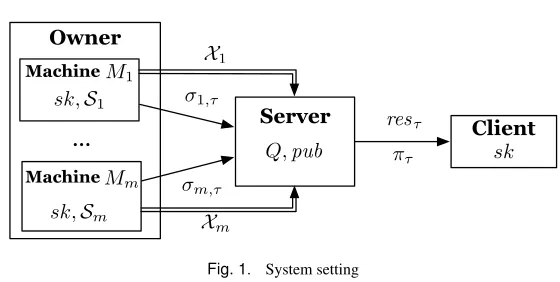
Despite its merits, outsourcing naturally raises the issue oftrust. Specifically, the third party may act maliciously to increase profit, e.g., it may collude with rival companies and present fraudulent results to bias the competition; or it may shed some of the workload and only compute on a sample of the input to save effort. Even when the server is honest, problems can arise, as it may run buggy software, or (given the scale of the problems considered) suffer from equipment failure or read/write errors. It is therefore particularly important to adopt methods forstream authentication. These en-able the clients to verify thecorrectnessof the streaming results they receive from the server, i.e., that they are untampered with (integrity) and up-to-date (freshness). The goal is to make stream au-thentication a very lightweight operation for all parties involved, and establish it as a standard tool for error-checking, in a similar way to the ubiquitous use of checksums for reliable file transfer. Targeted setting. Figure 1 illustrates our system architecture. Anowner possesses a set of ma-chines M1, M2, . . . , Mm, each generating or observing a data streamXi and outsourcing it to a
third party server. These machines are not required to directly communicate with each other, and their streams are disjoint. Aclientregisters acontinuous(i.e., long-running) queryQon the union of the streams at the server. The latter periodically reports the result to the client at regular time intervals, demarcated into epochsτ.
Each machineMimaintains a smallsummarySion its stream, which is updated with every new
tuple arrival. At the end of every epochτ,Micomputes asignatureσi,τ onSi, and sends it to the
server. This signatureauthenticatesMi’s stream at that particular epoch, and is created with a secret
keyskinstalled by the owner at the machine. The server then processes queryQ, and transmits result
resτalong with a smallproof πτ. The proof is produced in a query-specific fashion by combining
all the signatures with some public information pub (registered at the server by the owner at an offlinesetup stage). We assume that the client istrustedby the owner and, thus, possessessk. Using this key andπτ, the client canverifythe correctness of the result received for epochτ.
Our aim is to provide the above functionality for a wide range of query types, offering cryp-tographic security and satisfying certainperformance desiderata. In particular, our goals are to minimize the memory, communication and computational costs for the owner and clients. This is particularly crucial in applications such as wireless sensor networks, where the owner’s machines are motes with scarce resources and limited battery. The life-time of these systems is diminished by intense operations and communication. Secondarily, we further aim to ensure that the server’s costs are also low.
Owner
...
Server
Client M1
sk
sk,Sm
Mm
Q,pub
σ1,τ
σm,τ
πτ
Machine
Machine
X1
Xm
sk,S1
[image:3.612.166.446.84.225.2]resτ
Fig. 1. System setting
queries which, while fundamental, do not cover all stream outsourcing scenarios. Secondly, the authentication cost at the owner is non-trivial; it typically entails expensive cryptographic operations (e.g., modular exponentiations) for each epoch at the owner. While the cost of one such operation is minor, the overhead imposed for high speed data streams and short epochs can become intolerably high, especially when each machineMi might be a low-powered embedded device. This fact also
limits the data rates that the owner can process.
In contrast to current literature, we seek formore generalsolutions that impose a minimal, es-sentiallynegligible, cost to the data owner. We first devise constructions for fundamental problems represented aslinear algebraicqueries. We then use these schemes as building blocks in the design of authentication techniques for a wide range of important queries in streaming environments. In more detail, our contributions are summarized as follows:
• We introduce constructions for authenticating (i)sums of dynamic vectorsproduced by one or multiple streams, (ii)dot productsof dynamic vectors produced by different streams, and (iii) productsbetweendynamic matricesgenerated by different streams. Our schemes are extremely lightweight for the owner, as they mainly involve inexpensive hash operations and modular additions/multiplications in a very small finite field. They are also cheap for the client, who verifies the result without adding substantially to the cost of reading the output. Moreover, they impose only a small extra overhead to the computation cost of the server.
• We provide strongcryptographicguarantees for all our constructions, derived from formal def-initions and proofs.
• We show how to adapt the basic schemes in order to solve a range of database queries in stream authentication, including group by queries, joins, in-network aggregation, similarity matching, and event processing. To our knowledge, we are the first to address result authentication for such a large range of complex queries.
Roadmap. Section 2 includes necessary preliminary information and surveys the related work. Section 3 formulates the framework within which our stream authentication protocols will operate. Section 4 presents the basic constructions for authenticating the three fundamental linear algebraic queries. Section 5 adapts our main schemes to a variety of important database applications in the stream authentication setting. Section 6 contains our experimental evaluation, whereas Section 7 presents concluding remarks and future directions.
2. BACKGROUND 2.1. Preliminaries
Table I. Notation
Symbol Definition
m Number of owner machines
Mi Owner machinei
Xi The stream of tuples generated atMi Xi(τ) The tuple sequence ofMiat or before epochτ
Q The continuous query of the client
Q(Sm
i=1{Xi(τ)}) Result ofQon streamsX1, . . . ,Xmat epochτ
resτ Result sent by the server to the client at epochτ σi,τ Signature created by machineMiat epochτ
πτ Proof transmitted by the server to the client atτ ra,τ,ρa,τ Key values/vectors computed for machineaatτ
Si The summary maintained atMiat all times pub Public information output by the owner during setup
a,b Symbols (in lowercase bold letters) of vectors
A,B Symbols (in uppercase bold letters) of matrices
x←$ S An elementxbeing sampled uniformly from setS x← A The outputxof aprobabilisticalgorithmA x:=B The outputxof adeterministicalgorithmB
‘k’ Symbol denoting string concatenation ‘|’ Symbol denoting logical OR
s The security parameter
poly(s)/negl(s) A positive polynomial ins/ A negligible function ins
[n] The set{1,2, . . . , n}
Fk(x)def=F(k, x) Pseudo-random functionFof keykand messagex sk The secret key of the owner
p A prime number with bit sizeΘ(s)
Zp/G The finite field / cyclic group our algorithms operate on
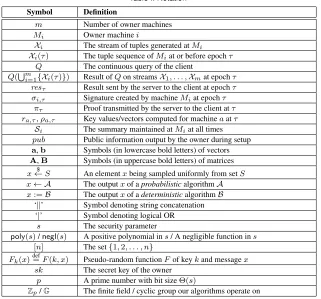
isinherent in most streaming applications (e.g., sensor networks) and is orthogonal to our work. Table I summarizes the most important notation used in this paper.
Adversary.Henceforth, any reference to an adversary implies aprobabilisticadversary that runs in timepolynomialin some security parameters.
Negligible functions.We call a functionν :N→Nnegligibleinsifν(s)<1/poly(s)for every
poly(·)and sufficiently larges. We denote a negligible function bynegl(s).
Pseudo-random functions.LetF:K ×S1→S2be an efficient, keyed function, whereK,S1and
S2are indexed by a security parameters. We say thatFis apseudo-random function(PRF) if for
all adversariesAit holds
|Pr[AFk(·)(1s) = 1]−Pr[Af(·)(1s) = 1]| ≤negl(s),
whereFk(x)
def
=F(k, x),k← K$ andf ←$ (S1→S2). Simply stated, an adversary distinguishes a
PRF from a truly random function only with negligible probability ins.
Cyclic groups, generators and multiplicative cyclic groups [19].LetGbe a group, letp=|G|
denote the order ofGand let1denote the identity element ofG. For any elementg∈G, the order
ofgis the least positive integernsuch thatgn=1. Let
hgi={gi:i
∈Zn}={g0, g1, . . . , gn−1}
denote the set of group elements generated by g. The group Gis calledcyclicif there exists an
element g ∈ Gsuch thathgi = G. In such a case, theorderof g is equal top = |G|andg is
called ageneratorof G. A cyclic group Gwith the binary operator of multiplication is called a
The Diffie Hellman Exponent (n-DHE) Assumption [5].Our security relies on a variant of the well-knowndiscrete logarithm problem. LetGbe a multiplicative cyclic group of orderp,g ∈ G
a generator ofG, andsthe bit size ofp. Then-DHE problem is defined as follows: given setV = {g, gk, gk2
, . . . , gkn
, gkn+2
, . . . , gk2n
} wherek ←$ Z∗p, computegk n+1
. The n-DHE assumption states that, for any adversaryA, it holds:
Pr[A(g, gk, gk2, . . . , gkn, gkn+2, . . . , gk2n) =gkn+1]≤negl(s)
Simply stated, even given the information inV, the (polynomially bounded) adversary is unable to solve the problem with any non-negligible probability.
One-time pad and nonces. One-time pad is a method of encrypting data which exhibitsperfect secrecy[15], if implemented correctly. In one-time pad encryption, a messageMis encrypted using a random key K which (i) has (at least) the samesize asM, and (ii) is used exactly once. The encryption is performed via an XOR operation asM⊕K. In our work, we use an alternative form of one-time pad that uses modular arithmetic. In particular, we encrypt a number M ∈ Zp by a
random (used once) keyK ∈Z∗pas(M +K) mod p. While slightly less efficient than an XOR
operation, this alternative mode of one-time pad offers the same security as the original, and it will be particularly helpful in our proposed techniques. Finally, we refer to any key that is used just once as anonce.
2.2. Related Work
The closest schemes to ours are PIRS [31] and DiSH [22], which both focus on authenticating results for group-by,sumqueries. In these works, the stream consists of unaggregated tuples. The server’s task is to perform agroup-byoperation to collate the tuples into predefined groups, and then to compute an aggregate such assumon each group. In both PIRS and DiSH the owner maintains a small summary on the observed stream, which facilitates verifying the result correctness. PIRS is aprobabilisticprotocol, where the client is the owner itself. Due to its simplified model and relaxed security guarantees, PIRS is quite lightweight. On the other hand, DiSH is acryptographic technique, which assumes that the clients are partiesuntrustedby the owner. The clients candirectly communicatethough with the owner to receive the summary. In order to address the challenge that clients cannot possess any secret material from the owner, DiSH employs expensive cryptographic primitives such as modular exponentiations during authentication and verification.
Note that PIRS and DiSH do not directly capture our general architecture (described in Section 1), where the owner and the clients are different physical entities that communicate with each other via the untrusted server. In order to adapt PIRS and DiSH to our scenario, the ownermust rely on some other message authentication technique for securely forwarding the summary to the clients via the server, e.g., using HMACs and public-key digital signatures [19], respectively. This inflicts extra overhead to both the owner (for authentication) and the client (for verification).
Also related to our work is the use of message authentication codes (MACs) that are homomor-phic, since they allow the linear combination of messages from different sources, along with the corresponding combination of the MACs of these messages. In our schemes, we also need to utilize the signatures of multiple sources (i.e., owner machines), but these signatures must beproperly com-putedandcombinedin order to authenticate the result of different operators. Homomorphic MACs were first proposed in [2] for network coding applications and have since been widely used, such as in [4] for evaluating multivariate polynomials onsigneddata, or in [26] for computing simple statis-tics in sensor networks. We emphasize that homomorphism is a property that message authentication techniques may exhibit, but not a tool for automatically authenticating general operators/functions (such as the ones examined in this paper) over distributed data. In particular, we are not aware of any prior work that has addressed the general linear queries such as matrix multiplication and dot products that we study here.
and joins [11; 25; 24; 16; 30], as well as continuousrange queries [17; 27]. All these methods rely onauthenticated data structures (such as Merkle trees), which are maintained by the owner and signed with public-key cryptosystems. These data structures are large: linear in the size of the input data. There has also been a line of work on verifying simple aggregate computations in distributed networks, such assum,min/maxandcount[12; 26; 23]. In this setting, the machines are organized into a tree hierarchy. The internal (potentially untrusted) nodes performin-network aggregationas they route information from the leaves to the root (sink).
Some related studies have been conducted within the theory community. The model ofannotated streamsallows the server to insert some “advice” into a stream to help a client compute a function of interest. This model was applied to problems such as recovering information about particular items from the stream, functions of the item frequencies (such as the frequency moments), and some graph computations [6]. The costs of these protocols are typically sublinear but polynomial in the size of the stream. These costs were subsequently reduced to logarithmic for some key problems, but only when there are multiple rounds of communication between the data owner and server [7]. Quite general computations can be authenticated following a streaming pass over the data, but this can require many thousands of rounds of interaction between the parties [14].
Our work differs from these prior efforts in several important respects. Firstly, we consider fun-damental problems that can be adapted to solve a wider range of important queries in stream out-sourcing. Secondly, our constructions impose a very low overhead to all parties. In particular, they do not entail the costly exponentiation operations involved in DiSH, and do not require the owner to maintain sophisticated structures, as in the database outsourcing solutions. Lastly, unlike PIRS, our work comes with strongcryptographic guarantees that formally demonstrate the security and robustness of our schemes against malicious activity and errors.
3. FORMULATION
Section 3.1 defines the system setting outlined in Section 1 as a formal stream authentication proto-col executed by the involved parties. Section 3.2 presents the security model.
3.1. Stream Authentication Protocol
The definition below formulates a stream authentication scheme, assuming a security parameters.
Definition 3.1. A stream authentication scheme is a set of five algorithms (KeyGen,Update,
Sign,Combine,Verify)running in time polynomial insand described as follows:
(sk,pub)←KeyGen(1s):. A probabilistic algorithm that takes as input a security parameters, and outputs secret keyskand public informationpub.
Si←Update(i, sk,Si, t):. A (potentially) probabilistic algorithm that takes as input id i, secret
keysk, summarySi, and incoming tuplet. It produces an updated summarySi.
σi,τ ←Sign(i, sk,Si, τ):. A (potentially) probabilistic algorithm that takes as input idi, secret key
sk, summarySi, and epochτ. It produces signatureσi,τ.
πτ:=Combine(Smi=1{σi,τ},Smi=1{Xi(τ)},pub):. A deterministic algorithm that takes as input
the union of the signatures and streams atτand public infopub. It produces proofπτ.
Yes|No:=Verify(sk, πτ,resτ, τ):. A deterministic algorithm that takes as input secret key sk,
proofπτ, resultresτand epochτ. It outputs a string that is eitherYesorNo.
The protocol is executed in the following stages:
— Setup:The protocol commences with anofflinesetup phase. The owner runsKeyGenand pro-duces a secret keyskand public infopub. It installs a unique identifieri, keyskand an initial summarySiin every machineMiand sendspubto the server. It also securely provides the client
withsk, e.g., via an SSL channel. Next, it concludes the setup phase and sets the system into motion.
— Update and signing at Mi: Whenever a new tuple t is generated by Mi, the machine runs
Siand outputs a new summary thatsubstitutesfor the old one. At the end of epochτ,Miruns
Signoni,sk,τand current summarySito produce a signatureσi,τ, which is sent to the server.
— Result and proof generation at the server: At the end of epoch τ the server receives new signatures from the machines. It computes and sends result resτ to the client in response to
continuous queryQ. Moreover, it transmits a proofπτ that is produced by algorithmCombine
onSm
i=1{σi,τ},
Sm
i=1{Xi(τ)}andpub.
— Verification at the client:At the end of epochτthe client receives from the server a new result
resτ, accompanied by a new proofπτ. It verifies result correctness viaVerify, which combines
resτ withπτ and the owner’s secret keysk. The output isYesif verification succeeds, andNo,
otherwise. Note that the client is stateless, i.e., it verifies w.r.t. the entire history of the data streams, not since the last successful verification.
The next definition formulatesscheme correctness.
Definition 3.2. A stream authentication scheme is correct if the following condition holds. For any security parameter s, let (sk,pub) be any output of algorithmKeyGen(1s). Let Xi(τ)
be any stream observed byMi up untilτ, andQ(Smi=1{Xi(τ)})the result of queryQatτ. Let
Si be the summary computed by executingUpdate onsk and on everyt ∈ Xi(τ). Let σi,τ be
the signature produced by Mi viaSign(i, sk,Si, τ). Finally, letπτ be the proof that is output by
Combine(Sm
i=1{σi,τ},Smi=1{Xi(τ)},pub). Then,Verify(sk, πτ,resτ, τ)returnsYeswhen
resτ=Q m
[
i=1 {Xi(τ)}
!
Note that scheme correctness does not specify the output of Verify in case resτ 6=
Q(Sm
i=1{Xi(τ)}). This is captured by the definition ofsecurity, included in the next subsection.
3.2. Security Definition
The adversary Amay be the server or any other entity other than the owner’s machines and the client. Ais allowed to access the raw data streams, i.e., data privacy isorthogonal to our work. Nevertheless, Amaytamper withthe outputs at any epoch. Our security goal againstAisresult correctness, which jointly guarantees (i)integrity(i.e., that the result is not falsified) and (ii) fresh-ness(i.e., that the result is up-to-date).
We rigorously model security via the following experiment, which is a variation of the standard existential unforgeability under an adaptive chosen-message attack[15]:
ExperimentExpA(1s)
(1) Pair(sk, pub)is output byKeyGen, andpubis given toA.
(2) Ais given oracle access toSignas follows:Apresents a triplet(T, i, τ0), whereT is a set
of tuples. The oracle keeps record of all submitted queries, and rejects a query that requests a signature for a certain(i, τ0)more than once. If it does not reject, the oracle initializes Si = 0and runsUpdate(i, sk,Si, t)for everyt ∈T, producing summarySi. It then runs
Sign(i, sk,Si, τ0), and returns the result toA.
(3) Aoutputs a pair(res∗
τ, πτ∗), with the restriction that
— res∗
τ 6=Q(S m
i=1{Xi(τ)})
— Signwas not queried for any triplet(T, i, τ0), such that(τ0 =τ)∧(T 6=X
i(τ))
(4) IfVerify(sk, π∗
We say that a stream authentication scheme issecure, if no adversaryAcan succeed in the above experiment with non-negligible probability, i.e., if it holds that
Pr[ExpA(1s) = 1]≤negl(s)
where the probability is taken over the random choice ofskand the random coin tosses ofA. Simply stated, during the attackAis allowed to obtain (through the oracle) any number of sig-natures for any machine and stream of its choice, at any epoch other than the epochτfor which it launches the attack. Atτ,Ais only allowed access to the valid signatures produced by the machines.
Athen launches the attack by presenting a pair(res∗
τ, πτ∗), such thatres∗τis different from the actual
result. Our aim is to provide protocols that are secure against such attacks and will not accept any such incorrect results.
4. BASIC CONSTRUCTIONS
In this section we present constructions that can be used as building blocks for designing authentica-tion schemes for a wide range of query types. In particular, we design techniques for authenticating dynamic vector sums(Section 4.1),dynamic matrix products(Section 4.2), anddynamic dot prod-ucts(Section 4.3). Throughout, we consider a security parameters, a primepwhose bit size isΘ(s), and a PRFF : Z∗p× {0,1}∗ →Z∗p, which are all known asglobalsto all parties. We assume that all the stream values and aggregate results belong toZp. This is without loss of generality, since
(i) for practical values ofs,Zpis large enough for any application, and (ii) application domains that
involve negative integers work directly forplarge enough, while those that involve real numbers can be converted toZpvia scaling and rounding.
4.1. Dynamic Vector Sum Authentication
We focus onmmachinesMi, and consider a vectoraiwithnentries, which is dynamically updated
as new tuplestare generated byMi. Each tuplet ∈ Xi is of the form(j, v), and updatesai by
addingvtoai[j]. The client’s queryQrequests the sum of the vectors produced by all machines at
every epochτ, i.e.,
Q( m
[
i=1
{Xi(τ)}) = m
X
i=1
ai=
"m X
i=1
ai[1], . . . , m
X
i=1
ai[n]
#
We term such a query adynamic vector sumquery, and present below a scheme called DVSfor authenticating it.
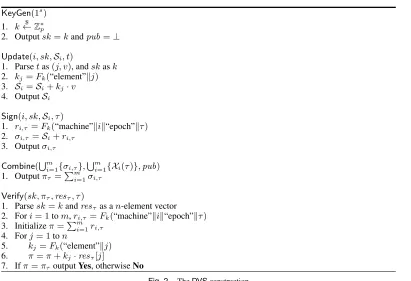
Figure 2 presents theDVSconstruction, which instantiates the general stream authentication pro-tocol outlined in Section 3.1. The intuition behind this construction is straightforward: the summary
Sicaptures the current state of vectorai, in such a way that the adversary, lacking knowledge of the
secretsk, has no way of finding another vectora∗i that would have the same summary, even given access to other signatures. The signatureσi,τ includes additional information (the nonceri,τ) that
prevents the server from re-using the same signature at different epochs or for different machines. All operations are performed modulop(i.e., the results are inZp).
Every summary is initialized to0during the setup phase. AlgorithmUpdateworks in a way such thatSiis equal to the dot productk·ai, wherek= [k1, . . . , kn].Signinjects a machine- and
time-dependent keyri,τ usedonce. Observe that everykjandri,τ value is produced withskvia PRFF,
where “element”, “machine” and “epoch” are string labels.Combinesimply adds all the signatures retrieved from the machines.Combinedoes not need any public information from the owner and, thus,pub is set to a null value inKeyGen. The client assumes that allm machines are involved in the protocol when executing Verify. In general, the client must know exactly which machines participate in the protocol, in order to properly calculate theri,τ values. As an additional remark,
observe that DVScan be used even when only a singlemachine is involved. In this case,DVS
KeyGen(1s) 1. k←$ Z∗p
2. Outputsk=kandpub=⊥
Update(i, sk,Si, t)
1. Parsetas(j, v), andskask
2. kj=Fk(“element”kj)
3. Si=Si+kj·v
4. OutputSi
Sign(i, sk,Si, τ)
1. ri,τ=Fk(“machine”kik“epoch”kτ)
2. σi,τ =Si+ri,τ
3. Outputσi,τ
Combine(Smi=1{σi,τ},Smi=1{Xi(τ)},pub)
1. Outputπτ =Pmi=1σi,τ
Verify(sk, πτ,resτ, τ)
1. Parsesk=kandresτ as an-element vector 2. Fori= 1tom,ri,τ=Fk(“machine”kik“epoch”kτ)
3. Initializeπ=Pmi=1ri,τ
4. Forj= 1ton
5. kj=Fk(“element”kj)
6. π=π+kj·resτ[j]
[image:9.612.109.520.87.368.2]7. Ifπ=πτoutputYes, otherwiseNo
Fig. 2. TheDVSconstruction
Correctness and security.The following theorem proves the correctness ofDVS.
THEOREM 4.1. DVSis correct.
PROOF. Let the actual result of Q at τ be Q(Sm
i=1{Xi(τ)}) =
Pm
i=1ai, where ai[j] =
P
t∈Xi(τ)∧t.j=jt.v. Observe that, after executing Update for all t ∈ Xi(τ) at any Mi, Si =
Pn
j=1kj ·ai[j]. Then,Combine calculatesπτ = (
Pn
j=1kj ·(
Pm
i=1ai[j])) +
Pm
i=1ri,τ. Now
notice that, ifresτ passed inVerifyis equal toQ(Sim=1{Xi(τ)}), then the algorithm computes aπ
that is equal to theπτcalculated above and, hence, the output isYes.
We next state the security ofDVS(the proof is in Appendix A.1).
THEOREM 4.2. IfFis a PRF, thenDVSis secure.
Performance.Every machineMineeds to store only the keysk, and its idi. Therefore, the memory
consumption isO(s+ logm), wheresis the security parameter that dictates the size ofsk, and
logmis the size of the machine id (wheremis the number of machines). Since the size of pis
Θ(s), the communication cost between any two parties isO(s). For any practical application,sand
logmcan be regarded asconstantsthat do not exceed20bytes. Note that we implementFkas an
HMAC [19], which involves two hash operations. BothUpdateandSignentail aconstantnumber of modular multiplications/additions and hashes. The overhead for the server is O(m)modular additions. Finally, the burden at the client isO(m+n)modular additions/multiplications and hashes.
4.2. Dynamic Matrix Product Authentication
We focus on two machines,Ma andMb. We consider ana×nmatrixAand an×nbmatrixB.
MatrixA(respectivelyB) is dynamically updated as new tuples are generated byMa (Mb). Each
(B[i][j]). The client’s queryQrequests thematrix product, denoted byAB, betweenAandBat every epochτ. We term such a query as adynamic matrix productquery. We next present a scheme, termed asDMP, for dynamic matrix product query authentication.
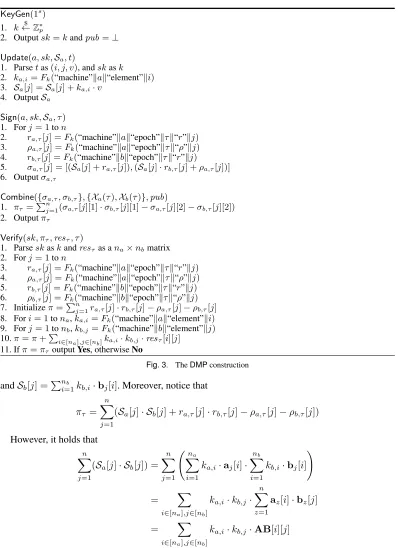
Figure 3 presents theDMPconstruction. The technique takes advantage of the following property of matrix multiplication. LetA = [a1a2. . .an], whereaj denotes thejthcolumnofA. Also let
B= [b1b2. . .bn]T, wherebjis thejthrowofB. Then it holds:
Q(Xa(τ)∪ Xb(τ)) =AB= n
X
j=1
aj⊗bj
whereaj⊗bjis the outer product of vectorsaj,bj, such that:
aj⊗bj=
aj[1]bj[1] aj[1]bj[2] . . . aj[1]bj[nb]
aj[2]bj[1] aj[2]bj[2] . . . aj[2]bj[nb]
. . . . aj[na]bj[1] aj[na]bj[2] . . . aj[na]bj[nb]
Ma(respectivelyMb) can create a summarySa[j](Sb[j]) for vectoraj(bj) in a similar manner to DVS. We can then compute a summary ofaj⊗bjfrom the productSa[j]·Sb[j]: for each entry of this
outer product, there is a corresponding term inSa[j]·Sb[j], scaled by a secret value (i.e., the product
of the two corresponding keys). In other words, we obtain a summary of the outer product result matrix with similar properties to theDVSsummary for a single vector. Since matrix multiplication can be expressed as a sum of outer products, we can usendifferent summariesSa[j],Sb[j](i.e.,
one for each column ofA, and one for each row ofB), and build a summary for productABby summing them up.
We assume thatMaknows thatMb participates in the query and vice-versa (this information is
part of the query description). The summariesSa,Sbare both initialized to zeron-element vectors
during the setup phase. AlgorithmsUpdateandSignare presented in the context ofMa.Sa now
containsnentries, one for eachcolumn. The case ofMb is symmetric:Sbalso includesnentries,
but one for eachrow. This can be achieved by instead parsingtas(j, i, v)in Line 1 ofUpdate, and proceeding accordingly.
To provide security for these summaries, the Sign function produces composite signatures σa,τ[j], σb,τ[j], each consisting of two elements/signatures. In particular, their first elements
(σa,τ[j][1]andσb,τ[j][1]) integrate machine-, time-, and column-/row- dependent valuesrto mask
the summaries as inDVS. In order to produce a proof for summaries of the formSa[j]· Sb[j], the
server needs to multiplyσa,τ[j][1]withσb,τ[j][1]. However, observe that termsra,τ[j]· Sb[j]and
rb,τ[j]· Sa[j]will appear in the resulting proof, which are hard to verify by the client withoutSa[j]
andSb[j]. Therefore, the machines provide additional info (namely signaturesσa,τ[j][2], σb,τ[j][2])
that enable the server to remove these values from the proof. To ensure security, these signatures incorporatenewone-time keys (denoted asρ).
Based on the above,Combinenow takes a combination of2nelements together to build a compact proof that includes the summary of the whole product matrix. Note thatπτ is just a single value
modulop. Similar toDVS,Combinedoes not need any public information from the owner and, thus,pubis set to a null value inKeyGen. Finally, algorithmVerifyneeds to include the various masking values created byMaandMbfor each of theirnparallel summaries and outputsYesonly
if the proof computed for the claimed result matches the provided proofπτ.
Correctness and security.The following two theorems state the correctness and security ofDMP:
THEOREM 4.3. DMPis correct.
PROOF. Let the actual result ofQ at τ be Q({Xa(τ)∪ Xb(τ)}) = AB, where A[i][j] =
P
t∈Xa(τ)∧(t.i=i)∧(t.j=j)t.vandB[i][j] =
P
t∈Xb(τ)∧(t.i=i)∧(t.j=j)t.v. Observe that, after
KeyGen(1s) 1. k←$ Z∗p
2. Outputsk=kandpub=⊥
Update(a, sk,Sa, t)
1. Parsetas(i, j, v), andskask
2. ka,i=Fk(“machine”kak“element”ki)
3. Sa[j] =Sa[j] +ka,i·v
4. OutputSa
Sign(a, sk,Sa, τ) 1. Forj= 1ton
2. ra,τ[j] =Fk(“machine”kak“epoch”kτk“r”kj)
3. ρa,τ[j] =Fk(“machine”kak“epoch”kτk“ρ”kj)
4. rb,τ[j] =Fk(“machine”kbk“epoch”kτk“r”kj)
5. σa,τ[j] = [(Sa[j] +ra,τ[j]),(Sa[j]·rb,τ[j] +ρa,τ[j])]
6. Outputσa,τ
Combine({σa,τ, σb,τ},{Xa(τ),Xb(τ)},pub)
1. πτ =Pnj=1(σa,τ[j][1]·σb,τ[j][1]−σa,τ[j][2]−σb,τ[j][2])
2. Outputπτ
Verify(sk, πτ,resτ, τ)
1. Parseskaskandresτas ana×nbmatrix
2. Forj= 1ton
3. ra,τ[j] =Fk(“machine”kak“epoch”kτk“r”kj)
4. ρa,τ[j] =Fk(“machine”kak“epoch”kτk“ρ”kj)
5. rb,τ[j] =Fk(“machine”kbk“epoch”kτk“r”kj)
6. ρb,τ[j] =Fk(“machine”kbk“epoch”kτk“ρ”kj)
7. Initializeπ=Pnj=1ra,τ[j]·rb,τ[j]−ρa,τ[j]−ρb,τ[j]
8. Fori= 1tona,ka,i=Fk(“machine”kak“element”ki)
9. Forj= 1tonb,kb,j=Fk(“machine”kbk“element”kj)
10.π=π+P
[image:11.612.110.508.86.634.2]i∈[na],j∈[nb]ka,i·kb,j·resτ[i][j] 11. Ifπ=πτoutputYes, otherwiseNo
Fig. 3. TheDMPconstruction
andSb[j] =Pin=1b kb,i·bj[i]. Moreover, notice that
πτ = n
X
j=1
(Sa[j]· Sb[j] +ra,τ[j]·rb,τ[j]−ρa,τ[j]−ρb,τ[j])
However, it holds that
n
X
j=1
(Sa[j]· Sb[j]) = n
X
j=1 na
X
i=1
ka,i·aj[i]· nb
X
i=1
kb,i·bj[i]
!
= X
i∈[na],j∈[nb]
ka,i·kb,j· n
X
z=1
az[i]·bz[j]
= X
i∈[na],j∈[nb]
ka,i·kb,j·AB[i][j]
Ifresτ is equal toAB, then it is easy to see that theπcomputed inVerifyis equal toπτ and,
THEOREM 4.4. IfFis a PRF, thenDMPis secure. For the proof, see Appendix A.2.
Performance. The memory consumption and computational cost ofUpdate at each machine is the same as inDVS. Due to thenmasked summaries, algorithmSigninvolvesO(n)modular addi-tions/multiplications and hashes, whereas the communication cost between a machine and the server becomesO(n). The server computesO(n)modular additions/multiplications inCombine. Finally, the client receives a constant sized proof, butVerifyentailsO(na+nb+n)hashes, andO(nanb)
modular additions/multiplications, proportional to the cost of reading the result. This is reduced if the result matrix is sparse: then, the time taken is proportional to the number of non-zero entries, which can be much lower.
Note that this protocol substantially reduces the burden on the data owner, compared to the cost it would pay to perform the matrix multiplication itself. Without outsourcing, the data owner would have to store theO(n2)entries of the matrices, and perform the super-quadratic amount of work to
carry out the multiplication. Here, the data owner’s requirements are reduced toO(n)storage per machine, and constant work per update.
4.3. Dynamic Dot Product Authentication
We focus on two machines,MaandMb, and considern-element vectorsa,b. Vectora(respectively
b) is dynamically updated as new tuples are generated byMa(Mb). Each tuplet∈ Xa(respectively
t ∈ Xb) is of the form(j, v), and updatesa(b) by addingv toa[j](b[j]). The client’s queryQ
requests thedot productbetweenaandbat every epochτ, i.e.,
Q(Xa(τ)∪ Xb(τ)) =a·b= n
X
i=1
a[i]·b[i]
We refer to such a query as adynamic dot product query, and present a scheme calledDDPfor authenticating it.
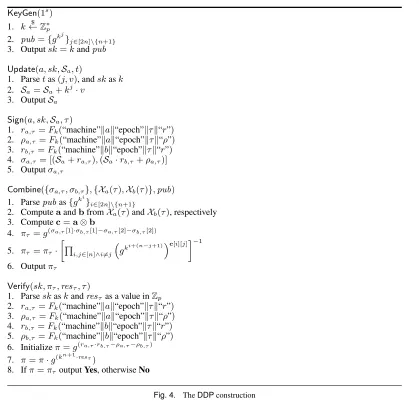
Figure 4 presents theDDPconstruction. Similar toDMP, we assume that Ma knows thatMb
participates in the query and vice-versa. AlgorithmsUpdateandSignare described in the context of Ma. The case of Mb is symmetric, with the vital difference that the summary is updated as
Sb =Sb+kn−j+1·v in Line 2 ofUpdate. The summariesSa,Sb are initialized to0during the
setup phase. We make use of a (multiplicative) cyclic groupGof orderpwith generatorg, whose
specifications arepublicand where then-DHE problem is hard (see Section 2.1).
Note that the dot product of two vectors is thetrace of their outer product. We use this fact to construct the protocol. We derive a signature of the outer producta⊗bin a similar manner to
DMP, where each element of the resulting matrix is scaled with a secret key. Furthermore, certain machine- and time-dependent masking is performed via the r and ρvalues. The server is then responsible for removingcertain elements a[i]·b[j], which are scaled byki+(n−j+1), from the
signature inCombine. Specifically, the server does this foreveryi 6= j (i.e., all the elements but those in the diagonal).
In order to facilitate this task, the owner provides some public infopubto the server concerning the scalar values ki+(n−j+1), with the exception ofkn+1. These keys are given as exponents of
generatorg ∈G. This is necessary because, otherwise, the server could trivially retrievekn+1 as
kn+i+1
·(ki)−1 modpfor somei, where(ki)−1is the multiplicative inverse ofkimodulop. This
cannot happen if the keys are in the exponent ofgdue to then-DHE assumption (we will use this fact later in our rigorous proof). All computations in Verify are performed in the exponent ofg. Following this, the outputπτ should contain solely the contribution from elements on the diagonal
of the outer product, all scaled bykn+1, plus the masking values.
KeyGen(1s) 1. k←$ Z∗p
2. pub={gkj}j
∈[2n]\{n+1} 3. Outputsk=kandpub
Update(a, sk,Sa, t)
1. Parsetas(j, v), andskask
2. Sa=Sa+kj·v
3. OutputSa
Sign(a, sk,Sa, τ)
1. ra,τ=Fk(“machine”kak“epoch”kτk“r”)
2. ρa,τ=Fk(“machine”kak“epoch”kτk“ρ”)
3. rb,τ=Fk(“machine”kbk“epoch”kτk“r”)
4. σa,τ = [(Sa+ra,τ),(Sa·rb,τ+ρa,τ)]
5. Outputσa,τ
Combine({σa,τ, σb,τ},{Xa(τ),Xb(τ)},pub)
1. Parsepubas{gki}i
∈[2n]\{n+1}
2. ComputeaandbfromXa(τ)andXb(τ), respectively 3. Computec=a⊗b
4. πτ =g(σa,τ[1]·σb,τ[1]−σa,τ[2]−σb,τ[2])
5. πτ =πτ·
Q
i,j∈[n]∧i6=j
gki+(n−j+1)c[i][j] −1
6. Outputπτ
Verify(sk, πτ,resτ, τ)
1. Parseskaskandresτas a value inZp
2. ra,τ=Fk(“machine”kak“epoch”kτk“r”)
3. ρa,τ=Fk(“machine”kak“epoch”kτk“ρ”)
4. rb,τ=Fk(“machine”kbk“epoch”kτk“r”)
5. ρb,τ=Fk(“machine”kbk“epoch”kτk“ρ”)
6. Initializeπ=g(ra,τ·rb,τ−ρa,τ−ρb,τ) 7. π=π·g(kn+1·resτ)
[image:13.612.103.522.87.497.2]8. Ifπ=πτoutputYes, otherwiseNo
Fig. 4. TheDDPconstruction
THEOREM 4.5. DDPis correct.
PROOF. Let theactualresult ofQatτ beQ({Xa(τ)∪ Xb(τ)}) = a·b = Pni=1a[i]·b[i],
wherea[j] = P
t∈Xa(τ)∧t.j=jt.v, andb[j] =
P
t∈Xb(τ)∧t.j=jt.v. Observe that, after executing
Update for allt ∈ Xa(τ)andt ∈ Xb(τ)atMa andMb, respectively,Sa =Pnj=1kj ·a[j]and Sb =Pnj=1kn−j+1·b[j]. Moreover, the proof output byCombineis
πτ=g(
Pn j=1k
j·kn−j+1·a[j]·b[j])+ra,τ·rb,τ−ρa,τ−ρb,τ
=gkn+1·(a·b)+ra,τ·rb,τ−ρa,τ−ρb,τ
Ifresτis equal toa·b, then theπcomputed inVerifyis equal toπτ and, thus,VerifyoutputsYes.
This concludes our proof.
Performance.In this scheme, the owner has to invest in someone-timepreprocessing effort to create
pub. This accounts forO(n)exponentiations inZp(forki), and anotherO(n)exponentiations in
G(forgk i
). Nevertheless, this cost isamortizedover the entire lifetime of the system. The memory consumption and the computational cost ofSignat each machine are (asymptotically) the same as inDVS. The cost inUpdatenow involves a modular exponentiation. Note though that the latter is performed in the small finite fieldZpand, hence, it is extremely lightweight.
To analyze the server’s computation cost inCombine, first observe that, settingi+(n−j+1) =z, the server can calculate
Y
i,j∈[n]∧i6=j
gki+(n−j+1)c[i][j]
= Y
z∈[2n]\{n+1} (gkz
)Pzc[i][j]
assuming that it has access to the set of outer product valuesc. However, the server does not need to explicitly generatec. Rather, it only needs the vector ofndifferentP
i+(n−j+1)=zc[i][j]values,
for2≤z≤2n. We can compute these values from the (discrete) convolution of the vectorsa,b, in timeO(nlogn)via the Fast Fourier Transform. Assuming we have these, then the cost at the server is dominated byO(n)exponentiations inG. For storage, the server has to store theO(n)values in pub, which is comparable to the cost of storing the inputsXaandXb.
Finally,Verifyat the client simply involves a constant number of evaluations ofFk, and a (single)
exponentiation inG.
5. APPLICATIONS
In this section, we discuss some common queries in stream outsourcing, and explain how the con-structions that we have provided can address them. We stress, though, that the applicability of our schemes is not limited to these cases; we are confident that our fundamental tools can capture a much wider set of applications. For brevity, we omit detailed discussion of correctness and security, which follow the pattern established by the main protocols in Section 4.
Group by queries.The class of group-by,sumaggregation queries are at the heart of many outsourced computation scenarios and have been the sole motivation for much of the prior work on stream authentication. The setting is that a large number of tuples is observed as a stream. These tuples may correspond, for example, to activity on a network, updates to a large database table, or events in an event-processing system. The requirement is for the server to collate the stream tuples into groups and report the sum for each group. We typically consider cases where the number of active groups (those with a non-zero sum) is substantially large, so that the data owner benefits from enlisting the server to perform the aggregation.
This problem is solved directly by the dynamic vector sum authentication protocol,DVS, applied to a single vector. Each stream tuple is translated into an update to the vector. The entries of the vector give the aggregate associated with each corresponding group. The approach naturally holds for the distributed setting, where updates might be spread across multiple streams. In this case, the object of the authentication is the vector given by the sum of the vectors derived from each of the streams.DVScaptures this scenario due to itshomomorphic property, which allows the client to verify a sum of vectors by checking asingleproof (produced by the server) that combines all individual vector signatures together.
Join Queries.Beyond simple grouping and aggregation, many important outsourced queries involve the computation of ajoinquery on relations. In traditional data stream management systems, join queries are regarded particularly challenging, with prior work focusing on approximate results [9; 29]. Hence, join queries are a prime candidate for outsourcing.
We explain how to authenticate join results in our setting, focusing on the common case of equi-join, for queries such asSELECT * FROM R, S WHERE R.x = S.x. Assume without loss of generality that the join result is given by the multiset of tuples(tR, tR.x, tS), wheretRis a tuple
suppose that the domain of the join values is[n]. We reduce this problem to an instance of a dot-product query, making use of acryptographic hash functionH, e.g., SHA-1 [19]. The inputs to our schemes are streams of(tR.x, tR)and(tS.x, tS)pairs originating from dynamic relationsR and
S, respectively. We transform an update toRof (tR.x, tR)into a tuple inXa as(tR.x, HR(tR)),
applying the hash functionHtotR. Similarly, we transform updates toSof(tS.x, tS)into a tuple in
Xbas(tS.x, HS(tS)). We then run theDDPprotocol over updates(j, v) = (tR.x, HR(tR))∈ Xa
atMa, and(j, v) = (tS.x, HS(tS))∈ XbatMb.
The server presents the claimed output multiset of(tR, tR.x, tS)tuples, along with the
accompa-nying proofπτ from theDDPprotocol. The client computesresτ =PtR.x=tS.xHR(tR)·HS(tS)
within theVerify routine. The protocol is correct, since the dot product between the two vectors generated by the above transformation is exactly thisresτvalue. In addition to the security ofDDP,
here we need to show that the adversary cannot present a result that produces the sameresτas the
actual result. In order to achieve this, we must follow the so-calledrandom oracle model[15; 13]. Briefly stated, this is a proof methodology that allows us to first prove the security of the scheme considering thatHis a truly random function. We can do this along the lines of our proof forDDP
in Appendix A.3. Then, we substituteHwith a hash function like SHA-1, and claim security due to the assumption about its cryptographic properties. We omit further details due to space constraints.
In the aforementioned problem, the goal was to authenticate the tuples produced by a join query on relations R,S on attribute x. Assume that R.y andS.z are attributes of relationsR andS, respectively. If, instead of the actual tuples, we are interested in authenticating the joint frequency distribution of each(R.y, S.z)pair in the join result, then this authentication can be achieved by a direct application of ourDMPprotocol. In this case, the machine containing relationR(S) builds a two-dimensional matrix, where each element of the matrix corresponds to the joint frequency of occurrences of each(R.y, R.x)((S.x, S.z)) pair of values inR(S). It is easy to see that the product of these two matrices provides the desired result in this application.
Another interesting query is computing thesizeof the equi-join result. This is given by a direct application ofDDP: if we treat every tupletwith join valuet.xas an update of the form(t.x,1), then vectorsa,bwill hold the frequencies of the relations on each join value. Therefore, the equi-join size is exactlya·b.
In-network Aggregation.This is a popular paradigm employed typically in sensor networks, which reduces the energy expenditure in routing raw data from the motes to a remote client [18]. Consider a set of sensors organized (without loss of generality) into a tree-structured network. Also assume that a client communicates only with the root sensor (sink), and wishes to perform some aggregation task (e.g.,sumorcount) on the readings of the sensors. Transmitting the raw data to the client inflicts considerable burden on the nodes positioned close to the sink, as they have to forward a considerable number of messages from nodes lower in the tree. In-network aggregation mandates that internal nodes perform the aggregation task on the data received from their children and forward only a small result, thus achieving significant battery savings.
In our setting, only the leaf sensors belong to the owner, whereas the internal tree infrastructure is outsourced to an untrusted third party [12; 26; 23]. The goal is to allow the client to authenticate the aggregation result on the union of the leaf readings received from the sink. OurDVSconstruction applies to this scenario as well. ItsKeyGen,Update,SignandVerifyroutines remain the same in this case. The main changes occur to theCombinealgorithm executed by the server. Here, each server in the network executesCombineon the inputs received from its children, and forwards the output to its parent in the routing tree. Notice that the client eventually receives a proof from the sink that is equal to the summation of the leaf sensor signatures. This is exactly whatCombinewould output in case a single server collected all the sensor signatures. Our scheme is extremely lightweight for all parties involved and, hence, it is ideal for the resource constrained sensor networks.
by a vector which has millions or billions of components. Similarity measures are vital in such settings. For instance, clustering of objects often entails distance (i.e., dissimilarity) computation between feature vectors. Another example involves determining the correlation of items (i.e., market stocks, retail products, etc) whose information (i.e., shares values, sales volume) is dispersed across different server machines. Correlation is also based on similarity.
Similarity between vectors is typically measured by an appropriate similarity or dissimilarity measure, such as the cosine similarity andEuclidean distance, respectively. The cosine similar-ity between vectors a,bis computed as kak·kbka·b , wherekak = √a·a is theL2 norm ofa. The
Euclidean distance betweenaandbis equal toka−bk=pkak2+kbk2−2a·b.
We can authenticate such measures by engaging theDDPconstruction, since both cosine simi-larity and Euclidean distance depend on inner product computation. The case ofa·bis carried out by direct application ofDDP. Fora·aandb·b,MaandMbmust apply twoseparateinstances
(i.e., with different keys) ofDDPon the same vector aandb, respectively. The modifications in
CombineandVerifyare straightforward and, thus, omitted.
Event co-occurrence.Event monitoring applications operate on massive streams in order to find patterns or correlations between certain events [10]. These include supply chain management of RFID tagged products, stock trading, monitoring of machines for malfunctions, environmental sens-ing for surveillance of establishments, and more. An important class of queries in this scenario is findingco-occurrenceof events. We provide a simple example. LetA(respectivelyB) be ann×1
(1×n) matrix representing a set ofnevents occurring at machineMa(Mb). A cell value is1if
the event occurs during the latest (or at a specific) epoch, and0otherwise. Then,ABis an×n matrix where cellAB[i][j]is1if eventico-occurs with eventjat the latest (or at a specific) epoch. The result matrix can help in determining event correlations. The above can be generalized to ma-trices with arbitrary dimensions. It is apparent that ourDMPconstruction is directly applicable for authenticating such queries.
6. EXPERIMENTS
In this section we experimentally evaluate our basic protocols, namelyDVS,DMPandDDP. We compareDVSwith PIRS (specifically PIRS-1) [31], which is the only scheme that addresses our trusted-client setting, in the context ofgroup by,sumqueries. However, we stress that PIRS is nota direct competitor, as it assumes that the client is the owner itself and has a weaker security model. We slightly adapt PIRS so that the machines send to the client their summaries via the server, after authenticating them using another authentication scheme. On the other hand, as we are the first to address authentication of dot and matrix products,DMPandDDPhave no competitors.
Implementation. We implemented all protocols in C on a 2.66GHz Intel Core i7 with 4GB of RAM, running MAC OS X. We used the GMP1 and OpenSSL2 libraries for implementing the cryptographic operations involved. We utilized HMAC with SHA-1 [19] for theF function, which produces 20-byte outputs. We employed HMAC with SHA-1 also as the message authentication scheme in PIRS for authenticating the summaries to the clients.
An important discussion concerns the selection of the size of the prime pthat defines theZp
domain (i.e., the value for security parameters). In DVS,DMPandPIRS, this can be as small as10bytes for safeguarding against guessing attacks on the keys. On the other hand, inDDPthis must be at least20bytes. The reason is that DDPrelies on the discrete logarithm problem. The well-known Pollard rho algorithm takesO(√p)steps to find a logarithm inZp[19], suggesting that
the size ofpshould be twice as long as the one that protects against simple guessing.
Furthermore, we computed the generator of the group used inDDPemploying the implemen-tation techniques included in [19]. Specifically, the element of orderpthat generates our group of
1http://gmplib.org/
Table II. Primitive Costs
Description Cost
[image:17.612.226.393.217.284.2]Modular addition inZp(|p|= 10/20bytes) 0.15µs/ 0.18µs Modular multiplication inZp(|p|= 10/20bytes) 0.19µs/ 0.28µs Modular exponentiation inZp(|p|= 10/20bytes) 4.8µs/ 7.4µs Time to derive the generator ofZq(|q|= 64bytes) 2.7sec Modular multiplication inZq(|q|= 64bytes) 0.56µs Modular exponentiation inZq(|q|= 64bytes) 55.6µs HMAC computation (with SHA-1) 3.53µs
Table III. Comparison of DVS with PIRS (single machine)
Evaluated Cost DVS PIRS CPU time forUpdate 5.3µs 2.3µs
CPU time forSign 4.8µs 4.7µs
CPU time forVerify 48.9ms 19.1ms
Summary size 10 bytes 10 bytes Proof size 10 bytes 30 bytes
concernGis selected fromZq, whereqis a64-byte prime of the formq= 2`p+ 1[19]. All
com-putations inGare moduloq. Table II includes the average cost (over 10,000 runs) of each primitive
operation entailed in the implemented protocols.
Evaluation ofDVSvs. PIRS.We comparedDVSwith PIRS using theWorld Cup Dataset3. The latter contains Web server logs from the 1998 Soccer World Cup. Each log entry consists of a client ID, the ID of the requested URL, the size of the response, etc. We used the first2million tuples from the log of day50. From each tuple in this set, we produced a tuple(j, v), wherej is a client ID, andvis the size of the response. We then focused on agroup by,sumquery that returns a vector, where thejthelement corresponds to a unique clientj, and the value of thejthelement is the sum of response sizes of all requests issued by clientj.
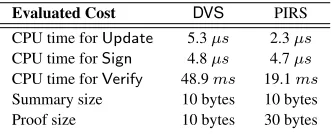
Table III illustrates the various costs we evaluated during our experiment, assuming a single stream generated by asinglemachine. We decomposed PIRS into algorithms of the formUpdate,
Sign, andVerify (Combinehas no cost in the single machine setting in both schemes and, thus, is omitted). The average number of non-zero elements in the result vector (which affects the CPU time in Verify) was around 12,000. PIRS and DVShave comparable CPU overheads for Sign. However, PIRS outperforms DVSfor Update andVerify because, contrary toDVS, it does not involve HMAC invocations. Recall though that this performance advantage of PIRS comes at the expense of a weaker security model. Moreover, observe that the CPU times forDVSare in the order of a few microseconds at the owner (5.3µsforUpdateand4.8µsforSign), and a few milliseconds at the client (48.9µsforVerify). The summary and proof size is negligible inDVS(10 bytes). The summary size in PIRS is the same, but its proof size is 20 bytes longer due to the additional HMAC that authenticates the summary.
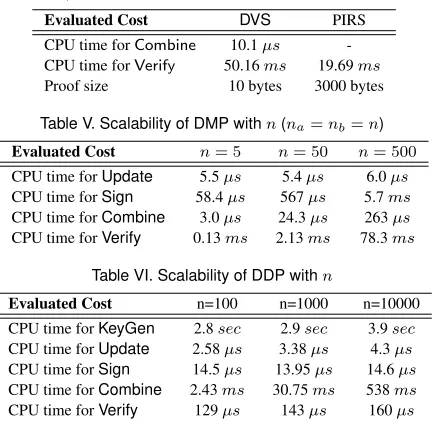
Table IV depicts the costs in the scenario where we repeat the previous experiment, but now the tuples are generated bym = 100machines. TheUpdateandSigncosts are unaffected bym and, hence, are omitted. In PIRS, there is noCombinecost, since the server simply forwardsm summaries and HMACs to the client. This considerably increases the total proof size to 3000 bytes. On the other hand, inDVS, the server combines the signatures of all the machines into asingleone, always maintaining the communication cost of 10 bytes. This comes with a very small overhead for the server due toCombine(10.1µs). The cost ofVerifyincreases by themextra hash computations in bothDVSand PIRS. However, note that the overall cost is rather dominated by the operations
Table IV. Comparison of DVS with PIRS (m= 100 ma-chines)
Evaluated Cost DVS PIRS
CPU time forCombine 10.1µs -CPU time forVerify 50.16ms 19.69ms
[image:18.612.200.416.110.322.2]Proof size 10 bytes 3000 bytes
Table V. Scalability of DMP withn(na=nb=n)
Evaluated Cost n= 5 n= 50 n= 500 CPU time forUpdate 5.5µs 5.4µs 6.0µs
CPU time forSign 58.4µs 567µs 5.7ms
CPU time forCombine 3.0µs 24.3µs 263µs
CPU time forVerify 0.13ms 2.13ms 78.3ms
Table VI. Scalability of DDP withn
Evaluated Cost n=100 n=1000 n=10000 CPU time forKeyGen 2.8sec 2.9sec 3.9sec
CPU time forUpdate 2.58µs 3.38µs 4.3µs
CPU time forSign 14.5µs 13.95µs 14.6µs
CPU time forCombine 2.43ms 30.75ms 538ms
CPU time forVerify 129µs 143µs 160µs
imposed by thenvector elements and, therefore, the overhead is very similar to the case of a single machine in bothDVSand PIRS.
Evaluation ofDMP.We consider the costs for matrix multiplication between twon×nmatrices. Here, we generate synthetic data by randomly filling entries—note that the data itself does not affect the performance of theDMPconstruction, as the steps taken are largely data independent. Table V shows the time costs of each of the operations asnvaries. TheUpdatestep is similar in all cases (∼6µs), as it does not depend onn. TheSignoperation scales linearly withn(proportionally to the square root of the input size), exactly as predicted by our analysis. Even for large matrices with hundred thousands of entries, this cost is in the order of a few milliseconds; extrapolating to billion entry matrices, the cost will remain below a second.Combinescales similarly, proportional to the size of the summary. OnlyVerifyis more expensive, due to the cost of reading the fulln×nresult, performing modular multiplications for each entry, and invokingO(n)HMAC calls. Yet this too is way below a second even for our largest example.
Evaluation ofDDP.We give our results forDDPin Table VI. Here, we also generate synthetic vectors of differing sizes. Observe that there is a non-trivial setup cost for this protocol, which stems from determining a generator forGand computing the exponentiated values inpub. However, most
of the work is in finding a suitable generator, although this truly is a one-time operation. The cost varies little with the vector sizen. As before,Updatedoes not depend onn, and in this case neither doesSign. Therefore, the two overheads are relatively unaffected byn. Our cost forCombinegrows linearly withn, as predicted by our performance analysis, and remains below one second even in our worst-case experiment (n = 10000). The cost forVerify is quite low, since it requires only a constant amount of light work for checking the proof.
supe-rior to PIRS in terms of client communication cost in the case of multiple machines. Finally,DMP
andDDPare the first secure, efficient, and scalable protocols for the problems of dynamic matrix multiplication and dynamic dot product, respectively.
7. CONCLUSIONS AND FUTURE WORK
In this paper we addressed the problem of result authentication in stream outsourcing settings. While prior work has focused on simple group by and sum queries in such scenarios, our protocols allow the authentication of several linear algebraic operators, such as sums or dot products over dynamic vectors and dynamic matrix multiplication, which are used in numerous applications over distributed data. Our experimental evaluation demonstrated that our protocols are extremely lightweight espe-cially for the owner in terms of running time, storage requirements and bandwidth consumption. Moreover, our schemes offer strong cryptographic guarantees for their security. In our future work, we plan to extend our lightweight techniques to the challenging setting where clients may collude with the server to attack other clients. In this case, the owner only grants a public key to the clients, hiding his secret key.
REFERENCES
D. Abadi, D. Carney, U. C¸ etintemel, M. Cherniack, C. Convey, C. Erwin, E. Galvez, M. Hatoun, A. Maskey, A. Rasin, A. Singer, M. Stonebraker, N. Tatbul, Y. Xing, R. Yan, and S. Zdonik. Aurora: A Data Stream Management System. In SIGMOD, 2003.
S. Agrawal and D. Boneh. Homomorphic MACs: MAC-Based Integrity for Network Coding. InACNS, 2009.
A. Arasu, B. Babcock, S. Babu, M. Datar, K. Ito, I. Nishizawa, J. Rosenstein, and J. Widom. STREAM: The Stanford Stream Data Manager (demonstration description). InSIGMOD, 2003.
D. Boneh and D. M. Freeman. Homomorphic Signatures for Polynomial Functions. InEUROCRYPT, 2011.
J. Camenisch, M. Kohlweiss, and C. Soriente. An Accumulator Based on Bilinear Maps and Efficient Revocation for Anony-mous Credentials. InPKC, 2009.
A. Chakrabarti, G. Cormode, and A. McGregor. Annotations in Data Streams. InICALP, 2009.
G. Cormode, J. Thaler, and K. Yi. Verifying computations with streaming interactive proofs. InVLDB, 2012.
C. Cranor, T. Johnson, O. Spatscheck, and V. Shkapenyuk. Gigascope: A Stream Database for Network Applications. In SIGMOD, 2003.
A. Das, J. Gehrke, and M. Riedewald. Approximate Join Processing Over Data Streams. InSIGMOD, 2003.
A. J. Demers, J. Gehrke, B. Panda, M. Riedewald, V. Sharma, and W. M. White. Cayuga: A general purpose event monitoring system. InCIDR, 2007.
P. Devanbu, M. Gertz, C. Martel, and S. G. Stubblebine. Authentic Data Publication over the Internet.J. Comput. Secur., 11(3):291–314, 2003.
M. N. Garofalakis, J. M. Hellerstein, and P. Maniatis. Proof Sketches: Verifiable In-Network Aggregation. InICDE, 2007. O. Goldreich.The Foundations of Cryptography - Volume 1, Basic Techniques. Cambridge University Press, 2001. S. Goldwasser, Y. T. Kalai, and G. N. Rothblum. Delegating Computation: Interactive Proofs for Muggles. InSTOC, 2008. J. Katz and Y. Lindell.Introduction to Modern Cryptography. Chapman and Hall/CRC Press, 2007.
F. Li, M. Hadjieleftheriou, G. Kollios, and L. Reyzin. Dynamic Authenticated Index Structures for Outsourced Databases. In SIGMOD, 2006.
F. Li, K. Yi, M. Hadjieleftheriou, and G. Kollios. Proof-Infused Streams: Enabling Authentication of Sliding Window Queries On Streams. InVLDB, 2007.
S. Madden, M. J. Franklin, J. M. Hellerstein, and W. Hong. Tag: a tiny aggregation service for ad-hoc sensor networks. In OSDI, 2002.
A. J. Menezes, S. A. Vanstone, and P. C. V. Oorschot.Handbook of Applied Cryptography. CRC Press, Inc., 1996. Microsoft. StreamInsight. http://msdn.microsoft.com/en-us/library/ee362541.aspx, 2010.
H. Nasgaard, B. Gedik, M. Komor, and M. P. Mendell. IBM Infosphere Streams: Event Processing for a Smarter Planet. In CASCON, 2009.
S. Nath and R. Venkatesan. Publicly Verifiable Grouped Aggregation Queries on Outsourced Data Streams. InICDE, 2013. S. Nath, H. Yu, and H. Chan. Secure Outsourced Aggregation via One-way Chains. InSIGMOD, 2009.
H. Pang, A. Jain, K. Ramamritham, and K.-L. Tan. Verifying Completeness of Relational Query Results in Data Publishing. InSIGMOD, 2005.
S. Papadopoulos, A. Kiayias, and D. Papadias. Secure and Efficient In-Network Processing of Exact SUM Queries. InICDE, 2011.
S. Papadopoulos, Y. Yang, and D. Papadias. CADS: Continuous Authentication on Data Streams. InVLDB, 2007. V. Shoup. Lower Bounds for Discrete Logarithms and Related Problems. InEUROCRYPT, 1997.
S. Viglas, J. F. Naughton, and J. Burger. Maximizing the Output Rate of Multi-Way Join Queries over Streaming Information Sources. InVLDB, 2003.
Y. Yang, D. Papadias, S. Papadopoulos, and P. Kalnis. Authenticated Join Processing in Outsourced Databases. InSIGMOD, 2009.
A. SECURITY PROOFS
We will prove all our constructions under the following general methodology [13]. We will construct anidealversion of each scheme, where functionFis substituted by a truly random functionf. The adversary will be able to obtain outputs off for inputs of its choice, but it will not be given direct access tof itself. We will next prove that the scheme is secure under this ideal model. Finally, we will conclude that therealimplementation of the scheme (i.e., the one that uses the PRFFinstead of f) is secure, since otherwise the adversary would distinguish the PRF from a truly random function.
A.1. Proof of Theorem 4.2 (
DVS)
Letk = [k1, k2, . . . , kn], wherekj is generated as inUpdate, but now via truly random function
f instead of PRFF. The adversaryAinteracts with the oracle as outlined inExpAin Section 3.2, and obtains asinglesignature for every (i,τ0) pair for any stream of its choice, such thatτ0 6=τ.
Leta∗i,τ0 be the dynamic vector produced by machineMi atτ0 for an arbitrary stream selected by
the adversary. Note thatAcan query the oracle forpoly(s)different epochsτ0. Then,
Aobtains the following set:
V={a∗i,τ0,(k·a∗i,τ0 +ri,τ0)}(i∈[m])∧(τ06=τ)
∪ {ai,τ,(k·ai,τ +ri,τ)}i∈[m]
whereai,τ is therealdynamic vector produced by machineMi at epochτwhen the stream is the
actualXi(τ). All thervalues are constructed as inSign, but again via functionf instead ofF. Set
V is theviewof the adversary in the attack.
Asucceeds in the attack if it presents(res∗
τ, π∗τ), such thatres∗τisdifferentfrom theactualresult
resτ =Pmi=1ai,τ, and
πτ∗=k·res∗τ+ m
X
i=1
ri,τ
so thatVerifyoutputsYes. Observe that this is equivalent to finding a pair(v∗,k·v∗)fromV, and then computingres∗
τ =resτ+v∗andπ∗τ =πτ+k·v∗(note thatv∗must benon-zero).
Nevertheless, everyri,τ0, ri,τ used in the components ofVarerandom(due tof) and usedonly
once. As such, every(k·a∗i,τ0+ri,τ0)and(k·ai,τ+ri,τ)inVcan be considered as the encryption
ofk·a∗i,τ0,k·ai,τ with keysri,τ0 andri,τ, respectively, where the encryption scheme is a
straight-forward variant of theone-time pad(see Section 2.1). Due to this scheme and sincekis random and secret, the adversary computesk·v∗for any givenv∗fromV only with probabilitynegl(s).
Based on the above discussion,Acan onlyguessa pair(res∗
τ, π∗τ). Consider the following
mul-tivariate polynomialinfinite fieldZp
P(X1, X2, . . . , Xn+1) =k1X1+. . .+knXn−Xn+1+ m
X
i=1
ri,τ
Notice that A guesses (res∗
τ, π∗τ) correctly if and only if res∗τ = [v1∗, v∗2, . . . , vn∗] such that
P(v∗
1, v2∗, . . . , vn∗, π∗τ) = 0. However, due to Lemma 1 in [28], for any (non-zero) multivariate
polynomialP inZp of degreed(in our cased = 1) and randomly chosenv∗1, v2∗, . . . , v∗n, πτ∗, the
probability thatP(v∗
1, v∗2, . . . , v∗n, πτ∗) = 0isd/p d=1
= 1/p=negl(s).
We derive thatDVSissecurew.r.t.ExpAin theideal model. Therefore, we also conclude that
DVSis secure in thereal model, under the assumption thatFis a PRF.
A.2. Proof of Theorem 4.4 (
DMP)
Letka= [ka,1, . . . , ka,na]andkb= [kb,1, . . . , kb,nb], whereka,i, kb,iare created as inUpdate, but