warwick.ac.uk/lib-publications
Original citation:Zhang, Junliang, Gody, Guillaume, Hartlieb, Matthias, Catrouillet, Sylvain, Moffat, J. and Perrier, Sébastien. (2016) Synthesis of sequence-controlled multi-block single chain nanoparticles by a step-wise folding-chain extension-folding process. Macromolecules, 49 (23). pp. 8933-8942.
Permanent WRAP URL:
http://wrap.warwick.ac.uk/83939
Copyright and reuse:
The Warwick Research Archive Portal (WRAP) makes this work by researchers of the University of Warwick available open access under the following conditions. Copyright © and all moral rights to the version of the paper presented here belong to the individual author(s) and/or other copyright owners. To the extent reasonable and practicable the material made available in WRAP has been checked for eligibility before being made available.
Copies of full items can be used for personal research or study, educational, or not-for profit purposes without prior permission or charge. Provided that the authors, title and full bibliographic details are credited, a hyperlink and/or URL is given for the original metadata page and the content is not changed in any way.
Publisher’s statement:
“This document is the Accepted Manuscript version of a Published Work that appeared in final form in Macromolecules copyright © American Chemical Society after peer review and technical editing by the publisher.
To access the final edited and published work
http://pubs.acs.org/page/policy/articlesonrequest/index.html .”
A note on versions:
The version presented here may differ from the published version or, version of record, if you wish to cite this item you are advised to consult the publisher’s version. Please see the ‘permanent WRAP URL above for details on accessing the published version and note that access may require a subscription.
Synthesis of Sequence-Controlled Multi-block Single Chain
Nanoparticles by a Step-wise Folding-Chain
Extension-Folding Process
Junliang Zhang,1 Guillaume Gody,1 Matthias Hartlieb,1 Sylvain Catrouillet,1 Jonathan Moffat,2 Sébas-tien Perrier1,3,*
1
Department of Chemistry, The University of Warwick, Coventry CV4 7AL, UK;
2
Asylum Research, Halifax road , High Wycombe, Buckinghamshire, HP12 3SE, UK;
3
Faculty of Pharmacy and Pharmaceutical Sciences, Monash University, 381 Royal Parade, Parkville, Victoria 3052, Australia
*Corresponding author: Email: [email protected]; Tel: +44 2476 528 085
ABSTRACT
molecu-lar (hydrogen bonds) linkage. The approach was used to create a highly complex penta-block copoly-mer having three individually folded subdomains with an overall dispersity of 1.21. The successful for-mation of SCNP was confirmed by size exclusion chromatography (SEC), nuclear magnetic resonance (NMR), differential scanning calorimetry (DSC) and atomic force microscopy (AFM).
INTRODUCTION
The highly specialized activity of biopolymers, e.g. proteins, is determined by the remarkable control of their precise tertiary three-dimensional structure, which arises from the controlled folding of a single polypeptide chain.1-5 The delicate controlled folding process of proteins is governed by the sophisticated sequence of amino-acid.3 Reproducing the specific way in which bio-macromolecules fold their linear polymeric chains into perfectly defined nanostructures is a major, yet, challenging goal in the field of macromolecular synthesis.5-7 Inspired by this model of biopolymers, folding a single linear polymer
chain into a single chain nanoparticle (SCNP) has been recognized as a robust strategy for the construc-tion of biopolymeric nanoparticles with potential applicaconstruc-tions in catalysis, sensing or biotechnology.8-14 Although the design and synthesis of single chain objects has recently received great attention,15 the development in this field is still in its initial phase. So far, several types of strategies to mediate the sin-gle chain collapse to form SCNPs have been explored,16-22 ranging from hydrogen bonding,23-27, 10, 28-31
sequences of the multi-block polymers can be controlled on demand. During the last few years, great developments in well-defined multi-block copolymers have been achieved using RAFT, ATRP or NMP.41-43, 1, 44-46 These polymerization methods enable the synthesis of tailored polymeric chains with well-controlled sequences. By introducing foldable functionalities in a defined region of a single poly-mer chain, the folding of a specific sequence can then be controlled on demand.
All of the above results have paved the way for synthesizing more elaborated SCNPs to approach the aim of mimicking nature. Recently, Lutz et al. reported the intramolecular double compaction of se-quence-controlled linear macromolecules into structured random coils at dilute concentrations.47 This strategy makes a wide variety of tailored polymeric single-chain microstructures attainable and provides new perspective to build complex SCNPs. So far, the investigation about preparing more than two com-pacted subdomains in one single sequence controlled polymer chain by a repeated “folding-chain exten-sion-folding” process has not been reported.
Herein, we report the synthesis of multi-block “pearl necklace” shape SCNPs by stepwise “folding-chain extension-folding” of sequence-coded block copolymers. As shown in Scheme 1, the first step was to synthesize a linear copolymer by RAFT polymerization. In this copolymer, OH-functionalities were introduced as foldable units being able to be cross linked using a bi-functional molecule.
In order to satisfy the demands of the continuous addition method and prevent inter-molecular cross linking, the reaction between the cross linker and the foldable units must proceed rapid.48 Isocyanates were chosen as they rapidly and quantitatively react with a wide range of nucleophiles (such as amines, thiols, alcohols, and carboxylic acids) under mild reaction conditions, without the production of a by-product.49 After folding of the first block, a spacer was introduced by chain extension with a non-functional monomer, followed by the introduction of a second foldable block, which again was folded using isocyanates. This procedure was repeated one more time to yield a penta-block consisting of three individual SCNPs each separated by a polymeric spacer representing a molecular pearl necklace.
MATERIALS AND METHODS
Materials.
2’-azobis(2-methylpropionate) (V601) was used without further purification. All polymerizations were carried out under a nitrogen atmosphere. 4, 4′-Methylenebis(phenyl isocyanate) (MDI, 98%) and p -Tolyl isocyanate was obtained from Sigma Aldrich and used as received. Diethyl ether (99.8%), anhy-drous DCM (99.8%), methanol (99.6%), 1-(3-Dimethylaminopropyl)-3-ethylcarbodiimide hydrochlo-ride (EDC x HCL, 98%), 4-dimethylaminopyridine (DMAP, 99%) and dibutyltin dilaurate (DBTDL, 95%) were obtained from Sigma Aldrich and used as received. Chloroform-d (CDCl3, 99.8% D atom)
and dimethyl sulfoxide-d6 (DMSO-d6, 99.9% D atom) obtained from Sigma Aldrich were used for 1H
NMR analysis. 2-(((butylthio)-carbonothioyl)thio)propanoic acid (called (propanoic acid)yl butyl trithi-ocarbonate (PABTC) in this paper) was prepared according to a previously reported procedure.51
Methods.
Nuclear Magnetic Resonance (NMR) spectroscopy (1H NMR and 13C NMR). Spectra were recorded
on a Bruker Avance III HD 400 spectrometer (400 MHz for proton and 100MHz for carbon) or a Bruker Avance III 600 (600 MHz for proton) at 27 °C in deuterated chloroform (CDCl3) or deuterated DMSO
(DMSO-d6). Chemical shift values (δ) are reported in ppm. The residual proton signal of the solvent (δH
= 7.26 ppm in CDCl3, δH = 2.51 ppm in DMSO-d6) was used as internal reference. For 13C NMR, the
carbon signal of the solvent (δC = 77.03 ppm in CDCl3) was used as internal reference.
Determination of monomer conversions. The conversions of the monomers were determined by com-paring the integration of the vinyl protons (δ ~ 6.50–5.50 ppm) to the integration of the three methyl protons belonging to the Z group of the MPABTC chain transfer agent (–CH2–CH3) or by comparing the
integration of the vinyl protons (δ ~ 6.50–5.50 ppm) before and after reaction using mesitylene as exter-nal reference.
Size Exclusion Chromatography (SEC). Number-average molar masses (Mn,SEC) and dispersity values
(Ð) were determined using size exclusion chromatography with either CHCl3 or DMF as an eluent. The
CHCl3 Agilent 390-LC MDS instrument was equipped with differential refractive index (DRI), and two
and a PLgel 5 µm guard column. The eluent is CHCl3 with 2 % TEA (triethylamine) additive. Samples
were run at 1 mL min-1 at 30 °C. Poly(methyl methacrylate), and polystyrene standards (Agilent Easy Vials) were used for calibration. H2O or Ethanol was used as a flow rate marker. Analyte samples were
filtered through a PVDF membrane with 0.22 µm pore size before injection. Respectively, experimental molar mass (Mn,SEC) and dispersity (Đ) values of synthesized polymers were determined by
convention-al cconvention-alibration using Agilent GPC/SEC software. The DMF Agilent 390-LC MDS instrument equipped with differential refractive index (DRI), viscometry (VS), dual angle light scatter (LS) and dual wave-length UV detectors. The system was equipped with 2 x PLgel Mixed D columns (300 x 7.5 mm) and a PLgel 5 µm guard column. The eluent is DMF with 5 mmol NH4BF4 additive. Samples were run at 1
mL min at 50 °C. Poly(methyl methacrylate) standards (Agilent EasyVials) were used for calibration. Analyte samples were filtered through a nylon membrane with 0.22 µm pore size before injection. Re-spectively, experimental molar mass (Mn,SEC) and dispersity (Đ) values of synthesized polymers were
determined by conventional calibration using Agilent GPC/SEC software.
Differential Scanning Calorimetry (DSC). The experiments were performed to determine the thermal behavior of the synthesized polymers on a Mettler Toledo DSC1. In all tests, a scan rate of 10 K/min was used in the temperature range of -30 to 180 °C for three heating and cooling cycles. The Tg value is
the maxima of the first derivative of (dH/dT).
Dynamic Light Scattering (DLS). The DLS measurements were performed on a MALVERN Instru-ment operating at 25 °C with a 633-nm laser module. MeasureInstru-ments were made at a detection angle of 173° (back scattering). The polymer solutions were prepared by dissolving the polymer samples in chlo-roform (1 mg/mL), which were filtered through a PVDF membrane with 0.22 µm pore size before being analysed.
Multi-mode AFM (Oxford Instruments Asylum Research). Images were acquired over a scan size of 1 µm at a pixel resolution of 512 and a scan rate of 1 Hz. Samples were diluted to 1 µg mL-1 in chloroform or di-chloromethane and 10 µL of solution was drop-deposited onto freshly cleaved mica discs. The data were analyzed by the Asylum Research software.
RAFT polymerization. CTA, monomer and azoinitiator were charged into a flask having a magnetic stirring bar. The flask was sealed with a rubber septum and degassed with nitrogen for 15 min. The solu-tion was then allowed to stir at the desired temperature in a thermos-stated oil bath for the desired time. After reaction, the mixture is cooled down in cold water to room temperature and open under air. A sample is taken for 1H NMR (to determine monomer conversion) and SEC analysis (to determine Mn.SEC
and Ð). See the supporting information for detailed procedure.
Single chain nanoparticles (SCNP) synthesis. The copolymer precursor was dissolved in dry DCM ([OH]0= 0.01 M). MDI (0.5 eq. of n(-OH)) was dissolved in dry DCM (the volume of the solution of
MDI was kept the same with the volume of the solution of the polymer). DBTDL was added to the solu-tion of MDI as catalyst. Both the solusolu-tion of copolymer precursor and MDI were degassed by N2 for 5
min. Subsequently, the solution of the copolymer precursor was added to the solution of MDI (with vig-orous stirring) at 2 mL h-1 using a syringe pump at room temperature. After addition of the solution of
the copolymer precursor, the reaction mixture was left for 2 h to let the reaction to complete. Then ex-cess amount of methanol was added to the reaction mixture to quench unreacted MDI. Subsequently, the reaction mixture was evaporated to dryness under reduced pressure. Then the crude product was dis-solved in minimum amount of DCM and precipitated in diethyl ether. See the supporting information for detailed procedure.
RESULTS & DISCUSSION
(NAM) resulting in a polymer decorated with OH functionalities. Methylene diphenyl di-isocyanate (MDI) was used as a cross linker, containing two isocyanate groups, which react rapidly with hydroxyl groups in the presence of a catalyst resulting in SCNP. Subsequently, chain extension using NAM was performed to create a spacer between individual SCNPs, followed by the addition of a further NAM/HEA block. A five block copolymer was synthesized including three blocks consisting of NAM/HEA, folded separately and separated by two NAM blocks.
Synthesis and folding of the first block (B1 and B1SCNP)
The linear polymer poly(NAM39-stat-HEA10) precursor B1(first block) containing statistically
distribut-ed pendant hydroxyl units was prepardistribut-ed by RAFT copolymerization of NAM and HEA as depictdistribut-ed in
Scheme 1. Optimized RAFT conditions, previously described for the synthesis of water soluble multi-block copolymers (Azoinitiator: VA-044 at 70 °C in H2O)45 were applied to provide a fast and
quantita-tive monomer conversion while maintaining high control over molar mass, narrow dispersity and high theoretical livingness. Particular attention was paid to the use of a non-free COOH chain transfer agent (methoxy-(propanoic acid)yl butyl trithiocarbonate, MPABTC, Scheme S1, Figure S1 and S2) to avoid any side reactions during the intramolecular cross linking step with MDI. The overall degree of polymerization of the first block was targeted to be 50 with 20% of HEA comonomer to ensure efficient intramolecular cross linking, as well as a high degree of livingness. After 2 h of polymerization, near quantitative monomer conversion (98%) was obtained from 1H NMR analysis for both monomers. Size-exclusion chromatography in CHCl3 revealed a mono-modal distribution and a narrow dispersity (Mn,th =
7,000 g mol-1, Mn,SEC = 6,200 g mol-1, Ð = 1.12, Figure 1 and Table 1). The monomer ratio and the DP
were determined by 1H-NMR (Figure S3).
As shown in Scheme 2 the folding of the linear copolymer B1 was carried out by the reaction of the
dibu-tyltin dilaurate (DBTDL) in dry DCM (to limit degradation of the isocyanate group into a primary amine). In order to reduce the competing intermolecular cross linking of multiple chains, such reactions are usually carried out at high dilutions (~10-5 – 10-6 mol L-1).48 However, even in dilute conditions, in-termolecular cross linking is still unavoidable.47
Scheme 2. A) Synthesis of the Single Chain Polymeric Nanoparticles B1SCNP and the Linear Control
Copolymer B1ctr from the Precursor Copolymer B1 (poly(NAM39-stat-HEA10)).
A solution to that problem was developed by Hawker et al. introducing a continuous addition method (by adding the solution of one reactant dropwise to the solution of the other reactant) to synthesize SCNPs.48Thisstrategy also permits the synthesis of well-defined and functionalized SCNPs in a rela-tively high concentration (ca. 0.01 mol L-1) and bigger quantities. For presented system, the slow addi-tion of the copolymer B1 ([OH] = 0.01 mol L-1) into a premade solution of the cross linker (MDI, 0.5
equivalent per hydroxyl group) in dry DCM was found to be the most successful approach to avoid in-termolecular cross linking reactions. After 24 h remaining isocyanate groups were quenched using methanol to prevent reactions with further blocks.
precursors, intermolecular cross linked species and SCNP.52, 4, 24, 53, 54 Comparing the SEC
chromato-gram of the material in chloroform after reaction (B1SCNP) with its parent copolymer B1, a shift towards
lower mass (i.e. smaller hydrodynamic volume, Mn,SEC = 6200 g mol-1 to 4800 g mol-1, Figure 1, Figure
S4) was observed, suggesting the successful formation of single chain polymeric nanoparticles B1SCNP.
[image:11.612.57.562.242.574.2]This result is consistent with previous literature about the intramolecular cross linking of a single poly-mer chain.32, 48, 47, 4, 54, 35, 38, 39
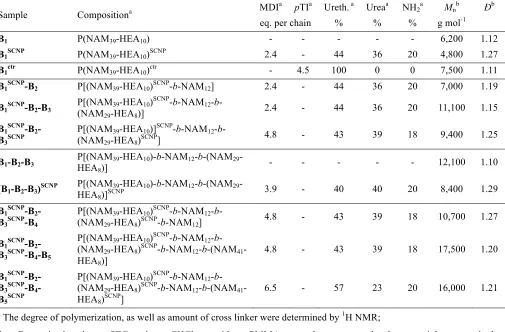
Table 1. Characterization of the Polymers by 1H NMR and CHCl
3-SEC.
Sample Compositiona MDI
a pTIa Ureth. a Ureaa NH
2a Mnb Ðb
eq. per chain % % % g mol-1
B1 P(NAM39-HEA10) - - - 6,200 1.12
B1SCNP P(NAM39-HEA10)SCNP 2.4 - 44 36 20 4,800 1.27
B1ctr P(NAM39-HEA10)ctr - 4.5 100 0 0 7,500 1.11
B1SCNP-B2 P[(NAM39-HEA10)SCNP-b-NAM12] 2.4 - 44 36 20 7,000 1.19
B1SCNP-B2-B3 P[(NAM39-HEA10)
SCNP-b-NAM 12-b
-(NAM29-HEA8)] 2.4 - 44 36 20 11,100 1.15
B1SCNP-B2 -B3SCNP
P[(NAM39-HEA10)]SCNP-b-NAM12-b
-(NAM29-HEA8)SCNP] 4.8 - 43 39 18 9,400 1.25
B1-B2-B3 P[(NAM39-HEA10)-b-NAM12-b-(NAM29
-HEA8)] - - - 12,100 1.10
(B1-B2-B3)SCNP HEAP[(NAM39-HEA10)-b-NAM12-b-(NAM29
-8)]SCNP 3.9 - 40 40 20 8,400 1.29
B1SCNP-B2 -B3SCNP-B4
P[(NAM39-HEA10)SCNP-b-NAM12-b
-(NAM29-HEA8)SCNP-b-NAM12] 4.8 - 43 39 18 10,700 1.27
B1SCNP-B2 -B3SCNP-B4-B5
P[(NAM39-HEA10)SCNP-b-NAM12-b
-(NAM29-HEA8)SCNP-b-NAM12-b-(NAM41
-HEA8)]
4.8 - 43 39 18 17,500 1.20
B1SCNP-B2 -B3SCNP-B4 -B5SCNP
P[(NAM39-HEA10)SCNP-b-NAM12-b
-(NAM29-HEA8)SCNP-b-NAM12-b-(NAM41
-HEA8)SCNP]
6.5 - 57 23 20 16,000 1.21
a The degree of polymerization, as well as amount of cross linker were determined by 1H NMR;
b Determined by SEC in CHCl
3 with PMMA used as molecular weight standards.
In order to investigate whether the observed changes in hydrodynamic volume is associated to the for-mation of covalent connections or hydrogen bonds between urethane units, a control copolymer B1ctr
was synthesized by reacting the linear copolymer B1 with a mono-functional isocyanate (p-tolyl
isocya-nate (pTI), Scheme 2). The SEC chromatogram obtained for the polymer B1ctr shows a shift towards
11
B1 and B1ctr confirms that the decreased hydrodynamic volume of B1SCNP is due to intramolecular cross
linking of B1 to obtain a collapsed nanoparticle from a random coil. It has to be noted that all SEC
[image:12.612.88.526.175.306.2]measurements were conducted using a flow rate marker as internal standard to minimize the error of the measurements.
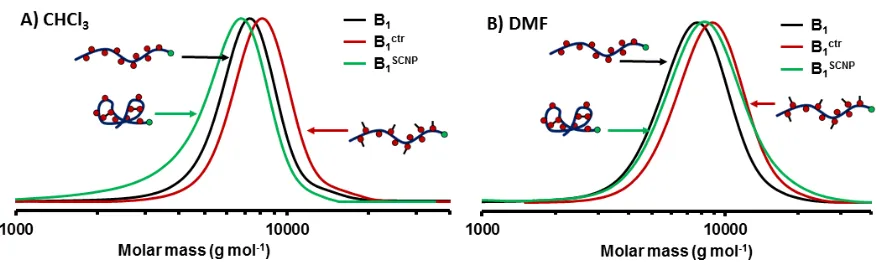
Figure 1. SEC RI traces of B1,B1SCNPand B1ctr in CHCl3 (A) and in DMF (B).
To visualize whether the observed change in hydrodynamic volume is the result of covalent cross link-ing or supramolecular interactions (e.g. hydrogen bonds), the parent polymer, the SCNP and the control were also investigated by SEC using DMF as eluent (Figure 1B). Due to its high polarity, DMF is a strong hydrogen bonding competitor solvent, which is expected to completely disrupt hydrogen bonds.55, 56
Surprisingly, the folded chain B1SCNP does have an increased hydrodynamic volume in DMF compared
to its parent polymer B1 and elutes at slightly decreased molecular weight as compared to B1ctr, which is
in contradiction to the results obtained in chloroform at first sight. However, this observation could be explained by the appearance of hydrogen bonds in CHCl3, which are disrupted by DMF. Indeed,
cova-lent cross linking is not expected to be solvent sensitive. The fact that B1ctr possesses a slightly higher
hydrodynamic volume in DMF than B1SCNP, indicates that covalent cross linking is involved in the
mo-12
lecular weights as compared to B1ctr is expected, as MDI, the cross linking agent of B1SCNP has a higher
molar mass than pTI, the functionalization agent of B1ctr. The increased Rh of B1SCNP in DMF as
com-pared to B1 could be a result of the increased molecular weight by the addition of multiple cross-linker
molecules. As hydrogen bonds are not expected to occur in DMF, MDI is partially solubilized and con-tributed to an increased Rh (which contradicts the decreasing effect of Rh caused by covalent
cross-linking) compared to the parent polymer.
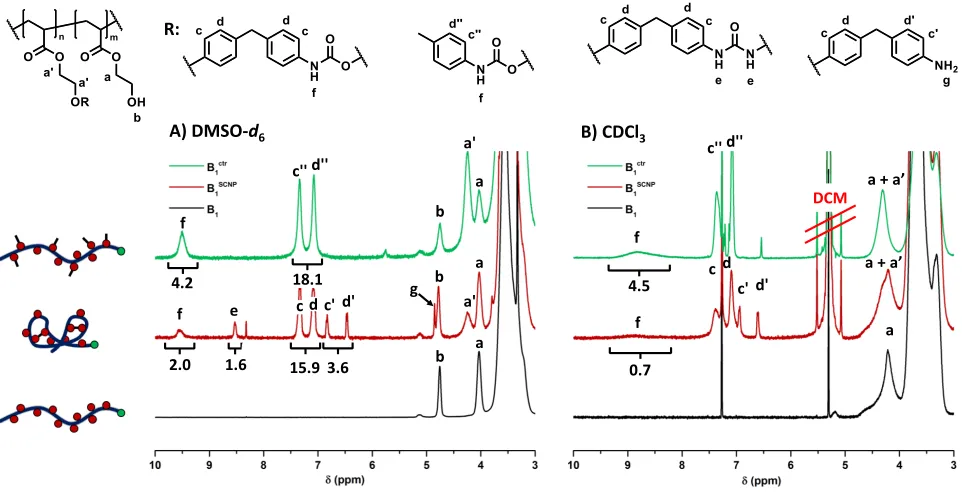
To prove the involvement of hydrogen bonding in the cross linking process, as well as to assess the amount of reacted cross linker, 1H NMR spectroscopy investigation was carried out (Figure 2). From the comparison of the spectra of B1SCNP and B1 in DMSO-d6 (Figure 2A, Figure S3 and S5) the
ap-pearance of MDI associated signals is visible (Figure 2A: Signal c & d). However, in addition to the signals expected for a urethane cross linked polymer, signals corresponding to urea and primary amine moieties are visible ((Figure 2A: Signal e & g; For a comparison with hydrolysed MDI, as well as methanol reacted MDI see Figure S6, S7 and S8). This can be explained by the hydrophilic nature of the polymer, which leads to presence of water during cross linking reaction even though dry solvents and reagents were used. The hydrolysis of MDI leads to the presence of primary amines which, in turn, can react with isocyanate moieties to form urea units. Indeed, in the case of B1SCNP, only 2.4 equivalents
MDI per polymer chain have reacted to form urethane (44%), urea (36%) and amine groups (20%), re-spectively (see Table 1). For B1ctr, 4.5 equivalents of isocyanate have reacted with polymeric OH
13
The formed amine possesses a higher reactivity towards free MDI as compared to OH groups and par-tially forms urea connections, which, in turn, results in an increase of hydrogen bonding in the SCNP. The presence of free primary amines further indicates the importance of steric hindrance, as the amine group has a higher tendency to react with isocyanates as compared to OH-functionalities. Indeed, the steric hindrance was not surprising and has been pointed out by Hawker et al.,32 Duxbury et al.57 and Berda et al.53 before. Furthermore, as the cross linking reaction is carried out in dichloromethane, a
sol-vent which does not compete with H-bonds, an additional compaction after the formation of urea and urethane functions is expected.
The presence of hydrogen bonds can also be shown by the difference between 1H NMR spectra meas-ured in DMSO-d6 and CDCl3 (Figure 2B). In contrast to DMSO, chloroform is not an H-bonds
com-petitor solvent. The exchange rate of protons involved in H-bonds is drastically reduced, which leads to a broadening or a disappearance of the signals.58 This behaviour is clearly seen on Figure 2B, as signals of urea have disappeared and a decrease in the integral of the urethane signals by 66% is observed. In the case of B1ctr, almost no change in the integral of the urethane signal could be detected proving the
prevalence of covalent cross linking in the cooperative covalent and supramolecular cross linking ob-served for B1SCNP. It is also likely, that the presence of urea moieties (which are known to form strong
14
Figure 2. 1H NMR spectra (400MHz) of linear polymer B1, folded polymer B1SCNP as well as control
polymer B1ctr in DMSO- d6 (A) and CDCl3 (B), respectively.
The successful formation of SCNPs can also be proven by differential scanning calorimetry (DSC) analysis. Due to the intramolecular cross-linking, the chain mobility will decrease compared to the line-ar polymer resulting in an increased glass transition temperature (Tg) value for SCNP.48, 60, 61, 37 The Tg
value of the B1SCNP increased significantly from the initial value of 117.2 °C for linear polymer B1 to
132.6 °C, while the Tg value of the B1ctr only increased slightly to 118.3 °C (Figure 3).
Figure 3. DSC curves of linear polymer B1, control polymer B1ctr andfolded polymer B1SCNP.
a a a a' a' b b b g c c'' c' d' d d'' e f f f f c d c' d' DCM a a + a’
a + a’
A) DMSO-d6 B) CDCl3
4.2 18.1 15.9 3.6 1.6 2.0 c'' d'' 4.5 0.7 R:
0 20 40 60 80 100 120 140 160
Temperature (°C)
Tg= 117.2
Tg= 118.3
Tg= 132.6
B1
B1SCNP
[image:15.612.67.300.564.662.2]15
Dynamic light scattering (DLS) measurements in chloroform of B1SCNP revealed a slightly bigger size
(Rh≈ 3 nm) than the parent polymer B1 but a smaller Rh as compared to the control polymer B1ctr (
Fig-ure S10 and S11). These results were similar to the observations of Fulton and co-workers about SCNPs.54 They proposed possible explanations for the results. One might be a nonspherical architecture of the SCNPs, different from that of the parent linear polymer resulting in a reduced diffusion speed, thus increasing the calculated particle size. The other explanation was that the compaction of linear pol-ymers caused the SCNPs leads to a relatively increased solubility, especially at the periphery of the par-ticle, which contributed the increase of the volume and caused the increased values of Dh. We believe
these explanations also apply to our system, especially the increase in solubility of SCNPs compared to the parent linear polymers. In our case, the linker MDI attached to the polymer chains after cross-linking will highly increase the solubility of the nanoparticle material which in turn increased the value of Dh. However, the difference in size to the control polymer, which was functionalized with a smaller
molecule, indicates a compaction of the SCNP.
Synthesis and folding of Triblock copolymer (B1SCNP-B2-B3SCNP)
As demonstrated, folding of the polymer increases steric hindrance, which will inhibit the addition of monomers to the macro-CTA. Consequently, the polymerization rate of the chain extension will be slower as compared to the polymerization of the first block at same conditions. Therefore, more initiator was required to reach full monomer conversions.
However, an increase in the propagating radical concentration will increase the termination rate and hence decrease the fraction of living chains.62 The high livingness of the polymer chains is of paramount importance for the chain extension in order to produce multi-block copolymers. Therefore, full conver-sion of the monomers for the chain extenconver-sions was not targeted after the first folding process. Since
B1SCNP contains hydrophobic MDI moieties, the polymer was water insoluble. In the following chain
16
block of poly(NAM) (B1SCNP-B2) at 70 °C (Figure S12). The DP of NAM was targeted to be 20. The
monomer conversion was found to be 62% by 1H NMR spectroscopy after 24 h of polymerization. Analysis of the molar mass distributions of B1SCNP-B2 by SEC revealed mono-modal distribution with a
clear shift to higher molar mass relatively to B1SCNP (from 4,800 g mol-1 to 7,000 g mol-1, Table 1,
Fig-ure 4).
In order to skip purification, the polymerization mixture of B1SCNP-B2 was used directly for the next
chain extension. The next block (B3) was targeted to have the same composition as the first block (B1).
After 24 h of polymerization, the conversions of NAM and HEA, determined by 1H NMR spectroscopy, were 77% and 76%, respectively. Analysis of the purified B1SCNP-B2-B3 by 1H NMR spectroscopy (
Fig-ure S13) revealed a DP of 8 for HEA and 29 for NAM, slightly lower than expected due to the 77% of conversion of the reaction. The SEC trace of the purified B1SCNP-B2-B3 displayed mono-modal size
dis-tribution and a narrow dispersity (Mn,SEC = 11,100, Ð = 1.15, Table 1, Figure 4) with a clear shift to
higher molar mass relative to B1SCNP-B2. The folding process of B1SCNP-B2-B3 was carried out using the
same conditions used for the synthesis of B1SCNP and was monitored by SEC and 1H NMR spectroscopy
[image:17.612.71.281.485.615.2]analysis.
Figure 4. SEC chromatograms (RI traces) of B1SCNP-B2, B1SCNP-B2-B3 and B1SCNP-B2-B3SCNP in CHCl3.
17
of B1SCNP-B2-B3 (from 11,100 g mol-1 to 9,400 g mol-1, Figure 4, , Figure S14, Table 1). This result
indicates that the hydrodynamic volume has decreased due to the cross linking reaction. According to the previous results on B1SCNP, this reduction in hydrodynamic volume was attributed to the
intra-polymer compaction through covalent and supramolecular cross-linking. The compaction process was further analysed by 1H NMR spectroscopy of the obtained products (Figure S15). By comparing the integrals of the MDI with the polymer backbone it was observed that (in addition to the cross linker at-tached to first block) 2.4 equivalents of MDI have reacted with the polymer bearing 42% of urethane units, 41% of urea units and 17% of primary amines. These values are comparable to the ratios observed for the first folding process and suggest a similar tendency to covalent and H-bond mediated cross link-ing. The steric hindrance after the folding of the polymer is expected to drastically reduce the reactivity of the remaining –OH of the first block of B1SCNP-B2-B3 with the cross linker. It is, therefore, reasonable
to assume that the second folding process only occurs within the third (B3) block.
In order to prove this assumption, a triblock linear copolymer of B1-B2-B3 (P(NAM39-stat-HEA10)-b
-PNAM12-b-(PNAM29-stat-PHEA8)) which has the same monomer composition as B1SCNP-B2-B3 was
synthesized (Figures S16, S17 and S18). This triblock copolymer was then folded using standard condi-tions (Scheme S2). The folding process was studied by 1H NMR spectroscopy and SEC analysis.
The 1H NMR spectrum of the cross linked material of (B1-B2-B3)SCNP reveals a slight decrease of the
amount of attached MDI (as compared to B1SCNP-B2-B3SCNP). However, a similar ratio between
ure-thanes, urea and amines was observed (Table 1, Figure S19). Hence, a slightly decreased degree of cross linking (covalent and supra molecular) for (B1-B2-B3)SCNP as compared to B1SCNP-B2-B3SCNP can
be assumed.
The SEC trace of (B1-B2-B3)SCNP displays a mono-modal chromatogram possessing a shift to lower
mo-lar mass compared to the linear precursor B1-B2-B3 (from 12,100 g mol-1 to 8,400 g mol-1, Figure 5,
-18
B2-B3)SCNP as compared to B1SCNP-B2-B3SCNP (Figure 5, Figure S21, Table 1)indicating the formation
of one SNCP instead of two particles connected by a P(NAM) block as assumed for B1SCNP-B2-B3SCNP.
This is further supported by the fact that the linear precursor (B1-B2-B3) possesses a higher
hydrody-namic volume as compared to B1SCNP-B2-B3. Additionally, the lower degree of cross linking as
deter-mined from 1H-NMR in combination with the decreased hydrodynamic volume of (B1-B2-B3)SCNP
com-pared to B1 SCNP-B2-B3SCNP illustrates the difference between the SCNP obtained by sequential and
glob-al folding.All the above results indicate the presence of two distinct folded subdomains within B1SCNP
[image:19.612.190.422.277.380.2]-B2-B3SCNP linked by a P(NAM) spacer.
Figure 5. Overlay of SEC chromatograms (RI traces) obtained in CHCl3 for B1SCNP-B2-B3SCNP, B1-B2
-B3 as well as (B1-B2-B3)SCNP.
Synthesis and folding of Penta-block copolymer (B1SCNP-B2-B3SCNP-B4-B5SCNP)
To explore the potential of the approach, a third chain-extension-folding cycle was attempted. The mac-ro-CTA B1SCNP-B2-B3SCNP containing two folded domains was first chain extended with a further spacer
block (NAM, B4, DP = 12). Again, a DP of 20 was targeted and 63% of monomer conversion was
achieved after 24 h (Figure S22). The polymerization was continued after addition of HEA and NAM, to produce the last foldable block with conversions of 85% (NAM) and 84% (HEA), respectively (B5,
19
The SEC traces of both chain extensions displayed mono-modal distribution possessing a clear shift to higher molar mass from B1SCNP-B2-B3SCNP to B1SCNP-B2-B3SCNP-B4 and from B1SCNP-B2-B3SCNP-B4 to
B1SCNP-B2-B3SCNP-B4-B5,respectively (Figure 6, Figure S24, Table 1). The composition of the
[image:20.612.198.421.160.266.2]addi-tional blocks was determined by 1H NMR spectroscopy (Table 1, Figure S25).
Figure 6. Overlay of SEC chromatograms (RI traces) obtained in CHCl3 for: B1SCNP-B2-B3SCNP-B4,
B1SCNP-B2-B3SCNP-B4-B5SCNP and B1SCNP-B2-B3SCNP-B4-B5.
The folding process of the 5th block was carried out using established conditions. After cross linking, the SEC trace in chloroform shows a shift toward lower molar mass species (from 17,500 g mol-1 to 16,000 g mol-1, Ð = 1.21, Figure 6, Figure S26, Table 1), indicating the formation of a third SCNP. The
obtained material was also characterized by 1H NMR spectroscopy (Figure S25). Similar to the previ-ous two folding process, the integrals of MDI associated aromatic peaks suggests the addition of two further cross linker molecules. In contrast to previous folding steps, the amount of resulting primary amine functions increased only slightly and more urethane bonds were formed, indicating a higher de-gree of covalent cross linking for the last block, which could be the result of a lower overall amount of water during cross linking reaction.
Based on the above results, it can also be concluded that this folding process is only within the fifth block B5. In order to demonstrate this, the penta-block based SCNP (B1SCNP-B2-B3SCNP-B4-B5SCNP) was
20
interfere with H-Bond formation should lead to the unspecific reformation of cross linking and a change in hydrodynamic volume. This was illustrated by comparing the SEC traces of the initial SCNP (B1SCNP
-B2-B3SCNP-B4-B5SCNP) and the DMF annealed material in CHCl3 (Figure 7). The change in elution
be-haviour shows that the partial interruption of H-bonds by the DMF leads to an increase in compaction after re-cross linking. These results indicate the existence of three individual folded SCNP within the polymer.
Having confirmed the formation of the penta-block based SCNP (B1SCNP-B2-B3SCNP-B4-B5SCNP) which
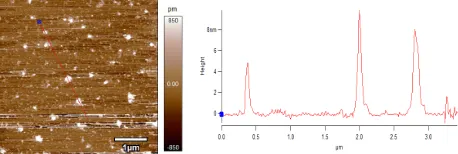
has three individually cross-linked subdomains, the final material was also characterized by AFM. Di-luted chloroform or dichloromethane solutions of B1SCNP-B2-B3SCNP-B4-B5SCNP at 1 µg mL-1 were
drop-deposited onto freshly cleaved mica disc. Figure 8, Figure S26 and Figure S27 showed height map images of the cast surface with a scan size of 1 µm. These figures display that these SCNPs have a height (from the particle peak to the surface of the mica disc) of around 6-8 nm. These size values are relatively high for the described materials,26, 63 which could indicate aggregation, although similar heights have been reported for AFM profiles of SCNPs.33 A stiffening of the nanostructure caused by the combination of covalent and supramolecular cross linking could explain the measured height profile of B1SCNP-B2-B3SCNP-B4-B5SCNP considering size determined by DLS for a single folded subdomain (Rh
21
Figure 7. Overlay of SEC chromatograms (RI traces) obtained in CHCl3 for penta-block based SCNP
(B1SCNP-B2-B3SCNP-B4-B5SCNP) before and after treatment with DMF sample.
Figure 8. AFM topography image of penta-block based SCNP B1SCNP-B2-B3SCNP-B4-B5SCNP(1 µm× 1
µm scan size, sample dissolved in chloroform).
CONCLUSION & OUTLOOK
In summary, a complex penta-block containing three individual SCNP segments with an overall disper-sity of 1.21 was synthesized using RAFT polymerization. Foldable block consists of a mixture of NAM and HEA, while for polymerization of spacer blocks only NAM was used. The OH groups of HEA were cross linked using a bis-isocyanate (MDI) to obtain covalently cross linked SCNP, which in turn also resulted in the formation of urea, as well as amine functions in the cross-linked sections. These moieties were able to further stabilize the SCNP due to hydrogen bonding interactions which were evidenced by
1H-NMR spectroscopy. Control experiments using mono-isocyanates, which are not able to cross link
covalently, did solely result in urethane groups, which were not able to form SCNP by supramolecular
1000 10000 100000
Molar mass (g mol-1)
B1SCNP-B2-B3SCNP-B4-B5SCNP
B1SCNP-B2-B3SCNP-B4-B5SCNP
[image:22.612.190.419.278.355.2]22
interaction. Therefore, it was concluded that described SCNP are stabilized by a synergistic interaction between covalent and supramolecular cross linking.
A chain extension-folding sequence was used to create polymers chains having up to three individual SCNP segments. The cross linking between blocks was ruled out by control experiments using a non-sequential folding procedure. Dissolving the penta-block-tri-SCNP in DMF to interrupt supramolecular
connections followed by the dilution in chloroform to reform hydrogen bonds revealed a decreased hy-drodynamic volume of DMF annealed sample by SEC analysis in CHCl3 which illustrates the
im-portance of hydrogen bonding, as well as the existence of individual folded domains within the parent penta-block.
The herein presented strategy represents a highly versatile way to produce multi-block SCNP which enables the folding of individual domains within polymer chains. This feature is a further step on the way to copy nature’s ability to synthesize highly defined bio-macromolecules with a distinct three di-mensional structure. Further work will focus on the introduction of different functionalities enabling orthogonal folding and unfolding within single macromolecules.
ASSOCIATED CONTENT
Supporting Information
Experimental information; 1H-NMR spectra and GPC traces of polymers not depicted in the manuscript. This material is available free of charge via the Internet at http://pubs.acs.org.
23
Corresponding Author
* Correspondence to [email protected]
ACKNOWLEDGEMENT
The Royal Society Wolfson Merit Award (WM130055; SP), and the Monash-Warwick Alliance is acknowledged for funding (SP; JZ). MH gratefully acknowledges the German Research Foundation (DFG, GZ: HA 7725/1-1) for funding. The authors gratefully acknowledge Oxford Instruments Asylum Research for AFM analysis.
REFERENCES
1. Gody, G.; Maschmeyer, T.; Zetterlund, P. B.; Perrier, S. Rapid and quantitative one-pot synthesis of sequence-controlled polymers by radical polymerization. Nat. Commun. 2013, 4, 2505. 2. Anfinsen, C. B. Principles that Govern the Folding of Protein Chains. Science 1973, 181, (4096), 223-230.
3. Dobson, C. M. Protein folding and misfolding. Nature 2003, 426, (6968), 884-890.
4. Schmidt, B. V.; Fechler, N.; Falkenhagen, J.; Lutz, J. F. Controlled folding of synthetic polymer chains through the formation of positionable covalent bridges. Nat. Chem. 2011, 3, (3), 234-38.
5. Mahon, C. S.; Fulton, D. A. Mimicking nature with synthetic macromolecules capable of recognition. Nat. Chem. 2014, 6, (8), 665-672.
6. ter Huurne, G. M.; Gillissen, M. A. J.; Palmans, A. R. A.; Voets, I. K.; Meijer, E. W. The Coil-to-Globule Transition of Single-Chain Polymeric Nanoparticles with a Chiral Internal Secondary Structure. Macromolecules 2015, 48, (12), 3949-3956.
7. Kirby, A. J. Enzyme Mechanisms, Models, and Mimics. Angew. Chem. Int. Ed. Engl. 1996, 35, (7), 706-724.
8. Liu, Y.; Pauloehrl, T.; Presolski, S. I.; Albertazzi, L.; Palmans, A. R.; Meijer, E. W. Modular Synthetic Platform for the Construction of Functional Single-Chain Polymeric Nanoparticles: From Aqueous Catalysis to Photosensitization. J. Am. Chem. Soc. 2015, 137, (40), 13096-105.
9. Ouchi, M.; Badi, N.; Lutz, J. F.; Sawamoto, M. Single-chain technology using discrete synthetic macromolecules. Nat. Chem. 2011, 3, (12), 917-24.
10. Terashima, T.; Mes, T.; De Greef, T. F. A.; Gillissen, M. A. J.; Besenius, P.; Palmans, A. R. A.; Meijer, E. W. Single-Chain Folding of Polymers for Catalytic Systems in Water. J. Am. Chem. Soc.
2011, 133, (13), 4742-4745.
24 13. Hanlon, A. M.; Lyon, C. K.; Berda, E. B. What Is Next in Single-Chain Nanoparticles?
Macromolecules 2016, 49, (1), 2-14.
14. Pomposo, J. A. Bioinspired single-chain polymer nanoparticles. Polym. Int. 2014, 63, (4), 589-592.
15. Altintas, O.; Barner-Kowollik, C. Single-Chain Folding of Synthetic Polymers: A Critical Update. Macromol. Rapid Commun. 2016, 37, (1), 29-46.
16. Lyon, C. K.; Prasher, A.; Hanlon, A. M.; Tuten, B. T.; Tooley, C. A.; Frank, P. G.; Berda, E. B. A brief user's guide to single-chain nanoparticles. Polym. Chem. 2015, 6, (2), 181-197.
17. Mavila, S.; Eivgi, O.; Berkovich, I.; Lemcoff, N. G. Intramolecular Cross-Linking Methodologies for the Synthesis of Polymer Nanoparticles. Chem. Rev. 2015.
18. Altintas, O.; Barner-Kowollik, C. Single chain folding of synthetic polymers by covalent and non-covalent interactions: current status and future perspectives. Macromol. Rapid Commun. 2012, 33, (11), 958-71.
19. Sanchez-Sanchez, A.; Pomposo, J. A. Single-Chain Polymer Nanoparticles via Non-Covalent and Dynamic Covalent Bonds. Particle & Particle Systems Characterization 2014, 31, (1), 11-23. 20. Gonzalez-Burgos, M.; Latorre-Sanchez, A.; Pomposo, J. A. Advances in single chain technology. Chem. Soc. Rev. 2015, 44, (17), 6122-6142.
21. Huo, M.; Wang, N.; Fang, T.; Sun, M.; Wei, Y.; Yuan, J. Single-chain polymer nanoparticles: Mimic the proteins. Polymer 2015, 66, A11-A21.
22. Aiertza, M.; Odriozola, I.; Cabañero, G.; Grande, H.-J.; Loinaz, I. Single-chain polymer nanoparticles. Cell. Mol. Life Sci. 2012, 69, (3), 337-346.
23. Cheng, C.-C.; Chang, F.-C.; Yen, H.-C.; Lee, D.-J.; Chiu, C.-W.; Xin, Z. Supramolecular Assembly Mediates the Formation of Single-Chain Polymeric Nanoparticles. ACS Macro Letters 2015,
4, (10), 1184-1188.
24. Foster, E. J.; Berda, E. B.; Meijer, E. W. Metastable Supramolecular Polymer Nanoparticles via Intramolecular Collapse of Single Polymer Chains. J. Am. Chem. Soc. 2009, 131, (20), 6964-6966. 25. Mes, T.; van der Weegen, R.; Palmans, A. R.; Meijer, E. W. Single-chain polymeric nanoparticles by stepwise folding. Angew. Chem. Int. Ed. Engl. 2011, 50, (22), 5085-9.
26. Berda, E. B.; Foster, E. J.; Meijer, E. W. Toward Controlling Folding in Synthetic Polymers: Fabricating and Characterizing Supramolecular Single-Chain Nanoparticles. Macromolecules 2010, 43, (3), 1430-1437.
27. Hosono, N.; Palmans, A. R. A.; Meijer, E. W. "Soldier-Sergeant-Soldier" triblock copolymers: revealing the folded structure of single-chain polymeric nanoparticles. Chem. Commun. 2014, 50, (59), 7990-7993.
28. Altintas, O.; Krolla-Sidenstein, P.; Gliemann, H.; Barner-Kowollik, C. Single-Chain Folding of Diblock Copolymers Driven by Orthogonal H-Donor and Acceptor Units. Macromolecules 2014, 47, (17), 5877-5888.
29. Altintas, O.; Lejeune, E.; Gerstel, P.; Barner-Kowollik, C. Bioinspired dual self-folding of single polymer chains via reversible hydrogen bonding. Polym. Chem. 2012, 3, (3), 640-651.
30. Stals, P. J. M.; Gillissen, M. A. J.; Paffen, T. F. E.; de Greef, T. F. A.; Lindner, P.; Meijer, E. W.; Palmans, A. R. A.; Voets, I. K. Folding Polymers with Pendant Hydrogen Bonding Motifs in Water: The Effect of Polymer Length and Concentration on the Shape and Size of Single-Chain Polymeric Nanoparticles. Macromolecules 2014, 47, (9), 2947-2954.
31. van Roekel, H. W. H.; Stals, P. J. M.; Gillissen, M. A. J.; Hilbers, P. A. J.; Markvoort, A. J.; de Greef, T. F. A. Evaporative self-assembly of single-chain, polymeric nanoparticles. Chem. Commun.
2013, 49, (30), 3122-3124.
32. Beck, J. B.; Killops, K. L.; Kang, T.; Sivanandan, K.; Bayles, A.; Mackay, M. E.; Wooley, K. L.; Hawker, C. J. Facile Preparation of Nanoparticles by Intramolecular Crosslinking of Isocyanate Functionalized Copolymers. Macromolecules 2009, 42, (15), 5629-5635.
25 34. Wong, E. H. H.; Lam, S. J.; Nam, E.; Qiao, G. G. Biocompatible Single-Chain Polymeric Nanoparticles via Organo-Catalyzed Ring-Opening Polymerization. ACS Macro Letters 2014, 3, (6), 524-528.
35. Beck, J. B.; Killops, K. L.; Kang, T.; Sivanandan, K.; Bayles, A.; Mackay, M. E.; Wooley, K. L.; Hawker, C. J. Facile Preparation of Nanoparticles by Intramolecular Cross-Linking of Isocyanate Functionalized Copolymers. Macromolecules 2009, 42, (15), 5629-5635.
36. Sugai, N.; Heguri, H.; Yamamoto, T.; Tezuka, Y. A Programmed Polymer Folding: Click and Clip Construction of Doubly Fused Tricyclic and Triply Fused Tetracyclic Polymer Topologies. J. Am. Chem. Soc. 2011, 133, (49), 19694-19697.
37. Song, C.; Li, L.; Dai, L.; Thayumanavan, S. Responsive single-chain polymer nanoparticles with host–guest features. Polym. Chem. 2015, 6, (26), 4828-4834.
38. Sanchez-Sanchez, A.; Fulton, D. A.; Pomposo, J. A. pH-responsive single-chain polymer nanoparticles utilising dynamic covalent enamine bonds. Chem. Commun. 2014, 50, (15), 1871-1874. 39. Whitaker, D. E.; Mahon, C. S.; Fulton, D. A. Thermoresponsive Dynamic Covalent Single-Chain Polymer Nanoparticles Reversibly Transform into a Hydrogel. Angew. Chem. Int. Ed. 2013, 52, (3), 956-959.
40. Shishkan, O.; Zamfir, M.; Gauthier, M. A.; Borner, H. G.; Lutz, J.-F. Complex single-chain polymer topologies locked by positionable twin disulfide cyclic bridges. Chem. Commun. 2014, 50, (13), 1570-1572.
41. Badi, N.; Lutz, J. F. Sequence control in polymer synthesis. Chem. Soc. Rev. 2009, 38, (12), 3383-90.
42. Lutz, J.-F. Sequence-controlled polymerizations: the next Holy Grail in polymer science? Polym. Chem. 2010, 1, (1), 55.
43. Lutz, J.-F.; Ouchi, M.; Liu, D. R.; Sawamoto, M. Sequence-Controlled Polymers. Science 2013,
341, (6146).
44. Gody, G.; Maschmeyer, T.; Zetterlund, P. B.; Perrier, S. Exploitation of the Degenerative Transfer Mechanism in RAFT Polymerization for Synthesis of Polymer of High Livingness at Full Monomer Conversion. Macromolecules 2014, 47, (2), 639-649.
45. Gody, G.; Maschmeyer, T.; Zetterlund, P. B.; Perrier, S. Pushing the Limit of the RAFT Process: Multiblock Copolymers by One-Pot Rapid Multiple Chain Extensions at Full Monomer Conversion.
Macromolecules 2014, 47, (10), 3451-3460.
46. Lutz, J.-F. Polymer chemistry: A controlled sequence of events. Nat. Chem. 2010, 2, (2), 84-85. 47. Roy, R. K.; Lutz, J. F. Compartmentalization of single polymer chains by stepwise intramolecular cross-linking of sequence-controlled macromolecules. J. Am. Chem. Soc. 2014, 136, (37), 12888-91.
48. Harth, E.; Horn, B. V.; Lee, V. Y.; Germack, D. S.; Gonzales, C. P.; Miller, R. D.; Hawker, C. J. A Facile Approach to Architecturally Defined Nanoparticles via Intramolecular Chain Collapse. J. Am. Chem. Soc. 2002, 124, (29), 8653-8660.
49. Gody, G.; Rossner, C.; Moraes, J.; Vana, P.; Maschmeyer, T.; Perrier, S. One-Pot RAFT/“Click” Chemistry via Isocyanates: Efficient Synthesis of α-End-Functionalized Polymers. J. Am. Chem. Soc.
2012, 134, (30), 12596-12603.
50. Coca, S.; Jasieczek, C. B.; Beers, K. L.; Matyjaszewski, K. Polymerization of acrylates by atom transfer radical polymerization. Homopolymerization of 2-hydroxyethyl acrylate. J. Polym. Sci., Part A: Polym. Chem. 1998, 36, (9), 1417-1424.
51. Ferguson, C. J.; Hughes, R. J.; Nguyen, D.; Pham, B. T. T.; Gilbert, R. G.; Serelis, A. K.; Such, C. H.; Hawkett, B. S. Ab Initio Emulsion Polymerization by RAFT-Controlled Self-Assembly§.
Macromolecules 2005, 38, (6), 2191-2204.
26 53. Tuten, B. T.; Chao, D.; Lyon, C. K.; Berda, E. B. Single-chain polymer nanoparticles via reversible disulfide bridges. Polym. Chem. 2012, 3, (11), 3068-3071.
54. Murray, B. S.; Fulton, D. A. Dynamic Covalent Single-Chain Polymer Nanoparticles.
Macromolecules 2011, 44, (18), 7242-7252.
55. Buurma, N. J.; Cook, J. L.; Hunter, C. A.; Low, C. M. R.; Vinter, J. G. The role of functional group concentration in solvation thermodynamics. Chemical Science 2010, 1, (2), 242-246.
56. Catrouillet, S.; Fonteneau, C.; Bouteiller, L.; Delorme, N.; Nicol, E.; Nicolai, T.; Pensec, S.; Colombani, O. Competition Between Steric Hindrance and Hydrogen Bonding in the Formation of Supramolecular Bottle Brush Polymers. Macromolecules 2013, 46, (19), 7911-7919.
57. Liu, J. W.; Mackay, M. E.; Duxbury, P. M. Molecular Dynamics Simulation of Intramolecular Cross-Linking of BCB/Styrene Copolymers. Macromolecules 2009, 42, (21), 8534-8542.
58. Higashijima, T.; Tasumi, M.; Miyazawa, T. 1H Nuclear magnetic resonance studies of melanostatin: Dependence of the chemical shifts of NH protons on temperature and concentration.
FEBS Letters 1975, 57, (2), 175-178.
59. Boileau, S.; Bouteiller, L.; Laupretre, F.; Lortie, F. Soluble supramolecular polymers based on urea compounds. New Journal of Chemistry 2000, 24, (11), 845-848.
60. Mecerreyes, D.; Lee, V.; Hawker, C. J.; Hedrick, J. L.; Wursch, A.; Volksen, W.; Magbitang, T.; Huang, E.; Miller, R. D. A Novel Approach to Functionalized Nanoparticles: Self-Crosslinking of Macromolecules in Ultradilute Solution. Adv. Mater. 2001, 13, (3), 204-208.
61. Cherian, A. E.; Sun, F. C.; Sheiko, S. S.; Coates, G. W. Formation of Nanoparticles by Intramolecular Cross-Linking: Following the Reaction Progress of Single Polymer Chains by Atomic Force Microscopy. J. Am. Chem. Soc. 2007, 129, (37), 11350-11351.
62. Zhong, M.; Matyjaszewski, K. How Fast Can a CRP Be Conducted with Preserved Chain End
Functionality? Macromolecules 2011, 44, (8), 2668-2677.
63. Altintas, O.; Willenbacher, J.; Wuest, K. N. R.; Oehlenschlaeger, K. K.; Krolla-Sidenstein, P.; Gliemann, H.; Barner-Kowollik, C. A Mild and Efficient Approach to Functional Single-Chain Polymeric Nanoparticles via Photoinduced Diels–Alder Ligation. Macromolecules 2013, 46, (20), 8092-8101.
64. Rabani, E.; Reichman, D. R.; Geissler, P. L.; Brus, L. E. Drying-mediated self-assembly of nanoparticles. Nature 2003, 426, (6964), 271-274.
65. Pomposo, J. A.; Perez-Baena, I.; Lo Verso, F.; Moreno, A. J.; Arbe, A.; Colmenero, J. How Far Are Single-Chain Polymer Nanoparticles in Solution from the Globular State? ACS Macro Letters 2014,
27