warwick.ac.uk/lib-publications
A Thesis Submitted for the Degree of PhD at the University of Warwick
Permanent WRAP URL:
http://wrap.warwick.ac.uk/91085
Copyright and reuse:
This thesis is made available online and is protected by original copyright. Please scroll down to view the document itself.
Please refer to the repository record for this item for information to help you to cite it. Our policy information is available from the repository home page.
The Uses of Classical Learning in the Río de la Plata,
c. 1750-1815
by
Desiree Arbo
A thesis submitted in partial fulfilment of the requirements for the
degree of Doctor of Philosophy in Classics and Ancient History
University of Warwick, Department of Classics and Ancient History
Table of Contents
LIST OF FIGURES ...V
LIST OF TABLES ...V
ACKNOWLEDGEMENTS ... VI
DECLARATION AND INCLUSION OF MATERIAL FROM A PREVIOUS
PUBLICATION ... VII
NOTE ON REFERENCES ... VII
ABSTRACT ... VIII
ABBREVIATIONS ... IX
INTRODUCTION... 1
1. Classical Reception, Neo-Latin and Identities ... 2
2. The geographies of classical learning ... 6
3. The Classical Tradition in Spanish America ... 12
4. Scholastics, humanists, and Jesuits ... 18
5. Jesuit exile and literary controversies ... 25
6. 1767-1810: Changes in classical learning ... 29
CHAPTER 1: JOSÉ MANUEL PERAMÁS’ LAUDATIONES QUINQUE (1766), JESUIT CLASSICAL LEARNING AND LOCAL CREOLE AMBITIONS ... 34
Introduction ... 34
Biography and Works ... 35
The Early Period (pre-1767): The Laudationes Quinque ... 37
Córdoba and Jesuit Education in the Rio de la Plata ... 37
The First Oration: Ignacio Duarte and the origins of creole nobility ... 40
Conquistador ancestors ... 45
The Second and Third Orations: Education for the good of the Republic and the Ignatian aims of Education ... 47
The Fourth Oration and the Language of Disease ... 50
Fifth Oration: Utilitas and Peramás’ concept of Republic ... 53
The utilitas of colleges in the Old World ... 56
The utilitas of colleges in the New World ... 59
Education and the dangerous company of ‘the worst kind of people’ ... 60
For the good of the Republic and the problem of the ‘New’ ... 65
For the glory of the Republic and Creole Latin Learning ... 69
Conclusion ... 72
CHAPTER 2: THE EXILE WRITINGS OF JOSÉ MANUEL PERAMÁS AND A JESUIT MODEL OF STATEHOOD (1767-1793) ... 73
Introduction ... 73
The ‘Middle Period’ (1767-1777): Annus Patiens (1768-69), Finis Anni Patientis elegia (1770), and De Invento Novo Orbe (1777)... 77
Coming to grips with exile ... 77
Aeneid II and Italy as the land of exile ... 80
Cicero and coming home to Italy, the ‘mother of eloquence’... 81
De Invento Novo Orbe (1777) ... 83
The Dedication: Celebrating Creole Saints ... 85
The Prologue and Sources of De invento novo orbe ... 87
The Epic as a response to the ‘Black Legend’ ... 91
The Later Period (1777-1793): De administratione guaranica and Jesuit notions of nation, patria and statehood in the missions of Paraguay ... 93
Presentation of the text and argument ... 94
At the frontier of the Spanish Empire: The Jesuits in Paraguay (1609-1767) and relations with the neighbouring Portuguese ... 96
Origins of Jesuit discourse on the missions: Responding to European and American critics ... 100
The ‘Jesuit Kingdom of Paraguay’ ... 103
Adapting Cicero and the invention of a ‘Guarani people’ ... 108
The communal system of the missions: Tacitus and Vanière ... 112
Vanière and Division of labour ... 116
Education for the Good of the Republic and Indian authorities ... 117
Jesuit ‘bee-keepers’ and warlike Indian ‘bees’ ... 120
Guarani patriotism and the uprising of 1754-1756 ... 124
Conclusion ... 127
CHAPTER 3: CLASSICAL LEARNING IN COLONIAL PARAGUAY, THE JESUIT COLLEGE OF ASUNCIÓN AND THE REAL COLEGIO SEMINARIO DE SAN CARLOS (C. 1750-1790) ...131
Introduction ... 131
The Jesuit College of Asunción ... 135
Institutional context ... 135
The Jesuit Library of Asunción ... 145
Asunción and the Neo-Classical Turn at the College of Villagarcía c. 1755-1767 ... 150
‘Baroque’ Latin Grammars and the teaching methods of Idiáquez ... 156
After 1767: Bourbon Reforms at the University of Córdoba ... 161
The Real Colegio Seminario de San Carlos of Asunción ... 166
Institutional Context ... 166
The Plan de Estudios of 1783... 173
Conclusion ... 180
CHAPTER 4: THE RECEPTION OF ANTIQUITY AND THE CONCEPT OF REPUBLIC IN THE POLITICAL THOUGHT OF THE RIO DE LA PLATA ...182
Introduction ... 182
‘Republic’ in Eighteenth-Century Europe and Spanish America ... 185
1809-1816: Imagining ‘republic’ in Buenos Aires and the Rio de la Plata .... 195
1811: Articulating self-government in Paraguay ... 201
1812-1814: Articulating ‘republic’ and the Paraguayan consulate ... 205
Conclusion: Francia’s Radical Republic ... 216
CONCLUSION ...218
EPILOGUE: NEW TROY AND NEW ROME ...225
BIBLIOGRAPHY ...229
List of Figures
Figure 1 - Map of the Jesuit Province of Paraguay and adjacent lands [c.1740]. ... 8Figure 2 - Der Neue Welt-Bott... 10
Figure 3 - Different kinds of dress of Jesuit priests and students.. ... 12
Figure 4 - Map of the Jesuit Province of Paraguay and adjacent lands (1756) ... 38
Figure 5 - Coat of arms of Duarte ... 42
Figure 6 - Map of the Governorates of Paraguay and Buenos Aires, with the division line established by Spain and Portugal in 1750 ... 98
Figure 7 - Signatures of the Indian authorities of San Joaquín. ... 120
Figure 8 - Dress of Spaniards in America. ... 139
Figure 9 - ANA SH Vol. 143 No. 3, f. 7 ... 171
List of Tables
Table 1 - Jesuit professors at the College of Asuncion (1758-1765) ... 143Acknowledgements
First and foremost, I would like to acknowledge the unfailing support and guidance of my two supervisors, Professor Andrew Laird and Professor Rebecca Earle. I am profoundly grateful for their extensive and enriching feedback. I also wish to thank the Graduate School at the University of Warwick for funding my research, the Department of Classics and Ancient History for having faith in this interdisciplinary project, and the Department of History for treating me as one of their own students and providing invaluable resources and teaching experience.
I would like to extend my appreciation to the Centre for the Study of the Renaissance for granting me a visiting studentship at Johns Hopkins University in Spring 2016, and to the CSR director Professor Ingrid De Smet for her continued encouragement. I cannot name all the professors and PhD students at Hopkins who offered useful comments on my project, but I would like to single out Dr. Earle Havens for his enthusiastic insights on book history and Jesuit libraries. Heartfelt thanks goes to Dr. Sara Miglietti and Dr. Eugenio Refini at Hopkins for organising the studentship.
I also wish to thank the Bodleian Library, the Queen’s College Library in
Oxford, the British Library, and the Sheridan Libraries at Johns Hopkins (which includes the Rare Books Collection at the Peabody Library). This thesis greatly benefitted from consulting their pre-1800 printed material. I am grateful to the staff at the Archivo Nacional of Asunción for guiding me through the archive collections and unearthing documents relating to Latin and the history of education in Paraguay.
academic life in the UK. I owe a certain debt of gratitude to Chinese buffets with my Warwick friends, which provided some much-needed levity during the writing-up period. I must also mention the kindness of the Jaspers of Somerset, who have been like a second family during my time in the UK. Most of all I would like to thank my family in Paraguay, especially my parents, who have never stopped supporting me. This thesis is dedicated to them.
Declaration and Inclusion of Material
from a Previous Publication
I declare that the thesis is my own work except a section of Chapter 2 (pp. 81-89) which was drawn from the following co-authored article, with some modifications: Desiree Arbo and Andrew Laird, ‘Columbus, the Lily of Quito and the Black Legend: The Context of José Manuel Peramás' Epic on the Discovery of the New World: De Invento Novo Orbe Inductoque Illuc Christi Sacrificio (1777)’ in Dieciocho: Journal of the Spanish Enlightenment 38 no. 1 (2015): 7-32.
I also declare that this thesis has not been submitted for a degree at another university.
Note on References
References to Peramás’ Laudationes Quinque are from the 2005 edition by
Marcela Alejandra Suárez, indicated in footnotes by the oration and page number. Example: Laudatio V (page 35).
References to Peramás’ De administratione guaranica include the original chapter
Abstract
Abbreviations
Classical texts
Amm. Marc. Ammianus Marcellinus Rerum Gestarum Caes. BGall. Caesar Bellum Gallicum
Cic. De or. Cicero De oratore
Cic. Inv.rhet. Cicero De inventione rhetorica Cic. Nat. D. Cicero De natura deorum Cic. Off. Cicero De officiis
Cic. Phil. Cicero Orationes Philippicae Cic. Prov.Cons. Cicero De provinciis consularibus Cic. QFr. Cicero Epistulae ad Quintum fratrem Cic. Red.pop. Cicero Post reditum ad populum Cic. Sest. Cicero Pro Sestio
Cic. Tusc. Cicero Tusculanae disputationes Columella Rust. Columella De re rustica
Hor. Ars P. Horace Ars poetica Hor. Carm. Horace Carmina (Odes) Hor. Epist. Horace Epistulae Hor. Epod. Horace Epodi Hor. Sat. Horace Satirae
Juv. Juvenal (Satires)
Liv. Livy Ab urbe condita
Luc. Lucan Pharsalia
Lucr. Lucretius De rerum natura Mart. Martial Epigrammata
Ov. Ars am. Ovid Ars amatoria Ov. Her. Ovid Heroides Ov. Met. Ovid Metamorphoses Ov. Pont. Ovid Epistulae ex Ponto Ov. Tr. Ovid Tristia
Plin. HN Pliny (the Elder) Naturalis historia Quint. Inst. Quintilian Institutio oratoria Sen. Med. Seneca (the Younger) Medea Stat. Silv. Statius Silvae
Suet. Gram. et rhet. Suetonius De grammaticis et rhetoribus Tac. Germ. Tacitus Germania
Tac. Hist. Tacitus Historiae
Val. Fl. Valerius Flaccus Argonautica Verg. A. Virgil Aeneid
Verg. Ecl. Virgil Eclogues Verg. G. Virgil Georgics
Reference works
CJPP Storni, Hugo. Catálogo de los jesuitas de la Provincia del Paraguay (Cuenca del Plata), 1585-1768. Roma: Institutum Historicum S.I, 1980.
DHCJ O’Neill, Charles and Joaquín M. Domínguez. Diccionario Histórico de la Compañía de Jesús: Biográfico-Temático. 4 vols. Roma/Madrid: Institutum Historicum S.I/ Universidad Pontificia Comillas, 2001.
OCD4 Hornblower, Simon, Antony Spawforth and Esther Eidinow, eds. Oxford Classical Dictionary. 4th edition. Oxford: Oxford
University Press, 2012.
Archives and collections
ANA Archivo Nacional de Asunción (Paraguay) SH Sección Historia
NE Sección Nueva Encuadernación
This thesis explores the functions of classical learning in colonial Paraguay as manifested in Latin and vernacular literatures, and primarily in relation to the legacy of the Jesuit endeavours in evangelisation and education, both rooted in Renaissance humanism and the broader culture of early modern Catholicism. The main argument is that classical learning contributed towards an articulation of different identities during rapidly changing political contexts and social dynamics in the Rio de la Plata, particularly as a result of the expulsion of the Jesuits in 1767. Classical learning thus functioned a tool that shaped relations between elites and the rest of the population of the region during the colonial period, and ultimately helped define the fraught relationship of the nascent American republics with Spain after 1808.
Chapter 1 and Chapter 2 explore the articulation of local elite and broader American identities through a study of the Latin works of the Jesuit José Manuel Peramás (1732-1793). Chapter 3 surveys the transformation of classical learning in colonial Rio de la Plata from a primarily Jesuit classical learning to a secular classical learning, with a focus on the Jesuit College of Asunción and the Real Colegio Seminario de San Carlos. Chapter 4 addresses the legacies of this classical learning in the Rio de la Plata between 1808 and 1816, when the political landscape was characterised by disputes over the meaning of ‘republic’ and the actual relevance of antiquity to projects of modern state-building. In short, the focus of this study is classical learning and the Spanish American social and cultural contexts within which it existed.
moral world-view. The second refers to effects of the ‘irruption’ of nearly five thousand Jesuits into Italy and the European Enlightenment, as Miguel Batllori labelled the phenomenon marked by the expulsion of the Jesuits from Spain and its overseas territories in 1767. This event stands as one of the great turning points of the period covered in this thesis, both as it shaped the literary production of José Manuel Peramás (Chapter 1 and 2), the decline of classical learning in the Rio de la Plata, where the Jesuits had been its main proponents (Chapter 3), and the simultaneous popularisation of an image of Rome outside of classrooms (Chapter 4).
In terms of sources, Chapter 1 and Chapter 2 explore the printed Latin production of Peramás before and after exile, respectively. The first part of Chapter 3 draws from archival material, printed grammars, and the inventory of the Jesuit library of Asunción, located in the Archivo General de la Nación in Buenos Aires (AGN). The second part of Chapter 3 analyses the programme of studies of the Real Colegio Seminario de San Carlos of Asunción (founded in 1783), which survives in a damaged manuscript held in the Archivo Nacional de Asunción, Paraguay (ANA). Chapter 4 is based on a variety of sources, including dictionaries, newspapers, and documents of the Paraguayan independence located in ANA.
The remainder of this introduction addresses and explains some broader issues and areas of investigation which have a direct bearing on the study to follow: (1) classical reception, classical tradition and the need for innovative methodologies, (2) the geographies of classical learning, (3) the classical tradition in Spanish America and the theme of ‘topping of the ancients’ (Überbietung), (4) Jesuit education, (5) Jesuit Latin literature in the Italian exile, and (6) transformations in classical learning in Spanish America after the Jesuit expulsion.
1.
Classical Reception, Neo-Latin and Identities
the productions of classical antiquity and responses to those productions in later times, up to our own.1 This interaction is the focus of classical reception (as distinct from longer established studies of Nachleben or the classical tradition outlined below) and it has some influence on the present study.
The name of the German-Jewish art historian and bibliophile Aby Warburg (1866-1925) has remained influential in classical tradition studies. Warburg sought to establish methodologies to study what he saw as the afterlife of ancient motifs in different civilisations and periods (Nachleben). In his 1893 dissertation Warburg analysed Botticelli’s Birth of Venus by correlating it with the
literary culture surrounding Botticelli’s patron Lorenzo de Medici in Renaissance Florence.2 Warburg’s theory offered a way to study the appearance of classical themes in a given historical time, although the notion of ‘survival’ is not without
its problems and has been challenged by reception theory: Nachleben ‘presupposed that the ancient text or artefact exerting influence on the cultures of later times itself remained the same.’3
Subsequent proponents of the classical tradition run a similar risk. Wolfgang Haase defined it as a continuous relationship which unites the Greco-Roman world with diverse presents of the Western world where one can detect the imprint of antiquity.4 Similar to Warburg’s Nachleben, (but definitely less so), the target culture may seem less distinctive, and the classical tradition may become monolithic and static. When used in the present study, ‘classical tradition’ must
therefore be taken as multi-faceted and organic. It is in the attitudes of Spanish Americans towards this tradition, which they perceived they belonged to and yet
1 Lorna Hardwick, ‘Introduction: Making Connections,’ in L. Hardwick and C. Stray, eds., A
Companion to Classical Receptions (Malden/Oxford: Blackwell, 2008), 1-9. See also Charles Martindale, ‘Reception’ in Craig W. Kallendorf, ed., A Companion to the Classical Tradition (Malden/Oxford: Blackwell, 2007), 295-311; Hans R. Jauss, Timothy Bahti, trans., Toward an Aesthetic of Reception (Brighton: Harvester, 1982); Charles Martindale and Richard F. Thomas, eds., Classics and the uses of reception, (Malden/Oxford: Blackwell, 2006).
2 Kurt Foster, ‘Introduction’ in Aby Warburg, David Britt, trans. The renewal of pagan antiquity:
contributions to the cultural history of the European Renaissance (Los Angeles: Getty Research Institute for the History of Art and the Humanities, 1999 [1932]), 11.
3 Laird, ‘Reception’, 356.
4 Wolfgang Haase ‘America and the Classical Tradition: Preface and Introduction’ in Wolfgang
sought to surpass, that we find revealing traits about the formation of creole and later national identities.
In practice, classical reception has come to be principally concerned with responses to ancient literary texts – a trend also reflected to a degree in the field of Neo-Latin studies.5 However, reception has not offered much in the way of methodologies, while Neo-Latin scholars have devoted increased attention to other approaches and cross-disciplinary research, with a geographical scope not limited to Europe, as exemplified by recent volumes such as Brill’s Encyclopedia of Neo-Latin Studies and The Oxford Handbook of Neo-Latin.6 Such developments in the field have been crucial in gaining a better understanding of intellectual currents that underpinned much of early modern culture, from the Renaissance to the Enlightenment. This thesis embraces the prospect of more interdisciplinary and eclectic approaches.
While the first two chapters are devoted to an analysis of the Latin works of Peramás, as a whole this is not a Neo-Latin thesis in the sense that it is not primarily concerned with literary and linguistic features of Latin texts. It does however grapple with the question posed almost two decades ago by Françoise Wacquet and which remains central to Neo-Latin studies: What did Latin ‘mean’ in the societies in which it existed?7 Investigation into the role of Latin in relation and competition with vernacular languages has always been a feature of Neo-Latin studies, particularly as it helps understand the construction of individual and
5 Cf. definition of ‘reception’ in the Oxford Classical Dictionary (4th edition), 1256-1257:
‘reception, in the specialized sense used within literary theory . . . Studies of reception-history (Rezeptiongeschichte) are studies of reading, interpreting, (re)fashioning, appropriation, use, and abuse of past texts over the centuries.’ For a comprehensive discussion see Andrew Laird, ‘Reception’ in Alessandro Barchiesi and Walter Scheidel, eds., The Oxford Handbook of Roman Studies (Oxford: Oxford University Press, 2010): 349-368.
6 Craig Kallendorf, ‘Review Essay: Recent Trends in Neo-Latin Studies’, Renaissance Quart. 69
no. 2 (2016): 617-629; Philip Ford, Charles Fantazzi and Jan Bloemendahl, eds., Brill's
Encyclopedia of Neo-Latin Studies, 2 vols. (Leiden/Boston: Brill, 2014); Sarah Knight and Stefan Tilg, The Oxford Handbook of Neo-Latin (Oxford: Oxford University Press, 2015). See also the volume of collected papers by Yasmin Haskell and Juanita Feros Ruys, eds., Latin and Alterity in the Early Modern Period (Tempe: Arizona Center for Medieval and Renaissance Studies/Brepols, 2010).
7 Françoise Wacquet, Latin or the Empire of a Sign (London: Verso, 2001), 3, 177. This is a
collective identities.8 This intersects with the interests of historians, most importantly for our purposes, with the interests of social and cultural historians. Peter Burke, for example, argued that languages in early modern Europe served to construct and reconstruct communities; the expansion of certain vernaculars signalled the rise of new communities, while other vernaculars disappeared.9 Language was one means by which individuals were ‘embedded’ in various peer groups and social contexts, to use the term by Natalie Zemon Davis – which means that identities could be multiple and fluid.10 Benedict Anderson’s study of nations as ‘imagined communities’ also addressed the role of language, locating
the decline of Latin as an international language of intelligentsia as one of the cultural roots of modern nationalism.11 The relationship between identities and Latin lies at the heart of this interdisciplinary project.
This thesis takes ‘classical learning’ as its subject of study because Latin was not the only indicator of a classical tradition in Spanish America (as discussed in section 3 below). By analysing the functions of classical learning in relation to its socio-historical contexts this thesis goes beyond classical reception, applying different methods to less familiar objects of study. In the Rio de la Plata there was no circle of poets and writers surrounding the elite families - the scholarly networks of the Jesuits perhaps provided the nearest equivalent to the Renaissance studio or humanist court circle. With the expulsion of the Jesuits in 1767 Latin fell into steep decline, while the Guarani population of the former missions became incorporated into mainstream colonial society. This study proposes that the contexts and social dynamics that enabled and shaped the transmission of classical learning in the Rio de la Plata were radically different from European settings, which requires different methodologies. The overall approach is more historical
8 An overview of the relationship between Latin and the modern vernaculars was offered in Jozef
Ijsewijn, Companion to Neo-Latin Studies (Amsterdam/Oxford: North-Holland, 1977), 40-44. A revised edition published in 1998 provides the updated version in Part II.
9 Peter Burke, Languages and Communities in Early Modern Europe (Cambridge: Cambridge
University Press, 2004).
10 Natalie Zemon Davis, ‘Boundaries and the Sense of Self in Sixteenth-Century France,’ in
Thomas C. Heller et al., eds., Reconstructing Individualism, Autonomy, Individuality, and the Self in Western Thought (Stanford: Stanford University Press, 1986), 53-63.
11 Benedict Anderson, Imagined Communities: Reflections on the Origin and Spread of
than reception-oriented, centred on two events that influenced the nature of classical learning: the expulsion of the Jesuits from Spain and its overseas territories in 1767, and the Napoleonic invasion of Spain in 1808 which catalysed the independence movements in Spanish America.
2.
The geographies of classical learning
It would be anachronistic to situate a study of classical learning in colonial Spanish America according to modern nomenclature of Latin American nations, though this has been common practice among historians of the classical tradition in America.12 This thesis adopts a regional outlook by focusing on the Rio de la
Plata, which is the area irrigated by this river and its tributaries and includes areas pertaining to the modern countries of Argentina, Paraguay, Uruguay, and parts of Brazil and Bolivia.The Rio de la Plata formed part of a trans-Atlantic cultural world, both as part of the Jesuit Province of Paraguay until 1767 and of the Spanish Empire until 1808.13
The first confirmed Spanish incursion into the area was the 1515 expedition of Juan Diaz de Solís. It ended in disaster: Solís was killed and dismembered by cannibalistic Amerindians on disembarking, and one of his caravels was shipwrecked on the island of Santa Catalina. Among the survivors was the Portuguese Aleixo García, who is credited with the discovery of Paraguay in 1524. This adventurer spent years among the coastal Indians, whom he then led in his own expedition across the continent in search of a fabled mountain of silver. García was reputed to have reached the Andean highlands but was killed on his return. News of García’s expedition in turn distracted Sebastian Cabot from his plan of reaching the Pacific Ocean in 1527, and he too decided to explore the ‘river of silver’ (Rio de la Plata). In 1534 a plan to conquer the area materialised
12 Cf. Andrew Laird, ‘Colonial Spanish America & Brazil’ in Sarah Knight and Stefan Tilg, eds.,
TheOxford Handbook of Neo-Latin (Oxford: Oxford University Press), 537.
13 On the inadequacy of national narratives applied anachronistically to Atlantic phenomena, see
when Charles I of Spain named Pedro de Mendoza the first governor-adelantado of the Rio de la Plata.
Forts in Buenos Aires and in Asunción were founded in 1536 and 1537. However, due to famine and continued threat from Indian attacks, Buenos Aires was abandoned in 1541. Asunción thus became the base of the conquest and colonisation of the Río de la Plata in the sixteenth century - it was from Asunción that Juan de Garay set out to found Buenos Aires for a second time in 1580. In 1617 the Governorate of the Rio de la Plata and Paraguay was divided into two separate units at the suggestion of the governor Hernando Arias de Saavedra (also known as Hernandarias). This eventually eroded Asunción’s position as the political and economic centre of the region. Hernandarias also invited the Jesuits in 1608 to gather native populations into settlements (reducciones) along the Paraguay and Paraná rivers, partly with the intention of limiting the exploitation of Indians. The missions of Paraguay would become the most famous endeavours of the Jesuits in Spanish America. The provincial headquarters themselves remained in Córdoba, in Tucumán.
Figure 1 - Matthäus Seutter, Paraquariae provinciae Soc[ietatis] Iesu cum adjacentibus novissima descriptio post iteratas peregrinationes, et plures observationes … [c. 1740]. Accessed 14 August
The Jesuits not only disseminated classical learning by means of founding colleges, but they also produced knowledge about the Americas that reached Europe by means of their extensive correspondence. The Jesuits of Paraguay were part of a global network where men, books and ideas circulated more efficiently than even through secular imperial networks.14 This was vital for a region which had no printing press, with the exception of the mission of Santa Maria la Mayor.15 This press was unique because it was built and staffed by Guarani typographers, who created their own woodblocks to illustrate the books. The press was in operation between 1700 and 1730, when it stopped printing due to lack of paper.16 It produced some Latin literature but most of its efforts went into printing texts for the instruction of the mission population, such as a revised version of the Guaraní grammar by Antonio Ruíz de Montoya.17
The book trade in the Rio de la Plata has recently started to be investigated. In a study of the Verdussen printing family of Antwerp, Stijn Van Rossem found that the Jesuit Province of Paraguay placed the largest order of books in 1681. The shipment - eleven cases and one bale of books, valued at 19,303 pesos - travelled from Cadiz to Buenos Aires after a complex series of loans and deals between the various echelons of the Jesuit hierarchy, their procurator in Seville, the book dealer and investor Juan Salvador Pérez, and his agents.18 This helps explain the considerable presence of books printed in the
14 J. Gabriel Martínez-Serna, ‘Procurators and the Making of the Jesuits’ Atlantic Network’, in
Bernard Bailyn and Patricia L. Denault, eds. Soundings in Atlantic History: Latent Structures and Intellectual Currents, 1500-1830 (Cambridge, Mass./London: Harvard University Press, 2009), 181-210.
15 On the book trade in general see Pedro J. Rueda Ramírez, Negocio e intercambio cultural: El
comercio de libros con América en la Carrera de Indias (siglo XVII) (Seville: Diputación de Sevilla, 2005). On the role of Jesuit procurators in shipping books within the Spanish imperial system see Agustín García Galán, El Oficio de Indias 1566-1767 (Seville: Fundación Fondo de Cultura de Sevilla, 1995).
16 José C. Balmaceda Abrate, ‘El origen de la imprenta en Argentina: introducción al estudio del
incunable guaraní impreso en Loreto,’ in Isabel I y la imprenta: consecuencias materiales, en el mundo cultural, de esta revolución tecnológica [Actas de las jornadas, Madrid, 18, 19 y 20 de noviembre de 2004] (Madrid: Ministerio de Cultura, 2005). See Guillermo Furlong, Orígenes del arte tipográfico en América, especialmente en la República Argentina (Buenos Aires: Editorial Huarpes, 1947), 127-149.
17 Antonio Ruiz de Montoya, Arte de la Lengua Guaranicon los escolios, anotaciones y apendices
del P. Paulo Restivo ... (Santa Maria la Mayor: 1724).
18 Stijn Van Rossem, ‘The Verdussens and the International Trade in Catholic Books (Antwerp,
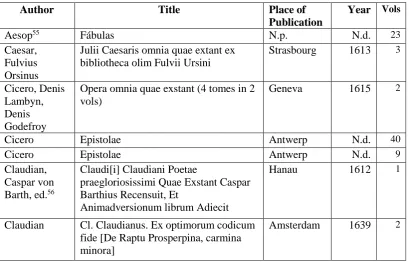
Netherlands in the library of Asunción, whose holdings of classical texts is explored in Chapter 3.
[image:21.595.160.459.204.663.2]The transfer of knowledge and the global nature of the Jesuit network is well illustrated by the image below: an engraving on the frontispiece of the 1726 German edition of missionary letters Allerhand so lehr als Geistreiche Brief, Schrifften und Reis-Beschreibungen, popularly known as Der Neue Welt-Bott (‘New World Messenger’).19
Figure 2 - Der Neue Welt-Bott mit aller hand nachrichten deren Missionarien Soc[ietatis] IESU
19 This is an added title page to Joseph Stöcklein, S.J., ed., Allerhand so lehr - als geist-reiche
A hugely successful anthology, Der Neue Welt-Bott continued expanding until 1761, with volumes published in Augsburg and later Vienna, though it remains little studied.20 In the image, Mercury holds the caduceus and sheets of paper as symbols of victorious eloquence. While the Renaissance indeed saw Mercury-Hermes as the tutelary divinity for Rhetoric, his role as mediator between gods and mortals went back to antiquity.21 With the monogram IHS hovering over the caduceus, the allegory of the Jesuit order could not be clearer: like angels, and like Mercury, the Jesuits are messengers of God bringing religion to all areas of the world. ‘I bring you tidings of great joy’ reads underneath the winged feet of
Mercury, alluding to the angel who announced the birth of Jesus in Luke 2.10.22 As missionaries and educators, Jesuits played a prominent role in the transmission of Christianity along with classical learning in America.
As the protector of commerce, Mercury was also an apt choice for an enterprise that involved the circulation of ideas and goods, in this case, printed books. The sheets of paper in the image symbolise a body of travel literature waiting to be printed in the volume. Mercury’s cape is attached to a globe, and he bears news that was literally pulled from the whole world (‘Ex America’, etc.),
just as the ship waving the Jesuit banner holds animals from all four continents: the camel (Africa), the lion (Europe), the spotted tiger (America) and the elephant (Asia). The epigraph explains that ‘they shall come from the rising and setting of the sun, from the direction of midday and midnight’ (Luke 13.29). The ship approaches a lighthouse with a shining lamp, which functions as symbols both of Christendom and knowledge, so that the image becomes in effect a
20 See Claudia von Collani, ‘Der Neue Welt-Bott: A Preliminary Survey,’ Sino-Western cultural
relations journal 25 (2003): 16-43; Bernd Hausberger, ‘El padre Joseph Stöcklein o el arte de inscribir el mundo a la fe’, in Karl Kohut and Maria Cristina Torales Pacheco, eds., Desde los confines de los imperios ibéricos: Los jesuitas de habla alemana en las misiones americana (Madrid/Frankfurt am Main: Iberoamericana/Vervuert, 2007), 631-662; Albrecht Classen, ‘A Global Epistolary Network: Eighteenth-Century Jesuit Missionaries Write HomeWith an Emphasis on Philipp Segesser’s Correspondence from Sonora/Mexico’, Studia Neophilologica, 86 no. 1 (2014): 79-94.
21 OCD4, 935; Yves Bonnefoy, ed., Roman and European Mythologies (Chicago/London:
University of Chicago Press, 1992), 135-137. On Mercury in Renaissance depictions of rhetoric see Heinrich F. Plett, ‘Iconography of Rhetoric and Eloquence’, in Rhetoric and Renaissance Culture (Berlin/New York, 2004), 217-218.
22 For a similar self-presentation of Jesuits as angels in the Imago Primi Saeculi (1640), made in
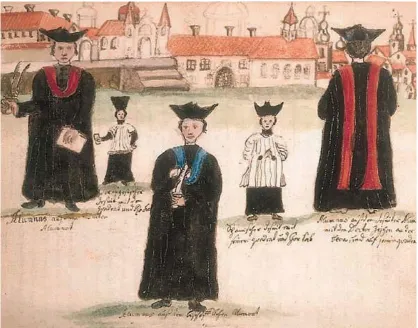
Figure 3 - Different kinds of dress of Jesuit priests and students. From left to right: Student from a Jesuit college, Portuguese Jesuit priest with hat and rochet, student of the diocese seminary, Spanish Jesuit priest with hat and surplice, student of the Jesuit college with the ensigns of doctor, beca,
and hat (Córdoba). By Florian Paucke, S.J. [Hin und Her, Zwettl Codex 420, 1770/1773-1780]. Bibliothéque Nationale de France photo reproduction: http://expositions.bnf.fr/utopie/grand/2_46c.htm.
allegory of evangelisation and knowledge transfer.23 The intimate connection between a kind of knowledge (classical learning) and early modern Catholicism, particularly but not exclusively in relation to the activities of the Jesuit order and their role in colonial society, will be a recurrent concern in what is to follow.
3.
The Classical Tradition in Spanish America
Since the arrival of the Spaniards in the late fifteenth century, ancient texts and languages were imported from Europe and sometimes appropriated by the peoples of the New World, including, very rarely, Indians and mestizos (individuals of
23 Renate Durr, ‘Der “Neue Welt-Bott” als Markt der Informationen: Wissenstransfer als Moment
mixed Spanish and Indian blood).24 The study and production of Latin literature was dominated by elites: the main recipients of classical learning were creoles, who for our purposes are defined as descendants of Europeans born in the Americas.25 A way of writing steeped in direct or indirect contact with ancient texts became part and parcel of creole literature and arts from its earliest stages, and was manifested in various forms, including texts, classrooms and political discourse. By the late eighteenth century, ambivalent attitudes towards classical learning explain its contribution to an articulation of an American identity at the same time as it became identified as a tool of domination of an elite. Thus, more than a ‘tradition’ in a literary sense, the uses of classical learning within the
American social and cultural contexts within which it existed suggest a way of life and thinking framed, in different ways, by references to antiquity.
The classical tradition in the first encounter of Europeans with the New World has been the object of several recent studies.26 Sabine MacCormack noted
that the chronicler Pedro Cieza de León (c.1518-1555) made ‘the Inca achievement intelligible and credible’ by using classical references.27 Cieza
observed for instance that the Inca road from Quito to Cuzco (and continuing to Chile) rivalled the Roman road in Spain known as the ‘silver road.’28 The Inca Garcilaso de la Vega (1539-1616), a mestizo chronicler, famously presented Cuzco as ‘another Rome in that empire’.29
24 Andrew Laird, ‘The teaching of Latin to the native nobility in Mexico in the mid-1500s:
contexts, methods, and results’, in Elizabeth P. Archibald et al., eds., Learning Latin and Greek from Antiquity to the Present [Yale Classical Studies Volume XXXVII] (Cambridge: Cambridge University Press, 2015), 118-135.
25 Andrew Laird, ‘Colonial Spanish America & Brazil’, 525-540.
26 A selection of the abundant literature on this may include Andrew Laird, ‘Latin America’ in
C.W. Kallendorf, A Companion to the Classical Tradition (Malden/Oxford: Blackwell, 2007), 222-236; Sabine MacCormack, On the wings of time (Princeton: Princeton University Press, 2007); David Lupher, Romans in a New World, Classical Models in Sixteenth-Century Spanish America (Ann Arbor: The University of Michigan Press, 2003).
27 MacCormack, On the wings of time, 17.
28 Cieza de León, Chronica del Peru 40: ‘Podrase comparar este camino a la calçada que los
Romanos hizieron, que en España llamanos camino de la plata.’
29 Inca Garcilaso de la Vega, Comentarios reales, Proemio al lector: ‘como Natural de la Ciudad
Roman historiography also allowed conquistadors to structure their narratives after the conquest. For example, during the rebellion of Gonzalo Pizarro against his brother Francisco (1545-1548), Gonzalo mused on how being brothers-in-law had not prevented Caesar and Pompey from falling out, and the conquistador Pedro de Valdivia wrote to Gonzalo from Chile reminding him of the role of avenger played by Octavian after the assassination of Caesar.30 These stand out as examples of how the ancient world helped Spaniards describe, analyse and evaluate their experience in a New World. As the Renaissance scholar Anthony Grafton stated, ‘ancient texts served as . . . tools . . . for the intellectual exploration of new worlds’.31
While Greece and Rome provided the first material with which Europeans interpreted or ‘invented’ America, the discovery of new lands also contributed to
revitalising symbols and myths from antiquity during the Renaissance in Europe itself, leading to the feverish search for the Amazons, cities of gold, Atlantis and fabulous creatures.32 Myths had suddenly become possible realities and
discoveries of new lands fed European utopias. For example, the Peruvian novelist and historian Luis Enrique Tord argued that the navigator Pedro Sarmiento de Gamboa (1532-1592) penned his description of his voyage to the Solomon Islands partly by drawing from Plato’s Timaeus, and that Sarmiento de Gamboa in turn influenced Francis Bacon’s New Atlantis, ‘one of the great utopias of the Renaissance’.33 This illustrates how European works not only influenced or
fuelled expeditions to the New World, but how European culture was itself coming to be shaped by the American discoveries.34
30 Guillermo Lohman Villena, ‘Huellas renacentistas en la cultura peruana del siglo XVI,’ in
Hampe Martinez, ed,. La tradición clásica en el Perú virreinal (Lima: Sociedad Peruana de Estudios Clásicos, Universidad Nacional Mayor de San Marcos), 116.
31 Anthony Grafton (with April Shelford and Nancy Siraisi), New Worlds, Ancient Texts: The
Power of Tradition and the Shock of Discovery (Cambridge/London: The Belknap Press of Harvard University, 1992), 6.
32 Irving A. Leonard, Books of the Brave (Berkeley: University of California Press, 1992), 60-61;
Franklin Pease, ‘Temas Clásicos en las crónicas peruanas de los siglos XVI y XVII’ in Hampe Martínez, ed., La Tradición Clásica en el Peru Virreinal (Lima: Sociedad Peruana de Estudios Clásicos, Universidad Nacional Mayor de San Marcos), 17-34.
33 Luis Enrique Tord, ‘Platón, la Atlántida, y los cronistas del Perú’ in Hampe Martinez, ed., La
Tradición Clásica en el Perú Virreinal (Lima: Sociedad Peruana de Estudios Clásicos, Universidad Nacional Mayor de San Marcos), 46.
34 See the collection of essays in Karen O. Kupperman ed., America in European Consciousness,
In a study of the classical tradition in medieval Europe, the German literary scholar Ernst Robert Curtius described ‘topping of the ancients’
(Überbietung) as a common medieval and Renaissance ‘topos’.35 These sorts of classical references became part of conquest chronicles. Bernal Díaz del Castillo (c.1496-1584) and Gonzalo Fernández de Oviedo (1478-1557) saw themselves as surpassing Roman generals in the greater number of battles Spaniards fought and the distances they travelled: ‘compared to Hernan Cortés I am reminded of the military efforts of Julius Caesar, but those of Cortés were in a new world, far from Europe, and accompanied by so many labours…36 According to Bernal Diaz, when Cortés famously scuttled his ships to prevent defection to Cuba, some men grumbled that not even the most famous Roman generals had dared to do this. Cortés replied that indeed, nothing like it had been done before, which was why they would be remembered more than men of the past.37 Cortés had successfully
imitated and surpassed Caesar and Pompey, who had already seen themselves as surpassing Alexander the Great.38
Moreover, Fernández de Oviedo suggested that in his description of nature and human events of America he had imitated but also outpaced Pliny the Elder, who himself had lost his life while observing the eruption of Mount Vesuvius in 79 A.D – a fact which Oviedo neglected to mention. Nevertheless, regarding seafaring Oviedo could claim more authority than Pliny, gained from his personal observation:
I found myself at sea in such a way that I could with more experience fear and understand the dangers of which Pliny had learnt through books or
35 Ernst R. Curtius, European literature and the Latin Middle Ages, Willard R. Trask, trans,
(Princeton: Princeton University Press, 1990 [1953]), 162-165.
36 Oviedo, Historia general 33.20: ‘por Hernando Cortés me ocurren al sentido las militares
fatigas de… Julio Céssar… Pero los de Hernando Cortés en un mundo nuevo ó tan apartadas provincias de Europa, é con tatnos trabaxos…’ This reference is from Part II of Oviedo’s work. Part I was published in the sixteenth century, containing Books 1-19 and the Libro de naufragios, which is known as Book 50 (Cf. Introduction note 39). Part II and Part III were not published until the mid-nineteenth century.
37 Díaz del Castillo, Historia verdadera, 69:‘Y a lo que señores dexis, que jamas Capitanes
Romanos de los muy nombrados han acometido tan grādes hechos como nosotros, vuestras Mercedes dizen verdad. E aora en adelante, mediante Dios, diran en las historias, que desto harán memoria, mucho mas que delos antepassados.’ Cf. Lupher, Romans in a New World, 8-42.
sailors of his day; for between seeing and hearing there is a great difference.39
While conquest signified the forcible annexation of peoples and lands, conversion meant incorporating the Amerindians into Renaissance Christianity, which was ‘more a way of life than a well-defined set of beliefs and rites. It encompassed
education, morality, art, sexuality, eating habits, and social connections, also orchestrating the calendar and important moments in life’.40 Yet the Latin that most converted Indians would have been exposed to was minimal, mainly in the Catholic liturgy and prayers. Missionaries valued classical learning because Latin was the language of the church, but more importantly because it provided a basis for comprehending and ‘reducing’ native languages to grammatical rules.41
This use of classical learning for missionary and didactic purposes remains a common feature throughout the colonial period, but it also had a political dimension. For instance, Andrew Laird argued that the establishment of the Imperial College of Santa Cruz de Tlatelolco in 1536 was not for the purpose of producing a native clergy, as is commonly believed, but ‘to create a gubernatorial class imbued with humanist principles.’42 Franciscan chroniclers extolled the
classical learning of their students, who were able to translate sacred and secular literature from Latin into Nahuatl.43 The work of Fray Bernardino de Sahagún and his disciples attests to the success of Tlatelolco; however the college eventually succumbed to insufficient funding amidst a polemic among religious orders about teaching Latin to Indians.44 In Chapter 2 it will be seen that the Jesuit outlook on
39 Oviedo, Corónica de las Indias 50.1 [Libro último de los infortunios y naufragios de casos
acaecidos en las mares de las Indias, yslas y tierra firme del mar oceano, f. 163v]: ‘[Y]o me vi en la mar en tal termino que pudiera cō mas experiencia ppria temer y entender los peligros della que plinio informado por sus libros o por marineros de su tiempo: porque de verlo a oyrlo ay mucha desproporcion y diferencia.’ See MacCormack, On the wings of time, 141.
40 Serge Gruzinski, The Mestizo Mind: The Intellectual Dynamics of Colonization and
Globalization (New York: Routledge, 2002), 56.
41 Keith Percival, ‘Nebrija’s Linguistic Oevre as a Model for Missionary Linguistics’, in Studies in
Renaissance Grammar [Variorum Collected Studies], (Aldershot: Ashgate, 2004), 15-29. Originally published in Elke Nowak, ed., Languages Different in All Their Sounds. Descriptive Approaches to Indigenous Languages of the Americas, 1500-1850 [Studium Sprachwissenschaft / Beiheft 31] (Münster: Nodus Publikationen, 1999).
42 Laird, ‘Teaching of Latin to the native nobility in Mexico’, 122. 43 Ibid., 133.
44 Josefina Zoraida Vázquez, El pensamiento renascentista español, (Mexico: El Colegio de
educating the Guarani in Paraguay was similar to that of sixteenth-century missionaries in New Spain: they provided members of the native elite with some instruction in Latin as preparation for occupying administrative posts.
Also as in Mexico, the collaboration of educated Indian elites in Paraguay was important in the production of Guarani literature, as they were involved in translating, printing and illustrating texts. An example is the Sermones and exemplos en lengua guarani (1727) by the cacique Nicolás Yapuguay, printed in the mission of Santa María la Mayor. This hybrid text consisted of sermons in Guarani, each beginning with a Latin title, and followed by Spanish explanations attributed to Father Paulo Restivo (1658-1740).45
With the foundation of pontifical universities and the arrival of the Jesuits in the sixteenth century, creoles and Spaniards became the main recipients of classical learning. Some Indians continued to be accepted at universities and colleges. For instance, several Indian names appear in the list of students at the Real Colegio Seminario San Carlos in Asunción (discussed in Chapter 3). The student population of the Jesuit University of Córdoba also seems to have been more diverse than previously thought; mestizos (and indeed, Europeans) often attended.46 A study of classical references in Peramás’ funeral orations in Chapter 1 shows that in the 1760s the creoles of the College of Monserrat (attached to the University of Córdoba) effectively segregated its pupils from ‘undesirable’
persons, which possibly included those of mixed race. An aspect of classical learning therefore is its status as an instrument of colonial power and as a defining characteristic of an elite social status that was jealously defended. At this point it is worth pausing to examine the nature of Jesuit education and the culture from which it emerged.
45 Barbara A. Ganson, The Guaraní Under Spanish Rule in the Río de la Plata (Stanford: Stanford
University Press, 2003), 81-82. Another collaboration between Yapuguay and Restivo was the Explicacion de el catechismo en lengua guarani (1724), which famously contained a table of kinship degrees among the Guarani in order to explain what kinds of marriage were lawful or unlawful (pp. 106-120).
46 Javier Francisco Vallejo, Die spanisch-amerikanische Jesuitenuniversität als gesellschaftlicher
4.
Scholastics, humanists, and Jesuits
Based on the 1548 blueprint for the college of Messina by Jerónimo Nadal, the definitive Ratio Studiorum of 1599 enshrined the Jesuit progression from the ‘lower classes’ (grammar, humanities and rhetoric) to the ‘higher faculties’ of
philosophy and theology.47 Enrolment in Jesuit colleges was consistently higher in
the lower disciplines; most students would never complete the full six to seven-year course.48
Beyond the Ratio, Jesuit education also included activities such as theatre, which was prominent but not integrated into the curriculum as such.49 Furthermore, most Jesuit schools implemented a ‘truncated’ version of the
Ratio.50 Regarding the sciences, more important than the Ratio perhaps was knowledge acquired and disseminated by means of correspondence throughout the college network, in a ‘geography of knowledge’ of global proportions.51
The implication is that despite their impressive contributions in practically all fields of knowledge, including literature and science, the most direct impact of Jesuit activity on the wider population of Europe and the Americas took place in relation to the teaching of grammar (i.e.: Latin) and rhetoric. Chapter 4 explores the holdings of the Jesuit library of Asunción and their place within the Ratio and other pedagogical manuals of the eighteenth century. Here the Ratio remains important because the calls for reforms of classical learning in Spain and Spanish America are characterised precisely by emphasising continuity with the spirit and injunctions of the Ratio.
47 Allan P. Farrell, trans., The Jesuit Ratio Studiorum of 1599. Translated into English, with an
Introduction and Explanatory Notes (Washington, D.C.: Conference of Major Superiors of Jesuits, 1970). Online at <http://www.bc.edu/sites/libraries/ratio/ratio1599.pdf>
48 Paul Grendler, Schooling in Renaissance Italy: Literacy and Learning, 1300-1600
(Baltimore/London: The Johns Hopkins University Press, 1989), 380.
49 John W. O'Malley, S.J. ‘How the First Jesuits Became Involved in Education’, in Vincent J.
Duminuco, S. J., ed., The JesuitRatio Studiorum: 400th Anniversary Perspectives (New York: Fordham University Press, 2000), 70.
50 John W. O’Malley, S.J., ‘From the 1599 Ratio Studiorum to the Present: A Humanistic
Tradition?’ in Vincent J. Duminuco, S. J., ed., The Jesuit Ratio Studiorum: 400th Anniversary Perspectives (New York: Fordham University Press, 2000), 138.
51 Steven J. Harris, ‘Mapping Jesuit Science: The Role of Travel in the Geography of Knowledge’,
Research into Jesuit education reflects current emphasis in Renaissance scholarship on distinguishing between programme and practice. Previously scholars such as Eugenio Garin and even Paul Grendler relied primarily on treatises by humanists, who sought to differentiate themselves from the scholastics by dubbing the latter as elitists, exaggerating their propensity for memorisation and repetition. As the Jesuit historian John O’Malley explained, humanists generally believed that reading classical literature would form upright character and devoted citizens, so that ‘the combination of eloquence and commitment to the public good would be the unwavering ideal of rhetorical, or humanistic education through the centuries.’52 These ideals were tested in the new grammar
schools.
The question which long occupied scholars of the Italian Renaissance was how different scholastic and humanistic methodologies actually were. The ground-breaking work of Anthony Grafton and Lisa Jardine questioned the extent to which humanism actually delivered its promises by means of a case-study of the school of Guarino of Verona (1374-1460).53 Robert Black’s work on
textbooks and student glosses in Italy revealed that much memorisation and drilling did take place, in line with Grafton and Jardine’s thesis.54 Both
‘scholastic’ and ‘humanist education’ require further explanation, since both
found their way into Jesuit pedagogy, and the characteristics of the debate between scholastics and humanists echoed well into the eighteenth century, including in Spanish America.
Scholasticism is a medieval creation that emerged with the rise of universities in the twelfth century. It could refer to a philosophy based on the study of Aristotle through medieval commentators such as Saint Thomas Aquinas. The term also presupposed ‘school’, in reference to the university system, which organised students into classes and determined the progression from lower to upper levels, a practice still in use today. Unlike the seven liberal arts of the
52 John W. O’Malley, S.J., ‘From the 1599 Ratio Studiorum to the Present’, 130.
53 Anthony Grafton and Lisa Jardine, From Humanism to the Humanities: Education and the
Liberal Arts in Fifteenth- and Sixteenth-Century Europe (London: Duckworth, 1986).
54 Robert Black, Humanism and education in medieval and Renaissance Italy: tradition and
medieval period, the university curriculum was arranged into introductory subjects and higher faculties of philosophy and theology. Learning took place through a variety of exercises, including disputationes, debates where each side dissected arguments, making further distinctions for each subject.55 Ultimately devoted to developing skills for the legal and medical professions, dialectics (the art of argumentation), was one of the hallmarks of scholasticism, and the target of humanist criticism. While the subject of grammar remained the cornerstone of both scholastic and humanist education, the latter advertised its emphasis on rhetoric (the art of persuasion) rather than dialectics.
The term ‘humanism’ itself did not exist in the fifteenth and sixteenth
centuries but was coined by nineteenth-century German intellectuals. In a 1945 article Paul Oskar Kristeller first articulated his influential definition of ‘humanist’ by emphasising the original meaning of umanista in vernacular Italian,
where it was a colloquial expression for a teacher of Latin or Greek. Kristeller’s humanism (studia humanitatis) included the subjects of grammar, rhetoric, poetry, history, and moral philosophy (ethics). Here humanism is mostly understood as a scholarly movement, not a philosophy that broke radically with the medieval past and ushered in modernity. 56
Hans Baron’s notion of ‘civic humanism’ has some bearing on this thesis.
First articulated in 1928, Baron argued that the writings of humanists ensured that notions of free speech, self-government and political participation survived amidst the rise of absolutist states in Europe. Baron’s analysis centred on the figure of Leonardo Bruni (1370-1444), whom he presented as a patriotic Florentine. More recent scholarship has questioned Baron’s thesis and focused instead on the contradictions within Bruni’s work, revealing Bruni more as a rhetorician than as a republican ideologue.57 Yet ‘civic humanism’ remains a useful concept. As
55 For a synthesis of academic life in the University of Paris see Olga Weijers, A Scholar’s
Paradise: Teaching and Debating in Medieval Paris (Studies in the Faculty of Arts. History and Influence) (Turnhout: Brepols, 2015).
56 For a comparative assessment of Kristeller and his main opponent Eugenio Garin see
Christopher Celenza, The Lost Italian Renaissance: Humanists, Historians, and Latin’s Legacy (Baltimore/London: The Johns Hopkins University Press, 2004), 16-57; James Hankins, ‘Two Twentieth-Century Interpreters of Renaissance Humanism: Eugenio Garin and Paul Oskar Kristeller”, Comparative Literature 23 (2001): 3-19.
57 James Hankins, ‘The "Baron Thesis" after Forty Years and Some Recent Studies of Leonardo
James Hankins suggests, it could be taken more generally to refer to a ‘style of thought’ coming from antiquity (mainly Cicero) that the study of letters would
inculcate good morals among elites and help reform society.58 In this sense Baron’s ideas of ‘civic humanism’ can be expanded beyond Florence or the Italian
Renaissance. As discussed further in this section, civic humanist goals were also appropriated by the Jesuits. In fact, Chapter 1 will show that Peramás expressed the value of classical learning in Córdoba by stating that it educated the leaders of the republic, encouraged virtue, and benefitted the whole of society.
Kristeller ascribed the bitterness between humanists and scholastics more to professional rivalries than to philosophical differences.59 Still, humanists themselves clearly saw differences. Lorenzo Valla (c. 1406–1457) ‘explicitly linked medieval grammar to scholastic doctrine’ and sought to correct Latin usage by referring to ancient texts that were being edited or rediscovered at the time.60
Marsilio Ficino (1433-1499), no outsider to the scholastic system, nonetheless defined himself as a Platonist ‘in contradistinction to what he saw as the failure of the scholastic method and Aristotelian philosophy to achieve the true goals of moral and religious education.’61 As the translator of Plato’s works into Latin, and as a philosopher in his own right, Ficino was crucial to the transmission of Platonic thought in early modern Europe.62 It is more than likely that the Jesuit Peramás used Ficino’s translations and commentaries when composing his treatise that compared Plato’s Republic to the Guarani missions of Paraguay, which is
analysed in Chapter 2.
The Renaissance dispute between humanists and scholastics had an important afterlife. Ficino’s concern that university culture of his day seemed
58 Hankins, ‘The "Baron Thesis" after Forty Years’, 330.
59 Paul Oskar Kristeller, ‘Humanism and Scholasticism in the Renaissance,’ Byzantion 17
(1944-1945), 346-374. Reprinted in Paul O. Kristeller, Studies in Renaissance Thought and Letters (Rome: Edizioni di Storia e Letteratura, 1956), 554-558.
60 Keith Percival, ‘Renaissance Grammar’, Studies in Renaissance Grammar [Variorum Collected
Studies], (Aldershot: Ashgate, 2004), 74. Originally published in Albert Rabil, Jr., ed.,
Renaissance Humanism: Foundations, Forms, and Legacy, vol. 3: Humanism and the Disciplines (Philadelphia: University of Pennsylvania Press, 1988), 67-83.
61 James Hankins, Plato in the Italian Renaissance, Vol. 1 (Leiden/New York: E.J. Brill, 1990),
272.
62 On Ficino’s impact on European philosophy, music, medicine, and other fields, see the collected
indifferent to strengthening religious truth seems to have struck a special chord among Jesuits. 63 While the first Jesuits studied at the University of Paris in the 1530s and saw much to commend the scholastic system, they did inherit humanist concerns over speculative scholastic philosophy. Even Francis Xavier in India, or Jerónimo Nadal, the founder of the first Jesuit college in Messina in 1548, criticised the excesses of scholastic speculation.64 Jesuits with Platonist tendencies in particular had much in common with the humanists. 65 For instance, writing in exile, the Jesuit Juan Andrés y Morell (1740-1817) commended Ficino’s exegesis of Plato, stating that Ficino ‘never devolved into insubstantial and capricious
subtleties as did those of the scholastics but . . . rather, aimed at acquisition and understanding of the true wisdom of Plato and Aristotle’.66
Jesuit education was rooted both in the exercises of scholasticism as well as the tenets of humanist pedagogues. As O’Malley explained, Jesuits arrived in
Paris at the time when the curriculum of the humanists entered universities, at the precise moment when, in the words of Grafton and Jardine, the studia humanitatis became the ‘humanities’. Jesuits saw humanistic and scholastic education as
complementary; the humanist system informed the rules of the Ratio for the lower classes, with emphasis on poetry, history and oratory as central to cultivating eloquence.67 The humanist aim to promote good character (pietas) through the study of classical literature also became an essential feature of the Jesuit educational system. Pietas correlated with their mission to promote Christianitas: the colleges would produce good Christian leaders, who would in turn benefit the rest of society with their virtue. Education became an act of mercy.68
63 See especially Susan Byrne, Ficino in Spain (Toronto: University of Toronto Press, 2015). 64 Gabriel Codina, S.J., ‘The “Modus Parisiensis”, in Vincent J. Duminuco, S. J., ed., The
Jesuit Ratio Studiorum: 400th Anniversary Perspectives (New York: Fordham University Press, 2000), 37-38.
65 Byrne, Ficino in Spain, 6-8.
66 Juan Andrés, Dell'origine, progressi e stato attuale d'ogni letteratura Vol. 5 (Parma: Nella
Stamperia Reale, 1794), 529: ‘Questi studj, benchè talvolta versassero in questioni di parole, non terminavano come gli scholastici in ghiribizzi, ed in sottigliezze insussistenti, ma tendevano a procciare la vera intelligenza di Platone e d’Aristotele.’
67 O'Malley, ‘How the First Jesuits Became Involved in Education’, 56-74.
68 O’Malley, ‘From the 1599 Ratio Studiorum to the Present: A Humanistic Tradition?’ 127-144.
In addition, the Jesuits saw the scholastic system as desirable to form their own members in philosophy and theology, with due attention paid to logic and dialectics. Thus, the definitive version of the Ratio of 1599 established a system based on classroom exercises, rewards, and public acts. Aquinas stood as the cornerstone of the Jesuit philosophy and theology courses. The formidable presence of Jesuits in intellectual, cultural and political debates from the order’s creation until their suppression in 1773, and beyond, attests to the overall success of their higher education.
After the Jesuit expulsion criticism of scholasticism resurfaced across the Atlantic, but with different connotations. In a study of the eighteenth-century University of San Carlos in Guatemala, John Tate Lanning noted that diatribes against scholasticism were seen as part of a programme of reform. Liberals within and without the university cloister agreed that science should be taught in Spanish, as the use of Latin ‘veiled the ignorance and bolstered the pretentiousness of the learned’. This group contended that Latin encouraged the artificial, retarded the growth of modern literature, impeded the study of science, and encouraged dishonesty, since Castilian had clandestinely taken over in the classroom anyway.69 They stated that ‘the imposition of a mutilated, barbarous Latin – and not Latin itself – and neglect of the mother tongue . . . caused backwardness and “turned the bravest stomach”’.70 These were common humanist arguments.
But this was no mere repetition of the Renaissance polemics. The San Carlos reformers also accused the university of wishing to ‘merely enjoy an empty advantage over the common people.’71 Classical learning, here seen as closely allied to the scholastic system, functioned as a symbol of power, distinguishing elites from the ‘common people’. In Pierre Bourdieu’s terms, knowing Latin and
(Mexico: Instituto de Investigaciones Filológicas, Universidad Nacional Autónoma de México, 1976); Andrew Laird, ‘Orator, sage and patriot: Cicero in colonial Latin America’ inGesine Manuwald, ed., The Afterlife of Cicero [Bulletin of the Institute of Classical Studies Supplements], (London: forthcoming); Robert A. Maryks, Saint Cicero and the Jesuits: The Influence of the Liberal Arts on the Adoption of Moral Probabalism [Volume 64 of Bibliotheca Instituti Historici S.I] (Aldershot: Ashgate, 2008).
69 John Tate Lanning, The Eighteenth-Century Enlightenment in the University of San Carlos de
Guatemala (Ithaca, New York: Cornell University Press, 1956), 29-33.
![Figure 1 - Matthäus Seutter, Paraquariae provinciae Soc[ietatis] Iesu cum adjacentibus novissima descriptio post iteratas peregrinationes, et plures observationes … [c](https://thumb-us.123doks.com/thumbv2/123dok_us/9488921.454981/19.595.114.522.87.629/matthaus-paraquariae-provinciae-adjacentibus-novissima-descriptio-peregrinationes-observationes.webp)
![Figure 2 - Der Neue Welt-Bott mit aller hand nachrichten deren Missionarien Soc[ietatis] IESU](https://thumb-us.123doks.com/thumbv2/123dok_us/9488921.454981/21.595.160.459.204.663/figure-welt-bott-hand-nachrichten-missionarien-ietatis-iesu.webp)


![Figure 8 - 'Dress of Spaniards in America’ by Florian Paucke, S.J. [Hin und Her. Zwettler Codex 420, 1770/1773-1780]](https://thumb-us.123doks.com/thumbv2/123dok_us/9488921.454981/150.595.196.427.85.368/figure-dress-spaniards-america-florian-paucke-zwettler-codex.webp)