
A Thesis Submitted for the Degree of PhD at the University of Warwick
http://go.warwick.ac.uk/wrap/74076
This thesis is made available online and is protected by original copyright. Please scroll down to view the document itself.
Antibacterial Complexes
A Thesis Submitted for the Degree of
Doctor of Philosophy
By
Adam John Millett MChem, BSc.
University of Warwick
Department of Chemistry
Acknowledgments i
Declaration iii
Conferences Attended iv
Courses/Meetings Attended v
Abstract vi
Abbreviations viii
Chapter 1 Introduction 1
1.1 Metals in Medicine 2
1.2 Cancer 3
1.3 Metal-Based Anticancer Agents 4
1.3.1 Platinum and Ruthenium Coordination Complexes 4
1.3.2 Organometallic Anticancer Complexes 7
1.3.3 Half-Sandwich Complexes 9
1.3.3.1 Ruthenium 10
1.3.3.2 Osmium 13
1.4 Iridium 15
1.4.1 Iridium(I) Anticancer Complexes 16
1.4.2 Octahedral Iridium(III) Anticancer Complexes 17 1.4.3 Half-Sandwich Iridium(III) Anticancer Complexes 19
1.5 Bacterial Resistance 27
1.5.1 Metal-Based Antibacterial Agents 27
1.6 Functionalising Metal Complexes 31
Chapter 2 Methods and Materials 45
2.1 Synthesis of Iridium Dimers 46
2.1.1 Materials 46
2.1.2 Preparation of Iridium Dimers 47
2.2 Methods and Instrumentation 48
2.2.1 Microwave Reactor 48
2.2.2 Nuclear Magnetic Resonance (NMR) Spectroscopy 48
2.2.3 Mass Spectrometry 49
2.2.3.1 Electro-Spray Ionisation Mass Spectrometry (ESI-MS) 49 2.2.3.2 High-Resolution Mass Spectrometry (HR-MS) 49
2.2.4 Elemental Analysis 50
2.2.5 High Performance Liquid Chromatography (HPLC) 50
2.2.5.1 Purity Determination 50
2.2.5.2 Relative Hydrophobicity Measurements 51
2.2.5.3 Chiral Resolution 52
2.2.6 Liquid Chromatography - Mass Spectrometry (LC-MS) 52 2.2.7 Electronic Absorption (UV-Vis) Spectroscopy 53
2.2.8 X-ray Crystallography 53
2.2.9 Density Functional Theory (DFT) Calculations 54 2.2.10 Inductively Coupled Plasma – Optical Emission Spectroscopy
(ICP-OES) 54
2.2.11 Inductively Coupled Plasma – Mass Spectrometry (ICP-MS) 55
2.2.12 pH and pH* Measurements 55
2.2.14.1 Cell Maintenance 56 2.2.14.2 In VitroGrowth Inhibition Assays 57 2.2.15 Prokaryotic Cellular Biological Studies 57
2.2.15.1 Cell Maintenance 57
2.2.15.2 In VitroGrowth Inhibition Assays 58
2.2.15.3 Cell Membrane Viability Assay 59
2.3 References 60
Chapter 3 Iridium(III) Half-Sandwich Anticancer Complexes Bearing
Functionally Diverse 2-Phenylpyridine Ligands 62
3.1 Introduction 63
3.2 Experimental Section 65
3.2.1 Materials 65
3.2.2 Syntheses 66
3.2.2.1 Synthesis of 2-(Rˈ-phenyl)-R-pyridine Ligands 66 3.2.2.2 Synthesis of [(η5-Cp*)Ir(2-(Rˈ-phenyl)-R-pyridine)Cl]
complexes 73
3.2.3 Methods 80
3.2.3.1 X-ray Crystallography 80
3.2.3.2 HPLC 80
3.2.3.2.1 Purity Measurements 80
3.2.3.2.2 Separation of Enantiomers 81
3.2.3.2.3 Relative Hydrophobicity Measurements 81
3.2.3.3 Computation 81
3.2.3.6 Catalytic Oxidation of NADH to NAD 82
3.2.3.7 Antiproliferative Activity 83
3.2.3.8 Metal Accumulation in A2780 Cancer Cells 83 3.2.3.9 Metal Distribution in A2780 Cancer Cells 84
3.2.3.10 ICP-OES Analysis 84
3.2.3.11 ICP-MS Analysis 84
3.3 Results 85
3.3.1 Synthesis and Characterisation 85
3.3.2 Separation of Enantiomers 91
3.3.3 Hydrolysis Studies 93
3.3.4 Binding to Nucleobases 94
3.3.5 Catalysis of NADH Oxidation 97
3.3.6 Antiproliferative Activity 101
3.3.7 Relative Hydrophobicity 102
3.3.8 Cellular-Iridium Accumulation 103
3.3.9 Cellular-Iridium Distribution 104
3.4 Discussion 105
3.4.1 Characterisation 105
3.4.2 Separation of Enantiomers 106
3.4.3 Hydrolysis 107
3.4.4 Interactions with Nucleobases 108
3.4.5 Catalytic Oxidation of NADH to NAD+ 109
3.4.6 Antiproliferative Activity 111
3.4.7 Correlations between Hydrophobicity, Iridium-Cellular
Accumulation and Potency 112
3.6 References 118
Chapter 4 Influence of Chlorido and Pyridyl Monodentate Ligands on the
Properties of the Anticancer Complex
[(η5-Cp*)Ir(2-(2ˈ-methylphenyl)pyridineX]0/+ 124
4.1 Introduction 125
4.2 Experimental Section 127
4.2.1 Materials 127
4.2.2. Synthesis 128
4.2.3. Methods 129
4.2.3.1 X-ray Crystallography 129
4.2.3.2 HPLC Purity Measurements 129
4.2.3.3 Aqueous Stability 130
4.2.3.4 Reaction with 9-Ethylguanine 130
4.2.3.5 Reaction with Reduced L-glutathione (GSH) 130
4.2.3.6 Catalytic Oxidation of NADH 131
4.2.3.7 Antiproliferative Activity 132
4.2.3.8 Total ROS Production in A2780 Cancer Cells 132 4.2.3.9 Induction of Apoptosis in A2780 Cancer Cells 133
4.2.3.10 ICP-OES Analysis 133
4.3 Results 133
4.3.1 Synthesis and Characterisation 133
4.3.4 Reaction with GSH 140
4.3.5 Catalytic Oxidation of NADH to NAD+ 147
4.3.6 Antiproliferative Activity 147
4.3.7 Induction of ROS 149
4.3.8 Induction of Apoptosis 150
4.4 Discussion 151
4.4.1 X-ray Crystal Structure of Complex19 151
4.4.2 Aqueous Stability 152
4.4.3 Reactions with Biomolecules 155
4.4.3.1 9-Ethylguanine 155
4.4.3.2 GSH 155
4.4.3.3 Catalytic Oxidation of NADH 159
4.4.4 Antiproliferative Activity, ROS and Cell Death 160 4.4.5 Selectivity of Complexes towards A2780 Cancer Cells 162
4.5 Conclusions 162
4.6 References 164
Chapter 5 Conjugation of the Anticancer Complex
[(η5-Cp*)Ir(2-phenyl-5-pyridinecarboxaldehyde)Cl] to Amines 168
5.1 Introduction 169
5.2 Experimental Section 172
5.2.1 Materials 172
5.2.2 Synthesis 172
5.2.3 Methods 176
5.2.3.3 Aqueous Stability 177
5.2.3.4 UV-Vis Spectroscopy 177
5.2.3.5 Fluorescence Measurements 177
5.2.3.6 Antiproliferative Activity 178
5.2.3.7 Epifluorescence Microscopy of A2780 Cells 178
5.2.3.8 ICP-OES Analysis 178
5.2.3.9 Reactions of Complex6with Peptides 179 5.2.3.10 Ultra High Resolution – Mass Spectrometry (UHR-MS) 179
5.3 Results 181
5.3.1 Reaction of Complex6with Ethanolamine 181 5.3.2 Synthesis and Characterisation of Schiff Base Conjugates 182 5.3.3 Aqueous Stability of Schiff Base Conjugates 186 5.3.4 Reduction of Schiff Base26to Secondary Amine27 188 5.3.5 Reaction between Complex26and Et3SiH 191
5.3.6 Aqueous Stability of Complex27 195
5.3.7 Fluorescence of Complexes6,26and27 196
5.3.8 Epifluorescence Microscopy of A2780 Cancer Cells 198 5.3.9 Reactions with Lysine-Containing Peptides 199
5.4 Discussion 208
5.4.1 Synthesis and Characterisation of Complexes21-26 208
5.4.2 Imine Reduction in Complex26 209
5.4.3 Aqueous Stability of Complexes21-27 213
5.4.4 Fluorescence of Complexes26and27 214
5.4.5 Reactions of Complex6with Lysine-Containing Peptides 216
5.5 Conclusions 217
Characterisation, Solution Chemistry and Biological Activity 223
6.1 Introduction 224
6.2 Experimental Section 227
6.2.1 Materials 227
6.2.2 Syntheses 227
6.2.2.1 Synthesis of Iminopyridine Ligands 227 6.2.2.2 Synthesis of [(η5-Cpx)Ir(ImPy)Cl]PF6Complexes 231
6.2.3 Methods 238
6.2.3.1 X-ray Crystallography 238
6.2.3.2 Computation 239
6.2.3.3 HPLC 239
6.2.3.3.1 Purity Measurements 239
6.2.3.3.2 Relative Hydrophobicity Measurements 239 6.2.3.4 Variable Temperature (VT)1H NMR 239 6.2.3.5 Nuclear Overhauser NMR Spectroscopy (NOESY) 240 6.2.3.6 Stability in Aqueous Solution by1H NMR Spectroscopy 241 6.2.3.7 Stability in Aqueous Solution and Lysogeny Broth (LB)
by LC-MS 241
6.2.3.8 Antibacterial Activity againstS. aureusandE. coli 242
6.2.3.9 Membrane Integrity ofS. aureus 242
6.2.3.10 Antiproliferative Activity Against Eukaryotic Cells 242
6.2.3.11 ICP-OES Analysis 243
6.3 Results 243
6.3.3 Aqueous Chemistry 256
6.3.3.1 1H NMR Spectroscopy 257
6.3.3.2 LC-MS 262
6.3.4 Relative Hydrophobicity 265
6.3.5 Antibacterial Activity 267
6.3.6 Membrane Integrity ofS. aureus 268
6.3.7 Antiproliferative Activity in Human Cell Lines 271
6.4 Discussion 273
6.4.1 Characterisation 273
6.4.2 Hindered Rotation of Complexes43-45 274
6.4.3 Aqueous Chemistry and Stability 276
6.4.4 Biological Activity 280
6.4.4.1 Antibacterial Activity 280
6.4.4.2 Antiproliferative Activity towards Eukaryotic Cells 283 6.4.4.3 Structure Activity Relationships (SARs) 284
6.5 Conclusions 286
6.7 References 288
Chapter 7 Conclusions and Future Work 292
7.1 Conclusions 293
7.2 Future Work 297
7.2.1 Reactivity of Functional Groups in Cells 297 7.2.2 Functionalising Complexes with Cell/Organelle-Targeting
Moieties 299
7.3 References 303
Compound Structures 305
Firstly, I would like to thank Prof. Peter Sadler for his supervision and guidance throughout this project. It has been a privilege to work within your research group and I am thankful for all of the opportunities you have given me throughout my time here.
Thank you to the ERC and the University of Warwick for the funding. I would also like thank my advisory panel, Prof. Tim Bugg and Prof. Peter Scott for their feedback. Thanks also to Prof. Martin Wills and Prof. Rob Deeth who have given me advice on various aspects of this work.
Thank you to Dr. Ivan Prokes for all of the NMR training and guidance, and Dr. Lijiang Song and Mr. Philip Aston for help with MS experiments. Also, thanks to Dr. Guy Clarkson for the X-ray crystallography.
Thank you to Dr. Isolda Romero-Canelón for all of the biological studies you have performed for me. Thanks also to Dr. Ruth McQuitty for the HPLC training. Thanks also goes to Dr. David Roper and Mr. Daniel McFeely (and Evyenia for training!) for allowing me to learn some microbiology techniques, it was both fun and frustrating! Thank you to Mr. Christopher Wootton for the UHR-MS work, you are truly an MS King among men and I know you will do brilliantly well in your PhD.
In particular, I must thank the old C411 crew for all of the laughs (aloe vera), the support, and being truly awesome people to work alongside.
To my homies Evyenia and Khatija… what can I say? True friends are hard to come by, and I know we will remain homies for the years to come. It may not seem like it but you have helped keep me sane! Joan and Nichola; thanks for the fun, the chemistry knowledge, and for always providing crisp snacks, true legends! Carlos – I owe you a cider. Thanks for all the help, mein Freund. Jess, you are a ridiculous person. A big thank you for the most epic karaoke session anyone has ever had -truly memorable. Abraha, a massive thanks for all the help and for putting up with me through all of my worries and anxieties, you have been a real calming influence. I will miss our tea chats! Sassy PP (Prinessa, of course!), an amazing friend and such a massive help with the last stages of my PhD – thank you! Maria and Socorro, I really enjoyed getting to know both of you, thank you so much for all of your help and guidance. Thanks also to our friendly visitor Ziga for all the fun!
Friends out of the “Warwick Chemistry” bubble – I will soon be coming out of hibernation and will once again be able to socialise with you all!
My family, I have been a complete nightmare during the past four years, and I can only apologise for inflicting this upon you. Thank you, in particular, to my mother, my auntie Carole and siblings Louise and Chris for always being there.
I hereby declare that except where specific reference is made to other sources, the work contained in this thesis is the original work of the author. It has been composed by myself and has not been submitted, in whole or in part, for any other degree, diploma, or other qualification.
Some of the work presented in this thesis has been published:
1. Millett, A. J., Habtemariam, A., Romero-Canelón, I., Clarkson, G. J. and Sadler, P. J. Contrasting Anticancer Activity of Half-Sandwich Iridium(III) Complexes Bearing Functionally Diverse 2-Phenylpyridine Ligands. Organometallics2015, 34, 2683-2694.
1. Drug Discovery Oxford 2012 - “Drug discovery: a job too complex for academia or industry alone?” (January 2012, Oxford - UK, attendance) 2. Dalton Division Join Interests Group Meeting (University of Warwick, UK): April 2012 (attendance)
April 2014 (poster presentation)
3. Postgraduate Chemistry Symposium (University of Warwick, UK): June 2012 (attendance)
May 2013 (poster presentation) May 2014 (oral presentation)
4. COST Action CM1105 Working Group # 4 meeting – “Metallodrugs II: Design and mechanism of action” (March 2013, University of Olomouc, Czech Republic, oral presentation)
5. International Symposium on Bioorganometallic Chemistry -ISBOMC14 (July 2014, University of Vienna, Austria, poster presentation)
1. Transferable skills in science 2. Avance Topspin Training Course 3. Weekly Chemical Biology cluster talks 4. RSC lectures
This thesis is concerned with the design of half-sandwich iridium(III) complexes of the type [(η5-Cp*)Ir(2-(Rˈ-phenyl)pyridine-R)X]0/+ (Cp* = pentamethylcyclopentadienyl), X = Cl-or pyridine derivatives) as anticancer agents, with particular focus on the effects that functionality in the chelating and monodentate ligands has on their chemical and biological properties. A set of phenyliminopyridyl (ImPy) complexes of the type [(η5-Cpx)Ir(ImPy)Cl]PF6 (Cpx = Cp*, tetramethyl(phenyl)-cyclopentadienyl (CpxPh) or tetramethyl(biphenyl)-cyclopentadienyl (CpxBiPh) was also synthesised and their solution chemistry and potential applications as antibacterial and anticancer agents investigated.
Electron donating (-CH3, -OH, -CH2OH and –OCH3) or electron withdrawing (-F, -CF3 -CHO and –NO2) groups were introduced to various positions on the 2-PhPy ligand, giving rise to seventeen complexes [(η5 -Cp*)Ir(2-(Rˈ-phenyl)pyridine-R)Cl]. Three X-ray crystal structures were determined, showing the expected pseudo-octahedral configuration. The functional groups have a profound effect on the resulting anticancer activities against a range of cell lines. Some complexes showed activity against A2780 human ovarian cancer cells comparable to cisplatin, and similar activity to [(η5-CpxPh)Ir(2-phenyl)pyridine)Cl]. The complexes all show similar extents of hydrolysis. The complexes preferentially bind to the model nucleobase 9-EtG over 9-MeA, and show the ability to catalytically oxidise the coenzyme NADH to NAD+. Contrasting anticancer activities were found for structural isomers. The hydrophobicity is related to substituent type and position on the ligand. The more hydrophobic complexes accumulated in A2780 cells to a greater extent. The extent of accumulation appeared to correlate with the potency of the complexes.
Cp*)Ir(2-(2ˈ-methylphenyl)pyridine)(S-O2)G] (sulfinate) which are reliant on the presence of O2. The antiproliferative activity against A2780 cells increased upon enhancement of stability at the monodentate site (19> 18 > 20 ~13) when activity was measured with no cell recovery time, with 19 exhibiting nanomolar activity (IC50 = 650 nM). All of the complexes induced high levels of total reactive oxygen species (ROS). Apoptotic cell death after 24 h recovery time was only observed for the pyridyl complexes.
Å Angstrom
bip biphenyl
ca. circa
CDDP cisplatin
COSY correlation spectroscopy
Cp* 1,2,3,4,5-pentamethylcyclopentadienyl CpxPh tetramethyl(phenyl)-cyclopentadienyl CpxBiPh tetramethyl(biphenyl)-cyclopentadienyl
δ chemical shift
d doublet
Da Dalton
dd doublet of doublets
DFT density functional theory
DNA deoxyribonucleic acid
EtBr ethidium bromide
9-EtG 9-ethylguanine
equiv. equivalents
ESI-MS electrospray ionisation – mass spectrometry
GSH L-glutathione
GSSG oxidised L-glutathione
ICP-OES inductively coupled plasma – optical emission spectroscopy ICP-MS inductively coupled plasma – mass spectrometry
i.e. id est
ImPy phenyliminopyridyl
J coupling constant
λ wavelength
LC-MS liquid chromatography – mass spectrometry
m multiplet
9-MeA 9-methyladenine
mM millimolar
μM micromolar
mol equiv. molar equivalents
MS mass spectrometry
m/z mass/charge
NAD+ ß-nicotinamide adenine dinucleotide (oxidised) NADH ß-nicotinamide adenine dinucleotide (reduced)
ng nanograms
nm nanometers
nM nanomolar
NMR nuclear magnetic resonance
NOESY nuclear overhauser effect spectroscopy
NP-HPLC normal phase –high performance liquid chromatography
PI propidium iodide
pp polypyridyl
ppb parts per billion
Py pyridine
Py-CF3 4-(trifluoromethyl)pyridine Py-NMe2 4-(dimethylamino)pyridine
ROS reactive oxygen species
RP-HPLC reverse phase –high performance liquid chromatography
s singlet
SRB sulfurhodamine B
t triplet
TFA trifluoroacetic acid
Trx-R thioredoxin reductase 1
UV-Vis ultraviolet-visible
Chapter 1
1.1
Metals in Medicine
The use of metals in medicine can be dated back to ancient civilisations, where for
example, the Greeks and Egyptians used silver to treat wounds and copper to purify
water for drinking. Historically, the development of the arsenic based arsphenamine
(salvarsan) in the early 1900’s for the treatment of syphilis is considered to be the
foundations of chemotherapy.1
In modern medicine, metal complexes have found a wide variety of uses as
diagnostic and therapeutic agents (Figure 1.1). Gadolinium(III) complexes
[Gd(DOTA)]-C7H18NO5+ (Dotarem) and [Gd(DTPA)]2-(C7H18NO5)2+ (Magnevist)
are used extensively as MRI contrast agents,2which exploit the paramagnetic nature of the Gd(III) ion to increase the T1 (longitudinal) relaxation rate of surrounding water protons.3 The radiopharmaceutical agent [99mTc(sestamibi)]+ (Cardiolite) is
used for the evaluation of cardiac problems and as a diagnostic test for breast cancer
utilising single photon emission computed tomography (SPECT). Gold(I) complexes
such as auranofin are anti-inflammatory drugs for the treatment of rheumatoid
arthritis,4,5 while bismuth compounds such as bismuth subsalicylate (Pepto-Bismol) is used to treat minor digestive discomfort.6 Metal-based compounds have also been
Figure 1.1.Some metal-based compounds currently used in medicine for diagnosis and therapy.
1.2
Cancer
Cancer is defined as the rapid division of abnormal cells which can infiltrate healthy
cells and spread throughout the body, forming secondary tumours otherwise known
as metastases. There are over 200 types of different cancers, and it is now estimated
that 1 in 2 people in the UK will develop cancer in their lifetime.8Cancer is also one of the leading causes of death in both developed and developing countries.9This vast
prevalence makes the effective treatment of cancer a research priority within
medicine.
Cancer is commonly treated using either one or a combination of different methods.
chemotherapy exploits the antiproliferative nature of particular chemical compounds
to kill cancer cells. Platinum-based treatments account for around 50% of the total
chemotherapeutic drugs used to treat patients, either alone or in combination therapy
with other antiproliferative agents.10
1.3
Metal-based Anticancer Agents
1.3.1 Platinum and Ruthenium Coordination Complexes
The most successful metallodrug to date for the treatment of cancer is the
square-planar Pt(II) complex cis-[PtCl2(NH3)2] cisplatin (Figure 1.2 a). Its antiproliferative
properties against sarcoma 180 (Lewis lung model) and leukaemia L1210 in mice
were first reported in 1969 by Rosenberg et al.11 Since the discovery of its remarkable anticancer activity, it has been used either alone or in combination to
treat bladder, cervical, lung, ovarian, head and neck, and testicular cancers, in which
cisplatin has helped achieve a 95% cure rate against the latter.12
The mechanism of action (MoA) is widely accepted to involve the direct binding to
nuclear deoxyribonucleic acid (DNA) via predominantly 1,2-intrastrand cross-links
with guanine bases.13,14This occurs through hydrolysis of the chloride ligands which
is favoured in the cell cytoplasm, due to a decrease in the chloride ion concentration
from around 104 mM (blood plasma) to 23 mM, forming the “active” cis
-[Pt(H2O)2(NH3)2]2+ species (Figure 1.2 b). The binding causes a kink in the DNA
duplex and recognition by high mobility group (HMG) proteins prevents DNA
repair, eventually leading to apoptosis (programmed cell death).15
Cisplatin suffers from a lack of specificity, leading to associated side-effects
including nephrotoxicity, neurotoxicity, ototoxicity and nausea and vomiting. This is
The second generation Pt(II) drugs [Pt(NH3)2(cyclobutane-1,1-dicarboxylate-O,O')]
carboplatin and [(1R,2R)-cyclohexane-1,2-diamine]Pt(ethanedioato-O,O')]
oxaliplatin (Figure 1.2 a) also exert their antiproliferative mechanism through DNA
damage, however, they exhibit less side-effects due to their greater chemical
[image:28.595.140.502.214.562.2]stability.16
Figure 1.2. (a) Structures of clinically used Pt(II) drugs cisplatin, carboplatin and oxaliplatin. (b) Activation of cisplatin via hydrolysis, promoting binding to the DNA duplex (red = Pt). The kink is recognised by the HMG protein (grey) which inserts a phenylalanine group (yellow) in the groove formed. Picture taken from reference.17
Inert low-spin octahedral Pt(IV) complexes, which can be activated by intracellular
reduction to Pt(II) species by reaction with ascorbic acid or glutathione (GSH), have
-[PtCl2(isopropylamine)2(OH)2)] iproplatin (Figure 1.3).20,21 Another promising
approach studied by Sadler et al. have been Pt(IV) complexes that can be
photoactivated by irradiation with UV or blue light as anticancer agents, the most
notable example being trans,trans,trans-[Pt(N3)2(OH)2(pyridine)2] (FM190) (Figure
1.3).22-24
Figure 1.3. Inert octahedral Pt(IV) complexes which exhibit anticancer activities upon reduction to Pt(II) by either reaction with intracellular reducing agents or irradiation with UV/blue light.
The successes and failings of Pt(II)-based treatments have led to the exploration of
transition metal complexes as new antiproliferative agents. The octahedral Ru(III)
complexes [trans-RuCl4(dimethylsulfoxide)(imidazole)]imidazolium NAMI-A (Sava
et al.) and [trans-RuCl4(indazole)2]indazolium KP1019 (Keppler et al.) (Figure 1.4)
have shown promise for the treatment of metastases25 and colorectal cancers,26 respectively, and have both entered phase I clinical trials. It is believed that the
intracellular reduction from Ru(III) to Ru(II) is responsible for their antiproliferative
action, in which the Ru(II)-Cl bond is believed to be more kinetically labile than in
Ru(III).27 This intracellular reduction is more easily achieved in cancer cells than in
healthy cells due to the more reducing environment, contributing to greater
Figure 1.4.Anticancer Ru(III) coordination complexes NAMI-A and KP1019 which are currently in clinical trials
1.3.2 Organometallic Anticancer Complexes
The study of organometallic complexes (a metal compound which contains at least
one metal-carbon bond) as anticancer agents is a rapidly expanding field of research,
contributing to the now widely used term of bioorganometallic chemistry.28,29Along
with coordination complexes, organometallic complexes can exhibit a wide range of
coordination modes and numbers, oxidation states and can accommodate a variety of
different ligands.
The first organometallic compound to show promise as a potential chemotherapeutic
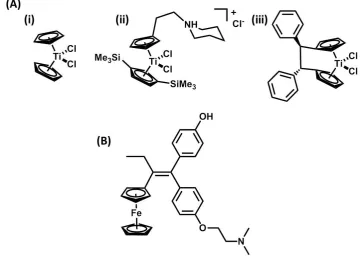
agent was the bent-metallocene titanocene dichloride [(η5-Cp)2TiCl2] (Cp = cyclopentadienyl) (Figure 1.5 a),30which reached stage II clinical trials for treatment of renal-cell carcinoma31 and metastatic breast cancer.32 The mechanism of action
was proposed to be similar to cisplatin, involving DNA cross-links, however, it is
now believed that it binds more strongly to the DNA phosphate backbone.33 Issues arising from complicated aqueous behaviour and drug formulation prevented further
McGowan et al. Functionalisiation of the Cp ring with ionic amine tethers led to
increase in activity and better aqueous solubility.34,35 Tackeet al. synthesised ansa-bridged derivatives which led to greater aqueous stability of the Cp rings and
increased activity compared to titanocene dichloride.36
Another promising organometallic drug candidate is ferrocifen (Jaouen et al.), in
which one Cp ring in ferrocene is conjugated to one of the active metabolites of the
organic breast cancer drug tamoxifen (Figure 1.5 b), which showed good activity
against both ER+ and ER- breast cancer cells.37 Proposed mechanisms of action include binding to the ERα subtype, suppressing estradiol-mediated DNA
transcription (similar mechanism to tamoxifen)38 and the production of reactive oxygen species (ROS) which may be related to the redox activation by the ferrocene
[image:31.595.139.500.423.679.2]moiety.39
1.3.3 Half-sandwich Complexes
One of the most promising series of organometallic anticancer agents is
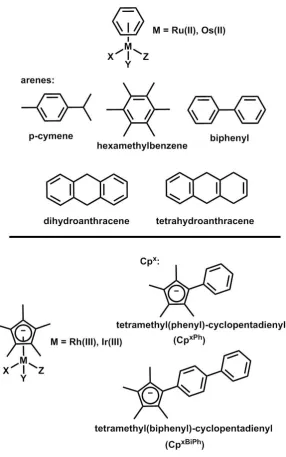
half-sandwich complexes. The general structure of half-half-sandwich complexes can be
described in relation to a piano-stool, where the seat is represented by the
coordination of a neutral arene for Ru(II) and Os(II), or negatively charged Cp* (Cp*
= pentamethylcyclopentadienyl) ring for Rh(III) and Ir(III) by binding of all 6 (η6) or 5 (η5) carbons present in the ring system, followed by the three legs of piano stool which correspond to mono- (X, Y and Z), bi (X-Y with Z monodentate) or tridentate
(X-Y-Z) ligands (Figure 1.6). The surrounding ligands can provide control of the
reactivity towards biomolecules and can also govern physicochemical properties
such as hydrophobicity, a property which has been demonstrated to be of importance
Figure 1.6.General structure of half-sandwich “piano-stool” complexes with typical arenes and Cp rings commonly used.
1.3.3.1 Ruthenium
Half-sandwich complexes of ruthenium have been shown to be encouraging
anticancer agents,42 and may be attractive alternatives to the platinum complexes
currently used in the clinic. One of the most successful examples
(concentration which inhibits 50% cell growth) against A2780 human ovarian cancer
cells of 5 μM,43and demonstrated activityin vivo(Figure 1.7).44
The primary target of RM175 is believed to be DNA, where it can form
monofunctional adducts via binding to guanine residues, leading to different
metal-adducts compared with cisplatin. This occurs after aquation of the chloride
monodentate ligand. The Ru(II)-guanine interaction is enhanced by the formation of
strong hydrogen-bonds between the NH2 protons on the ethylenediamine chelating
ligand and the C6 carbonyl of guanine (Figure 1.7), resulting in a strong preference
for binding to guanine residues over adenine.45 It was found that the complex
[(η6-p-cymene)Ru(1,2-bis(dimethylamino)ethane)Cl]PF6 which has no hydrogen bonding donors exhibits no cytotoxic activity against A2780 cells, suggesting that
this interaction is integral to the mechanism of action.46
The in vitro anticancer activity of [(η6-arene)Ru(ethylenediamine)Cl]+ complexes is directly related to the type of arene capping ligand present. Increasing the size of the
coordinated arene results in enhanced antiproliferative activity. The order of activity
based on the presence of the capping ligand is benzene < p-cymene < biphenyl <
dihydroanthracene < tetrahydroanthracene.44 This can be attributed to increased hydrophobicity which can lead to enhanced cellular accumulation via passive
diffusion into the cell. The presence of extended arene systems can also increase the
Figure 1.7. Activation via aquation of [(η6-biphenyl)Ru(ethylenediamine)Cl]PF6 (RM175) and subsequent binding to guanosine on DNA, as illustrated in the X-ray crystal structure [(η6-biphenyl)Ru(ethylenediamine)guanosine](PF6)2. The strong H-bond interactions (1.890 Å) between the C6 carbonyl and NH2 protons on the chelating ligand stabilise the Ru-guanine interaction.
Work by Hartinger et al. has shown that the coordination of bioactive chelating
ligands such as 3-hydroxyflavones and lapchol to half-sandwich Ru(II) complexes
(Figure 1.8 i) can lead to highly active anticancer complexes, where mechanisms
such as DNA binding and metal-centred ROS production may be involved.47,48
Another interesting class of Ru piano-stool complexes are the RAPTA series (Figure
1.8 ii) developed by Dyson et al. which show excellent antitumor activities against
metastases rather than primary tumours.49 It is proposed that DNA binding via
protonation may be responsible for the selective activity towards cancer cells over
healthy cells due the slightly acidic microtumour environment exhibited by cancer
developed a series of Ru(II) Cp kinase inhibitors bearing a pyridocarbazole chelating
ligand which exhibit promising anticancer activity. It was demonstrated that
blocking the inhibitory kinase action by methylation of the nitrogen in the ligand
abolished the antiproliferative activity, showing that the active complex is acting as a
structural scaffold for kinase inhibition.53,54 These scaffolds are inert and do not interact with DNAviathe monodentate site unlike RM175.
Figure 1.8.Half-sandwich Ru(II) complexes with promising anticancer activities, (i) lapchol derived complex, (ii) RAPTA-C and (iii) the substitutionally inert kinase inhibitor.
1.3.3.2 Osmium
Half-sandwich osmium(II) complexes have been less studied compared to
ruthenium, presumably due to being considered less kinetically labile and the general
consensus of being a toxic metal ion, a phobia which can be traced to the highly
toxic OsO4. Osmium compounds are now gaining increasing interest as potential
anticancer agents.55
Studies by Sadler et al. on the osmium analogue of RM175 [(η6
-biphenyl)Os(ethylenediamine)Cl]BF4 (Figure 1.9 i) showed an IC50 value against
RM175 (6.3 vs. 7.7), indicating that the hydroxide adduct is likely to be dominant at
physiological pH. In contrast, studies on anionic O,O-chelated complexes like [(η6
-biphenyl)Os(acetyl-acetonate)Cl] (Figure 1.9 ii) showed no anticancer activity. They
rapidly hydrolyse forming the biologically inactive hydroxo-bridged dimer,57
indicating that the chelating ligand can have a dramatic effect on the chemical
reactivity and the observed biological activity of half-sandwich metal complexes.
Another series of osmium half-sandwich complexes bearing N,O-chelated picolinic
acid ligands showed encouragingin vitroanticancer activities in the low-micromolar
range.41,58 One of the most promising Os(II) arene complexes to date is [(η6- p-cymene)Os(azpy-NMe2)I]PF6 (Figure 1.9 iii)) which exhibits nanomolar activity
against a range of cancer cell lines including ovarian, lung and colon.59Interestingly,
the iodido monodentate ligand exhibits minimal hydrolysis in aqueous media, yet is
10 times more potent than its chloride analogue,60 suggesting that “activation via
aquation” is not always required for anticancer activity within chelated
half-sandwich complexes. It is believed that a redox-based MoA involving mitochondrial
dysfunction may be responsible for its antiproliferative activity.
1.4
Iridium
Iridium is a late-transition metal element and is one of the six platinum group metals.
First discovered in 1803 as an impurity in platinum metal, it is named after the Greek
Goddess Iris, the personification of the rainbow, due to the numerous different
colours of its salts. A relatively rare metal, the global consumption of iridium was
5,540 kg in 2012.61 The oxidation state of iridium complexes can range from -1 to +5, allowing for a range of adopted geometries including square planar (+1),
tetrahedral (-1, 0), trigonal-bipyramidal (+1) octahedral (+3) and pseudo-octahedral
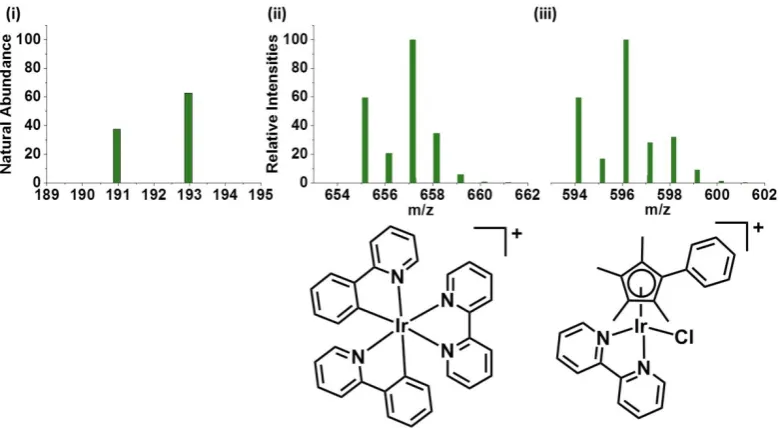
(+3, +4). Iridium has only two naturally occurring isotopes,191Ir and193Ir where the
latter is the most abundant. Upon formation of coordination/organometallic
complexes, the presence of organic compounds and halogens such as Cl and Br
create a distinctive isotopic pattern which aids the assignment of compounds by
[image:38.595.118.508.443.657.2]mass spectrometry (Figure 1.10).
Iridium complexes can exhibit interesting catalytic and photochemical properties, for
example, the highly active Crabtree’s catalyst is a square-planar Ir(I) complex for
homogeneous hydrogenation of highly-substituted olefins.62,63 Cyclometalated octahedral Ir(III) complexes exhibit favourable luminescence properties which have
been shown to be potentially useful as biological probes.64,65 Half-sandwich Ir(III) complexes are also excellent catalysts for a range of organic transformations,
including hydrogenation reactions of ketones66 and imines,67and have also recently been reported as efficient water oxidation catalysts in the presence of a chemical
oxidant.68,69
To date, iridium is only currently used in the clinic as a brachytherapy agent, a type
of internal radiotherapy, where sealed radioactive iridium-192 (ß-, half life – 73.83 d)
is placed inside the body next to or in the tumour site. It is most commonly used for
cervical, womb, vaginal and prostate cancers.70,71 Research into iridium cancer chemotherapeutic agents is still in its infancy, compared with the years of research
on platinum and ruthenium complexes.
1.4.1 Iridium(I) Anticancer Complexes
Following the success of square-planar Pt(II) anticancer complexes, early research
was focussed on 5d8 square-planar Ir(I) complexes of the type
[IrCl(cyclooctadiene)]272 and [Ir(acetyl-acetonate)(cyclooctadiene)]73 (Figure 1.11 i-ii) which exhibited antimetastatic activity against the Lewis lung model and
inhibition of primary Lewis lung carcinoma in mice, respectively. At the time of
discovery their mechanisms of action were not investigated. The rhodium analogues
showed no interaction with DNA, in which the authors claim a potentially different
More recently, some Ir(I)-NHC (NHC = N-heterocyclic carbene) complexes with
anticancer activity have been reported.74 One of the more promising candidates was reported by Metzle-Nolte et al. The complex [IrCl(NHC)(cyclooctadiene)] (Figure
1.11 iii) showed good activity against the human breast MCF-7 and colon HT-29
cancer cell lines (IC50 = 14.6 and 19.3 μM, respectively).75Preliminary mechanistic studies have shown that the complex can bind to proteins such as cytochrome c via
loss of the chloride and cyclooctadiene ligands, followed by oxidation of Ir(I)
allowing formation of kinetically inert Ir(III) octahedral protein adducts.
Figure 1.11.Squre-planar Ir(I) complexes studied for anticancer activity.
1.4.2 Octahedral Iridium(III) Anticancer Complexes
Due to the success of Ru(III) octahedral complexes NAMI-A and KP1019, Ir(III)
analogues have been studied for their anticancer properties (Figure 5.13).
Interestingly, no anticancer activity was observed for either [trans
-IrCl4(dimethylsulfoxide)(imidazole)]imidazolium76 or [
trans-IrCl4(imidazole)2]imidazolium,77 suggesting that the greater kinetic stability of the octahedral Ir(III) ion results in poor activity.
Octahedral complexes of Ir(III) exhibit interesting luminescence properties.
Emission tends to occur via triplet metal-to-ligand charge-transfer (3MLCT). They have been widely studied as biological probes. Interaction with the analyte of interest
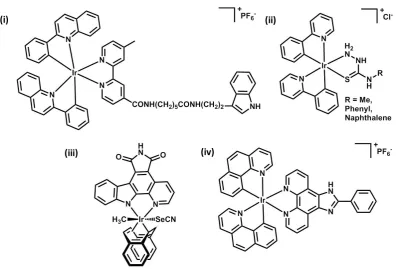
reported a series of cyclometallated polypyridyl Ir(III) complexes that have been
extensively studied for this purpose.65,78 Interestingly, some of these complexes also exhibit antiproliferative activity against cancerous cells, such as
[Ir(2-phenylquinoline)2(N,N)]PF6 (where N,N = indole-functionalised 2,2’-bypyridine)
(Figure 1.12 i) with IC50 values of down to 1.1 μM against the HeLa cell line.
Hydrophobicity appears to be an important characteristic for good activity.79
Ruiz et al. have reported cyclometallated Ir(III) complexes bearing
thiosemicarbazone ligands (Figure 1.12 ii) that show potent activity against A2780
human ovarian cancer cells with no cross-resistance against A2780cisR (cisplatin
resistant human ovarian cancer cell line) observed.80 The complexes are capable of inhibiting Cathepsin B as well as binding to the minor groove of DNA. No direct
binding to the model nucleobase 9-ethylguanine (9-EtG) was observed by 1H NMR spectroscopy.
Octahedral Ir(III) complexes can also be designed as structural scaffolds for the
inhibition of kinases, as demonstrated by Meggers et al.81,82 An interesting example is the complex trans,trans-
[(CH3)SeCNIr(pyridocarbazole)-(dibenzo[a,e]cyclooctatetraene)] (Figure 1.12 iii) which shows dual anticancer
activity through both antiangiogenic activity via inhibition of vascular endothelial
growth factor receptor kinases (VEGFR) and photoinduced antiproliferation via
irradiation with visible light, resulting in loss of the selanocyanide ligand, allowing
binding to biological targets.83Recently, Ma et al reported the first metallo-inhibitor
of the tumour necrosis factor-α converting enzyme (TACE) based on an octahedral
Ir(III) complex (Figure 1.12 iv) which shows promise in the development of
Figure 1.12 Octahedral iridium(III) complexes that show promise as potential anticancer agents.
1.4.3 Half-sandwich Iridium(III) Anticancer Complexes
There is an increasing interest in the use of half-sandwich iridium(III) complexes for
biological use.85,86The first examples were reported by Sheldricket al.They initially
studied DNA intercalators using complexes of the general structure
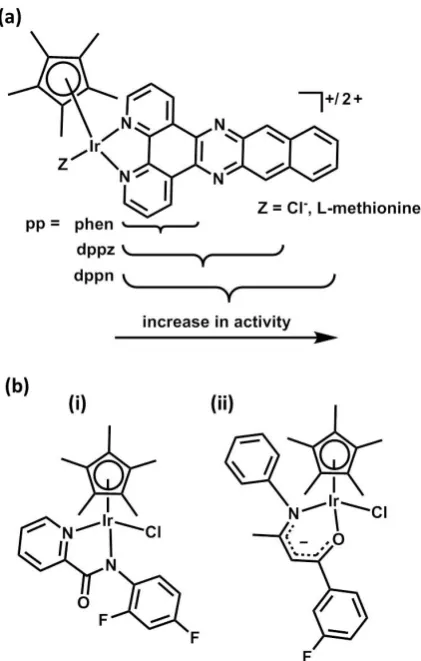
[(η5-Cp*)Ir(N,N)X]+/2+ (N,N = polypyridyl (pp) chelating ligand, X = chloride/L-methionine) (Figure 1.13 a). Enhanced interactions with DNA were observed upon
an increase in the surface area of the pp ligand. DNA intercalation was detected
using 2D NOESY for the complex [(η5-Cp*)Ir(dppz)(L-methionineH)]3+ (dppz = dipyridophenazine) with the hexanucleotide d(GTCGAC)2.87 Studies on the antiproliferative activity showed that the ability to intercalate between DNA bases
could be responsible for their biological activity. Complexes containing
ethylenediamine or 1,10-phenanthroline were poor intercalators and showed no
nucleobases directly at the metal centre, showing a dual-mode of DNA interaction.
The increase in size of the polypyridyl ligand also results in an increase in
hydrophobicity, which can increase cellular accumulation of compounds viapassive
diffusion through the lipophilic cell membrane.
McGowan et al. have recently reported cytotoxic neutral half-sandwich Ir(III)
complexes bearing anionic picolinamide andß-ketoiminate chelating ligands (Figure
1.13) which show promising activity against a variety of different cancer cell
lines.89,90 The picolinamide complexes were shown to be potent inhibitors of thioredoxin reductase 1 (Trx-R) which may contribute towards their mechanism of
action. The ß-ketoiminate complex [(η5 -Cp*)Ir(3′-fluorophenyl-3(phenylamino)-2-buten-1-one)Cl] also showed Trx-R inhibition and was able to retain modest
antiproliferative activity under hypoxic conditions against the HT-29 colon cancer
cell line, demonstrating that it can act as normoxic and hypoxic antitumor agent.91
Within the Sadler laboratory, a series of Ir(III) complexes bearing phenyl- or
biphenyl-substituted cyclopentadienyl capping ligands have been developed using
neutral N,N-chelating ligands (2,2ˈ-bipyridine, 1,10-phenathroline and
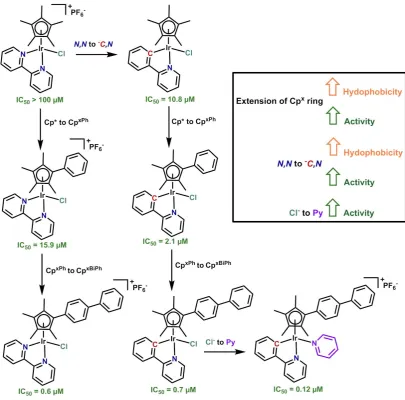
ethylenediamine), Figure 1.14. An increase in activity against A2780 human ovarian
cancer cells was observed following the order CpxBiPh > CpxPh > Cp*.92 Determination of the logP values indicated that an increase in extension of the Cpx
ligand resulted in greater hydrophobicity, which correlates with the extent of Ir
Figure 1.13. Half-sandwich Ir(III) complexes studied for anticancer activity (a) use of extended pp chelating ligands results in enhanced activity and (b) neutral anticancer complexes that show Trx-R inhibition.
This study was extended further by replacing the neutral N,N-chelating ligands with
isoelectronic anionic C,N-chelating ligands (2-phenylpyridine, 7,8-benzoquinoline,
Figure 1.14).93 An increase in activity was observed which was attributed to an increase in hydrophobicity of the resulting neutral complex ([(η5 -Cp*)Ir(2,2ˈ-bipyridine)Cl]PF6 log P = -0.95 vs. ([(η5-Cp*)Ir(2-phenylpyridine)Cl] log P = 1.57).94 The same trend was also observed upon introduction of the extended Cpx ligands as determined for the N,N-chelated compounds, resulting in highly potent
complexes. Furthermore, the replacement of the chloride monodentate ligand with
anticancer activity against A2780 cells (Ir-Cl IC50 = 0.7 μM vs. Ir-Py IC50 = 0.12
μM) and selectivity over healthy cells comparable to cisplatin.95
Despite Ir(III) being normally an inert low spin d6metal ion, the monodentate ligand in organo-Ir(III) chelated half-sandwich complexes can be kinetically labile.96
Hydrolysis studies show that equilibrium between Ir-Cl and Ir-OH2/OH in
[(η5-Cpx)Ir(X-Y)Cl]0/+ (X-Y = neutral N,N- or anionic C,N- chelating ligands) complexes is reached within under 5 mins at 310 K. The extent of hydrolysis is
greatest for the neutral complexes over charged complexes (as monitored by 1H NMR spectroscopy), which can be attributed to the anionic C,N-chelating ligand
facilitating chloride loss by increasing the electron density on the metal centre. This
also leads to the aqua adducts having higher pKa values in C,N-chelated complexes
over N,N-chelated systems ([(η5-Cp*)Ir(2,2ˈ-bipyridine)OH2]2+ pKa = 6.86 vs. [(η5-Cp*)Ir(2-phenylpyridine)OH2]+ pKa = 8.75).94 Interestingly, the use of pyridine as a monodentate ligand dramatically decreases the rate of hydrolysis, where the
half-life (t1/2) of hydrolysis for ([(η5-CpxBiPh)Ir(2-phenylpyridine)Py]PF6 is 77.8 min.95This complex also shows 18% conversion to the chloride complex under
Figure 1.14. Half-sandwich Ir(III) anticancer complexes investigated within the Sadler laboratory with IC50values against A2780 human ovarian cancer cells.
Studies into potential mechanisms of action have been focussed initially on
interactions with DNA, which have been shown to be of importance for many
metallo-anticancer complexes.97,98 Both N,N- andC,N-chelated complexes can bind to 9-EtG, but only the C,N-chelated complexes show any affinity towards
9-methyladenine (9-MeA), although binding to 9-EtG appears to be preferred in
determined by ethidium bromide (EtBr) displacement is strongly dependent on the
type of capping ligand used, in which the more extended ligands result in enhanced
EtBr displacement, suggesting that intercalation as well as direct nucleobase binding
may be important for antiproliferative activity. This has also been observed for
Ru(II) and Os(II) half-sandwich complexes that bear extended arene ligands.99,100
More recently, Ir(III) half-sandwich complexes bearing N,N- and C,N chelating
ligands have been shown to induce high levels of ROS causing mitochondrial
dysfunction.101,102Incubation withL-buthionine sulfoximine (L-BSO), which reduces the cellular levels of the ROS scavenger GSH,103 results in a two-fold increase in
antiproliferative activity for ([(η5-CpxBiPh)Ir(2-phenylpyridine)Py]PF6, confirming the role of ROS in the MoA of these complexes. Therefore, it is likely that these
complexes not only bind to DNA, but also cause mitochondrial damage.
Interestingly, it has been demonstrated that half-sandwich Ir(III) complexes can
catalytically oxidise reduced ß-nicotinamide adenine dinucleotide (NADH) to
NAD+.104,105 The disruption of the NAD+/NADH redox couple could have implications for cellular energy processes, including the citric acid cycle and the
oxidative phosphorylation of adenosine diphosphate (ADP) to adenosine
triphosphate (ATP).106 It has also been reported that the levels of NADH in cancer cells can be twice as high as in healthy cells, which may make NADH a good
biological target for cancer therapy.107
The oxidation of NADH by complexes [(η5-Cpx)Ir(1,10-phenanthroline)OH2]2+(Cpx – Cp*, CpxPh) has been proposed to proceed by interaction of the amide unit with the Ir centre (displacing H2O), along with ring slippage of the Cpxfromη5toη3allowing formation of the Ir-H species (detected by 1H NMR spectroscopy).104 The hydride
substrates such as the quinone vitamin K3 to the semiquinone derivative, where
coordination of another water molecule completes the catalytic cycle (Figure
[image:48.595.139.498.172.610.2]1.15).108
Figure 1.15. Proposed catalytic cycle for the oxidation of NADH to NAD+ by the half-sandwich Ir(III) anticancer complex [(η5-CpxPh)Ir(1,10-phenanthroline)OH2]2+ (taken from reference).104
This may contribute to the elevated levels of ROS observed in A2780 cells for this
complex. The rate of reaction with NADH is slower than its chloride analogue.
However, it has been hypothesised that the more stable pyridine ligand protects the
complex from deactivation from biomolecules such as GSH (present in mammalian
[image:49.595.182.456.243.448.2]cells at a concentration of between 0.5-10 mM),109 which may inhibit the desired reaction, ultimately leading to a more active complex (Figure 1.16).
Figure 1.16. Proposed reaction pathway of [(η5-CpxBiPh)Ir(2-phenylpyridine)Py]PF6 with NADH forming H2O2, and the protection from deactivation with GSH.95
It was demonstrated that these complexes can increase the ratio of NAD+/NADH in A2780 cells, presumably as a consequence of their ability to oxidise NADH to
NAD+, potentially a novel mechanism of action.104 Recently, arene Ru(II)
sulfonamido ethyleneamine complexes were shown to perform the reverse function.
Addition of non-toxic amounts of formate (hydride source) leads to catalytic
reduction of NAD+to NADH in A2780 cells.110Indeed, performing catalysis in cells by synthetic metal complexes is an expanding field of research, which includes
carbon-carbon bond formation and the removal of protection groups by
1.5
Bacterial Resistance
The rise of antibacterial resistance is becoming an increasing issue. Simple medical
procedures may soon become dangerous due to the risk of infection,113 with strains of bacteria such as methicillin resistant Staphylococcus aureus (MRSA) becoming
more prominent in hospitals. Therefore, new antibacterial agents are required that
can overcome this resistance. The resistance to traditional antibiotics has been
partially blamed on overuse and misuse. Bacteria can build resistance through
various mechanisms, including modification of the particular protein target site, the
up- or down-regulation of specific membrane pumps which facilitate transport of the
antimicrobial agent in/out of the cell, and the production of enzymes that can break
down the active agent.114
1.5.1 Metal-based Antibacterial Agents
Metal-based antibacterial agents may provide hope for the treatment of bacterial
infections that are becoming resistant to many organic drugs. To date, silver nitrate
and silver sulfadiazine (Figure 1.17 a i) are used to prevent infections developing in
burn wounds.115The Ag(I) ion is believed to exhibit the antibacterial activity (as well
the organic fragment in silver sulfadiazene), in which silver ions may react with thiol
groups in enzymes and also cause disruption of bacterial cell membranes.116 There appears to be no intrinsic toxicity of Ag(I) ions to the human body at low
concentrations, however, over-exposure to silver salts can lead to the condition of
argyria in which the skin turns a silver-grey colour.117 Silver-NHC complexes have
started to receive attention as alternatives to the traditionally used silver salts as
Although not an antibacterial, it is worth highlighting the success of the
organometallic antimalarial agent ferroquine, which contains the organic antimalarial
chloroquine combined with ferrocene (Figure 1.16 b) and has reached phase II
clinical trials.120 Ferroquine shows a similar mechanism of action as chloroquine
against chloroquine-sensitive P. falciparum, centred on the inhibition of hemozoin
formation. However, it is also highly active against chloroquine-resistant strains, in
which it has been proposed that the change in the physicochemical, geometrical and
electronic properties result in its activity.121 It has also been hypothesised that the ability to induce ROS and interference with lipids may contribute to the enhanced
[image:51.595.161.489.361.567.2]antimalarial activity of ferroquine over chloroquine.122
Figure 1.16(A) Silver antibacterial agents and (B) the antimalarial agent ferroquine.
Other transition metal ions have also been investigated for antibacterial activity,123 including Cu(II), Zn(II), Co(II), Ni(II) and Mn(II) bearing Schiff base chelating
ligands, and have shown promising activities against Gram-negative E. coli.124
Recently, research by Metzle-Nolte et al. have shown the promise of tri-metallic
agent. They show high activity against Gram-positive bacteria such asS. aureusand
MRSA,125 where a recent study highlighted that the Re-(CO)3 unit is essential for activity.126
Research on the platinum-group metals as antibacterial agents has centred
predominantly on Ru(II) complexes.127 Early studies on Ru(II) coordination complexes by Dwyer et al. in the 1960’s were focussed on inert pp scaffolds which
showed good activity against Gram-positive bacteria.128 However, further development was not performed, which may be as a consequence of the large
number of antibacterial agents being investigated at that time. Due to the increasing
concern over antibacterial resistance, new interest has arisen. Aldrich-Wright et al.
have reported a series of antibacterial Ru(II) complexes that are DNA intercalators
(Figure 1.17 i).129 It appears that lipophilicity and charge are of importance for high activity against Gram-positive bacteria.130 However, these properties can also make them toxic to healthy cells, especially when DNA is a biological target.
Organometallic Ru(II) complexes have also shown promise,131-133 for example, a ruthenocene complex conjugated to 6-aminopenicillic acid (6-APA), incorporating
an organometallic fragment with a novel ß-lactam unit (Figure 1.17 ii) shows high
activity against MRSA strains.134 The complex exhibits enhanced activity over the ferrocene derivative and 6-APA on its own, showing that the metal fragment plays a
Figure 1.17Ru(II) complexes which show promising antibacterial activity.
There are very few previous studies on the antibacterial activity of iridium
complexes, with most reports being over the past 5 years. Inert polypyridyl Ir(III)
octahedral complexes analogous to the Ru(II) complexes previously discussed have
been studied, but showed no antibacterial activity.135This was attributed to switching from an overall Ru 2+ to Ir 3+ charge resulting in decreased cellular accumulation.
Despite this initial result, it was then demonstrated that dinuclear octahedral Ir(III)
complexes with one labile coordination site show high activity againstS. aureusand
MRSA, Figure 1.18 (i).136 However, the complexes were shown to be bacteriostatic
rather than bactericidal.
Studies into antibacterial half-sandwich Ir(III) complexes are limited, but it has been
demonstrated that [(η5-Cp*)Ir(quinolin-8-olato)Cl] showed mild activity against Gram-positive bacteria but no activity against Gram-negative bacteria (Figure 1.18
ii).137 The complex also exhibits antiproliferative activity against the SK-MEL
human melanoma cell line. Further to this, a recent report on Ru(II), Rh(III) and
Ir(III) piano-stool complexes bearing a hydrazone Schiff base chelating ligand
showed good antibacterial activity for Ru(II) analogue againstS. aureusand E. coli,
which show good activity against Mycobacterium strains. Intriguningly, the L-amino
acid complexes exhibit better activity than D-amino acids. Hydrophobicity appears
to be important, where coordinated amino acids such as phenylalanine exhibit
enhanced activity compared to glycine.
Figure 1.18Ir(III) complexes which exhibit antibacterial activity.
1.6
Functionalising Metal Complexes
One of the major advantages of the use of metal complexes in medicinal chemistry is
their ability to affect a wide range of chemical and biological properties by
modification of the coordinated ligands.29,138Traditionally, these properties are tuned
viathe binding of different ligands to the metal complexes. For example, the use of a
pyridine monodentate ligand in N,N-chelated Ru(II) arene complexes blocks the
reactivity of the monodentate site towards hydrolysis and nucleobase binding, but
for controlled DNA binding and hence a greater control over the cytotoxic properties
of the complex.
The ability to add organic fragments that exert a particular function in the resulting
complex, such as aiding selectivity towards uptake in cancerous cells over healthy
cells, or delivery to a particular organelle, is an expanding area of research.141Pt(II) anticancer complexes cisplatin, carboplatin and oxaliplatin have been functionalised
for active drug transport and deliveryviaconjugation to organic/bioorganic moieties
such as estrogens, carbohydrates and peptides.142 Metal complexes can also be modified to attach them to nanoparticles, carbon-nanotubes and polymers.143-145This
can be advantageous for exploiting the enhanced permeability and retention (EPR)
effect, where molecules of high molecular weight (such as polymers) accumulate in
tumour tissue to a greater extent than in healthy cells. Polymer systems can also be
decorated with molecules to enhance receptor-mediated targeting, further increasing
their drug delivery and selectivity.146
Post-modifications to metal complexes allow for a diverse range of new complexes
to be prepared from one “parent” complex, without the need to make individual
ligands for coordination to the metal. In order to post-functionalise metal complexes,
a functional group is generally required on one of the ligands (unless the complex is
functionalised via addition of a ligand) that confers a particular reactivity towards
another functional group. Metzler Nolte et al. have pioneered the bioconjugation of
peptides and PNA oligomers to ferrocenyl and octahedral metal complexes using
Figure 1.19 Bio-conjugation of ferrocenyl and octahedral metal complexes to the peptide enkephalin using (A) Sonogashira coupling and (B) “click-chemistry”.
The use of aldehyde groups on ligands to functionalise metal complexes has recently
gained some attention. The advantage of using this system is the high reactivity that
aldehydes have towards nucleophilic attack by amines, which allows both organic
and bioorganic amines such as peptides and proteins (which contain a free amino
group) to be conjugated without using highly forcing conditions. The condensation
reaction produces the imine functional group (Figure 1.20), also known as a Schiff
base, which is susceptible to hydrolysis and is enhanced at acidic pH. In polymer
bonds as drug delivery vehicles for cancer drugs, where upon hydrolysis in the more
acidic microtumour environment the drugs are preferentially released in cancer
cells.149,150
Figure 1.20 Reaction of benzaldehyde with 2-methoxylethylamine to form the corresponding imine conjugate.
The exploitation of the reactivity of aldehyde groups on a Pt(II)-NHC complex was
recently demonstrated by Bellemin-Laponnaz et al., who showed that either primary
amines or hydroxylamines can form imines or oximes, respectively.151 C-protected amino acids can be easily conjugated to the complex to form Schiff bases, and it was
even demonstrated that the reduction of the imine to the secondary amine can be
performed using the weak reducing agent NaHB(OAc)3. Lo et al. have also
demonstrated how an octahedral Ir(III) complex bearing aldehyde substituents can
react with bovine serum albumin (BSA) via surface lysine residues, followed by
reduction using NaCNBH3 to form stable Ir(III)-bioconjugates with luminescent
properties.152
1.7
Aims
Due to promising results reported for the use of C,N-chelated iridium(III)
half-sandwich complexes as anticancer agents, a major part of this thesis is concerned
and activities of Cp* compounds viafunctionalisation of chelating and monodentate
ligands. Iminopyridine N,N-chelated iridium(III) complexes were also investigated,
examining the effects that functionality on the Cpxring and chelating ligand have on the chemical, antibacterial and anticancer activity. More specific aims were as
follows.
1. Synthesis, characterisation and evaluation of the chemical, physicochemical
and anticancer properties that arise from functionalising 2-phenylpyridine
ligands in complexes of the type [(η5-Cp*)Ir(2-phenylpyridine)Cl] with electron-donating and electron-withdrawing groups.
2. Studying the effects on the chemical and anticancer properties of chlorido
and pyridyl monodentate ligands on the complex [(η5 -Cp*)Ir(2-(2ˈ-methylphenyl)pyridine)X]0/+.
3. Exploring the functionalisation of the anticancer complex
[(η5-Cp*)Ir(2-phenyl-5-pyridinecarboxaldehyde)Cl] by reactions with amines and peptides to form new Schiff base conjugates, including the addition of a
fluorescent dansyl moiety. Reduction of the dansyl conjugate to the
secondary amine was investigated to enable investigations into tracking the
complexviaconfocal microscopy.
4. The synthesis, characterisation and evaluation of the solution chemistry of
1.8
References
(1) Williams, K. J.J. R. Soc. Med.2009,102, 343.
(2) Zhou, Z.; Lu, Z.-R. Wiley Interdiscip. Rev. Nanomed. Nanobiotechnol.2013,5, 1.
(3) Caravan, P.; Ellison, J. J.; McMurry, T. J.; Lauffer, R. B.Chem. Rev. 1999,99, 2293.
(4) Crooke, S. T.; Mirabelli, C. K.Am. J. Med.1983,75, 109. (5) Vane, J.; Botting, R.The FASEB Journal1987,1, 89. (6) Bierer, D. W.Rev. Infect. Dis.1990,12, S3.
(7) Medici, S.; Peana, M.; Nurchi, V. M.; Lachowicz, J. I.; Crisponi, G.; Zoroddu, M. A.Coord. Chem. Rev.2015,284, 329.
(8) Maddams, J.; Utley, M.; Moller, H.Br. J. Cancer2012,107, 1195. (9) Jemal, A.; Bray, F.; Center, M. M.; Ferlay, J.; Ward, E.; Forman, D.
CA Cancer J. Clin. 2011,61, 69.
(10) Harper, B. W.; Krause-Heuer, A. M.; Grant, M. P.; Manohar, M.; Garbutcheon-Singh, K. B.; Aldrich-Wright, J. R.Chem. Eur. J.2010,16, 7064.
(11) Rosenberg, B.; Vancamp, L.; Trosko, J. E.; Mansour, V. H. Nature 1969,222, 385.
(12) Hanna, N.; Einhorn, L. H.J. Clin. Oncol.2014,32, 3085.
(13) Lippert, B. Cisplatin - Chemistry and Biochemistry of a Leading Anticancer Drug; Helvetica Chimica Acta: Würzburg, 1999.
(14) Takahara, P. M.; Rosenzweig, A. C.; Frederick, C. A.; Lippard, S. J.
Nature1995,377, 649.
(15) Ohndorf, U.-M.; Rould, M. A.; He, Q.; Pabo, C. O.; Lippard, S. J.
Nature1999,399, 708.
(16) van der Vijgh, W. F.Clin. Pharmacokinet.1991,21, 242.
(17) Figure taken from http://web.mit.edu/lippardlab/gallery.html (last accessed 05/06/15).
(18) Hall, M. D.; Mellor, H. R.; Callaghan, R.; Hambley, T. W. J. Med. Chem.2007,50, 3403.
(19) Shi, Y.; Liu, S.-A.; Kerwood, D. J.; Goodisman, J.; Dabrowiak, J. C.
(20) Pendyala, L.; Cowens, J. W.; Chheda, G. B.; Dutta, S. P.; Creaven, P. J.Cancer Res.1988,48, 3533.
(21) Sessa, C.; Vermorken, J.; Renard, J.; Kaye, S.; Smith, D.; ten Bokkel Huinink, W.; Cavalli, F.; Pinedo, H.J. Clin. Oncol.1988,6, 98.
(22) Gandioso, A.; Shaili, E.; Massaguer, A.; Artigas, G.; Gonzalez-Canto, A.; Woods, J. A.; Sadler, P. J.; Marchan, V.Chem. Commun.2015,51, 9169.
(23) Farrer, N. J.; Woods, J. A.; Munk, V. P.; Mackay, F. S.; Sadler, P. J.
Chem. Res. Toxicol.2009,23, 413.
(24) Farrer, N. J.; Woods, J. A.; Salassa, L.; Zhao, Y.; Robinson, K. S.; Clarkson, G.; Mackay, F. S.; Sadler, P. J.Angew. Chem. Int. Ed.2010,49, 8905.
(25) Sava, G.; Pacor, S.; Mestroni, G.; Alessio, E. Clin. Exp. Metastasis 1992,10, 273.
(26) Berger, M. R.; Garzon, F. T.; Keppler, B. K.; Schmähl, D.Anticancer Res.1989,9, 761.
(27) Clarke, M. J.; Zhu, F.; Frasca, D. R.Chem. Rev.1999,99, 2511. (28) Jaouen, G.; Beck, W.; McGlinchey, M. J. Bioorganometallics: Biomolecules, Labeling, Medicine2006, 1.
(29) Hartinger, C. G.; Dyson, P. J.Chem. Soc. Rev.2009,38, 391.
(30) Köpf, H.; Köpf-Maier, P.Angew. Chem. Int. Ed. Engl.1979,18, 477. (31) Lümmen, G.; Sperling, H.; Luboldt, H.; Otto, T.; Rübben, H. Cancer Chemother. Pharmacol.1998,42, 415.
(32) Kröger, N.; Kleeberg, U. R.; Mross, K.; Edler, L.; Hossfeld, D. K.
Onkologie2000,23, 60.
(33) Guo, M.; Guo, Z.; Sadler, P.J. Biol. Inorg. Chem.2001,6, 698. (34) Allen, O. R.; Croll, L.; Gott, A. L.; Knox, R. J.; McGowan, P. C.
Organometallics2004,23, 288.
(35) Allen, O. R.; Gott, A. L.; Hartley, J. A.; Hartley, J. M.; Knox, R. J.; McGowan, P. C.Dalton Trans.2007, 5082.
(36) Strohfeldt, K.; Tacke, M.Chem. Soc. Rev.2008,37, 1174.
(37) Jaouen, G.; Top, S.; Vessieres, A.; Leclercq, G.; McGlinchey, M. J.
Curr. Med. Chem.2004,11, 2505.
(40) Ganeshpandian, M.; Loganathan, R.; Suresh, E.; Riyasdeen, A.; Akbarsha, M. A.; Palaniandavar, M.Dalton Trans.2014,43, 1203.
(41) van Rijt, S. H.; Mukherjee, A.; Pizarro, A. M.; Sadler, P. J. J. Med. Chem.2009,53, 840.
(42) Nazarov, A. A.; Hartinger, C. G.; Dyson, P. J. J. Organomet. Chem. 2014,751, 251.
(43) Morris, R. E.; Aird, R. E.; del Socorro Murdoch, P.; Chen, H.; Cummings, J.; Hughes, N. D.; Parsons, S.; Parkin, A.; Boyd, G.; Jodrell, D. I.; Sadler, P. J.J. Med. Chem.2001,44, 3616.
(44) Aird, R. E.; Cummings, J.; Ritchie, A. A.; Muir, M.; Morris, R. E.; Chen, H.; Sadler, P. J.; Jodrell, D. I.Br. J. Cancer2002,86, 1652.
(45) Chen, H.; Parkinson, J. A.; Parsons, S.; Coxall, R. A.; Gould, R. O.; Sadler, P. J.J. Am. Chem. Soc.2002,124, 3064.
(46) Habtemariam, A.; Melchart, M.; Fernández, R.; Parsons, S.; Oswald, I. D. H.; Parkin, A.; Fabbiani, F. P. A.; Davidson, J. E.; Dawson, A.; Aird, R. E.; Jodrell, D. I.; Sadler, P. J.J. Med. Chem.2006,49, 6858.
(47) Kandioller, W.; Balsano, E.; Meier, S. M.; Jungwirth, U.; Goschl, S.; Roller, A.; Jakupec, M. A.; Berger, W.; Keppler, B. K.; Hartinger, C. G. Chem. Commun.2013,49, 3348.
(48) Kurzwernhart, A.; Kandioller, W.; Enyedy, E. A.; Novak, M.; Jakupec, M. A.; Keppler, B. K.; Hartinger, C. G.Dalton Trans.2013,42, 6193.
(49) Dyson, P. J.; Sava, G.Dalton Trans.2006, 1929.
(50) Fukamachi, T.; Chiba, Y.; Wang, X.; Saito, H.; Tagawa, M.; Kobayashi, H.Cancer Lett.2010,297, 182.
(51) Allardyce, C. S.; Dyson, P. J.; Ellis, D. J.; Heath, S. L. Chem. Commun.2001, 1396.
(52) Casini, A.; Gabbiani, C.; Sorrentino, F.; Rigobello, M. P.; Bindoli, A.; Geldbach, T. J.; Marrone, A.; Re, N.; Hartinger, C. G.; Dyson, P. J.; Messori, L. J. Med. Chem.2008,51, 6773.
(53) Meggers, E.; Atilla-Gokcumen, G. E.; Grundler, K.; Frias, C.; Prokop, A.Dalton Trans.2009, 10882.
(54) Martin, E. K.; Pagano, N.; Sherlock, M. E.; Harms, K.; Meggers, E.
(55) Hanif, M.; Babak, M. V.; Hartinger, C. G.Drug Discov. Today2014,
19, 1640.
(56) Peacock, A. F. A.; Habtemariam, A.; Moggach, S. A.; Prescimone, A.; Parsons, S.; Sadler, P. J.Inorg. Chem.2007,46, 4049.
(57) Peacock, A. F. A.; Habtemariam, A.; Fernández, R.; Walland, V.; Fabbiani, F. P. A.; Parsons, S.; Aird, R. E.; Jodrell, D. I.; Sadler, P. J. J. Am. Chem. Soc.2006,128, 1739.
(58) Peacock, A. F. A.; Parsons, S.; Sadler, P. J.J. Am. Chem. Soc. 2007,
129, 3348.
(59) Fu, Y.; Habtemariam, A.; Pizarro, A. M.; van Rijt, S. H.; Healey, D. J.; Cooper, P. A.; Shnyder, S. D.; Clarkson, G. J.; Sadler, P. J.J. Med. Chem.2010,
53, 8192.
(60) Fu, Y.; Habtemariam, A.; Basri, A. M. B. H.; Braddick, D.; Clarkson, G. J.; Sadler, P. J.Dalton Trans.2011,40, 10553.
(61) U.S. Geological Survey Mineral Commodity Summaries: Platinum Group Metals, 2013,
http://minerals.usgs.gov/minerals/pubs/commodity/platinum/myb1-2012-plati.pdf. (62) Crabtree, R. H.; Felkin, H.; Morris, G. E. J. Organomet. Chem.1977,
141, 205.
(63) Xu, Y.; Mingos, D. M. P.; Brown, J. M.Chem. Commun.2008, 199. (64) You, Y.; Cho, S.; Nam, W.Inorg. Chem.2014,53, 1804.
(65) Lo, K. K.-W.; Li, S. P.-Y.; Zhang, K. Y.New J. Chem.2011,35, 265. (66) Prakash, O.; Singh, P.; Mukherjee, G.; Singh, A. K. Organometallics 2012,31, 3379.
(67) Hopmann, K. H.; Bayer, A.Coord. Chem. Rev.2014,268, 59.
(68) Savini, A.; Bucci, A.; Bellachioma, G.; Giancola, S.; Palomba, F.; Rocchigiani, L.; Rossi, A.; Suriani, M.; Zuccaccia, C.; Macchioni, A.J. Organomet. Chem.2014,771, 24.
(69) Blakemore, J. D.; Schley, N. D.; Balcells, D.; Hull, J. F.; Olack, G. W.; Incarvito, C. D.; Eisenstein, O.; Brudvig, G. W.; Crabtree, R. H. J. Am. Chem. Soc.2010,132, 16017.


![Figure 1.7. Activation via aquation of [(η6-biphenyl)Ru(ethylenediamine)Cl]PF6](https://thumb-us.123doks.com/thumbv2/123dok_us/9527847.457960/35.595.162.469.70.330/figure-activation-via-aquation-biphenyl-ru-ethylenediamine-cl.webp)
![Figure 1.15.xPh)Ir(1,10-phenanthroline)OH(taken from reference).by thehalf-sandwich Ir(III) anticancer complex [(η5-Cp+ Proposed catalytic cycle for the oxidation of NADH to NAD2]2+104](https://thumb-us.123doks.com/thumbv2/123dok_us/9527847.457960/48.595.139.498.172.610/phenanthroline-reference-sandwich-anticancer-complex-proposed-catalytic-oxidation.webp)
