http://wrap.warwick.ac.uk
Original citation:
Bal, Jay, Lashari, Shaan and Nabavieh, S. Mohammad (2014) Making successful virtual clusters. Working Paper. Coventry, UK: WMG, University of Warwick.
Permanent WRAP url:
http://wrap.warwick.ac.uk/61963 Copyright and reuse:
The Warwick Research Archive Portal (WRAP) makes this work by researchers of the University of Warwick available open access under the following conditions. Copyright © and all moral rights to the version of the paper presented here belong to the individual author(s) and/or other copyright owners. To the extent reasonable and practicable the material made available in WRAP has been checked for eligibility before being made available.
Copies of full items can be used for personal research or study, educational, or not-for-profit purposes without prior permission or charge. Provided that the authors, title and full bibliographic details are credited, a hyperlink and/or URL is given for the original metadata page and the content is not changed in any way.
A note on versions:
The version presented here is a working paper or pre-print that may be later published elsewhere. If a published version is known of, the above WRAP url will contain details on finding it.
Making successful virtual clusters
Jay Bal* , Shaan Lashari, S. Mohammad Nabavieh.
International Digital Lab, University of Warwick, Coventry, CV4 7AL, UK.
Improving competitiveness through the support of regional clusters is a common ingredient of
industrial policy in many countries. Can we get the same benefits through virtual clusters? This
was a core question in this research. To answer this question a literature review on the benefits of
geographical clusters as well as benefits and challenges of virtual clusters was conducted. The
authors operate an industrial virtual cluster in a UK using a web based portal and comment on its
operation and limitations. A further question asks whether it can work to create a single cluster
across national boundaries. A questionnaire was prepared and distributed to 31 firms in Pakistan to
assess the barriers they face working with the UK cluster. Through analysis of the data from the
questionnaire, a set of recommendations to improve business communications in virtual clusters is
suggested.
Keywords: Virtual Clusters (VCs); Virtual Breading Environments (VBEs); Geographical Clusters (GCs); Trust in VCs;
1. Introduction
This study attempts to assimilate the success factors of geographical clusters into virtual clusters. By doing so companies which operate in virtual clusters could enjoy the same cooperation benefits that companies in geographical clusters are currently enjoying. The authors have created and run a virtual cluster “The West Midlands Collaborative Commerce marketplace (WMCCM)” with detailed
competence profiles of 400+ engineering companies located in the West Midlands, UK. Though this
virtually operated, geographically based cluster has been successful in boosting the economic performance of its member companies, (over US$5Bn worth of contracts were won by members in 2011-12) attempts to link them with other regions to break the bounds of geography have not yet succeeded, though individual examples of success have occurred. This paper identifies and analyses the attitudes of engineering businesses in Pakistan to working with this virtual cluster. The remainder of this paper is organised as follows: section two reviews geographical clusters and their benefits for companies. In section three, the benefits and challenges of virtual clusters are presented. Trust is identified as one of the most important factors for virtual clusters and various aspects of trust for virtual clusters are presented in section four. The research methodology applied in this research together with the result of data analysis are presented in section five, with a set of recommendations for improving communications for virtual clusters discussed in section six.
2. Geographical Clusters
Smaller firms making car components have also clustered here to support the Original Equipment Manufacturers (OEM).
2.1. Geographical Clusters’ Benefits
Porter (1998) describes firms associated with geographical clusters as having better productivity, and that they often perform better than firms that are outside the cluster perform. Porter’s classifications of these benefits (with comments from other authors) are:
2.1.1. Better Access to Employees and Suppliers
A geographical cluster often already has a good pool of skilled labour as skilled labour is attracted to the region by the opportunities available. This makes the hiring process for a firm easier, and usually the labour is more productive than in other non-clustered areas. Fabiana et al (2000) points out that average size of firms in a cluster is smaller than those outside by about three employees. This suggests that firms in a cluster are more productive.
2.1.2. Trust among actors
Trust is a key factor in the formation of clusters and a causal factor for the collaboration and collective actions of firms within a cluster (Dupuy & Torre, 2006). Trust is built over time among firms within a cluster due to repeated actions, which generate a reputation. Thus, informed decisions can be taken when working with them based on their reputation. There is often a high level of trust among people working in the same cluster, it is easier to make agreements, and people are more willing to share their knowledge out of a sense of community (Porter, 1998).
Firms inside a GC have innovation advantages in terms of both better speed of innovation and lesser expenditure on R&D activities as well as a market for newly innovated products. Bagella and Becchetti (2000) empirically found that firms that are belong to clusters in Italy spent less on R&D than firms outside the clusters. They argue that this is due to easy imitation of new technology and products inside a cluster due to better knowledge flows. Porter (1998) argues that firms inside a cluster innovate according to the sophisticated demand in the region and thus innovation is driven by customer requirements. This puts the firms at a lesser risk in terms of innovation and new product development because they have an informed idea of customers’ requirements and even sometimes, they have a customer before the new or improved product is developed.
2.1.4. Access to specialized information and knowledge
Firms inside a cluster have better access to knowledge and information due to collaboration and cooperation among them. Firms have relationships with suppliers and other groups operating at a different part of the production cycle of an industry and are able to exchange knowledge with each other about new technologies and better ways of carrying out business operations (Porter, 2000). Henry and Pinch (2006) have argued that firms in a cluster build up a pool of knowledge through ‘learning by doing’. This knowledge flows within the cluster boundaries as firms imitate and help each
other by sharing experiences. Common culture in the cluster in terms of behaviour in business
transactions helps firms in clusters enter into agreements easily and transaction costs are reduced.
2.1.5. Complementarities
there are directly (e.g. Car Assembly and Tyre Manufacturers) and indirectly (e.g. transport, telecommunication and finance) complementing companies, the clusters are much more sustainable and more stable in an unstable environment (Desrochers et al, 2008).
3. Virtual Clusters or Virtual Breading Environments (VBE)
The capability provided by modern communications technology may give us the ability to gain the benefits of geographical clusters without the constraint of local location.
3.1. Definition of Virtual Cluster
There is no exact definition for the term ‘virtual clusters’ in the literature; however, the definition of Virtual Breading Environments (VBEs) is very close to what it is referred to as virtual cluster in this paper. In addition, a number of authors including Galeano & Molina (2005) have used these two terms interchangeably. Camarinha-Matos & Afsarmanesh (2005) define VBEs as “an association or pool of organizations and their related supporting institutions that have both the potential and will to cooperate with each other through the establishment of a “base” long-term cooperation agreement and
interoperable infrastructure.” One of the main goals of a virtual cluster is to assimilate all of the benefits of a geographical cluster; this includes the formation of business collaborations. However, apart from this purpose, a virtual cluster should be able to satisfy the needs of its members as a GC does in terms of easy access to suppliers, employees, and customers. Innovation should be achieved through alliances between firms and knowledge flow within the cluster. The following are some examples of VBEs that are currently operational.
3.1.1. ITESM (IECOS)
looking for engineering capabilities of firms to do a project. IECOS also supplies engineering services, mechanical and construction related products.
3.1.2. Virtuelle Fabrik
The most cited virtual enterprise in the geographical cluster based in Switzerland and the most well researched one is Virtuelle Fabrik. This project started in 1997 and is apparently now running without external funding. It offers engineering solutions as well as components in metalworking and plastic injection moulding among other things (Pluss & Huber, 2005). The way the orders are processed is that the order is posted on the intranet of the network and all the companies can see the order. Then the most suitable company in terms of core competency and most value added in fulfilling the order will take the responsibility to find the other necessary partners. A virtual organization is then created. Quality, cost and time objectives are decided upon and eventually the order is delivered (Pluss & Huber 2005).
3.2. Virtual Clusters’ Benefits
Afsarmanesh & Camarinha-Matos (2005) have identified a number of advantages for VBEs. These benefits are summaries in table 1.
Table 1 - Virtual Clusters' Benefits (Source: Afsarmanesh & Camarinha-Matos, 2005).
Virtual Clusters’ Benefits Description
Quick VO formation
By reducing the complexity and the required effort for VO creation, virtual clusters provide a cost-effective, agile and flexible environment for VO reconfiguration.
Efficient IC technology
infrastructure VBE members could make a use of effective IC technology infrastructures, which is used as a foundation for cooperation and partnership.
VBEs’ motivational methods VBEs have guidelines and mechanisms to facilitate formation and development of VOs.
VBEs’ sensible management VBEs have realistic management to ensure that all of the required competencies and resources are available inside the VBE.
VBEs’ supportive facilities VBE members could utilize the VBEs’ insurance and life maintenance facilities via harmonizing institutions for insurance, branding, training purposes.
VBEs’ trust-building mechanism
VBEs have various methods of trust building methods such as keeping record of members’ performance history and guidelines for developing trust among VBE members.
VBEs’ collaboration
mechanism VBEs have wide range of rules and principles such as partnership ethics and IPR protection to facilitate cooperation and partnership between members.
VBE members’ profiling feature
The availability of members’ profile in VBEs which consists of various information such as members’ products and services, competencies, and resources, increasing the chances of VO creation for VBE members, even from remote geographic regions.
Improved risk-taking capability of VBE members
Since in VBEs the required time and effort for creation of VOs are reduced and an extensive range of competencies and indicators of other members past performance and level of trustworthiness are available for members, VO initiators’ capability for risk-taking is highly improved.
3.3 Virtual Clusters’ Challenges
Various authors have talked about challenges of virtual clusters; in this section, some of these challenges will be presented. Rosas & Camarinha-Matos (2008) mention issues such as companies’ trust level prediction, collecting competencies, withdrawal of previous performance data and members’ readiness evaluation, and improvement, as elements that need to be considered in VBEs. In
addition, Afsarmanesh & Camarinha-Matos (2005) have mentioned the following elements as the main challenges that VBE frameworks are confronting.
3.3.1. Competencies Management:
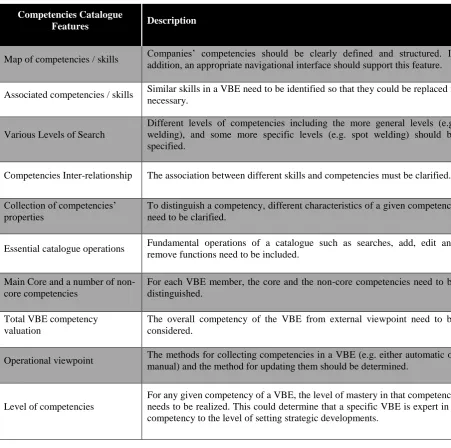
Table 2 - VBE Competencies' Catalogue Features (Source: Afsarmanesh & Camarinha-Matos, 2005).
Competencies Catalogue
Features Description
Map of competencies / skills Companies’ competencies should be clearly defined and structured. In addition, an appropriate navigational interface should support this feature.
Associated competencies / skills Similar skills in a VBE need to be identified so that they could be replaced if necessary.
Various Levels of Search
Different levels of competencies including the more general levels (e.g. welding), and some more specific levels (e.g. spot welding) should be specified.
Competencies Inter-relationship The association between different skills and competencies must be clarified.
Collection of competencies’ properties
To distinguish a competency, different characteristics of a given competency need to be clarified.
Essential catalogue operations Fundamental operations of a catalogue such as searches, add, edit and remove functions need to be included.
Main Core and a number of non-core competencies
For each VBE member, the core and the non-core competencies need to be distinguished.
Total VBE competency valuation
The overall competency of the VBE from external viewpoint need to be considered.
Operational viewpoint The methods for collecting competencies in a VBE (e.g. either automatic or manual) and the method for updating them should be determined.
Level of competencies
For any given competency of a VBE, the level of mastery in that competency needs to be realized. This could determine that a specific VBE is expert in a competency to the level of setting strategic developments.
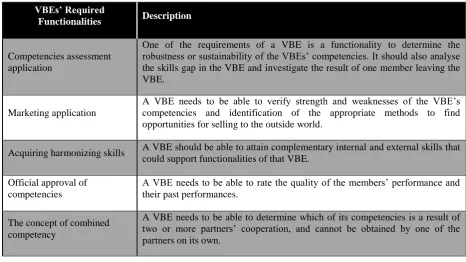
Table 3 - VBEs' Required Functionalities (Source: Afsarmanesh & Camarinha-Matos, 2005).
VBEs’ Required
Functionalities Description
Competencies assessment application
One of the requirements of a VBE is a functionality to determine the robustness or sustainability of the VBEs’ competencies. It should also analyse the skills gap in the VBE and investigate the result of one member leaving the VBE.
Marketing application
A VBE needs to be able to verify strength and weaknesses of the VBE’s competencies and identification of the appropriate methods to find opportunities for selling to the outside world.
Acquiring harmonizing skills A VBE should be able to attain complementary internal and external skills that could support functionalities of that VBE.
Official approval of competencies
A VBE needs to be able to rate the quality of the members’ performance and their past performances.
The concept of combined competency
A VBE needs to be able to determine which of its competencies is a result of two or more partners’ cooperation, and cannot be obtained by one of the partners on its own.
3.3.2 Value Systems:
Afsarmanesh & Camarinha-Matos (2005) argues that in any VBE framework for any products or services a “value creating system” needs to be created through formation of VOs. Value system of a
VBE needs to provide the following:
A directive method: a method to understand members’ behaviour, to create performance
indicators and to ensure social consistency
A communication method: a method to guarantee smooth effectiveness among exchanged
objects
From a managerial viewpoint, it is crucial to find out which values in the list of values should be included in a specific VBEs’ value system. Another related research challenge is the details of
performance indicators - for VBE as a whole, for VOs and for VBE members.
3.3.3 System of incentives:
incentives for participants are business profits and having access to knowledge. The following are a number of incentives for members of a business related VBE:
(i) A guarantee to be involved in certain number of VOs during a particular period.
(ii) Making use of a number of fundamental equipments, which are provided in the VBE pool
of assets
(iii) Participation in conferences, courses, and tutorials to improve companies’ productivity
(iv) An early assessment of the member and a promise to provide productive advice and
recommendations to enhance companies’ position in an agreed period
3.3.4 Trust management:
Afsarmanesh & Camarinha-Matos (2005) point out the importance of trust as one of the most important elements, which needs to be included in a VBE to create an effective and productive cooperation and transaction. Having a trustworthy environment in a VBE could assist information sharing and open communication, which could result in a faster contract process. A trustworthy environment could also reduce management, transaction and acquisition costs, and could certainly influence knowledge creation. Nevertheless, trust building is not a straightforward task. Trust is a result of past and present performance of an organisation in a VBE. Therefore, trust building usually
takes time and needs to be supported by the VBE (Afsarmanesh & Camarinha-Matos, 2005).
4 Management of Trust in VBEs
4.1 Importance of Competence Profiling for trust building
Armoutis et.al (2007) have also come up with a competence based framework for online collaboration in which companies or firms in a virtual cluster setting are listed according to their competencies. According to Armoutis et.al, (2007) competency is “the notion that captures the capabilities represented by the key tangible assets, embodied with the abilities of human beings and their key experience and knowledge. It can be interpreted as the company's ability to change and to adapt to different situations or market sectors that have the potential for better profitability.”
Accordingly, it is essential that companies’ competencies would be available to other firms and there would be a way to validate that information by an evaluation from an “expert” in the field to validate the information on competency. This information could then help companies to find the most suitable suppliers and customers for their products. This framework provides a good and logical starting point for virtual clusters. This is because the first thing that is needed is the presentation of information regarding the firms operations and processes that potential suppliers are looking to supply or potential customer is looking to buy from.
4.2 Trust building among Virtual Teams
conferencing seems to be a promising tool for people in geographically distant locations to communicate and collaborate if they wish to.
4.3 Trust in Long distance Business Relationships
Zheng et al (2002) and Moore et al (1999) measured trust by different prisoner dilemma games between participants and found out that trust is highest after a face-to-face meeting between the participants. Olson et al (2002) found that the richer the media of communication in virtual teams, the better the trust. Thus, video and audio conferencing was deduced to be better than online chat. They also saw an effect of “delayed trust” which was that after a few rounds participants who did not meet face-to-face, developed trust and their results in the prisoner’s dilemma game improved. This shows that people can develop trust to the level of a face to face interaction through being in trust, or not to trust decision situation few time with a particular person. Therefore, if no opportunistic behaviour takes place at either end, then the parties will start trusting each other in the next interaction. Thus, the first and most crucial step towards developing trust in a virtual cluster is to make sure that somehow the firms themselves initiate the initial interaction.
5.0 Research Methodology
A questionnaire consisting of seven questions was distributed to thirty firms to do a statistically significant quantitative analysis. Because of the limitations of this research, it was not possible to find firms inside a cluster all of which have worked in a long distance setting or have had international customers or suppliers. Therefore, some firms, which answered the questionnaires, were firms that were located inside cities, which have agglomeration advantages. According to Press (2006), GCs are all areas where firms have agglomerated and there are agglomeration externalities like the existence of low transport cost and other co location advantages.
industry. Thus, the results from these firms will be applicable when analyzing how to duplicate factors that are associated with the benefits accruing to firms in a GC.
5.1 Questionnaire Design
The complete questionnaire of this research can be found in appendix A. The first question in the questionnaire is about GCs and their benefits. The second question was set to see the potential reasons or advantages of working in a long distance setting. To further help in this analysis respondents were asked in question three as to which of the benefits of geographical clusters, are lacking in virtual clusters.
The fourth question was used to specifically verify the role of trust in business operation. The bias assumption is that trust as an important factor, this needed to be validated. From the fifth question onwards the inductive research starts. Question five looked at the benefits of trust to entrepreneurs working in an embedded setting, or close local proximity or belonging to the same culture.
The sixth question gauged the elements that help in developing trust among entrepreneurs working in a long distance setting. The last question examined propositions that the authors devised to check whether the entrepreneurs felt that the proposed online tools will help them develop trust in a long distance business setting or not.
5.2 Data Analysis
5.2.1 Question One
In the first question of the questionnaire, the participants were asked about the benefits of
working with local companies located in the same region or close proximity.
Among the alternatives in this question, “Trust and low transaction costs” and “Low transportation costs” were identified to be the most important benefits, which are very important to
firms located in an area with agglomeration advantages. Moreover, “Access to other firms who are producing complementary products” and “Easy Access to customers” were also found to be
specialized knowledge about new technologies” and “Collaboration opportunities” were found to be
neither an important, nor an unimportant benefit to firms located in an area with agglomeration advantages.
5.2.2 Question Two
In the second question, the participants were asked about the benefits of working with companies which are not located in the same region, may be collaborating online or dealing with a long distance supplier or customer. The participated companies in this survey agree that “Access to better technology of other firm or quality” and “Access to new market” are two most important
benefits, which can also lead to a long distance business relationship. Moreover, Firms are unresolved on whether “Lower Unit Cost” and “Customized product” are reasons/benefits for getting into a long
distance business relationship.
5.2.3 Question Three
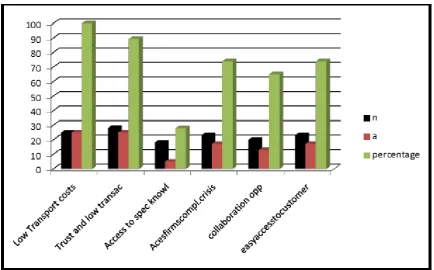
Figure 1 - Benefits lacking in cluster setting at a long distance
The black bar represents the number of respondents who rated the corresponding benefit neutral or positive. The red bar represents the number of people who thought that, that benefit was lacking, in their opinion, in long distance business dealing. The green bar represents the percentage of respondents (who answered question three) who think that the benefit is lacking or not present. As it can be seen from figure 1, “Low Transport costs” and “Trust and low transaction costs” are the two most important issues, as more than 85% of the respondents (green bar) of this question thought these are lacking in a long distance business relationship.
5.2.4 Questions Four & Five
time of crisis from other firms” or “getting contracts due to trust developed because of working over the years”, are as a result of trust in dealing with suppliers, customers or/and business partners in close
proximity.
5.2.5 Question Six
The sixth question asked participants’ opinion regarding the important factors in developing trust in
another party in a long distance setting (where all communication is via the phone or the internet). It was seen that “Actual meeting” is considered very important factor in developing trust among
potential business doers in a long distance setting. Moreover, “Information about processes and competencies of the other firm” and “Frequent easy and low cost communication” are two other relatively important factors in developing trust in a long distance setting. In addition, “Information about company’s financial position and history” is not an important nor an unimportant factor in
developing trust among potential business collaborators in a long distance setting. 5.2.6 Question Seven
Finally, in the seventh question, the participants were asked about online tools or factors that could help in developing trust and assist in getting into a long distance business relationship with a supplier, customer or business partner. It has identified that among the mentioned alternatives in this question, “Having pictures of people that you will be dealing with as business partner” will not have a
very significant impact on developing trust. In addition, participants tend to agree that other factors including “A Rating System to rate previous performance of prospect business partner”, “Having an
in-depth knowledge about the potential business partner,” and “finding the prospect business partner from a well-known or branded website” are beneficial tools or factors that could assist in getting into long distance business dealing. Moreover it was identified that “video conferencing” does not have a very significant effect on increasing trust but neither is it useless in developing trust.
6 Recommendations
recommendations could assist in increasing the level of trust among member-organisations of VCs. This is crucial to success.
6.1 Conferences and Meetings
Actual meetings are very important for forming trust among entrepreneurs. In an interview, Mr. Naseer, CEO of Infotechgroup, mentioned that “it is not only that you know your potential partner, but the knowledge that the other person has gone through some effort to take out the time to come and meet you” that builds trust. That this business deal is as important to him as it is to you and that helps you trust the person you are going to do business with. Therefore, to develop trust it is important that in a VC there are opportunities for the entrepreneurs and potential business partners to meet.
‘Actual meeting’ was a significantly factor when entrepreneurs were asked about trust forming when
doing business. Some entrepreneurs were asked why they thought an actual meeting was important in t developing trust. They said that it was important because they needed to “connect” with the person they were doing business with, they needed to feel “comfortable”, and after the meeting they felt more “confident” that the business deal or contract is going to go through as planned. These three words
were used often in discussions with entrepreneurs. Though the virtual cluster needs to be dynamic and preferably companies should be able to collaborate and do business with only computer mediated communication, the fact is that there will always be a need for entrepreneurs to meet, needs to be kept in mind.
6.2 Communication
Entrepreneurs felt that a video conferencing feature would neither help them trust other companies nor increase their likelihood of working with them. Four firms were asked afterwards through a phone call why they felt that this feature would not work. They answered that it would be hard to get representatives of CEOs from both firms on the phone at the same time especially if there is a time difference between the two regions of the firms. They felt uncomfortable with the technology and were not sure about how a video conference is supposed to proceed in terms of formalities and etiquette. This may be because they are located in Pakistan and video conferencing is not commonly used by SME owners. However, the suggestion is that ample communication avenues should be provided in the VC and communication should be made economical in terms of time and money so that entrepreneurs can easily reach and work with each other.
6.3 Annual Report
When two small companies want to enter into a business contract, an annual report or financial statement will help entrepreneurs to make better decisions about which companies to work with. This would increase the chances of companies working with each other and if this feature were available in a VC, it would encourage companies to trust and work with each other. However, members might not be willing to divulge their annual reports so easily, especially if they have not been performing well lately. Members should be convinced by the VC administration or informed that if they can present their annual reports it will increase their chances of getting business on the cluster. A potential problem is that start-up companies often do not have a track record or a published set of accounts. The authors experience with the WMCCM VC is that recommendation or approval by a reputable neutral third party (such as a University) can help to alleviate these issues.
6.4 Catalogue of products
catalogue of products but it may encourage a sample from a supplier, which could be the starting point of a profitable business relationship. The danger is that sometimes companies define themselves too much by their products instead of their capability and unduly restrict the markets they address. They often do not appreciate that their current products are just one application of their capabilities, there may be many others. An example was a WMCCM company that made metal stampings for tractors. Their business focus and website was focussed on tractors, not their stamping capability, and hence when the tractors business fell into difficulty they did not easily see other opportunities in retail, automotive or railway markets.
6.5 Interactive Video of the Factory or Operations
Videos have the quality to capture a lot more information and deliver a more trustworthy impression of reality than just pictures or verbal descriptions. In the questionnaire, entrepreneurs agreed to the notion that an interactive video of the factory and/or operations would be a helpful factor in developing trust. By having a video of the factory, or even live webcams customers can place orders based on better information about the factory. The customers could more easily assess the technological level of the firm. These techniques can bring them a lot of additional business and would be a strong contributory success factor for a virtual cluster. In the West Midlands in the UK, a firm put up web cam feeds of its machinery and factory through its website and as a result attracted many customers from outside the UK. The fact that customers could potentially see their order being
worked on increased trust substantially.
6.6 Rating system to develop trust
The rating system should also be fair in the sense that a company will get a rating only after it has fulfilled a minimum number of contracts. The number of successful contracts or dealings completed by a company should be on the profile page of the company. Their rating on the virtual cluster will provide a sense of pride to business owners, just like in a geographical cluster where “word of mouth” reputation is important. Social networks and blogs can, and increasingly are, taking over this “word of mouth” communication role and need to be incorporated into a VC.
6.7 Professional Virtual Communities (PVC); A Supporting Tool To VCs
The PVCs’ main role is to share knowledge and help find new business opportunities. PVCs are virtual representations of the local chamber of commerce or trade association. A question about their value was posted on a PVC, called the ‘West Midland ICT Cluster’ hosted on the LinkedIn networking site. An example response was:
“Absolutely!, Quite apart from the networking aspects that allowed us to engage with other
like minded ICT companies, the help and advice provided has been invaluable. I would
recommend this to any ICT business seeking to grow their business, but especially if they are
looking for partners or other revenue opportunities via networking. The very first meeting I
went to someone gave me a lead!”
This example shows that the PVC, like a normal community, has the potential of bringing people who have same business interests closer and thus to emulate a GC by bringing all the businesses related to one industry into one virtual space for interaction. However, this does not mean that PVCs can completely emulate the knowledge diffusion advantages of a GC. Few people are very responsive on PVCs, the majority do not actively contribute. In PVCs people are not as embedded as when they are participating in a GC or where they belong to the same area, culture, and social circle. Thus sharing of knowledge may decrease due to this lack of “embeddedness”, as argued by Wasko and Faraj (2005).
helpful in disseminating knowledge but to expect that it would be able to replicate the knowledge diffusion observed in a GC would be ambitious.
6.8 VC Administration
Thompson (2010) has discussed in his guide to collaborative networks that too much formality will not develop an atmosphere of trust. The first and foremost role of the VC administration is to make their VC into a brand name like Amazon.com or Ebay.com. In handling customer relationships in e-business, it is important to gain the trust of the customer (Davies, 2004).
The VC should spend on advertising and promoting itself via its current members and through publishing its own newsletter. These things will help to create a brand name of the VC. Members should pay a fee to use the cluster and these activities should be financed through that fee. If the VC administration can make itself into a popular, trusted brand identity, it would make entrepreneurs more comfortable in working with other companies on the VC. This could also drive companies to seek membership and to meet all the requirements of the VC. This would provide more funds for promotion, and a virtuous cycle established.
6.9 Competency
Presenting competency, that is, the processes and activities that they are good at it, is important in reaching new markets and developing new products. If a VC displays the competencies of all firms and a log of their business dealings then firms can locate each other and communicate to see if some cooperation could be developed. A suggestion for this, given by Thompson (2010), is that each of the firms in such a network would list their core competences on a board. Other business owners can then note and put their competence next to them with a comment on how they can produce added value through collaborating.
competence-based system for business opportunities. They suggest that a customer will demand certain core competencies to fulfil an order. The VC administration will try to find a match of core competencies from its membership for the order and help organise a response to the opportunity.
Overall a VC could be seen as having a three level of competency system.
1. A competency listings for each member,
[image:24.595.106.559.299.577.2]2. A presentation of the competency of the whole VC, and 3. The competency configured for a particular opportunity.
Figure 2 illustrates the competency map for the WMCCM cluster.
Figure 2: Competency Map for the WMCCM Virtual Cluster
6.10 Expected Return
trust and thus higher risk is accepted in exchange for a high expected return. Therefore, if a VC can have some firms that are capable of delivering highly desirable technology or products to countries or regions where they are not available, entrepreneurs would be willing to do business with members of the VC, without significant trust development requirements.
7 Conclusion
The result of the questionnaires show that among all of the benefits of working in an region with agglomeration advantages, or inside a GC, trust and low transportation costs are the most important advantages. These are not inherent in VCs and thus mechanisms need to be devised.
It has been identified that one of the main elements in improving the level of trust among companies exploring a long distance relationship is having face-to-face meetings. In this research various factors important for creating trust in a VC have been discussed However, having an actual face to face meeting was still the main essential element. They can boost the level of confidence in business owners to begin and continue a relationship with potential business partners.
Another important conclusion is that business owners prefer to find their geographically distant business partners from well-known third party websites. Therefore, VC administrators need to
build a brand identity for it to operate as a trusted third party.
Finally, it is necessary to remember that the expected return from a business transaction has a high influence on the level of risk-taking by business partners. Therefore, organisations are more likely to accept a higher level of risk if they realise that by joining a VC they could have access to
competencies, which they need but are not available in their region.