Natural sensitivity or tolerance of plants to ac-cumulate metals is substantially affected by plant species and genotypes. In this context, plants can be divided into three groups. (i) Excluders – plants insensitive for uptake and accumulation of potentially toxic elements. Mainly monocoty-ledon grasses belong into this group (sudangrass, fescue) (ii) Indicators – majority of agricultural plants whose content of elements more or less linearly responds to increasing available content of trace elements in soil (wheat, oat, maize). (iii) Accumulators – plants accumulating higher con-tents of elements in their tissues according to their increase in the soil. Accumulators include many species of Brassicaceae (mustard) and Compositae (lettuce, spinach) families. Hyperaccumulators are plants commonly grown on metalliferous soils and able to complete their life cycle without any
symptoms of metal phytotoxicity (Baker et al. 2000). These plants can even prosper on contaminated soils and accumulate extremely high contents of trace elements in aboveground biomass (Baker 1987).
Phytoremediation, the use of plants to remedy contaminated soils, is an emerging technology re-quiring a greater understanding of the underlying mechanisms for its optimization (McGrath and Zhao 2003). Number of plant species was already tested because of their ability to accumulate po-tentially toxic elements to high extent in the above ground biomass. Recently, two strategies have been tested within the phytoremediation technologies. The application of hyperaccumulating plants (such as Thlaspi caerulescens or Alyssum bertolonii) producing a relatively low amount of aboveground biomass but accumulating high amounts of one
Removal of As, Cd, Pb, and Zn from contaminated soil
by high biomass producing plants
P. Tlustoš
1, J. Száková
1, J. Hrubý
2, I. Hartman
2, J. Najmanová
1, J. Nedělník
2,
D. Pavlíková
1, M. Batysta
11
Czech University of Agriculture in Prague, Czech Republic
2
Research Institute for Fodder Crops, LtD., Troubsko, Czech Republic
ABSTRACT
The uptake of As, Cd, Pb, and Zn and potential phytoremediation efficiency of five high biomass producing crops, white sweetclover (Melilotus alba L.), red clover (Trifolium pratense L.), curled mallow (Malva verticillata L.), saf-flower (Carthamus tinctorius L.) and hemp (Cannabis sativa L.) commonly used as grazing and/or energy crops was evaluated in both pot and field experiments at soils with different level of element contamination. In pot expe-riment the highest phytoremediation efficiency was demonstrated byC. tinctorius where 4.8% of Cd and 1.1% of Zn were removed from the moderately contaminated soil in one vegetation period when repeated harvest of aboveground biomass was performed. The removal of As and Pb was negligible for all the investigated plant species. At the highest element content in soil inhibition of plant growth due to the element phytotoxicity to plants was reported in most of cases. In the precise field experiment lower phytoremediation efficiency (biennial phytoremediation factors did not exceed 0.2% for Pb and Zn and 0.3% for Cd for C. tinctorius) was determined but yield suppress was not observed. Thus, free space for manipulation with element mobility in soil to increase element uptake by plants remains for further research.
Keywords: high biomass producing crops; arsenic; cadmium; lead; zinc; uptake; contaminated soil
or more elements in this biomass represents the first approach. The alternative approach comprises an application of high biomass producing plants characterized by lower ability to accumulate risk elements where total uptake of elements is com-parable to hyperaccumulating plants due to high yield of aboveground biomass. In this context, zinc accumulating Brassica spp. seems to be more effec-tive for removing this element from the polluted soil compared to zinc hyperaccumulator Thlaspi caerulescens producing one order lower amount of shoot biomass (Ebbs et al. 1997). The plant species tolerant to high element contents in soil followed by an intensive uptake of these elements belong in most cases into families Caryophyllaceae, Brassicaceae, Cyperaceae, Poaceae, Fabaceae, and Chenopodiaceae (Kabata-Pendias and Pendias 2001). Also EPA recommendations (EPA 2000) include metal accumulator plants such as maize (Zea mays), sorghum (Sorghum bicolor), and lu-cerne (Medicago sativa) among plants able to re-move a greater mass of metals but more research is necessary to verify it.
The present results suggest that fast-growing trees and especially willows have a very promis-ing potential for phytoremediation use because of their large biomass and good ability to accumu-late risk elements, especially cadmium and zinc (Pulford and Watson 2002). Among herbaceous species, tobacco (Nicotiana tabacum L.) accumu-lating predominantly Cd and Cu, and maize (Zea mays L.) are discussed as effective plants because of high production of aboveground biomass with a relatively high content of elements. Comparing to N. tabacum, Z. mays is able to remove more Zn (Wenger et al. 2002). For phytoextraction purpose, however, the effectiveness of maize still seems to be insufficient (Keller et al. 2003, Schmidt 2003). Cadmium and lead are retained predominantly in roots of maize demonstrating limited mobil-ity of elements within plant (Bricker et al. 2001). Relatively high contents of Pb in aboveground biomass showed Indian mustard [Brassica jun-cea (L.) Czern.], rye grass (Lolium perene L.), sunflower (Helianthus anuus L.) or smallwing sedge (Carex microptera Mack.) (Klassen et al. 2000). Moreover, sunflower demonstrated a good ability for phytoextraction of copper. Relatively high contents of As and Zn were determined in biomass of amaranth (Amaranthus hybridus L.) accumulating the elements in order leaves > stems > roots; this plant however seems to be insufficient and questionable for practical use for phytoreme-diation as well (Jonnalagadda and Nenzou 1997).
The phytoremediation efficiency of some plant species, such as Brassica juncea for removal of Pb, Thlaspi caerulescens for Cd and Zn, Amaranthus retroflexus for Cs, and Helianthus annus for Cs and Sr, was also tested in field conditions (Saxena et al. 1999).
In our investigation, the uptake of As, Cd, Pb, and Zn by five high biomass producing crops (coming from the families Asteraceae, Fabaceae, Malvaceae, and Cannabaceae) commonly used as grazing and/or energy crops was determined and evaluated in both pot and field experiments at soils with different level of element contamination to assess the potential suitability of these plants for phytoremediation purpose.
MATERIAL AND METHODS
Pot experiments
Plants were cultivated in 6-litre plastic pots with 5 kg of air-dried soil and there were made three replicates for each treatment in the case of preliminary experiment and experiment II and six replicates in the case of experiment I. Soil moisture was regularly controlled and kept at 60% of MWHC. The aboveground biomass of plants was harvested in the end of vegetation period in the case of preliminary pot experiment and experiment II, while C. tinctorius was harvested twice and T. pratense even three times during the vegetation period of pot experiment I and II, where total element uptake was calculated for an evaluation of the experiments. After harvest, the aboveground biomass was gently washed with deionised water, checked for fresh and dry biomass, ground and analyzed.
Field experiment
The phytoremediation efficiency of hemp (Cannabis sativa L. – var. Juso 11), curled mallow (M. verticillata), white sweetclover (M. alba), and safflower (C. tinctorius) were investigated in precise field experiment (plot size 5 m2) during two
vegeta-tion periods. The element contents in the soil were modified by addition of aqueous solutions of follow-ing salts: Cd(NO3)2.4 H2O, Pb(CH3COO)2.2 H2O, Zn(NO3)2.6 H2O, and Zn(CHCOO)2.2 H2O before sowing in amounts leading to three levels of ele-ment contents in soils:
Level 1 – control without addition of elements re-sulting in total contents 1.6 mg/kg Cd, 60 mg/kg Pb, and 95 mg/kg Zn.
Level 2 –final element content in soil resulting in total contents 10 mg/kg Cd, 1000 mg/kg Pb, and 400 mg/kg Zn.
Level 3 – final element content in soil resulting in total contents 40 mg/kg Cd, 4000 mg/kg Pb, and 1000 mg/kg Zn.
Four samples of aboveground biomass represent-ing plant material from 0.25 m2 were collected
from each plot, gently washed by deionised water, checked for fresh and dry biomass, ground and analyzed.
Analytical procedures
The plant samples were decomposed by a dry ashing procedure as follows: An aliquot (~1 g) of the dried and powdered plant biomass was weighed to 1 mg into a borosilicate glass test-tube and de-composed in a mixture of oxidizing gases (O2 + O3 + NOx) at 400°C for 10 hours in Dry Mode Mineralizer Apion (Tessek, Czech Republic). The ash was dissolved in 20 ml of 1.5% HNO3 (electronic grade purity, Analytika Ltd., Czech Republic) and kept in glass tubes until the analysis (Miholová et al. 1993). Soil samples were taken before the start of the experiment from the bulk, air dried at 20°C, ground in a mortar and passed through a 2-mm plastic sieve. Total element concentrations in soil were determined in digests obtained by two-step decomposition as follows: 0.5 of sample was de-composed by dry ashing in a mixture of oxidiz-ing gases (O2 + O3 + NOx) in Apion Dry Mode Mineralizer (Tessek, CZ) at 400°C for 10 h; the ash was then decomposed in a mixture of HNO3 + HF, evaporated to dryness at 160°C and dissolved in diluted aqua regia (Száková et al. 1999).
[image:3.595.65.532.91.177.2]Element concentrations in the digests were deter-mined by atomic absorption spectrometry (AAS, VARIAN SpectrAA-400, Varian, Australia) in flame (Cd, Pb, Zn), and flameless (Pb) measure-ment modes, and by inductively coupled plasma optical emission spectrometry (ICP-OES, VARIAN VistaPro, Varian, Australia). Arsenic was deter-mined by a continuous hydride generation tech-nique using a Varian SpectrAA-300 (Australia) atomic absorption spectrometer equipped by
Table 1. Basic characteristics and nutrient status of experimental soils, and total element contents in experi-mental soils used in pot experiments
Soil Soil type pH Corg
(%)
Ca* K* Mg* P* As Cd Pb Zn
mg/kg
A Chernozem 6.8 1.8 5717 219 202 132 18.0 0.416 29.3 87.1
B Cambisol 6.1 2.1 2242 67.9 42.1 36.8 37.5 4.73 1158 180
C Chernozem 6.8 1.8 5717 219 202 132 118 40.4 2029 87.1
hydride generator VGA-76. A mixture of potas-sium iodide and ascorbic acid was used for pre – reduction of the sample and the extract was acidified by HCl before measurement. Certified reference materials RM NCS DC 73350 Poplar leaves and RM 7001 Light Sandy Soil were applied for quality assurance of analytical data. Statgraphics Plus 5.0 for Windows (Manugistics 1997) was used to perform statistical evaluation of the data where analysis of variance was applied for the evaluation of the data.
RESULTS AND DISCUSSION
The yield of dry aboveground biomass of ex-perimental plants in preliminary pot experi-ment showed the effect of soil properties as well as of the contamination level. At soil A the yield varied between 17.3 g (M. verticillata)and 32.6 g (M. alba), at soil B between 22.7 g (M. verticil-lata) and 118 g (M. alba), and at soil C between 9.7 g (M. verticillata) and 52.4 g (M. alba). Except M. alba the results showed comparable biomass yield at uncontaminated soil A and moderately contaminated soil B, and a significant suppress of biomass yield at contaminated soil C. Comparing the yields of plant biomass in the pot experiment II (see below) the yields of M. alba at the soils B and C were surprisingly high in the preliminary pot experiment where the suppress of plant yield
[image:4.595.64.533.107.330.2]was observed at soil C compared to soil B, as well. Within the preliminary pot experiment, the results concerning M. alba cannot be compared among individual soils. The element contents in plant bio-mass (Table 2) showed the lowest values of As, Pb, and Zn in M. alba, and Cd in T. pratense at uncon-taminated soil A. Also Gray et al. (1999) confirmed a relatively low capability of T. repens compared to other crops such as carrot (Daucus carota), lettuce (Lactuca sativa), or lucerne (Medicago sativa) to accumulate elements. At soils B and C the lowest ability of T. pratense to accumulate cadmium, and of M. alba to accumulate arsenic and zinc was confirmed but in the case of lead the response of individual plant species was different in different soils. Expectably, the element contents in plants differed according to the contamination level in the soil but the differences between the moderately contaminated soil B and extremely contaminated soil C were not significant; the val-ues were even lower at soil C in some cases such as As, Pb, and Zn in M. alba. Among the plant species, only cadmium contents showed higher differences representing more than one order of magnitude at one soil. The total element uptake by plants reflecting differences in plant yield (Table 3) confirmed the importance of high production of aboveground biomass for an effective removal of elements from the soil. The highest element uptake was observed at the moderately contami-nated soil B where the high contents of element
Table 2. Element contents in aboveground biomass of the individual plant species according to the level of total element contents in soils – preliminary pot experiment; n = 3, the data marked by the same letter did not sig-nificantly differ at α = 0.05 within individual columns of data and individual soil
Soil Species As Cd Pb Zn
mg/kg
A
Carthamus tinctorius 0.599 ± 0.058c 0.551 ± 0.068c 0.492 ± 0.049a, b 29.8 ± 3.1b Melilotus alba 0.057 ± 0.007a 0.152 ± 0.036a, b 0.257 ± 0.072a 11.9 ± 1.4a Malva verticillata 0.192 ± 0.028b 0.368 ± 0.179b, c 0.883 ± 0.190b 38.9 ± 5.7c Trifolium pratense 0.166 ± 0.022b 0.084 ± 0.026a 0.870 ± 0.290b 33.9 ± 4.3b, c
B
Carthamus tinctorius 1.30 ± 0.05c 13.9 ± 2.7c 12.2 ± 3.6a 65.2 ± 2.4c Melilotus alba 0.529 ± 0.015a 3.62 ± 0.54a, b 23.4 ± 0.3b 26.4 ± 0.7a Malva verticillata 0.920 ± 0.099b 5.07 ± 0.88b 13.2 ± 1.1a 43.8 ± 4.9b Trifolium pratense 0.774 ± 0.194a, b 0.766 ± 0.056a 9.62 ± 1.02a 38.7 ± 9.7a, b
C
were combined with high yield of plant biomass, unaffected by elevated total content of elements in soil. Remediation factors given as percentage of element content removed by plants from defined amount of soil did not exceed 0.1% in the case of arsenic and lead and 0.5% in the case of zinc. Therefore, phytoremediation efficiency of investi-gated plants was negligible. Slightly higher removal was observed in the case of cadmium where the highest remediation factor (1.9%) was calculated for C. tinctorius at soil B. Evidently, the plants tested in our experiment confirmed a response of element contents in plant biomass on increas-ing element content in soil without symptoms of element phytotoxicity in the case of moderately contaminated soil. Differences in behaviour of individual plant species are also evident. However, the phytoremediation efficiency of these plants was not sufficient for practical use of these plants in phytoremediation technologies.
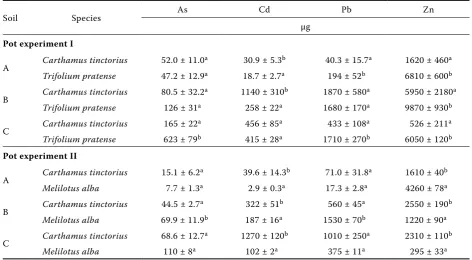
In the pot experiment I, the possible increase of element removal by aboveground biomass of C. tinctorius and T. pratense from the experi-mental soils by repeated harvest of plant biomass during one vegetation period was investigated; C. tinctorius was harvested twice and T. pratense three times. While total yield of dry biomass of T. pratense was very similar regardless of soil type and/or soil contamination level and varied between 60.1 g and 63.4 g, suggesting thus a rela-tive resistance of T. pratense to high contents of
[image:5.595.64.533.104.330.2]elements in soil, the yield of C. tinctorius was 29.4 g, 44.4 g, and 11.3 g at soils A, B, and C, re-spectively, confirming the negative effect of high level of soil contamination. Weighed means of element contents in plant biomass are summarized in Table 4. Cadmium contents were higher in C. tinctorius; on the contrary, lead contents were higher in T. pratense in all three experimental soils. Concerning arsenic and zinc, different pattern was observed according to individual soil types. At soil B no differences were observed between element contents in both experimental plants while at soils A and C lower As and higher Zn contents were determined in T. pratense. The total element uptake by experimental plants (Table 5) was af-fected by lower yield of C. tinctorius, especially at the soil C. Figure 1 presents percentage of elements removed from soil by individual harvests of plant biomass. These results suggested that T. pratense is able to accumulate elements more intensively at the beginning of the vegetation period and earlier harvest of the biomass is reasonable. In the case of C. tinctorius the elements were distributed almost equally between both harvests of biomass. The remediation factors of As and Pb did not exceed 0.2% and confirmed the poor ability of tested plants to take up these elements. In the case of zinc the remediation factors varied between 0.12 (soil C) and 0.66% (soil B) and between 1.1 (soil B) and 1.6% (soil A) for C. tinctorius and T. pratense, respec-tively, demonstrating the importance of biomass
Table 3. Total element uptake by aboveground biomass of the individual plant species from the pot according to the level of total element contents in soils – preliminary pot experiment; n = 3, the data marked by the same letter did not significantly differ at α = 0.05 within individual columns of data and individual soil
Soil Species As Cd Pb Zn
µg
A
Carthamus tinctorius 14.4 ± 2c 13.1 ± 0.6c 12.0 ± 2.6a 719 ± 99b
Melilotus alba 1.8 ± 0.1a 5.0 ± 1.6b 8.1 ± 1.7a 371 ± 16a
Malva verticillata 3.2 ± 0.6a, b 5.5 ± 0.7b 14.5 ± 2.9a 604 ± 102b Trifolium pratense 5.4 ± 0.4b 2.7 ± 0.7a 27.7 ± 7.3b 1100 ± 70c
B
Carthamus tinctorius 42.7 ± 2.1b 460 ± 105b 403 ± 135a 2200 ± 30b
Melilotus alba 62.6 ± 2.2c 428 ± 66b 2760 ± 50b 3200 ± 70c
Malva verticillata 20.9 ± 2.9a 116 ± 27a 299 ± 39a 924 ± 64a Trifolium pratense 23.9 ± 6.9a 23.3 ± 0.6a 296 ± 45a 1370 ± 390a
C
Carthamus tinctorius 9.1 ± 1.8a 222 ± 52c 155 ± 64a, b 434 ± 97a, b
Melilotus alba 15.2 ± 1.7b 245 ± 34c 543 ± 60c 712 ± 21c
yield for final efficiency of phytoremediation pro-cedure. The ability of C. tinctorius to accumulate cadmium in aboveground biomass resulted in the
[image:6.595.64.534.104.364.2]highest phytoremediation factors 1.5% at soil A and 4.8% at soil B while phytoremediation factors of T. pratense were 0.9 and 1.1% at soils A and B,
Table 4. Element contents in aboveground biomass of the individual plant species according to the level of total element contents in soils – pot experiments I and II; n = 6 (experiment I), n = 3 (experiment II), the data marked by the same letter did not significantly differ at α = 0.05 within individual columns of data and individual soil
Soil Species As Cd Pb Zn
mg/kg Pot experiment I
A Carthamus tinctorius 1.79 ± 0.45b 1.06 ± 0.21b 1.38 ± 0.58a 58.3 ± 23.9a Trifolium pratense 0.755 ± 0.224a 0.293 ± 0.037a 3.09 ± 0.95b 108 ± 5b
B Carthamus tinctorius 1.77 ± 0.63a 25.4 ± 5.9b 42.1 ± 11.5b 158 ± 6a Trifolium pratense 1.96 ± 0.42a 4.15 ± 0.51a 26.9 ± 2.5a 157 ± 10a
C Carthamus tinctorius 17.7 ± 4.4a 42.5 ± 5.5b 44.4 ± 12.8a 44.7 ± 4.2a Trifolium pratense 10.4 ± 1.7a 6.94 ± 0.34a 28.2 ± 3.5a 101 ± 6.0b Pot experiment II
A Carthamus tinctorius 0.458 ± 0.122a 1.33 ± 0.69b 2.96 ± 1.67a 51.3 ± 7.8b Melilotus alba 0.321 ± 0.079a 0.226 ± 0.019a 1.52 ± 0.16a 17.2 ± 0.8a
B Carthamus tinctorius 1.05 ± 0.11a 7.54 ± 1.06a 15.2 ± 2.7a 59.8 ± 3.8a Melilotus alba 3.82 ± 0.42b 10.4 ± 1.7a 77.3 ± 10.9b 67.5 ± 8.9a
C Carthamus tinctorius 3.57 ± 0.24a 67.5 ± 10.6b 48.1 ± 3.8b 125 ± 26b Melilotus alba 6.50 ± 0.69a 6.06 ± 0.04a 22.6 ± 0.4a 17.6 ± 2.5a
Table 5. Total element uptake by aboveground biomass of the individual plant species from the pot according to the level of total element contents in soils – pot experiments I and II; n = 6 (experiment I), n = 3 (experiment II), the data marked by the same letter did not significantly differ at α = 0.05 within individual columns of data and individual soil
Soil Species As Cd Pb Zn
µg Pot experiment I
A Carthamus tinctorius 52.0 ± 11.0a 30.9 ± 5.3b 40.3 ± 15.7a 1620 ± 460a Trifolium pratense 47.2 ± 12.9a 18.7 ± 2.7a 194 ± 52b 6810 ± 600b
B Carthamus tinctorius 80.5 ± 32.2a 1140 ± 310b 1870 ± 580a 5950 ± 2180a Trifolium pratense 126 ± 31a 258 ± 22a 1680 ± 170a 9870 ± 930b
C Carthamus tinctorius 165 ± 22a 456 ± 85a 433 ± 108a 526 ± 211a
Trifolium pratense 623 ± 79b 415 ± 28a 1710 ± 270b 6050 ± 120b Pot experiment II
A Carthamus tinctorius 15.1 ± 6.2a 39.6 ± 14.3b 71.0 ± 31.8a 1610 ± 40b Melilotus alba 7.7 ± 1.3a 2.9 ± 0.3a 17.3 ± 2.8a 4260 ± 78a
B Carthamus tinctorius 44.5 ± 2.7a 322 ± 51b 560 ± 45a 2550 ± 190b Melilotus alba 69.9 ± 11.9b 187 ± 16a 1530 ± 70b 1220 ± 90a
C Carthamus tinctorius 68.6 ± 12.7a 1270 ± 120b 1010 ± 250a 2310 ± 110b
[image:6.595.61.534.504.764.2]respectively. At soil C where biomass yield was suppressed by the high element content in soil the phytoremediation factors were 0.2% for both plants. Evidently, the application of plants able to offer more than one harvest during vegetation period together with their ability to accumulate high element contents in aboveground biomass can lead to an increase of phytoremediation efficiency. In our case, however, the effectiveness of element removal from contaminated soil occurred only in the case of cadmium.
The subsequent effect on phytoremediation efficiency of high biomass producing plants was evaluated in pot experiment II. In this case, C. tinctorius followed T. pratense and M. alba followed C. tinctorius in the pots from the pot ex-periment I. The element contents in plant biomass are summarized in Table 4 and total element uptake by plant biomass in Table 5. Although some of the results differed from the experiment I, the data did not show an unambiguous trend to different
pattern compared to the previous experiments. Higher ability of C. tinctorius to accumulate the investigated elements compared to M. alba was also confirmed as in the preliminary pot experi-ment in most of cases. The remediation factors of M. alba did not exceed 0.2% of zinc and in the case of cadmium varied between 0.1% (soil C) and 0.7% (soil B). C. tinctorius removed from 0.3 to 0.5% of zinc and from 0.6 to 1.9% of cadmium from ex-perimental pots. The results suggested a low effect of plantation of high biomass producing crops on subsequent vegetation period of these plants where neither element contents nor phytoremediation efficiency were substantially changed.
The phytoremediation efficiency of investigated plants can be compared with the efficiency of willows cultivated in the same soils. Willows are generally characterized by high production of aboveground biomass and an intensive uptake of cadmium and zinc (Pulford and Watson 2002, Klang-Westin and Eriksson 2003). In our inves-0% 25% 50% 75% 100% So il A So il B So il C So il A So il B So il C So il A So il B So il C So il A So il B So il C
As Cd Pb Zn
1st harvest 2nd harvest 3rd harvest
0% 25% 50% 75% 100% So il A So il B So il C So il A So il B So il C So il A So il B So il C So il A So il B So il C
As Cd Pb Zn
[image:7.595.142.438.62.418.2]1st harvest 2nd harvest
Figure 1. The distribution of uptake of investigated elements among individual harvests of aboveground biomass of T. pratense (a) and C. tinctorius (b) during one vegetation period – pot experiment I
a
tigation, the cadmium concentrations in leaves and twigs of willows after two vegetation periods as dependent on willow clone varied between 9.6 and 113 mg/kg in leaves, and 11.4 and 50.2 mg/kg in twigs and the zinc contents between 117 mg/kg and 222 mg/kg in leaves and 99 mg/kg and 222 mg/kg in twigs at soil B. Comparing the remediation factors, a reasonable phytoextraction potential of willows was obtained for cadmium and zinc at this soil after three vegetation periods where aboveground biomass released about 30% and 5% of total element content, respectively. Among the investigated clones, S-150 S. × smithiana and S-391 S. × rubens demonstrated the highest phy-toextraction effect for Cd and Zn (Vysloužilová et al. 2003, Száková et al. 2004). Hyperaccumulators Arabidopsis halleri and Thlaspi caerulescens were able to accumulate 82.3 and 271 mg/kg Cd and 2746 and 1500 mg/kg Zn, respectively in the pot experiment at soil B representing annual reme-diation factor 4.8 and 7.6% for Cd and 2.9 and 1.0% for Zn, respectively (Fischerová et al. 2006). Evidently, the high biomass producing crops were able to reach remediation factors of Cd and Zn comparable to hyperaccumulating plants at mod-erately contaminated soil where plant growth is not inhibited by high content of elements in soil and the biomass is harvested repeatedly during the vegetation period. Fast growing trees such as willows however demonstrated the highest phytore-mediation efficiency for Cd and Zn because of very
high biomass production and/or high accumulation of these elements in harvestable parts.
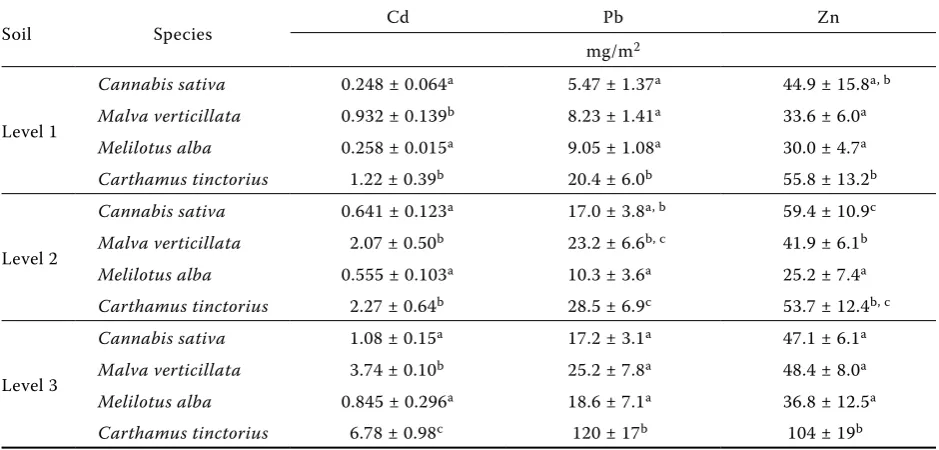
[image:8.595.64.533.107.330.2]For a practical application of plants in phytore-mediation technologies the verification of the results in field experiment is necessary. In our experiment the experimental plants demonstrated a different pattern in field conditions compared to the pot trials. The plant yield was not affected by contamination level (Table 6) of the topsoil and the differences in biomass yield among the experimental plants were lower compared to the pot experiments. Evidently, the limited volume of pots and a well developed contact of all roots with the whole amount of the soil support the more significant manifestation of experimental factors. Regardless of the investigated element, the element contents in C. sativa and M. alba were lower compared to C. tinctorius and M. ver-ticillata, where a higher level of lead was deter-mined in C. tinctorius and of cadmium and zinc in M. verticillata (Table 6). Except for zinc the addition of contaminating elements to the soil led to the increase of element contents in plants. However, the differences in element contents in plant biomass at contamination levels 2 and 3 did not correspond to the interval between these levels, suggesting high immobilization rate of element salt solutions added to the soil. Because the dif-ferences in biomass yield were relatively low, the total element uptake by harvested plants reflected the ability of individual plant species to accumulate
Table 6. The average yield of aboveground biomass and element contents in individual plant species according to the level of total element contents in soils – biennial field experiment; n = 4, the data marked by the same letter did not significantly differ at α = 0.05 within individual columns of data and individual element levels in soil
Soil Species (kg/mYield 2)
Cd Pb Zn
mg/kg
Level 1
Cannabis sativa 2.22 ± 0.61b 0.113 ± 0.019a 2.55 ± 0.75a 20.0 ± 2.9b Malva verticillata 1.41 ± 0.10a 0.667 ± 0.134c 5.85 ± 1.07b 23.8 ± 3.5b Melilotus alba 2.02 ± 0.29a, b 0.129 ± 0.016a 4.50 ± 0.45a, b 14.8 ± 0.2a Carthamus tinctorius 2.51 ± 0.52b 0.481 ± 0.088b 8.15 ± 2.18c 22.2 ± 2.9b
Level 2
Cannabis sativa 2.52 ± 0.39c 0.254 ± 0.019a 6.71 ± 0.86a 23.5 ± 0.8b Malva verticillata 1.15 ± 0.04a 1.79 ± 0.37c 20.1 ± 5.0c 36.3 ± 4.1c Melilotus alba 1.46 ± 0.34a 0.388 ± 0.047a 7.12 ± 1.67a 17.3 ± 2.4a Carthamus tinctorius 1.93 ± 0.30b 1.17 ± 0.23b 14.6 ± 1.5b 27.6 ± 2.8b
Level 3
Table 7. Total uptake of elements by aboveground biomass of individual plant species according to the level of total element contents in soils – biennial field experiment; n = 4, the data marked by the same letter did not significantly differ at α = 0.05 within individual columns of data and individual element levels in soil
Soil Species Cd Pb Zn
mg/m2
Level 1
Cannabis sativa 0.248 ± 0.064a 5.47 ± 1.37a 44.9 ± 15.8a, b Malva verticillata 0.932 ± 0.139b 8.23 ± 1.41a 33.6 ± 6.0a
Melilotus alba 0.258 ± 0.015a 9.05 ± 1.08a 30.0 ± 4.7a
Carthamus tinctorius 1.22 ± 0.39b 20.4 ± 6.0b 55.8 ± 13.2b
Level 2
Cannabis sativa 0.641 ± 0.123a 17.0 ± 3.8a, b 59.4 ± 10.9c Malva verticillata 2.07 ± 0.50b 23.2 ± 6.6b, c 41.9 ± 6.1b
Melilotus alba 0.555 ± 0.103a 10.3 ± 3.6a 25.2 ± 7.4a
Carthamus tinctorius 2.27 ± 0.64b 28.5 ± 6.9c 53.7 ± 12.4b, c
Level 3
Cannabis sativa 1.08 ± 0.15a 17.2 ± 3.1a 47.1 ± 6.1a
Malva verticillata 3.74 ± 0.10b 25.2 ± 7.8a 48.4 ± 8.0a
Melilotus alba 0.845 ± 0.296a 18.6 ± 7.1a 36.8 ± 12.5a
Carthamus tinctorius 6.78 ± 0.98c 120 ± 17b 104 ± 19b
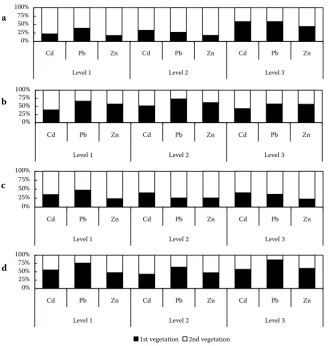
the investigated elements (Table 7). In most of cases, the total element uptake by plants decreased in order: C. tinctorius > M. verticillata > C. sativa = M. alba. Distribution of element uptake by plants between individual vegetation periods (Figure 2) suggested a slightly higher element uptake in the first vegetation period at the soil contamination level 3 but the element mobility was not assessed by determination of mobile portions of elements. Most probably, the mobile forms of elements added to the soil were sorbed and/or bound to individual soil compartments. The differences in element uptake by C. sativa and M. alba in individual vegetation periods were caused by substantially higher yield of biomass in the second season. Phytoremediation factors calculated as an element removal from 1 m2
of soil to the depth 30 cm did not exceed 0.2% for Pb and Zn and 0.3% for Cd. Evidently, the phytoex-traction efficiency differs under field and labora-tory conditions by unlimited volume of soil. Also Wieshammer et al. (2005) investigated cadmium uptake by S. fragilis and S. caprea in pot experi-ment and found that the values of Cd contents in leaves from pot experiment were higher compared to hydroponic study demonstrating the importance of experimental conditions for an evaluation of ele-ment accumulation capacity of plants for possible phytoremediation use. The phytoremediation ef-ficiency in field conditions is likely to be lesser than when determined in laboratory conditions (Nanda Kumar et al. 1995) as confirm our results.
REFERENCES
Baker A.J.M. (1987): Metal tolerance. New Phytol.,
160: 93–111.
Baker A.J.M., McGrath S.P., Reeves R.D., Smith J.A.C. (2000): Metal Hyperaccumulator Plants: A Review of the Ecology and Physiology of a Biological Resource for Phytoremediation of Metal-Polluted Soils. In: Terry N., Bañuelos G. (eds.): Phytoremediation of Contaminated Soil and Water. Lewis Publ. CRC, Boca Raton: 85–107.
Bricker T.J., Pichtel J., Brown H.J., Simmons M. (2001): Phytoextraction of Pb and Cd from a superfund soil: Effects of amendments and croppings. J. Environ. Sci. Health, 36: 1597–1610.
Ebbs S.D., Lasat M.M., Brady D.J., Cornish J., Gordon R., Kochian L.V. (1997): Phytoextraction of cadmium and zinc from a contaminated soil. J. Environ. Qual., 26: 1424–1430.
EPA (2000): Introduction to phytoremediation. EPA/ 600/R-99/107. U.S. Environmental Protection Agency, Cincinatti, Ohio.
Fischerová Z., Tlustoš P., Száková J., Šichorová K. (2006): A comparison of phytoremediation capabil-ity of selected plant species for given heavy metals. Environ. Pollut. (Accepted)
Gray C.W., McLaren R.G., Roberts A.H.C., Condron L.M. (1999): Cadmium phytoavailability in some New Zealand soils. Aust. J. Soil Res., 37: 461–477. Jonnalagadda S.B., Nenzou G. (1997): Studies on arsenic
rich mine dumps. II. The heavy element uptake by vegetation. J. Environ. Sci. Health., A32: 455–464. Kabata-Pendias A., Pendias H. (2001): Trace Elements in
Soils and Plants. 3rd ed. CRC Press, Boca Raton, USA.
Keller C., Hammer D., Kayser A., Richner W., Brod-beck M., Sennhauser M. (2003): Root development and heavy metal phytoextraction efficiency: Com-parison of different plant species in the field. Plant Soil, 249: 67–81.
Klang-Westin E., Eriksson J. (2003): Potential of Salix
as phytoextractor for Cd on moderately contaminated soils. Plant Soil, 249: 127–137.
Klassen S.P., McLean J.E., Grossl P.R., Sims R.C. (2000): Fate and behaviour of lead in soils planted with
metal-0% 25% 50% 75% 100%
Cd Pb Zn Cd Pb Zn Cd Pb Zn
Level 1 Level 2 Level 3
0% 25% 50% 75% 100%
Cd Pb Zn Cd Pb Zn Cd Pb Zn
Level 1 Level 2 Level 3
0% 25% 50% 75% 100%
Cd Pb Zn Cd Pb Zn Cd Pb Zn
Level 1 Level 2 Level 3
0% 25% 50% 75% 100%
Cd Pb Zn Cd Pb Zn Cd Pb Zn
Level 1 Level 2 Level 3
[image:10.595.122.451.60.407.2]1st vegetation 2nd vegetation
Figure 2. The distribution of uptake of investigated elements among individual harvests of aboveground biomass of C. sativa (a), M. verticillata (b), M. alba (c), and C. tinctorius (d) during two subsequent vegetation periods – field experiment
a
b
c
resistant species (River Birch and Smallwing Sedge). J. Environ. Qual., 29: 1826–1834.
Manugistics (1997): Statgraphics Plus for Windows User Manual. Manugistics, Inc., Rockville, MD.
McGrath S.P., Zhao F.J. (2003): Phytoextraction of met-als and metalloids from contaminated soils. Curr. Opin. Biotechnol., 14: 277–282.
Miholová D., Mader P., Száková J., Slámová A., Svatoš Z. (1993): Czechoslovakian biological certified reference materials and their use in the analytical quality as-surance system in a trace element laboratory. Fresen. J. Anal. Chem., 345: 256–260.
Nanda Kumar P.B.A., Dushenkov V., Motto H., Raskin I. (1995): Phytoextraction: The use of plants to remove heavy metals from soils. Environ. Sci. Technol., 29: 1232–1238.
Piechalak A., Tomaszewska B., Barałkiewicz D. (2003): Enhancing phytoremediative ability of Pisum sati-vum by EDTA application. Phytochemistry, 64: 1239–1251.
Pulford I.D., Watson C. (2002): Phytoremediation of heavy metal-contaminated land by trees – a review. Environ. Int., 1032: 1–12.
Salt D.E., Smith R.D., Raskin I. (1998): Phytoremedia-tion. Annu. Rev. Plant Physiol. Plant Mol. Biol., 49: 643–668.
Saxena P.K., KrishnaRaj S., Dan T., Perras M.R., Vet-takkorumakankav N.N. (1999): Phytoremediation of heavy metal contaminated and polluted soils. In: Prasad M.N.V., Hagemeyer J. (eds.): Heavy Metal Stress in Plants – From Molecules to Ecosystems, Springer-Verlag, Berlin, Heidelberg, Germany: 305–329. Schmidt U. (2003): Enhancing phytoextraction: The
effect of chemical soil manipulation on mobility,
plant accumulation, and leaching of heavy metals. J. Environ. Qual., 32: 1939–1954.
Száková J., Tlustoš P., Balík J., Pavlíková D., Vaněk V. (1999): The sequential analytical procedure as a tool for evaluation of As, Cd and Zn mobility in soil. Fresen. J. Anal. Chem., 363: 594–595.
Száková J., Tlustoš P., Vysloužilová M., Pavlíková D., Najmanová J. (2004): The cumulative phytoremedia-tion efficiency of Salix spp. for removal of Cd and Pb from soils in three-year pot experiment. Chem. Inž. Ekol., 11: 665–672.
Šichorová K., Tlustoš P., Száková J., Kořínek K., Balík J. (2004): Horizontal and vertical variability of heavy metals in soil at a polluted area. Plant Soil Environ.,
50: 525–534.
Vysloužilová M., Tlustoš P., Száková J. (2003): Zn and Cd phytoextraction potential of seven clones of Salix
spp. planted on heavy metal contaminated soils. Plant Soil Environ., 49: 542–547.
Wenger K., Gupta S.K., Furrer G., Schulin R. (2002): Zinc extraction potential of two common crop plants,
Nicotiana tabacum and Zea mays. Plant Soil, 242: 217–225.
Wieshammer G., Unterbrunner R., Sommer P., Dos Santos M.N., Wenzel W.W. (2005): Salix caprea and
Salix fragilis: Promising candidates for the extrac-tion of Cd and Zn from contaminated soils. In: Proc. 8th ICOBTE, Adelaide, Australia: 814–815.
Zbíral J. (2000): Determination of phosphorus in cal-careous soils by Mehlich 3, Mehlich 2, CAL, and Egner extractants. Commun. Soil Sci. Plant Anal.,
31: 3037–3048.
Received on April 5, 2006
Corresponding author: