Eggshell quality is one of the most important issues in the poultry industry, influencing the economic profitability of egg production and hatchability. High breaking strength of eggshell and absence of shell defects are essential for pro-tection against the penetration of pathogenic bac-teria such as Salmonella sp. into eggs. It has been estimated that eggs with damaged shells account for 6–10% of all eggs produced, which leads to great economic losses (Washburn, 1982; Roland, 1988). One of the main concerns is a decrease in eggshell quality as the hen ages, due to an increase
in egg weight without an increase in the amount of calcium carbonate deposited in the shells. For this reason, the incidence of cracked eggs could even exceed 20% at the end of the laying period (Nys, 2001).
Most of the studies on the effects of nutrition on eggshell quality in laying hens have been fo-cused on macrominerals (Ca, P) and vitamin D3 (Nys, 1999). Supplying the hen with an optimal Ca intake is the most crucial in order to ensure the proper calcification of the eggshell, but increasing the Ca level in the diet to above 3.6–3.8% usually
Supported by the Ministry of Science and Higher Education of Poland (Project No. N N311 2470 33).
Laying performance and eggshell quality
in laying hens fed diets supplemented
with prebiotics and organic acids
S. Świątkiewicz, J. Koreleski, A. Arczewska
National Research Institute of Animal Production, Department of Animal Nutrition and Feed Science, Balice, Poland
ABSTRACT: The aim of the study was to evaluate the effect of organic acids and the prebiotic fructans on egg production and eggshell quality when added to the layer diet with different levels of calcium and phos-phorus. The experiment was carried out on 168 Bovans Brown hens, allocated to 14 groups of 12 replications. Each hen (replication) was kept in an individual cage 40 cm × 40 cm in size. A 2 × 7 factorial arrangement, with two dietary levels of calcium and phosphorus (normal – 3.70% Ca, 0.65% P, and reduced – 3.25% Ca, 0.60% P) and with diets supplemented by selected additives (none, 0.75% inulin, 0.75% oligofructose, 0.50% volatile fatty acids (VFA), 0.25% medium chain fatty acid (MCFA), 0.30% VFA + 0.20% MCFA, 0.75% inulin + 0.50% VFA) was used. The experiment was carried out over 34 weeks, from the age of 26 to 70 weeks. There were no statistically confirmed effects of the factors studied in this experiment on egg performance, i.e. laying rate, egg mass, feed intake and feed conversion. Reducing the dietary levels of Ca and P significantly decreased eggshell percent, thickness, density and breaking strength. The additives used had a considerable effect on eggshell quality at 46, 58 and 70 weeks of age, and these positive effects were most pronounced in the case of inulin and MCFA. There was no significant interaction between Ca and P dietary levels and the additives used. It was thus concluded that selected feed additives which lower the pH of the diet and intestinal content can beneficially influence eggshell quality in older high-producing laying hens.
has no beneficial effect on eggshell quality. The use of a particulate limestone as a source of Ca for layers has been shown to be more efficient in terms of the shell breaking strength (Koreleski and Swiatkiewicz, 2004).
There is also some evidence that feed additives increasing the availability of Ca and other minerals may improve hen eggshell quality. The results of some studies carried out on rats, broiler chickens and pigs have indicated that organic acids may improve the utilization of minerals in monogas-tric animals (Lutz and Scharrer, 1991; Radclife et al., 1998; Boling et al., 2000; Mroz et al., 2000; Omogbenigun et al., 2003; Liem et al., 2008). One of the factors the mechanism of this effect is con-nected with is the reduction of intestinal pH, which leads to an increase in the activity of digestive enzymes (accelerated conversion of pepsinogen to pepsin) and in the solubility of minerals. Some experiments with layers and old broiler breeder hens have demonstrated that organic acids can have a positive effect on laying performance and eggshell quality (Park et al., 2002; Yesilbag and Colpan, 2006; Sengor et al., 2007; Soltan, 2008). In the recent study with older laying hens (from 75 to 80 weeks of age) organic acids beneficially affected soft-shell + broken egg production, feed conver-sion ratio and IgY concentration in yolks, but had no influence on laying rate and eggshell strength and thickness (Park et al., 2009). The addition of acidifiers (phosphoric acid and citric acid) to the diet for broilers lowered the pH of the crop and gizzard content, however, there were no statisti-cally significant effects of acids on performance parameters (Andrys et al., 2003).
Prebiotics are defined as non-digestible food that beneficially affects the host by selectively stimu-lating the growth and/or activity of one, or a lim-ited number, of bacteria in the colon (Gibson and Roberfroid, 1995). Inulin and oligofructose, i.e. the fructans that naturally occur in many plants, are considered to have strong prebiotic prop-erties. They are not digested by the enzymes of monogastric animals, so they are fully available to fermentation by intestinal microflora and may selectively stimulate the growth of lactic acid bac-teria, mainly Bifidobacterium. Inulin is a long-chain fructan containing up to 60 fructose molecules, whereas oligofructose is a partial enzymatic hy-drolysate of inulin, with a chain length between 3 and 8 (Chen et al., 2005b). The positive effect of inulin or fructooligosaccharides on the utilization
of Ca and other minerals was observed mainly in model experiments with rats (Delzenne et al. 1995; Ohta et al., 1995; Morohashi et al., 1998; Kruger et al., 2003; Zafar et al., 2004; Coudray et al., 2005; Coudray et al., 2006; Demigne et al., 2008). Added to the diet for broilers, inulin increased the length of intestinal villus (Rehman et al., 2007), which might stimulate the absorption of minerals. In laying hens, oligofructose or inulin improved egg performance, mineral utilization, eggshell percent and eggshell breaking strength, they increased the serum pancreatic amylase activity and decreased the concentration of cholesterol in yolk, without affecting the interior egg quality (Chen and Chen, 2004; Chen et al., 2005a,b,c).
The objective of the present study was to evalu-ate the effect of addition of inulin, oligofructose, volatile fatty acids or medium-chain fatty acids to the diet with two levels of calcium and phosphorus on egg performance and eggshell quality in high-producing layer hens.
MATERIAL AND METHODS
Birds, diets and management
The Krakow Local Ethic Committee for Expe- riments with Animals approved all the experimen-tal procedures relating to the use of live animals. A total of 168 Bovans Brown hens at 18 weeks of age, obtained from a commercial source, were placed in individual cages on the wire-mesh floor under controlled climate conditions in a poultry house of the Experimental Station of the National Research Institute of Animal Production. The cage dimen-sions were 40 × 40 cm, equalling 1 600 cm2 of the
floor space in total. During the pre-experimental period, a commercial laying hen diet was offered for ad libitum consumption (17% crude protein, 2 770 kcal/kg AMEN, 3.70% Ca and 0.38% avail-able P).
At 26 weeks of age, the hens were randomly as-signed to one of the 14 dietary treatments, with 12 individually caged layers for each treatment. During the experiment, the hens were provided with water and feed ad libitum, and they were ex-posed to a 14 L:10 D lighting schedule with a light intensity of 10 lux.
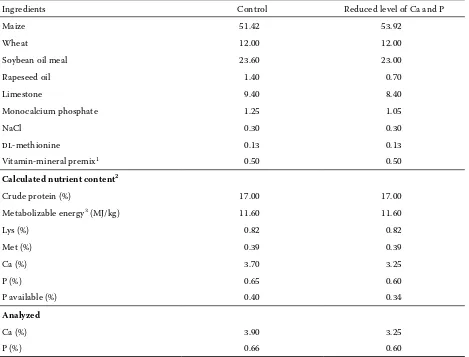
experimental diets (Table 1) contained normal (3.70 and 0.65%) or lowered (3.25 and 0.60%) levels of Ca and P. These diets were either unsupplemented or supplemented with additives as follows: 0.75% inulin (BENEOTM IPS, Orafti, Belgium), 0.75%
oli-gofructose (BeneoTM OPS, Orafti, Belgium), 0.50%
VFA (0.20% formic, 0.15% propionic and 0.15% ace-tic acid), 0.25% MCFA (0.125% caproic and 0.125% capric acid), 0.30% VFA + 0.20% MCFA or 0.75% inulin + 0.50% VFA.
The experimental diets were fed to the hens from the 25th to the 70th week. The nutrient
con-tent of the diets was calculated in accordance with
the chemical composition of raw feedstuffs, and the metabolizable energy value on the basis of equations from European Tables (Janssen, 1989). Samples of feed components were analyzed, using standard methods (AOAC, 1990), for moisture (method 930.15), crude protein (984.13), crude fat (920.39) and ash (942.05). Amino acids were ana-lyzed in acid hydrolysates, after initial performic acid oxidation of sulphur amino acids and after alkaline hydrolysis of tryptophan (AOAC, 1990; method 982.30). The Ca content was analyzed by flame atomic absorption spectrophotometry (AOAC, 1990; method 968.08) and total P con-Table 1. Composition of experimental diets (%)
Ingredients Control Reduced level of Ca and P
Maize 51.42 53.92
Wheat 12.00 12.00
Soybean oil meal 23.60 23.00
Rapeseed oil 1.40 0.70
Limestone 9.40 8.40
Monocalcium phosphate 1.25 1.05
NaCl 0.30 0.30
dl-methionine 0.13 0.13
Vitamin-mineral premix1 0.50 0.50
Calculated nutrient content2
Crude protein (%) 17.00 17.00
Metabolizable energy3 (MJ/kg) 11.60 11.60
Lys (%) 0.82 0.82
Met (%) 0.39 0.39
Ca (%) 3.70 3.25
P (%) 0.65 0.60
P available (%) 0.40 0.34
Analyzed
Ca (%) 3.90 3.25
P (%) 0.66 0.60
1the premix provided per 1 kg of diet: vitamin A 10 000 IU; vitamin D
3 3 000 IU; vitamin E 50 IU; vitamin K3 2 mg; vitamin B1
1 mg; vitamin B2 4 mg; vitamin B6 1.5 mg; vitamin B12 0.01 mg; Ca-pantothenate 8 mg; niacin 25 mg; biotin 0.1 mg; folic acid 0.5 mg; choline chloride 250 mg; manganese 100 mg; zinc 50 mg; iron 50 mg; copper 8 mg; iodine 0.8 mg; selenium 0.2 mg, cobalt 0.2 mg
2calculated from tables of feed composition on the basis of component nutrient content
3according to the European Table of Energy Values for Poultry Feedstuffs (Janssen, 1989) as a sum of ME content of feed
[image:3.595.66.535.103.460.2]tent by colorimetry, using the molybdo-vanadate method (AOAC, 1990; method 965.17).
Measurements
During the experiment, the number and weight of eggs were registered daily, feed consumption was re-corded monthly, and egg production, egg mass, daily feed intake and feed conversion (feed consumed per 1 g of produced egg mass) were calculated.
At 34, 46, 58 and 70 weeks, one egg from each hen (i.e. 12 eggs from each treatment) was collected to determine eggshell quality indices, i.e. eggshell percent, eggshell thickness and eggshell density. The eggs were analyzed using semi-automated egg quality equipment (QCM+, Technical Services and Supplies (TSS), York, UK). Shell thickness was meas-ured near the equator of the egg, using an electronic micrometer (QCT device, TSS, York, UK). Eggshell density (dried shell weight per unit of shell area, mg/cm2) was calculated by Eggware software (TSS,
York, UK). Further 12 eggs from each treatment were collected for the measurement of eggshell breaking strength, using an Instron Testing Machine, Model 5542 (Instron Ltd., High Wycombe, England), equipped with a 500 Newton load cell. The eggs were compressed at a constant crosshead speed of 10 mm/ min, and breaking strength was determined at the moment of the eggshell fracture.
Statistical analysis
The data were subjected to statistical analysis using a completely randomized design, in accordance with the GLM procedure of Statistica 5.0 (Statsoft, Inc., Tulsa, OK). All the data were analyzed using two-way ANOVA. When significant differences in treatment means were detected by ANOVA, Duncan’s multi-ple range test was applied to the separate means. Statistical significance was considered at P ≤ 0.05.
RESULTS
Laying performance
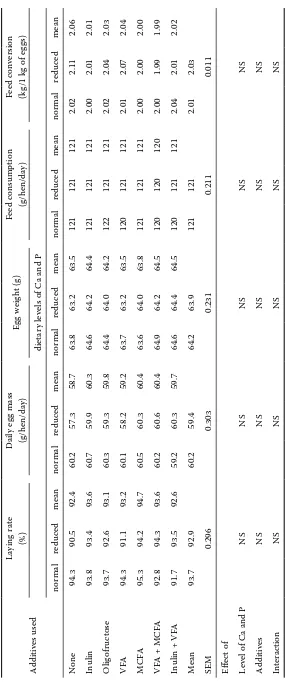
The mean egg production, averaged across all the dietary treatments throughout the experimental pe-riod (hen age 26–70 weeks) was 93.4%; egg weight 63.5 g; daily egg mass 59.4 g/hen; daily feed
con-sumption 121 g/hen; and feed conversion 2.02 kg of feed/1 kg of eggs (Table 2). The mean mortality during the experiment was low and amounted to 0.6% (one dead layer in the group with reduced level of dietary Ca and P and without additives was noted). The experimental factors (dietary level of Ca and P and dietary supplementation of selected additives) had no significant effect on laying per-formance parameters, as compared with the control group (P > 0.05).
Eggshell quality
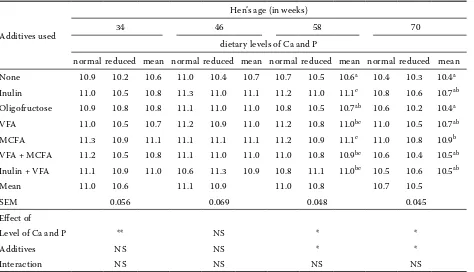
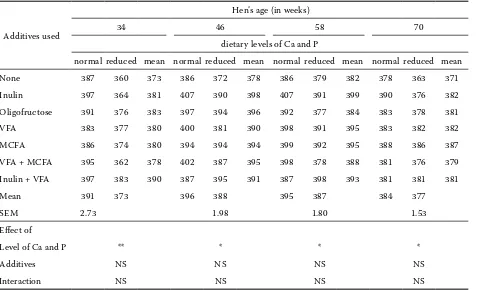
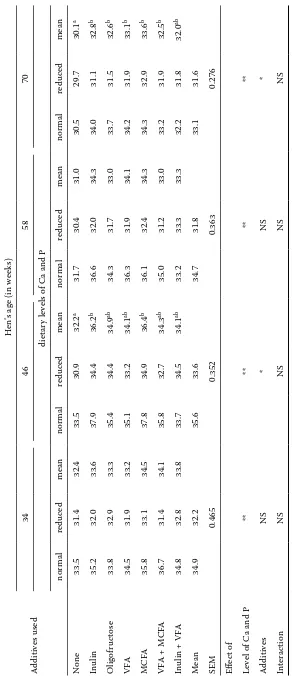
The mean eggshell percent, averaged across all the dietary treatments throughout the experimental pe-riod, was 10.8% at 34 weeks of age; 11.0% at 46 weeks of age; 10.9% at 58 weeks of age; and 10.6% at 70 weeks of age (Table 3). The mean eggshell thickness was 382, 392, 391 and 380 µm (Table4); eggshell den-sity 87.4, 89.3, 88.3 and 85.5 mg/cm2 (Table 5); and
eggshell breaking strength 33.5, 34.6, 33.2 and 32.3 N (Table 6), respectively at 34, 46, 58 and 70 weeks of age. Reducing the dietary levels of Ca and P sig-nificantly decreased the eggshell percent in hens at 34, 58 and 70 weeks of age, eggshell thickness at 34, 46, 58 and 70 weeks of age, eggshell density at 34, 58 and 70 weeks of age and eggshell breaking strength at 34, 46, 58 and 70 weeks of age.
At 36 weeks of age, there were no statistically confirmed effects of the additives used in this ex-periment on eggshell percent, thickness, density and breaking strength, but in older hens some additives positively affected the eggshell quality. In 46-weeks-old hens, eggshell breaking strength was improved after the inclusion of inulin and MCFA in the diet (Table 6). At 58 weeks of age, eggshell percent and density were significantly increased by inulin, VFA, MCFA, VFA + MCFA and inulin + VFA addition (Tables 3 and 5). At 70 weeks of age, eggshell percent was significantly improved by MCFA (Table 3), shell density by VFA and MCFA (Table 5) and egg-shell breaking strength by inulin, oligofructose, VFA, MCFA, VFA + MCFA, and inulin + VFA (Table 6).
DISCUSSION
Laying performance
Table 3. Effects of experimental factors on eggshell percent (%)
Additives used
Hen’s age (in weeks)
34 46 58 70
dietary levels of Ca and P
normal reduced mean normal reduced mean normal reduced mean normal reduced mean
None 10.9 10.2 10.6 11.0 10.4 10.7 10.7 10.5 10.6a 10.4 10.3 10.4a
Inulin 11.0 10.5 10.8 11.3 11.0 11.1 11.2 11.0 11.1c 10.8 10.6 10.7ab
Oligofructose 10.9 10.8 10.8 11.1 11.0 11.0 10.8 10.5 10.7ab 10.6 10.2 10.4a
VFA 11.0 10.5 10.7 11.2 10.9 11.0 11.2 10.8 11.0bc 11.0 10.5 10.7ab
MCFA 11.3 10.9 11.1 11.1 11.1 11.1 11.2 10.9 11.1c 11.0 10.8 10.9b
VFA + MCFA 11.2 10.5 10.8 11.1 11.0 11.0 11.0 10.8 10.9bc 10.6 10.4 10.5ab
Inulin + VFA 11.1 10.9 11.0 10.6 11.3 10.9 10.8 11.1 11.0bc 10.5 10.6 10.5ab
Mean 11.0 10.6 11.1 10.9 11.0 10.8 10.7 10.5
SEM 0.056 0.069 0.048 0.045
Effect of
Level of Ca and P ** NS * *
Additives NS NS * *
Interaction NS NS NS NS
a,b,cvalues in the columns with different letters differ significantly (P ≤ 0.05); NS – P > 0.05; *P ≤ 0.05; P ≤ 0.01
Ca and P and dietary supplementation of selected additives) on laying performance. Similarly to our findings, Yildiz et al. (2006) reported no effect of inulin added to the diet in the form of dried Jerusalem artichoke (Helianthus tuberosus L.) on laying rate, feed consumption and feed conver-sion. In contrast, Chen et al. (2005b) found that the inclusion of 1% inulin or oligofructose in the layer diet improved egg production and feed con-version.
The effect of organic acids (a mixture of formic and propionic acids) on laying performance was studied in an experiment with Lohman layers con-ducted by Yesilbag and Colpan (2006). Similarly to our results, they found no effect of organic acids on feed consumption and feed conversion; however they observed an improved laying rate at 24–28 and 36–38 weeks of age as a result of the inclusion of 0.5–1.5% organic acids into the diet. Also Gama et al. (2000) showed that the addition of organic acids into layer diet for 4 or 8 weeks im-proved egg production. Soltan (2008) reported the beneficial influence of organic acids (formic acid and salts of butyric, propionic and lactic acids)
on average egg production (from 54 to 70 weeks of age) at the highest inclusion level (780 ppm), but not when the lower inclusion levels (260 or 520 ppm) were used. The positive effect of ace-tic acid on laying performance was also observed in hens reared under conditions of heat stress (Kadim et al., 2008).
Eggshell quality
Table 4. Effects of experimental factors on eggshell thickness (µm)
Additives used
Hen’s age (in weeks)
34 46 58 70
dietary levels of Ca and P
normal reduced mean normal reduced mean normal reduced mean normal reduced mean
None 387 360 373 386 372 378 386 379 382 378 363 371
Inulin 397 364 381 407 390 398 407 391 399 390 376 382
Oligofructose 391 376 383 397 394 396 392 377 384 383 378 381
VFA 383 377 380 400 381 390 398 391 395 383 382 382
MCFA 386 374 380 394 394 394 399 392 395 388 386 387
VFA + MCFA 395 362 378 402 387 395 398 378 388 381 376 379
Inulin + VFA 397 383 390 387 395 391 387 398 393 381 381 381
Mean 391 373 396 388 395 387 384 377
SEM 2.73 1.98 1.80 1.53
Effect of
Level of Ca and P ** * * *
Additives NS NS NS NS
Interaction NS NS NS NS
NS – P > 0.05; *P ≤ 0.05; **P ≤ 0.01
In this study, reducing the dietary levels of Ca and P negatively affected eggshell quality parameters throughout the whole experimental period (at 34, 46, 58 and 70 weeks of age). Similar results were obtained in a study conducted on Hy-Line layers, where increasing the dietary Ca level from 3.1 to 3.7% resulted in a significant linear improvement of eggshell quality (Sohail and Roland, 2000). The significant effect of the dietary Ca level on the egg-shell was also observed by Castillo et al. (2004), who noticed that shell specific gravity was greater in hens fed a diet with 3.83% Ca than in those re-ceiving 2.96% Ca; however there were no significant differences between the Ca levels of 3.22 and 3.83%. Safaa et al. (2008) reported that eggshell percent, thickness and density significantly increased when the dietary level of Ca was raised from 3.5 to 4.0%. In a study carried out on white Lohman hens, in-creasing the Ca level from 3.0 to 3.8 had a positive effect on eggshell weight (Narvaez-Solarte et al., 2006). In contrast, Rama Rao et al. (2003) found no beneficial effect on eggshell weight and thick-ness when the dietary Ca content was increased
statistically confirmed effect of inulin from dried Jerusalem artichoke on the weight, thickness and breaking strength of eggshells during a 16-week trial with layers.
The positive effect of the prebiotic fructans, es-pecially inulin, on eggshell quality, observed in this study, is probably connected with the stimulation of mineral availability. According to Scholz-Ahrens et al. (2007), the mechanism of the positive effect of fructans on mineral utilization is complex and can be attributed to such factors as the high solubility of minerals because of the increased production of short-chain fatty acids by probiotic bacteria through an increased supply with substrate (fructans), al-teration of the intestinal mucosa and increase of the absorption surface by means of the beneficial effect of bacterial fermentation products on the proliferation of enterocytes, increased expression of Ca-binding proteins, release of bone modulat-ing factors, degradation of phytates by probiotic bacteria enzymes and overall improvement of the gut health.
In this study, the addition of MCFA and, to a lesser extent, VFA, had a positive influence on eggshell characteristics, i.e. eggshell percent, density and breaking strength, at 46, 58 and 70 weeks of age. This influence can probably be at-tributed to an increased availability of Ca and P, brought about by a decrease in pH in the upper part of the intestinal tract and the stimulating ef-fect of organic acids on the villus height, which was observed in broilers by Garcia et al. (2007) and Senkoylu et al. (2007). It has also been proposed that organic acids (citric acid) improved Ca avail-ability by chelating Ca and reducing the forma-tion of insoluble Ca-phytate-complexes (Boling et al., 2000). Abdel-Fattah et al. (2008) reported that chicks fed a diet supplemented with organic acids had significantly higher Ca and P blood con-centrations, which the authors attributed to the lowering of intestinal pH and the increase in the absorption of these macroelements by the utiliza-tion of these acids.
The results of the present study are similar to those reported by Sengor et al. (2007), who in an experiment with old breeder White Bovans hens found that eggshell breaking strength was increased after the inclusion of short-chain fatty acids (VFA) in the diet. The authors also reported that VFA decreased the number of dirty, cracked and misshapen eggs. Soltan (2008) stated that organic acids (a mixture of formic acid and salts
of butyric, propionic and lactic acids) added to the diet in the amount of 780 ppm improved egg-shell thickness at 70 weeks of age and reduced the number of broken eggs, but had no effect on eggshell weight. The author indicated that the ob-served improvement in eggshell quality was con-nected with an increase in Ca concentration in serum, which can be attributed to the beneficial effect of organic acids on Ca absorption (Soltan, 2008). Orban et al. (1993) reported that high doses of ascorbic acid (2 000 or 3 000 ppm) improved the specific gravity of eggs, which was connected with the increased concentration of Ca in the blood. In contrast, in their experiment with Lohman lay-ers, Yesilbag and Colpan (2008) found no effect of formic and propionic acids on eggshell thickness and eggshell breaking strength.
In conclusion, the results of this study indicate that selected feed additives which lower the pH of the diet and intestinal content could have a positive effect on the eggshell quality in older (from 46 to 70 weeks of age), high-producing laying hens fed a diet with a normal or reduced level of Ca and P. A significant improvement in shell quality was obtained by the use of inulin, oligofructose, volatile fatty acids and medium-chain fatty acids.
REFERENCES
Abdel-Fattah S.A., El-Sanhoury M.H., El-Mednay N.M., Abdel-Azeem F. (2008): Thyroid activity, some blood constituents, organs morphology and performance of broiler chicks fed supplemental organic acids. Inter-national Journal of Poultry Science, 7, 215–222. Al-Batshan H.A., Scheideler S.E., Black B.L., Garlich J.D.,
Anderson K.E. (1994): Duodenal calcium uptake, femur ash, and eggshell quality decline with age and increas-ing followincreas-ing moult. Poultry Science, 73, 1590–1596. Andrys R., Klecker D., Zeman L., Mareček E. (2003): The
effect of changed pH values of feed in isophosphoric diets on chicken broiler performance. Czech Journal of Animal Science, 48, 197–206.
AOAC (1990): Officials methods of analysis. 15th ed.
As-sociation of Official Analytical Chemists, Aarlington, USA.
Castillo C., Cuca M., Pro A., Gonzalez M., Morales. E. (2004): Biological and economic optimum level of cal-cium in White Leghorn laying hens. Poultry Science, 83, 868–872.
Chen Y.C., Chen T.C. (2004): Mineral utilization in layers as influenced by dietary oligofructose and inulin. In-ternational Journal of Poultry Science, 3, 442–445. Chen Y.C., Nakthong C., Chen T.C. (2005a): Effect of
chicory fructans on egg cholesterol in commercial lay-ing hen. International Journal of Poultry Science, 4, 109–114.
Chen Y.C., Nakthong C., Chen T.C. (2005b): Improve-ment of laying hen performance by dietary prebiotic chicory oligofructose and inulin. International Journal of Poultry Science, 4, 103–108.
Chen Y.C., Nakthong C., Chen T.C., Buddington R.K. (2005c): The influence of dietary beta-fructan supple-ment on digestive functions, serum glucose, and yolk lipid content of laying hens. International Journal of Poultry Science, 4, 645–651.
Coudray C., Rambeau M., Feillet-Coudray C., Tressol J. C., Demigne C., Gueux E., Mazur A., Rayssiguier Y. (2005): Dietary inulin intake and age can significantly affect intestinal absorption of calcium and magnesium in rats: a stable isotope approach. Nutrition Journal, 4, 29–36.
Coudray C., Feillet-Coudray C., Gueux E., Mazur A., Rayssiguier Y. (2006): Dietary inulin intake and age can affect intestinal absorption of zinc and copper in rats. Journal of Nutrition, 136, 117–122.
De Ketelaere B., Govaerts T., Coucke P., Dewil E., Viss-cher J., Decuypere E., De Baerdemaeker J. (2002): Measuring the eggshell strength of 6 different genetic strains of laying hens: techniques and comparisons. British Poultry Science, 43, 238–244.
Delzenne N.M., Aertssens J., Verplaetse H., Roccaro M., Roberfroid M. (1995): Effects of fermentable fructoo-ligosaccharides on mineral, nitrogen, and energy di-gestive balance in the rats. Life Science, 57, 1579–1587.
Demigne C., Jacobs H., Moundras C., Davicco M.J., Hor-cajada M.N., Bernalier A., Coxam V. (2008): Compar-ison of native or reformulated chicory fructans, or non-purified chicory, on rat cecal fermentation and mineral metabolism. European Journal of Nutrition, 47, 366–374.
Gama N.M.S.Q., Oliveira M.B.C., Santin E., Berchieri Jr. A. (2000): Supplementation with organic acids in diet of laying hens. Ciencia Rural, 30, 499–502.
Garcia V., Catala-Gregori P., Hernandez F., Megias M.D., Madrid J. (2007): Effect of formic acid and plant ex-tracts on growth, nutrient digestibility, intestine mu-cosa morphology, and meat yield of broilers. Journal of Applied Poultry Research, 16, 555–562.
Gibson G.R., Roberfroid M.B. (1995): Dietary modulation of the human colonic microflora. Introducing the con-cept of prebiotics. Journal of Nutrition, 125, 1401–412. Janssen W.M.M.A. (1989): European table of energy
val-ues for poultry feedstuffs. In: 3rd ed. Working Group
No. 2 of the European Branch. World’s Poultry Science Associace, Beekbergen, The Netherlands.
Kadim I.T., Al-Marzooqi W., Mahgoub O., Al-Jabri A., Al-Waheebi S.K. (2008): Effect of acetic acid supple-mentation on egg quality characteristics of commercial laying hens during hot season. International Journal of Poultry Science, 7, 1015–1021.
Kim W.K., Donalson L.M., Mitchell A.D., Kubena L.F., Nisbey D.J., Ricke S.C. (2006): Effects of alfalfa and fructooligosaccharide on molting parameters and bone qualities using dual x-ray absorptiometry and conven-tional bone assays. Poultry Science, 85, 15–20. Koreleski J., Swiatkiewicz S. (2004): Calcium from
lime-stone meal and grit in laying hen diets - effect on per-formance, eggshell and bone quality. Journal of Animal and Feed Science, 13, 635–645.
Kruger M.C., Brown K.E., Collet G., Layton L., Schollum L.M. (2003): The effect of fructooligosaccharides with different degree of polymerization on calcium bioavail-ability in the growing rat. Experimental Biology and Medicine, 228, 683–688.
Liem A., Pesti G.M., Edwards Jr. H.M. (2008): The ef-fect of several organic acids on phytate phosphorus hydrolysis in broiler chicks. Poultry Science, 87, 689–693.
Lutz T., Scharrer E. (1991): Effect of short-chain fatty acids on calcium absorption by the rat colon. Experi-mental Physiology, 76, 615–618.
Mineo H., Hara H., Kikuchi H., Sakurai H., Tomita F. (2001): Various indigestible saccharides enhance net calcium transport from the epithelium of the small and
large intestine of rats in vitro. Journal of Nutrition, 131,
3243–3246.
Morohashi T., Sano T., Ohta A., Yamada S. (1998): True calcium absorption in the intestine is enhanced by fructooligosaccharide feeding in rats. Journal of Nutri-tion, 128, 1815–1818.
benzoate in diets with or without organic acids on di-etary buffering capacity, apparent digestibility, retention of nutrients, and manure characteristics in swine. Jour-nal of Animal Science, 78, 2622–2632.
Narvaez-Solarte W., Rostagno H.S., Soares P.R., Uribe-Velasquez L.F., Silva M.A. (2006): Nutritional require-ment of calcium in white laying hens from 46 to 62 wk of age. International Journal of Poultry Science, 5, 181–184.
Nys Y. (1999): Nutritional factors affecting eggshell qual-ity. Czech Journal of Animal Science, 44, 135–143. Nys Y. (2001): Recent developments in layer nutrition for
optimising shell quality. In: Proceedings of 13th
Euro-pean Symposium of Poultry Nutrition. Blankenberge, Belgium, 45–52.
Ohta A., Ohtsuki M., Baba S., Adachi T., Sakata T., Sagaguchi E. (1995): Calcium and magnesium absorption from the colon and rectum are increased in rats fed fructooligosac-charides. Journal of Nutrition, 125, 2417–2424.
Omogbenigun F.O., Nyachoti C.M., Slominski B.A. (2003): The effect of supplementing microbial phytase and organic acids to a corn-soybean based diet fed to early weaned pigs. Journal of Animal Science, 81, 1806–1813.
Orban J.I., Roland D.A., Cummins K., Lovell R.T. (1993): Influence of large doses of ascorbic acid on perform-ance, plasma calcium, bone characteristics, and egg-shell quality in broilers and Leghorn hens. Poultry Science, 72, 691–700.
Park J.H., Park G.G., Ryu K.S. (2002): Effect of feeding organic acid mixture and yeast culture on performance and egg quality of laying hens. Korean Journal of Poul-try Science, 29, 109–115.
Park K.W., Rhee A.R., Um J.S., Paik I.K. (2009): Effect of dietary available phospohorus and organic acids on the performance and egg quality of laying hens. Journal of Applied Poultry Research, 18, 598–604.
Radcliffe J.S., Zhang Z., Kornegay E.T. (1998): The effects of microbial phytase, citric acid, and their interaction in a corn-soybean meal-based diet for weanling pigs. Journal of Animal Science, 76, 1880–1886.
Rama Rao S.V., Panda A.K., Raju M.V.L.N., Shyam Sunder G., Praharaj N.K. (2003): Requirement of calcium for commercial broilers and white leghorn layers at low dietary phosphorus levels. Animal Feed Science and Technology, 106, 199–208.
Rehman H., Rosenkranz C., Bohm J., Zentek J. (2007): Dietary inulin affects the morphology but not the sodium dependent glucose and glutamine trans-
port in the jejunum of broilers. Poultry Science, 86, 118–122.
Roland Sr. D.A. (1988): Research note: egg shell problems: estimates of incidence and economic impact. Poultry Science, 67, 1801–1803.
Safaa H.M., Serrano M.P., Valencia D.G., Frikha M., Jimenez-Moreno E., Mateos G.G. (2008): Productive performance and egg quality of brown egg-laying hens in the late phase of production as influenced by level and source of calcium in the diet. Poultry Science, 87, 2043–2051.
Scholz-Ahrens K.E., Ade P., Marten B., Weber P., Timm W., Asil Y., Gluer C.-C., Schrezenmeir J. (2007): Preb-iotics, probPreb-iotics, and synbiotics affect mineral absorp-tion, bone mineral content, and bone structure. Journal of Nutrition, 137, 838S–846S.
Sengor E., Yardimci M., Cetingul S., Bayram I., Sahin H., Dogan I. (2007): Effects of short chain fatty acid (SCFA) supplementation on performance and egg character-istics of old breeder hens. South African Journal of Animal Science, 37, 158–163.
Senkoylu N., Samli H.E., Kanter M., Agma A. (2007): Influence of a combination of formic and propionic acids added to wheat- and barley-based diets on the performance and gut histomorphology of broiler chickens. Acta Veterinaria Hungarica, 55, 479–490.
Sohail S.S., Roland D.A. Sr. (2000): Influence of phytase on calcium utilization in commercial layers. Journal of Applied Poultry Research, 9, 81–87.
Soltan M.A. (2008): Effect of organic acid supplementa-tion on egg producsupplementa-tion, egg quality, and some blood serum parameters in laying hens. International Journal of Poultry Science, 7, 613–621.
Swiatkiewicz S., Koreleski J. (2008): The effect of zinc and manganese source in the diet for laying hens on egg-shell and bones quality. Veterinary Medicine, 53, 555–563.
Washburn K.W. (1982): Incidence, cause, and prevention of eggshell breakage in commercial production. Poul-try Science, 61, 205–2012.
Yesilbag D., Colpan I. (2006): Effects of organic acid supplemented diets on growth performance, egg pro-duction and quality and on serum parameters in lay-ing hens. Revue de Medicine Veterinaire, 157, 280–284.
Yildiz G., Sacakli P., Gungor T. (2006): The effect of
di-etary Jerusalem artichoke (Helianthus tuberosus) on
cho-lesterol content in laying hens. Czech Journal of Animal Science, 8, 349–354.
Zafar T.A., Weav C.M., Zhao Y., Martin B.R., Wastney M.E. (2004): Nondigestible oligosaccharides increase cal-
cium absorption and suppress bone resorption in ova-riectomized rats. Journal of Nutrition, 134, 399–402.
Received: 2009–07–27 Accepted after corrections: 2009–12–01
Corresponding Author