Procurement and distribution of milk from villag-es has been phenomenal since the evolution of the cooperative Societies in india. The government of india set up the national Dairy Development Board in 1970 for strengthening the supply chain network in dairy cooperatives throughout the country. The operation Flood programme not only accelerated the growth of the dairy sector but also helped india to become the world’s largest milk producer. The production of milk has increased many times since the independence, which is mainly due to the increased number of live-stock, especially buffaloes The productivity of this sector is low due to its small-scale operations, the mixed farming system, the lack of finance, and hybrid animals etc. increasing the efficiency in production is a significant factor of the productivity growth and it can be increased by using better technologies along with the better management of all crucial inputs, which are at the disposal of the farmers. A higher level of technical efficiency is essential for a higher profitability and to enhance the competitiveness in the dairying sector. Technical inefficiency connotes the ability of farms to produce the maximum possible output with the given set of resources.
recent studies have shown that dairy farmers failed to exploit the full potential of technology. Bailey et al. (1989), Fraser and coridna (1999), Mbaga et al. (2002) and Dalton (2004) have examined the efficiency of the dairy sector in developed as well as in developing
countries. reardon and Barrett (2000), Sartorius and Kristen (2007), Demircan et al. (2010) and caberera et al. (2010) have found that small dairy farmers are gradually becoming less profitable and loosing their market share due to a tighter alignment of the supply chain producing for international markets. Burki and Khan (2008) analyzed the effects of the supply chain on the productive/technical efficiency and found that building the supply chain management practices has a strong positive effect on the productive efficiency. Sharma and gulati (2003) and Kumar and Jain (2008) analyzed the farm level efficiency for dairy farmers in india using the stochastic frontier production function approach. Binam et al. (2004) analysed the factors affecting the technical efficiency among small-holder farmers in the slash and burn agriculture zone of cameroon. however, there seems to be a lack of studies where the technical efficiency of farmers following the modern supply chain management practices has been measured and compared with non-followers of the modern supply chain practices. Further, the influence of some farm and farmers specific characteristics and socio-economic features on the inefficiency has not been examined; which is undoubtedly very significant for policy makers. in this background, the present paper investigates the technical efficiency along with the technical inef-ficiency effects on milk production of the member and non-member dairy farmers in india.
Technical efficiency and supply chain practices
in dairying: The case of India
Surender Mor
1, Supran Sharma
21
Chaudhary Devi Lal University (CDLU), Sirsa, India
2
Shri Mata Vaishno Devi University (SMVDU), Katra, Jammu, India
Abstract: The presented paper investigates the technical efficiency of small dairy farmers in india using the stochastic production frontier function approach. The study reveals that building the supply chain can increase the efficiency of dai-ry farmers, as the milk producers who are part of a cooperative supply chain experienced a higher technical efficiency as compared to those who do not follow the modern supply chain practices. The milk producers in the supply chain are found better crisis managers as their inefficiency is the least attributed to their own decisions. The possession of the crossbred li-vestock, schooling of the manager and the institutional finance have been found affecting the efficiency of the dairy farmers positively and significantly. The study recommends the expansion in the supply chain network of the cooperative milk soci-eties for enhancing the efficiency and profitability of the dairy sector along with the provision of more crossbred livestock and an easy availability of finance.
MATERIAL AND METHODS
Material
The present study uses the farm-level cross section data from small dairy farmers of north india for the year 2009–2010. The sample farms were selected by using a two-stage random sampling technique. in the first stage, one village was selected randomly from each of the five north indian states (Punjab, haryana, himahcal Pradesh, Uttar Pradesh and Jammu & Kashmir). in the second the stage, 40 milk producers from each village were selected randomly by consid-ering them into two strata, i.e., 20 member farmers (supply chain practitioners) and 20 non-members farmers (non- practitioners). in all, a sample compris-ing of 200 milk producers was selected. information on a wide range of the socio-economic and business characteristics was also gathered through the struc-tured survey schedule, which includes the number of crossbred animals, the experience and education, the amount of milk produced the expenses on feed and fodder, input and output prices, the membership in the cooperative union of the dairy farmers. These variables have been used by Bravo-Ureta and rieger (1991) and Battese and coelli (1996). The experience and education (formal years of education) is measured in years. The value of livestock represents the present value of livestock and it is measured in money terms. The herd size is the average number of animals per farm. The institutional finance ratio is the ratio of loan from the institutional sources to the total loans taken for the purpose of dairying.
Methods
The present study has employed the stochastic frontier production function approach for the mea-surement of the farm level technical inefficiency. The concept of frontier production was first proposed by Farrell (1957), further, developed by Aigner et al. (1977) and Meeusen and Broeck (1977). Jondrow et al. (1982) have provided the method to estimate technical efficiency for the individual farms. Battese and coelli (1995) have specified stochastic frontiers and models for the technical inefficiency effects and
simultane-ously estimating all the parameters involved. in such a specification, output of each farm is bounded above by a frontier, which varies across observations. This technique measures the efficiency of farms relative to their own frontier. in the stochastic frontier produc-tion, the disturbance term is composed of two parts; one symmetric, which captures the random effects outside the control of farms and the statistical noise contained in every empirical relationship, and the other one-side, which captures the deviations from the frontier due to the technical inefficiency.
Formally,
Y = f(x) eEi
where:
Ei = Vi – Ui i = (1, 2, … n)
vi = the symmetric component ui ≥ 0 = the one-sided component
Since the frontier is stochastic in nature, permit-ting random variations of the production frontier across observations, the technical inefficiency, which is captured by the one-sided error component, i.e., ui≥ 0, is relative to the stochastic frontier.
Stochastic frontier production function
Technical inefficiency of the individual dairy farm is estimated through the stochastic frontier produc-tion funcproduc-tion, which is defined as:
inYi = β0 + β1lnX1 + β2lnX2 + β3lnX3 + β4lnX4 + Vi – Ui
where:
Yi = milk production in $1
X1 = value of feed in $2
X2 = labour hours
X3 = value of livestock in $ X4 = fixed cost in $3
β’s = parameters to be estimated
Vi = symmetric error term which is assumed to be in dependently and identically distributed having distribution
Ui = one sided error term, reflecting technical inefficiency, which is assumed to be independent of Vi, is such that Ui is the non-negative truncation (at zero) of the normal distribution with mean μ and variance σ2 .
1output is the money value of the total milk production by an animal during its lactation period, multiplied by the market
price and the price offered by the cooperative societies which also include the imputed value of home consumption The cooperative Milk Societies have offered prices ranging from $ 0.53 to $ 0.86 per liters based on the content of FAT and SnF. The value of 1 $ is considered to be 44.70 indian rupees.
2Value of feed includes the cost of dry fodder, green forage, feed and concentrates etc.
Inefficiency model
Ui= δ0 + δ1 Z1 + δ2 Z2 + δ3 Z3 + δ4 Z4 + δ5 Z5
where:
Z1 = crossbreed Z2 = experience Z3 = education Z4 = herd size
Z5 = institutional finance ratio
The variables, Z1,…, Z5, are included in the model for the technical inefficiency effects to indicate the possible effects of the farmer specific characteristics on the efficiency of milk production. The β’s and δ’s are unknown parameters to be estimated together with the other parameters, which are expressed in terms of
and
where the γ parameter lies between zero and one.
it is worth mentioning here that the above model for the inefficiency effects can only be estimated if the inefficiency effects are stochastic and have a particular distributional specification. hence, it is interesting to test the following hypotheses: (1) h0: γ =δ0 = … = δ5 = 0, i.e., inefficiency is absent (2) h0: γ = 0, i.e., inefficiency effects are not
sto-chastic
(3) h0: δ0 = … = δ5 = 0, i.e., the coefficients of ex-planatory variables in the models are simultane-ously zero
(4) h0: δ1 = … = δ5 = 0, i.e., the coefficients of the variables in the model for inefficiency effects are zero
The tests of these hypotheses for the parameters of the frontier are conducted using the generalized likelihood ratio statistics, λ defined as;
λ = –2 [LRR – LRU]
where LRR is the value of the likelihood function for the frontier model in which parameter restrictions are specified by the null hypothesis and LRUis the value of the likelihood function for the general linear frontier model. if the null hypothesis is true, then λ has approximately a chi-square (or mixed square) distribution with the degrees of freedom equal to the difference between the parameter estimated under LRR and LRU, respectively.
The technical efficiency of the farmer, given the specification of the model, is defined by TEi = E (–Ui). Thus, the technical efficiency of the farmer lies be-tween zero and one and it is inversely related to the inefficiency model. The parameters of the stochastic
frontier production function model are estimated by the method of the maximum likelihood using the Econometric computer Program FronTiEr Version 4.1XP (coelli and Battese 1996).
Farm/farmer specific characteristics
To indicate the possible effects of farm specific characteristics on the efficiency of milk production, the variables such as the number of crossbred ani-mals, the experience and education of the manager, the herd size and the institutional finance ratio are included in the model for the technical inefficiency measurement. The number of crossbred animals in the livestock is likely to cast a negative effect on the level of inefficiency. The crossbred animals yield more milk as compared to the traditional ones and thus lead to a higher level of technical efficiency. hence, the farms having more crossbred livestock tend to be more efficient. Farmers having more experience are expected to be more efficient as they possess more experience in managing their enterprises and they are expected to be better crisis managers. Similarly, the farmer who possesses more formal years of education to his/her credit is expected to be more efficient as he/she tends to be more open to the new methods and technologies and more innovative as compared to others. Similarly, the farm possessing a larger herd size is hypothesized to be more efficient (provided that it possesses adequate resources to manage it). The milk producers having more finance from the institutional sources are again hypothesized to be more efficient as compared to others as they are subjected to the least exploitation and have to pay a lower rate of interests and other charges.
RESULTS AND DISCUSSION
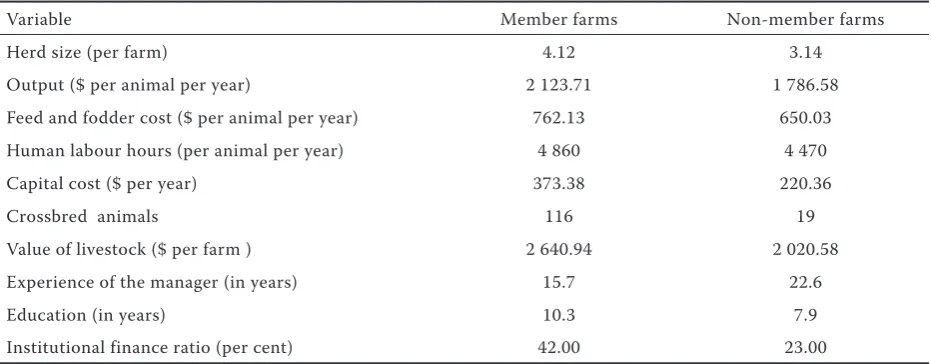
and non-member farms. The member farms have been found possessing 116 crossbred livestock against just 19 in the case of the non-member farms, while the average value of livestock per farm was $ 2640.94 and $ 2020.58, respectively, for the member and non-member farms. The non-non-member farms mangers have more experience as compared to the member farms, but in terms of education, the case is reverse, and further, the member farms have shown more faith in the institutional source of finance as compared to the non-member ones.
The maximum likelihood estimates for the param-eters in the stochastic frontier model are presented in Table 2. The parameters estimated for feed, labour and livestock are found statistically significant at 5% level of significance, whereas the parameter
estimate for capital cost turns out to be statistically insignificant, though attached with a negative sign for both categories of farms. The coefficient of the capital cost turns out to be positive but statistically insignificant, which may be due to the low varia-tions in the variable. Both categories of farmers experienced increasing returns to scale, which is more pronounced in the case of the non-member farmers indicating a higher scope of increasing production by increasing the amount of inputs. As a whole, comparing the two models, the maximum likelihood estimates for the parameters are more or less similar for the supply chain practitioners and non-practitioners.
Parameter estimates of inefficiency model
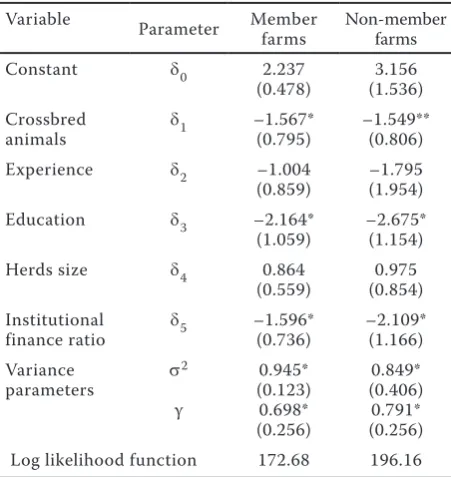
[image:4.595.66.532.84.266.2]The estimated coefficients of the explanatory vari-ables in the model for the technical inefficiency ef-fects (Table 3) are of interest and have important implications. The possession of crossbred animals in the livestock was found to have a negative asso-ciation with technical inefficiency, which indicates that farmers having more crossbred livestock tend to have a lower inefficiency. This could be explained in terms of a high milk yield by the crossbred live-stock as compared to the traditional ones, leading to a higher milk production and efficiency of farm-ers. The coefficient of experience is estimated to be negative but statistically insignificant indicating that inefficiency tends to decline as the number of the years of experience increases for both categories of farms. This appears despite the fact that the non-members farms possess more years of experiences. it may be due to the reason that the experience of farming of the non-member farmers is not associated Table 1. Summary statistics of the study variables for dairying in india
Variable Member farms non-member farms
herd size (per farm) 4.12 3.14
output ($ per animal per year) 2 123.71 1 786.58
Feed and fodder cost ($ per animal per year) 762.13 650.03
human labour hours (per animal per year) 4 860 4 470
capital cost ($ per year) 373.38 220.36
crossbred animals 116 19
Value of livestock ($ per farm ) 2 640.94 2 020.58
Experience of the manager (in years) 15.7 22.6
Education (in years) 10.3 7.9
[image:4.595.64.290.539.734.2]institutional finance ratio (per cent) 42.00 23.00
Table 2. Maximum likelihood estimates for parameters of the stochastic frontier for dairying in india
Variable
Pa
ra
m
et
er
s
M
em
be
r
fa
rm
s
n
on
-m
em
be
r
fa
rm
s
constant β0 3.263
(0.539) (1.006)2.549
Feed β1 1.858*
(0.831) (1.026)1.926* Labour hours β2 1.053*
(0.541) (0.431)0.832* Livestock β3 1.098*
(0.541) (0.906)1.949* capital cost β4 0.787
(0.457) (0.965)1.169
returns to scale 4.796 6.656
with education as they possess less education years compared to the member farms. The coefficients of education turn out to be negative and statistically significant for both categories of farms, which reflects that inefficiency tends to decline with the increased years of formal education, as the educated farmers are more innovative and receptive of new technol-ogy like crossbreeds, etc. The coefficient of the herd size turns out to be positive but insignificant for both categories. The coefficient of the institutional finance ratio in the model for the inefficiency effects
is experienced to be negative and statistically sig-nificant and hence it affects inefficiency negatively, and the coefficient is higher in the case of farmers who are not at all following the modern supply chain management practices.
Tests of hypotheses
[image:5.595.64.290.101.340.2]Tests of various null hypotheses associated with the models were carried out using the likelihood ratio (Lr) statistics and the results are presented in Table 4. The first null hypothesis, h0: γ = δ0 = … = δ5 = 0, i.e., that inefficiency is absent from the model, is strongly rejected for both categories of farms at 5% level of significance. it also indicates that the tra-ditional mean response function is not an adequate representation of the data for milk production. The second null hypothesis, h0: γ = 0, which specifies that the inefficiency effects are not stochastic, is again rejected for the member and non-member farms at 5% level of significance. So, we do not accept the null hypothesis that there was no technical inefficiency. The parameter γ is estimated to be 0.698, which suggests that 69.8% inefficiency is due to the farm’s own decision and the remaining 30.2% are due to the factors outside the control of the farmers for the member farms. on the other hand, the parameter γ is estimated to be 0.79 for the non-members farms indicating that 79% of inefficiency is due to the farm’s own decision and the remaining 21% are due to the factors outside the control of the farmers for the non-member farms. in other words, 14.70% of their technical inefficiency (70% of 21% inefficiency) for the member farms is due to their wrong decision which is 26.86% (79% of 34% inefficiency) in case of Table 3. Maximum likelihood estimates for parameters of
inefficiency models for dairying in india
Variable Parameter Member
farms non-memberfarms
constant δ0 2.237
(0.478) (1.536)3.156 crossbred
animals δ1 –1.567*(0.795) –1.549**(0.806)
Experience δ2 –1.004
(0.859) (1.954)–1.795
Education δ3 –2.164*
(1.059) –2.675*(1.154)
herds size δ4 0.864
(0.559) (0.854)0.975 institutional
finance ratio δ5 –1.596*(0.736) –2.109*(1.166) Variance
parameters σ
2
γ
0.945* (0.123) 0.698* (0.256)
0.849* (0.406) 0.791* (0.256) Log likelihood function 172.68 196.16
[image:5.595.65.532.572.697.2]Figures in parentheses represent standard errors **Statistically significant at 5% level
Table 4. Likelihood ratio tests of the hypotheses for parameters of the stochastic frontier for dairying in india null hypotheses Farm level Log likelihood λ critical value Decision 1. h0: γ = δ0 = … = δ5= 0 member non-member 146.37186.27 52.62*19.78* 14.1014.10 reject h0
reject h0 2. h0: γ = 0 member non-member 148.38184.19 48.60*23.94* 7.05#7.05# reject h0
reject h0 3. h0: δ0 = … = δ5= 0 membernon-member 158.27190.32 11.68**28.82* 12.5910.64 reject h0
reject h0 4. h0: δ1 = … = δ5 = 0 member non-member 152.06191.18 41.24*9.96** 11.109.23 reject h0
reject h0
#This critical values for the hypotheses are obtained from Table 1 of Kodde and Palm (1986, p. 1246) at q + 1 degrees of
freedom, where q is the number of parameters to be estimated, whereas the other value in this column represents chi square values.
the non-member farms. The parameter γ also reflects that the inefficiency effects are highly significant in the analysis of milk production.
The third null hypothesis considered in the model, h0: δ0 = … = δ5= 0, i.e., that the coefficients of the explanatory variables in the inefficiency models are simultaneously zero, is also rejected. it indicates that the five explanatory variables taken in the model make a significant contribution in the explanation of the inefficiency effects associated with the value of output for member as well non-member farms. The last null hypothesis considered, h0: δ1 = … = δ5 = 0, i.e., that the coefficients of the variables in the model for inefficiency effects are zero, is also rejected for both the categories of farmers. it reflects that all the coefficients of the explanatory model are sig-nificantly influenced by the number of crossbred animals, the herd size, the education and experience and the institutional finance for the farmers for both the categories of farmers.
Technical efficiency
Estimates of the farm specific technical efficiencies for each category of farmers are presented in Table 5. The mean technical efficiency for the member farms following the modern supply chain management prac-tices turned out to be 79% as compared to the non-member farm (66%). Thus the non-member dairy farms
possess 21 percent technical inefficiency, while the non-member farms have been found possessing 34% technical inefficiency. Further, it is observed that 67% of the member and 85% of the non-member farms are realizing technical efficiency below the mean level, i.e., 79% and 66% level, whereas 33% of the member and 15% non-member farms have the technical ef-ficiency above the mean level. The heterogeneity in management and production practices employed by these farmers may explain the distribution of tech-nical efficiency. The failure of most of the farmers to maximize output while operating in the rational region of production may be due to their failure to adopt appropriate management practices.
Potential output and output forgone
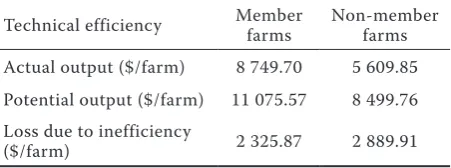
The potential output as well as loss of output is estimated by dividing the actual output by the mean technical efficiency whereas the output forgone is the difference between the potential output and the actual output. Table 6 presents an account of the potential as well as the output forgone in dairying in india. These non-member farms in average lose the output worth of $ 2889.91 annually, while the member farms lose the output value of $ 2325.87 only due to the technical inefficiency. This can be regained by way of a better utilization of resources which are at the disposal of farmers.
CONCLUSION
[image:6.595.64.290.98.222.2]The study is an attempt to analyze the impact of the participation in the modern supply chain man-agement practices formed through the cooperative milk union on dairy farmers in india. it is found from the present analysis that the farmers following the modern supply chain management practices are able to reduce the level of inefficiency. There found a variation in the level of technical efficiency of the member dairy farmer and non-member dairy farm-ers that turns out to be 79% and 66%, respectively. Thus, the milk production can be increased by 21% and 34% for the actors and non- actor of the supply chain, if this level of inefficiency is removed, without increasing the level of inputs. in other words, dairy farmers can gain considerably higher profits just by increasing the efficiency in their operations. The study also reveals that the impact of wrong own decisions on technical inefficiency was more pronounced in the case of the non-member farmers. The possession of crossbred animals, the experience and education of Table 5. Technical efficiency statistics of dairying in
in-dia
Technical efficiency Member farms non-member farms
Below mean efficiency 67 85
Above mean efficiency 33 15
Mean technical efficiency 79% 66%
Maximum 96% 94%
Minimum 43% 29%
Total farms 100 100
Table 6. Estimated potential output and output forgone for dairying in india
Technical efficiency Member farms non-member farms Actual output ($/farm) 8 749.70 5 609.85 Potential output ($/farm) 11 075.57 8 499.76 Loss due to inefficiency
[image:6.595.65.291.682.766.2]the managers and the institutional finance ratio affect technical inefficiency negatively and it is statistically significant for the supply chain member as well as non-members. The paper advocates more provisions of the crossbred livestock, provisions of education and improving the institutional access to credit for the farmers engaged in dairying. The study, further, suggests the need to organize training programmes for dairy farmers so that they can be inspired to be a part of some modern value chain practices so as to enhance the efficiency and profitability as well as to equip them with more infrastructural resources for the dairying purpose.
REFERENCES
Aigner D., Lovell c.A.K., Schmidt P. (1977): Formulation and estimation of stochastic frontier production func-tions models. Journal of Econometrics, 6: 21–37. Bailey D.V., Biswas B., Kumbhakar S.c. (1989): An analysis
of technical, allocative, and scale inefficiency. Western Journal of Agricultural Economics, 14: 30–37.
Binam J.n., Tonye n.W., nyambi g., Akoa M. (2004): Fac-tors affecting the technical efficiency among smallholder farmers in the slash and burn agriculture zone of cam-eroon. Food Policy, 29: 531–545.
Bravo-Ureta B.E., rieger L. (1991): Dairy farm efficiency measurement using stochastic frontiers and neoclassical duality. American Journal of Agricultural Economics, 73: 421–428.
Burki A., Khan A. (2008): Milk Supply chain and Efficiency of Smallholder Dairy Producers in Pakistan. cMEr Working Paper Series, Lahore University of Manage-ment Sciences.
caberera V.E, Soles D., corral J. D. (2010): Determinants of technical efficiency among dairy farms in Wisconsin. Journal of Dairy Science, 93: 383–387.
Battese g.E., coelli T.J. (1995): A model for technical inefficiency effects in a stochastic frontier produc-tion funcproduc-tion for panel data. Empirical Economics, 20: 325–332.
Battese g.E., coelli T.J. (1996): identification of factors which influence the technical inefficiency of indian
farmers. Australian Journal of Agricultural Economics, 40: 103–128.
Dalton T.J. (2004): indivisibility and Spatial components of Dairy Firm inefficiency. in: American Agricultural Economics Associations Annual Meeting, August 1–4, Denver, colorado.
Demircan V., Binici T., zulauf c.r. (2010): Assessing pure technical efficiency of dairy farms in Turkey. Agricultural Economics – czech, 56: 141–148.
Farrell M.J. (1957): The measurement of productive ef-ficiency. Journal of royal Statistical Society, Series A, 120: 253–290.
Fraser i., coridna D. (1999): An application of data envelop-ment analysis to irrigated dairy farms in northern Vic-toria, Australia. Agricultural Systems, 59: 267–282. Jondrow J., Lovell c.A.K., Materov i.S., Schmidt P. (1982):
on the estimation of technical inefficiency in the sto-chastic frontier production function model. Journal of Econometrics, 19: 233–238.
Kodde D.A., Palm F.c (1986): Wald criteria for jointly test-ing equality and inequality restrictions. Econometrica, 54: 1243–1248.
Kumar S.V., Jain D.K. (2008): Technical efficiency of dairy farms in Tamil nadu. Journal of the india Society of Agricultural Statistics, 62: 22–33.
Mbaga D.M., romain r., Larue B., Lebel L. (2002): Assess-ing technical efficiency of Quebec dairy farms. canadian Journal of Agricultural Economics, 51: 121–137. Meeusen W., Broeck V.D. (1977): Efficiency estimation from
cobb-Douglas production function with composed error. international Economic review, 18: 435–444.
reardon T., Barrett c.B. (2000): Agro industrialization, globalization, and international development: An over-view of issues, patterns, and determinants. Agricultural Economics, 23: 195–205.
Sharma V.P., gulati A. (2003): Trade liberalization, market reforms and competitiveness of indian dairy sector. MTiD, Discussion Paper no. 61, international Food Policy research institute, Washington, D.c.
Sartorius K., Kirsten J. (2007): A framework to facilitate institutional arrangements for smallholder supply in developing countries: An agribusiness perspective. Food Policy, 32: 640–655.
Arrived on 16th January 2011
Contact address: