INTRODUCTION
The SAPARD programme (Special Accession Prog-ramme for Agriculture and Rural Development) is
a pre-accession programme designed to support development of agriculture and rural areas in can-didate countries.
Regional aspects of the SAPARD programme
implementation in the Slovak Republic
Regionálne aspekty implementácie programu SAPARD
v Slovenskej republike
S. BUCHTA
Research Institute of Agricultural and Food Economics, Bratislava,
Slovak republic
Abstract: The article presents the analysis of regional distribution for the approved and completed projects by 2004 under the SAPARD programme in the Slovak Republic. The distribution of funding strongly favoured powerful (innovative) busi-ness subjects which increased their competitivebusi-ness and gained the “advantage of technology advance” (which, in time may change into the rent of technology advance) associated with growth in labour productivity and high probability of invest-ment return. The impleinvest-mentation of the SAPARD programme provides a strong impetus to the restructuring of businesses in agrifood industry, it accelerates and improves the selection among the businesses and economical differentiation. The bulk of the approved funding for projects under the individual measures for agriculture and processing industry within the SAPARD programme was distributed among western and southern regions of Slovakia. The implementation of the SAPARD programme, on one hand, has helped to reduce regional disparities in the vertical spatial approach by the diversion of the bulk of funding to the economically less favoured southern areas of Slovakia lagging behind in terms of infrastructure. On the other hand, though, it has increased the regional disparities in the horizontal spatial view with regard to the fact that most of the funding is spent in the developed regions of western Slovakia. Eastern Slovakia thus has become a disadvanta-ged and minority recipient of the financial assistance under this programme.
Key words: SAPARD programme, projects, regional implementation, beneficiaries, financial assistance, regional develop-ment
Under the SAPARD programme, it was possible to support activities within the following 9 measures:
Measure No 1 Investments in agricultural enterprises (sectors: sheep, poultry, fruit and ve-getable, cattle and pigs)
Measure No 2 Improving the processing and market-ing of agricultural and fishery products (milk processing and dairy products industry, processing of meat, poul-try, fruits and vegetables, readymade meals, fish and fishery products) Measure No 3 Support to establishment of producers’
marketing organizations
Measure No 4a Diversification activities in rural areas for non-infrastructure investments Measure No 4b Diversification activities –
infrastruc-ture investments not generating sub-stantial net revenue
Measure No 5 Forestry
Measure No 6 Agricultural procedures targeted at protection of environment and land-scape
Measure No 7 Land consolidation
Measure No 8 Human resources development Measure No 9 Technical assistance
As of May 2004, the SAPARD Agency does not conclude any new financial assistance contracts under the SAPARD programme. However, the funding for the approved projects is scheduled to continue until the end of 2006.
In terms of the SAPARD financial assistance, the projects funded from the SAPARD may be divided into two groups – projects where private invest-ments are required, and those that do not call for such investments. Measures No 1, 2, 4 and 5 are among those where private investments are required. Other measures No 3, 4b, 6, 7, 8 and 9 do not call for private investments and the projects are fully covered by public funding, with 75% of funding provided by the Community and 25% by the state budget.
Project funding under the SAPARD programme is based on the refund principle. This means that the beneficiary of financial assistance may only receive a refund for eligible expenses in the project if such expenses have been paid already.
METHODOLOGY
The work is based on the secondary analysis of statis-tical data structured in horizontal and verstatis-tical spatial aggregation, at the level of NUTS III and/or NUTS IV. Primary data were provided by the Agricultural
Paying Agency (APA) aggregated by numerous as-pects (such as regional aggregations, legal structure of enterprise, etc.).
The basis of working methodology used the fol-lowing approaches:
– regionally differentiated analysis (on the level of NUTS III and NUTS IV) for distribution of number of projects (approved and completed) under SAPARD programme;
– regionally structured (on the level of NUTS III and NUTS IV) financial allocation of projects (ap-proved and completed) under the SAPARD pro-gramme.
The following methods were used during the work: – mathematical-statistical data analysis
– secondary analysis of available analytical data for these issues, statistical data from the APA and other basis materials
The regional analysis used dichotomic spatial ag-gregation for the horizontal (east-west) and vertical (north-south) views:
– western and eastern regional aggregationwas cre-ated in the horizontal spatial view. This horizontal dichotomy is based on territorial units on NUTS III level. West regional aggregation included the Bratislava, Trnava, Nitra, Trenčín and Žilina re-gions. The Eastarea included the Banská Bystrica, Prešov and Košice regions.
– The vertical spatial structure comprised of the northern and southern regional aggregations. These were based on the level of NUTS IV regions. The regional South aggregation comprised of these districts: Bratislava I–V, Malacky, Pezinok, Senec, Dunaj-ská Streda, Galanta, Hlohovec, Piešťany, Senica, Skalica, Trnava, Myjava,Nové Mesto nad Váhom, Partizánske, Prievidza,Trenčín, Komárno, Levice, Nitra, Nové Zámky, Šaľa, Topoľčany, Zlaté
Moravce, Banská Štiavnica, Krupina, Lučenec,
The aim of the presented work is to provide a sub-ject-specific mid term evaluation focused on the regional aspects for implementation of programmes under the SAPARD and the Sectoral Operational Programme Agriculture and Rural Development, with critical assessment for the first results of im-plementation until 2004, whereas the work has not yet included the most recent impacts.
APPROVED PROJECTS UNDER SAPARD PROGRAMME
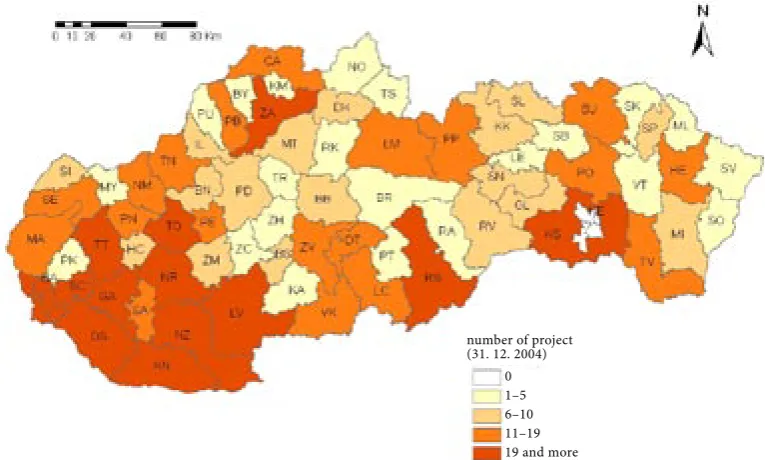
By the end of 2004, 948 financial assistance con-tracts were completed in the total amount of SKK 4.6 billion for assistance provided by public funding under the SAPARD programme. Of the total of nine measures, seven had regional dimensions – they were implemented in numerous regions within the Slovak Republic. Throughout the monitored period (until 2004), the bulk of approved projects was concentrated under Measure 1 (370 projects, i.e. 39%) and Measure 2 (204 projects, i.e. 22%). Out of these 2 measures, the approved projects accounted for almost two thirds (61%) of the total number of approved projects. Most of the projects (211, i.e. 23%) were concentrated in Nitra region and, as a result, almost every fourth approved
project under the SAPARD programme (measures 1 through 7) in 2004 originated in this region1
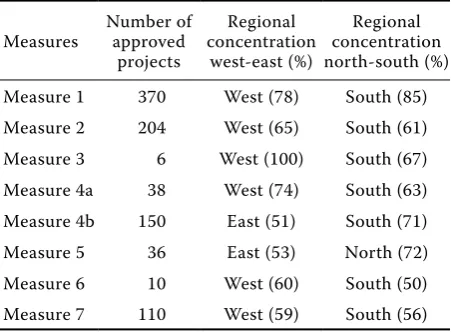
Over two thirds of the projects under Measures 1 through 7 – total (Table 1) were allocated to the west (67%) and to the south (70%). The most significant shift in distribution of the projects to the west and south was observed mainly for Measure 1 and 3.
[image:3.595.306.532.406.572.2]The overall majority shift to west and south (Table 2, Map 1 and 2) was typical for all measures (with the exception of measures 4b and 5). Insufficient distribu-tion of projects in the east has resulted in unbalanced spatial distribution of businesses and associated risks of permanent regression in the development of agri-cultural businesses in these less economically favoured regions; with subsequent impact on spatial economic and social development. Within the framework of the regional development, the SAPARD programme has shown the minimum horizontal absorption ability of the capital for agricultural businesses in eastern areas.2 On the other hand, the increased distribution of projects into southern areas has had a positive ef-fect on the increasing competitiveness of agricultural
Table 1. Regional distribution of approved projects for measures No 1–7 (total) under the SAPARD programme in 2004
Regional aggregation Slovak Republic
Number of projects, total
Share of the total number of approved
projects (%)
West 615 67
East 309 33
North 273 30
South 651 70
Source: APA, own calculations
Table 2. Majority regional distribution of the number of approved projects under SAPARD programme, by indi-vidual measures
Measures Number of approved projects
Regional concentration
west-east (%)
Regional concentration north-south (%) Measure 1 370 West (78) South (85) Measure 2 204 West (65) South (61) Measure 3 6 West (100) South (67) Measure 4a 38 West (74) South (63) Measure 4b 150 East (51) South (71) Measure 5 36 East (53) North (72) Measure 6 10 West (60) South (50) Measure 7 110 West (59) South (56) Source: APA, own calculations
1 The leading position of the Nitra region is logical, given the fact that the share of agricultural production in 2004 in
the region amounted for 25.6% of the total volume of agricultural production in the Slovak Republic, and the number of registered farms (legal entities and private individuals) in 2003 made one fourth (26.1%) of the total number of registered farms. The share of land acreage used by these farms amounted to one fifth (19.5%) of the total land used in the Slovak Republic (Chrastinová 2004, Gubová 2004).
2 The forecasts for future are equally unfavorable. Despite the statements by the Slovak government to streamline the
[image:3.595.64.290.469.571.2]businesses in the generally underdeveloped regions in the south of Slovakia. Approved projects in the SAPARD programme were regionally distributed in such a way that they do not contribute to mitigation of the horizontal differences between regions. The regional shift to the regions of western and southern Slovakia occurred mainly in measures 1 and 2. Most of the successful projects were provided by the most developed businesses, mainly due to the fact that they fulfilled the requested criteria of economic viability. The viability criteria have proved to be somewhat discriminative as it excludes from competition those entities that would need to be involved. On the other hand, with regard to the rate of return and efficiency of investments, the rational and logical solution is to support entities that are most likely to improve their competitive position in the market. To a certain extent, the country faces a dilemma “development of competi-tiveness vs. spatial regional balance”. We believe that the SAPARD programme is internally differentiated to this end. The aim of the supportive measures for producers and processors is mainly to support their competitiveness; while measures associated with general development of rural areas (e.g. environment protection, land modifications) and infrastructure development (development of rural municipalities) tend to remove the differences between regions. On the other hand, though, the SAPARD key objective is not to remove and counterbalance the differences between regions. The dominant measures are targeted rather at increasing competitiveness than to saving
weaker entities. The conditions also stipulate that the support may only be provided to such a business that can prove its viability (new member states were given a concession for eligibility of companies that may prove their viability at the end of project). As a result, the task of the agrifood sector in this pro-gramme (especially in primary production) is not to generally remove regional disparities. On the other hand, it should not increase the regional disparities (with adverse effect on regional competitiveness), mainly in rural regions lagging behind.
Measure 1 and especially Measure 2 were typical in their accumulation of several projects into one business entity. In average, almost 3 projects under Measure 2 were attributed to one beneficiary. In terms of legal structure, the leading beneficiaries were partnerships which made up for two thirds of the total number of business beneficiaries.
[image:4.595.81.464.68.298.2]Total volume of costs for all projects approved under the SAPARD programme in 2004 amounted to SKK 8.604 billion. Financial assistance provided by the SAPARD (the EU contribution + SR) amounted to SKK 4.622 billion (i.e. 53.7%). These were dominant measures, both in terms of number of projects and in terms of the volume of approved funding. The high concentration of projects per beneficiary was also reflected in the highest average value of costs per beneficiary under Measure 2 (one beneficiary of projects under Measure 2 received 2.6 times more in funding than one beneficiary of projects under Measure 1).
Figure 1. Approved projects distribution of the SAPARD programme (total measures 1–7) in districts of Slovakia Source: APA, author the RIAFE
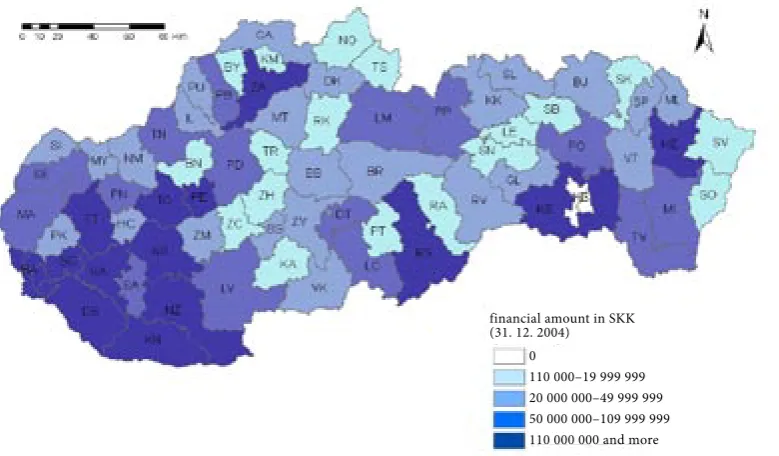
The bulk of the approved funding for projects and individual measures under the SAPARD programme was distributed among western and southern regions of Slovakia. The largest shift into these regions was observed for Measures 3 and 1 (Table 3).
With respect to the indicated regional aggregation in 2004, the SAPARD programme provided for the following distribution of public funding: SKK 2.999 billion to the western (65.4 %) and SKK 1.588 billion (34.6%) to the eastern regions. In terms of vertical regional aggregation, northern regions received SKK 1.301 billion (28.4%) and the south received SKK
3.287 billion (71.6%) in public funding. In terms of the horizontal regional aggregation two thirds of the approved funding were allocated to the west and in terms of vertical regional aggregation, almost three quarters of regionally identified funding were allo-cated into the southern regions (Table 4).
[image:5.595.88.478.66.294.2]Distribution of funding from the SAPARD pro-gramme mostly favoured larger entities. The SAPARD programme was not used as an instrument to achieve regional balance (although it played this role in the vertical spatial terms), rather it affected the selection and differentiation of businesses and contributed to the acceleration of business restructuring in agrifood industry. This is a logical and rational approach, given the rate of return and affectivity of investments. The programme helped to increase the competitiveness of viable businesses, contributed to growth in technol-ogy and labour productivity. In agrifood industry, the
Figure 2. Financial assistance distribution of the SAPARD programme (approved project of measures 1–7) in the dis-trict of Slovakia
[image:5.595.65.291.581.746.2]Source: APA, author the RIAFE
Table 3. Majority regional distribution of the volume of public funding for approved projects under the SAPARD programme, by individual measures
Measures aggregation Regional west-east (%)
Regional concentration north-south (%) Measure 1 West (81) South (89) Measure 2 West (60) South (61) Measure 3 West (100) South (85) Measure 4a West (70) South (72) Measure 4b East (53 ) South (72) Measure 5 East (51) North (81) Measure 6 West (55) South (59) Measure 7 West (60) South (61) Source: APA, own calculations
Table 4. Regional distribution of approved public funding for Measures 1–7 of the SAPARD programme in 2004
Regional aggregation Slovak Republic
Financial assistance by SAPARD in SKK
(EU contribution + SR) Share (%)
West 2 999 688 194 65.4
East 1 588 245 220 34.6
North 1 300 831 350 28.4
South 3 287 102 064 71.6
Source: APA, own calculations
0
[image:5.595.310.532.643.746.2]SAPARD programme increased regional differences. On the other hand, though, these effects are mitigated by direct payments which act to the contrary, i.e. they counterbalance regional differences by their general (horizontal) regional approach.
COMPLETED PROJECTS UNDER SAPARD PROGRAMME
By the end of 2004, 327 projects were completed under the SAPARD programme (i.e. one third of the total number of approved projects). About one fourth (27.2%) of projects (of the total number of approved projects) in agriculture was completed, together with three quarters (71.4%) of projects in processing industry, more than half (58.3%) of forestry projects and one third (30%) of projects in rural municipalities. These included projects under measures 1, 2, 4a, 4b and 5. Of this number, two thirds of the projects were distributed among both west and south (Table 5).
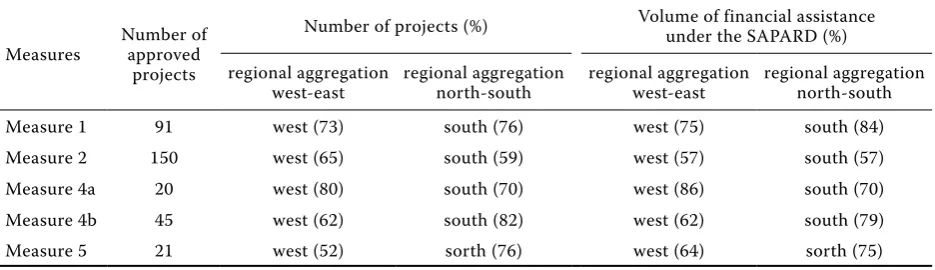
The general majority regional shift to the west and south was typical (Table 6) for all measures (with the exception of Measure 5 – forestry, where a logical
ma-jority shift to northern areas took place). Most of the completed projects were concentrated under Measure 2 (150 projects) and Measure 1 (91 projects). Out of those 2 measures, completed projects amounted to almost three quarters (74%) of the total number of completed projects over the year in question.
In terms of legal structure, the leading beneficiaries were partnerships which made up for three quarters (73%) of the total number of business beneficiaries (cooperatives comprised 15% and private farmers 12%, i.e. one eighth). The partnerships completed 5 times more projects than the cooperatives.
By the end of 2004, the public funding from the SAPARD programme (EU contribution + SR) for the completed projects amounted to SKK 1.57 billion, which represents one third (34.2%) of the approved package SKK 4.6 billion of financial assistance to be paid by SAPARD (measures 1–7, i.e. without meas-ures 8 and 9). This means that until 2006, more than SKK 3 billion must be withdrawn, i.e. 65.8% of the contracted amount of funding.
[image:6.595.65.530.444.543.2]The allocation of public funding from the SAPARD programme saw substantial eccentric shift into south-western regions, mainly under Measure 1. The com-panies in the east and north received a substantially
Table 6. Majority regional distribution (number and funding) of the completed projects under the SAPARD programme, by individual measures, in %
Measures Number of approved projects
Number of projects (%) Volume of financial assistance under the SAPARD (%) regional aggregation
west-east regional aggregation north-south regional aggregation west-east regional aggregation north-south
Measure 1 91 west (73) south (76) west (75) south (84)
Measure 2 150 west (65) south (59) west (57) south (57)
Measure 4a 20 west (80) south (70) west (86) south (70)
Measure 4b 45 west (62) south (82) west (62) south (79)
Measure 5 21 west (52) sorth (76) west (64) sorth (75)
[image:6.595.64.532.613.748.2]Source: APA, own calculations
Table 5. Regional distribution of the completed projects under measures 1, 2, 4a, 4b and 5 (total) and funding of the SAPARD programme in 2004
Regional aggregation
Slovak Republic Number of completed projects, total
Share of the total number of completed
projects (% )
Financial assistance by the SAPARD in SKK (EU contribution + SR)
Financial assistance by the SAPARD (%)
West 216 66 985 241 161 63
East 111 34 585 413 494 37
North 114 35 564 652 262 36
South 213 65 1 006 002 393 64
lower portion of funding (SKK 585 million and SKK 565 million, respectively). The distribution of fund-ing from completed projects was the same as the regional distribution for approved projects, i.e. a substantial vertical geographical differentiation was recorded (Table 5).
Over the period, the businesses in processing indus-try withdrew two thirds (65.4%) of the total volume of approved financial assistance from the SAPARD, compared to the agricultural businesses, which with-drew only one fifth (22.1%) of the approved volume of public funding from the SAPARD. This means that the processing companies shall withdraw only about one third (34.6%) on funding from the SAPARD by 2006 and new projects must be transferred into the Sectoral Operational Programme Agriculture and Rural Development which has assumed the tasks of the SAPARD after the accession into the EU. The acceleration in the actual drawdown was caused by the response to the strict sanitary and hygienic EU standards, by the modernisation and innovation efforts in production, effort to increase labour productivity and thus quickly react to the opportunities in opened markets of the integrated EU. Besides, financial po-sition of these businesses and availability of credits is by far better than for the businesses in primary agricultural production. This swift response was typical mostly for the major entities which accumu-lated numerous projects.3As a result, production has concentrated into the major business entities using modern technology and innovations.
The assessment of Measures 1 and 2 (as the ba-sic measures with the highest number of projects) in terms of west-east regional aggregation shows substantial regional imbalances for both approved and completed projects. The SAPARD programme, however, has failed to contribute to the balanced regional structure of businesses. The regions lag-ging behind did not receive substantial assistance and during the implementation of the SAPARD the territorial differentiation of businesses continued to increase, mainly in the horizontal spatial section. The regional disparities were mainly caused by the varied economic strength of business entities in regions, differences in production concentration and size of businesses (major corporations were more likely to see their projects to be approved) and the differentiated
production structure and/or allocation of processing industry (Regionálna analýza… 2005).
The clear winner of the SAPARD programme imple-mentation were the business entities in the process-ing industry which withdrew two thirds of the total volume of approved financial assistance under the respective applicable measure; as opposed to the business entities in agriculture which withdrew only one fifth of the approved funding.
The SAPARD programme did not provide a sub-stantial contribution to regional development through the balanced and general regional competitiveness. This was caused by the eccentric spatial allocation of the supportive funding and also by the fact that the supported business entities failed to generate new job opportunities (with the exception of Measure 4a) although they helped increase the labour pro-ductivity. The programme so far did not produce a major impact on regional prosperity, as well as on the social and economic level of regions in terms of their capability to generate the additional regional income and to maintain the rate of employment.
The public funding from the SAPARD programme thus increases the competitiveness of strong business entities (especially in some segments of processing industry) and they accelerate the restructuring of businesses in the agrifood industry of the Slovak Republic. In contrast to the general horizontal ap-proach of direct payments, with lower effectivity of investments, the SAPARD programme represents a project-focused and selective approach geared towards support of competitiveness in agrifood industry with high effectivity and rate of return for the associated investments (Buchta 2004).
CONCLUSION
The SAPARD programme has fulfilled its objectives, especially in terms of training of administration staff involved in the programme implementation and has prepared the business public for the new system of support policy within the EU (Správa o imlementácii… 2005).
The analysis of distribution for the approved projects under the SAPARD programme has shown a spatial shift towards “rich West”, as opposed to the “poor
3 The average financial assistance by the SAPARD per 1 project (in the category of completed projects) amounted to
East”. The regional shift to the regions of western and southern Slovakia occurred mainly in measures 1 and 2. On the other hand, the increased distribution of projects into southern areas has had a positive effect on the increasing competitiveness of agricultural businesses in the generally underdeveloped regions in the south of Slovakia.
In the medium term, the primary focus will be on business, rather than on the spatial and regional differentiation. The distribution of such funding strongly favours powerful (innovative) business enti-ties which increase their competitiveness and gain the “advantage of technology advance” (which, in time may change into the rent of technology advance) associated with growth in labour productivity and high probability of investment return (Identifikácia predpokladov… 2004). The implementation of the SAPARD programme clearly contributes to the in-crease in competitiveness of business entities, mainly economically viable entities. It provides a strong impetus to the restructuring of businesses in agrifood industry, it accelerates and improves the selection among the businesses and economic differentiation. It does not contribute to balanced regional structure of businesses, rather it increases the regional disparities (especially in the east-west line). On one hand, the SAPARD has helped to reduce regional disparities in the vertical spatial approach by diversion of the bulk of funding to the economically less favoured southern areas of Slovakia lagging behind in terms of infrastructure. On the other hand, though, it has increased regional disparities in the horizontal spatial view with regard to the fact that most of the funding is spent in the developed regions of western Slovakia. Eastern Slovakia thus has become a disadvantaged and minority recipient of financial assistance under this programme. Even though the SAPARD pro-gramme and consequently, the Sectoral Operational Programme Agriculture and Rural Development, are not primarily meant as the instrument to remove regional imbalances, it should at least not increase those disparities. Therefore, the implementation of the SAPARD programme has brought about two antagonistic effects. It removes regional disbalances between north and south, but in east-west direction, it rather increases disparities.
REFERENCE
Buchta S. (2004): Sociálna diferenciácia vidieka a pre-dikcia rozsahu dopadov štrukturálnej politiky na rozvoj vidieka (Social differentiation of rural areas and prediction of structural policy impacts on the development of rural areas). Ekonomika poľnohos-podárstva (Agriculture Economy), IV (4): 37–45. Gubová M. (2004): Správa o výsledkoch monitoro-vania štrukturálnych zmien v poľnohospodárstve SR (Report on monitoring results for structural changes in the agriculture of the Slovak Republic). RIAFE, Bratislava.
Chrastinová Z. (2004): Analýza ekonomických a in-štitucionálnych faktorov zmien efektívnosti poľ-nohospodárstva SR (Analysis of economical and institutional factors of changes in effectivity of agriculture in the Slovak Republic). RIAFE, Bra-tislava.
Identifikácia predpokladov a možností prekonávania technologickej a inovačnej medzery SR (Identifi-cation of assumptions and capacity to overcome the technology and innovation gap in the Slo-vak Republic) (2004). Ústav slovenskej a svetovej ekonomiky SAV (Institute of Slovak and World Economy SAV), Bratislava, December.
Regionálna analýza implementácie SAPARDu za roky 2000–2004 (Regional analysis of SAPARD implementation in 2000–2004) (2005). Kvistgaard Consult, MA SR, January.
Správa o implementácii a čerpaní predvstupových nástrojov, štrukturálnych fondov a Kohézneho fondu k 31. 12. 2004 (Report on implementation and drawdown on pre-accession instruments, Structural Funds and Cohesion Fund as of 31 De-cember 2004) (2005). Material for discussion by the Government of the Slovak Republic, MCRD, 2 March.
Strednodobé hodnotenie Špeciálneho predvstupo-vého programu pre poľnohospodárstvo a rozvoj vidieka Sapard v SR (Mid-term evaluation of the Special Accession Programme for Agriculture and Rural Development – SAPARD) (2003). Bratislava, September.
www.nbs.sk
www. mpsr.sk/apa/
Arrived on 4th October 2005
Contact address:
PhDr. Stanislav Buchta PhD., Výskumný ústav ekonomiky poľnohospodárstva a potravinárstva, Trenčianska 55, 824 80 Bratislava, Slovenská republika